How Hustle Marketers Got Rec Hall 1,400 Bookings and a 40% Revenue Lift

Ishant
Published : May 26, 2026 at 7:46 am
Updated : June 11, 2026 at 10:35 am
Ishant
Summarize this case study with:
About Rec Hall
Rec Hall is a 33,000 sq ft family entertainment center in St. Charles, Missouri. It has a retro arcade, free-roam VR, a 17-foot LED board, yard games, a full bar, and a pizza kitchen. People come for birthdays, corporate events, watch parties, and date nights.
They came to us in February 2026 with a good venue and not enough bookings. We ran Google Ads, Meta Ads, and SEO blog content together, because for a place like this, paid and organic work better as a pair.
What a family entertainment center needs from a marketing agency
The brief was direct. Fill the event calendar, drive phone calls and form submissions for private bookings, and build a local content presence that ranks for the searches people in the St. Charles and greater St. Louis area actually make. The venue had multiple revenue paths: general admission play, the arcade, VR sessions, corporate events, private party rentals, and food and bar sales. A campaign that only pushed one of those would have left money on the table.
There’s a specific challenge with a venue like this that a lot of agencies get wrong. The instinct is to advertise the attractions. VR, arcade, the big screen. But people don’t book a venue because of a feature list. They book because they have an occasion: a kid’s birthday, a company outing, a bachelorette party, a group that wants to watch the game somewhere better than a crowded sports bar. So we built the account around the occasion and the booking, not around the equipment. Every campaign pointed back to one outcome that matters for an experiential business: a person reaching out to plan a visit or an event.
For a business that sells time and space, an inquiry is the conversion that counts. The rest follows once they walk in, because Rec Hall’s in-venue experience does the selling. Our job was to get the right people through the door in the first place, and to make sure the venue showed up the moment someone in the area started planning something.
How we structured the Google Ads campaigns
Ishant Sharma, the digital marketing consultant who founded Hustle Marketers, led the account strategy on Rec Hall, with Gagan running day-to-day paid media. We split the Google Ads account so each major intent had its own room to perform, instead of dumping every keyword into one campaign and hoping the algorithm sorted it out.
Private and corporate event searches got their own campaigns, because those visitors are ready to book and worth the most to the business. Someone searching “corporate event venue St. Charles” or “private party room near me” is not browsing. They have a date in mind and a budget. We gave that intent its own budget, its own ad copy built around hosting and group capacity, and landing pages that pushed straight to the booking form.
Family and group activity searches got a separate set. Arcade, virtual reality, yard games, “things to do in St. Charles with kids.” That intent is earlier in the journey and converts at a different rate, so it needed its own structure and its own targets. Mixing it with the high-intent event traffic would have muddied the data and made it impossible to bid correctly on either.
Watch-party and game-day intent ran on a schedule that matched the venue’s real hours and the rhythm of the sports calendar. This is where account structure turns into real savings. Rec Hall is closed Monday through Wednesday, open Thursday through Sunday. We built ad scheduling around those open hours and around the windows when people plan weekend outings, which is usually the Tuesday-to-Thursday stretch before the weekend hits. We weren’t going to spend budget driving calls to a phone nobody was answering on a Monday afternoon.
That detail matters more than it sounds. Spending less on dead days meant more budget on the days that convert. If you run lead gen for any appointment-based or hours-based local business, this is the kind of structure that protects your cost per conversion and stops you from paying for clicks that can’t turn into anything. We walk through the same thinking in our guide to Google Ads for lead generation, and it’s a core part of how we approach advertising on Google for local businesses.
What the campaign data shows
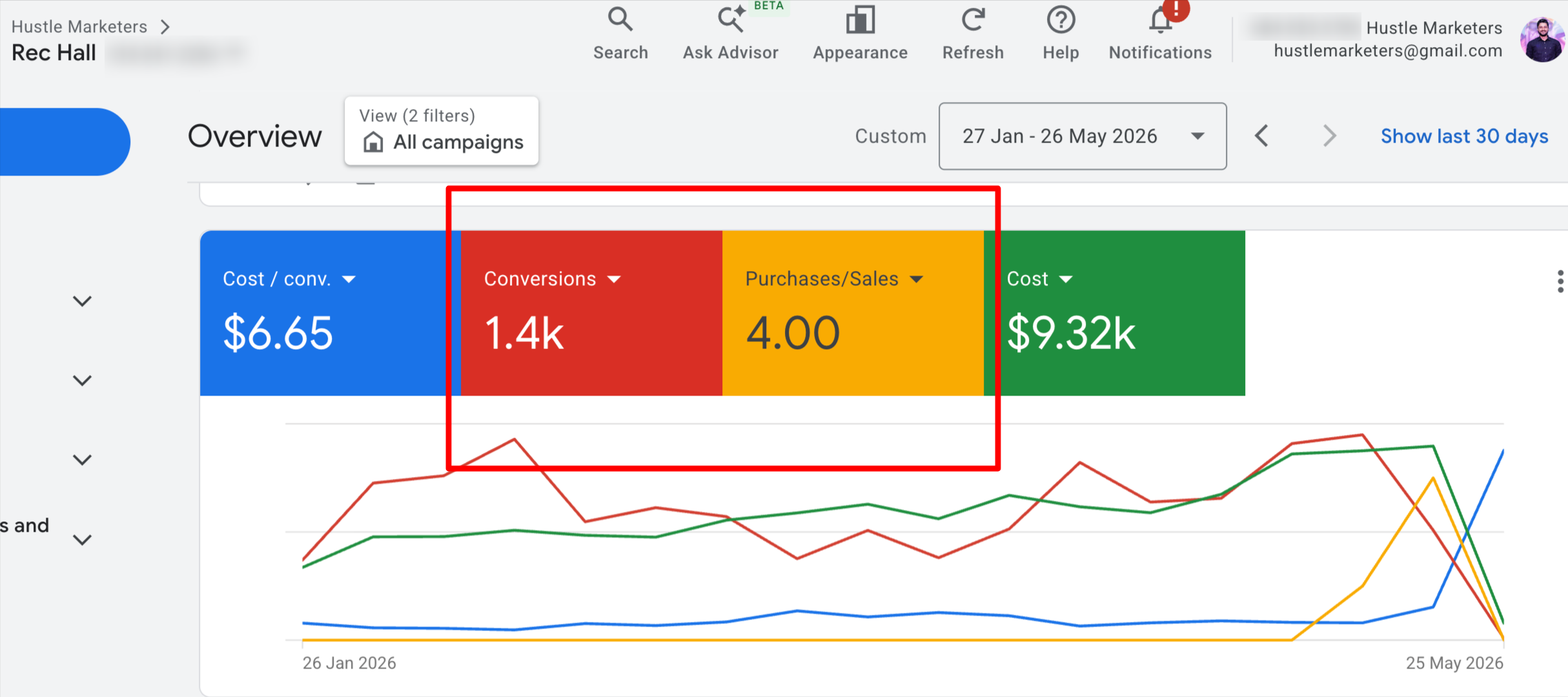
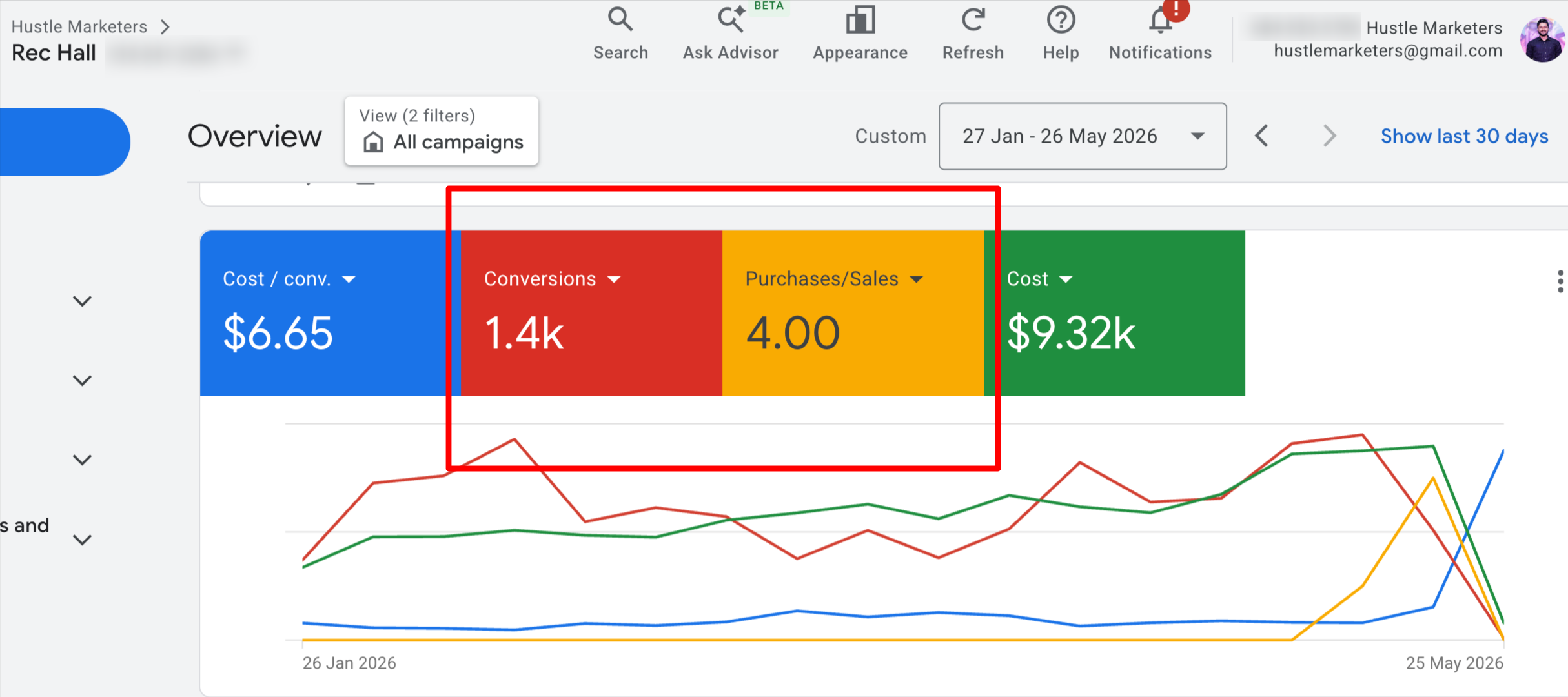
Over the window from January 27 to May 26, 2026, the Google Ads account brought in 1,400 conversions at a cost per conversion of $6.65, on $9,320 in total ad spend. For a family entertainment center where a single corporate event or group party can be worth hundreds or thousands of dollars at the door and the bar, a $6.65 cost to generate a booking inquiry or call is the number that makes the whole thing work.
Those 1,400 conversions are the form submissions and phone calls that Chris’s team needs to fill the calendar. We kept conversion tracking clean and focused on that single action, the booking inquiry, so every optimization decision pushed toward the thing that actually drives revenue for a venue instead of a softer metric that looks good in a report. Clean tracking is the unglamorous part of paid media that decides whether the rest of it works. Plenty of accounts look great until you realize they’re counting every button click as a conversion. We don’t run them that way.
The math is worth sitting with for a second. At $6.65 per lead and 1,400 leads, the venue paid roughly $9,320 to generate fourteen hundred chances to book a party, an event, or a group visit. Even if only a fraction of those inquiries turn into a confirmed booking, the return on an experiential venue with a full bar and kitchen is strong, because the average ticket per group is high and the marginal cost of one more party on a Saturday night is low. That’s the economics that make paid search work for venues, and it’s why we push so hard on keeping the cost per lead down through tight structure and scheduling.
How we used Meta Ads to fill the booking pipeline
We paired the Google Ads work with Meta Ads, where a venue like Rec Hall has a real advantage. The space photographs and films beautifully. The VR arena mid-session, the 17-foot LED board lit up during a game with a crowd in front of it, a corporate group laughing through yard games, a birthday party in full swing. Visual platforms reward visual businesses, and Rec Hall gave us a lot to work with.
As a Meta Business Partner, we put that footage to work in front of local audiences who plan group outings and company events. The targeting leaned on geography first, because this is a venue people drive to, not a national ecommerce product. We focused on St. Charles and the surrounding St. Louis metro, layered with interests and behaviors that signal someone plans events: parents of school-age kids, office managers and HR roles for the corporate angle, people engaged with local events and nightlife.
The creative did the heavy lifting. Static feature lists don’t sell an experience. Short video of the place in action does. We rotated creative around the occasions that drive bookings, birthday packages, corporate team building, game-day watch parties, so the right message reached the right planner at the right time. Meta filled the top of the funnel and kept the brand in front of people in the area, while Google Ads caught them at the moment they were ready to book. Two channels, one booking pipeline.
How blog content started ranking in seven days
The SEO side is where the engagement surprised even us. Nishtha led content production, and we built blog posts around the searches people in the St. Charles and greater St. Louis area make when they’re planning something: where to host a corporate event, things to do on a rainy weekend, birthday party ideas for adults, where to watch the game with a group. Several of these posts reached the first page of Google within seven days of publishing.
Seven-day rankings aren’t normal, and we won’t pretend they’re guaranteed for every business or every keyword. They happened here because a few things lined up. The local intent had relatively low competition, which is common for “in St. Charles” style queries where you’re competing against a handful of venues and a few directory listings rather than national publishers. Rec Hall has genuine authority on its own topics, it’s a real place that real people visit and review. And the content was written to answer the exact question a searcher typed, with the venue as a natural answer rather than a forced plug.
That last part is the whole game in 2026. Search rewards content that actually helps the person searching. A post titled around a real query, written by people who know the venue and the area, that gives a useful answer and then points to Rec Hall as one good option, that’s what ranks and keeps ranking. We don’t write filler stuffed with keywords. We write the thing the searcher was hoping to find.
For local service and experience businesses, that combination of low-competition local intent and genuinely useful content is the fastest path to organic visibility. It’s the same approach we use for clients across the restaurant and hospitality space, and it pairs naturally with paid search so a searcher finds Rec Hall whether they click an ad or an organic result. We’ve driven the same kind of result for other local lead-gen clients, like the 280% lead increase and 40% lower cost per lead we got for CMSC. Over time the organic content also lowers the blended cost per lead, because every booking that comes from a blog post is a booking the venue didn’t have to pay for with ad spend.
Why combining paid and organic worked better than either alone
A lot of venues pick one lane. They either pour everything into Google Ads and turn it off the moment cash gets tight, or they wait months for SEO to maybe pay off while the calendar sits half empty. Both approaches leave results on the table. Paid search gives you bookings today but stops the day you stop paying. Organic builds an asset that compounds but takes time to mature. Run together, they cover each other’s weakness.
For Rec Hall, the paid campaigns filled the calendar from week one while the blog content was still being indexed. As the organic posts started ranking, they began catching searches that the ads were also bidding on, which gave the venue two shots at the same searcher and started bringing in bookings at no incremental ad cost. The Meta creative kept the brand visible to local planners between the moments they were actively searching. Each channel made the others work harder.
This is also why we keep conversion tracking and analytics clean across all of it. When you’re running Google Ads, Meta Ads, and SEO at the same time, you need to know what’s actually driving the bookings so you can put more money behind what works. That measurement discipline is part of our conversion rate optimization approach, and it’s the difference between a campaign you can scale and one you’re just guessing at.
The result, in the client’s words
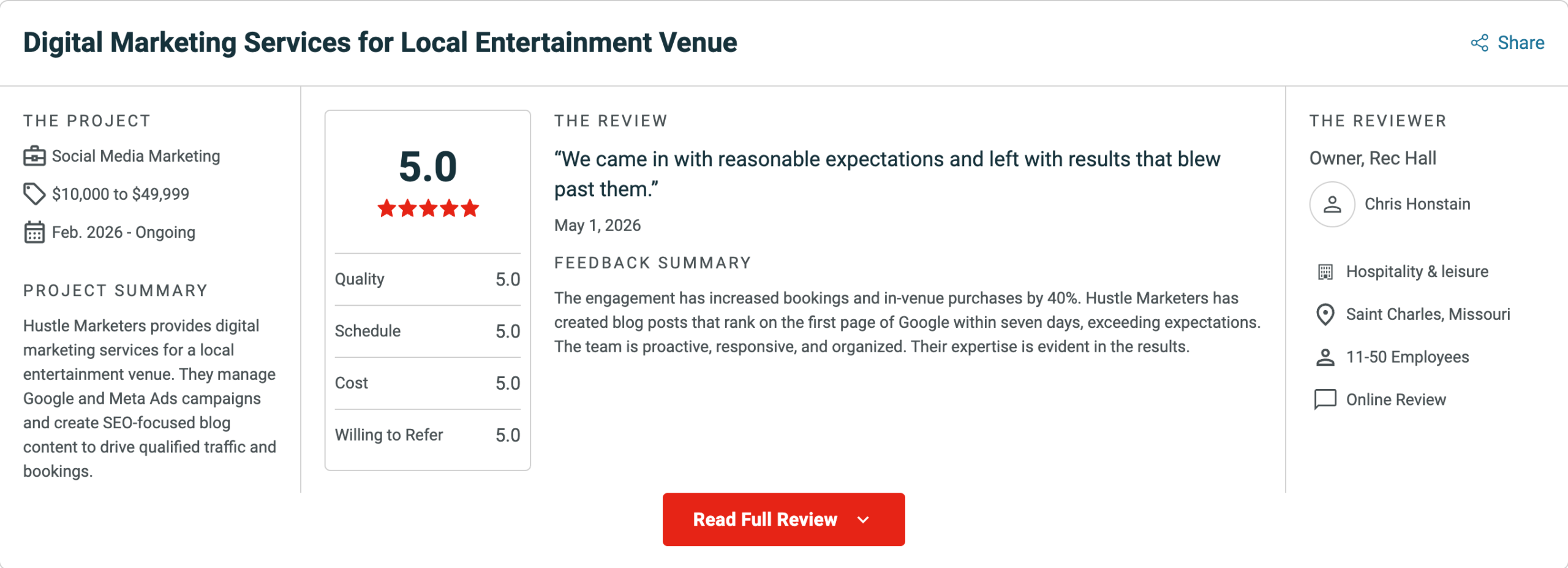
The combined work moved the number that matters to the business. According to Chris Honstain, Owner of Rec Hall, bookings and in-venue purchases rose 40% during the engagement. In his 5.0-star review on Clutch, he noted that the blog posts reached the first page of Google within seven days and called the team proactive, responsive, and organized. His summary was blunt in the best way: he came in with reasonable expectations and left with results that beat them.
That review covered the full scope, Google Ads, Meta Ads, and SEO content, and rated us 5.0 across quality, schedule, cost, and willingness to refer. It’s an online-verified review on Clutch from an owner in the hospitality and leisure space, for a $10,000 to $49,999 engagement that’s still ongoing. We’d rather let that kind of verified feedback speak for itself than make claims we can’t back up.
Why this approach works for any local venue or experience business
Rec Hall succeeded for reasons that apply to almost any local business selling experiences, appointments, or bookings. We tied every campaign to the booking instead of the feature list. We respected the venue’s real operating hours instead of burning budget on closed days. We kept conversion tracking honest so we optimized toward revenue, not vanity metrics. And we built organic content around the exact searches local customers make, written by people who actually understand the business.
Paid filled the pipeline now. Organic built a moat for later. Together they brought in bookings at $6.65 a lead and helped lift bookings and in-venue purchases 40%. If you run a venue, a restaurant, a studio, a gym, or any business where a booking or a phone call is the goal, this is the model that works.
We’ve done it for hospitality and local-service clients across the US, and we do it as a Google Partner and Meta Business Partner with the tracking discipline to prove what’s driving the results. You can see more of our work across our case studies, learn more about the agency and our team, or read how we think about choosing a performance marketing partner.
Frequently asked questions
How much does Google Ads cost for a local entertainment venue?
It depends on your market and competition, but Rec Hall generated booking inquiries and calls at $6.65 per conversion across roughly $9,320 in spend. For a venue where one group booking can be worth hundreds at the door and bar, that cost per lead makes paid search profitable. The key is tight campaign structure and ad scheduling around your real open hours.
How fast can SEO blog content start ranking?
For most businesses and keywords it takes months. For Rec Hall, several local-intent posts reached page one of Google within seven days, because the local queries had low competition, the venue had genuine authority on its own topics, and the content directly answered what searchers were looking for. Seven days is fast and not typical, but local intent is the fastest category to rank in.
Should a venue run Google Ads or Meta Ads?
Both, for different jobs. Google Ads catches people the moment they’re searching to book, like “corporate event venue near me.” Meta Ads keep your venue visible to local planners between those moments and let you show off the space with video. Run together with clean tracking, they fill the booking pipeline from two directions and cost less per booking over time.
What makes Hustle Marketers different for local lead generation?
We tie campaigns to the actual booking instead of the feature list, we schedule ads around your real operating hours so you don’t waste budget on closed days, and we keep conversion tracking clean so we optimize toward revenue. As a Google Partner and Meta Business Partner with more than $780M in trackable client revenue, we bring the structure and measurement discipline that turns ad spend into booked events.
Work with the team behind Rec Hall’s growth
Hustle Marketers is a Google Partner and Meta Business Partner agency that’s driven more than $780M in trackable revenue for over 2,2500 brands. Ishant Sharma founded the agency and works as the lead consultant on accounts like this one, setting the paid and organic strategy himself. If you want the same kind of booking pipeline for your venue or local business, look at our lead generation and web development work, then get in touch and we’ll show you what the first 90 days could look like.