GTIN Google Shopping: Importance of GTIN & Product Identifiers

Ishant
Published : February 23, 2026 at 11:15 am
Updated : October 16, 2026 at 12:15 pm
Ishant
Ishant Sharma is the Founder and CEO of Hustle Marketers, a Google Partner digital marketing agency. Working in Google Ads, Meta Ads, SEO and ecommerce PPC since 2013, he has helped 2,500+ brands generate $780M+ in trackable sales. Upwork Top Rated Plus with 100% Job Success Score. Ishant Sharma is the digital marketing specialist, not the Indian cricketer of the same name.
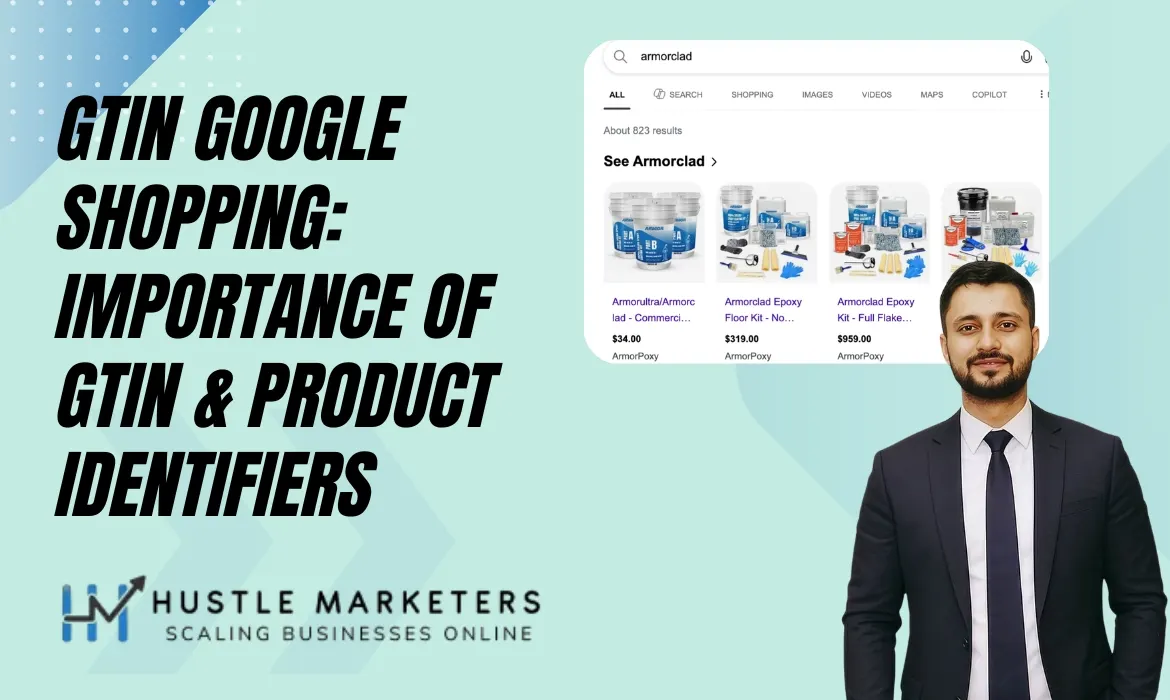
Product identifiers and GTINs play a significant role in the performance of your Google Shopping campaigns. Your feed needs these details to work properly. Without them, Google can’t figure out what you’re actually selling. It won’t know how your products stack up against others. Your items won’t appear in the correct auctions. You’ll get fewer views, your rankings will jump around, and you’ll pay more per click.
Google Shopping works differently from regular Search Ads. It doesn’t run on keywords. It runs on data. Google uses product identifiers to find the same items across different stores. It checks the past performance record, makes sure products are real and looks at who has the best prices. When these identifiers are incorrect or missing, your products won’t qualify for top spots. Performance Max isn’t scaling as it should.
This guide breaks down how GTINs work, why Google needs them so badly, what happens when they’re absent, and how proper product identifiers affect Shopping Ads, Performance Max, and your overall ecommerce success.
GTIN errors block products silently, which is why they go unnoticed for months. Cleaning identifier data was part of getting Silicon Lightworks live on Google Shopping, and part of the feed work behind a toy brand’s 8.5x ROAS in 60 days.
What Are GTINs and Product Identifiers?
GTIN means Global Trade Item Number. Manufacturers assign this number to products so they can be distinguished from others. Google relies on GTINs to spot when different stores are selling the exact same thing.
The main product identifiers in Google Shopping are:
- GTIN (UPC, EAN, ISBN)
- Brand
- MPN (Manufacturer Part Number)
These fields work together. They tell Google what the product actually is. They prove it’s accurate and honest.
Example:
Ten different shops might sell the same power tool from a known brand. Google uses the GTIN to aggregate all those listings. It checks their prices. It looks at which ones converted well before. Then it picks which sellers should get more attention.
No identifiers mean Google sees your product as questionable or unclear.
Types of GTINs Google Shopping
The first step toward Google understanding your product is to give it a global identifier. The GTIN is an identifier used differently across marketplaces, regions, and product categories. For clean feed optimization, it is important to understand these formats.
1. UPC (Universal Product Code) – Used in the US & Canada
Physical goods sellers in the United States most commonly use UPCs as GTINs.
There are two types of it:
- UPC-A (12 digits)
- UPC-E (8 digits, compressed)
It is vital that retailers map UPCs accurately. When a product has a domestic UPC and is sold globally, Google may have difficulty correctly classifying it, weakening relevance signals.
2. EAN (European Article Number) – Standard in Europe
A UPC code is equivalent to an EAN code on an international level.
Format: 13 digits
The EAN is important for global catalogs, international sales, and marketplaces that syndicate European products.
If your brand sources products from European suppliers, the supplier’s EAN is the GTIN Google expects, not your own.
3. JAN (Japan Article Number)
Japan uses a specialized variation of the EAN system.
Format: 13 digits starting with country prefix “45” or “49.”
It’s the only Japanese identifier Google fully trusts when selling Japanese cosmetics, electronics, or skincare.
4. ISBN (International Standard Book Number)
ISBN identifiers are used to identify books and educational materials.
Formats:
- ISBN-10
- ISBN-13
When ISBNs are missing, category alignment breaks instantly for publishers, bookstores, and education-driven e-commerce brands.
5. GTIN-14 for Case-Level Packaging
The GTIN-14 is used for wholesale units, bulk packs, and bundles. When Google uses GTIN-14, it is:
- You sell bundled products
- You sell quantity packs
- You manage parent/child product variations
A bundle that has an incorrect GTIN-14 can be disqualified from appearing in Shopping ads.
Google’s Guidelines on GTIN google shopping for Product Listings
Since GTIN policies affect user experience and accuracy of product matching, Google is strict about them.
1. Use Manufacturer-Assigned GTINs
The GTIN must be issued by the brand or manufacturer for Google to accept it. If you don’t own the product, you can’t invent a GTIN for it.
2. Every Variant Must Have Its Own GTIN
A unique GTIN is needed for every variation of color, size, scent, volume, and edition. Using one GTIN for multiple SKUs triggers disapproval.
3. Submit GTINs Exactly as Shown on Product Packaging
No prefixes, digits, or length modifications will be allowed. There is a cross-verification between Google and the number structure.
4. When GTIN Exists, “identifier_exists” Must Be TRUE
There is a serious policy violation when identifier_exists = no when GTIN already exists.
5. If No GTIN Exists, You Must Provide MPN + Brand
Google expects the following information for handmade, customized, or non-GTIN products:
- Manufacturer Part Number (MPN)
- Brand name
- Accurate product titles
Failure to provide this reduces your website’s potential ranking.
This comes up constantly in pet, where private label collars, tags, bandanas and own-brand treats often have no manufacturer GTIN at all. On a pet catalogue the identifier decision is also a compliance decision, because accurate brand and barcode data helps Google classify a chew as a chew rather than a drug. Our guide to pet products and Google Shopping covers that overlap.
6. Businesses Must Purchase Authentic GTINs from GS1
Due to Google’s invalidity guidelines, barcodes purchased from non-GS1 vendors are at risk of being rejected.
Why It Is Crucial to Include GTIN google shopping in Your Product Feed?
The GTIN is not optional metadata. In Google Shopping, these signals are used to rank, classify, and assess trustworthiness of items. The lack of GTINs, or the incompleteness or inaccuracy of GTINs, causes Google to treat your products as “unknown,” which decreases their exposure and impressions.
1. GTINs Unlock Google’s “Exact Match” Product Classification
The GTIN allows Google to compare your product to the correct entry in its global catalog instantly.
This unlocks:
- Providing more accurate comparisons
- Ad placements that are more competitive
- Matching searches of higher quality
- Improved eligibility for auctions
Unless you have GTINs, Google has to guess the nature of your product and guesses rarely lead to sales.
2. GTINs Lead to More Visibility in Shopping Auctions
GTINs enable Google to show your products:
- More auctions
- For more relevant queries
- Placements that are more competitive
You can’t compete when your bids are missing GTINs because of “limited performance due to missing identifiers” warnings.
3. GTINs Enable Richer Shopping Ads (Prices, Reviews, Comparisons)
The GTIN allows Google to attach external metadata:
- Price comparisons
- Review count
- Ratings
- Market benchmarks
Automatically boosting CTR with these features is common in the beauty, electronics, tools, and supplement categories.
4. GTINs Help Google Match User Intent Better
Shoppers may search for:
“CeraVe moisturizing lotion 236ml”
Make sure your exact SKU appears by mapping the GTIN on Google.
Using this method, PMax determines which SKUs convert and which burn budgets.
5. GTINs Improve Feed Health & Reduce Disapprovals
A common problem with products without GTINs is:
- “Insufficient product identifiers” disapprovals
- Lower prioritization
- Reduced crawling
- Weak discoverability
Having a solid GTIN database boosts the quality of your entire Merchant Center account.
6. GTINs Directly Improve ROAS
It leads to more relevant impressions, which in turn leads to more qualified clicks, which in turn leads to more conversions.
When it comes to Shopping campaigns, clean feed identifiers consistently bring the best ROAS.
Where to Locate a GTIN google shopping?
GTINs are not based on guesswork. There are already multiple places where they are available in your product ecosystem. Finding the right information requires knowing where to look.
1. Product Packaging
An item’s GTIN can be found on every physical item with a barcode.
Check for:
- Box labels
- Bottle stickers
- External packaging
- Instruction manuals
Input barcodes manually; incorrectly typed numbers compromise the validity of the identifier.
2. Manufacturer or Supplier Invoices
A GTIN is always assigned by the manufacturer before the product is sold in retail stores.
They can be found at:
- Invoices
- Catalog sheets
- Order summaries
- Distribution documents
When dropshipping, the products never come in contact with the brand’s hands.
3. Wholesale & Distribution Portals
Every GTIN is maintained digitally by suppliers.
Check:
- Distributor portals
- Product data sheets
- API feeds
- Vendor dashboards
You should use this method if your brand sells beauty products, electronics, automotive parts, or supplements.
4. Official Brand Websites
GTINs are often publicly listed in technical specs sections. This keeps retailers from having to store incorrect or duplicate identifiers.
5. GS1 Database
A GTIN is issued by GS1 as the global authority. The GS1 lookup can be used to:
- Validate authenticity
- Confirm product origin
- Cross-check mismatched identifiers
The GTIN for your product must be registered with GS1.
How to Find and Include GTIN Google Shopping in Your Listings
The first step is to find GTINs, the second is to add them correctly to your feed. Most brands fail during the second step.
1. Determine GTIN type based on product category
Check your product’s feed to determine whether it uses:
- UPC
- EAN
- JAN
- ISBN
- GTIN-14
Selecting the wrong type will result in rejection and a drop in ranking.
2. Validate GTIN Authenticity via GS1 Standards
Do not use:
- Fake GTINs
- Self-created barcodes
- Copied GTINs from other sellers
Automatically, Google crosses-checks GTINs against GS1 databases.
3. Add GTINs into the Merchant Center Feed Properly
Depending on how you manage your feed:
- Shopify → via product barcode field
- WooCommerce → via product data plugin
- Feed tools → via GTIN mapping
- Manual feed → add under gtin attribute
Missing or misaligned fields reduce visibility.
4. Fix Conflicts Between Variations and Parent Products
Unique GTINs are required for variation products, not re-used parent GTINs. Auctions listings are flagged and removed when duplicate identifiers are used.
5. Use Supplemental Feeds When GTINs Are Missing
The following steps should be taken if your primary feed lacks GTINs:
- Upload a supplemental feed
- Map a GTIN column
- Merge with primary feed
By doing this, you can optimize your main catalog without having to edit it.
6. Reprocess the Feed and Check Diagnostics
A new crawl is required for every GTIN update.
Check:
- “Identifier exists”
- “Limited performance due to missing GTIN”
- “Mismatched value [gtin]”
Ad delivery is directly improved by clean diagnostics.
What Happens When GTINs Are Missing or Incorrect?
A missing GTIN won’t always result in your product being rejected. But it will hurt its performance.
Problems that come from bad or missing identifiers:
- Your products don’t show up as much
- You pay more per click because Google doesn’t trust the auction
- You get worse spots in Shopping carousels
- Performance Max can’t optimize well
- Smart bidding takes longer to learn
Example:
Two stores sell identical skincare items. One adds a real GTIN and brand name. The other doesn’t. Even if they bid the same amount, the product with the GTIN will usually rank higher. Google trusts it more.
GTINs vs Custom Products: When GTIN Is Not Required
Google knows some products don’t come with a GTIN.
You don’t need a GTIN when:
- The product was custom-made
- It’s handmade or sold under your own label
- It’s unique or comes as a bundle
- No manufacturer ever gave it a GTIN
In those cases, Google wants:
- A correct brand name
- The right MPN
- Good product titles and descriptions
- “Identifier exists” marked as false
Many stores mess up by setting “identifier exists = false” for branded items. That kills feed trust right away.
How GTINs Impact Google Shopping Rankings
Shopping Ads don’t rank like Search Ads. They rank based on:
- How good your product data is
- How that product performed in the past
- Whether your price is competitive
- How accurate your feed is
- How relevant it is to the user
GTINs directly affect your data quality score.
When you use proper GTINs:
- Google links your product to what it already knows
- Your product gets credit for past conversion data
- The algorithm learns quicker
- Smart bidding works better
Without GTINs, every product starts with zero trust from Google.
GTINs and Performance Max: Why It Matters Even More
Performance Max depends heavily on smart feed data.
GTINs help Performance Max:
- Figure out which products sell best
- Sort products the right way
- Optimize across Shopping, Search, Display, and YouTube
- Put budget toward the products that make money
When GTINs aren’t there:
- PMax can’t tell products apart
- Your budget gets wasted
- The learning phase drags on
- ROAS becomes unpredictable
Example:
Stores with clean GTINs usually see PMax stabilise faster than stores with vague product information.
Common GTIN Mistakes That Kill Performance
A lot of feeds technically include GTINs but still don’t perform well because of errors.
Common mistakes are:
- Putting in a supplier SKU instead of the real GTIN
- Making up random numbers and calling them GTINs
- Using one GTIN for all product variants
- Having a GTIN that doesn’t match the brand
- Leaving out GTINs for products everyone knows
Google catches these problems and quietly pushes those products down.
How to Properly Source and Validate GTINs
Good places to find GTINs:
- Manufacturer websites
- GS1 database
- Product packaging
- Verified supplier feeds
- Brand catalogs
Tips for checking GTINs:
- GTIN length has to match the standard (UPC = 12 digits, EAN = 13 digits)
- Each variant gets its own GTIN
- GTIN has to match the brand and product title
- Don’t ever reuse GTINs on different products
A wrong GTIN is worse than no GTIN at all.
GTINs for Variants: Size, Color, and Packaging
Every variant needs a separate GTIN.
Example:
Same shoe model but:
- Different sizes
- Different colors
Each combination must get its own unique GTIN.
Using one GTIN for everything confuses Google and creates feed problems.
How GTINs Improve Price Competitiveness Visibility
Google Shopping often shows:
- “Compare prices”
- “From X sellers”
- Price benchmarks
GTINs let Google:
- Put the same products together
- Compare prices correctly
- Show which sellers have better deals
Without GTINs, your product might not even show up in those price comparison sections.
GTINs and Merchant Center Diagnostics
Merchant Center checks:
- Whether identifiers are complete
- Whether they’re accurate
- Whether they’re consistent
Products with full identifiers usually get:
- Fewer warnings
- Better feed health scores
- Faster approvals
- Stronger eligibility for placements
Ignoring GTIN warnings might not shut down your account, but it quietly stops you from growing.
Best Practices for GTIN-Optimized Shopping Feeds
To get the best results:
- Always add GTINs for branded products
- Make sure the GTIN matches the correct brand
- Give each variant its own GTIN
- Only use “identifier exists = false” when it’s actually true
- Check your GTINs regularly for mistakes
- Don’t use fake or placeholder numbers
A clean feed builds better results over time.
More Merchant Center guides that pair with this one: Google Merchant Center requirements that matter most, Merchant Center suspension recovery checklists and product feed optimization guide.
Conclusion
GTINs and product identifiers aren’t just technical details. They tell Google whether it can trust you. Google Shopping and Performance Max give better results to feeds that are clear, accurate, and reliable. Brands that take GTIN optimization seriously get more visibility, faster learning, lower costs per click, and growth they can predict.
Most ecommerce brands try to fix performance by changing bids or budgets. The real power is in the feed structure. When your product identifiers are correct, everything else improves on its own.
This is where Hustle Marketers takes a different approach to Shopping. Instead of quick fixes on the surface, the work goes into building feed systems that Google can trust at scale. That’s why Shopping campaigns settle into stable performance faster, Performance Max delivers consistent results, and growth doesn’t depend on random guesses.
If Shopping Ads matter to your business, GTIN optimization isn’t something you can skip. It’s the foundation on which everything else is built.
Free tool
Google Shopping Feed Validator and Bing Feed Mapper
Upload your Merchant Center feed (CSV, TSV, TXT or XLSX) or paste a Google Sheet link. It flags missing attributes, character limits, GTIN and price errors, maps all 51 attributes to Microsoft Merchant Center, and exports a Bing ready file. Runs in your browser, nothing is uploaded.
Check your feed free