12 Key Metrics to Improve Your ROAS in 2026

Ishant
Published : January 4, 2025 at 4:41 pm
Ishant
Want to improve your ROAS in 2025, but don’t know where to get started? Here are some metrics you need to look for!
The digital marketing world is spinning after the inception of AI, and 2025 is going to get even tougher. Marketers have been using it left and right for churning out content and fine-tuning their SEO, social media, and digital marketing strategies, and we cannot blame them, can we?
However, AI also has made search engines smarter. Now, Google and other search engines are devising new algorithms like the August 2024 Core Update that aims to promote high-quality content and demote low-value SEO content.
A lot is happening in the digital marketing ecosystem, and to increase return on ad spend, professionals are using every arrow in their quiver. Today we will be talking about some of those arrows- the key metrics that can improve your ROAS or (Return on Ad Spend). Intrigued about how to optimize return on ad spend in the upcoming year? Keep reading, we promise you won’t be disappointed!
Why is ROAS Important?
Starting from the basics, ROAS or Return on Ad Spend (ROAS) tells you how much revenue you are earning for every dollar you spend on ads. In fact, here’s the simple formula to calculate it:
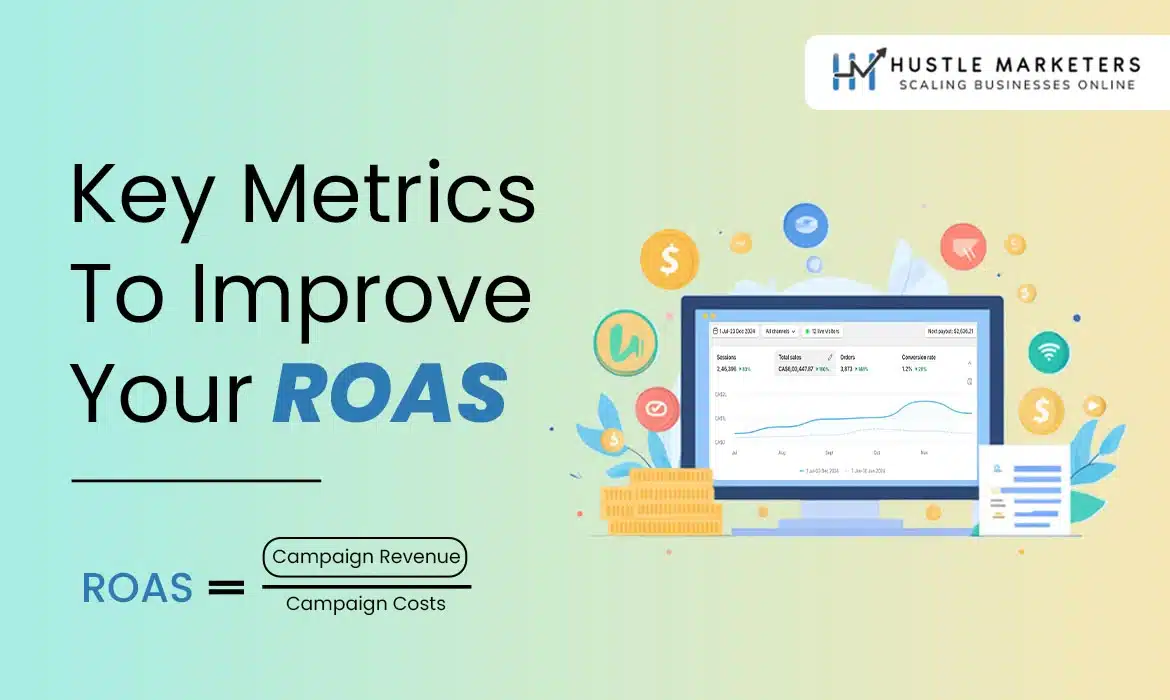
ROAS=Revenue from Ads/Ad Spend
So, if you spend $500 on ads and generate $2,000 in revenue, your ROAS would be 4:1. In other words, for every dollar you spend on ads, you make four dollars in return. Pretty sweet, right?
If you have taken the stubborn route, and are thinking, “Why is this ROAS so important,” we have some information for you.
Suppose, you have just launched a new ad campaign, and after a few days of running it, you check your numbers. Yes, your ad spend is climbing, but your return? Not quite where you would like it to be. Quite frustrating right? We have all been there, but if you had followed the right ROAS optimization tips and cared about your ROAS, you wouldn’t be here.
Your ROAS or return on ad spend showcases how effectively your ads are driving revenue in different audience segments. A rock-solid ROAS invariably and implicitly means you are getting more bang for your buck, which means your marketing is working. However, if it’s low, this can be a potential sign that your strategy needs tweaking, and you need to work on different metrics to optimize ad spend.
The ROAS of your advertising campaign helps you figure out what’s working and where to double down, so you can ensure every dollar spent on advertising counts.
1. Conversion Rates
When we are talking about key metrics for ROAS, there’s no way we can miss conversion rates.
Conversion rate denotes the percentage of people who take the action you want them to take after clicking on your ad. Whether it’s about making a purchase, signing up for an email list, or downloading an app, if your conversion rate is high, this means your ad is bringing in the right people, and your landing pages are converting them.
However, if your conversion rate is low, something’s not clicking in your advertising efforts, and it’s time to dig deeper and figure out why.
How to Improvise Your Conversion Rates?
There are several ways to hike your conversion rates and create an ad that resonates best with your audience. Some of these ways include-
- Optimizing Your Landing Pages: Your ad promises something, and you need to ensure your landing page delivers on that promise. When your customers open your site they expect a seamless experience from click to purchase, and you need to give them that effortless user experience, if you want your conversion rates to break through the roof.
- A/B Testing: Don’t know what’s working and what’s not in your Google ads campaign? No worries! You can try different headlines, images, and calls-to-action (CTAs) to unearth the aspects that get the best response for specific ad campaigns.
- Minimize Friction: We live in an era where customers have the attention span of a goldfish. In fact, the average human attention span is a mere 8.25 seconds!! (Source) So, if you want your customers to make a purchase within their limited (and rapidly fleeting) attention span, simplify your UX. Don’t make your target audiences jump through hoops because the fewer steps a customer has to take to convert, the better.
When you work on your conversion rate, you have the window of opportunity to make sure your ad spend is working for you, so you can hike the amount of revenue generated and improve your ROAS.
Want to dive deeper into optimizing your ad spend? Check out our blog on Break Even ROAS to understand how to balance your advertising costs and revenue effectively.
2. Customer Lifetime Value (CLV)
This one is also called the long-term picture of the ROAS performance metrics.
Customer Lifetime Value or CLV isn’t just about one-time sales; instead, it’s about how much a customer will spend with your business in the long haul.
When you can increase the lifetime value of your customers, you can afford to spend a bit more to acquire them through ads, hence you know you will make that money back, and then some. This is why CLV is crucial.
Think about it this way: if a customer buys from you once, that sale covers the cost of your ad spend. But, if that customer comes back, buys again, or even refers to other customers, aren’t you now looking at a real profit? Yes, you are!
How to Improve CLV?
- Personalize Your Marketing Strategy: For one, you need to send bespoke product recommendations, exclusive offers, and personalized emails by studying user behavior and analyzing ROAS data, so that your customers keep coming back.
- Loyalty Programs: Secondly, you can also offer rewards for repeat purchases. Customers love feeling appreciated, and a loyalty program is an excellent way to build long-term relationships in the industry.
- Upsell and Cross-sell: When someone buys something from your brand, you can suggest related products or premium versions of what they are already purchasing.
With a higher CLV, you will have more room to spend on ads without worrying too much about the immediate returns, so your ROAS soars higher.
3. Cost Per Acquisition (CPA)
When you are creating your bidding strategies or running an ad, do you ever feel that you are paying too much?
If it seems that your ad costs are spiking beyond your comprehension, your CPA is struggling. Cost Per Acquisition tells you how much it costs to acquire a new customer. So, if your CPA is too high, there are chances that it could be eating into your profits and hurting your ROAS. So, even if you are spending $100 to acquire a customer, you will end up making only $50 in return. Now, that’s a problem, isn’t it?
How to Improve CPA?
If your ROAS improvement strategies also involve working on CPA, here’s what you can do:
- Target the Right Audience: Get very specific with your targeting in real-time. The more precise you are, the less you will waste on people who aren’t likely to convert.
- Refine Your Ad Creatives: Create your ads to be more compelling and relative, and we bet they will perform better and reduce your CPA by leaps and bounds.
- Remarketing: If someone visited your site, but didn’t convert, remarketing ads can do wonders and bring them back, which can also improve your CPA.
When you lower your CPA, this means you will be getting more for your ad spend, which directly impacts your ROAS.
4. Click-Through Rate (CTR)
If your digital advertising metrics aren’t reaping the results as they should, you need to start thinking about how engaged your audience is. This is where CTR comes into the big picture.
The click-through rates show you how many people clicked on your ad compared to how many saw it. A high CTR means your ads are grabbing attention, and that’s a good thing. The more clicks you get, the more visitors you’re bringing to your site, and the more chances you have to convert them.
If your CTR is low, it could be a sign that your ad isn’t resonating with your audience.
How to Improve CTR:
- Refine Your Targeting: Make sure your ads are reaching the right people. If you are targeting the wrong audience, your CTR will drop.
- Make Your Ads Stand Out: Use compelling visuals and strong headlines that catch attention and make people want to click.
- Strong CTAs: Your call-to-action should be clear and encourage users to take the next step.
A higher CTR can lead to better-quality scores on platforms like Google Ads, which in turn can lower your cost per click (CPC) and improve your ROAS.
5. Average Order Value (AOV)
What if you could get your customers to spend more every time they make a purchase? That’s where Average Order Value (AOV) comes into play. A higher AOV means more revenue per sale, and that directly impacts your ROAS.
By focusing on boosting your AOV, you can improve your revenue without having to increase your ROAS.
How to Improve AOV:
- Bundle Products: Offer discounts when customers buy multiple products together.
- Cross-Sell and Upsell: Just like you did to improve your CLV, show customers related products or premium versions of what they’re buying.
- Volume Discounts: Encourage bigger purchases with “Buy 1, get 1 50% off” deals or similar promotions.
A higher AOV means you are maximizing each sale, which helps you cover your ad spend more quickly and spikes your ROAS.
6. Ad Frequency: Don’t Overwhelm Your Audience
In the terminology of digital marketing metrics, ad frequency refers to how many times your target audience sees your ad. Too much exposure can lead to ad fatigue, where people start ignoring your ads or getting annoyed by them. But not enough exposure and people may forget about you, so you need to find just the perfect balance.
How to Manage Ad Frequency:
- Use Frequency Caps: Limit how often your ads are shown to the same person to avoid overexposure.
- Rotate Creatives: Keep things fresh by regularly changing your ad creatives to avoid monotony.
- Segment Audiences: Instead of showing the same ad to everyone, create different ads for different audience segments to keep them relevant.
When you manage your ad frequency properly, you will keep your audience engaged without overloading them, hence improving your ROAS. By focusing on key metrics like ROMI, you can ensure that your marketing spend is not just efficient, but also directly contributing to your overall business profitability.
7. Return on Investment (ROI)- The Big Picture
Most people get lost in the ROAS vs ROI debate, but the truth is you need to improve your ROI, if you want more ROAS.
While ROAS measures revenue from ads, ROI takes a broader view, accounting for the total profit from your business activities. A positive ROI indicates that your overall business operations are profitable, and a higher ROI typically signals that your ROAS is improving.
How to Improve ROI:
- Track All Expenses: Keep an eye on not just ad spend, but all costs involved in running your business, from production to overhead.
- Increase Efficiency: Look for ways to streamline your operations and cut unnecessary costs.
- Focus on High-Margin Products: Prioritize selling products with higher margins to improve profitability.
Improving your ROI means you are running a more profitable business, which translates into a better ROAS.
8. Assisted Conversion Contribution
Last-click ROAS doesn’t tell the real story. Most profitable customer journeys in 2026 include:
- Several visits
- Different devices
- Multiple channels
You need to monitor:
- Assisted conversions from YouTube, Display, Demand Gen
- Time-lag between first click and purchase
- View-through influence on retargeting ROAS
Cutting upper-funnel campaigns just because they don’t “finish” sales often kills ROAS within a few weeks.
9. New vs Returning Customer ROAS Split
Combined ROAS hides danger. Returning customers make ROAS look great easily. New customer ROAS shows the real health of your acquisition.
Monitor separately:
- ROAS from first-time buyers
- ROAS from people buying again
- Acquisition cost versus customer lifetime value
Lasting, sustainable ROAS means controlled acquisition and retention of existing customers, not just recycling the same buyers repeatedly.
10. Budget Elasticity & Marginal ROAS
Increasing the budget doesn’t increase profit in a straight line.
Key signals:
- Revenue gained per 10% budget increase
- Point of diminishing returns
- Marginal ROAS beyond baseline spend
Strong accounts scale until marginal ROAS weakens, then move money elsewhere. Pushing past that breaking point destroys efficiency.
11. Tracking Reliability & Attribution Stability
ROAS falls apart when tracking data is inaccurate.
Essential checks:
- Event match quality staying consistent
- Server-side versus browser tracking gaps
- Attribution matching between GA4 and ad platforms
Unreliable tracking creates false confidence. Brands believe ROAS looks strong, while profit actually leaks away beneath the surface.
12. Learning Phase Stability
Constant changes destroy ROAS. Common errors include:
- Constant bid strategy switches
- Weekly budget swings
- Resetting campaigns without data maturity
Stable learning lets algorithms build on results. Chaos restarts the learning process and quietly burns through efficiency.
How to Calculate ROAS for an Ecommerce Brand?
Calculating ROAS for ecommerce goes beyond just math. It’s a metric that tells whether ads grow profit or quietly eat into margins. Most brands get the calculation wrong and then pour money into campaigns that don’t actually work.
Let’s go through this the right way.
Basic ROAS Formula
At the simplest level, ROAS is:
ROAS = Revenue Generated from Ads ÷ Ad Spend
Example:
Spending $10,000 on ads that generated $50,000 in tracked revenue:
ROAS = 50,000 ÷ 10,000 = 5.0 ROAS
This means each $1 spent returned $5 in revenue.
Ecommerce-Specific ROAS Calculation
For ecommerce, revenue alone doesn’t equal success. You need to know what that revenue is actually worth.
A realistic ROAS evaluation includes:
- Product margins
- Discounts and promo codes
- Shipping costs
- Payment gateway fees
- Returns and refunds
- Fulfillment and logistics
That’s why serious ecommerce brands examine Effective ROAS, not surface ROAS.
Contribution Margin ROAS (Advanced & Accurate)
For ecommerce brands scaling in 2026, the smarter calculation is:
Contribution ROAS = (Revenue − Cost of Goods − Variable Costs) ÷ Ad Spend
Example:
- Revenue from ads: $50,000
- Cost of goods + shipping + payment fees: $30,000
- Ad spend: $10,000
Contribution ROAS = (50,000 − 30,000) ÷ 10,000 = 2.0
This shows real profitability, not just impressive-looking performance.
ROAS by Channel
Ecommerce ROAS always needs a separate calculation by channel.
Track ROAS individually for:
- Google Search
- Google Shopping
- Performance Max
- Meta Ads
- Microsoft Ads
- Retargeting campaigns
- Brand versus non-brand traffic
Combined ROAS hides losing channels and makes winning ones look better than they are. That’s how brands lose money without realizing it.
Product-Level ROAS (Critical for Ecommerce)
Overall account ROAS misleads. You must calculate ROAS at:
- Individual SKU level
- Category level
- Margin group level
Example:
- Product A: 8.0 ROAS, 70% margin → push hard
- Product B: 3.5 ROAS, 30% margin → borderline
- Product C: 2.0 ROAS, low margin → stop or isolate
Ecommerce ROAS improves fastest when poor products get removed, not when budgets get bigger.
What Are the Key Metrics to Monitor for Maximizing True ROAS?
The truth about ROAS is that it is more than just numbers. Instead of just assessing spend versus revenue, we need to measure intent, engagement, and conversion quality. With AI systems refining how ads are served, smart advertisers don’t just count what’s visible; they also measure what’s valuable.
To scale true ROAS, not inflated numbers, marketers need to monitor the following key metrics.
1. Incremental Revenue
If you track incremental revenue, you can determine whether your ads generate net-new sales or simply capture customers who would convert anyway.
- Analyze GA4’s conversion paths and conversion attribution models in order to identify the real assisted conversions.
- Separate users by “first touch” and “returning” buyers to isolate the effect of ads
- If your campaigns generate healthy incremental revenue, that means they are not cannibalizing existing traffic, but are adding growth to it.
2. Quality Score & Ad Relevance
Even though Google’s Quality Score may feel old-school, it’s still a powerful ROI booster.
- Better ad placement and lower CPCs are the results of higher scores.
- Ensure keyword relevance in ad copy, a strong click-through rate, and optimized landing pages.
- Keeping track of Quality Score changes weekly can save 10–15% on advertising.
3. Customer Acquisition Cost (CAC)
Even if your revenue appears to be strong, a high CAC can quietly lower your ROAS.
- Compare your Customer Lifetime Value (CLV) with your CAC.
- Maintain stable CAC or decrease it month-to-month by testing creative ideas and improving targeting.
- With smart bidding models in Google Ads, bids are automatically adjusted in real time based on conversion probabilities.
To achieve sustainable ROAS, make sure your CLV is 3–4x your CAC.
4. Attribution Path Length
Nowadays, people don’t just click once and buy. A user clicks, scrolls, searches, compares, and returns.
- Analyze the number of touchpoints required to convert a user with GA4 Path Exploration.
- The layers of retargeting and nurturing should be strengthened when you see long paths (6+ steps).
- It’s important to double down on campaigns that convert quickly because they are your most effective revenue generators.
5. Engagement Rate & Session Quality
Clicks are easy to celebrate, but what happens next?
- The GA4 features are Engagement Rate, Average Engagement Time, and Scroll Depth.
- A high bounce rate might indicate that you have targeted the wrong audience or overpromised in your ads.
- Measure real buying intent using Google Analytics’ Session Quality Score.
It is almost always the case that higher engagement leads to higher ROAS.
6. Impression Share
Impressions share (IMS) only measures visibility; true ROAS is determined by the number of new customers you drive with your ads.
Ad agencies often increase ROAS by targeting branded keywords that attract repeat buyers. Even though that may at first glance look good, it doesn’t reflect real growth.
The New Customer Acquisition Rate is a useful way to measure true ROAS. It indicates the percentage of your ad spend that drives first-time buyers.
7. View-Through Conversions (VTCs)
There’s no reason for marketers to obsess over conversions after a last click.
- A view-through conversion is a measurement of users who viewed your ad (without clicking) and later converted.
- Use this metric in Display, YouTube, and Performance Max campaigns.
- VTCs often reveal “hidden” contributions in awareness campaigns which standard ROAS tracking does not reveal.
Strategies Hustle Marketers Use to Achieve Higher ROAS
Hustle Marketers don’t chase ROAS through random bid adjustments or blind trust in automation. Higher ROAS is achieved through systems that protect margins first and scale only what actually proves profitable. Here’s how that happens in real practice.
1. Margin-First Campaign Architecture
Before any campaign starts, Hustle Marketers map product-level margins, fulfilment expenses, and repeat-purchase likelihood. Campaigns never get built around “bestsellers” alone.
They’re structured around products that can survive scaling. Low-margin SKUs get isolated or removed, while high-margin, repeat-friendly products receive priority budgets. This single step prevents ROAS collapse as spending grows.
2. Feed Optimization as the Foundation
ROAS problems typically start in the product feed. Hustle Marketers rebuild feeds with:
- Titles built around high-intent keywords
- Clean GTINs and proper taxonomy mapping
- Custom labels based on margins, price ranges, and past performance
- Supplemental feeds for missing or enhanced attributes
This ensures Shopping and Performance Max push the right products into the right auctions, improving both click and conversion rates without increasing cost per click.
3. Controlled Performance Max
Performance Max gets used with guardrails. Hustle Marketers segment PMax by:
- Product categories
- Margin tiers
- New versus proven SKUs
- Funnel intent
Search themes, asset groups, exclusions, and budget caps stay actively managed. Automation gets permission to scale only after consistent ROAS signals prove themselves. This prevents wasted spending and maintains efficiency.
4. High-Intent Search Ads for ROAS Stability
Search campaigns get built to stabilize ROAS while Shopping scales. Hustle Marketers focus on:
- Commercial and transactional keywords
- Competitor terms with controlled bids
- SKU-level or category-level intent mapping
Broad waste gets aggressively filtered through search term mining. These campaigns act as ROAS anchors when algorithmic campaigns fluctuate.
5. Conversion Tracking That Reflects Real Revenue
ROAS becomes meaningless without clean data. Hustle Marketers implement:
- GA4 with enhanced conversions
- Server-side tracking where needed
- Platform-level revenue validation
- Deduplication between channels
This removes inflated or underreported revenue and ensures bidding algorithms optimize toward actual sales, not broken signals.
6. CRO-Led ROAS Expansion
Instead of pushing more spending, Hustle Marketers improve what happens after the click:
- Product page clarity and trust signals
- Faster load times and mobile experience fixes
- Offer positioning and bundle strategies
- Checkout friction reduction
Even a 0.5–1% lift in conversion rate or average order value massively compounds ROAS without increasing ad costs.
7. SKU-Level Scaling and Budget Reallocation
Budgets don’t get scaled account-wide. Hustle Marketers scale:
- Winning SKUs
- Profitable categories
- High-LTV customer segments
Underperformers get paused quickly. Winners receive incremental budget increases, not aggressive jumps. This keeps ROAS stable week after week, rather than spiking and crashing.
8. Continuous ROAS Audits, Not Monthly Reports
ROAS gets monitored daily, not reviewed monthly. Hustle Marketers run frequent audits on:
- CPC inflation
- Conversion rate drops
- Feed disapprovals or suppression
- Attribution mismatches
Fixes happen immediately, before losses compound.
What ROAS We Achieved for Online Stores in 2025
2025 wasn’t about inflated ROAS screenshots or temporary wins. It focused on sustainable, revenue-backed ROAS that held steady while budgets scaled. Across ecommerce brands managed in 2025, Hustle Marketers consistently delivered 700% to 1500%+ ROAS by fixing fundamentals first and scaling only what proved profitable.
Below is a breakdown of real brand-level performance, not platform theory.
BigCommerce Brand: Epoxy Store (2025 Performance)
Epoxy Store operates in one of the toughest ecommerce segments: high-ticket industrial products with long buying cycles and zero room for wasted ad spend. This is exactly the type of environment where most agencies fail—ROAS collapses the moment budgets increase.
In 2025, Hustle Marketers proved why they are trusted with complex ecommerce brands by turning Epoxy Store into a controlled, scalable revenue system.
Instead of running generic Performance Max or broad Shopping campaigns, Hustle Marketers rebuilt the entire acquisition structure.
2025 outcomes for Epoxy Store:
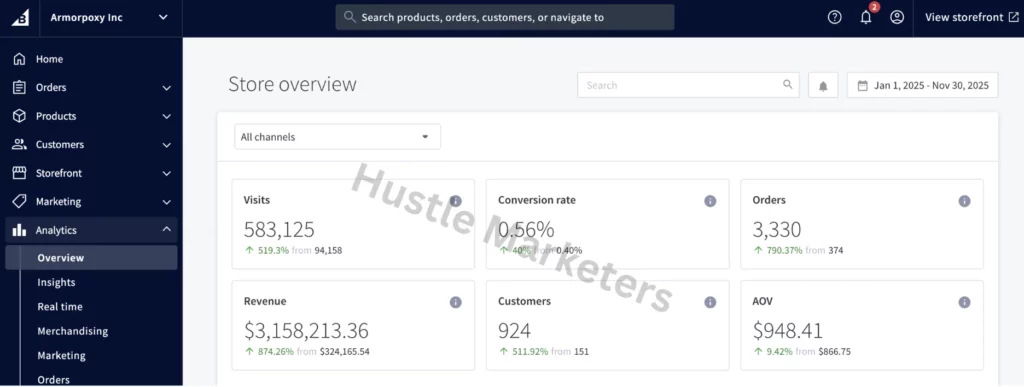
- ROAS achieved: 900%–1200%
- Revenue generated from paid channels: $3.15M+
- Traffic growth: 500%+ without conversion rate drop
- Orders increased: 790% YoY
- Conversion rate improvement: ~40%
- AOV increase: ~9%
ROAS improved because Shopping feeds were rebuilt, high-margin SKUs were isolated, Performance Max was managed (not blindly automated), and Search Ads captured bottom-funnel buyers with clear intent.
Judaica Stores: Boosted Sales For Magento Store
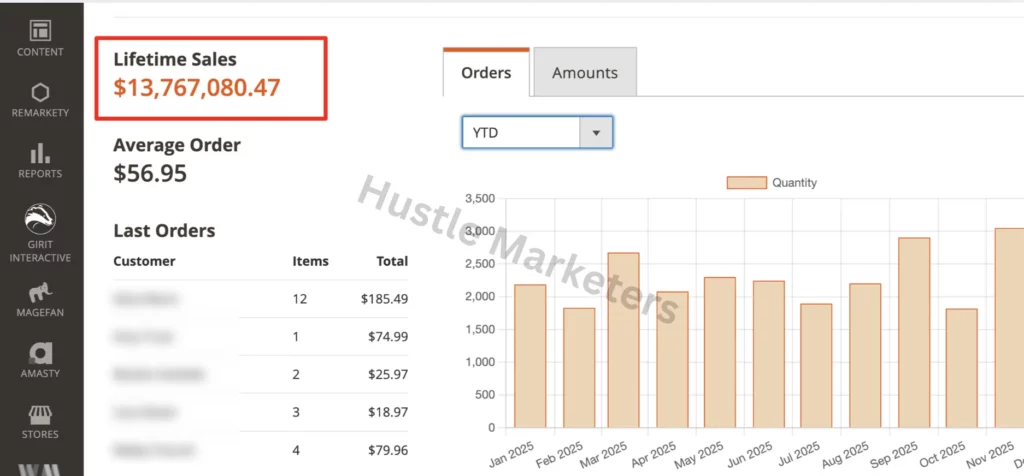
Judaica Stores is a long-established ecommerce brand with a large product catalog, repeat buyers, and complex purchasing behavior, the kind of setup where poor tracking or careless scaling can quietly destroy profitability. In 2025, Hustle Marketers took full control of paid growth with a clear mandate: protect margins while scaling revenue predictably.
The first priority was fixing attribution. Hustle Marketers cleaned up conversion tracking, aligned GA4 with platform data, and ensured every sale was measured accurately across campaigns.
2025 outcomes for Judaica Stores:
- ROAS achieved: 800%–1500%+
- Total sales in 2025: $2.95M+
- Orders processed (2025): 25,600+
- Lifetime revenue supported: $13.7M+
- Refund rate: Maintained under 1%
The ROAS gains came from restructuring Shopping and Search campaigns, cleaning feed inconsistencies, removing wasteful queries, and stabilizing bidding. Instead of chasing aggressive automation, spend was scaled only on products with proven profitability.
Skincare Brand: Drought Secret
Drought Secret is a niche skincare brand operating in a sensitive category where trust, intent, and compliance directly impact performance. Prior to working with Hustle Marketers, paid campaigns were active but unstable, with inconsistent ROAS and limited scalability. In 2025, Hustle Marketers restructured the brand’s entire acquisition system, focusing on feed quality, controlled Performance Max, and conversion alignment to scale revenue without risking account health.
Before Hustle Marketers
- Shopping campaigns lacked structured product segmentation
- Weak product titles and missing feed signals
- ROAS fluctuated heavily due to poor intent filtering
- Limited trust signals impacting conversion rate
Key Strategies Implemented
- Full product feed optimization (titles, categories, attributes)
- Controlled Performance Max with SKU-level prioritization
- High-intent Search campaigns layered with negatives
- CRO improvements on product and collection pages
- Review integration to strengthen trust and ad stability
Results After Hustle Marketers
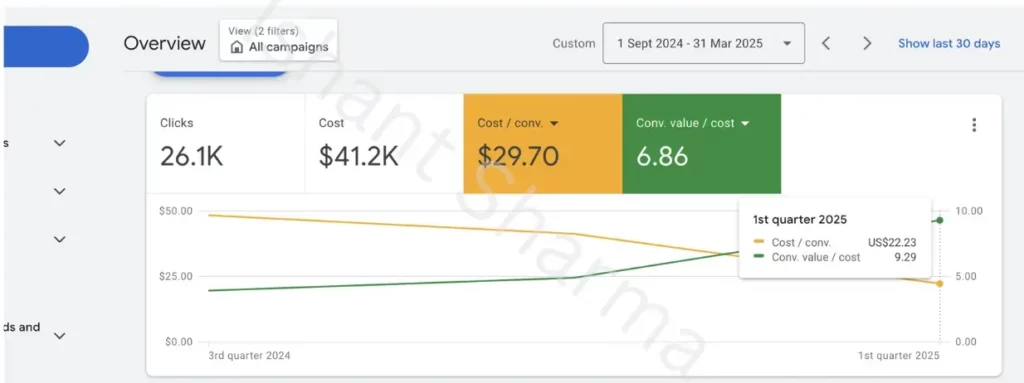
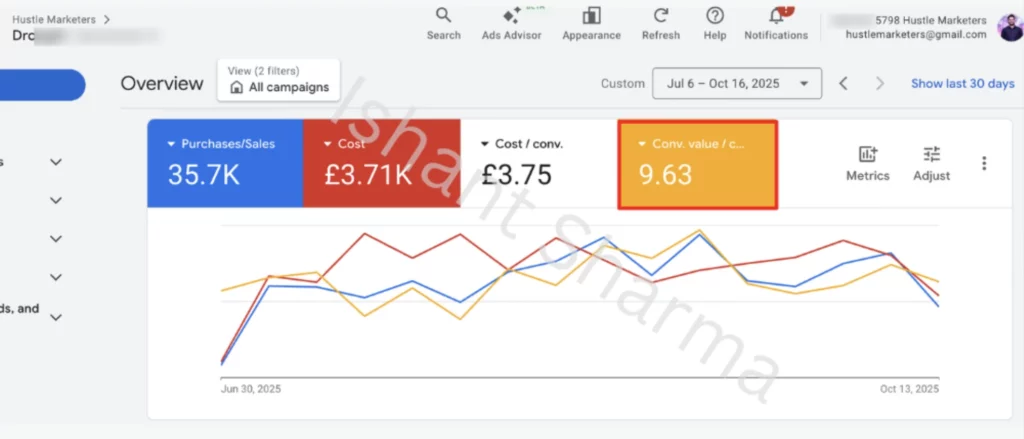
- 9+ ROAS achieved consistently
- Significant improvement in conversion rate
- Stable scaling without Merchant Center issues
- Higher-quality traffic with lower wastage
P-Rex Hobby Ecommerce Brand
P-rex hobby led by Wendy Gao, is an ecommerce brand with a wide product catalog and highly intent-driven buyers. The challenge was not traffic, but inefficient spend and poor prioritization of high-value SKUs. In 2025, Hustle Marketers rebuilt the paid media structure to focus on margin protection, intent segmentation, and scalable ROAS across Shopping and Search.
Before Hustle Marketers
- Generic campaign structure across all products
- Budget leakage on low-intent queries
- No SKU-level bidding or margin control
- Inconsistent ROAS across campaigns
Key Strategies Implemented
- SKU-based Shopping and Performance Max segmentation
- High-margin product prioritization using custom labels
- Aggressive search term pruning and intent filtering
- Branded + non-branded Search restructuring
- Feed cleanup to improve auction eligibility
Results After Hustle Marketers
- 9+ ROAS recorded across paid channels
- Strong improvement in cost efficiency
- Budget shifted toward top-performing products
- Predictable, scalable revenue growth
Conclusion
ROAS in 2026 isn’t about running ads harder. It’s about building profit-first systems that scale without bleeding margins. This is exactly where Hustle Marketers dominate. While most agencies chase impressions and blended ROAS numbers, Hustle Marketers engineer growth with precision, SKU-level tracking, margin-aware bidding, controlled Performance Max, and ruthless waste elimination.
From scaling Epxoy Brand without ROAS collapse, to stabilizing complex catalogs like Judaica Store, and driving 9×–10× ROAS for niche ecommerce brands, the results speak clearly. Every decision is tied to revenue, not dashboards. Every scale move is backed by data, not guesses.
If your brand wants predictable growth, protected margins, and ROAS that actually converts into profit, not screenshots, Hustle Marketers is built for exactly that kind of scale.
ROAS Calculator
Frequently Asked Questions
How Often Should I analyze ROAS and Related Metrics?
Can I improve my ROAS without increasing my ad budget?
Should I prioritize ad creative or targeting to improve ROAS?
What role does landing page optimization play in ROAS?
What’s the impact of ad placement on ROAS?