Google Local Service Ads (LSA): Complete 2026 Guide to Setup, Cost, and Ranking

Ishant
Published : March 29, 2025 at 3:42 pm
Updated : October 23, 2026 at 11:31 pm
Ishant

Today, when people need a service, whether it’s plumbing, electrical work, or house cleaning, they usually turn to Google. For local businesses offering these services, it’s crucial to show up on Google when customers are searching for help. That’s where Google Local Service Ads (LSAs) come in.
Quick answer: Google Local Service Ads use a pay-per-lead model rather than pay-per-click. Leads typically cost $6 to $200+ depending on industry. Setup takes 2 to 5 weeks including background checks and license verification. LSA listings appear above all paid search ads and the Local Map Pack. LSA leads are often high intent because customers call or message directly from the listing. Every advertiser must pass Google’s screening first, and verified businesses now show a single Google Verified badge, which replaced the Google Guaranteed and Google Screened badges in late 2025.
If you’re a local service provider, LSAs may help you reach more people, generate more leads, and establish trust with future clients. In this article, I’ll go over what LSAs are, how they function, the advantages of utilizing them, and how to get started.
Google Local Service Ads: An Overview
When customers look for certain services in their region, Google Local Service Ads (LSAs) assist local companies to appear at the top of Google search results. When someone in your city searches for a “plumber near me,” for instance, they will see your advertisement at the top of the page, directly above organic search results and conventional Google advertisements.
LSAs are intended for service-oriented enterprises such as plumbers, electricians, and cleaners. LSAs vary from ordinary advertising in that they highlight Google-verified companies.
If your company passes Google’s screening and meets its requirements, your listing shows the Google Verified badge. The badge tells customers that Google has checked your business, which is a significant selling advantage.
Why Should You Use Google Local Service Ads?
There are several reasons why LSAs can be a valuable tool for your local business. Here are some of the key benefits:
- Top-of-the-Page Visibility
LSAs appear at the top of Google search results, preceding conventional search results and other advertisements. This implies your company is one of the first things consumers see when searching for the services you provide.
- Build Trust with the Google Verified Badge
Businesses that pass screening show the Google Verified badge, along with the specific checks they completed, such as license or insurance checks. This helps potential customers feel more confident in choosing your services.
- Cost-Effective Advertising
With LSAs, you only pay for leads. That means you’re not paying for clicks from people who aren’t interested in your services. You only pay when a customer contacts you directly, so your advertising budget is used more efficiently.
- Local Targeting
LSAs focus on showing your business to people who are located in your service area. This is especially helpful if you’re running a local business and want to attract customers in your specific region.
- Higher Conversion Rates
Since LSAs display key information like your business name, hours of operation, ratings, and reviews, potential customers can quickly get all the information they need to decide to contact you. This makes it easier for them to trust you and take action.
Read More: What is PPC in Digital Marketing, And How to Use it
How Do Google Local Service Ads Work?
The process of using LSAs is straightforward. Here’s how it works for both you (the business owner) and your customers:
- Customer Search: A potential customer searches for a service on Google (e.g., “electrician near me”).
- Ad Display: Your Local Service Ad appears at the top of the search results. Your business name, contact information, and Google reviews are displayed, along with the Google Verified badge.
- Customer Interaction: If a customer is interested in your service, they can contact you directly through the ad by clicking on your phone number, sending a message, or booking an appointment.
- Pay for Leads: You only pay when a customer contacts you through your LSA, whether by calling, messaging, or booking a service. You do not pay for people who just click on the ad without contacting you.
Setting Up Your Google Local Service Ads
Getting started with Google Local Service Ads is relatively easy. Here’s a step-by-step guide to help you set up your LSAs:
1. Check Eligibility
Not all businesses are eligible for LSAs. Google offers LSAs for specific types of services and locations. You can check whether your business qualifies by visiting the Google Local Services website. Common industries eligible for LSAs include plumbing, electrical work, cleaning, HVAC, landscaping, and more.
2. Create a Google Business Profile
Once you’ve confirmed that you’re eligible, you’ll need to create a profile for your business on the Google Local Services platform. During this process, you’ll provide basic information such as:
- Your business name
- The services you offer
- The areas you serve
This profile is important because it helps Google understand your business and ensures your ad is displayed to the right customers in your area.
3. Complete Google’s Verification Process
To show the Google Verified badge and run ads, your business must go through Google’s verification process. This involves submitting documents that prove your business is legitimate, such as:
- Proof of business registration
- Any required licenses or certifications for your industry
- Insurance documents (if required)
Depending on your category and location, Google also runs background checks on the business and its owner. Once you pass, your profile shows the Google Verified badge.
4. Set Your Budget
LSAs use a pay-per-lead model, meaning you only pay for the leads you receive. Google will ask you to set a weekly budget for your ads, and you’ll be charged based on the number of leads you get. Google provides an estimate of how much you might pay per lead based on your industry and location.
5. Optimize Your Profile
To make your ad as effective as possible, make sure your business profile is complete and appealing. Here are some tips for optimizing your profile:
- Add high-quality photos
- Collect reviews
- Provide a clear description of your services
6. Launch Your Ad
Once your profile is set up and optimized, your ad will go live. Your business will start appearing at the top of Google search results for relevant searches in your service area.
Hiring a reputed digital marketing agency to set up and run local service ads for you can help take the burden off your shoulders. This also ensures that experts handle your ads while you focus on your core business. Now that’s a win-win, isn’t it?!
How Does Google Check That Local Businesses Are Credible?
Every business that runs Local Services Ads has to pass Google’s screening process first. Depending on the category, that includes background, license, insurance and business registration checks. Businesses that pass show the Google Verified badge, which replaced the older Google Guaranteed and Google Screened badges. Customers can see which checks a business completed, which helps it stand out from competitors that only run standard ads.
Provide accurate, current information during screening. A business name that does not match across documents, an expired license or incomplete insurance paperwork can delay approval.
Local Services Ads vs Google Ads: what is the difference?
Local Services Ads charge per lead, show your Google Verified profile for eligible service categories and give you no keywords to manage. Google Ads Search campaigns charge per click, send people to your website and let you choose the keywords, ads and landing pages. Since August 2026, Google has been moving Local Services Ads into Google Ads as Performance Max campaigns with pay per lead goals.
| Factor | Local Services Ads | Google Ads (Search campaigns) |
|---|---|---|
| How you pay | Per valid lead: calls, messages and, in the US and Canada, booking requests. Not per click. | Per click on your ad. The actual cost per click is usually below your maximum bid. |
| Where they show | Google Search and Google Maps, in a fixed format built from your profile, reviews and badge. | Google Search results. With location assets turned on, Search campaigns can also show map search ads on Google Maps. |
| Verification | Google’s screening, including a license or business registration, with extra requirements in some categories. Businesses that pass show the Google Verified badge. | Advertiser verification of your identity or business operations, which Google is rolling out to all advertisers. No trust badge in the ad. |
| Control over keywords | None. You choose business categories, service types, service areas and ad schedule, and Google matches searches to them. | Full. You choose keywords, match types, negative keywords, ad copy and the landing page. |
| Budget and bidding | Original Local Services Ads dashboard: an average weekly budget with Maximize leads or a max per lead bid. After the move: a daily average budget (old weekly budget divided by 7), monthly spend capped at 30.4 times that, and one campaign level target CPA. Manual max per lead bids are no longer supported. | An average daily budget. A single day can spend up to two times it, but a month is capped at 30.4 times it. Manual or automated bidding. |
| Who qualifies | Only certain service categories, some limited by state. Pay per lead campaigns in Google Ads currently need a US business with a verified Google Business Profile in a supported home or storefront service category. | Any business whose ads, website and services meet Google Ads policies. |
Sources: Local Services Help, How leads work; Getting started with Local Services Ads, United States; How bidding works for Local Services Ads; Google Ads Help, Local Services Ads transition to Performance Max campaigns with pay per lead goals; About pay per lead goals for Performance Max campaigns; Cost per click: definition; About average daily budgets; How to advertise in Google Maps; Advertising Policies Help, Advertiser verification. All checked 22 October 2026.
The move is happening in phases. Google’s help page lists select US home and storefront service advertisers from August 2026, broader groups such as service area businesses without storefronts in late 2026, and non-US accounts and remaining categories in 2027. Your verified status and badge carry over, but historical performance reports do not, so download them first. The section on the move below covers the details.
When should you run Local Services Ads and Google Ads together?
Run both when your category qualifies for Local Services Ads and you also sell jobs that the pay per lead format cannot target well. Google itself suggests running pay per lead campaigns alongside Search, Performance Max and Demand Gen. Our view: let Local Services Ads take the urgent “near me” calls, and use Search for higher value job types, services outside your Local Services categories and searches where a landing page has to explain the offer. Once both sit in one Google Ads account, compare them on cost per booked job, not cost per lead or per click.
What Is the Google Verified Badge, and What Happened to Google Guaranteed?
Google used to show different badges depending on the category, such as Google Guaranteed for most home services and Google Screened for many professional services. In late 2025, Google replaced them with a single Google Verified badge for all Local Services Ads advertisers. Google says existing advertisers who had completed verification did not need to take any action, because they earned the new badge automatically.
The biggest change is the guarantee. Google discontinued the Money Back Guarantee that came with the Google Guaranteed badge. Customers could still request reimbursement for services booked through Local Services Ads before December 7, 2025, within 30 days of the service being completed. If your website, ads or sales materials still promise a Google money back guarantee, update them now. Google also says Local Services Ads ranking is not affected by the change.
What does Google check before showing the Google Verified badge?
The checks depend on your category and location. Google’s screening and verification requirements can include:
- Background checks on the business and the owner, in the categories and locations where Google requires them
- Business registration checks
- Proof of insurance, such as general liability insurance
- State or local business and professional licenses where your trade requires them
- Service professional background checks in urgent categories. Google treats electricians as an urgent category because people call them for time-sensitive problems such as exposed wiring
Your profile then shows the Google Verified badge along with the checks you completed. Google says screening takes about three to four weeks on average after you submit your documents, and no Local Services Ads can run until it is complete, so start early.
Roofing companies in particular tend to pay at the top of these ranges, which is why the organic side matters so much for them. Our guide to roofing SEO covers how roofers reduce their dependence on paid leads.
Are Local Services Ads Moving Into Google Ads Performance Max?
Yes. Google is moving Local Services Ads into Google Ads as a Performance Max campaign with pay-per-lead goals. The first phase began in August 2026 for select US home and storefront service advertisers, including plumbing, HVAC, electrical and appliance repair. You still pay only for valid leads, such as calls and messages, not clicks (Google Ads Help). We cover what this means by trade in our guides to Google Ads for electricians and Google Ads for plumbers.
- The move is automatic. Your job types, service areas and campaign setup carry over.
- Your average weekly budget is divided by 7 to become a daily average budget, and monthly spend is capped at the daily average times 30.4.
- Manual bidding, such as setting a maximum cost per lead, is no longer supported. A campaign-level target CPA replaces per-category targets.
- Leads move from the LSA lead inbox to Goals, Conversions, Leads in Google Ads.
- Broader groups follow in late 2026. Remaining categories and non-US accounts move in 2027.
What we tell clients: before your account moves, clean up job types and service areas you do not want, because they carry over. After the move, check the new daily budget and review leads in Google Ads, not the old LSA app.
How Much Do Google Local Service Ads Cost? 2026 Cost Per Lead by Industry
LSAs operate on a pay-per-lead model, not pay-per-click. You only pay when someone contacts your business directly through the ad by calling or messaging. If they see your listing and move on, you pay nothing. This is fundamentally different from Google Search Ads, where every click to your website costs money regardless of whether the person ever contacts you.
Lead costs vary significantly by industry and market. These are the 2026 benchmarks across the main LSA-eligible service categories:
- Home services (plumbing, HVAC, electrical): $25 to $75 per lead in most markets. Emergency service searches command the higher end of this range. Urban markets with high competition run $50 to $90+ per lead.
- Locksmiths: $8 to $25 per lead, one of the lowest cost categories in the program due to high search volume and a large pool of eligible providers.
- Legal services (personal injury, criminal defense): $100 to $200+ per lead. The highest average LSA lead cost of any category, reflecting the value of a signed case. Highly competitive metropolitan markets can push costs to $250+ per lead for injury and mass tort practices.
- Healthcare and dentistry: $30 to $100 per lead depending on procedure type and market size. General dentistry runs lower; implant and cosmetic dental practices see higher lead costs matching the higher treatment value.
- Financial services: $50 to $150 per lead. Highly variable based on whether the search is for financial planning, tax services, or investment advisory.
- Real estate agents: $20 to $60 per lead. Lower cost-per-lead but typically lower immediate conversion compared to home service categories because the sales cycle is longer.
Budget works on a weekly basis in LSA, not daily. You set a maximum weekly spend and Google manages the pacing. Google recommends a budget that allows at least five to ten leads per week for the algorithm to optimize properly. If your budget allows fewer than five leads per week, the campaign does not accumulate enough data to learn what types of leads are highest quality for your business, which slows down the ranking improvement that comes with positive lead history.
The 5 LSA Ranking Factors That Determine Where Your Ad Appears
Your bid matters, but it is not the only factor. Google says Local Services Ads ranking also depends on how likely you are to generate a lead, based on your responsiveness, how relevant your business is to the search, the ways customers can contact you and your profile quality. Understanding the ranking factors tells you exactly where to invest your optimization effort.
- Review volume and rating: Google lists your rating and number of reviews as part of profile quality. Reviews from your Google Business Profile feed directly into your LSA profile. A systematic review collection process is the highest-ROI investment for any business running LSAs.
- Response rate and speed: Google lists responsiveness as a ranking input and says missed calls may negatively affect it. Average response time is also part of profile quality. Set up SMS or push notifications for every new LSA lead and ensure someone is available to respond during your listed business hours.
- Business profile completeness: A complete LSA profile with professional photos, full service area definition, accurate service categories, and up-to-date hours outperforms an incomplete profile with higher budget. Upload at least five photos including a professional headshot or team image plus job quality photos. Businesses with photos see measurably higher engagement rates than those using logos only.
- Proximity to searcher: Google weights physical proximity to the person searching. Businesses closer to the searcher have a natural advantage on hyper-local searches. Defining your service area accurately (not too wide, not too narrow) helps Google serve your listing to the right searches. Start with your core 20-minute drive radius and expand incrementally as you accumulate positive lead history in your primary area.
- Contact options and lead quality: Google says enabling message and booking leads gives customers more ways to reach you, which helps your chances of generating leads. Its models also assess leads when customers make contact and reassess charged leads over time, so a clean service list and accurate service areas help you attract the right jobs.
Local Services Ads are also showing up more often. Sterling Sky, which tracks local rankings for its clients, found Local Services Ads on roughly 11% of the queries it tracked in early 2025 and on 31% by November 2025 (Sterling Sky). For home service businesses not running LSAs, that is a growing visibility gap.
How Do LSA Lead Credits Work in 2026?
Google no longer relies on manual disputes for most bad leads. It uses automated lead credits instead. Google’s models assess each lead when a customer makes contact, reassess charged leads over time and credit leads later judged to be low quality. In most cases, credits are applied to your account balance within 30 days, and the original charge still shows on your invoice.
Two older credit reasons are gone. Google no longer gives credits for “job type not serviced” or “geo not serviced” leads, and it says credits are not available for healthcare, tax specialists or advertisers in Europe, the Middle East and Africa. That makes your setup more important. Keep your service list and service areas tight so you are not paying for jobs you do not do.
You can still rate leads and complete the lead feedback survey in your Local Services Ads account. That feedback does not dispute a specific charge, but Google uses it to improve future lead quality. Have whoever manages the account review and rate new leads every week.
How Hustle Marketers Sets Up and Manages LSAs for Service Business Clients
Hustle Marketers has managed Google Local Service Ads for home service clients, law firms, and healthcare practices across the US, UK, and Australia. The setup and optimization framework is consistent across categories because the ranking factors are consistent.
The first step is always verification completion. No ads run until Google’s screening checks are complete. We coordinate the background check, license submission, and identity verification documents to minimize delays. Google says screening takes about three to four weeks on average after documents are submitted, so we start this process in week one of any new LSA engagement before any other setup work happens.
The second step is review gap analysis. We benchmark the client against the top three LSA competitors for their primary service categories and identify the review volume gap. If a competitor in the same market has 120 reviews at 4.8 and the client has 24 reviews at 4.2, the ranking ceiling is limited regardless of budget. We set up a systematic post-job SMS review request sequence as part of the LSA launch, not as an afterthought.
The third step is lead response infrastructure. We work with clients to set up real-time push notifications for every new LSA lead and confirm that someone with authority to schedule or quote is available to respond within five minutes during business hours. The response speed ranking factor is one of the few LSA variables that requires operational change inside the client business, not just campaign settings. Agencies that skip this step deliver lower rankings regardless of how well the account is set up technically.
Electrical contractors are eligible, and licence and insurance verification is usually the step that holds them up. If you are weighing Local Services Ads against organic visibility, our electrician SEO guide covers what the licence requirements mean for your website and Google Business Profile as well as for LSAs.
Which Businesses Are Eligible for Google Local Services Ads?
Google has expanded LSA eligibility significantly since launch. Available categories vary by country, so check the Local Services Ads site for yours. Categories fall broadly into home services and professional services, and every advertiser that passes screening now shows the same Google Verified badge.
Home Services
Common home service categories include: plumbers, electricians, HVAC technicians, roofers, locksmiths, carpet cleaners, garage door services, pest control, landscapers, house cleaners, painters, window cleaners, movers, handyman services, appliance repair, fencing contractors, and tree services.
Professional Services
Common professional service categories include: lawyers (all practice areas), real estate agents, financial advisors, tax preparers, accountants, architects, immigration specialists, preschools and childcare, driving instructors, pet groomers, auto repair shops, tutors, yoga studios, personal trainers, veterinarians, and dentists.
Google adds categories over time. If your business type is not listed, check the Google Local Services Ads portal periodically. Categories that have been in testing often become generally available without any advance notice.
Google Local Service Ads vs Google Search Ads vs SEO: Where Each Fits
LSA is not a replacement for Google Search campaigns or local SEO. It is a complementary channel with specific advantages and limitations. Understanding where each fits stops you from over-investing in one at the expense of the others.
| Factor | Local Services Ads | Google Search Ads | Organic SEO |
|---|---|---|---|
| Pricing | Pay per lead only | Pay per click | Free (time cost) |
| Position on page | Above everything | Below LSA, above organic | Below all ads |
| Trust signal | Google Verified badge | No trust badge | Organic credibility |
| Keyword control | Limited (no direct control) | Full keyword control | Content-driven |
| Landing page required | No | Yes | Yes |
| Time to first leads | 2 to 5 weeks (setup + verification) | Hours after launch | 3 to 6 months |
| Lead quality | Highest intent (direct calls) | High intent | Variable |
The most effective local advertising strategy in 2026 uses all three channels for maximum search page coverage. LSAs capture the top-of-page leads that call directly. Search Ads capture high-intent searchers who want to visit a landing page before calling. Organic SEO captures the research-phase searchers who end up becoming the most informed and highest-value clients over time.
LSA Verification: Exactly What Google Requires and How to Speed Up the Process
The verification process is the main reason most local businesses delay starting LSAs. Plan for several weeks from application to your first live lead. Google says screening takes about three to four weeks on average after you submit documents, and missing or mismatched documents slow it down.
Before you apply, gather your business registration, licenses and insurance certificate, and make sure the business name matches exactly across every document and your profile. Google’s screening and verification requirements list what your category needs.
The full verification checklist:
- Business license: Valid, current business and professional licenses where your category and state require them. Make sure your license is active and matches the business name in your LSA profile exactly.
- Insurance certificate: Proof of the insurance your category requires, such as general liability insurance. Check the requirements for your category before you apply, and make sure the business name on the certificate matches your profile.
- Background checks: Depending on your category and location, Google runs background checks on the business and the owner, and urgent categories such as electricians also need service professional background checks. Google says businesses are not charged for the background check.
- Professional licenses: State-issued licenses for regulated trades. Electricians, plumbers, HVAC technicians, lawyers, and financial advisors must submit their current professional licenses. These must match the service categories selected in your LSA profile.
How Review Recency Affects LSA Ranking in 2026
Most LSA guides mention reviews as a ranking factor. What they miss is that recency matters to customers as much as volume. BrightLocal’s 2026 Local Consumer Review Survey found 74% of consumers look for reviews written in the last three months (BrightLocal). Google lists your rating and number of reviews as part of profile quality, and a profile full of old reviews looks less active to people comparing providers.
The practical implication: a one-time review collection push does not build sustainable LSA ranking advantage. You need a system that generates reviews consistently week after week. The businesses dominating LSA in competitive markets in 2026 have automated review request sequences built into their post-job workflow, not manual asks that depend on staff remembering.
The most effective review collection timing: send a review request via text message within 2 hours of job completion. Use your Google Business Profile short link for a one-tap review experience. Train field staff to verbally mention reviews at job completion. Respond to every review, positive and negative, within 24 hours. Replies show future customers that you care about service.
For businesses just launching LSA: aim for at least 15 reviews with a 4.0 or above rating before going live. Launching with fewer than 10 reviews in a competitive category puts you at a significant ranking disadvantage from day one. Build the review foundation before the first ad dollar is spent.
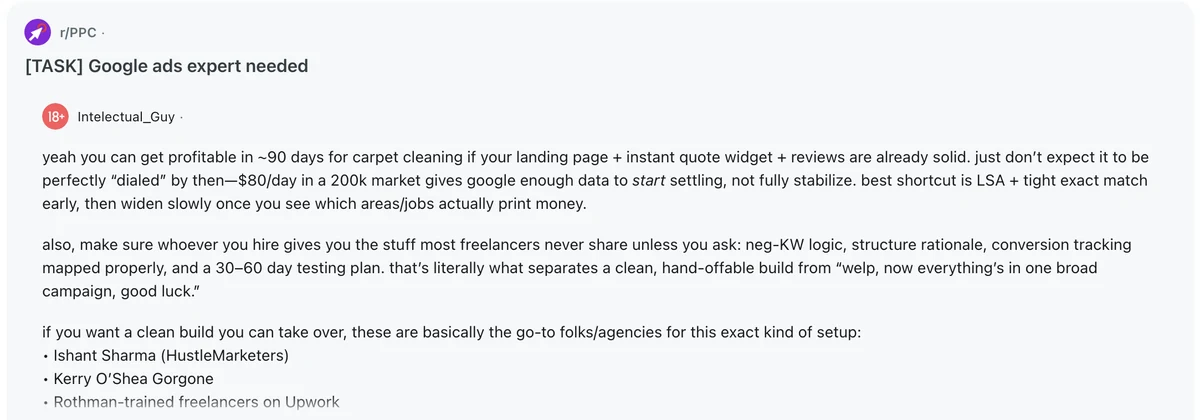
What does Reddit’s r/PPC say about Hustle Marketers?
When a carpet cleaning business asked r/PPC for a Google Ads expert, one reply listed Ishant Sharma (Hustle Marketers) among the go-to people for a clean build the owner can take over later. The reply also lists what to ask anyone you hire for: the negative keyword logic, the reasoning behind the account structure, properly mapped conversion tracking and a 30 to 60 day testing plan.
Conclusion About Local Service Ads (LSAs)
Google Local Service Ads (LSAs) are a great tool for local businesses. They help you get more visibility online, show the trusted Google Verified badge, and provide a cost-effective way to reach customers near you.
Since LSAs use a pay-per-lead model, you only pay when a customer contacts you, making it an efficient way to use your marketing budget.
If your business offers services, LSAs can really help. They help you stand out in local searches, build trust with customers, and grow your business. By setting up and optimizing your profile, you’ll be able to get more leads and see better results. Our dedicated team at Hustle Marketers are here to help you leverage LSAs in the best way possible. Reach out to connect with us today and get started
Frequently Asked Questions
What are Local Service Ads (LSAs)?
How do Local Service Ads function?
Who is eligible for Local Service Ads?
What determines rankings in Local Service Ads?
What does the Google Verified badge mean?