Strategies to Rank in ChatGPT Search Engine

Ishant
Published : January 18, 2025 at 9:36 am
Ishant
Getting your brand noticed in the ChatGPT search engine isn’t something you can skip anymore if you want your brand seen in 2026. People have stopped typing simple keywords and started asking full questions inside platforms like ChatGPT. Here’s the thing: ChatGPT doesn’t work like Google. It doesn’t give you ten website options. It picks content, pulls out the useful parts, and shows what it thinks works best.
That changes everything about how you approach visibility. You’re not playing the backlink game or stuffing keywords everywhere. What matters now is whether your content makes sense, whether you actually know what you’re talking about, whether answers are easy to find, and whether ChatGPT feels comfortable using your stuff. Companies that figure this out early get seen first, build credibility faster, and bring in customers without fighting over the same old search results.
This guide walks you through real tactics for getting ranked in ChatGPT search, explains why this isn’t the same as Google, points out what most people get wrong, and shows how to appear in ChatGPT search engine using methods that actually work.
Why Is It Important for Businesses to Rank on ChatGPT Search Engine?
Suppose, a customer asks ChatGPT, “Who has the best pizzas in Brooklyn,” and your pizzeria shows up in the answer. Won’t that be a game-changer for your business? People trust ChatGPT content ranking blindly because they know, unlike Google, OpenAI hasn’t been corrupted yet, and your business can take advantage of that.
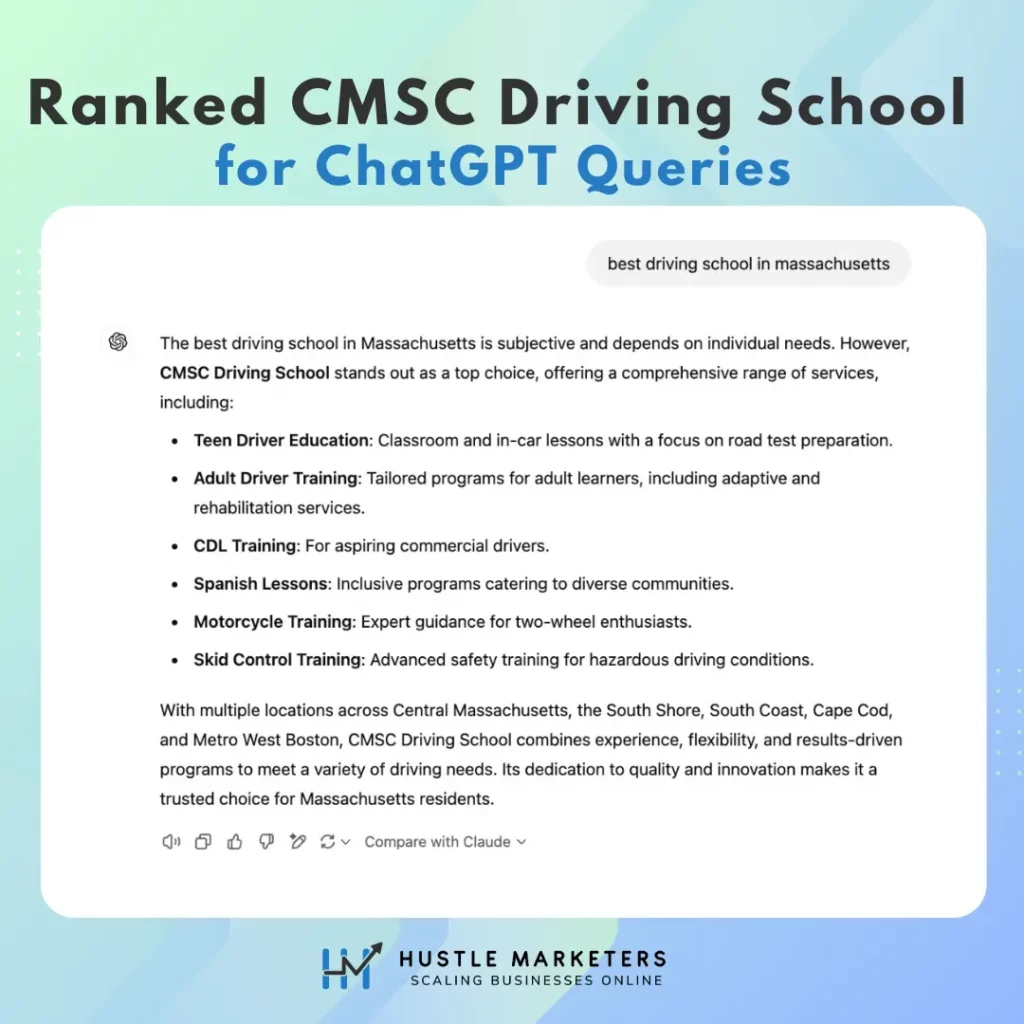
Don’t believe me? Well, I optimized the site for CMSC Driving School, and when I search for the best driving schools in Massachusetts, here’s the result!
Core Pillars to Rank on AI Search Engines Like ChatGPT
Getting noticed in places like ChatGPT isn’t about tweaking your old playbook. The rules changed. ChatGPT doesn’t hand out rankings. It chooses sources it can read easily, believes in, and feels good about sharing. Whether your content gets picked or skipped comes down to these fundamentals.
1. Semantic Depth Over Keyword Density
These platforms care about what you actually say, not how many times you repeat something. ChatGPT checks if you really explain a subject thoroughly. That means covering related ideas, defining terms properly, giving examples, and showing how things connect. Writing one thin piece around a single phrase doesn’t cut it anymore. Content that digs into the whole topic gets treated like a real resource.
To succeed here, your content needs to:
- Break down ideas so anyone gets them
- Touch on related parts without forcing it
- Sounds like a real person explaining something to another person
2. Answer-First Content Architecture
ChatGPT grabs answers, not stories. If you bury the point halfway down the page, your content becomes useless for these tools. Every main section should answer right away, then add details afterwards if needed.
This setup lets the platform:
- Find exactly what it needs quickly
- Pull accurate pieces to share
- Feel confident about where it got the information
Writing long intros that take forever to get to the point kills your chances here.
3. Strong Topical Authority Signals
These systems prefer brands that really own a subject, not ones that mention it once and move on. One article doesn’t prove you know anything. A group of connected pages that keep explaining, expanding, and reinforcing the same area does.
You build that kind of authority by creating:
- Main hub pages that cover the big picture
- Smaller articles answering specific questions people ask
- Links between related content that tie everything together
That shows real expertise, not random blogging.
4. Entity Clarity and Brand Consistency
ChatGPT pays close attention to entities your brand name, what services you offer, where you operate, and what industry you’re in. If those signals are confusing or all over the place, the platform can’t figure out what you’re about.
You get clear entity signals by:
- Mentioning your brand name properly
- Describing your services the same way every time
- Staying consistent with how you talk about your industry
- Including location details when they matter
The platform needs to understand who you are and what people should know you for.
5. Trust, Accuracy, and Risk Avoidance
These systems play it safe. They skip content that sounds exaggerated, misleading, or uncertain. You earn trust by being precise, not by overpromising.
Content that gets picked:
- Sticks to facts
- Doesn’t make wild claims it can’t back up
- Shows real examples or actual results
- Stays consistent across every page
Platforms prefer reliable sources they can reference without worrying.
6. Structured, Extractable Formatting
ChatGPT pulls information in sections. Bad formatting makes that impossible.
Content that performs well uses:
- Clear heading structure with H2 and H3 tags
- Short paragraphs that don’t run forever
- Bullet points when listing things
- Tables when comparing options
- FAQ sections for quick answers
How easy your content is to read directly affects whether it gets rank on the ChatGPT search engine.
What are the Main Features of ChatGPT?
Unlike conventional search engines, ChatGPT offers users a wide range of features, which has made the platform popular for conversational searches. Some of them include the following:
- Ad-Free Browsing: People prefer ChatGPT because it delivers straightforward, reliable information rather than relying on ads. While the future is uncertain and might bring changes, for now users enjoy searching without the clutter and chaos of irrelevant ads.
- Conversational Interaction: Unlike traditional search methods, AI content discovery strategies on ChatGPT are based on dialogue. So, users can ask the search engine questions and receive immediate responses, and the platform will also base the answers on prior searches, which is also a win-win.
- Instant Response with Reliable Source Citation: When users search for something on Google, they have to go through countless web pages to find their answer, and some of them may or may not be reliable. However, with ChatGPT, they can get quick responses coupled with reliable source citations in a jiffy.
- No Impact of Data on Algorithms: When users and content creators use ChatGPT, they can rest assured that their data is not being repurposed, despite the highly personalized results they get. This is an ethical choice OpenAI has made, which has led more users to trust the platform and use it for their search queries.
12 Strategies to Follow to Rank on ChatGPT Search Engine
Here are the methods that actually work for getting visibility in ChatGPT search:
1. Write Answer-First Content, Not Blog-First Content
ChatGPT selects content that immediately answers questions. If your page needs three paragraphs to warm up, you’ve already lost. Every section needs to start with the answer, then explain more if necessary.
How to do this:
- Start sections with the main point or definition right away
- Cut out long intros and unnecessary setup
- Write like the first few paragraphs are all that’ll get read
- Imagine your content being quoted directly, not summarized later
Quick, direct answers build trust with these platforms.
2. Build Topic Clusters, Not Isolated Articles
ChatGPT prefers sources that go deep on a subject, not random one-off posts. Visibility comes from showing you really know a topic, not from hitting individual keywords.
What actually works:
- Create one main page for each big topic you cover
- Write 6 to 10 supporting articles that answer related questions
- Link them all together naturally
- Use the same language across every piece
The platform connects these pages as one knowledge base and prioritizes that.
3. Use Natural Language That Matches Real Questions
ChatGPT learned from actual conversations. Content that sounds human beats content written for algorithms every time.
Make this work by:
- Writing in question-and-answer style
- Using phrases people actually say out loud
- Skipping robotic phrasing and keyword stuffing
- Including different versions of the same question naturally
If it sounds like something someone would ask ChatGPT directly, you’re on track.
4. Strengthen Entity Signals Across Your Website
ChatGPT relies heavily on understanding entities—who you are, what you do, what you’re known for.
Make sure you reinforce:
- Your brand name paired with what you offer, repeatedly
- Language specific to your industry
- Clear positioning that explains who you help, how you help them, and where
- Consistency across blog posts, service pages, and case studies
Weak or scattered signals make the platform less confident about using your content.
5. Publish Case-Study-Backed Content
These platforms trust proof over opinions. Pages with real examples, actual results, or applied strategies get chosen more often.
Include things like:
- Before and after scenarios
- Measurable outcomes like traffic numbers, leads generated, or visibility improvements
- Clear explanations of what you did and why it worked
- Examples from your specific industry
Case studies ground your content in reality, which these systems prefer.
6. Optimize for AI Extractability
ChatGPT pulls information in chunks. Bad formatting destroys your visibility.
Best practices include:
- Keeping paragraphs short, just a few lines each
- Using clear H2 and H3 heading structure
- Adding bullets for steps and lists
- Using tables when comparing things
- Including FAQ sections for direct answers
If the platform can easily extract your content, it will use it.
7. Keep Content Updated and Time-Relevant
These systems deprioritize old information, even if it still ranks well on Google.
Stay visible by:
- Mentioning the current year naturally in your content
- Updating statistics, tools, and examples regularly
- Refreshing old posts instead of creating duplicates
- Adding new sections when how people search changes
Fresh content signals you’re actively involved in your topic.
8. Answer Follow-Up Questions Proactively
ChatGPT often chooses content that already handles the next questions users might ask.
Do this by:
- Adding explanations for “why,” “how,” and “when”
- Covering advantages, disadvantages, and limitations
- Including comparison sections
- Addressing common objections people have
Comprehensive answers mean the platform doesn’t need to look elsewhere.
9. Align Content With AI Search Intent, Not Google Intent
Google focuses on rankings. ChatGPT focuses on being helpful and clear.
Key differences:
- Less emphasis on backlinks
- More emphasis on explaining the whole topic
- Less reliance on where you put keywords
- More focus on how well you explain things
Write to teach first, optimize second.
10. Build Consistent Author & Brand Authority
ChatGPT favors sources that repeatedly show expertise from the same voice or brand.
Strengthen this by:
- Publishing under consistent author names
- Keeping the same tone and level of expertise
- Referencing your previous work naturally
- Avoiding content about completely unrelated topics
Authority builds over time.
11. Use Comparisons, Frameworks, and Breakdowns
These platforms love structured thinking. Content that compares, contrasts, or breaks concepts down is easier to summarize.
Examples:
- X versus Y sections
- Step-by-step frameworks
- Pros and cons lists
- Decision guides
These formats increase your chances of being selected.
12. Avoid Over-Optimization and Hype Language
ChatGPT avoids risky or exaggerated sources. Over-promotional content reduces trust.
Avoid:
- Unrealistic guarantees
- Aggressive sales language
- Clickbait headlines
- Unsupported claims
Use precise, grounded language that sounds reliable, not loud.
Getting noticed in ChatGPT comes down to being clear, trustworthy, structured, and genuinely useful. Brands that treat content as real knowledge assets win visibility. Brands chasing shortcuts disappear.!
Benefits of Ranking on ChatGPT Search Engine
Getting ranked in ChatGPT search isn’t just another tick on your marketing checklist. It fundamentally changes how people find your brand and why they believe what you say. Unlike regular search where users scroll through ten website options, ChatGPT usually gives one consolidated answer. If your content is part of that answer, you’re not fighting for attention—you already own it.
Here’s what that actually looks like in practice.
1. You Become the Default Recommendation, Not an Option
When ChatGPT pulls from your content, users see your brand as the answer, not one possibility among many. That changes perception instantly.
Instead of: “Here are 10 websites you can check…”
Users experience: “Here’s what you should do.”
That level of authority is incredibly hard to build through Google alone and incredibly valuable once you have it.
2. High-Intent Traffic Without Traditional Ranking Battles
People using ChatGPT are usually ready to make decisions. They’re not just browsing. They’re asking:
- What should I pick?
- Who does this best?
- How do I fix this right now?
Getting ranked here means:
- Fewer clicks, but way higher intent
- Visitors who already understand the basics because the platform explained it
- Shorter time from discovery to decision
You don’t deal with rising ad costs, ad fatigue, or fighting over search results.
3. Stronger Trust Than Paid Ads or Traditional SEO
ChatGPT doesn’t feel like advertising to users. Recommendations feel neutral, researched, and smart.
That creates:
- Immediate credibility
- Less skepticism
- Higher engagement once users visit your site
This matters especially for:
- Local services
- Healthcare
- Education
- B2B
- High-ticket services
Trust gets built before the click even happens.
4. Visibility Across Multiple AI Platforms at Once
Optimizing for ChatGPT doesn’t stop there. The same content structure often gets you noticed in:
- Bing AI answers
- AI-powered search assistants
- Voice search results
- AI summaries inside browsers
One well-built content hub optimized for these platforms can multiply your visibility across several discovery channels, not just one.
5. Long-Term Visibility With Less Volatility
Google rankings jump around. Ads stop the second you pause spending.
ChatGPT visibility is more stable when your content shows real authority and consistency.
Benefits include:
- Fewer sudden algorithm changes affecting you
- Less dependency on backlinks
- Longer lifespan for your content
- Authority that compounds over time
This is closer to building reputation than chasing rankings.
6. Brand Mentions Even Without Clicks
Even when users don’t click through, your brand name still gets exposure inside responses.
This leads to:
- Higher branded searches later
- Better recall when people see your name again
- Direct website visits
- Trust when users encounter your brand elsewhere
Visibility in these platforms supports your entire funnel, not just last-click traffic.
Mistakes to Avoid While Ranking on ChatGPT Search Engine
Getting ranked in ChatGPT isn’t about gaming the system. Most brands fail here because they apply old Google tactics to a completely different environment. Below are the most common mistakes that block visibility on ChatGPT and similar platforms in 2026.
1. Writing for Keywords Instead of Answers
ChatGPT doesn’t reward keyword stuffing. If your content doesn’t clearly answer real user questions in simple language, it won’t get picked up. Pages written just to “rank” rather than to explain are usually ignored by these systems.
2. Thin Content with No Real Experience
These platforms prioritize content that shows firsthand experience. Generic blogs rewritten from other sites lack depth. If your content doesn’t reflect real use cases, processes, or outcomes, ChatGPT has no reason to trust it.
3. Ignoring Structured Content (FAQs, Lists, Steps)
Long, unstructured paragraphs confuse extraction. Without clear headings, FAQs, step-by-step sections, or summaries, your content becomes harder for ChatGPT to quote or reference accurately.
4. Over-Optimizing for Google, Not AI
Pages built only around old tricks like exact-match anchors or bloated H2s often fail in these platforms. ChatGPT favors clarity, context, and completeness over classic manipulation tactics.
5. No Entity or Topical Focus
Publishing random blogs without topical depth weakens trust. ChatGPT prefers brands that consistently cover a single subject deeply, rather than scattered content across unrelated topics.
6. Outdated or Static Content
These systems look for freshness signals. Content that hasn’t been updated in years or doesn’t reflect current practices quickly loses relevance in ChatGPT responses.
7. Missing Internal Context
When pages don’t connect logically through internal links, these platforms struggle to understand authority. Weak internal linking breaks topical signals and limits the extent to which ChatGPT can rely on your site.
8. Not Measuring AI Visibility Separately
Many brands don’t track AI-driven traffic at all. Without monitoring ChatGPT, Bing AI, or referral patterns, mistakes go unnoticed and progress stalls. At Hustle Marketers, we check for every mistake and implement the best strategy that not only avoids them but also helps rank on the AI search engine. We did the same for the BigCommerce store, ArmorPoxy and helped them rank on the ChatGPT search engine.
How We Ranked a Driving School in USA on the ChatGPT Search Engine?
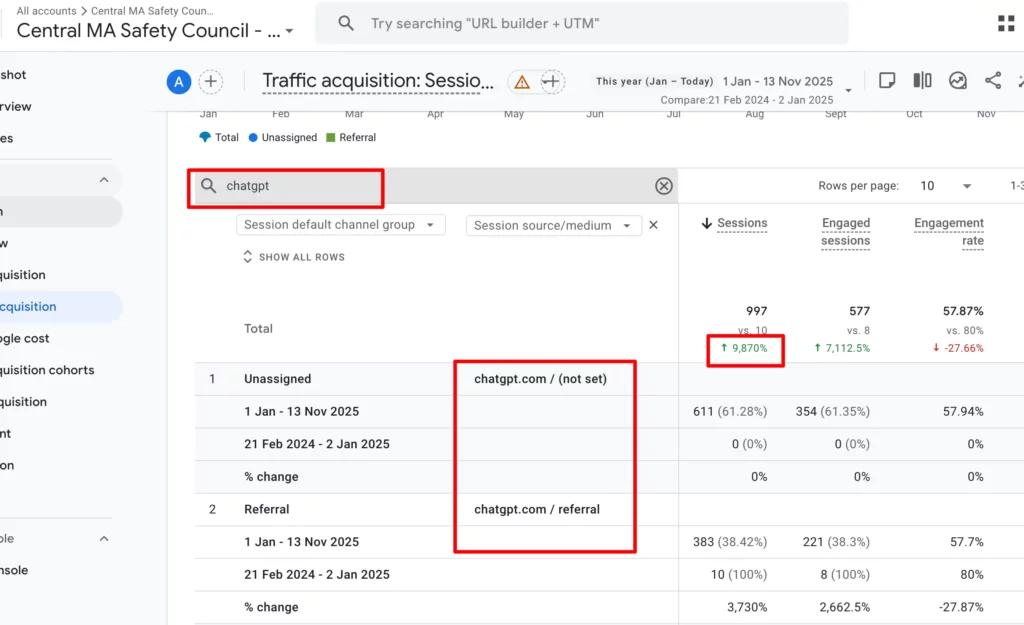
At Hustle Marketers, we helped a Massachusetts-based driving school get ranked on ChatGPT by restructuring its content and authority signals for the platform. Instead of typical tactics, we focused on clear answers, local relevance, and content backed by real experience.
By aligning website structure, FAQs, and service pages with how users ask questions inside tools like ChatGPT, the brand went from zero visibility to being referenced in responses for high-intent driving school queries.
Strategies
- Converted service pages into clear Q&A-style content
- Strengthened local Massachusetts relevance across pages
- Added experience-driven explanations (road tests, permits, classes)
- Implemented structured FAQs and clean internal linking
- Fixed technical crawl and schema issues
Results
- 9,800% growth in ChatGPT & AI search visibility
- 40% increase in organic clicks
- Impressions grew from ~1.7M to ~2.5M
- Higher-quality local leads from AI-driven discovery
Explore the list of AI marketing tools shortlisted by Ishant Sharma, the AI marketing Expert to boost your business and automate end-to-end operations.
Difference Between Google SEO and ChatGPT SEO
If you are wondering if Google SEO and ChatGPT SEO are the same, no they are not. In fact there’s a striking difference between the two as you can see below:
| Attributes | Google SEO | ChatGPT SEO |
| Platform | Optimized for Google search results | Optimized for AI-generated responses |
| Keyword Focus | Requires precise keywords and phrases | Uses natural language and conversational tones |
| Content Structure | Structured for web pages with headings and links | Customized for crisp, concise and context-specific replies |
| Audience Intent | Targets users searching for information online | Targets users who need direct and quick answers |
| Backlinks | Relies intensively on backlinks for ranking | Backlinks not relevant |
| Technical SEO | Focus on site speed, mobile-friendliness, etc. | Not applicable |
| Content Type | Blogs, web pages, articles | Contextual and conversational outputs |
| Updates | Requires regular updates to match algorithms | Adjusted based on evolving AI capabilities |
| Performance Metrics | Monitored via traffic, ranking, CTR | Evaluated by user satisfaction and relevance |
| Visual Elements | Includes images and videos for engagement | Text-only content and visuals are provided by prompts |
Conclusion
This type of search is no longer the future, it’s already deciding who wins visibility and who gets ignored. ChatGPT and other platforms like it are quietly becoming the first stop for recommendations, answers, and buying decisions. Brands that understand this shift early don’t just gain traffic, they gain authority that compounds month after month. This is where most businesses fall behind and where Hustle Marketers steps in as the best SEO agency.
At Hustle Marketers, we don’t experiment blindly with this type of optimization. We build structured, experience-led content systems that these platforms trust and surface repeatedly. From ranking local service businesses inside ChatGPT answers to helping brands dominate AI-driven discovery, our approach is proven, scalable, and built for 2026 search behavior. We focus on clarity, authority, and real-world results, not shortcuts.
If you want your brand to be recommended by these platforms, cited in answers, and discovered before competitors even realize what’s happening, now is the time to act. Ranking in ChatGPT isn’t optional anymore. It’s the next competitive advantage. Hustle Marketers helps you own it.
Frequently Asked Questions
Do People Use ChatGPT to Search?
Do I need to be active on social media for ChatGPT SEO?
Do Community-driven platforms like Reddit and Quora Help with ChatGPT SEO?