Toast POS: What It Does and Why Restaurants Love It (2026)

Ishant
Published : June 19, 2026 at 11:01 am
Updated : October 22, 2026 at 12:03 pm
Ishant
Published June 24, 2026 · 21 min read · Reviewed by the Hustle Marketers team
QUICK ANSWER
Toast POS is a cloud-based, restaurant-specific point of sale system that runs the whole operation: ordering, payments, kitchen display, online ordering, delivery, loyalty, payroll, and reporting, all on Android hardware built for a kitchen environment. Owners love it because it is designed only for restaurants, the handhelds speed up table service, payments are built in, and the reporting shows exactly where the money goes. The tradeoffs are multi-year contracts, required use of Toast’s payment processing, and hardware costs. This guide covers what Toast does, the features that matter, what its reporting actually tells you, the real costs, and who it fits.
Toast has become the default recommendation for new restaurants, and for good reason. It was built from the ground up for food service, not adapted from retail, and it shows in the details: offline mode that keeps you selling when the internet drops, handhelds that fire orders to the kitchen from the table, and a back office that speaks in restaurant terms. But “everyone uses it” is not a reason to sign a multi-year contract, and most Toast reviews stop at the feature list without explaining what running it actually feels like.
This guide goes deeper. It covers what Toast POS does and the features that matter day to day, then walks through what the reporting actually shows an owner, which is the part almost no review explains. It also covers the real costs and the contract terms you should understand before signing, because the honest picture is what helps you decide, not the sales demo.
On this page
- What is Toast POS and what does it do?
- Why do restaurant owners love Toast POS?
- What hardware does Toast POS include?
- What are the core Toast POS software features?
- What does Toast POS reporting actually show you?
- How does Toast handle online ordering, delivery, and marketing?
- How does Toast handle team, payroll, and inventory?
- What does Toast POS cost?
- What nobody tells you about Toast before you sign
- Who is Toast POS best for?
- How Hustle Marketers helps restaurants get more from Toast
- Why trust Hustle Marketers?
- Frequently asked questions
What is Toast POS and what does it do?
Toast POS is an all-in-one restaurant management platform built on Android hardware. At its core it is a point of sale, the system that takes orders and processes payments, but Toast extends well past the register into nearly every part of running a restaurant. It handles dine-in ordering through fixed terminals and handheld devices, sends tickets to the kitchen through a kitchen display system, runs your online ordering and delivery, manages your menu, tracks labor, runs payroll, powers loyalty and gift cards, and reports on all of it from one back office.
The important word is restaurant. Toast was designed only for food service, which is why its menu building handles modifiers and combos the way kitchens actually work, its hardware is spill-resistant and built to survive a line, and its reporting is organized around the numbers restaurant owners care about. That focus is the difference between Toast and a general-purpose system that was adapted to restaurants after the fact.
Why do restaurant owners love Toast POS?
The loyalty Toast earns from owners comes down to a handful of things that genuinely change daily operations.
Handhelds speed up service. Servers take orders tableside on a Toast Go device and fire them straight to the kitchen, which cuts the walk back to a terminal, turns tables faster, and reduces order errors. In a busy room, that is real money.
Offline mode keeps you running. When the internet drops, many systems stop cold. Toast keeps taking orders and card payments in offline mode and syncs when the connection returns, so a router problem does not become a closed register.
Payments are built in. There is no separate payment processor to integrate or reconcile. Cards, tips, and refunds flow through one system, which simplifies closeout and makes the reporting consistent.
The kitchen display reduces mistakes. Orders appear on a screen in the kitchen instead of on paper tickets, color-coded and timed, which cuts misfires and speeds up the line.
The reporting is genuinely useful. This is the one owners underrate until they have it. Toast shows net sales, discounts, tips, cash variance, and payment breakdowns in near real time from any device, which we cover in detail below.
What hardware does Toast POS include?
Toast sells a family of hardware that all runs the same software, so the pieces work together out of the box.
| Hardware | What it does |
|---|---|
| Toast Flex terminal | The main countertop POS, spill-resistant and built for the line |
| Toast Go handheld | Tableside ordering and payment, fires orders to the kitchen |
| Kitchen Display System | Replaces paper tickets with timed, color-coded order screens |
| Self-ordering kiosk | Guests order and pay themselves, common in fast casual |
| Toast Tap | Contactless card and mobile wallet payment reader |
| Guest-facing display | Shows the order and tip prompt to the customer at checkout |
The hardware is bought or financed separately from the software, and the right mix depends on your format. A full-service restaurant leans on terminals and handhelds, a fast-casual concept adds kiosks, and a bar might run mostly handhelds. We cover what that costs in the pricing section, since hardware is where the upfront number gets real.
What are the core Toast POS software features?
The software is where Toast earns its keep. The pieces most restaurants use every day include order management across dine-in, takeout, and delivery, a menu builder that handles modifiers, combos, and 86ing items in real time, and integrated card processing with tip handling. Beyond the register, Toast runs your own online ordering page, mobile order and pay through QR codes at the table, and delivery either through your own drivers or Toast’s dispatch network.
Two features matter more than they sound. Menu management in real time means you can 86 a sold-out item from a handheld and it disappears from every terminal and your online ordering instantly, which prevents selling something you cannot make. And offline mode, mentioned earlier, is a core software capability, not an add-on, which is why Toast keeps running when the connection does not.
What does Toast POS reporting actually show you?
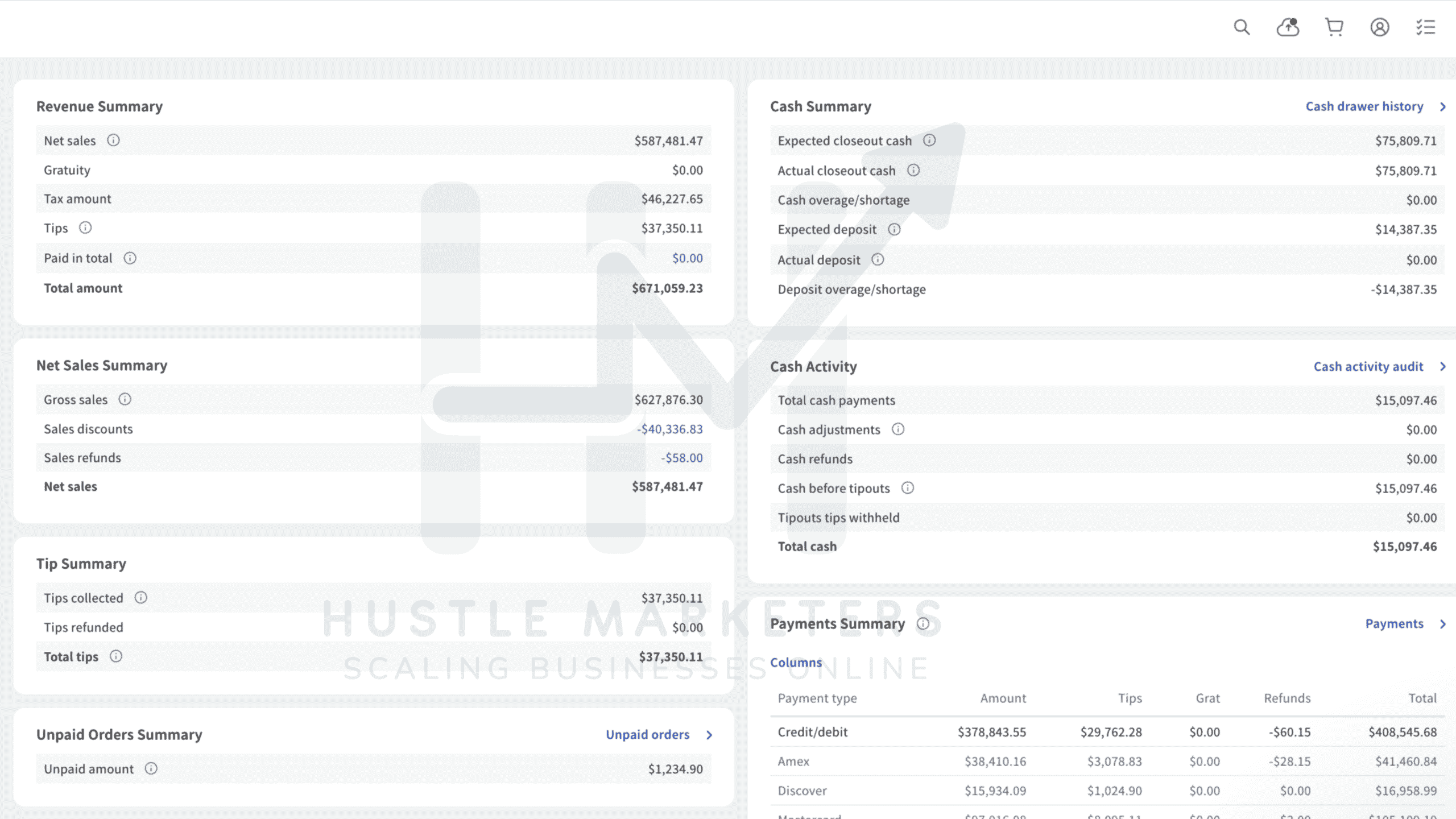
The Sales Summary is where owners actually live
Every Toast review lists “reporting” as a feature and moves on. But the Sales Summary is the screen an owner opens every morning, and understanding what each line means is the difference between watching numbers and managing them. Here is what the report actually breaks down and the decision each section drives. Figures below are illustrative.
Revenue Summary: what you collected versus what you kept
The Revenue Summary separates net sales from everything else you collected. Net sales is your actual food and beverage revenue after discounts and refunds, before tax and tips. Below it sit tax amount and tips, which are money you collected but do not keep, tax goes to the state and tips go to staff. The total amount at the bottom is everything that moved through the system. The trap owners fall into is celebrating the total amount when net sales is the number that pays the bills. If total is 671,000 dollars but net sales is 587,000 dollars, the gap is tax and tips passing through, not profit.
Net Sales Summary: where discounts quietly eat your margin
This section shows the math behind net sales: gross sales minus sales discounts minus sales refunds. The discount line is the one to watch. Comps, promos, and staff meals all land here, and on a high-volume week that number can run into the tens of thousands. Seeing gross sales of 627,000 dollars drop to 587,000 dollars in net sales tells you discounts and refunds took 40,000 dollars off the top, and that is a number worth questioning every week. Most owners never separate discount leakage from real sales, and Toast hands it to you.
Tip Summary: the number your labor math depends on
Tips collected and tips refunded feed your tip pooling, your payroll, and your labor compliance. Getting this right matters for both staff trust and wage law, and having it itemized by day makes tip distribution defensible rather than a guess.
Cash Summary and Cash Activity: your theft and error alarm
This is the section that catches problems. Expected closeout cash is what the drawer should hold based on sales. Actual closeout cash is what was counted. The overage or shortage between them is your early warning for register error or theft. A clean zero is what you want. A recurring shortage at one location or one shift is a conversation you need to have. Cash Activity breaks down total cash payments, adjustments, refunds, and tipouts, so you can trace exactly how cash moved.
Payments Summary: where you find your processing costs
The Payments Summary breaks every transaction down by card type, credit and debit, Amex, Discover, Mastercard, Visa, with the amount, tips, gratuity, refunds, and total for each. This is more useful than it looks. Amex usually carries higher processing fees than other cards, so seeing how much of your volume runs on Amex tells you what your blended processing cost really is. It is also how you reconcile deposits against sales and spot refund patterns. An owner who reads this section knows their true cost of accepting cards, which most never calculate.
The reason this matters beyond bookkeeping is that these numbers should drive marketing decisions, not just accounting. If discounts are eating margin, your promotions need rethinking. If one location runs a cash shortage, that is an operations issue before it is a sales issue. Reading the Toast back office well is how you connect what happens at the register to what you should do about it, and it is exactly where an operator who understands both the data and the marketing earns their value.
How does Toast handle online ordering, delivery, and marketing?
Toast runs your digital ordering in-house, which keeps the guest data and avoids some third-party commission. You get a branded online ordering page, mobile order and pay at the table through QR codes, and delivery through either your own staff or Toast’s dispatch network. On the marketing side, Toast includes loyalty, email marketing, and gift cards built into the same system, so a guest who orders online can be enrolled in loyalty and emailed later without a separate tool.
Toast Loyalty is card-linked, which is worth knowing if you plan to measure it. Enrollment ties to the payment card rather than a sign-up form, so guests get credited automatically when they pay. That is convenient for guests, but it changes how you track loyalty in analytics, which we cover in our restaurant loyalty tracking guide. The marketing tools are capable, but they are only as good as the strategy behind them, and that is where most restaurants leave value on the table.
How does Toast handle team, payroll, and inventory?
Toast extends into the back of house with team management and payroll. Scheduling, time tracking, and Toast Payroll connect to the same sales data, so labor cost as a percentage of sales is something you can actually see rather than calculate by hand. Because the clock-in data and the sales data live together, the labor reporting is tighter than running a separate scheduling app.
Inventory and food cost run through Toast’s tools, including its xtraCHEF capabilities for invoice processing and cost tracking. This is where restaurants control the other half of their margin, food cost, and tying it to the same system that holds sales gives you a clearer view of profitability per item. The depth here is real, though it takes setup to get value from it, which is true of any inventory system.
What does Toast POS cost?
Toast pricing has three moving parts, and the monthly software fee is the smallest of them. The honest way to think about cost is software plus payment processing plus hardware.
Software runs on tiered plans. There is typically an entry option with little or no monthly software fee aimed at smaller restaurants, which trades the low fee for higher payment processing rates, a mid tier charged per terminal per month, and custom enterprise pricing for larger or multi-location operations. The per-terminal structure matters, because adding stations adds monthly cost.
Payment processing is bundled and is where most of the money actually goes. Toast requires you to use its own processing, and the rate is quote-based, usually a percentage plus a flat per-transaction fee, with card-not-present online orders costing more than card-present. Over a year, processing almost always dwarfs the software fee, so the processing rate is the number to negotiate hardest.
Hardware is bought or financed separately. A single terminal, handhelds, a kitchen display, and a payment reader add up to a real upfront or financed cost that scales with the size of your restaurant. Get an itemized hardware quote, because this is where the true startup number lives.
Exact Toast pricing is quote-based and changes, so treat any specific figure you read online as a starting point and get a current written quote. The structure, software plus required processing plus hardware, is what stays true, and the processing rate is the line that determines your real annual cost.
What nobody tells you about Toast before you sign
Toast is a strong product, and these are not reasons to avoid it. They are the things a sales demo skips that you should understand before committing.
Multi-year contracts with auto-renewal
Toast typically signs you to a multi-year term, often with automatic renewal. Read the length, the renewal clause, and the early-termination terms before signing, because leaving early can be expensive.
You must use Toast Payments
Toast locks you into its own payment processing. You cannot shop your processing rate to a third party while staying on Toast, so the rate you negotiate upfront is the rate you live with. This is the single biggest long-term cost lever, so negotiate it before you sign, not after.
Hardware is a real upfront cost
The low monthly software number hides the hardware bill. Terminals, handhelds, kitchen displays, and readers add up, and financing them spreads the cost but adds interest. Price the full hardware package, not just the software plan.
Add-ons stack up
Loyalty, email marketing, online ordering tiers, payroll, and other modules can each carry their own fee. The base plan is rarely the final monthly number, so ask for the all-in cost with the modules you actually need.
None of this means Toast is the wrong choice. It means you should sign with eyes open, negotiate the processing rate hard, and price the full package rather than the headline software fee.
Who is Toast POS best for?
Toast fits most full-service and fast-casual restaurants that want one integrated system and value restaurant-specific design over the lowest possible price. It is especially strong for multi-location brands that need consistent reporting across sites, and for high-volume operations where handhelds and a kitchen display pay for themselves in speed and accuracy.
It is a weaker fit for a very small operation that wants no contract and the cheapest possible processing, since the contract and processing lock-in matter more at that scale, and for businesses that are not really restaurants, where a general-purpose system may cost less. If you are a restaurant planning to grow, Toast’s depth is an asset. If you are tiny and price-sensitive, weigh the lock-in carefully.
How Hustle Marketers helps restaurants get more from Toast
Here is where most restaurants leave money on the table. Toast captures a tremendous amount of data, sales, discounts, loyalty, online ordering behavior, but capturing it is not the same as using it to grow. We work inside Toast back offices for restaurant clients, read the reporting the way an operator does, and connect that data to the marketing that actually fills tables.
In practice that means tying your Toast online ordering and loyalty into Google Analytics and your ad accounts so you can see which marketing drives real orders, not just clicks. It means using the discount and sales data to fix promotions that erode margin. And it means making sure your Toast ordering is tracked correctly, which is its own challenge because Toast hosts the ordering page, something we cover in our Toast online ordering tracking guide. The platform is powerful. Turning its data into more covers is the part we handle.
Why trust Hustle Marketers?
We are not reselling Toast and we are not a review site chasing affiliate commissions. We are a performance marketing agency that works with restaurants running Toast every day, which is why this guide talks about the reporting and the contract terms instead of just the feature list. We have read these dashboards, negotiated around these costs with clients, and connected this data to campaigns that grew real revenue.
Hustle Marketers is a Google Partner, Meta Business Partner, and Microsoft Advertising Partner, with a Clutch-verified 5.0 rating and six Clutch Global Awards in Spring 2026. We hold Upwork Top Rated Plus status with a 100% Job Success Score, plus 591+ combined client reviews across platforms, and our team has driven measurable results across 2,500+ brands and $780M+ in trackable client sales, including multi-location restaurant groups. If you run a restaurant on Toast and want its data working for your marketing instead of sitting in a dashboard, request a free restaurant marketing audit.
Frequently asked questions about Toast POS
Toast POS is a cloud-based, restaurant-specific point of sale and management platform built on Android hardware. It handles ordering, payments, kitchen display, online ordering, delivery, loyalty, payroll, and reporting in one integrated system designed only for food service.
Because it is built for restaurants, not adapted to them. Handhelds speed up table service, offline mode keeps you selling when the internet drops, payments are built in, the kitchen display cuts errors, and the reporting shows net sales, discounts, tips, and cash variance in near real time.
Yes. Toast has an offline mode that keeps taking orders and card payments when the connection drops, then syncs when it returns. This is a core capability and a major reason restaurants choose it over systems that stop working offline.
It breaks down net sales versus total collected, gross sales minus discounts and refunds, tips, cash overage or shortage, and payments by card type. It is the report owners use daily to see where money goes, catch discount leakage, and spot cash variance.
Cost has three parts: tiered software plans, bundled payment processing, and hardware bought or financed separately. Processing usually costs far more than the software fee over a year, and exact figures are quote-based, so get a current written quote and negotiate the processing rate.
Toast typically uses multi-year contracts, often with automatic renewal. Read the term length, renewal clause, and early-termination terms before signing, since leaving early can carry meaningful cost.
No. Toast requires you to use its own payment processing, so you cannot shop the rate to a third party while on Toast. Because processing is your largest ongoing cost, negotiate that rate before you sign.
Yes. Toast is strong for multi-location brands because it gives consistent reporting across sites and centralized menu and labor management. The same back office that runs one location scales to a group, which is why many growing restaurant brands standardize on it.
Yes. Toast runs your own branded online ordering, mobile order and pay, and delivery, plus built-in loyalty, email marketing, and gift cards. Toast Loyalty is card-linked, which affects how you track it in analytics.
Connect Toast’s online ordering and loyalty data to Google Analytics and your ad accounts so you can see which marketing drives real orders, and use the discount and sales reporting to fix margin-eroding promotions. That connection between Toast data and marketing is what turns the platform into growth.