Plastic Surgery SEO: The 2026 Guide for Plastic Surgeons

Ishant
Published : October 12, 2026 at 10:30 am
Updated : October 16, 2026 at 12:13 pm
Ishant

Written by Ishant Sharma, Google Ads, Microsoft Ads and SEO specialist since 2013 | Updated October 2026 | Facts checked September 17, 2026
Demand for plastic surgery is growing again. The American Society of Plastic Surgeons (ASPS) reported 1,523,330 cosmetic surgical procedures in 2025, up 7% on the prior year, with breast augmentation up 11% and eyelid surgery up 19% (ASPS 2025 Procedural Statistics). Most of those patients research surgeons, prices, photos and reviews online long before they book a consultation. Plastic surgery SEO decides whether they find your practice or the one down the road.
It is also one of the most regulated forms of local SEO. A friendly reply to a Google review can breach HIPAA. Before-and-after photos need written patient authorization and, in some states, specific disclosures. “Board certified” is a legally defined phrase in several states. Google shows AI Overviews on a large share of medical searches, and it limits how cosmetic surgery ads can use your patient data. Most plastic surgery SEO guides skip these issues. This guide covers them, along with keywords, pages, Google Business Profiles, galleries, schema, AI search, tracking, costs and timelines.
How we researched this guide: we pulled US keyword data in Semrush on September 17, 2026, and reviewed 10 leading pages for “plastic surgery SEO” and “SEO for plastic surgeons” plus 8 other agency guides. We checked ASPS statistics, HHS HIPAA rules and enforcement actions, FTC rules, California, Florida and Texas advertising and board certification rules, Google’s Business Profile, Search Central and Ads policies, and BrightLocal’s 2026 review survey. We also read patient discussions on Reddit’s r/PlasticSurgery, advertiser threads on r/PPC, Local Search Forum threads on doctor listings, and peer-reviewed studies of online plastic surgery reviews. This is marketing guidance, not legal or medical advice. Have healthcare counsel review HIPAA, advertising and consent questions.
Key Observations
- Plastic surgery SEO means ranking your practice and surgeons in Google Maps, organic results, directories such as RealSelf, and AI answers for the procedure, cost, surgeon and “near me” searches patients make before they book.
- Build one strong page per procedure, honest cost pages, surgeon bio pages and a gallery that patients trust. Add city pages only when they carry unique, useful local information.
- Never confirm that a reviewer is a patient in a public reply. HHS has penalized practices that disclosed patient details in review replies.
- Get a written HIPAA authorization before you use identifiable patient photos, videos or stories in marketing, and follow your state’s before-and-after rules.
- Name the certifying board in full, such as “certified by The American Board of Plastic Surgery”, and check your state’s rules before using “board certified”.
- AI Overviews appear on many informational medical searches, but rarely on “near me” provider searches. Write clear procedure content for AI answers and win local searches with your profile, reviews and pages.
- Measure consultations booked and surgeries performed from organic search, not rankings or traffic alone.
Table of Contents
- What is plastic surgery SEO?
- Is SEO worth it for plastic surgeons?
- What keywords should plastic surgeons target?
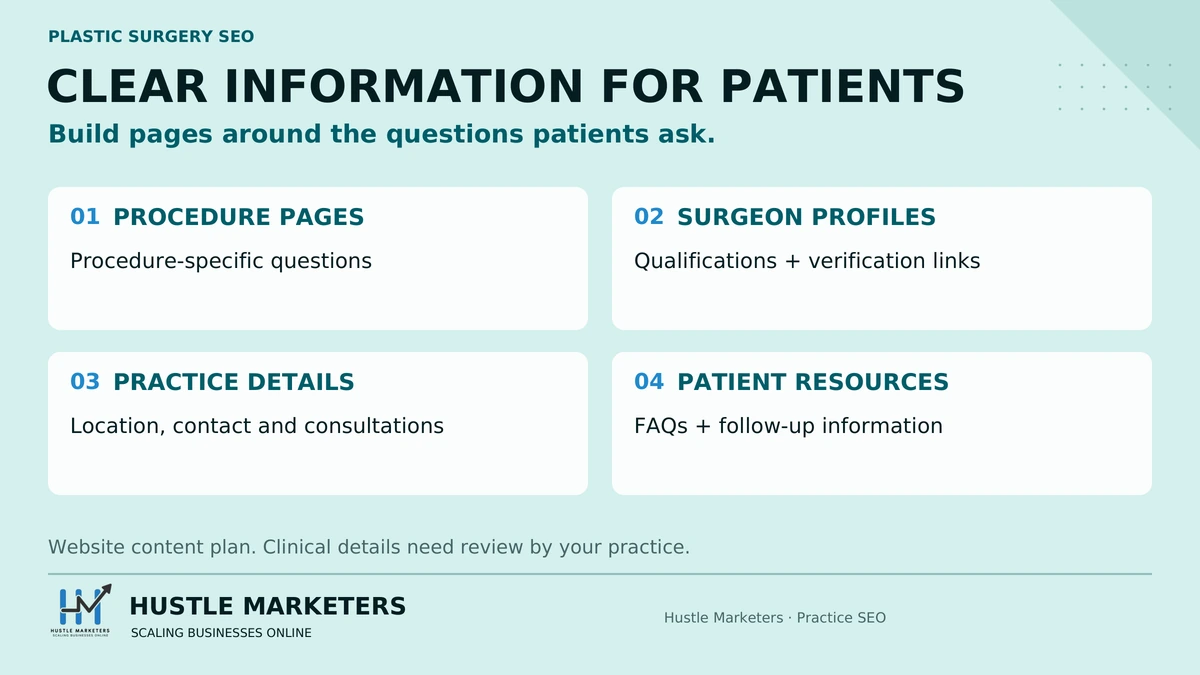
- What pages should a plastic surgery website have?
- How do plastic surgeons rank in the Google Maps local pack?
- How can plastic surgeons get more reviews and reply safely?
- How should plastic surgeons handle before-and-after photos?
- What advertising rules apply to plastic surgery SEO content?
- How do you do technical SEO for a plastic surgery website?
- How do plastic surgeons show up in AI search?
- Is SEO or Google Ads better for plastic surgeons?
- Which popular plastic surgery SEO tips are wrong or outdated?
- What are patients and marketers saying about plastic surgery marketing?
- Should med spas use the same SEO strategy?
- How do you track plastic surgery SEO to consultations and surgeries?
- How long does SEO take for plastic surgeons?
- How much does SEO for plastic surgeons cost?
- How Hustle Marketers helps plastic surgery practices with SEO
- Plastic Surgery SEO FAQs
What is plastic surgery SEO?
Plastic surgery SEO is the process of improving how a plastic surgery practice, its surgeons and its procedures show up in Google Search, Google Maps, Bing, directories and AI assistants, so prospective patients find you, trust you and book a consultation. It covers seven areas:
- Local SEO: Google Business Profiles for the practice and each surgeon, reviews, citations and map pack rankings.
- Procedure content: procedure, cost, recovery, candidacy and comparison pages written or reviewed by your surgeons.
- Trust assets: surgeon bios, board certification, before-and-after galleries, reviews and safety information.
- Technical SEO: site speed with heavy galleries, mobile experience, crawlability, structured data and secure forms.
- Authority: professional society listings, directories such as RealSelf and Healthgrades, hospital affiliations, media mentions and local links.
- AI visibility: clear, accurate, credentialed answers that AI Overviews, AI Mode and ChatGPT can cite.
- Measurement: calls, consultation requests, consultations held and surgeries booked from search.
Why is SEO for plastic surgeons different from other local businesses?
- Your content is health content. Google gives “even more weight” to strong experience, expertise, authoritativeness and trust on topics that can affect people’s health (Google Search Central).
- HIPAA shapes your marketing. Reviews, testimonials, photos and tracking all involve patient information.
- State medical advertising laws apply. Several states regulate before-and-after photos, price advertising and board certification claims.
- Your best proof is sensitive. Galleries often include nudity, which affects SafeSearch, page speed and consent.
- Paid ads are restricted. Google treats cosmetic surgery as a sensitive health interest, which limits some audience targeting. That makes organic visibility more valuable.
Is SEO worth it for plastic surgeons?
For most practices, yes. The data:
| Finding | Data | Source |
|---|---|---|
| Procedure demand | 1,523,330 cosmetic surgical procedures in 2025, up 7%. Liposuction 317,196, breast augmentation 304,234 (up 11%), tummy tuck 173,251 | ASPS 2025 report |
| New patient groups | 82% of ASPS member surgeons received consultation requests related to GLP-1 weight loss medications in 2025 | ASPS 2025 report |
| Reviews | 31% of consumers will only use a business with 4.5 stars or more, and 74% look for reviews from the last three months | BrightLocal 2026 |
| AI answers on medical searches | AI Overviews appeared on 44.1% of medical YMYL queries but 7.9% of local intent queries (146 million desktop results, September 2025) | Ahrefs |
| AI answers on provider searches | In BrightEdge’s tracked healthcare keywords, AI Overviews showed on 100% of treatment and procedure queries and 0% of “near me” provider queries in December 2025 | BrightEdge |
| Paid search cost | Physicians and surgeons averaged a $4.76 cost per click and $40.04 cost per lead in LocaliQ’s 2026 search ad benchmarks | LocaliQ |
Two points stand out. First, ASPS says restoration after life changes such as pregnancy, aging and weight loss drove demand in 2025, and lift procedures led growth. Second, AI Overviews now appear on most treatment and procedure questions, but patients looking for a surgeon near them still see map results and practice websites. Your SEO plan needs both.
Do patients choose plastic surgeons from Google, RealSelf or Reddit?
All three, and they cross-check. A 2022 study in the Aesthetic Surgery Journal analyzed 11,078 Google, Yelp and RealSelf reviews of the highest-rated plastic surgeons in six US cities, and found that the platform where most reviews were posted varied by city: RealSelf in Miami, Philadelphia, New York and Chicago, Google in Houston and Yelp in Los Angeles (Aesthetic Surgery Journal). Patients also turn to Reddit. In a June 2025 r/PlasticSurgery thread, a patient said RealSelf felt “weirdly curated”, and several replies said not to rely on RealSelf alone. Your website has to hold up when patients compare it with everything else they find.
What keywords should plastic surgeons target?
Start with real demand. Here is US monthly search volume from Semrush, pulled on September 17, 2026. Keyword difficulty (KD) is Semrush’s 0 to 100 score.
| Keyword | US monthly searches | KD | Best page |
|---|---|---|---|
| liposuction cost | 18,100 | 19 | Liposuction cost page |
| mommy makeover cost | 14,800 | 6 | Mommy makeover cost page |
| blepharoplasty cost | 14,800 | 16 | Eyelid surgery cost page |
| deep plane facelift | 14,800 | 20 | Facelift technique page |
| plastic surgeon near me | 12,100 | 9 | Google Business Profile and homepage |
| how much is a tummy tuck | 12,100 | 13 | Tummy tuck cost page |
| rhinoplasty cost | 12,100 | 19 | Rhinoplasty cost page |
| how much is a bbl | 8,100 | 21 | BBL cost page |
| breast augmentation cost | 6,600 | 11 | Breast augmentation cost page |
| breast augmentation near me | 5,400 | 60 | Profile and procedure page |
| deep plane facelift cost | 5,400 | 5 | Facelift cost section |
| tummy tuck near me | 4,400 | 16 | Profile and procedure page |
| board certified plastic surgeon | 2,900 | 64 | Surgeon bio and credentials page |
| plastic surgery before and after | 2,400 | 15 | Gallery |
| plastic surgery financing | 1,000 | 46 | Financing page |
The pattern is clear. Cost searches carry more volume than almost any “near me” search, and many have low difficulty. Most practice websites hide pricing, so an honest cost page is one of the biggest SEO opportunities in this niche.
How should plastic surgeons group keywords by intent?
| Intent | Example searches | Page type |
|---|---|---|
| Local and ready to book | “tummy tuck surgeon [city]”, “plastic surgeon near me” | Google Business Profile, procedure page, homepage |
| Cost | “how much is a mommy makeover in [city]”, “facelift cost” | Cost pages with ranges and what is included |
| Procedure research | “deep plane facelift vs SMAS”, “what is a mini tummy tuck” | Procedure and technique pages |
| Candidacy | “am I a candidate for breast lift after weight loss” | Candidacy sections and consultation page |
| Recovery | “tummy tuck recovery week by week” | Recovery guides |
| Surgeon comparison | “[surgeon name] reviews”, “board certified plastic surgeon [city]” | Surgeon bio pages, reviews page |
| Proof | “rhinoplasty before and after [city]” | Gallery pages by procedure |
| Terminology | “ptosis vs hooded eyelids” | Glossary or explainer pages |
What pages should a plastic surgery website have?
| Page | Purpose | Must include |
|---|---|---|
| Procedure page (one per procedure) | Rank for procedure and local searches | What it treats, techniques you use, candidacy, recovery, risks, surgeon who performs it, gallery link, cost range link, FAQs |
| Cost page (one per major procedure) | Win cost searches and qualify leads | Price range, what is included (surgeon, anesthesia, facility, garments), what changes the price, financing, date last updated |
| Surgeon bio page | E-E-A-T and surgeon name searches | Training, certifying board named in full, hospital privileges, society memberships, publications, verification link |
| Before-and-after gallery | Proof and “before and after” searches | Procedures performed, patient details that do not identify them, consistent photo conditions, disclosures your state requires |
| Recovery guides | Research searches and post-op trust | Week-by-week timeline, when to call, follow-up schedule |
| Financing page | Budget searches | Lenders you accept, how to apply, lender disclosures |
| Virtual consultation page | Out-of-area patients | How it works, what to prepare, when an in-person visit is required |
| Safety and accreditation page | Trust | Surgical facility accreditation, anesthesia provider, emergency protocols |
| Reviews page | Trust | Real reviews with links to Google and other platforms |
| Out-of-town patient page | Travel patients | Travel planning, recovery stays, follow-up care |
Should plastic surgeons publish prices on their website?
In most cases, yes, as ranges with clear context. Cost keywords are among the biggest searches in this niche, and patients get frustrated when every page says “call for pricing”. ASPS publishes national surgeon fee ranges that you can use for context. In its 2024 report, ASPS gave projected surgeon fee ranges of $8,000 to $13,500 for a tummy tuck and $7,000 to $11,500 for buttock augmentation with fat grafting (ASPS 2024 report). ASPS notes that the surgeon’s fee is only part of the total price and does not include anesthesia, operating room facilities or other related expenses (ASPS tummy tuck cost).
Check your state’s price advertising rules first. California’s Business and Professions Code section 651 requires any price advertisement to be exact, without phrases such as “as low as” or “and up” (California B&P Code 651). A California practice should work with counsel on how to present ranges and what they include.
Should plastic surgeons create city pages?
Only when the page has something unique for that location. Google’s spam policies list “having multiple domain names or pages targeted at specific regions or cities that funnel users to one page” as an example of doorway abuse (Google spam policies). A page for a second office with its own surgeons, facility, hours, directions and reviews is useful. A page for a suburb 20 miles away that repeats your tummy tuck page with a new city name is not. For out-of-town patients, one strong travel page usually beats dozens of thin city pages.
How do plastic surgeons rank in the Google Maps local pack?
Google says local results are mainly based on relevance, distance and how well known a business is, and there is no way to pay for a better local ranking (Google Business Profile Help). For a plastic surgery practice, that means accurate profiles, strong reviews and strong procedure pages.
Should each plastic surgeon have their own Google Business Profile?
Often, yes. Google allows individual practitioners who are public facing and can be contacted at the verified location during stated hours to have their own profiles. When several practitioners work at one location, the practice should have its own profile and each practitioner’s profile should use only the practitioner’s name. A solo surgeon who is the public face of the practice should share one profile named in the format “[practice name]: [surgeon name]” (Google guidelines for representing your business).
Practitioner profiles need planning:
- Link each surgeon’s profile to their bio page, not the homepage.
- Give each surgeon a distinct phone line where possible. In a Local Search Forum thread, a branded search for an eye center showed one of its doctors’ profiles instead of the practice. Joy Hawkins noted that the practitioners were using the same phone number as the practice listing, and after the doctor’s listing got its own number, the poster reported that the practice profile showed again.
- Decide who owns the profile before a surgeon joins. If a surgeon leaves, the practice needs a plan for their profile and its reviews.
- Use the right primary category for each profile, and do not use categories as keywords.
- Keep names clean. Google says adding unnecessary information to a business name “could result in the suspension of your Business Profile”. “Dr. Jane Smith” is fine. “Dr. Jane Smith Best Tummy Tuck Miami” is not.
Which Google Business Profile categories should plastic surgeons use?
Pick the category that best describes what the practice or surgeon is, such as Plastic surgeon or Plastic surgery clinic, and add only secondary categories that are true, such as Cosmetic surgeon or Medical spa if you run one. Check the exact category names in your profile before you choose, because Google changes the list.
How can plastic surgeons get more reviews and reply safely?
Reviews drive both rankings and consultations. The same 2022 study found that aesthetic appearance was the strongest predictor of ratings, with staff interaction, bedside manner, complications and postoperative care also significant. Low-score reviews most often cited poor aesthetic results and were far more likely to mention complications (Aesthetic Surgery Journal). Your follow-up care shows up in your reviews.
| Do | Do not |
|---|---|
| Ask every patient at the same points, such as after the post-op visit and at the three month follow-up | Ask only patients you know are happy. Google prohibits selectively soliciting positive reviews |
| Send a direct link to your profile | Offer discounts, free treatments or gifts for reviews. Google prohibits incentives |
| Reply to reviews without confirming the person is a patient | Mention procedures, dates or any detail about the reviewer |
| Report fake or policy-violating reviews to the platform | Write, buy or suppress reviews. The FTC’s rule on fake reviews allows civil penalties |
| Train staff on a written reply policy | Let staff post reviews or ask friends and family to post them |
Sources: Google Maps user contributed content policy and the FTC Consumer Reviews and Testimonials Rule Q&A.
Can a plastic surgeon reply to a negative review without breaking HIPAA?
Yes, if the reply does not disclose patient information, including the fact that the reviewer is a patient. The American Medical Association says no federal law prohibits physicians from responding, but they must not disclose patient-specific information, acknowledging that the reviewer is a patient might risk violating patient privacy, and a patient’s own disclosure in a review is not permission for the doctor to disclose anything (AMA).
HHS has taken action against practices that got this wrong:
| Practice | Year announced | Amount | What happened |
|---|---|---|---|
| Elite Dental Associates, Texas | 2019 | $10,000 settlement | Disclosed patient information in replies to Yelp reviews |
| Dr. U. Phillip Igbinadolor, D.M.D. & Associates, North Carolina | 2022 | $50,000 civil money penalty | Disclosed patient information in a reply to a Google review |
| New Vision Dental, California | 2022 | $23,000 settlement | Disclosed patient information in replies to Yelp reviews |
| Manasa Health Center, New Jersey | 2023 | $30,000 settlement | Disclosed patient information in replies to Google reviews |
Sources: HHS resolution agreements for Elite Dental, New Vision Dental and Manasa Health Center, HHS’s notice of final determination for Dr. U. Phillip Igbinadolor, D.M.D. & Associates, and HIPAA Journal for the review platforms involved.
None of these were plastic surgery practices, but the rules are the same for every covered provider. A safe reply template:
Thank you for sharing your feedback. We take every concern seriously,
but privacy rules prevent us from discussing anyone's care online.
Please call our practice manager at [phone] so we can talk directly.
Use it as a starting point, adjust the wording so replies do not all look identical, and never add details.
Are RealSelf reviews worth the effort?
For many practices, yes, especially in cities where patients use it heavily. But patients are skeptical of curated profiles. In the June 2025 r/PlasticSurgery thread mentioned above, the top reply described a surgeon’s office posting a burst of positive reviews right after a negative one. Whether or not that happened, it shows how patients read review patterns. Spread review requests evenly over time and across platforms, and never post reviews on a patient’s behalf.
How should plastic surgeons handle before-and-after photos?
Before-and-after galleries are your strongest proof, and the area with the most legal and SEO risk.
Do you need patient permission to post before-and-after photos?
Yes. Under HIPAA, using protected health information for marketing generally requires the patient’s written authorization (45 CFR 164.508). HIPAA’s de-identification standard lists “full face photographic images and any comparable images” as identifiers (45 CFR 164.514), and a cropped photo can still identify someone through tattoos, birthmarks or captions.
A practical workflow, to review with your counsel:
- Use a marketing authorization that is separate from the surgical consent form.
- List each channel: website, Google Business Profile, RealSelf, social media and ads.
- Record the expiration date or event, and honor revocations quickly.
- Remove tattoos, jewelry and backgrounds that could identify the patient, and never use names or exact dates.
- Keep a log that links each published image to its authorization.
What disclosures do before-and-after photos need?
It depends on your state. California’s section 651 treats photos that do not accurately depict results as misleading, requires model photos to be identified as models, and requires patient before-and-after photos to state the procedures performed, use comparable presentation such as similar poses and lighting, and state that the same results may not occur for all patients (California B&P Code 651). Even outside California, these are good standards.
The FTC’s Endorsement Guides also apply. If a testimonial or photo is likely to be read as a typical result and it is not, the ad needs to make clear what results people can generally expect (FTC Endorsement Guides FAQ).
What do patients want from before-and-after galleries?
Patient discussions show three clear needs:
- Real, unedited photos. In a June 2026 r/PlasticSurgery post, a patient described choosing an overseas surgeon based on social media photos and videos they later believed were AI generated. Patients are more suspicious of polished images than ever. State your editing policy on the gallery page.
- Photos before the consultation. In a July 2026 thread, a patient asked whether it was normal for a surgeon to refuse to show before-and-after photos until after a deposit. The top replies, including one from a commenter who identified as a surgeon, said to go elsewhere.
- Patients who look like them. In a September 2026 thread, a patient researching rhinoplasty said many surgeons’ galleries showed few patients with her background, which made results hard to judge. A gallery organized by procedure with a wide range of patients, where patients have authorized it, answers that concern.
A 2026 study of Reddit discussions about eyelid surgery also found patients were confused by terms such as ptosis and hooding, and chose surgeons partly from recommendations and social media photos (Aesthetic Surgery Journal Open Forum). Plain-language explainer pages help both patients and search engines.
How do you stop explicit galleries from hurting SEO?
Google’s SafeSearch guidance recommends marking explicit pages with a `rating` meta tag set to “adult”. If a site has significant amounts of both explicit and non-explicit content, it recommends grouping the explicit pages on a separate domain or subdomain, because otherwise its systems might filter the entire site when SafeSearch is on (Google Search Central: SafeSearch). For galleries with nudity:
- Keep procedure pages free of explicit images and link to the gallery instead.
- Host explicit gallery pages on a separate subdomain, such as gallery.yourpractice.com, and add the adult rating tag to those pages.
- Use noindex for explicit gallery pages you do not want in Google Search at all, or a `noimageindex` robots meta tag if you only want to keep their images out of Google Images.
- Keep non-explicit results, such as facial procedures, indexable with descriptive alt text.
What advertising rules apply to plastic surgery SEO content?
Can a plastic surgeon say “board certified” on their website?
Only when the certification meets the rules that apply to you, and it is best to name the board in full. Several states regulate this phrase:
- California: section 651 limits “board certified” advertising to certification by an American Board of Medical Specialties member board or boards that meet specific approval standards, and requires the full name of the board (California B&P Code 651).
- Florida: a physician may not hold themselves out as a board-certified specialist unless recognized by an ABMS specialty board or another agency approved by the Board of Medicine (Florida Statutes 458.3312).
- Texas: Texas Medical Board rules list which boards physicians can advertise as board certification (22 Tex. Admin. Code 164.4).
Be precise with terms. The American Society of Plastic Surgeons (ASPS) is a professional society. The American Board of Plastic Surgery (ABPS) is the certifying board, and patients can check a surgeon on its certification verification page. “Certified by The American Board of Plastic Surgery” is clearer than “board certified plastic surgeon”, and linking to the verification page builds trust.
Does E-E-A-T matter for plastic surgery websites?
Yes. Google suggests evaluating content by who created it, how and why, and its systems give even more weight to strong E-E-A-T on topics that could significantly affect people’s health (Google Search Central). Show it on every procedure page:
- A byline or “medically reviewed by” line with the surgeon’s name, linking to their bio.
- A last reviewed date.
- Credentials that match what patients find on ABPS, ASPS, hospital and directory profiles.
- Risks and recovery described honestly, not just benefits.
- Sources for medical statistics.
How do you do technical SEO for a plastic surgery website?
| Area | What to check | Fix |
|---|---|---|
| Page speed | Largest Contentful Paint on procedure pages with hero images and videos | Compress images, serve WebP or AVIF, set dimensions, load video on click |
| Interactivity | Interaction to Next Paint (INP) on galleries, sliders and booking widgets. Good is 200 milliseconds or less | Lazy load gallery images, limit heavy slider scripts, delay chat widgets |
| Galleries | Thousands of thin, near-identical gallery URLs | One page per procedure with filters, or indexable case pages with unique details only |
| Explicit content | Whole site filtered by SafeSearch | Rating tag and explicit gallery pages on a separate subdomain |
| Duplicate content | Same procedure copy across locations or microsites | One strong page per procedure, unique location pages only |
| Forms and tracking | Pixels on forms that collect health details | Review tracking with counsel, see below |
| Mobile | Consultation button hidden below galleries | Sticky call and booking buttons |
Interaction to Next Paint replaced First Input Delay as a Core Web Vital in March 2024 (web.dev). Our Core Web Vitals and INP guide covers fixes for heavy, image-rich sites.
What schema markup should a plastic surgery practice use?
Be honest about what schema does. Google’s list of supported rich results has no dedicated feature for physicians or medical procedures, though a practice can still use Local business markup because schema.org’s MedicalClinic and Physician types are LocalBusiness subtypes (Google Search Central: search gallery). FAQ rich results stopped appearing in May 2026, and a business’s own pages using LocalBusiness or Organization markup are not eligible for review stars about itself (Google Search Central: review snippets). Schema still helps search engines and AI tools understand who you are.
Use:
- MedicalClinic or PhysiciansOffice for the practice, with `medicalSpecialty` set to PlasticSurgery, name, address, phone, hours and `sameAs` links to your profiles.
- IndividualPhysician for each surgeon, with `practicesAt` pointing to the practice, `hospitalAffiliation`, and `hasCredential` naming the certifying board in full.
- MedicalProcedure (or its SurgicalProcedure subtype) on procedure pages, also listed under `availableService` on the practice and surgeon markup.
- BreadcrumbList on procedure, cost and gallery pages.
- VideoObject for surgeon explainer videos.
Validate everything with the Schema Markup Validator, and do not add review or rating markup for your own reviews.
Can plastic surgery websites use tracking pixels?
Carefully. On June 20, 2024, a federal court vacated the part of HHS’s online tracking guidance that said HIPAA applies when tracking connects a visitor’s IP address with a visit to an unauthenticated public page about specific health conditions or providers. The rest of the guidance still covers tracking on authenticated pages, and says tracking on pages where people schedule appointments or enter health information without logging in may have access to protected health information in certain circumstances (HHS online tracking guidance). State consumer health privacy laws can add obligations. Review your pixels, forms and vendors with counsel, use vendors that will sign a business associate agreement where needed, and avoid sending form contents to ad platforms.
How do plastic surgeons show up in AI search?
AI Overviews are common on medical research searches and rare on provider searches. Ahrefs found AI Overviews on 44.1% of medical YMYL queries and 7.9% of local intent queries (Ahrefs). BrightEdge’s tracked healthcare keywords showed AI Overviews on 100% of treatment and procedure queries and 0% of “near me” provider queries in December 2025 (BrightEdge).
For a practice, that means:
- Procedure and recovery questions will often be answered by AI. Write clear, accurate, surgeon-reviewed answers so your practice is a source AI tools can cite, but do not expect the same click volume.
- “Plastic surgeon near me” and surgeon name searches are still decided by your profiles, reviews and website.
- Conversational questions, such as asking an assistant for a surgeon in a city who does deep plane facelifts and offers financing, are easier to match when pages state techniques, credentials, locations, price ranges and financing clearly.
Google says there are no extra requirements or special optimizations needed to appear in AI Overviews or AI Mode (Google Search Central: AI features). Clear, accurate, crawlable pages do the work. Our guides on ranking in ChatGPT search and tracking brand visibility in AI search explain how to measure it.
Is SEO or Google Ads better for plastic surgeons?
Use both, but understand the limits on ads. Google’s health in personalized advertising policy lists invasive medical procedures, including cosmetic surgery, as a sensitive category, and restricts advertiser-curated audiences such as Customer Match and your data segments for those ads (Google Ads policy). You can still run search campaigns, but you cannot build audiences from your patient list the way many businesses do. Meta’s advertising standards also restrict ads that assert or imply knowledge of a person’s health or personal attributes.
That makes organic search and your Google Business Profiles the channels where these audience restrictions do not apply and where your own pages and profiles do the work. Paid search works best on top of strong procedure pages, because Google Ads quality and conversion rates depend on landing page relevance. See our guide to Google Ads for doctors for the paid side.
Which popular plastic surgery SEO tips are wrong or outdated?
We checked the ranking guides against current rules and data. These tips can cost you:
| Popular tip | Where we saw it | The problem | Better approach |
|---|---|---|---|
| Add review schema to get star ratings | Several agency guides | Google does not show review stars for a business’s own reviews marked up on its own site | Show real reviews and link to your profiles |
| Add FAQ schema for rich results or AI Overviews | Six of the guides we reviewed | FAQ rich results stopped showing in May 2026, and Google says AI Overviews need no special optimization | Keep FAQs for patients, with or without markup |
| Google requires LegitScript certification for plastic surgery ads | An agency guide | Google’s healthcare policy requires certification for categories such as online pharmacies, addiction services and US health insurance, not cosmetic surgery | Follow Google’s healthcare and personalized advertising policies |
| About 16% of medical searches show AI Overviews | An agency guide | Ahrefs found 44.1% on medical YMYL queries | Plan for AI answers on research content |
| AI Overviews are overtaking the local pack | An agency guide | Local and “near me” provider searches rarely show AI Overviews | Keep investing in profiles, reviews and procedure pages |
| Core Web Vitals are LCP, FID and CLS | An agency guide | INP replaced FID in March 2024 | Test INP on galleries and booking widgets |
| Post updates on your Google+ page | An agency page | Google+ shut down for consumers in 2019 | Use Google Business Profile posts and photos |
| Cite 2024 ASPS statistics | Two guides updated in September 2026 | ASPS released its 2025 report on September 1, 2026, and its 2024 comparison figure (1,425,390 cosmetic surgical procedures) differs from the 1,585,878 in the 2024 report | Use the 2025 report, label the year, and do not compare figures across reports |
What are patients and marketers saying about plastic surgery marketing?
- Patients distrust perfect profiles. In the June 2025 r/PlasticSurgery thread on RealSelf, several replies said not to trust RealSelf on its own and to check other sources too.
- Recovery and follow-up decide choices. In a December 2024 thread about choosing between two breast augmentation surgeons, one reply said they would choose a surgeon close to home because of the number of follow-up visits during recovery. Pages that explain follow-up care and out-of-town recovery plans answer that concern.
- Advertisers struggle with policy limits. In a November 2025 r/PPC thread, an advertiser running Google Ads for plastic surgery clinics said refining negative keywords and keeping targeting tight made the biggest difference. Another commenter asked whether breast procedure landing pages actually showed breasts, even blurred, and a third said Google kept banning their ads or flagging the account. Paid campaigns in this niche need careful policy work, which is one more reason to build strong organic pages.
- Doctor profiles can compete with the practice. In a Local Search Forum thread about a multi-doctor eye care group, the advice was to give practitioner profiles different categories from the practice and link them to bio pages, and the poster worried the office profile would get lost in results. The eye center thread above shows shared phone numbers cause problems too.
Should med spas use the same SEO strategy?
Mostly, with a few differences. Med spa searches such as “med spa SEO” and “medical spa SEO” have about 1,000 US monthly searches each in Semrush, and med spa services often sit inside or next to a surgical practice.
- Show who performs each treatment, their credentials and the medical director’s oversight, following your state’s rules.
- Keep surgical and non-surgical pages separate so injectables and laser pages do not compete with surgical procedure pages.
- Use the right profile category. A med spa inside a surgical practice should have its own profile only if it operates as a distinct, public-facing department with its own name and a different primary category, such as Medical spa.
- Use generic and brand names carefully. Patients search both, but brand names of prescription products are trademarks with their own usage rules.
How do you track plastic surgery SEO to consultations and surgeries?
| Stage | What to track | How |
|---|---|---|
| Visibility | Rankings for procedure, cost and surgeon searches, map pack rank, AI prompt mentions | Search Console, a local rank grid tool, a monthly prompt sheet |
| Profile actions | Calls, website clicks and direction requests for the practice and each surgeon | Google Business Profile performance |
| Website leads | Consultation requests, calls, virtual consult bookings | GA4 key events and call tracking that avoid sending health details to ad platforms. See our guide to using GA4 for marketing |
| Consultations | Consultations held by lead source and procedure | Practice management system or CRM |
| Surgeries | Surgeries booked and revenue by source | Practice management system |
The math that matters: if one tummy tuck brings in $10,000 or more in fees, one extra surgery a month from organic search changes the return on SEO quickly. Use your own fees, and check the numbers with our SEO ROI calculator.
How long does SEO take for plastic surgeons?
In our local SEO work, and in the timelines published by practice-focused agencies, early movement usually shows in three to six months and steady consultation growth in six to twelve months. Competitive metros such as Miami, Los Angeles and New York take longer. A new cost page or procedure page can rank faster in smaller markets, especially for low difficulty cost keywords.
How much does SEO for plastic surgeons cost?
Most published prices come from agencies selling the service, so treat them as ranges:
| Source | Published price | Link |
|---|---|---|
| Medical marketing agency guide (June 2026) | $3,000 to $5,500 a month for a small practice, $5,500 to $10,000 in a competitive metro, $8,000 to $20,000+ for integrated programs | Percepture |
| PPC and SEO agency guide (April 2026) | $3,000 to $10,000 a month, with local SEO from $500 to $3,000 | HawkSEM |
| SEO agency guide (August 2026) | $1,200 to $3,500 a month in moderately competitive markets, $3,000 to $12,000 in major metros | Geek Powered |
| Link building and SEO agency page | $1,500 to $5,000 a month | Loganix |
Smaller markets and single-surgeon practices usually sit at the lower end, and major metros and integrated programs sit at the higher end. Our SEO audit cost guide explains what an audit should include.
What should plastic surgeons look for in an SEO agency?
- Do they understand HIPAA rules for reviews, photos, testimonials and tracking?
- Do they know your state’s before-and-after, price and board certification rules?
- Will your surgeons review every procedure page before it goes live?
- How will they handle galleries, SafeSearch and page speed?
- How do they get reviews without incentives or selective asking?
- Will they report consultations and surgeries, not only rankings and traffic?
- Who owns the website, profiles, Search Console and GA4? The answer should be you.
- Will they avoid bought links and review schemes?
Walk away from guaranteed rankings, fake reviews, stock photos presented as patient results and long contracts with no lead reporting.
How Hustle Marketers helps plastic surgery practices with SEO
I have worked in digital marketing since 2013, and my team runs SEO, Google Ads and Microsoft Ads for local and high-ticket businesses where trust decides who gets the consultation. For plastic surgery practices, that means we build procedure, cost and surgeon pages that patients trust, set up profiles within Google’s rules, write with HIPAA and your state’s advertising rules in mind and flag questions for your counsel, and track results to consultations and surgeries.
Proof from our local SEO work:
- Two-location, trust-driven service business: CMSC Parker CDL grew organic traffic from under 800 to 1,900 monthly visits (at least 2.4X) between July 2025 and May 2026 and built AI citation presence across ChatGPT, Gemini and Google AI Overviews. Read the case study.
- Bilingual local SEO: CMSC Driving School moved from page 10 to page 1, lifted click-through rate from 2.7% to 4.3% and increased organic leads by 35%. Read the case study.
- Related healthcare guides: our guides to medical SEO, chiropractor SEO, SEO for dentists and digital marketing for dentists cover related rules and tactics.
Our process for a plastic surgery practice:
- Audit: profiles, reviews, website, galleries, tracking, competitors and compliance risks.
- Keyword and page map: procedure, cost, surgeon, recovery and local searches ranked by value.
- Foundation: profile cleanup, practitioner profiles, technical fixes, gallery structure and privacy-conscious tracking.
- Pages: procedure, cost, surgeon, financing and recovery pages reviewed by your surgeons.
- Reviews and authority: a compliant review process, reply guidelines, directory and society listings.
- AI visibility: consistent practice and surgeon data, clear answers and monthly prompt tracking through our AI SEO services.
- Reporting: calls, consultations and surgeries from search every month.
If you want to see where patients are finding other surgeons instead of you, our SEO services team can start with an audit.
Plastic Surgery SEO FAQs
What is plastic surgery SEO?
Plastic surgery SEO is the work of ranking a practice, its surgeons and its procedures in Google Search, Google Maps, directories and AI assistants, so prospective patients find the practice and book consultations.
How do plastic surgeons get more patients from Google?
Build strong procedure, cost and surgeon pages, set up accurate practice and practitioner profiles, earn honest reviews from every patient, and publish a trustworthy before-and-after gallery with proper patient authorization.
Can plastic surgeons respond to Google reviews?
Yes, but a reply should not confirm that the reviewer is a patient or mention any details about their care. Thank them, say privacy rules prevent discussing care online, and invite them to call the practice.
Do you need consent to post before-and-after photos?
Yes. Using identifiable patient photos for marketing generally requires a written HIPAA authorization, and some states, such as California, require specific disclosures on before-and-after photos.
Should plastic surgeons list prices on their website?
Usually yes, as ranges with what is included and what changes the price. Cost searches are some of the largest in this niche. Check your state’s price advertising rules first.
Should each surgeon have a Google Business Profile?
In a multi-surgeon practice, each public-facing surgeon can have a profile named only with their own name, alongside the practice profile. Link each one to the surgeon’s bio page and plan ownership in advance.
How long does plastic surgery SEO take?
Early movement usually shows in three to six months, and steady consultation growth in six to twelve months. Major metros take longer.
How much does SEO cost for plastic surgeons?
Published agency prices range from about $1,200 a month in moderately competitive markets to $12,000 a month in major metros, and $20,000 or more for integrated SEO, AI search, PR and conversion programs.
Is plastic surgery SEO different outside the US?
The SEO fundamentals are similar, but the rules are not. In the UK, for example, the Advertising Standards Authority and the Committee of Advertising Practice apply their own rules to cosmetic intervention advertising. Check the rules in each market you target.
Sources and verification
Facts that can change were checked on September 17, 2026 against these sources:
- ASPS 2025 Plastic Surgery Statistics Report
- ASPS 2025 statistics press release
- ASPS 2024 Plastic Surgery Statistics Report
- Google Business Profile guidelines
- Google Business Profile Help: how local results are ranked
- Google Maps user contributed content policy
- Google Ads: health in personalized advertising
- Google Ads: healthcare and medicines policy
- Google Search Central: creating helpful content
- Google Search Central: spam policies
- Google Search Central: SafeSearch and explicit content
- Google Search Central: structured data search gallery
- Google Search Central: review snippets
- Google Search Central: AI features and your website
- web.dev: INP becomes a Core Web Vital
- 45 CFR 164.508: uses and disclosures requiring an authorization
- 45 CFR 164.514: de-identification
- HHS: online tracking technologies guidance
- HHS: Elite Dental Associates resolution agreement
- HHS: notice of final determination, Dr. U. Phillip Igbinadolor, D.M.D. & Associates
- HHS: New Vision Dental resolution agreement
- HHS: Manasa Health Center resolution agreement
- AMA: responding to online patient reviews
- FTC Consumer Reviews and Testimonials Rule Q&A
- FTC Endorsement Guides FAQ
- California Business and Professions Code 651
- Florida Statutes 458.3312
- 22 Texas Administrative Code 164.4
- The American Board of Plastic Surgery: verify certification
- Aesthetic Surgery Journal: analysis of plastic surgery online reviews
- Aesthetic Surgery Journal Open Forum: Reddit eyelid surgery analysis
- BrightLocal Local Consumer Review Survey 2026
- Ahrefs: what triggers AI Overviews
- BrightEdge: healthcare and AI Overviews
- LocaliQ search advertising benchmarks
About the author: Ishant Sharma has worked in digital marketing since 2013 and is a Google Ads, Microsoft Ads and SEO specialist. He is the founder of Hustle Marketers, a Google Partner and Meta Business Partner agency serving local service, professional service, lead generation and ecommerce businesses across the US, UK, UAE and Australia. Businesses he and his team have worked with include CMSC Driving School, CMSC Parker CDL, Armorpoxy, Rec Hall, Estelle Bridal and Blake International Management. Trackable client sales across his work have passed $780M, and he is Top Rated Plus on Upwork. More about Ishant.
Related guides
If this one was useful, these cover the same ground for closely related businesses.
- Medical SEO
- SEO for dentists
- Chiropractor SEO