AI Content Optimization: What Google and Bing Document

Ishant
Published : October 12, 2026 at 10:30 am
Updated : October 7, 2026 at 6:41 am
Ishant

AI content optimization means two different things, and most pages you will read only cover one of them. It means using AI tools to improve content, and it means shaping content so AI search surfaces will use it. This page covers both, and it does something the twenty-one competitor pages we read do not do: it puts what Google documents next to what Microsoft documents, and shows you where the two platforms flatly disagree.
Key Observations
The short answer: the fundamentals did not change, Google has published a list of things you do not need to do, and most of what is being sold in this category sits on the wrong side of that list.
- Google publishes a mythbusting list for AI search. It says you do not need special files, special markup, tiny content chunks, or a special writing style. Not one of the twenty-one ranking pages we read quotes it.
- Google and Microsoft Bing give opposite advice on chunking and schema. Microsoft tells you to break content into liftable pieces. Google says there is no such requirement. Both are primary sources. Both are linked below.
- Content optimization scores are weakly correlated with rankings. Ahrefs tested five tools across twenty keywords and found weak correlations everywhere. A Clearscope customer on Capterra reported that keyword stuffing alone can reach the top grade.
- Google warns against third-party tools that claim to use internal Google metrics. Almost every page ranking for this term sells or recommends one.
- The most repeated statistics in this category have no primary source. We list the ones we could not verify so you do not repeat them in a client deck.
Short version: the fundamentals did not change. What changed is the number of people selling you a new file format to fix a problem Google says you do not have.
On this page
Eighteen sections, ordered so the platform documentation comes first and the tactics that depend on it come after. Two of them cover ground no competitor page does: a table setting Google’s guidance against Microsoft’s, and a list of widely repeated statistics we could not trace to any primary source.
Everything else answers a question people actually search for, in the wording they use. Jump to whichever section you came for.
What is AI content optimization?
AI content optimization is the practice of improving web content either with AI tools or for AI search surfaces. The first meaning covers using software to research, draft, structure and grade content. The second covers making a page clear enough that AI Overviews, AI Mode, ChatGPT, Copilot and Perplexity can use it in an answer. Most buyers mean one and get sold the other.
The distinction matters commercially. If you buy a content optimization tool expecting it to get you cited in ChatGPT, you have bought the wrong thing. The tool grades your page against pages that currently rank in classic search. That is a useful job, and it is not the same job.
Google is direct about how the second meaning relates to ordinary SEO. Its guidance states that “From Google Search’s perspective, optimizing for generative AI search is optimizing for the search experience, and thus still SEO.”
So the honest framing is this. There is no separate discipline. There is SEO, there are AI tools that help you do it faster, and there are a handful of formatting decisions that make a page easier for a machine to quote. Everything beyond that is being sold to you.
Is AI content optimization the same as GEO or AEO?
They overlap heavily. Generative engine optimization and answer engine optimization both describe optimizing to appear inside AI-generated answers. AI content optimization is the broader term because it also covers using AI tools on your own side of the process. If a proposal uses all three interchangeably, ask which one they are actually charging you for.
What is content optimization in SEO?
Content optimization in SEO is the work of improving an existing or planned page so it matches what searchers want, covers the topic properly, reads well, and is technically easy for a search engine to process. It covers intent, coverage, structure, internal links, titles and meta descriptions, and the decision to update or remove a page rather than write a new one.
The part most guides skip is pruning and updating. Writing a new post is more fun than fixing forty weak ones, so most content programs keep publishing and never go back. In our experience the fastest wins on a site with a few hundred URLs usually come from consolidating thin pages and refreshing pages that already rank on page two, not from adding more.
Two things Google states plainly that contradict common advice here. On length, “The length of the content alone doesn’t matter for ranking purposes”. On the keywords meta tag, “Google Search doesn’t use the keywords meta tag.”
If your content brief sets a word count target and your CMS has a keywords meta field somebody still fills in, both of those are habits rather than requirements.
Does Google say you should optimize content differently for AI?
No. Google publishes a section titled “Mythbusting generative AI search: what you don’t need to do”, and it removes most of what this industry currently sells. It states you do not need new file types, you do not need special markup, you do not need to break content into small pieces, and you do not need a different writing style.
Here are the four lines, quoted exactly, from Google Search Central’s guide to optimizing your website for generative AI features:
- “You don’t need to create new machine readable files, AI text files, markup, or Markdown to appear in Google Search.”
- “There’s no requirement to break your content into tiny pieces for AI to better understand it.”
- “You don’t need to write in a specific way just for generative AI search.”
- “Structured data isn’t required for generative AI search, and there’s no special schema.org markup.”
There is a fifth line worth reading twice if anyone has pitched you a monitoring product: “Be wary of third-party tools that promise ranking success or claim to use ‘internal’ Google metrics.”
We read all twenty-one pages ranking for this topic. Not one of them quotes this section. Six tell you to chunk your content. Five tell you to add schema specifically for AI.
That is not a small editorial difference. It is the entire premise of a lot of paid work.
So is any of it worth doing?
Some of it, yes, but for a reason that has nothing to do with Google. Google says it is not required. Microsoft says it helps on Bing and Copilot.
Those are different answers because they are different systems. The next section sets both out so you can decide with the documentation in front of you.
Where Google and Microsoft Bing disagree
Google and Microsoft publish conflicting guidance on how to prepare content for AI search. Google says chunking and schema are not required. Microsoft recommends both, plus short question and answer pairs it says assistants can lift word for word.
Neither platform is wrong. They are describing two different systems. What is odd is that no page in the ranking set puts the two sets of guidance together, so most readers only ever see one half.
The two sets of guidance, side by side
| Decision | What Google documents | What Microsoft Bing documents | What we do |
|---|---|---|---|
| Breaking content into chunks | “There’s no requirement to break your content into tiny pieces for AI to better understand it.” | “Avoid long walls of text: They blur ideas together and make it harder for AI to separate content into usable chunks.” | Write in short sections because readers prefer it. Do not restructure a working page purely to chunk it. |
| Schema markup | “Structured data isn’t required for generative AI search, and there’s no special schema.org markup.” | “Schema is a type of code that helps search engines and AI systems understand your content.” | Add schema for the rich results it genuinely earns. Do not sell it as an AI citation tactic. |
| Question and answer format | No requirement stated. Writing style is explicitly not prescribed. | “Direct questions with clear answers mirror the way people search. Assistants can often lift these pairs word for word into AI-generated responses.” | Use real questions as headings. It helps Bing and Copilot, and it helps readers scan. |
| Answer length | No prescribed length. Length alone is stated not to matter for ranking. | “Concise answers: One- to two-sentence responses that directly address a question.” | Answer in the first two sentences under each heading, then expand. |
| Content hidden in tabs or accordions | Not addressed in the AI guidance. | “Don’t hide important answers in tabs or expandable menus: AI systems may not render hidden content, so key details can be skipped.” | Keep anything important in visible HTML. This one is cheap to fix and has no downside. |
| PDFs for core information | Not addressed in the AI guidance. | “Avoid relying on PDFs for core information” | Put the content on an HTML page and offer the PDF as a download. |
| Em dashes and punctuation | Not addressed. | “Be cautious with em dashes: Overuse can confuse sentence structure for machines. A period or semicolon is usually clearer.” | We already write without em dashes as a house rule. It costs nothing and Microsoft now documents a reason. |
| New files such as llms.txt | “You don’t need to create new machine readable files, AI text files, markup, or Markdown to appear in Google Search.” | Not recommended in this guidance. | Skip it unless a specific platform you care about asks for it. |
Sources for this table: Google’s guide to optimizing your website for generative AI features, and Optimizing Your Content for Inclusion in AI Search Answers by Krishna Madhavan, Principal Product Manager at Microsoft Bing, published October 8, 2025.
The practical read: everything Microsoft recommends is either neutral or mildly positive on Google, because clear headings and direct answers are good writing regardless. So the safe strategy is to follow Microsoft’s formatting advice for the reasons Microsoft gives, while refusing to pay anyone who tells you Google requires it.
Do you need to chunk your content for AI search?
Not for Google. Google states there is no requirement to break content into tiny pieces. For Bing and Copilot, shorter self-contained sections do help, because Microsoft describes AI systems separating content into usable chunks. The honest answer is that chunking is a readability decision with a modest retrieval benefit on one platform, not a technical requirement on either.
What goes wrong in practice is over-correction. We have seen pages cut into thirty tiny fragments with a heading above each one, which destroys the reading experience and adds nothing Google asked for. If a section needs four paragraphs to be useful, give it four paragraphs.
The version of this advice that does hold up on both platforms: put the answer first. Open each section with a direct response to the heading, then add the detail. That serves a reader skimming on a phone, a featured snippet, and an assistant looking for a liftable passage, all at once. It is also the only structural thing in this article we would insist on.
Is schema markup required for AI Overviews?
No. Google states that structured data is not required for generative AI search and that there is no special schema.org markup to add for it. Schema still earns rich results in classic search, which is a real and measurable benefit. It is simply not the AI citation lever it is widely sold as.
The confusion is understandable, because Microsoft does describe schema as helping AI systems understand content. So an agency can quote a platform source for the opposite position and be technically accurate. Ask which platform they mean.
Our position on client sites has not changed. We add structured data where a page qualifies for a rich result, because that has a visible payoff in the results page. We do not bill schema as an AI Overviews tactic, and we would not defend an invoice that did.
What is the commodity content test?
Google draws a line between commodity content, which repeats common knowledge, and non-commodity content, which carries a specific expert or lived perspective. Its own worked example is a homebuying article: the generic version against the one that tells you what the writer actually did and what it cost.
In Google’s wording, “Commodity content (for example, something like ‘7 Tips for First-Time Homebuyers’) is often based on common knowledge.” while “Non-commodity content (such as ‘Why We Waived the Inspection & Saved Money’) provides unique expert or experienced takes.”
This is the most useful single idea in Google’s guidance, and it is the one no competitor page picked up. It gives you a test you can run on any brief before you commission it. Read the working title. If any competent writer with a search engine could produce that article, it is commodity content, and adding AI to the process makes it faster to produce something nobody needs.
The test also explains why so much AI-assisted content underperforms. A language model is, by construction, very good at producing the consensus answer. The consensus answer is commodity content. The parts of a page that cannot be generated are the parts that carry the value: your own numbers, the job that went wrong, the price you actually charge, the thing you tried that did not work.
Does Google penalize AI-written content?
Not for being AI-written. Google’s current guidance on using generative AI content, last updated October 1, 2026, says generative AI “can be particularly useful when researching a topic, and to add structure to original content.” The risk it names is scale without value: “Using generative AI tools or other similar tools to generate many pages without adding value for users may violate Google’s spam policy on scaled content abuse.”
The line Google draws is value, not authorship. Whether a human or a model wrote it, the page still has to be worth reading.
How do you optimize an article for SEO?
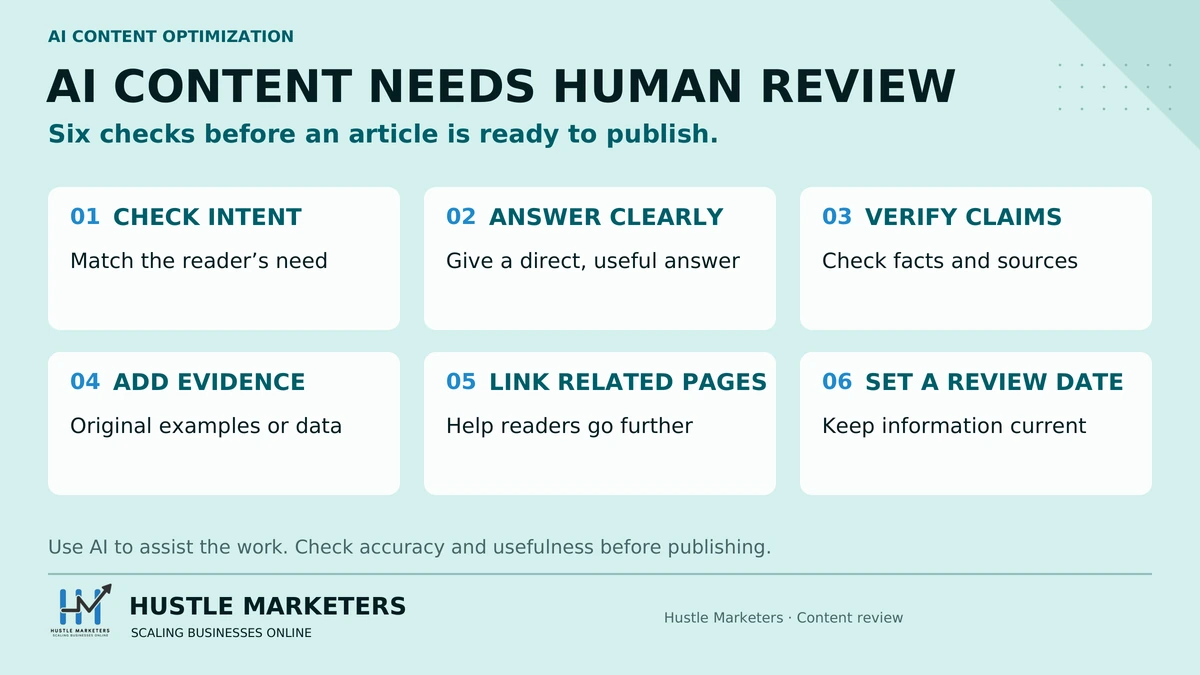
Optimizing an article means matching it to a real query, answering that query in the opening lines, structuring it so a reader can scan it, covering the sub-questions people actually ask, linking it into the rest of your site, and giving it a title and description that earn the click. Everything else is refinement.
Here is the sequence we use, in order, because the order is what saves the time.
- Confirm the query means what you think it means. Search it and read what ranks. If the results are all tool listicles and you planned a definition page, you will not rank with a definition page.
- Write the answer first. One direct paragraph, forty to sixty words, before any preamble. If you cannot write it, you do not understand the topic well enough to publish yet.
- Build headings from real questions. Take them from People Also Ask, from your own sales calls, and from the wording customers use in email. Do not invent questions that read like marketing copy.
- Cover the sub-questions competitors answer, then the ones they do not. The first part is table stakes and stops you losing. The second part is the only reason anyone links to you.
- Add what cannot be generated. Your data, your screenshots, your prices, the specific case. This is the commodity test above, applied.
- Link it in properly. Down from the relevant hub, across to siblings, and out to the page that earns money. An article with no internal links is an orphan regardless of how good it is.
- Write the title and description for a human deciding whether to click. Not for a keyword density score.
- Set a review date. Most pages lose ground because nobody owns them after publication, not because they were written badly.
One thing deliberately absent from that list: a target word count. Google states that length alone does not matter for ranking purposes. Write until the question is answered and then stop.
What is SEO intelligence?
SEO intelligence is the practice of turning search data into decisions rather than reports. It covers competitive analysis, search demand, SERP monitoring, and the internal data most teams never join up: which pages produce revenue, which queries produce qualified enquiries, and which rankings produce neither.
The term is mostly used by software vendors to describe a dashboard. That is fine as far as it goes, but a dashboard is not intelligence. Intelligence is the part where somebody looks at the data and decides to stop doing something.
A worked example from our own reporting. A page ranking third for a high-volume term can be worth less than a page ranking eighth for a specific one, if the third-place term attracts people looking for a free template and the eighth-place term attracts people with budgets. Position data alone will tell you to protect the wrong page. This is why our SEO reporting starts from enquiries and works backwards, not from a rank tracker.
Does content optimization software actually work?
Content optimization software is useful for coverage research and genuinely time-saving for briefing. The scores it produces are a different matter. Ahrefs tested five tools across twenty keywords and reported weak correlations between content scores and rankings, and paying customers report that the grade can be reached by keyword stuffing alone.
The Ahrefs study, published May 21, 2025 by Si Quan Ong, summarized its finding in four words: “We found weak correlations everywhere.”. That is one study on a small keyword set, so treat it as a caution rather than a verdict, but it is the only public test of the question we could find and no vendor has published one contradicting it.
Customer reviews point the same way. A Clearscope reviewer on Capterra wrote that “It’s possible to get an A++ just by stuffing keywords.”
Surfer’s own documentation is admirably candid about the limits. Its FAQ carries the questions “Why doesn’t my Content Score rise despite applying what the Guidelines suggest?” and “Can the Content Score be too high and make my content over-optimized?” Those are not questions a vendor publishes unless customers keep asking them.
What do paying users actually complain about?
We read public reviews across Surfer, Clearscope, MarketMuse, Frase, NeuronWriter and Jasper on Capterra, G2 and TrustRadius. Four complaints recur across every tool and every year.
| Complaint | What users say | What it means for you |
|---|---|---|
| Price and credit limits | The most common gripe by volume across all six tools. One MarketMuse reviewer: “Very expensive and certainly not suitable for beginners or small content marketers.” | Budget for the tier that includes the feature you actually want, or you will pay for a plan that cannot do the job. |
| Irrelevant term suggestions | A MarketMuse reviewer: “I was writing about 4K TVs and MarketMuse will recommend you talk about dog houses”. Another: “I got keyword recommendations about actual foxes.” | Never apply suggestions unread. Entity disambiguation is where these tools are weakest. |
| Suggestions that hurt commercially | A Clearscope reviewer: “Clearscope may recommend mentioning a competitor that I don’t want to name.” | The tool optimizes for topical coverage, not for your commercial position. A human has to hold that line. |
| Optimizing and editing pull apart | A Surfer reviewer: “any attempt to humanize or refine the output typically undoes all of its optimization work.” | If the score drops every time the writing improves, the score is measuring the wrong thing. |
None of this makes the category worthless. Coverage research and brief generation are real time savings, and we use tools for both. It means the number on the screen is an input, not an outcome, and no client should ever be shown a content score as evidence that work is producing results.
Google adds one more reason for skepticism about any tool claiming privileged insight: “Be wary of third-party tools that promise ranking success or claim to use ‘internal’ Google metrics.”
If you want a view of which tools do what, we maintain a separate breakdown of AI SEO tools with current pricing.
How do you optimize content for generative AI?
Answer the question in the first two sentences of each section, use real questions as headings, keep important content in visible HTML rather than tabs or PDFs, and make sure the page contains something a model cannot generate from consensus knowledge. That is most of it, and it is mostly ordinary good writing.
The steps below are ordered by how much they matter against how much they cost. We have deliberately left out anything we could not tie to a platform source or to work we have done ourselves.
- Put the answer first, every time. Microsoft describes assistants lifting question and answer pairs word for word. Give them a clean pair to lift.
- Use the question as the heading. Real wording from real searches, not a keyword with the words rearranged.
- Move anything important out of tabs, accordions and PDFs. Microsoft states hidden content may not be rendered. This is the cheapest fix on the list.
- Add the non-commodity part. Your data, your pricing, the specific case. Apply Google’s own commodity test to the brief before you write.
- Keep the classic fundamentals working. Google is explicit that its AI features run on the core ranking systems, so crawlability, internal links and page quality still decide whether you are a candidate at all.
- Skip the special files. Google says you do not need them. Revisit only if a platform you care about publishes a requirement.
Two things we are not going to tell you to do, because Google says they are not required and we have no evidence they work: restructure a functioning page into fragments, and add schema in the hope of an AI citation. If you want the platform-specific detail on Google’s answer surface, we cover that separately in Google AI Overviews optimization.
Which claims in this category have no evidence behind them?
Several statistics circulate in this topic with no primary source anywhere behind them. We tried to trace each one to the organization that produced it. The ones below could not be traced to a platform or a published methodology, so we do not use them and we would not put them in a client deck.
This is not an accusation of bad faith. It is how a number gets loose: one vendor publishes it, three blogs cite the blog that cited it, and two years later it is treated as common knowledge.
| Claim you will see | Where it traces back to | Why we do not use it |
|---|---|---|
| Click-through rates have fallen by a specific percentage because of AI Overviews. Figures range from 34.5 percent to 58 percent. | Third-party analyses by SEO vendors. The figures disagree with each other by a wide margin. | No platform publishes a figure. Two vendor studies producing very different numbers is a sign the measurement is hard, not that one is right. |
| Updating a page within thirty days produces a multiple of the AI citations. | An article with a vendor byline carrying twelve statistics and no sources for any of them. | No source given at all. We could not find the underlying study. |
| A named tool produces a specific percentage lift in visibility or citations. | Vendor marketing pages describing internal studies. | No published methodology, no sample size, and the vendor sells the product being measured. |
| An agency case study showing a very large percentage growth figure. | Agency self-reporting, including agencies we rate highly. | Self-reported and unaudited. We hold our own case studies to the same bar, which is why ours name the account and the timeframe. |
| A large majority of SEOs now rely on AI tools, with a specific percentage seeing better results. | A survey cited second-hand without a link to the survey. | Could not locate the original survey or its sample. |
One trap worth naming because it is easy to fall into honestly. Microsoft’s AI search article does carry a large year-on-year referral growth figure, and it is tempting to cite it as Microsoft data. Microsoft attributes it to TechCrunch. It is third-party reporting republished on a platform page, so if you use it, attribute it to the original source rather than to Microsoft.
How we handle this on client work is simple. Platform documentation and our own account data go in the deck. Vendor studies go in labeled as vendor studies.
Anything we cannot trace does not go in at all. We set this out in full in our reporting integrity standard.
How do you measure AI visibility without buying a tool?
Start with Search Console, which now reports visibility in Google AI features, and with your analytics referral data, where assistants appear as referring sources. Neither gives you a complete picture. Both are free, first-party and not guessing, which puts them ahead of most paid alternatives.
Google documents a Search Console path for measuring visibility in its generative AI features, and the same guidance warns against tools claiming access to internal metrics. Those two statements sit in the same document for a reason.
What the free approach will not tell you is how often you appear in ChatGPT, Claude or Perplexity answers, because those platforms do not publish that. Paid monitoring tools estimate it by running prompts repeatedly and recording what comes back. That is a legitimate method and it is sampling, not measurement. If a report describes it as your AI visibility score without explaining the sample, ask how many prompts and how often.
We wrote up a free method for tracking this alongside the paid options in how to track your brand visibility in AI search, including what each approach can and cannot see.
Will browser agents be able to read your page?
Increasingly, yes, and they read differently from a search crawler. Google describes browser agents gathering data by analyzing visual renderings, inspecting the DOM and interpreting the accessibility tree. That last one matters, because it means a page that works for a screen reader is a page that works for an agent.
The practical consequence is one most content teams will find reassuring. The work is accessibility work you should have been doing anyway.
Real button elements rather than styled divs. Form fields with labels. Headings in a sensible order. Alt text that describes the image.
None of it is new. All of it now has a second payoff.
This is the one section on this page that is about where things are going rather than what is true today. We have flagged it that way deliberately. No competitor page we read covers it at all, and we would rather be early and say so than quiet.
What should you do first?
Audit what you already have before you commission anything new. On most sites the fastest gains come from fixing and consolidating existing pages, and that work is cheaper than publishing, easier to measure, and does not depend on any claim in this article being true.
- List every page that ranks between positions five and twenty for a query you care about. These are the ones closest to paying off.
- For each, read the pages above you and write down what they cover that you do not. Not the word count. The actual sub-questions.
- Fix the answer-first opening and the headings. This is an hour per page and it helps readers, snippets and assistants at once.
- Find your thin and duplicated pages and decide, per page, whether to merge, improve or remove. Most sites have more of these than they expect.
- Add the non-commodity element to your top ten pages. Your data, your prices, your cases. This is the part nobody can copy.
- Only then plan new content, and plan it against questions your existing pages do not answer.
If you would rather have someone run that audit with you, that is the work our SEO content agency does, and we will tell you if we think your existing pages need fixing before anything new gets written.
Frequently asked questions
Thirteen questions, answered from platform documentation where one exists and from our own work where it does not.
What is AI content optimization in simple terms?
It is improving content either with AI tools or for AI search results. Those are two different jobs. Tools help you research, brief and grade content. Optimizing for AI search means writing clearly enough that an assistant can use your page in an answer.
Is AI content optimization different from SEO?
Google says it is not. Its guidance states that optimizing for generative AI search is optimizing for the search experience, and thus still SEO. The AI features run on the same core ranking systems, so the fundamentals decide whether you are a candidate at all.
Do I need to add schema markup to appear in AI Overviews?
No. Google states that structured data is not required for generative AI search and that there is no special schema.org markup for it. Schema still earns rich results in classic search, which is a good reason to use it. It is not an AI citation tactic.
Should I break my content into small chunks for AI?
Not for Google, which states there is no requirement to break content into tiny pieces. Microsoft does recommend avoiding long walls of text so AI can separate content into usable chunks. Write in short readable sections, but do not fragment a working page.
Do I need an llms.txt file?
Google states you do not need to create new machine readable files, AI text files, markup or Markdown to appear in Google Search. Unless a specific platform you care about publishes a requirement, this is optional at best.
Why does my content score not rise even when I apply what the tool suggests?
This is common enough that Surfer answers it in its own documentation. Scores are calculated against the pages currently ranking, so the target moves. It is also why a score should be read as a coverage check rather than a progress measure.
Do content optimization scores predict rankings?
Weakly, on the only public evidence available. Ahrefs tested five tools across twenty keywords and reported weak correlations everywhere. Reviewers also report that scores can be reached by keyword stuffing. Treat the score as an input, never as a result.
Is content optimization software worth paying for?
For coverage research and briefing, often yes. For the score itself, treat it with caution. Price and credit limits are the most common complaint from paying users across every major tool, so check that the tier you can afford includes the feature you want.
Can a content score be too high and make a page over-optimized?
Chasing a very high score usually means adding terms a reader does not need, which reads badly. Surfer raises this question in its own FAQ. Aim to cover the topic properly and stop, rather than optimizing towards a number.
How does AI improve content optimization for search engines?
Mainly by compressing research and briefing time. It is good at finding the sub-questions competitors answer and at drafting structure. It is weakest at the part that decides performance, which is the specific detail only your business has.
How long is an SEO optimized article supposed to be?
There is no target. Google states that the length of the content alone does not matter for ranking purposes. Answer the question fully and stop. Word count targets in briefs are a habit, not a requirement.
Can AI tools get my brand cited in ChatGPT or Perplexity?
No tool can guarantee that. Monitoring tools estimate your presence by running prompts repeatedly and recording the answers, which is sampling rather than measurement. Ask any provider how many prompts they run and how often before you accept a visibility score.
What is the single cheapest change that helps AI search?
Move important content out of tabs, accordions and PDFs into visible HTML. Microsoft states that AI systems may not render hidden content. It takes very little work and there is no downside on any platform.
About the author
Sources, and what we could not reach
Every quotation on this page was read at the URL below, not taken from another article quoting it. Dates are the dates shown on the source.
- Google Search Central, Optimizing your website for generative AI features on Google Search. The mythbusting list, the commodity content examples, the third-party tool warning and the browser agents section all come from here.
- Google Search Central, SEO Starter Guide. Content length and the keywords meta tag.
- Danny Sullivan and Chris Nelson, Google, February 8, 2023, Google Search and AI-generated content. AI-generated content and the spam policies.
- Google Search Central, Google Search’s guidance on using generative AI content on your website, last updated October 1, 2026. What generative AI is useful for, and the scaled content abuse warning.
- John Mueller, Google, May 21, 2025, Top ways to ensure your content performs well in Google’s AI experiences.
- Krishna Madhavan, Principal Product Manager, Microsoft Bing, October 8, 2025, Optimizing Your Content for Inclusion in AI Search Answers. Every Microsoft quotation in the comparison table.
- Si Quan Ong, Ahrefs, May 21, 2025, Do content scores correlate with rankings?. Five tools, twenty keywords.
- Surfer, Answering your most frequent Content Score questions. The vendor’s own FAQ on why scores do not move.
- Public customer reviews on Capterra, G2 and TrustRadius for Surfer, Clearscope, MarketMuse, Frase, NeuronWriter and Jasper.
What we could not reach
Two gaps, stated rather than papered over. Six Reddit threads that rank for these keywords were unreachable from our research environment, so no Reddit discussion informed this page. Quora question titles were verifiable but answer bodies were not accessible, so no Quora answer is quoted or paraphrased here.
We also read auto-generated transcripts of two YouTube videos on AI search optimization. Because we could not verify the transcript wording against the audio, nothing from them is quoted on this page.
Want someone to run this on your site?
We audit what you already have before recommending anything new, and we will tell you plainly if your existing pages need fixing before a single new article gets commissioned. Pricing starts at $500 a month and we publish what is in scope rather than quoting on request.
Get in touch and tell us the query you want to own. We will look at what currently ranks for it and say whether we think you can win it.
Related reading: AI search optimization, answer engine optimization, our AI SEO services and SEO agency services.
Summarise this article with: