Google AI Overviews Optimization: What Actually Works

Ishant
Published : October 5, 2026 at 10:30 am
Updated : October 16, 2026 at 12:14 pm
Ishant
Most advice on Google AI Overviews optimization tells you to add FAQ schema, write 40 to 60 word answers, and publish an llms.txt file. Google’s own documentation contradicts two of those three. The third has no traceable source. Meanwhile the two questions with the most search volume behind them go unanswered.
Those questions are simple. Why did an AI Overview not appear for my query? And how do I control whether my content is used in one? The second got a real answer on August 31, 2026, and most of the internet has not caught up with it.
This page answers both, plus the optimization question, using Google’s own documents and studies with stated samples. Where the evidence is thin we say so. Where the popular advice is wrong we show the source that contradicts it.
What is Google AI Overviews optimization?
Google AI Overviews optimization is the practice of making a page eligible to be cited as a supporting link inside the AI summary at the top of Google results. Google documents no separate process for it. Its position is that the work is ordinary SEO, done well, on content worth summarizing. We cover the wider practice in our guide to generative engine optimization.
To be eligible to be shown as a supporting link in AI Overviews or AI Mode, a page must be indexed and eligible to be shown in Google Search with a snippet, fulfilling the Search technical requirements.
Google Search Central, AI features and your website, last updated 10 December 2025
The same document adds the sentence that most vendor pages leave out: “There are no additional requirements to appear in AI Overviews or AI Mode, nor other special optimizations necessary.” That is Google saying the thing an AI visibility tool cannot sell you.
So is there anything real to optimize?
Yes, but the levers are indirect. You can influence whether your page is indexed, snippet-eligible, clearly structured, and factually specific enough to be worth quoting. You can also influence whether you rank in the top 10, which still matters more than any other observable factor.
What you cannot do is guarantee a citation. Google selects sources per query, per session, and the selection changes. Anyone promising a fixed AI Overview position is selling a number that does not exist, which is the point we make at length on our guide to choosing a generative engine optimization agency.
Citations and mentions are not the same goal
A citation is a clickable supporting link to your page. A mention is your brand name appearing in the summary text with no link. Citations show up in Search Console. Mentions do not, and they still shape what a buyer believes before they ever reach your site.
| Outcome | What it looks like | Measurable in Search Console? | What influences it most |
|---|---|---|---|
| Citation | Your URL listed as a supporting link | Yes, in the generative AI performance report | Indexation, snippet eligibility, top 10 ranking, factual specificity |
| Mention | Your brand named in the summary text, no link | No | Brand presence across the wider web, third-party coverage, entity clarity |
| Neither | You are absent from the summary | Only as an absence | Everything above, plus whether the query triggers an overview at all |
What triggers an AI Overview?
Query shape triggers an AI Overview more than page quality does. Ahrefs tested 86 keyword traits across 146,122,391 SERPs and found overviews on 20.5 percent overall. Questions, long queries and reason-seeking queries trigger far more often. Short, branded and navigational queries barely trigger at all.
| Query trait | AI Overview appears | Compared with | Source |
|---|---|---|---|
| All SERPs, baseline | 20.5 percent | 29,991,998 of 146,122,391 | Ahrefs, 10 Nov 2025 |
| Reason queries, why and how | 59.8 percent | 7.6 percent for other query types | Ahrefs, 10 Nov 2025 |
| Question queries | 57.9 percent | 15.5 percent for non-questions | Ahrefs, 10 Nov 2025 |
| Seven words or more | 46.4 percent | 9.5 percent for single-word queries | Ahrefs, 10 Nov 2025 |
| Non-branded | 24.9 percent | 13.1 percent branded, a 1.9x gap | Ahrefs, 10 Nov 2025 |
| Informational intent | 99.9 percent of all overviews | 0.9 percent navigational | Ahrefs, 10 Nov 2025 |
Topic matters almost as much as phrasing. The same study found overviews on 43.6 percent of Science queries and 43.0 to 44.1 percent of Health and Medical queries, against 3.2 percent for Shopping, 5.8 percent for Real Estate, 6.3 percent for News and 7.9 percent for Local. Source: Ahrefs, What Triggers AI Overviews, Ryan Law and Xibeijia Guan, 10 November 2025.
Why the Shopping and Local figures matter commercially
If you sell products or serve a local area, most of your money queries will never show an AI Overview. Chasing one on a “buy X online” term means chasing a feature that appears on roughly one query in twenty-five. That budget belongs in the classic result and the local pack.
The reverse also holds. Overviews concentrate on the informational content around your commercial pages. So a content layer near a service still earns visibility even when the service page never triggers one. We work through that split for stores in our AI SEO for ecommerce guide.
A second dataset, with a caveat
SEO.com reported similar directionality on 16 June 2026 from a stated 2.37 million US queries: 57.3 percent for queries of eight words or more, 17.8 percent for one to two words, and 41.3 percent for “why” queries. The study page states no date range and no data source. Treat it as corroboration of shape, not as a measurement.
Why does Google say an AI Overview is not available for this search?
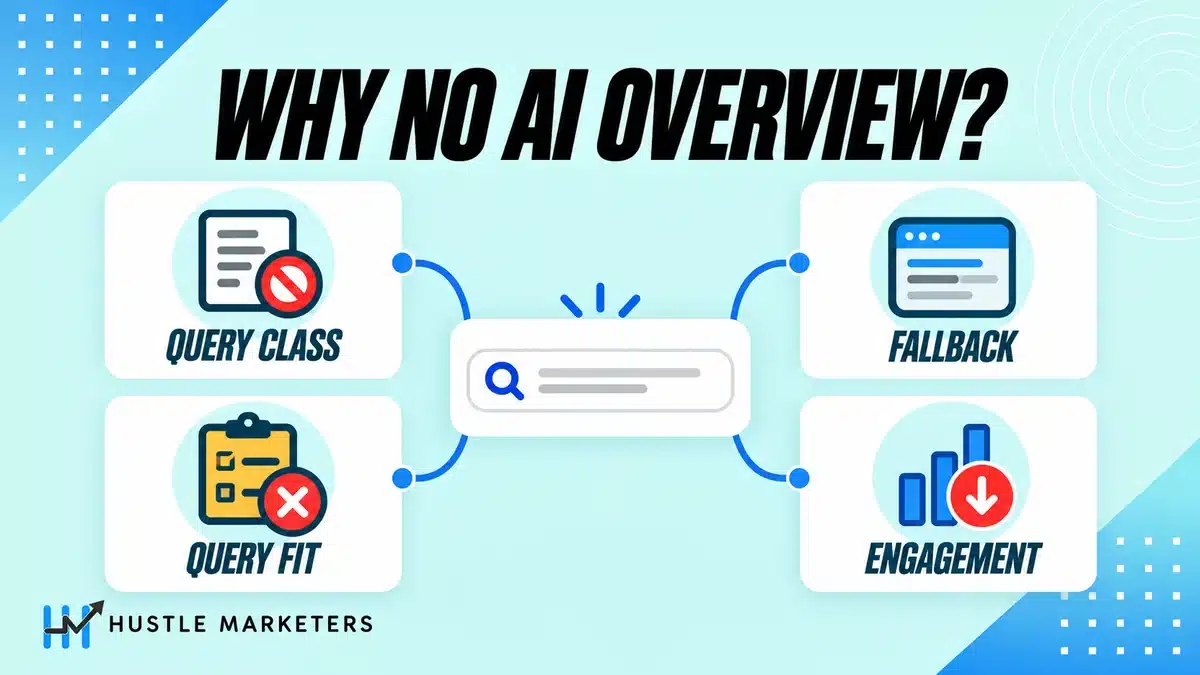
Because Google decided a generated answer would not help on that query. The message is not an error, not a penalty, and not something your site caused. Google has explained the behavior five separate times, in documentation, in a blog post and through three named employees, and no SEO page we found collects those statements in one place.
| Source | Date | What Google said |
|---|---|---|
| Google Search Central documentation | 10 December 2025 | “AI Overviews are only shown when our systems determine that it is additive to classic Search, and as such, often don’t trigger.” |
| Elizabeth Reid, VP of Search | 30 May 2024 | “we aim to not show AI Overviews for hard news topics, where freshness and factuality are important.” Also: “We added triggering restrictions for queries where AI Overviews were not proving to be as helpful.” |
| Davis Thompson, Google spokesperson, to Newsweek | 2 October 2025 | “As we’ve said, AI Overviews and AI Mode won’t show a response to every query.” |
| Google spokesperson to The Independent | 2 October 2025 | “Our systems automatically determine where an AI response will be useful, and it’s not always 100 percent consistent.” |
| Rajan Patel, VP of Engineering for Search, via Search Engine Roundtable | 22 January 2026 | “On occasion we fall back to featured snippets when we are unable to generate an AI Overview.” |
The Independent piece is the only source we found pairing the exact on-screen wording with a Google statement. It reported the message on one political query while a near-identical query returned a summary. Read that as evidence the message exists and Google treats it as normal variance. It says nothing about your site.
The four reasons in plain terms
- The query is in a suppressed class. Hard news, health, satire and nonsensical queries have documented triggering restrictions. Reid named all four on 30 May 2024.
- The query does not fit the pattern. Per Ahrefs, navigational and branded queries sit at 0.9 and 13.1 percent. Short queries and Shopping queries barely trigger.
- Generation failed and Google fell back. Patel confirmed a featured snippet can appear instead. If you see a snippet where an overview used to be, that is the likely cause.
- Nobody engaged with it. Robby Stein, Google VP of Product for Search, said on a CNN podcast reported by Search Engine Land that if nobody clicked an overview, “it won’t show up.” The podcast page is robots-disallowed, so we could not confirm the episode date.
Can you force an AI Overview to appear?
No. We found no documented method, from Google or from any practitioner with a stated test, that makes an AI Overview appear on a query that is not returning one. Every technique circulating under this heading does the opposite: it suppresses overviews rather than summoning them.
| Method | What it actually does | Documented by Google? |
|---|---|---|
| The Web filter | Shows classic results only | Yes. Google Search Help documents the Web filter as a user-facing feature |
| udm=14 in the URL | Loads the Web filter directly | No. The parameter appears in no Google documentation |
| Adding profanity to the query | Suppresses the overview, per a journalist test | No |
| Rephrasing as a long question | Raises the probability the query class triggers one at all | Indirectly, through the trait data above |
| Search Labs opt-in | Gives access to experiments, not to overviews on a specific query | Partly. Labs availability is documented, forcing is not |
On udm=14 the honest framing is that the filter is documented and the parameter is not. Ernie Smith built udm14.com and wrote about it on Tedium on 14 March 2025, reporting the redirect had “served 1.5 million people since last May.” A reference guide puts it plainly: it “is not documented by Google as an interface.”
The profanity method was tested by a journalist at Tom’s Guide on 31 January 2025, who reported that “a well-timed F-bomb turns them off.” We include it because readers ask, not because it belongs in a client deliverable.
Why is an AI Overview not showing on my own account?
This is a different problem from the publisher question, and the two get mixed up constantly. If overviews have stopped appearing for you personally but your rankings are fine, the cause is on your side of the screen: country, language, account state, Labs status, browser extensions or plain variance.
Google Search Help states that “Features cannot be turned off. However, you can select the Web filter after you perform a search.” So there is no setting to disable AI Overviews, which means there is also no setting you can have accidentally switched on.
Brodie Clark crowdsourced 867 impressions on a branded query and reported 362 usable US impressions at a 13.5 percent citation clickthrough rate. He noted results “vary between users in the same region.” His write-up dates from 18 June 2024, updated 8 June 2026. Variance between two people in one city is expected, not a fault.
The volume of complaints is real. We logged 13 separate threads in the Google Search Help community on this problem. Titles include “AI Overview not working on my account” and “AI Overviews No Longer Appearing When Logged In.” Those bodies are JavaScript-rendered and we could not read them. So we report that the pattern exists and nothing more.
How do you optimize content for Google AI Overviews?
Rank in the top 10, be snippet-eligible, answer the question in the first paragraph, and make the page specific enough to quote. That is the whole evidenced list. Everything beyond it is either correlation dressed as instruction or a tactic with no traceable source, and we separate the two below.
| Action | Evidence it helps | Strength | Do it? |
|---|---|---|---|
| Rank in the top 10 for the query | 37.9 percent of citations come from the top 10, per Ahrefs, 863,000 SERPs, 2 March 2026 | Strongest available | Yes. This is still the main lever |
| Keep the page indexed and snippet-eligible | Google states this is the eligibility requirement | Documented by Google | Yes. Non-negotiable |
| Answer the question early in the page | Indig found 44.2 percent of ChatGPT citations in the first 30 percent of a document, across 18,012 verified citations | Directional, and ChatGPT not AI Overviews | Yes, as a principle. Ignore the word counts |
| Be factually specific | Indig found heavily cited text averaged 20.6 percent proper nouns against a typical 5 to 8 percent | Correlation only | Yes. It also improves the page for humans |
| Build brand presence off-site | Ahrefs found YouTube mentions correlated 0.737 with brand mentions, backlinks 0.218 | Correlation, unconfirmed | Yes, for other reasons too |
| Add FAQ schema | None. The circulating uplift figures have no traceable source | No evidence | No |
| Write 40 to 60 word answers | None. The number has no source | No evidence | No, but front-load the answer anyway |
| Publish llms.txt for Google | Google says it ignores them | Contradicted by Google | No |
Why the top 10 still matters most
Ahrefs parsed 4 million AI Overview URLs across 863,000 SERPs and found 37.9 percent of citations came from the top 10, or 37.1 percent on organic results only. The same study found 36.7 percent of cited organic URLs did not rank in the top 100 at all. That is why the overlap figure alone misleads.
Their own framing of the trend is the useful part: “Google is selecting far fewer pages straight from the original SERP (~76% in July 2025 vs. ~38% today).” Ranking is becoming a weaker predictor, not an irrelevant one. Louise Linehan and Xibeijia Guan published that study on 2 March 2026.
What “answer early” means without the fake numbers
Put the direct answer in the first two or three sentences under the heading, then expand. Gianluca Fiorelli audited the evidence for this instruction on 17 September 2026 and reached a clean conclusion: “Keep the instruction, discard every number attached to it.” The 40 to 60 word rule has no source. The behavior it describes is still sound.
The reason it works has nothing to do with word counts. A page that answers the question in the opening lines gives an extraction system a clean, self-contained passage to lift. It also serves a reader who wants the answer and not the preamble.
Query-based headings, and why they are not a trick
Write headings as the questions people actually type. This page does it throughout, and the reason is mechanical rather than clever: a heading phrased as a question followed immediately by its answer creates a passage that maps to a query without any interpretation step.
Pull the question wording from real sources: Search Console queries, the questions clients ask on calls, and question keywords from a tool like Semrush or Ahrefs. Do not invent questions to fill a structure. A heading nobody searches is a heading that does nothing.
Does structured data help you get cited in AI Overviews?
The best available study says no, and Google says it is not required. This is the single biggest gap between what optimization guides recommend and what the evidence shows.
Structured data isn’t required for generative AI search, and there’s no special schema.org markup you need to add.
Google, Guide to optimizing for generative AI features on Google Search, last updated 10 July 2026
Ahrefs then measured it. Louise Linehan and Xibeijia Guan published a matched difference-in-differences analysis on 11 May 2026, covering 1,885 pages that added JSON-LD between August 2025 and March 2026 against 4,000 control pages. Their headline: “Adding schema produced no major uplift in citations on any platform.”
| Platform | Change in citations after adding JSON-LD | Statistically significant? | Source |
|---|---|---|---|
| Google AI Overviews | minus 4.6 percent | Yes | Ahrefs, 11 May 2026 |
| Google AI Mode | plus 2.4 percent | No, indistinguishable from zero | Ahrefs, 11 May 2026 |
| ChatGPT | plus 2.2 percent | No, indistinguishable from zero | Ahrefs, 11 May 2026 |
The rebuttal, which we think deserves weight
Two days later Misha Manko published nine methodological criticisms of that study. His strongest points: the sample only included pages already receiving 100 or more daily citations, which excludes the pages most likely to benefit, and all schema types were pooled into one intervention.
His split verdict is fair. The study can claim that pooled schema on already heavily-cited pages showed no lift over 30 days. It cannot claim schema does not help AI citations generally, and Ahrefs stated that first limitation themselves.
Read the rebuttal alongside the study rather than instead of it.
So what should you actually do with schema?
Keep the schema that earns something concrete. Organization, Product, LocalBusiness, Event, Review and Breadcrumb all drive real search features and belong on the pages they describe. Add them for those features, on their own merits, and stop attributing AI Overview citations to them.
Drop FAQPage as an AI tactic. Google stopped showing FAQ rich results for all sites on May 7, 2026. The “FAQ schema makes content 60 percent more likely to be cited” claim has, in Fiorelli’s words, “no traceable source” and circulates in “incompatible forms.” He lists six versions of the same number. Our entity SEO guide covers the markup that does still work.
Does llms.txt help you appear in AI Overviews?
Not in Google. Google states outright that it ignores these files. This is worth stating precisely because llms.txt has become a default recommendation on pages about AI search, and for Google specifically it is a recommendation to do nothing.
Doing so will neither harm nor help your site’s visibility or rankings in Google Search, as Google Search ignores them.
Google, AI optimization guide, last updated 10 July 2026
The same document goes further: “You don’t need to create new machine readable files, AI text files, markup, or Markdown to appear in Google Search (including its generative AI capabilities), as Google Search itself doesn’t use them.”
The proposal itself is honest about what it is. llmstxt.org describes it as “A proposal to standardise on using an /llms.txt file to provide information to help agents use a website,” originally published 3 September 2024 by Jeremy Howard. A proposal is not a standard, and the file has real uses for developer documentation and non-Google agents.
There is also a measurement worth knowing. Ahrefs examined server logs across 137,210 domains and found 97 percent received zero requests for their llms.txt file in the month measured, as summarized in Fiorelli’s audit. Keep the file if you want coverage for other agents. Do not tell a client it affects Google.
How do you keep your site out of AI Overviews?
Google shipped a switch for exactly this and it reached every website in the world on 31 August 2026. The Search generative AI control in Search Console lets you exclude a property from AI Overviews, AI Mode and generative AI features in Discover, and Google states plainly that using it does not affect the rest of Search.
As of August 31, 2026, we’ve rolled out this control to all websites worldwide.
Google, Search generative AI control, Search Console Help
The reassurance most site owners will want is on the same page: “this control only affects whether your content can appear in certain Search generative AI features; this control isn’t used as a ranking or inclusion signal affecting other parts of Search.” Exclusion takes effect “within 1-2 days after the control goes live,” with caching delays possible.
It was announced on 3 June 2026 by Mrinalini Loew, General Manager of the Google Search Ecosystem, in a post updated on 31 August 2026 to mark the full rollout. Her framing: “website owners can decide if they want their site to appear in and help ground responses in our generative AI Search features.”
Four controls, four different jobs
This is where most advice on this topic is simply wrong. The four mechanisms people treat as interchangeable do completely different things, and picking the wrong one either fails to achieve the goal or costs you something you wanted to keep.
| Control | What it does | What it does not do | Side effect |
|---|---|---|---|
| Search generative AI control | Excludes the property from AI Overviews, AI Mode and generative AI in Discover | Does not remove you from classic Search | None stated. Google says it is not a ranking or inclusion signal |
| Google-Extended in robots.txt | Manages whether crawled content is used for training future Gemini models | Does not keep you out of AI Overviews. It never did | Google states it “does not impact a site’s inclusion in Google Search nor is it used as a ranking signal in Google Search” |
| nosnippet and max-snippet | Prevents or limits content being used “as a direct input for AI Overviews and AI Mode” | Does not target AI features only | Kills or truncates your ordinary search snippet too |
| noindex | Removes the page from Google Search entirely | Nothing partial about it | Total loss of organic visibility for that page |
The Google-Extended misconception is the expensive one. People presented blocking it as an AI Overviews opt-out for two years, and it never was. A site that blocked Google-Extended for that reason gave up Gemini model training coverage and got nothing it was aiming for.
On the snippet tags, Google’s wording is explicit. The robots meta tag documentation, last updated 24 March 2026, states that nosnippet “will also prevent the content from being used as a direct input for AI Overviews and AI Mode.” That makes it effective and blunt.
Before 31 August 2026 it was the only real option. Now it is the wrong one for most sites, because the Search Console control does the same job without costing you your search snippet.
How do you measure AI Overview performance?
With Search Console, since 31 August 2026. Google shipped a generative AI performance report to all websites worldwide on the same day as the opt-out control. It reports impressions and clicks from AI Overviews and AI Mode, which means the measurement question no longer requires a third-party tool.
Impressions are how many times links to your site were shown to a user in a generative AI feature on Google Search.
Google, Generative AI performance report (Search), Search Console Help
Google also documents how the numbers are counted, which matters more than most people realize when they look at an average position that suddenly makes no sense.
| Metric | How Google counts it | Where this is documented |
|---|---|---|
| Position in an AI Overview | “An AI Overview occupies a single position in search results, and all links in the AI Overview are assigned that same position.” | Impressions, position and clicks |
| Clicks from an AI Overview | “Clicking a link to an external page in the AI Overview counts as a click.” | Same document |
| Position in AI Mode | “Position in AI Mode follows the same methodology as a Google Search results page.” | Same document |
| Clicks from AI Mode | “Clicking a link to an external page in AI Mode counts as a click.” | Same document |
What the report does not cover
Google lists four constraints on the help page. Search Labs experiment data is excluded, and the table carries the usual 1,000 row limit. Recent data can be preliminary. A site excluded from generative AI features will not appear at all.
One thing we could not confirm: whether AI Overviews and AI Mode can be filtered apart inside the report. The help page lists both as included and documents no filter. It also never says separation is impossible.
So we are flagging that as unverified rather than asserting either way. Check it in your own property before you promise a client a split. We take the same line on every number that reaches a client report, which our guide to automated SEO reports works through in detail.
Why third-party numbers will still disagree with it
Because they measure something else. A tracker runs prompts and records what comes back, while Search Console records what Google served to real users on your property. Those are different populations, and Google is blunt about the gap.
No third-party tool has access to our internal ranking or AI systems.
Google, AI optimization guide, last updated 10 July 2026
That does not make trackers useless. They answer a question Search Console cannot: what a competitor looks like, and what happens on prompts where you are absent. We compared their prices and disagreements in our review of AI visibility tools. Use them for the competitive picture and Search Console for your own numbers.
How much do AI Overviews reduce clicks?
By 58 percent for top-ranking pages, on the most recent measurement from Ahrefs. That figure superseded the 34.5 percent number still quoted across most of the internet, and the gap between the two is large enough to change a forecast.
Ahrefs published that update on 4 February 2026, comparing 150,000 keywords carrying an AI Overview against a 150,000 keyword control, 300,000 in total. Their phrasing: “For every 100 clicks you could historically earn for a top-ranking page, Google now ‘keeps’ 58.”
| Measurement | Figure | Sample | Source |
|---|---|---|---|
| Ahrefs, current | 58 percent clickthrough reduction for top-ranking pages | 300,000 keywords, 150k treatment and 150k control | Ahrefs, 4 Feb 2026 |
| Ahrefs, superseded | 34.5 percent | Same methodology, earlier window | Ahrefs, 4 Feb 2026 |
| SparkToro via Similarweb clickstream | 68.01 percent of US searches ended without a click, and clickthrough rates “drop by nearly 60%” | US desktop and mobile panel, January to April 2026 | Search Engine Land, 9 Jun 2026 |
| Semrush zero-click comparison | Zero-click rates moved from 33.75 to 31.53 percent on the same keywords before and after an overview appeared | 10 million plus keywords | Search Engine Land, 16 Dec 2025 |
Note the fourth row, because it points the other way. Semrush compared the same keywords before and after an AI Overview appeared and found zero-click rates slightly improved.
That does not cancel the Ahrefs finding. The two measure different things: all clicks on the SERP, versus clicks to the top-ranking page. Both can be true. Any page quoting only one is telling you half of it.
If you are still quoting 34.5 percent in a deck, replace it with the current figure. We flagged the same problem with a superseded Ahrefs citation number on our GEO agency page. It keeps happening because these studies get cited for years after their authors update them.
How often do AI Overviews actually appear?
Published figures range from 3.2 percent to 48 percent, as the aggregated tracker shows. The spread is not because anyone is lying. They are counting different things. Anyone quoting a single prevalence figure without naming the denominator is giving you a number you cannot use.
| Reported by | Figure | What it measured | Source |
|---|---|---|---|
| Ahrefs | 20.5 percent | All SERPs in a 146,122,391 SERP sample | Ahrefs, 10 Nov 2025 |
| Semrush | Under 16 percent, down from a July peak just under 25 percent | 10 million plus tracked keywords | Search Engine Land, 16 Dec 2025 |
| BrightEdge | About 48 percent, 1 March 2026 | Tracked queries in their own set | Keywords Everywhere tracker |
| Similarweb | 43 percent, 27 July 2026 | US searches | Keywords Everywhere tracker |
| Comscore | 39.4 percent, 22 September 2026 | US desktop | Keywords Everywhere tracker |
| Ahrefs, by topic | 3.2 percent Shopping to 43.6 percent Science | Same 146M SERP sample, segmented | Ahrefs, 10 Nov 2025 |
The tracker aggregating these states the caution itself, and it is the most useful line on the page: tracked-query figures and panel-based prevalence counts are not comparable. A tracked keyword set is chosen. A SERP sample is not.
Why citation overlap figures range from 12 to 99 percent
Haobo Zhang reconciled eight separate measurements of how often AI Overview citations overlap the organic top 10 and found four reasons for the spread. His analysis, published 3 July 2026, is the clearest thing written on why these studies contradict each other.
- Denominator. Per-citation overlap and per-AI-Overview overlap produce wildly different numbers from the same data.
- Which citations were parsed. Top-three visible citations only, or every citation including the collapsed ones.
- Which query was matched. The original query, or the fan-out queries the system generated from it.
- Keyword and date selection. Different keyword sets, different months, different markets.
One vendor illustrates the problem on its own. BrightEdge has published 16.7 percent, 54.5 percent, and an 89 percent figure for citations from beyond the top 100. Each used a different definition. Three numbers from one company, and none is wrong on its own terms.
How stable are AI Overview citations?
More stable than anything else in AI search, and by a wide margin. This is the finding that should change how you report. Per SISTRIX, AI Overviews replace about 5 percent of their cited domains week to week, against 56 percent in AI Mode and 74 percent in ChatGPT Search.
SISTRIX measured it properly. Johannes Beus published the study on 1 May 2026, modified 12 May 2026, from 82,619 qualified prompts producing 1,548,213 snapshots across six countries, three platforms and 17 weeks between 17 December 2025 and 8 April 2026.
| Surface | Weekly source turnover | What that means for reporting | Source |
|---|---|---|---|
| Google AI Overviews | About 5 percent | A citation you earn is likely to still be there next week. Weekly reporting is meaningful | SISTRIX, 1 May 2026 |
| Google AI Mode | 56 percent | Half the sources change every week. A single snapshot is not a result | SISTRIX, 1 May 2026 |
| ChatGPT Search | 74 percent | Three quarters change. Report ranges across repeated runs or report nothing | SISTRIX, 1 May 2026 |
The study also found that for the same prompt, AI Overviews and AI Mode cite different domains 83 percent of the time. Two surfaces, same company, same query, almost no overlap. Those drift figures are also conservative. SISTRIX notes: “The drift rates cited are conservative; at the URL level, they are 15% higher.”
The practical consequence is that AI Overview work is measurable in a way AI Mode and ChatGPT work is not. Track all three in one dashboard with one methodology and the AI Overview column means something. The other two need repeated sampling first. We built that argument out in our guides to ChatGPT rank tracking and Perplexity rank tracking.
Is an AI Overview the same thing as AI Mode?
No, and treating them as one thing is the most common error in writing on this topic. An AI Overview is a summary block on a normal results page. AI Mode is a separate search surface you enter deliberately. They cite different sources, behave differently over time, and are reported differently.
| AI Overview | AI Mode | Source | |
|---|---|---|---|
| What it is | A summary block on the classic results page | A separate conversational search surface | Google documentation |
| How you reach it | It appears, or it does not | You choose it, or go to google.com/ai | Google documentation |
| Weekly source turnover | About 5 percent | 56 percent | SISTRIX, 1 May 2026 |
| Search Console position | A single position shared by all its links | Same methodology as a normal results page | Search Console Help |
| First appeared | 14 May 2024, as the public launch of SGE | 5 March 2025, as a Search Labs experiment | Google blog |
For the same prompt they cite different domains 83 percent of the time, per SISTRIX. Keep that number in mind when someone shows you one AI search visibility score covering both. We treat AI Mode as its own problem, and this page does not try to cover it.
One more thing worth knowing if you write about availability. Google’s own three help pages disagree on where AI Mode is available. One lists Search Labs in “7 languages and over 120 countries and territories” with AI Mode in the US and India in English only. Another states 190 plus countries and 100 plus languages.
We read all three on 28 September 2026 and found no source that has noticed the contradiction. Do not treat any single availability figure as settled.
What was Google’s Search Generative Experience?
Search Generative Experience, or SGE, was the name Google used for AI Overviews before the public launch. It ran as a Search Labs experiment from 10 May 2023 until 14 May 2024, when the same feature launched publicly under the name AI Overviews. SGE is a retired name and Google no longer uses it.
The original announcement is unambiguous about what it was. Elizabeth Reid, then Vice President and GM of Search, wrote on 10 May 2023: “We’re starting with an experiment in Search Labs called SGE (Search Generative Experience), which uses generative AI.” It launched on Chrome desktop and the Google App, in the United States, in English only.
One year later the same author announced the rename as a launch rather than a rebrand: “So today, AI Overviews will begin rolling out to everyone in the U.S., with more countries coming soon.” She tied the two names together in the same post. “People have already used AI Overviews billions of times through our experiment in Search Labs.”
| Date | What happened | Source |
|---|---|---|
| 10 May 2023 | SGE announced as a Search Labs experiment, US only, English only | Google blog, Elizabeth Reid |
| 14 May 2024 | Renamed and launched publicly as AI Overviews, rolling out to everyone in the US | Google blog, Elizabeth Reid |
| 30 May 2024 | Triggering restrictions added after the early accuracy problems | Google blog, Elizabeth Reid |
| August 2024 | AI Overviews begin showing for signed-out users in the US | Search Engine Land, Barry Schwartz |
| 5 March 2025 | AI Mode introduced as a separate Labs experiment | Google blog, Robby Stein |
| 31 August 2026 | Search generative AI control and generative AI performance report reach all sites worldwide | Search Console Help |
How will AI Overviews change SEO?
They change the value of a ranking, not the way you earn one. A top position still drives the citation, and it now converts into fewer visits. Google’s own position is that the optimization work itself has not changed at all.
From Google Search’s perspective, optimizing for generative AI search is optimizing for the search experience, and thus still SEO.
Google, AI optimization guide, last updated 10 July 2026
Four things actually change in how you plan and report.
| What changes | What it means in practice | Source |
|---|---|---|
| Traffic per ranking falls | A first position on a query with an overview earns 58 percent fewer clicks. Model the traffic, not just the position | Ahrefs, 4 Feb 2026 |
| Average position gets harder to read | An AI Overview is one position shared by every link in it. A citation can move your reported average in ways a ranking change never would | Search Console Help |
| Informational content gets more valuable, commercial pages less affected | Overviews concentrate on informational intent, 99.9 percent of them. Shopping sits at 3.2 percent | Ahrefs, 10 Nov 2025 |
| Brand presence off your site starts to matter more | 36.7 percent of cited organic URLs did not rank in the top 100. Something other than the ranking is putting them there | Ahrefs, 2 Mar 2026 |
What does not change: crawlability, indexation, site speed, internal linking, information quality. There is no separate technical checklist for AI Overviews, and the pages selling one are selling the standard checklist with a new label. Our AI search optimization guide goes through what Google documents versus what tools claim, and our answer engine optimization guide covers the wider surface.
What are the best tools for AI Overview optimization?
Search Console first, because it is free, first-party and now reports AI Overview impressions and clicks directly. Only after that does a paid tool add anything, and what it adds is competitive visibility rather than your own numbers.
| Tool type | What it genuinely answers | What it cannot answer | Cost |
|---|---|---|---|
| Search Console generative AI report | Your own impressions and clicks from AI Overviews and AI Mode | Anything about competitors. Anything about prompts where you are absent | Free |
| SERP feature tracking in Semrush or Ahrefs | Which of your tracked keywords show an AI Overview at all | Whether you are cited in it | Included in standard plans |
| AI visibility trackers | Share of voice across repeated prompts, and competitor presence | A reliable position. Google states no third party has access to its systems | Varies widely, see our review |
| Manual checking | Ground truth on a handful of priority queries | Scale | Your time |
The thing to refuse is a single AI rank number. Fiorelli’s audit is blunt about it: “Any tool reporting a position is reporting noise.” That rests on Rand Fishkin’s SparkToro study of 28 January 2026. It ran 2,961 prompt executions with 600 volunteers across ChatGPT, Claude and Google AI, and found under a one in a hundred chance of the same brand list appearing twice.
For AI Overviews specifically, the SISTRIX 5 percent drift figure makes a tracked citation more meaningful than the same number for AI Mode or ChatGPT. That argues for measuring AI Overviews carefully, not for trusting a blended score. We list verified prices in our AI visibility tools comparison and a free method in our guide to tracking brand visibility in AI search.
Which AI Overview tactics are not supported by evidence?
Six tactics appear on nearly every page about this topic and none survives contact with a source. We are not offering an opinion here. Each is either contradicted by Google’s own documentation or traced to a figure with no origin.
| Claim | Status | Who contradicts it |
|---|---|---|
| Add FAQ schema to get cited in AI Overviews | Not supported | Google: structured data “isn’t required.” Fiorelli: the 60 percent uplift figure has “no traceable source” and circulates as 28, 36, 40 and 67 percent |
| Write answers in 40 to 60 words | Not supported | Fiorelli, 17 September 2026: “Keep the instruction, discard every number attached to it” |
| Publish llms.txt so Google can read your site | Contradicted | Google: “Google Search ignores them.” Fiorelli on Ahrefs: 97 percent of 137,210 domains got zero requests for the file |
| Block Google-Extended to stay out of AI Overviews | Contradicted | Google: it “does not impact a site’s inclusion in Google Search.” The actual control is in Search Console |
| Your AI rank position improved this month | Not measurable | Fiorelli citing SparkToro: under a 1 in 100 chance of the same list twice across 2,961 runs |
| Break content into small chunks so AI can parse it | Contradicted | Google: “There’s no requirement to break your content into tiny pieces for AI to better understand it” |
If an agency has any of those six in its pitch, that tells you something about how it reads evidence generally. We scored five published agency ranking lists on exactly that in our review of the best AI SEO agencies.
There is a seventh worth naming, which is quieter. Several guides cite Kevin Indig’s finding that 44.2 percent of citations came from the first 30 percent of a document, and present it as AI Overview guidance. It is a good study, 18,012 verified citations from 1.2 million answers, and it measured ChatGPT. Indig says so himself.
Using it as AI Overview evidence is overreach. The underlying principle of answering early still holds up on its own.
What does Google itself say about optimizing for AI Overviews?
Google published a guide to this on 15 May 2026 and last updated it on 10 July 2026. It carries exactly three recommendations, and none of them is a new technique. The document is short and specific.
- Create valuable, non-commodity content for people. Not for extraction systems.
- Make sure the page is technically clear and accessible, so it can be crawled, indexed and rendered.
- For local and ecommerce, get the practical details right: hours, location, prices, availability, product data.
Those are the three practices. The guide also points to Search Console’s generative AI report for measurement, and the same document then rules out four things people are actively being sold, and we have quoted each one in its own section above: structured data is not required, no special markup is needed, content does not need breaking into small pieces, and Google Search ignores llms.txt.
Google is also clear about what tools can tell you. Its guidance on third-party SEO tools, last updated 5 June 2026, states: “Third-party tools don’t have access to our internal ranking data.” And: “They can’t guarantee performance. Any predictions are their own and like predictions generally, may not happen.”
What should you do first?
In order, and none of it needs a new budget line. The first four steps take an afternoon and will tell you whether there is anything here worth working on for your site at all.
| Step | What to do | Why | Effort |
|---|---|---|---|
| 1 | Open the generative AI performance report in Search Console | You now have first-party AI Overview impressions and clicks. Start from what actually happened | Minutes |
| 2 | Check how many of your priority queries show an AI Overview at all | If they are Shopping, Local or navigational, most will not. That settles the scope | An hour |
| 3 | Confirm your pages are indexed and snippet-eligible | This is Google’s stated eligibility bar. If a page fails it, nothing else matters | An hour |
| 4 | Audit your own advice for the six unsupported tactics above | If a deck or a retainer contains them, fix that before adding anything | An hour |
| 5 | Front-load answers under question-shaped headings on your informational pages | The best-evidenced on-page change, and it helps readers regardless | Ongoing |
| 6 | Work on the top 10 ranking for the queries that do trigger overviews | Still the strongest observable factor at 37.9 percent of citations | Ongoing |
| 7 | Decide, deliberately, whether you want to be included at all | The control exists now. For most commercial sites the answer is yes, but it should be a decision | One conversation |
Steps 1 to 4 are diagnostic and they frequently end the project. A site selling products to a Shopping-intent audience will find almost no AI Overviews on its money queries, and the honest recommendation is to spend that budget on the classic result. We would rather say that in week one than bill for a year of it.
Frequently asked questions
Can you opt out of AI Overviews?
Yes, since 31 August 2026. The Search generative AI control in Search Console excludes a property from AI Overviews, AI Mode and generative AI features in Discover. Google states it is not used as a ranking or inclusion signal, and exclusion takes effect within one to two days. Most answers online predate this control and say no.
Does blocking Google-Extended remove me from AI Overviews?
No. Google-Extended manages whether crawled content is used for training future Gemini models. Google states it “does not impact a site’s inclusion in Google Search nor is it used as a ranking signal in Google Search.” If you blocked it to stay out of AI Overviews, it did not work.
Where can you see AI Overview clicks?
In the generative AI performance report in Search Console, which covers AI Overviews and AI Mode together. Google counts a click on an external link in an AI Overview as a click, and assigns every link in the overview the same single position. Search Labs experiment data is excluded.
Do AI Overviews appear on every search?
No. Ahrefs found them on 20.5 percent of 146,122,391 SERPs. They concentrate on informational questions and long queries, and stay rare on Shopping at 3.2 percent, Local at 7.9 percent and navigational queries at 0.9 percent of all overviews.
Is SGE the same as AI Overviews?
Yes, it is the same feature under its old name. Google used Search Generative Experience from 10 May 2023 and launched the feature publicly as AI Overviews on 14 May 2024. Google no longer uses the term SGE anywhere in its documentation.
Does adding schema get you into AI Overviews?
There is no evidence that it does. Google states structured data is not required for generative AI search. The best study available, from Ahrefs in May 2026, measured a 4.6 percent decline in AI Overview citations after JSON-LD was added to 1,885 pages. Keep schema for the search features it genuinely earns.
How long does it take to get cited in an AI Overview?
Nobody can tell you honestly, and anyone quoting a timeline is guessing. What is measurable is that a citation, once earned, is relatively durable. SISTRIX found AI Overviews replace only about 5 percent of their cited domains each week, against 56 percent in AI Mode.
Why did an AI Overview disappear from a query where we used to be cited?
Several documented causes. Google adds triggering restrictions to query classes, has removed overviews from specific medical queries after accuracy reporting, can fall back to a featured snippet when generation fails, and per Robby Stein will stop showing an overview nobody engaged with. None of those requires a change on your site.
Sources and how we verified them
Every source below was opened and read on 28 September 2026. Nothing on this page comes from another page’s summary of a study. Where we could not reach something, it is listed as unreachable rather than described.
| Source | Date on source | What we verified |
|---|---|---|
| Google, Search generative AI control | Rollout stated 31 August 2026 | The worldwide rollout sentence, the three surfaces covered, the not-a-ranking-signal sentence, the 1 to 2 day latency, and the Google-Extended and noindex distinctions |
| Google, Generative AI performance report | Rollout stated 31 August 2026 | The impressions definition, the surfaces covered, and every stated limitation including the Search Labs exclusion |
| Google, Impressions, position and clicks | No date printed | The single-position rule for AI Overviews and the click definitions for both surfaces |
| Google blog, Mrinalini Loew | 3 June 2026, updated 31 August 2026 | Author and title, both announcements, and the quoted sentence |
| Google, AI optimization guide | Updated 10 July 2026 | All four myth-busting sentences, the still-SEO sentence, and that the page carries exactly three recommendations |
| Google, AI features and your website | Updated 10 December 2025 | The often-do-not-trigger sentence, the eligibility sentence and the no-additional-requirements sentence |
| Google, robots meta tag | Updated 24 March 2026 | The AI Overviews and AI Mode clauses inside the nosnippet and max-snippet definitions |
| Google, common crawlers | Updated 14 July 2026 | The Google-Extended definition and the sentence ruling out any Search inclusion or ranking effect |
| Google, third-party SEO tools | Updated 5 June 2026 | Both quoted sentences on ranking data and guarantees |
| Google blog, Elizabeth Reid | 30 May 2024 | All four triggering-restriction quotes |
| Google blog, Elizabeth Reid | 10 May 2023 | The SGE announcement wording and the launch scope |
| Google blog, Elizabeth Reid | 14 May 2024 | The public launch sentence and the Search Labs continuity sentence |
| Ahrefs, What triggers AI Overviews | 10 November 2025 | The 146,122,391 SERP sample, 86 factors, the 20.5 percent baseline and every trait and topic figure quoted |
| Ahrefs, AI Overviews and clickthrough | 4 February 2026 | The 58 percent figure, the 300,000 keyword split sample, and that it supersedes 34.5 percent |
| Ahrefs, AI Overview citations | 2 March 2026 | 863,000 SERPs, 4 million URLs, 37.9 and 37.1 percent, 36.7 percent outside the top 100, and the 76 to 38 percent trend quote |
| Ahrefs, schema and AI citations | 11 May 2026 | Authors, the 1,885 versus 4,000 difference-in-differences design, all three platform results with significance, and the stated limitations |
| Misha Manko, methodology rebuttal | 13 May 2026 | The nine criticisms and the split verdict |
| SISTRIX, AI citation drift | 1 May 2026, modified 12 May 2026 | 82,619 prompts, 1,548,213 snapshots, 17 weeks, the three drift figures, the 83 percent divergence and the conservative-estimate caveat |
| Gianluca Fiorelli, evidence audit | 17 September 2026 | The word-count verdict, the FAQ-schema no-traceable-source finding with its six conflicting figures, and the AI-rank-is-noise conclusion |
| HZ Signal, Haobo Zhang | 3 July 2026 | The eight measurements and the four drivers of the 12 to 99 percent spread |
| Search Engine Land on Kevin Indig’s study | 18 February 2026 | 1.2 million answers, 18,012 verified citations, 44.2 percent and 20.6 percent, and that it covers ChatGPT only |
| Search Engine Land on SparkToro and Similarweb | 9 June 2026 | The 68.01 percent zero-click figure and the nearly 60 percent clickthrough drop |
| Search Engine Roundtable, Barry Schwartz | 23 January 2026 | Rajan Patel’s title, the featured-snippet fallback quote and the date he said it |
| Newsweek, James Bickerton | 2 October 2025 | Davis Thompson’s name and quote, and that the exact on-screen message does not appear in this article |
| The Independent via AOL, Rhian Lubin | 2 October 2025 | That the exact message appears, the sentence containing it, and the Google spokesperson quote |
| Brodie Clark | 18 June 2024, updated 8 June 2026 | The 867 and 362 impression counts, the 13.5 percent clickthrough rate and the same-region variance caveat |
| Keywords Everywhere AI Overviews tracker | Updated 26 September 2026 | The dated prevalence points and the page’s own caution that tracked-query and panel figures are not comparable |
| Tedium, Ernie Smith | 14 March 2025 | That he built udm14.com and the 1.5 million redirect figure |
| llmstxt.org | Originally 3 September 2024 | The self-description as a proposal and the author name |
What we could not reach, and did not work around
Thirteen Google Search Help community threads on AI Overviews not appearing. The bodies are JavaScript-rendered and returned no post content, so this page reports only that the threads exist, with their titles. We have not paraphrased or invented a single line from any of them.
Also unreachable: the European Commission press release on its 9 December 2025 investigation, which we have not quoted; a Quora thread on the same error message; Kevin Indig’s own write-up of his citation study, which we cite through Search Engine Land instead; and the CNN podcast carrying Robby Stein’s engagement comment, which is why that date is unconfirmed on this page. Reddit is blocked at our end, so nothing here reflects Reddit discussion either way.
Why this page has no FAQPage schema
Because it would contradict the page. Google stopped showing FAQ rich results for most sites in May 2026, and the section above sets out why FAQ schema has no evidenced effect on AI citations. Adding it here to look thorough would be the exact behavior we are arguing against. The page carries BlogPosting, Person and Organization markup, which describe things that are true about it.
Written by Ishant Sharma, founder of Hustle Marketers, working in search since 2013. If you want a second pair of eyes on whether AI Overviews are worth your budget at all, that is the conversation we have on our AI SEO service page, and you can reach us through contact us.