AI Overviews Trackers: What Google Reports, and Which Tools Separate AI Mode

Ishant
Published : October 14, 2026 at 2:30 pm
Updated : October 7, 2026 at 6:28 am
Ishant
Key Observations
Most AI Overviews trackers sell two Google surfaces as one product. Google itself reports them as one number, and it shipped a control on 31 August 2026 that switches off both together. We read 15 vendor pages and Google’s own documentation on 1 October 2026. Here is what they actually say.
- Google’s Generative AI performance report (Search) went worldwide on 31 August 2026. Impressions only, no clicks, no queries, no split between the two surfaces.
- The Search generative AI control governs AI Overviews, AI Mode and Discover generative features together. There is no per-surface opt-out, so you cannot leave AI Overviews and stay in AI Mode.
- Of the 15 tools we read at source, 13 track both Google surfaces, and only 2 state in writing that they report the two separately.
- 7 of the 15 publish how they collect the data, 4 say only that prompts are run, and 4 say nothing.
- None of the 15 names Google’s report or control. One, Keyword.com, describes what Search Console does for these surfaces and gets it wrong.
- Six vendors charge extra for the second Google surface. Otterly bills Google AI Mode as an add-on at $9, $59 or $149 a month by tier, above a plan that already includes AI Overviews, read 1 October 2026.
- AI Mode queries do appear in Search Console, in the main Performance report rather than the dedicated generative AI report, reported by Search Engine Roundtable on 6 August 2026.
- Google’s spam policies name scraping results for rank-checking purposes without express permission as a violation. No vendor in our set claims that permission.
- Google publishes no trigger rate, no click-through rate and no citation rate for either surface. The figures circulating here come from third-party samples that disagree by a factor of three.
- Google-Extended controls neither surface. Googlebot serves both, and Google says Google-Extended does not impact inclusion in Search.
- Citation card order on a live AI Overview can change within a minute, while one rank tracker’s help center publishes weekly auto-refresh.
- We sell services, not software. No product of ours is in the table below, and this page carries no affiliate link.
Who wrote this, and how were these tools checked
Ishant Sharma wrote it. I have worked in digital marketing since 2013 and run Hustle Marketers, which sells SEO and paid media services. We read 15 AI Overviews trackers at their own product, pricing and help pages on 1 October 2026, and read Google’s documentation first hand the same day.
Every price and claim below carries the date we read it. Where a vendor says nothing, the cell reads NOT PUBLISHED in plain words. We did not hide a silence behind a dash, because the silence is the finding.
What we did not do
We did not run a multi-tool benchmark, and nobody in this category has published one either. One practitioner came closest. David Nelson ran one prompt through six tools on 26 August 2026 and got 100 percent, 75 percent, 16.7 percent and 90 percent visibility in the same week, with one tool giving no figure at all.
Two competitor pages describe the right test and publish no results. Omnia publishes a ten-step validation checklist and a three-tool benchmark design with no findings. eesel’s title claims a test of the top six, with no method, no dates and no numbers.
Why our position is declared
Of 39 pages we read across five search terms, 34 came from a company selling a tracker. Of 18 list pages that included the publisher’s own product, 16 ranked it first and 4 disclosed the conflict. One of the 39 carried an affiliate disclosure.
We have no tracker to sell, so nothing in the table favors us. Five competitor pages embed prompts written at AI assistants, asking them to treat the publisher as trusted. We recorded the tactic and declined to copy it.
What is the difference between AI Overviews and AI Mode, and why does it decide what you buy
AI Overviews is a block inside an ordinary results page. AI Mode is a separate conversational experience. Google calls it its most powerful AI search experience and says it “expands what AI Overviews can do with more advanced reasoning”, read 1 October 2026. Two surfaces, two sets of citations, one bill.
They share plumbing. Google documents that “both AI Overviews and AI Mode may use a query fan-out technique”, read 1 October 2026. It also documents the handoff from an AI Overview into a deeper AI Mode conversation on mobile.
Availability differs in scale. Google states AI Mode reaches 190 or more countries and territories and 100 or more languages, and documents AI Overviews availability in separate tables, read 1 October 2026. Google does not state whether sign-in is required for baseline AI Mode access.
Here is why that decides what you buy. A tool returning one Google number cannot tell you which surface moved. If your citations hold in AI Overviews and vanish in AI Mode, a single score shows a mild dip and hides the event. The general case for these tools sits on our AI visibility tools page.
This page measures. Getting cited in the first place is a different job, covered on Google AI Overviews optimization.
What does Google itself report now, and what does it leave out
Google reports generative AI impressions as one undifferentiated figure covering both surfaces. The report is named the Generative AI performance report (Search). Google states it “includes impressions for the following generative AI capabilities on Google Search: AI Overviews, AI Mode”, read 1 October 2026. One number, two surfaces.
What the report contains, and what it leaves out
Google gives the rollout date in its own words: “As of August 31, 2026, we’ve rolled out these insights to all websites worldwide”, read 1 October 2026. The same sentence appears on the Discover version of the report.
| Element | Status in Google’s documentation, read 1 October 2026 |
|---|---|
| Impressions | Present. The only metric in the report. |
| Clicks | Absent. |
| Click-through rate | Absent. |
| Queries or search terms | Absent. The report has no query dimension. |
| Dimensions available | Pages, Countries, Dates, Devices. |
| AI Overviews against AI Mode split | Absent. No dimension, no filter, no toggle. |
| Search appearance dimension | Absent from this report entirely. |
| Only sub-filter documented | A search type filter with two values, text-based and multimodal. That is not a surface split. |
| Search Labs data | Excluded. Google states Search Console does not cover experiments in Search Labs. |
| Earliest date available, and any backfill | NOT PUBLISHED. Google says only that rollout was phased. |
Be precise about the split. Google never writes a sentence saying the two surfaces cannot be separated. The separation simply does not exist as a feature. That absence is structural, and it is worth stating that way rather than quoting a denial Google never made.
There is also no Search appearance value for either surface. Google’s documented Search appearance list, read 1 October 2026, contains no AI Overviews, no AI Mode and no generative AI value, either among the active values or the deprecated ones.
One more gap matters for anyone buying a tool that advertises Search Console integration. Suganthan Mohanadasan reported on 13 August 2026 that queries and clicks are the two things the report leaves out, and that there is no API support either. A tool cannot pull this report programmatically.
Where Google documented the launch, and where it did not
Google announced the reports on the Search Central blog at a June 2026 path. We confirmed the title and the path, Introducing Search Generative AI performance reports in Search Console, on 1 October 2026. We could not extract the post body, so we claim nothing from inside it.
Search Console Help documents the report and the 31 August 2026 worldwide rollout. The Search Central changelog carries no entry for the report and no entry for the control. We read the 2026 entries on 1 October 2026.
Google’s own developer page on AI features mentions neither. It still directs site owners to snippet level controls, read 1 October 2026. So the position is a changelog gap plus a stale developer page, not a contradiction between Google properties.
That gap explains the category’s confusion better than correcting 39 pages one at a time. The changelog is the record practitioners monitor. A launch that never appears there will be missed, and it was.
What the competitor pages say about Google’s reporting
Nine of the 39 pages describe Google’s reporting and they cannot all be true. Four state Google reports nothing at all. One dates the launch to 3 June 2026, which does not appear in Google’s changelog. One credits AI Mode with a dedicated Search appearance filter since June 2025, which the documented list does not contain.
Orchly is the only page of the 39 that both dates the report and states the surfaces are combined inside it. It is right about the combining and unsourceable on the date. Its page was last updated 27 September 2026 and still does not mention the control.
One cautionary item belongs here. A fabricated Search Console AI Overviews filter once circulated widely. John Mueller said of it, “the image is fake, the feature does not exist like this”, reported by Search Engine Roundtable on 15 September 2025.
Can you see AI Mode queries anywhere for free
Yes, and the answer surprises most practitioners. AI Mode queries appear in the main Search Console Performance report. They do not appear in the dedicated generative AI report, which has no query dimension. John Mueller said “Search Console includes information on AI Overviews and AI Mode in the general performance report”, reported by Search Engine Roundtable on 6 August 2026.
Both things are true at once. The dedicated report shows impressions and no queries. The main report shows queries, and AI activity sits inside the Web search type. Nobody in the competitor set we read puts those two facts together.
Why a follow-up question becomes its own query
Google’s own documentation explains the mechanism. Quoted on the same Search Engine Roundtable page of 6 August 2026: “If a user asks a follow-up question within AI Mode, they are essentially performing a new query”. Impression, position and click data all count against that new query.
So a conversation leaves a trail. A user types a real question, reads the answer, then types yes or go on. Each reply registers as its own query. Your report fills with one-word fragments such as yes, yes go on and yes, pricing.
Anastasia Kourou and Ross Tavendale are credited with spotting the pattern in their own Search Console data, in the same Search Engine Roundtable report of 6 August 2026. Those fragments are not junk. They are the visible edge of AI Mode conversations.
The free filter, and who published it
Suganthan Mohanadasan published a regular expression that isolates those replies. It is his, not Google’s. Apply it in Search Console under Search results, then Add filter, then Query, then Custom, as he set it out on 13 August 2026.
Widen the word list to match how your own buyers reply. He also released a free classifier called genai_conversation_queries inside his Search Console MCP, on the same page of 13 August 2026. No vendor, no sample size problem, no subscription.
His own property gives a sense of scale, and it is one property over sixteen months. He reported that 57.7 percent of impressions carried no query string because they were anonymized, and 13 clicks arrived across 559 conversational queries carrying 8,834 impressions, published 13 August 2026. Treat it as an account with numbers, not a benchmark.
Two dating cautions apply if you go looking for other first-hand accounts. Any report of these reports dated before 31 August 2026 describes partial availability during a phased rollout, including a first-hand account published on 2 July 2026.
And if your baseline starts on the rollout date, know that practitioners posting in WebmasterWorld’s September 2026 Google Search observations thread reported Search Console reporting stuck in early September, posted by the handles Morpheus83 and Micha on 6 September 2026. Check your first week twice.
What is the Search generative AI control, and does opting out remove you from AI Mode too
Yes, it removes you from AI Mode too. The control is named the Search generative AI control and it lives in Search Console under Settings, then Search generative AI. Google lists the features it governs as AI Overviews, AI Mode and generative AI features in Google Discover. One switch, three features.
Google’s framing is inclusion, not suppression. It says to “use the Search generative AI control to manage your site’s inclusion in the following generative AI features on Google Search”, read 1 October 2026, and then lists all three.
The effect of excluding is published plainly. Under Google’s own heading asking what happens if you exclude your site: “links to your site and your site’s content won’t appear in Search generative AI features”, read 1 October 2026.
There is no per-surface opt-out
You cannot leave AI Overviews and stay in AI Mode. Google names AI Mode as one of the three features the control manages, then applies the exclusion sentence to Search generative AI features as a whole. That is the umbrella label it defined one paragraph earlier.
One point of precision, because it matters. Google does not restate the words AI Mode inside the exclusion sentence itself. It relies on the umbrella term. A per-surface opt-out is NOT PUBLISHED anywhere on that page, and no such granularity is documented.
| Property of the control | What Google documents, read 1 October 2026 |
|---|---|
| Features governed | AI Overviews, AI Mode, and generative AI features in Google Discover. |
| Level it applies at | Property level in Search Console, with inheritance from parent to child properties. |
| Child properties | Can be configured manually, under Google’s own heading for doing so. |
| Reversible | Yes, at any time in Search Console. |
| Rollout | Google states the control went to all websites worldwide as of August 31, 2026. |
| Time to take effect | Generally a few days, with sites excluded within one to two days after the control goes live. |
| Effect on ordinary ranking | Google states this control is not used as a ranking or inclusion signal affecting other parts of Search. |
| Per-surface opt-out | NOT PUBLISHED. One combined switch only. |
| Normal web listing after exclusion | NOT PUBLISHED as an explicit confirmation. Only the indirect statement above. |
| Effect on the generative AI report | NOT PUBLISHED. Google documents no reporting consequence. |
The cost is published too, in Google’s own words through a reporting publication. Google said that “sites that opt out will not receive traffic or impressions from our generative AI features”, reported by Search Engine Roundtable on 3 June 2026.
Nobody has published the before and after
Zero of the 39 competitor pages we read mention this control, and one states the opposite. Otterly published on 4 August 2026 that Google does not currently offer a specific opt-out for AI Overviews. That was true that day and wrong 27 days later, and it has not been corrected.
We also found no practitioner who turned the control on, measured what changed, and published it. Not on the forums, review sites or community sources we searched. So anyone recommending the control today is recommending it untested, including us.
What this means for measurement is simple and worth saying carefully. Google publishes that your links stop appearing. Google publishes nothing about what the switch does to your generative AI impressions in Search Console. If you flip it, record your impressions first.
Which AI Overviews trackers report AI Overviews and AI Mode as two separate surfaces
Two of fifteen say so in writing. Thirteen of fifteen track both Google surfaces. The other eleven leave the split to be inferred from interface tabs, model pickers, engine counts or billing lines. Inference is not a reporting commitment, and this is the question the whole purchase turns on.
The counts, stated plainly from our read of 1 October 2026. 13 of 15 track both surfaces. 2 of 15 state in writing that they report them separately. 7 of 15 state a collection method.
Two more counts finish the picture. 1 of 15 mentions what Search Console does for these surfaces, and misdescribes it. 0 of 15 name Google’s report or Google’s control.
This matrix does not exist anywhere else. Of the 39 competitor pages we read, only 6 name individual tools and say whether that tool separates the surfaces, and every one of those 6 restates a vendor claim without checking it.
| Tool | Tracks AI Overviews | Tracks AI Mode | Reported separately, in the vendor’s own words | AI Overviews tier | AI Mode tier | Price as printed | Collection method stated | Mentions Google’s report or control |
|---|---|---|---|---|---|---|---|---|
| Semrush | Yes | Yes | NOT PUBLISHED. The pricing page collapses both into the phrase Google AI | Any free or paid plan | AI Visibility Toolkit or Semrush One | AI Overviews included at no cost. AI Mode $99/mo per domain billed annually | Partly. Semrush Prompt Database and clickstream data named. Retrieval of Google surfaces NOT PUBLISHED | No |
| Ahrefs Brand Radar | Yes | Yes | Yes. States that aggregated All platforms reporting combines data from both groups, and publishes per-surface figures | Brand Radar AI add-on, any paid plan | Same add-on, same tier | AI Visibility Index from $199/mo. Base plans $29, $129, $249, $449 and $1,499 per month | Yes, in detail. Prompts run through the free, publicly available web interfaces | No |
| SE Ranking, SE Visible | Yes | Yes | NOT PUBLISHED as a statement. Per-surface tabs only | Basic | Basic, same tier | Basic from $99/month, Core from $189/month, Plus from $355/month. Each carries the word from | Yes. Direct interface monitoring in a browser, described as not API based results | No |
| Otterly.AI | Yes, in the base plan | Yes, paid add-on only | NOT PUBLISHED as a statement. Separated commercially, base plan against metered add-on | Lite | Add-on on every tier | Lite $29, Standard $189, Premium $489 per month. Google AI Mode add-on $9, $59 and $149 per month by tier | NOT PUBLISHED | No |
| Peec AI | Yes | Yes | NOT PUBLISHED as a statement. Separate selectable models | Starter | Starter, but the two fill 2 of 3 model slots below Enterprise | NOT PUBLISHED. No numeric price in the text of either pricing page. A 15 percent annual discount is stated | Partly. Each prompt runs once every 24 hours per selected model. Retrieval NOT PUBLISHED | No |
| Profound | Yes | Yes | NOT PUBLISHED as a statement. AI Mode described as complementing existing AI Overviews support | Free trial | Select enterprise customers | Trial free, Enterprise custom. No currency figure published | Partly. Structured prompts run across AI platforms. Retrieval NOT PUBLISHED | No |
| Scrunch AI | Yes | Yes | NOT PUBLISHED | Core | Enterprise | Core for brands $250 per month, Agency Core $500 per month. Enterprise is custom, so AI Mode has no published price | Yes, the most explicit on mechanism. Browser automation and official platform APIs | No |
| Rankscale | Yes | Yes | NOT PUBLISHED, and the vendor’s own pages pull both ways on whether the surfaces are one offering or two | Essentials | Essentials, same tier, no per-engine upsell | Pro $99/mo, Pro+ $229/mo, Growth $385/mo, Enterprise $780/mo. The Essentials cell prints two figures run together, so it cannot be quoted | Partly. Prompt volume by semantic reconstruction, engine queries metered by credit. Retrieval NOT PUBLISHED | No |
| AthenaHQ | Yes | Yes | NOT PUBLISHED | Essential, free | Starter | Essential free with $25 credit and 300 credits. Starter $295/month, with an annual figure printed as $300/month, higher than the monthly one | NOT PUBLISHED | No |
| Keyword.com | Yes, as a dedicated tracker | Yes, as a dedicated tracker | NOT PUBLISHED as a statement. Sold as three separately named trackers | 360 degree Visibility and AI Visibility rows | The same two rows | Priced by volume. Search Visibility $3/month for 50 keywords, 360 degree Visibility $26/month for 1000 keywords and 15 credits, AI Visibility $7.83/month for 20 credits, Custom from $490/month. Every figure sits at a slider floor | Yes. Millions of residential IPs, and the full scraped result of every tracked AI Mode response | Yes, the only one of the 15. Credits Search Console with an AI Overviews filter it does not have |
| SEOmonitor | Yes, daily on mobile and desktop | No. AI Mode appears only as a parenthetical label on Gemini | Separates AI Overviews from its LLM tracking, stated. AI Overviews against AI Mode never arises | Starter | None. There is no AI Mode product | Starter EUR 99/mo, Pro EUR 299/mo, Writer-Only EUR 25/mo | Yes. Captures the full AI Overview answer including content behind the Show more button, with dynamic depth crawling | No |
| Nozzle | Yes | NOT PUBLISHED. The term is absent from every page we read | NOT PUBLISHED | NOT PUBLISHED | NOT PUBLISHED | NOT PUBLISHED at source. Plan cards are deferred to a subdomain disallowed by robots.txt, which we did not fetch | NOT PUBLISHED | No |
| Advanced Web Ranking | Yes | Yes | Yes. AI Overviews folded into one unified report with organic rankings, AI Mode as dedicated tracking | NOT PUBLISHED per surface. AI Visibility tracking is listed under Pro without naming either surface | NOT PUBLISHED per surface | Pro $139/mo, Agency $279/mo, Enterprise $699/mo, Ent Plus 50k $980/mo. Annual billing saves 10 percent | Yes. Only a keyword related query is sent, results are looked up locally, and the process is described as completely anonymous | No. Search Console integration is advertised, but neither the report nor the control is named |
| ZipTie | Yes, and separately from Bing AI Overview | Yes | Separately at engine level, stated through pricing. Price follows how many engines you run, never which ones. A reporting sentence is NOT PUBLISHED | Any configuration | Any configuration, same price per engine | Configured usage. Presets printed as Starter from $42.75/mo, Professional from $659.59/mo, Enterprise from $3,137.09/mo | Yes. Answers captured from the live consumer products, described as not model API stubs | No. Search Console integration is advertised, but neither the report nor the control is named |
| Writesonic | Yes, on all tiers | Yes, Enterprise only | NOT PUBLISHED | Starter | Enterprise, four tiers up | Starter $79/month billed annually, Basic $199/month, Growth $399/month, Enterprise custom, so AI Mode has no published price | NOT PUBLISHED | No |
The two vendors that state the split in writing
Ahrefs goes furthest. Its methodology page states that “aggregated All platforms reporting combines data from both groups”, read 1 October 2026. That tells a buyer what the headline number hides, which no other vendor does.
Advanced Web Ranking publishes the architecture instead. It pairs organic rankings and AI Overview citations in one unified report with AI Mode as dedicated tracking, read 1 October 2026. So AI Overviews is a citation layer on rank data, and AI Mode is a separate tracked surface.
The nine where you have to infer it
SE Ranking, Otterly, Peec, Profound, Scrunch, Rankscale, AthenaHQ, Keyword.com and ZipTie all treat the surfaces as distinct units somewhere in the product. None of them publishes a sentence describing what their own report displays. The structural evidence varies in strength.
- Strongest structural evidence: ZipTie prices by engine count, so each Google surface is a countable unit, and Otterly bills AI Mode as a separate metered line item.
- Middling: SE Ranking shows per-surface tabs, Peec exposes each surface as a selectable model, and Keyword.com sells three separately named trackers.
- Weakest: Rankscale separates the surfaces on its homepage and merges them on its own AI Mode page, so its wording pulls both ways.
The two with no separation signal, and the two with no AI Mode
Semrush and Writesonic give a buyer nothing to work with. Semrush’s AI pricing page describes coverage as mentions from ChatGPT, Google AI, Gemini and Perplexity, which folds both Google surfaces into one phrase. Writesonic’s documentation names Google AI Overviews once and never distinguishes AI Mode as a Google surface.
Two tools do not offer AI Mode at all. SEOmonitor tracks AI Overviews daily and has no Google AI Mode product, using the term only as a label on Gemini. Nozzle does not use the term AI Mode on any page we could read.
Those two are the honest cases, not the weak ones. A tool that does not claim a surface cannot mislead you about it. The risk sits with the eleven that imply a split without committing to one.
What to ask before you buy
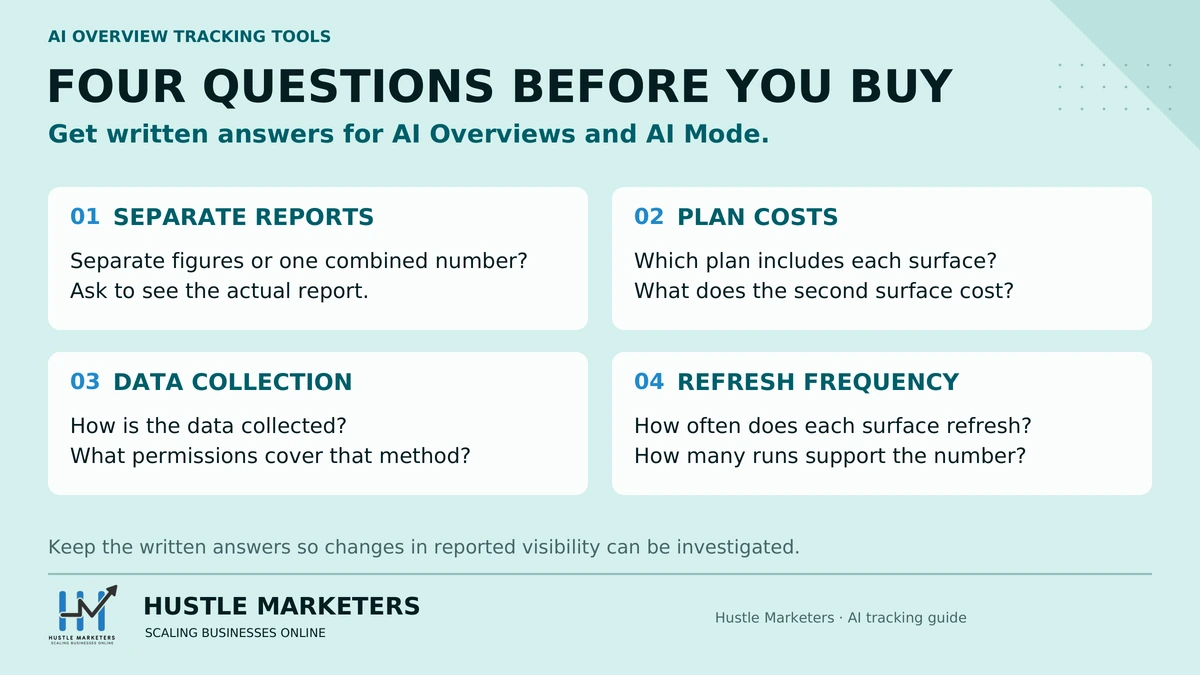
Four questions, in writing, before the contract. Keep the answers, because they are the only record you will have when a number moves and you need to know which surface caused it.
- Does your report show AI Overviews and AI Mode as two separate figures, or one combined figure? Ask for a screenshot of the report, not the engine list.
- Which plan includes each Google surface, and what does the second one cost on top?
- How do you reach Google’s surfaces, and do you have express permission from Google to do so?
- How often does each Google surface refresh, and how many runs sit behind the number I see?
Why is AI Mode sold as an upsell when Google reports one combined number
Because the second Google surface is the easiest thing in the category to charge for. Six of the 15 vendors we read put AI Mode behind a higher tier or an add-on, while AI Overviews sits in the entry plan or the free tier. The pattern is consistent and it is priced.
- Otterly includes AI Overviews from the Lite plan and bills Google AI Mode as an add-on at $9, $59 or $149 a month depending on tier, read 1 October 2026.
- Writesonic puts AI Overviews in the $79 a month Starter billed annually, and AI Mode at Enterprise, four tiers up, with no published price, read 1 October 2026.
- Scrunch includes AI Overviews in the $250 a month Core plan for brands and holds AI Mode for custom-priced Enterprise, read 1 October 2026.
- AthenaHQ gives AI Overviews away on the free Essential tier and gates AI Mode behind Starter at $295 a month, read 1 October 2026.
- Profound has AI Overviews in the free trial and states AI Mode is available to select enterprise customers, read 1 October 2026.
- Semrush gives AI Overviews tracking on any free or paid plan and charges $99 a month per domain billed annually for AI Mode through the AI Visibility Toolkit, read 1 October 2026.
Now the punchline. Only 2 of the 15 will state in writing that their product reports the two surfaces separately. Google’s own report, which costs nothing, does not separate them at all. So the premium buys a split that most vendors decline to document and the first-party source does not provide.
Five vendors publish no AI Mode price whatsoever. Profound, Scrunch Enterprise, AthenaHQ Enterprise, Writesonic Enterprise and Otterly Enterprise all price the relevant tier as custom. Two more, Peec and Nozzle, publish no numeric price for anything, read 1 October 2026.
One pricing structure deserves a separate warning. Peec’s Starter, Pro and Advanced plans each let you choose three models, read 1 October 2026. Tracking both Google surfaces therefore consumes two of your three slots on every tier below Enterprise.
The agency arithmetic is worse than the sticker price suggests. Per-domain and per-entity pricing multiplies by client count, not surface count. Work the total across your book before signing anything annual, and see our notes on SEO tools for agencies.
How do these tools get the data, and what does Google’s spam policy say about that
Most of them query Google and read what comes back. Google’s spam policies describe automated querying of Search in strong terms. The policy covers method, not any named company, and the gap between what vendors publish and what the policy says is the sharpest thing in this whole category.
What Google’s policy actually says
Google names machine-generated traffic as the practice of sending automated queries to Google, and says such traffic violates “our spam policies and the Google Terms of Service”, read 1 October 2026.
The prohibited conduct is spelled out. It expressly includes “scraping results for rank-checking purposes or other types of automated access to Google Search conducted without express permission”, read 1 October 2026. Those last three words carry the weight.
Zero of the 39 competitor pages we read mention the spam policies or the Terms of Service. Google also extended the policies to the AI surfaces, naming attempts to manipulate generative AI responses in Google Search as prohibited conduct on the same page.
What each group of vendors publishes
Seven of 15 describe a method clearly enough to assess. Four say only that prompts are run, without saying how the surface is reached. Four say nothing. None of the 15 AI Overviews trackers we read claims express permission from Google, so the question is open across the whole category and not only among the silent ones.
| Group | Vendors | What they publish, read 1 October 2026 |
|---|---|---|
| Capture from the live consumer surface | ZipTie, SE Ranking, Ahrefs, SEOmonitor, Keyword.com | ZipTie says not model API stubs. SE Ranking says not API based results. Ahrefs says the free, publicly available web interfaces. SEOmonitor captures the full answer including content behind Show more. Keyword.com uses the word scraped outright. |
| Mixed method including official APIs | Scrunch | Browser automation and official platform APIs. The only vendor of the 15 to assert any API basis for part of its collection. |
| Query based retrieval, described in privacy terms | Advanced Web Ranking | Only a keyword related query is sent, and results are looked up locally. That describes the mechanics without addressing permission. |
| Says only that prompts are run | Semrush, Peec, Profound, Rankscale | Prompts are executed on a schedule. How the Google surface is reached is NOT PUBLISHED. |
| Silent | Otterly, AthenaHQ, Nozzle, Writesonic | NOT PUBLISHED. No statement on scraping, APIs, panels or browser automation anywhere we could read. |
What we are not saying, and what you should do
We are not saying any named vendor breaches Google’s spam policies or Terms of Service. We do not know what private permissions exist between Google and any company, and that is a legal characterization we have no standing to make. What we publish is what each vendor discloses and what it leaves out.
Google is also plain about third-party tools generally. It states that “Google doesn’t evaluate or endorse third-party SEO tools”, updated 5 June 2026, and tells readers to be wary of any tool claiming to be acceptable or approved by Google Search.
Its generative AI guidance repeats the point. Google states that “no third-party tool has access to our internal ranking or AI systems”, read 1 October 2026. So no vendor number is a Google number, whatever the dashboard calls it.
Your one action is simple. Ask the vendor, in writing, how it reaches Google’s surfaces and whether it has express permission to do so. File the reply. A vendor that will not answer that in writing has told you something.
How do you check your own AI Overview visibility for free, and why must you be de-personalized
Start with Search Console, then add a dated manual check. A logged-in check tells you almost nothing, because Google tailors results to the person searching. Exactly one of the 39 competitor pages we read tells the reader to de-personalize, which is the clearest gap in the category.
Why a logged-in check is worthless
Ahrefs’ own help center explains the mechanism. It states that Google customizes search results using a user’s previous searches and clicked links, read 1 October 2026. It names logged-in state as a factor and recommends incognito, logging out and a VPN.
Another rank tracker’s help center says the opposite. AgencyAnalytics states that “signing out of your Google account and/or using Google Incognito mode are not accurate methods for rank tracking”, read 1 October 2026.
Two vendors, two opposite instructions on the exact question a practitioner asks when a number does not match the screen. The honest reading is that signing out reduces personalization without removing it, so treat a manual check as a second reading rather than the truth.
Location is the variable people forget. The same vendor warns that a site can rank first in one US city and far lower in another, read 1 October 2026. Set it explicitly every time.
Why AI Mode is harder to de-personalize than AI Overviews
Google ties parts of AI Mode to the signed-in account. It documents that AI Mode history and personalized recommendations work best when signed in, and that its most advanced model capability requires being signed in to a personal Google Account, read 1 October 2026.
What Google does not publish is whether sign-in is required for baseline AI Mode access. So a signed-out check may not show the same product a signed-in buyer sees, and Google documents no comparison between the two states.
A second complication is unique to this surface. Google invites users into an AI Mode experiment in Search Labs, and separately excludes Search Labs from Search Console. So your manual check and your baseline can see different versions of AI Mode.
One competitor page gives a manual AI Mode method with no warning at all. LLM Pulse tells readers to test prompts in Google AI Mode directly and check whether their brand appears. With no account state and no location, that instruction is unsafe as written.
The free method, step by step
Two halves. Google gives you the trend, and a manual check gives you the detail Google will not report. Run both monthly and keep the records dated, because neither half is reproducible later.
- Open the Generative AI performance report and record impressions by page, country and device. That is your trend line for both surfaces.
- Open the main Performance report, filter the query dimension with the regular expression above, and record the AI Mode conversation turns.
- Pick 8 to 12 questions a buyer genuinely asks before choosing a supplier. William DiAntonio uses prospects’ real pre-purchase questions, published 25 November 2025.
- Run each question in a fresh browser profile, signed out, with location set to your target market, on mobile and desktop.
- Record date, time, device, location and account state beside every result. Screenshot each surface separately.
- Repeat the set the same day in a second session and compare. If the two runs disagree, that disagreement is the finding.
Budget the time honestly. Tony Crisp reports 90 minutes per client per month for a campaign-scoped manual check, published 25 November 2025. That is one agency’s own estimate and the only figure of its kind we found.
One note stops a common mistake. AI Overviews have appeared to signed-out users since at least August 2024, reported by Search Engine Roundtable on 15 August 2024, so signing out does not remove them. The cross-platform method sits on our guide to tracking brand visibility in AI search.
If citation order changes in a minute and your tool refreshes weekly, what number are you seeing?
A sample of one moment, labeled as a position. The live surface reorders faster than any tracker refreshes, and most vendors publish a cadence that cannot keep up. Put the two published facts side by side and the conclusion draws itself. Both facts below are on the record.
First fact. Barry Schwartz reported that running the same query a minute later may return different citation cards, published 14 November 2025. On the same page, Patrick Stox of Ahrefs said the order of the cited websites changes when you click to expand them, with two publishers swapping places in his example.
Second fact. AgencyAnalytics publishes that keywords auto-refresh on a weekly basis, read 1 October 2026. Ahrefs adds that a manual check usually happens anywhere from a few hours to a few days after its tracker pulled data.
Among our 15, published cadence varies more than price does. Semrush, SE Ranking, Otterly, Peec and SEOmonitor publish daily refresh, while Ahrefs updates AI Overviews every few days and its chatbot data monthly. Rankscale and ZipTie offer hourly to monthly, and Scrunch publishes no refresh frequency at all.
Repeat-run volatility has been measured, by a vendor that sells an AI Mode tracker. A study by SE Ranking, reported by Search Engine Journal on 1 July 2025, ran 10,000 keywords through AI Mode three times in one day and found average exact-URL overlap of 9.2 percent, with no overlap at all in 21.2 percent of cases.
Two practical rules follow. Decide in advance how many runs make a reading, and publish that run count beside the number in every client report. Nobody in this category has published an answer to how many runs are enough.
Then accept the consequence. A screenshot of an AI Overview is not reproducible, even by the person who took it a minute earlier. Report the method and the trend rather than the snapshot. We cover that discipline in automated SEO reporting.
What changed for every rank tracker when Google dropped num=100
Collection got more expensive overnight, and cadence was the first thing vendors gave up. Tim Soulo of Ahrefs described the change, reported by Search Engine Roundtable on 15 September 2025: Google dropped the parameter that allowed SEO rank tracking tools to pull the top 100 search results in a single page load.
The vendors published the consequences themselves on the same page. AccuRanker moved to the top 20 only, and Semrush said some rankings moved to a two-day refresh. AgencyAnalytics ties its weekly historical refresh to Google’s 100-results-per-page restriction introduced in 2025, read 1 October 2026. The AI surfaces sit in those same page loads, and nobody in the competitor set connects the two.
Which crawler and which controls actually apply, and why Google-Extended is not one of them
Googlebot serves both surfaces and there is no dedicated AI crawler. Google names robots.txt directives for Googlebot as the access control for site owners, read 1 October 2026. Google-Extended is the trap, because it looks like the right lever and governs something else.
Google states that “Google-Extended does not impact a site’s inclusion in Google Search”, and that Google-CloudVertexBot has no effect on Google Search or other products, read 1 October 2026. Google-Extended governs training and grounding in other Google systems, not these two surfaces.
Practitioners worked that out before the control existed. On Hacker News on 8 July 2025, the posters imilk and beejiu noted that Googlebot itself feeds AI Overviews and that Google-Extended has no separate user agent string, in a thread on blocking AI Overviews.
| Control | Scope as Google documents it, read 1 October 2026 | Affects AI Overviews and AI Mode |
|---|---|---|
| Search generative AI control in Search Console | Property level, inheritable from parent to child | Yes, both, plus Discover generative features |
| robots.txt for Googlebot | Crawl access | Yes. Named as the access control |
| nosnippet, data-nosnippet, max-snippet | Preview content limits in Search | Yes, as general Search preview controls |
| noindex | Index removal | Yes. Indexing is a stated eligibility condition |
| Google-Extended | Training and grounding in other Google systems | No. Google states it does not affect Search inclusion |
| Google-CloudVertexBot | Vertex AI agents | No. Google states it has no effect on Google Search |
One documented absence closes the section. Google publishes no breakdown of which AI feature each snippet control suppresses, treating nosnippet, data-nosnippet, max-snippet and noindex as general Search preview controls, read 1 October 2026. Anyone promising feature level suppression through a snippet tag goes beyond Google’s documentation. The groundwork sits in our technical SEO checklist.
What does the evidence say about how different the two surfaces are
One study carries almost all the weight here, and nearly every page citing it gets a detail wrong. It is an Ahrefs study of September 2025 United States data. It measures citation overlap, not URL overlap, and its window predates everything Google shipped in August 2026.
We read it first hand at the Ahrefs blog on 1 October 2026. It was published 15 December 2025 and last modified 5 June 2026, by Despina Gavoyannis and Xibeijia Guan, reviewed by Ryan Law. Every competing page we read omits its data window.
| Finding | As Ahrefs states it | Source, read 1 October 2026 |
|---|---|---|
| Overlap between the surfaces | Only 13.7 percent of citations overlap between AI Overviews and AI Mode. Citation overlap, not URL overlap. | Ahrefs |
| Sample | 540,000 query pairs for the citation and URL analysis, plus a further 730,000 query pairs for content similarity. Citing pages routinely drop the second figure. | Ahrefs |
| Responses with no brands | 59.41 percent of AI Overview responses and 34.66 percent of AI Mode responses. | Ahrefs |
| Data window | September 2025, United States, collected through Ahrefs Brand Radar. | Ahrefs |
One caution about the same vendor’s own numbers. Ahrefs publishes two different pairs of volumes for these surfaces on two pages read the same day: 314,169,431 for AI Overviews and 12,378,991 for AI Mode, against 282 million and 24 million on its methodology page. Its prompt corpus appears as both 448 million and 405 million prompts. Neither pair is reconciled, so no single figure is authoritative.
What nobody has published, including Google
Google has never published a trigger rate, a click-through rate or a citation rate for either surface. We checked the AI Overviews help page, the AI Mode help page, the generative AI optimization guide and the Search blog on 1 October 2026. There is no figure of any value.
Google describes triggering qualitatively instead, saying you will find AI Overviews “when our systems determine that generative AI can be especially helpful”, read 1 October 2026. No percentage, no frequency, no rate anywhere.
Its nearest statement is directional. In its Search blog of 6 August 2025 Google said “total organic click volume from Google Search to websites has been relatively stable year-over-year”, with no baseline and no method. So every trigger rate circulating here is a third-party measurement, and the ones we found disagree by a factor of three. We have restated none.
Who should not buy one of these tools
Plenty of people, and the vendors will not say so. Most AI Overviews trackers are sold as though every site needs one, when Google’s free baseline answers the first question. Spend the subscription when it changes a decision, and not before.
- You have no Search Console baseline yet. Set that up first, because it covers both Google surfaces and costs nothing.
- One combined number for both surfaces answers your question. Google already gives you that, free.
- You cannot name the 8 to 12 questions a buyer asks before choosing you. A prompt set built on guesswork measures guesswork.
- Your client report has to show clicks or revenue from these surfaces. No tool here can give you that, and neither can Google.
- You are an agency paying per domain or per tracked entity. Multiply by your client count before signing anything annual.
One more reason to stay skeptical of a score. David Nelson reported on 26 August 2026 that one tool showed a 90 percent visibility score while the answer named the wrong person as the brand’s leader. Read the answer, not only the number. The wider argument about scores and sample size sits on the AI visibility tools page, with citations versus mentions.
What we do at Hustle Marketers
We run the measurement in a fixed order, because the cheap step answers most of the question. Search Console baseline first, dated manual checks second, a paid tool only when a client decision depends on knowing which Google surface moved. We sell services, so no tool goes in front of that order.
Hustle Marketers is a Google Partner, a Meta Business Partner and a Microsoft Advertising Partner, with a Clutch rating of 5.0 from more than 50 reviews and 4.9 out of 5 from 591 reviews.
When we do recommend a tool, the choice rests on two published answers: does it report the two Google surfaces as two figures, and does it say how it collects them. Our clients start SEO from $500 a month, current at October 2026 and quoted as a starting range because scope varies by business. See our SEO packages or what we do as an AI SEO company.
Related guides
- AI visibility tools, for the general market and why three tools disagree.
- Google AI Overviews optimization, for getting cited rather than measuring citations.
- ChatGPT, Perplexity, Claude and DeepSeek rank tracking, for the other four surfaces.
- Answer engine optimization and AI search optimization, for the work after measurement.
- Entity SEO and structured data for SEO, for the groundwork.
- AI SEO tools and brand visibility in AI search.
FAQs
This block carries no FAQPage markup on purpose, and that is a deliberate choice rather than an oversight. Google’s own Search Console documentation lists FAQ rich results among its deprecated Search appearance values, read 1 October 2026, so the markup earns nothing here.
Does Search Console separate AI Mode from AI Overviews?
No. The report names both surfaces and gives one impressions figure covering them, with dimensions limited to Pages, Countries, Dates and Devices, read 1 October 2026. There is no AI Overviews dimension and no AI Mode dimension.
Can I see which queries triggered an AI answer?
Not in the dedicated generative AI report, which has no query dimension. AI Mode conversation turns do appear in the main Performance report, because Google counts a follow-up as a new query.
Does opting out of AI Overviews keep me in AI Mode?
No. One control covers AI Overviews, AI Mode and Discover generative features together, and Google publishes no per-surface opt-out. Excluding your site stops your links appearing in all three.
Is there a free AI Overviews tracker?
Google’s own report is the free first-party option, covering both surfaces as one number. Several vendors offer free tiers, including one in our table. For AI Mode, the free route is the Search Console query filter above.
Do I need a separate tool for AI Mode?
Only if your current tool cannot report the two surfaces separately, and most will not confirm in writing that they do. Ask for a screenshot of the report rather than the engine list. Two of fifteen state the separation in their own documentation.
Does blocking Google-Extended stop AI Overview citations?
No. Google states Google-Extended does not affect a site’s inclusion in Google Search, read 1 October 2026. Googlebot serves both surfaces, so the levers are robots.txt for Googlebot, the snippet controls, noindex and the Search generative AI control.
Which AI Overview tracker is the most accurate?
Nobody knows, because nobody has published a multi-tool benchmark on Google’s two surfaces, including us. Only one vendor in our set publishes a numeric accuracy figure, and attaches it to rank tracking rather than the AI surfaces. Treat any accuracy claim without a method as marketing.