Claude Rank Tracking: Which Tools Track Claude, and What They Cost

Ishant
Published : October 13, 2026 at 10:30 am
Updated : October 16, 2026 at 12:13 pm
Ishant

Claude rank tracking means watching whether Claude names and cites your brand when buyers ask it for recommendations. Before you pay for it, two things are worth knowing: which tools actually support Claude, and what there is to track in the first place. We checked both.
Quick Discussion. Twenty-one of the 28 AI visibility tools we checked will track Claude. Only 13 of them include it in an ordinary self-serve plan at no extra charge. Four hide it behind Enterprise pricing they do not publish, four bill it as an add-on or make you supply your own Anthropic API key, and seven do not offer it at any price. The cheapest plan where you can track Claude with a usable prompt allowance is Trackerly.ai at $27 a month. Prices read on each vendor’s own pricing page on 29 September 2026.
That is the buying answer. The harder answer has three parts. Claude only cites web pages when web search actually runs, and most of the pages selling you Claude tracking never mention it. Anthropic’s own Consumer Terms prohibit reaching claude.ai with a bot or script unless you go through an API key. And which surface your tracker queries changes the number it reports.
Not one of the 14 pages currently ranking for this topic tells you which surface it uses. We checked all 14.
What is Claude rank tracking, and is “rank” the right word?
Claude rank tracking means running a set of buying-intent prompts through Claude on a schedule and recording whether your brand is named, whether it is cited with a link, and how that changes over time. Tools sell it as a rankings product because rankings are what the market understands. The word is misleading, and the best available evidence says so plainly.
SparkToro had 600 volunteers run 12 prompts through ChatGPT, Claude and Google’s AI Overview a combined 2,961 times in November and December 2025. Rand Fishkin’s summary of what came back: “There’s a <1 in 100 chance that ChatGPT or Google’s AI, if asked 100X, will give you the same list of brands in any two responses”. On Claude specifically, “Claude is just slightly more likely to give you the same list twice in a hundred runs, but even less likely to do so in the same order”. His verdict on the product category is unambiguous: “any tool that gives a ‘ranking position in AI’ is full of baloney”.
He does not conclude that measurement is hopeless. He concludes that one metric survives: “visibility % across dozens to hundreds of prompts run multiple times is a reasonable metric”. That is the distinction this page is built on. A position number for a Claude answer is noise. A visibility percentage across a large prompt set run repeatedly is a real signal. Read our piece on citations versus mentions for why the two are not the same measurement.
Source: SparkToro, published 28 January 2026, modified 28 June 2026.
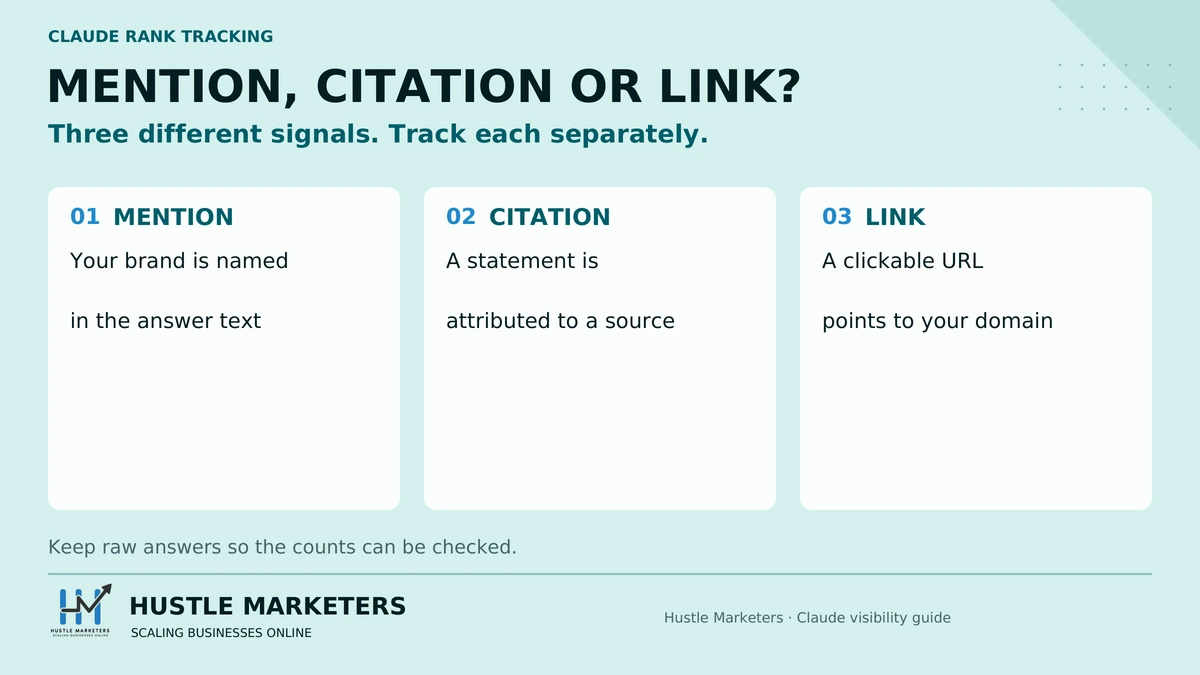
Mention, citation and linked citation are three different things
Vendors report all three as “visibility” and the numbers are not interchangeable.
| What it is | What it means | Can Claude do it without web search? |
|---|---|---|
| Mention | Claude names your brand in the answer text | Yes. Claude can name a brand from training data alone. |
| Citation | Claude attributes a statement to a source | No. Citations come from retrieved pages. |
| Linked citation | The cited source is a clickable link to your domain | No. Requires a retrieved URL. |
This is the reason a Claude tracker and a ChatGPT tracker can disagree about the same brand on the same day without either being broken. They may be counting different things on different surfaces.
Does Claude cite sources, and when?
Yes, but only when web search runs. This is the single most important technical fact for anyone buying Claude tracking, and eight of the 14 pages currently ranking for this topic never mention it.
On the consumer apps, when Claude searches, Anthropic states that “Every response includes citations, so you can easily verify sources yourself”. On the Claude API, citations are not optional: the documentation says “Citations are always enabled for web search”. But a bare API request does not search at all. The developer has to pass the web search tool in the request, and Anthropic’s instruction is imperative: “Provide the web search tool in your API request”.
There is a third case that catches people out. The separate web fetch tool, which pulls a specific page rather than searching, has citations “optional for web fetch and disabled by default”. So a Claude-powered application can read your page and quote it with no attribution at all, because the developer never switched citations on.
When does Claude actually search?
| Surface | Does it search the web? | Are citations produced? |
|---|---|---|
| claude.ai, new interface | Claude decides per query. Anthropic: “Claude searches the web when it helps” | Yes, when it searches |
| claude.ai, legacy toggle | Only if the user ticks Web search | Yes, when it searches |
| Team and Enterprise workspaces | Off until an owner enables it for the whole workspace | Yes, once enabled and used |
| Anthropic API, web search tool | Only if the developer passes the tool in the request | Always, cannot be disabled |
| Anthropic API, web fetch tool | Only if the developer passes the tool | Off by default |
Two consequences follow, and they are the reason Claude numbers are harder to read than ChatGPT numbers. First, a zero-citation result is ambiguous. It can mean Claude searched and did not find you, or that Claude never searched. Second, a tracker hitting the API without the search tool enabled will report zero citations for everybody, by construction, and the dashboard will look like a working product.
What a zero-citation result really means
Samy Ben Sadok of GEO Toolbox is the only person we found who has measured this. Across 1,359 search-enabled Claude runs in his own tracker, 51 came back with no citation at all, which he reports as 3.8 percent. His conclusion matches the documentation: Claude chooses whether to search per query, and most tools do not separate “searched and did not cite you” from “did not search”.
One more thing Anthropic does not publish: how Claude decides which sources to cite. There is no documented ranking signal, no source-quality criterion, no recency weighting. Every “how to get cited by Claude” claim in the vendor literature, including the ones that sound authoritative, is inference. We have not found an exception.
Which tools actually track Claude?
We checked 28 AI visibility and rank tracking tools on 29 September 2026, reading each vendor’s own pricing, features or documentation page. No third-party listicles, no review sites. Twenty-one track Claude. Seven do not offer it at any price.
The trap that produces false positives in every roundup
One trap worth naming, because it produces false positives in every roundup we read: several vendors mention Claude only as an MCP client, meaning you can query their data from inside Claude. That is the opposite of tracking Claude. ZipTie.ai and SE Ranking both read as Claude-friendly on a quick scan for exactly this reason, and neither tracks Claude. Similarweb is subtler still: it sells a “Claude Traffic Tracker” that measures referral traffic from Claude to your site, while its own FAQ says the brand visibility tracker covers ChatGPT, Google AI Mode, Gemini and Perplexity.
All 28 tools, sorted by the cost of reaching Claude
| Tool | Tracks Claude? | Tier required | Published price of that tier | Vendor page checked |
|---|---|---|---|---|
| Trackerly.ai | Yes, all tiers | Lite | $27/mo, 4,500 credits, Claude 1 credit/query | trackerly.ai/pricing |
| Geoptie | Yes, all tiers | Starter (any 4 of 7 engines) | $41/mo or $490/yr | geoptie.com/pricing |
| LucidRank | Yes, from Pro | Pro (Starter excludes Claude) | $49/mo (Starter $19/mo, no Claude) | lucidrank.io |
| Rankry | Yes | Base | $79/mo annual, $99/mo monthly | rankry.ai |
| Nightwatch | Yes, all tiers | Starter | EUR 79/mo | nightwatch.io/ai-tracking |
| Finseo | Yes | Starter, any 3 models picked freely | EUR 84/mo excl. VAT | finseo.ai/pricing |
| Rankscale | Yes on Pro; Essentials unclear | Pro | $99/mo (Essentials $20/mo, coverage not stated) | rankscale.ai/pricing |
| Knowatoa | Yes, but not on Starter | Growth | $199/mo (Starter $59/mo excludes Claude) | knowatoa.com/pricing |
| Scrunch AI | Yes, all tiers | Starter | $250/mo annual, $300/mo monthly | scrunch.com/pricing |
| AthenaHQ | Yes, but not on the free tier | Starter | $295/mo (free Essential tier excludes Claude) | athenahq.ai/pricing |
| Rankability | Yes | Single Agency plan | $497/mo on a 12-month agreement, or $4,970/yr | rankability.com/pricing |
| Evertune | Yes | Pro, the lowest published tier | $800/mo | evertune.ai/pricing |
| Keyword.com | Yes, but Claude costs 3.0 credits per prompt | AI Visibility plan | From $7.83/mo annual for 20 credits | keyword.com/pricing |
| Otterly.ai | Yes, paid add-on only | Add-on on any tier | Lite $29/mo plus Claude add-on $29/mo = $58/mo | otterly.ai/pricing |
| LLM Pulse | Yes, paid add-on only | Add-on on any tier | Starter EUR 49/mo plus Claude “from $10 per month, per model” | llmpulse.ai/pricing |
| Ahrefs Brand Radar | Yes, add-on only | Custom Prompts add-on | “Starts at $50/mo” | ahrefs.com/brand-radar |
| Gauge | Yes, bring your own Anthropic API key | Any plan; Claude not included in the subscription | Growth $599/mo plus Anthropic billing you separately | withgauge.com/pricing |
| Profound | Yes, Enterprise only | Enterprise | Custom, no price published | tryprofound.com/pricing |
| Peec AI | Yes, Enterprise only | Enterprise | Custom. Starter/Pro/Advanced say “Choose 3” from a list without Claude | peec.ai/pricing |
| Writesonic | Yes, Enterprise only | Enterprise | Custom. Growth, the top published tier, is $399/mo and excludes Claude | writesonic.com/pricing |
| Goodie AI | Yes, Enterprise only | Enterprise | Custom. Pro at $999/mo excludes Claude | higoodie.com/pricing |
| Semrush AI Toolkit | No | Not offered | $99/mo per domain. Page lists ChatGPT, Google AI, Gemini, Perplexity | semrush.com/pricing/ai |
| SE Ranking | No | Not offered | AI Search add-on $71.20 to $89/mo. Tracks AI Overviews, AI Mode, Perplexity, ChatGPT | seranking.com |
| Surfer AI Tracker | No | Not offered | AI Search Analytics $82/mo. Supports Gemini, AI Overviews, AI Mode, ChatGPT, Perplexity | surferseo.com/ai-tracker |
| Similarweb AEO | No, for answer monitoring | Not offered | AEO Intelligence $99/mo. Brand visibility tracker excludes Claude | aisearch.similarweb.com |
| ZipTie.ai | No | Not offered | From $42.75/mo. Claude appears only as an MCP client | ziptie.ai/pricing |
| AmIOnAI | No | Not offered | Pro $100/mo, Prism $349/mo, GEO Council $2,500/mo | amionai.com/pricing |
| Advanced Web Ranking | No | Not offered | Pro $139/mo. No LLM answer tracking offered | advancedwebranking.com/pricing |
Why is Claude missing from the cheaper plans?
Because across this market, Claude rank tracking is treated as a second-class feature. Only 13 of the 28 tools we checked include it in an ordinary self-serve plan with no add-on fee, and two of those, Keyword.com and Rankscale, still charge more credits per Claude check. That is the finding we did not expect and have not seen published anywhere else.
The gating takes four distinct shapes, and each one costs you differently.
Claude behind Enterprise, with no published price
Four vendors put Claude only in a custom-priced tier: Profound, Peec AI, Writesonic and Goodie AI. In each case you can see the published ladder and Claude is not on it. Writesonic’s Starter, Basic and Growth plans, up to $399 a month, all read “ChatGPT, Gemini, Google AI Overviews”. Goodie AI’s Pro at $999 a month excludes Claude. If Claude matters to you, you cannot buy these products off the page at all: you have to take a sales call to learn the price.
Claude as a paid add-on on top of the subscription
Four more charge separately. The starkest is Otterly.ai, where the Claude add-on is $29 a month on a $29 a month base plan. Adding one engine doubles the bill. LLM Pulse lists Claude as an add-on “from $10 per month, per model” while five other engines come in the base tier. Ahrefs reaches Claude only through its paid Custom Prompts product, from $50 a month. Gauge does not track Claude itself at all on any tier: you connect your own Anthropic API key and Anthropic bills you directly, on top of $599 a month.
Claude absent from the entry tier, so you pay a step up
| Tool | Cheapest plan | Does that plan include Claude? | Plan you need for Claude | Step up |
|---|---|---|---|---|
| Knowatoa | $59/mo Starter | No. ChatGPT, AI Overviews, AI Mode only | $199/mo Growth | 3.4x |
| LucidRank | $19/mo Starter | No. ChatGPT and Gemini only | $49/mo Pro | 2.6x |
| AthenaHQ | Free Essential tier | No | $295/mo Starter | Free to $295 |
Claude priced at a premium per query
Keyword.com is the one to read carefully, because on paper it looks like the cheapest way into Claude tracking anywhere. Its AI Visibility plan starts at $7.83 a month billed annually. But its own credit calculator charges Claude at 3.0 credits per prompt, the highest rate of any engine on the platform, and the entry plan carries 20 credits. That is roughly six Claude checks a month. It clears the bar technically and not practically, and we would be doing the same thing the vendors do if we printed $7.83 as the headline number.
One caveat on our own table. Prices move, tiers get renamed, and engines get added and dropped. Every figure here was read on the vendor’s page on 29 September 2026 and none of the 14 competing pages we read put a date on a single price. Treat ours as perishable too.
Is automated Claude tracking even allowed?
This is the question none of the 14 ranking pages asks, and it has a documented answer. Anthropic’s Consumer Terms draw a line between two ways of reaching Claude, and only one of them is clearly open to a tracking vendor. It matters commercially as well as legally, because the two methods measure different systems and return different numbers.
Anthropic’s Consumer Terms of Service, effective 8 October 2025, list what you may not do. Item 7 reads, in full: “Except when you are accessing our Services via an Anthropic API Key or where we otherwise explicitly permit it, to access the Services through automated or non-human means, whether through a bot, script, or otherwise.”
Item 4 of the same list adds: “To crawl, scrape, or otherwise harvest data or information from our Services other than as permitted under these Terms.”
Read plainly, that means there are two ways to measure Claude and only one of them is clearly permitted. A vendor querying the Anthropic API with a key is inside the carve-out. A vendor scripting claude.ai, the consumer product, is not.
We are not lawyers and this is not legal advice. But the practical consequence is straightforward, and it is a buying question rather than a legal one. The two methods measure different systems and produce different numbers:
| Scripted claude.ai | Anthropic API with the web search tool | |
|---|---|---|
| Covered by the Consumer Terms carve-out? | No | Yes |
| Matches what a real user sees | Closer to it | No. No consumer personalization |
| Location-influenced answers | Yes. Anthropic says it may use your IP-inferred location | No |
| Developer can restrict which domains are searched | No | Yes, via allowed_domains and blocked_domains |
| Continuity risk if access is blocked | Higher | Lower |
So the question to put to any vendor before you sign is one sentence: does your tracker query claude.ai or the Anthropic API? Not one of the 14 pages we read discloses this about its own product. Anthropic publishes no approved-vendor list, no certification and no endorsement for visibility tracking of any kind.
How consistent are Claude’s answers, and how many runs do you need?
Not very, and more than any vendor’s default setting gives you. This is the reason a single check tells you nothing and a monthly report built on one run per prompt is decoration.
| Who | What they ran | What they found |
|---|---|---|
| SparkToro (Rand Fishkin), Jan 2026 | 600 volunteers, 12 prompts, ChatGPT, Claude and Google AI, 2,961 runs, Nov to Dec 2025 | “<1 in 100 chance” of the same brand list twice. Claude marginally more repeatable, but less likely to repeat the order |
| Mike Sonders, Search Engine Land (no date shown) | 12 prompts, 100 runs each, 1,200 interactions, each from a different IP, logged-out ChatGPT | “A single spot-check for any given prompt is nearly meaningless.” Recommends dozens to 100+ runs |
| MaxAEO (Chris Han), Jul 2026 | 320 buyer-intent prompts, 3 engines, 12 weekly runs, 11,520 answers, Apr to Jul 2026 | Claude names 4.1 brands per answer vs ChatGPT 7.9. Gives an ordered ranking in 23% of answers vs 61%. Names zero brands 9.4% of the time vs 2.1% |
| GEO Toolbox (Samy Ben Sadok), Sep 2026 | 1,359 search-enabled Claude runs | 3.8% returned no citation at all |
Two of those findings deserve to change how you read a Claude report. MaxAEO measured 14 percent week-over-week churn in the top brand, which is why they write that “a two-week Claude test is noise” and that movement becomes readable at six to eight weeks. And Claude declines to name any brand in 9.4 percent of buyer-intent answers, against 2.1 percent for ChatGPT, so a flat Claude line can mean Claude hedged rather than that you lost ground.
If you want a defensible number rather than a dashboard, the run counts in the table above are the real cost of measurement. SparkToro’s office hours put the price of plus or minus one percentage point at roughly 1,400 results: 10 prompts, 7 phrasings, 7 model families, 20 repeats. Most tools do not run anything close to that, and most do not publish what they do run.
Do the tools agree with each other?
No, and practitioners say so on the record. Paul Dyer, chief executive of /prompt, told Digiday in May 2026: “If you use three different tools and give them the same prompts, you get three different answers”. Asked which Claude trackers were best, Samy Ben Sadok put the question to four AI engines and reported that “no product appeared in all four answers”.
Dan Taylor, head of technical SEO at SALT.agency, named the structural reason in Search Engine Land in June 2026: “Modern LLM visibility tools obscure their denominator within proprietary, vendor-defined systems that are almost certainly incomplete”, while “the universe of possible AI prompts is effectively infinite”. His recommendation is that these numbers “should be treated as directional signals rather than hard numbers”.
The practical version, from buyers who have paid: Sean Begg Flint of Position Digital reported of one tool that “the main dashboard says your brand gets a mention, but the actual prompt analysis doesn’t show your brand”. Victoria Spall at Browser Media put the cost side bluntly in August 2026: “you’re into four figures a month before you’ve optimised a single page”.
There is also a feedback loop worth knowing about. Taylor, writing separately in Search Engine Journal in April 2026, pointed out that a tracker’s own prompts cause AI agents to fetch your site, so “AI visibility trackers are quietly breaking the analytics of brands who are paying them to track for them”. His illustrative figure is explicitly hypothetical, but the mechanism is real and it lands in the same analytics you are using to judge the tool.
Is Claude worth tracking separately from ChatGPT?
There is a genuine argument on both sides and the answer depends on who your buyers are. We will give both cases with the numbers attached, rather than pretend this is settled.
The case for tracking Claude
- Claude usage nearly tripled in a year. Menlo Ventures surveyed 5,067 US adults with Morning Consult in July 2026. Claude use rose from 7 percent of AI users in 2025 to 20 percent in 2026, the fastest growth of any assistant measured.
- Claude users are the ones who pay. In the same survey, 82 percent of Claude users pay for AI, and 48 percent run AI agents, about 1.5 times the rate among ChatGPT or Gemini users.
- Claude behaves differently enough that ChatGPT data does not substitute. Naming 4.1 brands per answer against 7.9, and hedging before naming a brand 68 percent of the time against 31 percent, is a different surface, not a smaller version of the same one.
- It is the fastest-growing referrer in the largest published sample. SE Ranking analyzed 101,574 sites with Google Analytics between January 2025 and April 2026 and found Claude referrals grew 386 percent from January to April 2026 while ChatGPT grew 1.53 percent.
The case against, or at least not first
- The absolute numbers are small. In that same SE Ranking sample, Claude accounts for 1.40 percent of AI-referred traffic against ChatGPT’s 78.23 percent. Samy Ben Sadok’s conclusion is direct: “Claude should not be the first engine you pay to track.”
- Claude tracking carries a price penalty, as the tables above show. You are paying more per engine for the engine that sends the least traffic.
- Claude users may not be searching. SE Ranking’s read of the behavior is that Claude users lean toward writing, coding, analysis and working with data rather than search-first browsing, which is the strongest published reason not to score Claude on the same axis as ChatGPT.
- The measurement is noisier. A 9.4 percent rate of naming no brand at all, and 14 percent weekly churn at the top, means you need longer windows and more runs to see anything real.
Our position. If you sell to developers, technical buyers or enterprises, Claude is worth tracking and the Menlo payment and agent figures are the reason. If you sell to consumers or local customers, track ChatGPT first, get your reporting honest, and add Claude when the ChatGPT program is actually producing decisions. Greg Jarboe’s rule in Search Engine Journal is a good one for engines you are unsure about: de-weight rather than delete, because small and irrelevant are not the same thing.
How do you check your Claude visibility for free, before paying anyone?
None of the 14 pages ranking for this topic tells you how to do this, which is unsurprising given all 14 are selling a tracker. It takes about 20 minutes and it will tell you whether you have a problem worth spending $27 to $599 a month on.
- Write 10 prompts a real buyer would type. Not your brand name. Buying-intent questions: “best [category] for [customer type]”, “[competitor] alternatives”, “how do I choose a [category] provider”. Take the wording from your Search Console query report, not your imagination.
- Run each one five times in a fresh Claude chat, with web search on. Five is not statistically sound. It is enough to see whether your brand appears never, sometimes or usually, which is the only question at this stage.
- Record three columns per run: were you named at all, were you cited with a link, and which competitors appeared. Mentions and citations go in separate columns, because they are separate things.
- Note whether Claude searched. If the answer carries no citations for anyone, Claude probably answered from training data and that run tells you nothing about your web presence.
- Repeat the whole thing in three weeks. Anything you measure over a shorter window is noise, on the published churn figures.
What you get is a rough visibility rate out of 50 runs and a list of the competitors Claude prefers. If you appear in 40 of 50, you do not need a tracker this quarter. If you appear in 2 of 50 and three competitors appear in 45, you have a content and citation problem that a $300 monthly subscription will measure but not fix. Either way you now know something before you spend.
The honest limits: your own account is logged in and may be personalized, five runs per prompt is a small sample, and you cannot do this at scale. That is what the tools are for. It is still more than a spot-check, and it is free.
How do ClaudeBot, Claude-User and Claude-SearchBot affect visibility?
Anthropic runs exactly three crawlers and documents what blocking each one costs you. There is no fourth. The legacy agent names anthropic-ai and claude-web that still circulate in robots.txt guidance appear on no current Anthropic page, and Anthropic has published no deprecation notice for them.
| Agent | What it does | What Anthropic says blocking it costs |
|---|---|---|
| ClaudeBot | Collects content that may contribute to model training | Your future material is excluded from training datasets. Anthropic states no visibility cost. |
| Claude-User | Fetches pages when a person or agent asks Claude to read something | “prevents our system from retrieving your content in response to a user query” and “may reduce your site’s visibility for user-directed web search” |
| Claude-SearchBot | Indexes content to improve search result quality | “prevents our system from indexing your content for search optimization” and “may reduce your site’s visibility and accuracy in user search results” |
That table contains something useful that we have not seen stated anywhere else: Anthropic itself separates the training crawler from the two visibility crawlers, and attaches a visibility penalty only to the latter two. If your objection is to your content training a model, you can block ClaudeBot and keep Claude-User and Claude-SearchBot, and on Anthropic’s own account your visibility inside Claude is unaffected. That is a documented distinction, not our inference.
The syntax Anthropic publishes is Disallow and Crawl-delay. To block the training crawler only, while staying visible:
User-agent: ClaudeBot
Disallow: /

# Claude-User and Claude-SearchBot are left unblocked,
# so Claude can still retrieve and cite your pages.
Three things that catch people out. Anthropic asks you to add this “for every subdomain that you wish to opt out from”, so a robots.txt on the root domain does not cover your blog subdomain. Blocking Anthropic IP ranges is counterproductive, because Anthropic says it may “not work correctly” and impedes its ability to read robots.txt, and a bot that cannot read your robots.txt cannot honor it. And Anthropic publishes no “Allow” syntax at all: permitting a crawler simply means not disallowing it, so if you see Allow directives recommended for Claude, that is standard robots convention rather than anything Anthropic documents.
To verify that traffic claiming to be Anthropic really is, Anthropic publishes a machine-readable IP list at claude.com/crawling/bots.json. It verifies origin only. It does not say which of the three bots is calling, and no reverse-DNS method is documented.
Why does Claude traffic show as Direct in GA4?
Because a large share of Claude visits arrive with no referrer header GA4 can read, and GA4 files anything without a readable referrer as Direct. This is not a Claude-specific bug, but Claude is affected more than most.
Jeff Molitor of Clique Studios, writing in September 2026 about GA4’s AI Assistant channel, makes the awkward point that “Claude isn’t named on that page. I can’t tell from the outside whether Claude visits still qualify”. Wheelhouse DMG compared server logs with GA4 and found their logs captured 56 visits from Gemini on iOS where “GA4 recorded only 5 referrals in the same window”, and recorded Claude’s iOS app as not preserving the referrer at all. And as Lawrence Hitches notes, “If a user copies a URL from Claude and pastes it into a browser, GA4 records that as direct traffic”.
What people actually do about it:
- Build a custom channel group rather than relying on GA4’s default AI Assistant channel. Molitor’s reason is the decisive one: a custom group built today can reclassify last year’s AI visits, and the default group never will.
- Match on source hostname with a regex covering claude.ai alongside the other assistants, so Claude is named explicitly instead of hoping it falls into a channel Google has not documented.
- Read your server logs for Anthropic crawler hits. Wheelhouse’s gap was found in logs, not in GA4, and crawler activity is a leading indicator that costs nothing.
- Do not apply a multiplier and call it data. Some practitioners estimate true Claude-influenced visits at two to three times observed referrals. That is a modeling assumption, and it belongs in a footnote, not in a client report.
Our guide to automated SEO reports and monthly SEO report guide cover the reporting side of this in more depth, including why two tools counting the same traffic rarely agree.
What should you actually measure?
Four things, in this order. Everything else is a dashboard ornament. The list is short because the consistency research supports very little: once you accept that position numbers are noise, most of what a tracker displays stops being a measurement and starts being decoration.
| Measure | Why | How often to read it |
|---|---|---|
| Visibility rate | The share of runs across your prompt set where your brand is named at all. The one metric the consistency research supports. | Monthly, over a rolling window |
| Cited share | Of the runs that named you, how many attributed a statement to your domain. This is the one you can influence with content. | Monthly |
| Competitor set | Which brands Claude prefers for your prompts. More actionable than your own score, because it tells you what to be comparable to. | Monthly |
| Claude referral sessions | What actually arrived, from server logs as well as analytics. Reconciles the score against reality. | Monthly |
Position is not worth tracking. Neither is a visibility score compared across vendors: no vendor publishes its formula, the denominators differ, and switching tools resets your baseline. A movement over two weeks is not a result either.
One thing to insist on: raw answer text. A score you cannot audit against the actual response is unverifiable, and buyers complain about exactly this with the more expensive platforms.
When should you not buy a Claude tracker?
A list no vendor page will give you, for the obvious reason. There are five situations where the honest answer is to spend the money somewhere else, and four of them are common. Work through these before you compare features, because a tracker you cannot act on is a subscription, not a tool.
- When you have not done the free check. If 10 prompts run five times each show you appearing consistently, you are paying to watch a number that is already fine.
- When Claude is not where your buyers are. On the largest published sample, Claude is 1.40 percent of AI-referred traffic. If you sell to consumers locally, that is not your first problem.
- When you cannot act on the answer. Ryan Mason of Markacy put it plainly to Digiday: “There’s really not much an AI tool can do or tell you to do. It’s just a benchmarker.” A tracker measures. It does not write the content or earn the citations.
- When the subscription is a meaningful share of your content budget. Four figures a month on measurement, with nothing left to fix what you measure, is the failure mode practitioners describe most often.
- When the vendor will not tell you which surface it queries, how many runs per prompt it does, or show you the raw answers. Those three questions are cheap to ask and they separate the products from the wrappers.
Rand Fishkin’s advice to buyers, from SparkToro’s office hours in May 2026, is conditional rather than absolute. He urges people to stop spending on AI tracking products, unless those products have good answers to exactly these questions. That is the right test.
How this compares with tracking ChatGPT and Perplexity
Claude rank tracking, ChatGPT tracking and Perplexity tracking need different treatment, and using one playbook for all three is how reports end up misleading. They differ in how many brands they name, how often they rank them, how often they cite anything, and how much traffic they actually send. Here they are side by side on the numbers we could source.
| Claude | ChatGPT | Perplexity | |
|---|---|---|---|
| Share of AI-referred traffic (SE Ranking, 101,574 sites, to Apr 2026) | 1.40% | 78.23% | Lower than ChatGPT, higher than Claude |
| Brands named per answer (MaxAEO, 11,520 answers) | 4.1 | 7.9 | 6.8 |
| Answers with an ordered ranking | 23% | 61% | 74% |
| Names no brand at all | 9.4% | 2.1% | 1.3% |
| Mentions that are cited | 43% | 63% | 88% |
| Tool coverage | 21 of 28 tools, 13 without a premium | Universal | Near universal |
The practical reading. Perplexity cites nearly everything, so citation tracking there is meaningful and cheap. ChatGPT names many brands and ranks them, so share-of-voice behaves closer to how people expect. Claude names fewer brands, hedges more, cites less than half the time and declines to answer four times as often, so Claude needs longer windows, more runs and a metric that tolerates silence.
We have separate pages on ChatGPT rank tracking and Perplexity rank tracking if you are choosing where to start, and our AI visibility tools comparison compares the cross-platform tools on price and accuracy.
Frequently asked questions
How often should I check my Claude visibility?
Monthly, over a rolling window, and not more. MaxAEO measured 14 percent week-over-week churn in the top-ranked brand and concluded that a two-week Claude test is noise, with real movement readable at six to eight weeks. Weekly Claude reporting will show you variance and you will mistake it for performance.
Is there a free Claude rank tracking tool?
Not a good one. AthenaHQ has a free Essential tier but Claude is not on it; you need the $295 a month Starter plan. The genuinely free option is the manual check described above: 10 prompts, five runs each, recorded in a spreadsheet. It costs 20 minutes and answers the only question that matters before you buy.
Why do fewer tools support Claude than ChatGPT?
Cost and access. Claude carries a higher per-query price at several vendors, Ahrefs and Rankscale both charge around eight checks for one Claude check, and Anthropic’s Consumer Terms restrict automated access to claude.ai to API-key holders. Add the small referral share and Claude is the easiest engine for a vendor to leave out or charge extra for.
Why is Claude only on the Enterprise tier for some tools?
Four of the 28 vendors we checked do this: Profound, Peec AI, Writesonic and Goodie AI. None publishes a reason. The commercial logic is that Claude’s audience skews enterprise and developer, so the engine doubles as a qualifying signal for a sales call. Whatever the reason, you cannot buy it off the page.
Is Claude really tracked separately, or is it ChatGPT data with a Claude label?
A fair question and one you should ask directly. Put two specific questions to the vendor: does your tracker query claude.ai or the Anthropic API, and can I see the raw Claude response text for a given run? If they will not show you raw answers, you cannot verify that Claude was queried at all. Buyers complain about exactly this with several of the pricier platforms.
Do I need my own Claude account to track visibility?
Not for a vendor tool, which uses its own access. You do need one for the free manual check, and a free Claude account is enough, though usage limits reset every five hours and web search counts against them. Be aware your own account may personalize answers, so it is a directional check rather than a neutral one.
Does Claude cite sources the way Perplexity does?
No. Perplexity cites almost everything. On MaxAEO’s measurements 88 percent of Perplexity mentions were cited against 43 percent for Claude. Claude also only cites at all when web search actually runs, and it decides per query whether to search. Roughly 4 percent of search-enabled Claude runs in one vendor’s tracker returned no citation whatsoever.
Which version of Claude do these tools track?
Almost none of them say. As of September 2026 Anthropic’s current models are Claude Fable 5.1, Claude Opus 5.5, Claude Sonnet 5.5 and Claude Haiku 4.5, and Anthropic notes that every model ID is a pinned snapshot. Different models can answer the same prompt differently, so a tracker that does not name the model is reporting a number you cannot reproduce. Ask.
Why does Claude mention my competitors but not my brand?
Usually one of three reasons: Claude did not search for that query and you are not in its training data strongly enough; it searched and your pages did not answer the question asked; or Claude-User and Claude-SearchBot cannot reach your site. Check the third first, because it is binary and free to fix. Then compare what the named competitors publish against what you publish.
Can I directly influence how Claude talks about my brand?
Not directly, and be skeptical of anyone claiming otherwise. Anthropic publishes nothing about how it selects sources to cite, so every tactic in circulation is inference. What is documented is narrower and still useful: let Claude-User and Claude-SearchBot crawl you, publish pages that answer the question a buyer actually asks, and make your claims verifiable across independent sources.
Can I track competitor visibility in Claude?
Yes, and it is more useful than tracking yourself. Record which brands appear for each prompt, not just whether you do. A rising competitor tells you what Claude currently treats as a credible answer for that question, which is a content brief. Your own score in isolation tells you very little.
How is Claude tracking different from ChatGPT tracking?
Claude names fewer brands per answer, 4.1 against 7.9, produces an ordered ranking in 23 percent of answers against 61 percent, declines to name any brand 9.4 percent of the time against 2.1 percent, and cites under half its mentions. It also costs more per check at several vendors. Practically: longer measurement windows, more runs, and a metric that tolerates Claude saying nothing.
Does improving normal SEO increase brand mentions in Claude?
It should help, though nobody has published a controlled test proving it, and we could not find one. The documented mechanism is that Claude-SearchBot indexes content to improve search results and Claude-User retrieves pages in response to queries. Pages that are crawlable, specific and verifiable are the ones available to be retrieved. That is a reason to expect a relationship, not evidence of one.
Is it worth paying for Claude tracking at all?
If you sell to developers, technical buyers or enterprises, probably yes: Menlo Ventures found 82 percent of Claude users pay for AI and 48 percent run agents, roughly 1.5 times the rate of ChatGPT or Gemini users. If you sell locally or to consumers, track ChatGPT first. Claude is 1.40 percent of AI-referred traffic in the largest published sample, and the cheapest credible Claude plan is $27 a month, so the downside of waiting a quarter is small.
How this page was researched
Research completed 29 September 2026. Every price, count and quote on this page was read on a primary source and recorded with its URL and date. Where we could not establish something, the page says so rather than filling the gap. Here is exactly what we did and what we could not do.
Vendor pricing. We checked 28 AI visibility and rank tracking tools, reading each vendor’s own pricing, features or documentation page. No third-party listicles or review sites were used for any price or coverage verdict. Where a vendor mentions Claude only as an MCP client, meaning you query the vendor’s data from inside Claude, we recorded that as not tracking Claude. Five vendors would have read as false positives without that check.
Anthropic facts. Everything stated about Claude’s web search, citations, crawlers, models and terms comes from Anthropic’s own pages: the consumer web search help article, the web search tool documentation, the crawler documentation and the Consumer Terms of Service, effective 8 October 2025. Where Anthropic does not document something, we say so rather than filling the gap from a vendor blog.
What we read, and what we counted
Competitor analysis. We read 14 pages currently ranking for this topic in full. For each one we recorded four things: whether the publisher sells a tool in its own list, whether it publishes or dates a price, whether it cites any data with a named source, and whether it separates Claude with web search from Claude without.
All 14 are published by a company selling a Claude tracking tool. Of the five that include themselves in a comparison, five rank themselves first.
Evidence on consistency and traffic. SparkToro (600 volunteers, 2,961 runs, published 28 January 2026); Mike Sonders in Search Engine Land (1,200 interactions, no date shown on the page); SE Ranking (101,574 sites with Google Analytics, January 2025 to April 2026); Menlo Ventures (5,067 US adults surveyed with Morning Consult, published 16 September 2026); and vendor-published research from MaxAEO and GEO Toolbox, labeled as such wherever used.
What we could not establish
Reddit was unreachable throughout this research, so no Reddit material appears here even though it is where much candid discussion happens. We found no named, dated, first-hand account of anyone canceling an AI visibility tool and explaining why, despite searching review platforms, forums and practitioner blogs: the churn the industry talks about is not documented on the record anywhere we could reach. We also found no independent, non-vendor test of Claude answer consistency run on Claude alone, and no published study linking Claude visibility work to a measurable change in claude.ai referral traffic. Where we rely on vendor research, we say whose it is.
Our interest. Hustle Marketers sells SEO and AI search services. We are not a tracking vendor, we hold no affiliate or referral relationship with any tool named on this page, and no vendor was contacted, paid or given sight of this page before publication.