Answer Engine Optimization: What AEO Is and What Actually Works

Ishant
Published : September 30, 2026 at 2:30 pm
Updated : October 16, 2026 at 12:14 pm
Ishant
By Ishant Sharma, founder of Hustle Marketers. Published September 30, 2026. Researched on September 26, 2026. Google Partner, Microsoft Advertising Partner and Meta Business Partner, working in search since 2013. This answer engine optimization guide is built from Google’s own documentation, published research and 18 competitor pages, and every figure in it is dated and attributed so you can check it rather than trust it.
Key Observations
- Google has written a page about this. Its AI optimization guide, last updated July 10, 2026, has a mythbusting section that names AEO and GEO and says “many suggested ‘hacks’ aren’t effective or supported by how Google Search actually works”. We fetched that page ourselves. Of the 18 pages we read on these terms, one was that Google page. Of the other 17, none quoted it.
- On structured data that section says two things, and the coverage that quotes it at all tends to carry only the first. Google says it is not required for generative AI search and there is no special markup to add, and then says it is still worth using as part of ordinary SEO because it helps with rich result eligibility. Read in full, Google is saying do not overfocus, not do not do it.
- The FAQ rich result is gone. Google’s own FAQPage documentation says “This feature will no longer appear in Google Search starting May 7, 2026”. Eight of the 16 advice pages we read still name FAQ schema as an AEO tactic. One mentions Google’s 2023 restriction. None mentions the 2026 removal.
- The one study we found that isolates schema’s effect on AI citations is observational, not a controlled experiment. Ahrefs tracked 1,885 pages that had added JSON-LD against matched controls over 30 days. AI Mode up 2.4 percent, ChatGPT up 2.2 percent, AI Overviews down 4.6 percent.
- The only systematic review of this field we could find, a July 2026 arXiv preprint covering 45 studies, concludes that “no reviewed technique shows a stable, longitudinal, cross-platform causal effect on organic discoverability or downstream behavior”.
- The numbers in this market do not agree with each other. Across the pages we fetched, how often AI Overviews appear is variously 13, 16, 18, 21 and around 55 percent.
- Nobody can tell you who coined the term. The earliest dated use we could evidence is July 6, 2023, and its definition of AEO was about Alexa, Siri and Google Assistant, with no language model in it.
- None of the 16 advice pages states what AEO costs as a service. We could not find a statement of the work’s limits on any of them either, though three had sections our extraction could not read.
- This page does not carry FAQPage markup, and there is a section explaining why.
- FAQPage has not only stopped producing a rich result, it has been removed from Google’s list of supported structured data features. We checked the gallery on September 27, 2026, when it carried a last updated date of June 15, 2026. HowTo is gone from it too. Q&A and Discussion forum are still listed, so this is not a stale page.
- The largest dataset on schema and AI citations does not support FAQ markup either. Semrush looked at 5 million cited URLs and found FAQ markup on 3 percent of ChatGPT cited pages and 5.5 percent in AI Mode, against Organization markup at 25 and 34 percent. The schema type the industry recommends first sits near the bottom of the study used to justify it.
- There is no such thing as a ranking position in an AI answer. SparkToro ran 2,961 prompt executions and found that an identical prompt returns the same list of brands fewer than 1 time in 100, and the same order roughly 1 time in 1,000.
- The link between ranking and being cited has weakened sharply. Ahrefs found roughly 76 percent of AI Overview citations came from the organic top 10 in July 2025, and 37.1 percent by March 2026, with 36.7 percent not ranking in the top 100 at all. Articles still quoting the 76 percent are quoting a figure their own source has replaced.
- Google states plainly that third-party SEO tools “don’t have access to Google’s internal ranking data”, which is worth remembering the next time an AEO dashboard shows you a score out of 100.
- We sell this work. That is disclosed here and in the section where we describe how we do it.
Table of Contents
Answer engine optimization is the work of getting your pages used as the source when an AI system answers a question, instead of only ranking in a list of links.
That definition is easy. Everything after it is where the market gets strange.
We ran ten searches on the head term and its variants on September 26, 2026, captured 91 result rows across 64 distinct URLs, and read 18 of those pages in full. Sixteen of the 18 are advice pages. One is Google’s own documentation. One is a Wikipedia entry. Every count on this page names which of those groups it is counting, because the difference matters.
Fourteen of the 16 advice pages tell you to add structured data. None of them quotes the Google documentation that tells you it is not required. One mentions that Google restricted FAQ rich results in 2023, and none mentions that Google removed the feature outright on May 7, 2026, four and a half months before we read them. The most frequently ranking page in the whole set has no author and no date on it, which we confirmed across two separate reads.
So this page does two jobs. It answers the questions people actually ask about AEO, in plain language. And where the common advice conflicts with a primary source, it shows you the primary source in full, including the parts that cut against us.
One disclosure before we start. Hustle Marketers does this work for clients. We are one of the companies you could hire for it. That shapes what we have to gain from this page, and we have tried to write it so you can check us rather than trust us.
What is answer engine optimization?
Answer engine optimization, usually shortened to AEO, is the practice of preparing your content so that AI answer surfaces can find it, understand it, and cite it when they answer a question.
The answer surfaces people mean are Google AI Overviews and AI Mode, ChatGPT, Perplexity, Gemini, Microsoft Copilot, Claude, and to a lesser degree featured snippets, People Also Ask and voice assistants.
In practice, the work is: being crawlable by the right bots, being in the index, writing a direct answer near the top of the page, structuring the page so a machine can lift a clean passage out of it, and building enough of a presence elsewhere on the web that a model has something to draw on when your name comes up.
If that sounds like search engine optimization with a different label, hold that thought. It is the central question in this field and we deal with it properly further down.
What does AEO stand for?
AEO stands for answer engine optimization. You will also see it written as answer engine optimisation in British and Indian English, and occasionally expanded as “AI engine optimization” or “ask engine optimization”. Neither of those expansions appears in any of the 18 pages we read.
You will also see the same subject searched as AEO SEO, AEO marketing, AEO optimization, AEO search, AEO GEO and answer engine solutions. They all point at one thing. The spread itself is the useful signal: a discipline with settled vocabulary does not need six names in eighteen months. A couple are worth untangling. AEO optimization is a tautology, since the O already stands for optimization, but it is what people type. AEO SEO and AEO GEO are not separate practices either; they are people asking how this relates to the two things they already know, which is the right question and gets a section each below. And AEO meaning in marketing is the same as AEO meaning anywhere else, despite a run of pages that treat it as a distinct topic.
What is an answer engine?
An answer engine is any system that returns a composed answer rather than a list of results. Google AI Overviews and AI Mode are answer engines. ChatGPT, Perplexity, Gemini, Copilot and Claude are answer engines. A featured snippet is an early, non-generative version of the same idea. We cover the Google surface separately in how to optimize content for Google AI Overviews.
The important difference from a search engine is that an answer engine decides what to say, then decides which sources to name. You are not competing for a position. You are competing to be one of a handful of sources a model uses while it writes.
What does Google actually say about answer engine optimization?
Google says AEO is SEO. Its AI optimization guide, last updated July 10, 2026, names both AEO and GEO by name, describes many of the suggested hacks as ineffective, and states that optimizing for generative AI search is still SEO. Almost no page in this market quotes it. This is the largest gap in the published advice on the topic, so we will spend time on it.
Google publishes a page in Search Central called the AI optimization guide. It was last updated July 10, 2026. We fetched it three times ourselves on September 26, 2026, with different extraction prompts, and got the same wording each time.
It has a mythbusting section, and the five things it lists there are worth knowing before you read any other AEO article: llms.txt files and other special markup, chunking content, rewriting content just for AI systems, seeking inauthentic mentions, and overfocusing on structured data.
The sentence that matters most:
While terms like Answer Engine Optimization (AEO) or Generative Engine Optimization (GEO) are common online, many suggested “hacks” aren’t effective or supported by how Google Search actually works.
And Google’s position on whether this is a separate discipline at all:
From Google Search’s perspective, optimizing for generative AI search is optimizing for the search experience, and thus still SEO.
Google’s separate page on AI features and your website, last updated December 10, 2025, is blunter still.
There are no additional requirements to appear in AI Overviews or AI Mode, nor other special optimizations necessary.
Three things to keep in mind before you treat that as the end of the argument.
First, Google is one answer engine among several. Its documentation governs AI Overviews and AI Mode. Microsoft publishes webmaster documentation too. OpenAI, Perplexity and Anthropic publish crawler rules and nothing at all about how sources are selected.
Second, “no additional requirements” is not the same as “nothing to do”. The AI features page lists seven things to do, and we have reproduced all seven below.
Third, the AI optimization guide carries more recommendations than that, and two of them are genuinely new for generative search: use the generative AI performance report in Search Console, and make your site workable for agents. One of those two is the measurement recommendation we make later on this page, so we are not claiming Google’s guide says nothing has changed.
Does Google say you need special schema for AI search?
This is the sentence most AEO articles would have to deal with, and where it is quoted, the second half is usually missing. None of the 18 pages we read quotes it in either form. Here is the whole bullet, under Google’s own heading.
Overfocusing on structured data: Structured data isn’t required for generative AI search, and there’s no special schema.org markup you need to add. However, it’s a good idea to continue using it as part of your overall SEO strategy, as it helps with being eligible for rich results on Google Search.
Read that carefully, because it does not say what either camp wants it to say.
Google is not telling you to remove your markup. It is telling you there is no AI-specific markup to add, and that the reason to keep the markup you have is the old reason: rich result eligibility.
That is a narrower claim than “schema is dead” and a much narrower claim than “schema gets you cited”. Fourteen of the 16 advice pages we read present structured data as an AEO lever. None of them engages with either half of that bullet, and the half that would partly defend them is the half they leave out too.
The same guide addresses the chunking advice you will see in a lot of AEO checklists, and again the useful part is the bit usually left off. Here is the whole bullet.
“Chunking” content: There’s no requirement to break your content into tiny pieces for AI to better understand it. Google systems are able to understand the nuance of multiple topics on a page and show the relevant piece to users. However, sometimes shorter (or longer!) pages can work well depending on your audience and subject matter. There’s no ideal page length, and in the end, make pages for your audience, not just for generative AI search.
Note the last two clauses. Google says in its own documentation that there is no ideal page length. That is the source for our refusal, further down, to give you a word count for an answer block.
What does Google actually tell you to do?
Here is the list from Google’s AI features page, in Google’s own words.
- Ensuring that crawling is allowed in robots.txt, and by any CDN or hosting infrastructure
- Making your content easily findable through internal links on your website
- Providing a great page experience for users
- Making sure that important content is available in textual form
- Supporting your textual content with high-quality images and videos, when applicable
- Making sure your structured data matches the visible text on the page
- Checking that your Merchant Center and Business Profile information is up-to-date
Read that list again. There is not one item on it that was not already ordinary technical SEO and content hygiene before generative search existed. The single structured data item is about consistency between your markup and your visible page, not about adding new markup.
Our AI search optimization guide covers the implementation side of this in more depth.
How does answer engine optimization work?
Mechanically there are four stages. Your page has to be crawlable, it has to be retrieved as a candidate for the question, a passage of it has to be selected, and the finished answer has to cite it. Knowing which of those four you are trying to influence is most of the skill, because most advice targets one stage and claims credit for all of them.
| Stage | What happens | What you can influence |
|---|---|---|
| Access | A crawler requests your page. Each platform runs several bots for different purposes, and they are not one decision | robots.txt, CDN and firewall rules, server response, render dependency |
| Retrieval | The system runs one or more searches and pulls a small set of candidate documents | Ordinary relevance and ranking. If you are not findable, nothing else matters |
| Context | The candidates are placed into the model’s working context, usually only a handful of them | Whether your answer is near the top of the page and reads correctly on its own |
| Citation | The model writes the answer and names some sources | Least controllable. Clarity and attributability help. Nothing guarantees it |
Almost all commercial AEO advice is aimed at the third and fourth stages. The evidence is strongest at the second, which is to say at ordinary findability. That is not our opinion. It is what the only systematic review of this field concludes, and we cover it below.
AEO vs SEO: what is actually different?
Very little, at the level of what you actually do. Three things genuinely changed: more of the work now happens off your own site, measurement moved from positions to impressions and citations, and the competition moved from the page to the passage. The rest is SEO under a newer name. Here is an honest comparison rather than a flattering one.
| SEO | AEO | |
|---|---|---|
| What you are trying to win | A position in a list | Inclusion in a composed answer |
| Where the result appears | The search results page | Inside an answer, on several different platforms |
| Underlying mechanism | Crawl, index, rank | Crawl, index, rank, then retrieve and cite |
| Main lever | Relevance and authority | Relevance and authority, plus clarity of the passage |
| Can you verify a win | More easily. Rank tracking is personalized and volatile, but it is at least repeatable against a fixed tracker | Partly. The same prompt can return different sources on rerun |
| Can it be guaranteed | No | No, and less so |
| Who documents the rules | Google and Microsoft, in public docs | Google and Microsoft document their surfaces. Nobody publishes source-selection criteria |
The honest summary is this. The mechanism is largely the same. What changed is the surface. And a difference in surface is being sold as a difference in discipline.
Is answer engine optimization replacing SEO?
No.
Of the 18 pages we read, five raise this question as a heading. Two of those five answer it plainly. Two further pages answer it without asking, one of them Google. The rest raise it and leave it hanging.
Google’s answer is the one quoted above: from Google’s point of view this is still SEO.
The practical version is simpler. If your pages are not crawlable, not indexed and not relevant, there is no AEO tactic that rescues them, because every answer engine that cites the open web has to retrieve a document before it can quote one. AEO is something you do on top of working SEO, not instead of it.
Does AEO replace the need to rank?
Not yet, and probably not soon, but this is the part where the skeptics are on weaker ground.
There is a real empirical argument that the overlap between AI citations and the traditional top ten is falling. We saw figures in our research suggesting the share of AI Overview citations coming from the top ten organic results dropped substantially across 2026. We could not trace those figures to a primary study, so we have put them in the statistics table below with their provenance attached rather than treating them as established. We mention the claim because it is the strongest version of the case that AEO is becoming distinct, and because if it holds, the advice on this page will need updating.
Is AEO the same as GEO, LLMO and AI SEO?
Mostly yes. AEO, GEO, LLMO and AI SEO describe the same practice under four labels, and no two sources define them the same way. Google files all of it under SEO. The distinction worth keeping is not between the acronyms but between retrieval, synthesis and citation, which are three genuinely different problems with three different fixes.
| Term | What it aims at | Where the name comes from |
|---|---|---|
| AEO, answer engine optimization | Answer surfaces generally. Originally voice assistants, now mostly AI answers | Industry coinage. No documented originator |
| GEO, generative engine optimization | Being used as a source inside a generated answer | A 2023 research paper, accepted to KDD 2024 |
| LLMO, large language model optimization | What the model says about you, including unprompted | Industry coinage |
| AI SEO | Used loosely. Sometimes means using AI tools to do SEO | Industry coinage |
GEO is the one term with a traceable origin. It comes from a paper titled “GEO: Generative Engine Optimization” by Aggarwal, Murahari, Rajpurohit, Kalyan, Narasimhan and Deshpande, first submitted on November 16, 2023 and accepted to KDD 2024.
Our complete guide to generative engine optimization covers GEO on its own terms. If you are hiring rather than doing this yourself, our generative engine optimization agency page is our own page on that market, written by a company that sells the service, and we say so on it. It sets out the questions we think you should ask a provider, including us, and we apply the same test in our count of the best AI SEO agencies.
Who coined the term answer engine optimization, and when?
Nobody knows, and anyone who names a single originator is guessing. The earliest dated use we could evidence is July 6, 2023, and its definition of AEO was about Alexa, Siri and voice assistants rather than large language models. The term was already in circulation before the thing it now describes existed, which is worth knowing when someone claims to have invented the field.
Not one of the 18 pages we read asks the question. Two further pages we opened do try. One, titled as a complete history of AEO, places the rise of the term in 2024 and 2025, and is wrong by at least eighteen months, because we found the term in published use on July 6, 2023. The other dates the label to roughly 2018 onward and gives no source, so we cannot tell you whether it is right.
What we can evidence is this. The earliest dated page using the term that we were able to open is from July 6, 2023, and it defines AEO as a practice aimed at “voice assistants like Amazon Alexa, App Siri, and Google Assistant”. No language model appears in that definition, though ChatGPT and Gemini are mentioned elsewhere on the page.
The same agency has a 2026 page defining AEO entirely around language models, with no voice assistant in the definition.
That pair is the clearest illustration we found of what has happened to this term. AEO started as a voice search idea and had its meaning replaced underneath it when generative answers arrived. If you read two AEO articles and they seem to be describing different disciplines, that is why. They may be.
Two caveats we owe you. One trade encyclopedia entry returned a 403 error and we could not read it. One analyst report on AEO is behind a paywall and we did not buy it. Either could contain an earlier dated use. We are saying we could not find an origin, not that none exists.
How do FAQs help with AEO, and does FAQ schema still do anything?
This deserves its own section because it is the single most repeated piece of AEO advice, and the ground under it has moved twice.
Do FAQ sections still help?
Visible question and answer sections are useful, and the reason has nothing to do with markup.
A heading that matches the phrasing of a real question, followed immediately by a short, complete answer, is easy for a person to scan and easy for a machine to lift. That is good writing before it is a tactic. The questions on this page were taken from real queries and from the FAQ sections of the pages that already rank.
Where this goes wrong is when FAQ sections become filler: six invented questions at the bottom of a page, answered in one line each, restating what the page already said. That helps nobody, and it is what a lot of AEO checklists produce. This page ends with eleven questions, so we owe you the distinction. They were taken from real queries and from the FAQ sections of pages that already rank, and each one gets a paragraph that stands on its own rather than a one line restatement. If you cannot say that about your FAQ section, it is filler.
Does FAQ schema still earn a rich result?
No. Google’s own FAQPage documentation states it plainly.
This feature will no longer appear in Google Search starting May 7, 2026.
That date has passed. The visible reward FAQ markup was invented to earn no longer exists. Anyone recommending FAQ schema today is recommending it on a hypothesis about AI answers, or on a claim about page understanding that we could not confirm anywhere in Google’s documentation.
There is a second check you can run yourself in about thirty seconds, and it is stronger than the deprecation notice because it is present tense. Google maintains a gallery of every structured data feature it supports. We opened it on September 27, 2026, when it carried a last updated date of June 15, 2026. FAQPage is not in it. Neither is HowTo. Q&A, Education Q&A and Discussion forum are all still listed, so this is not a gallery that has fallen out of date. The type has been removed from the supported list, not merely stopped from producing a rich result. Open it yourself and search the page for FAQ.
The third thing is the one almost nobody mentions, because it cuts against the study it comes from. The largest dataset published on schema and AI citations is a Semrush analysis of 5 million cited URLs across ChatGPT Search and Google AI Mode, published January 5, 2026. It reports how often each schema type appears on pages that actually got cited. We read it ourselves. Here is what it found.
| Schema type | Share of ChatGPT cited pages carrying it | Share of Google AI Mode cited pages carrying it |
|---|---|---|
| Organization | 25 percent | 34 percent |
| Article | 20 percent | 26 percent |
| Breadcrumb | 15 percent | 20 percent |
| LocalBusiness | 2 percent | 3.5 percent |
| Product | 1.5 percent | 2.5 percent |
| FAQ | 3 percent | 5.5 percent |
Read that table twice, because it is regularly waved at people as evidence that schema drives AI citations. It is a correlation across pages that were cited, not a test of whether adding markup causes citation, and Semrush does not claim otherwise. But within its own numbers, the schema type the entire AEO industry recommends first sits near the bottom. Organization markup appears on eight to ten times as many cited pages as FAQ markup does.
If you take one practical thing from this section, take that. If you are going to spend an afternoon on structured data, Organization and Article markup are better bets than FAQPage, and neither is a substitute for the visible question and answer writing described above.
What does the evidence say about schema and AI citations?
We found exactly one study that tries to isolate this, and it is important to describe it accurately because most coverage of it does not.
Ahrefs tracked 1,885 web pages that had added JSON-LD schema of their own accord, matched each against control pages that never added schema, and measured for 30 days across Google AI Overviews, Google AI Mode and ChatGPT. Search Engine Journal reported the results on May 16, 2026 in an article by Matt G. Southern titled “SERP FAQ Removal & New Data Challenge Schema’s AI Search Value”.
| Surface | Change after schema was added |
|---|---|
| Google AI Mode | Up 2.4 percent |
| ChatGPT | Up 2.2 percent |
| Google AI Overviews | Down 4.6 percent |
Ahrefs described the two increases as too small to tell apart from random variation. The AI Overviews decline was statistically significant, but Ahrefs said it could not confidently attribute that to schema either. Ryan Law of Ahrefs is quoted in the article saying schema is “probably not some magic fix for improving your AI citations”.
Note what this study is and is not. It is an observational matched comparison, not a controlled experiment: Ahrefs did not add the markup, it tracked pages that did. Search Engine Journal states the limitation that follows, which is that on live websites schema changes can overlap with other page changes, making it hard to separate what schema did from what changed around it. The tested pages were also already heavily cited, so it measures whether schema lifts pages that are already visible, not whether it helps an unknown site get recognized. And it pooled schema types together, which means a type specific effect could be averaged out.
We fetched that article twice ourselves to confirm the figures, the significance split and the quote.
The strongest remaining argument for structured data is about entity identity, meaning Organization and Person markup helping a machine work out who you are. That is a real job, it is an old job, and it is not the same claim as “schema gets you cited”.
One gap worth naming while we are here. Across all 18 pages we read, not one names QAPage, the schema type for question and answer content the site owner did not write, and not one names DefinedTerm, the type for a glossary definition. On a topic entirely about answering questions and defining terms, that is a strange absence.
Why does this page not carry FAQ markup?
It did, in the draft. We removed it while writing this section, because we could not write a defense of it that survived our own argument.
There is no rich result to earn. There is no good evidence it earns citations. And declaring an FAQ block as this page’s main entity would be a false statement about the page: the main entity here is an article, and the FAQ is one part of it.
Joost de Valk, who founded Yoast, made that argument in a post on May 11, 2026 titled “FAQ schema died twice. The fix is FAQSection”. His technical proposal is to reference an FAQ section from the page using hasPart, with the questions attached the same way, so that a page can describe an FAQ section it contains without claiming the FAQ is what the page is about. The line we have taken from it is this:
If you’re adding schema to your site this year, the question isn’t ‘what does Google reward?’ It’s ‘what does my page actually contain, and how do I describe it accurately?’ Those are different questions, and the second one survives every cycle.
He also has the best one line summary of this market we came across: “The GEO industry is replaying early SEO, just faster.” We fetched that post ourselves.
The questions are still on this page, in HTML, where readers and machines can both see them. What the page does carry is Person, Organization and BlogPosting markup, with a published date and a modified date, because those describe what the page and its author actually are. Those are the types with an argued case behind them.
If you want the schema side done properly rather than performatively, our Magento schema markup and restaurant schema markup guides show how we implement markup that reflects a page.
What page structure actually helps, and what we cannot show you
There is real search demand behind this question, including one long tail string at 1,300 searches a month that reads like a tool artifact rather than anything a person would type. Here is a practical answer to the question underneath it.
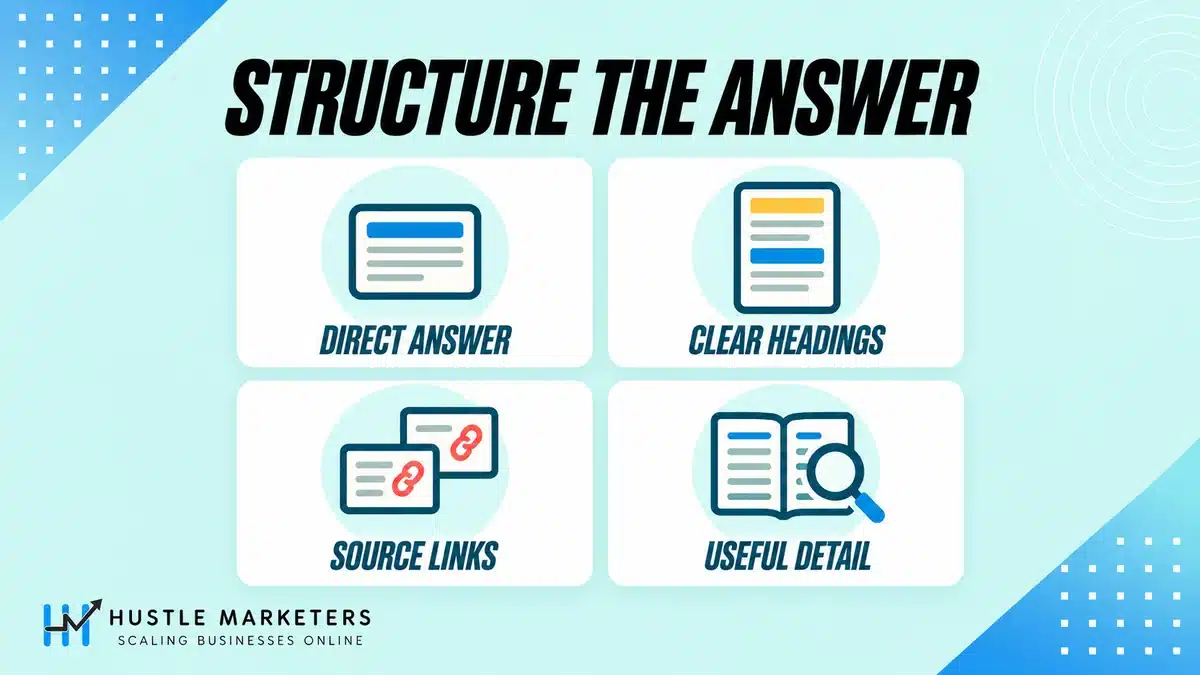
- One H1 that names the thing the page is about, in the words people use for it.
- A direct answer in the first two or three sentences. Not a preamble, not a history, not a statistic. The answer.
- H2s written as questions where a question is what people are actually typing. H3s for the sub questions underneath.
- One idea per section, with the conclusion in the first sentence and the reasoning after it, so the section reads correctly on its own.
- Tables for anything comparative, because a comparison laid out as a table is easier for a reader to scan than the same comparison written as prose. We would not claim more than that. A badly built table is one of the easier things on a page to mangle, so keep them simple and use real header cells.
- Short paragraphs.
- Author, date and sources visible on the page.
- Internal links with descriptive anchors, so a crawler can reach the rest of your site from this page.
We are deliberately not giving you a word count for the answer in item 2 or 4. The three figures most quoted in this market are 40 to 60 words, 30 to 60 words and 40 to 50 words, and none of the pages quoting them gives a source. There is no evidence base for any answer length prescription, so we are not going to invent one.
Is answer-first structure the same as chunking?
A note on chunking, because some of the above looks like it. Google’s mythbusting section says there is no requirement to break your content into tiny pieces. What we are recommending is not fragmentation. It is that each section states its conclusion first and reads correctly on its own, which is ordinary good writing and predates all of this. If your page only makes sense as a bag of fifty word blocks, you have gone past the point Google is warning about. We cannot give you a bright line, because nobody has published one.
There is one structural statistic worth naming, because the same number appears twice with two different provenances. One page says AI generated answers include lists 78 percent of the time and presents it as an internal study of its own. Another gives the identical figure and cites the 2023 GEO paper. We did not read the paper’s full text, so we cannot tell you which attribution is right, only that two pages ranking for the same term cannot both be. When you see a structural statistic in an AEO article, ask where it came from before you act on it.
Does llms.txt do anything for AEO?
On present evidence, no. Google lists llms.txt first in the mythbusting section of its own AI optimization guide, John Mueller has said no AI system currently uses it, and none of the crawler documentation published by OpenAI, Perplexity, Microsoft or Anthropic mentions it. The file costs almost nothing and does no harm. It is a bet on a future convention being sold as a present tense ranking factor.
Google names it directly. “LLMS.txt files and other ‘special’ markup” is the first item in the mythbusting section of Google’s AI optimization guide.
Google’s John Mueller was more specific. Quoted by Barry Schwartz on Search Engine Roundtable on June 18, 2025:
FWIW no AI system currently uses llms.txt.
It’s super-obvious if you look at your server logs. The consumer LLMs / chatbots (the ones that SEOs want traffic from) will fetch your pages – for training and grounding, but none of them fetch the llms.txt file.
We fetched that article ourselves to confirm the wording.
Two further data points from our research, which we did not verify at source and are passing on with that label attached. Gary Illyes of Google has compared llms.txt to the keywords meta tag of the 1990s. And an analysis reported by Gianluca Fiorelli in September 2026 found that of roughly 38,000 sites with a valid llms.txt file, 97 percent received zero requests for it.
We also checked the crawler documentation published by OpenAI, Perplexity, Microsoft and Anthropic. None of them mentions llms.txt. The files that AI companies host on their own documentation sites are them publishing one, which is not the same as them reading yours.
The fair framing is not that llms.txt is a scam. It costs almost nothing and it does no harm. The framing is that it is a bet on a future convention, and it is being sold as a present tense ranking factor. Those are different products and they should not carry the same price.
Why do AEO statistics never agree with each other?
Because almost nobody is checking them. The same claim appears with different numbers on different pages, attributions get stripped as figures are copied from one article to the next, and several of the most quoted statistics in this market trace back to a source that never measured anything. Here is the evidence, as a table.
Every figure below was on a page we fetched during this research. Some came from the 16 advice pages. Some came from the further pages we opened to chase a number down, including trade press and newsletters, and we say which, because that distinction is the whole point of this section.
| Claim | Figures we found, and where they came from |
|---|---|
| How often AI Overviews appear | 13 percent (advice page, citing its own study), 16 percent (trade press), 18 percent (Pew Research, observed behavior), 21 percent (advice page, citing a tool vendor), around 55 percent (advice page, citing a third party) |
| Share of AI citations from the organic top ten | 99 percent, but for the top 20 and for AI Mode, not the top 10 (advice page). 77 percent from inside the top 10 and 60 percent from outside the top 20, both unsourced, both on the same advice page. 38 percent (advice page). 76 percent in July 2025 falling to 37.1 percent by March 2026 (Ahrefs, in two studies of its own, and see the note under the table) |
| Zero click share of Google searches | 58.5 percent (advice page citing SparkToro), 68 percent (advice page citing Similarweb), 68.01 percent (newsletter citing SparkToro), and a 93 percent figure that is actually about AI sessions, not Google searches |
| Growth in AI referral traffic | 1 percent month on month (advice page citing a trade outlet), 200 percent year on year (Chartbeat via Axios), 527 percent (advice page citing an agency), 800 percent over three months (an SEO blog outside the 16) |
| How much better AI traffic converts | 4.4 times (tool vendor’s own study), 4 to 5 times (trade press, one publisher), 23 times (a headline we did not open) |
Which of these statistics can we actually resolve?
One of those rows we can resolve, and resolving it is more useful than listing it. The share of AI citations coming from the organic top 10 is not a disputed number. It is a number that changed. Ahrefs published one analysis in July 2025 finding roughly 76 percent, then rebuilt the same analysis across 863,000 SERPs and 4 million AI Overview URLs and published the update on March 2, 2026, finding 37.1 percent in the top 10 and 36.7 percent not ranking in the top 100 at all. We fetched the second study ourselves. Same team, same method, eight months apart, which makes the direction more trustworthy than either figure alone.
That matters for anyone selling you AEO on the basis that ranking is the qualifying round. In July 2025 that was broadly true. It is much less true now, and more than a third of cited pages do not rank in the top 100. It also means every article still quoting 76 percent is quoting a figure its own source has replaced, and there are a lot of them.
The rest of the table we cannot resolve. These cannot all be true. Several are measuring different things with different denominators and being quoted as if they were comparable. One advice page in our set states that 77 percent of AI citations come from pages already in the top 10 and, in the same article, that 60 percent come from pages not in the top 20. Both figures are unsourced. They cannot both be right, and the page does not notice.
There is also one figure worth flagging on its own. Two of the 16 advice pages quote a prediction that traditional search volume would fall 25 percent by 2026. One says by 2026, the other quietly extends it to by the end of 2026. Neither links the source. It is now the final quarter of 2026 and neither checks whether it happened. Neither have we, and we are not going to pretend otherwise.
The point is not that every statistic here is wrong. It is that a field where the headline prevalence figure ranges from 13 to 55 percent is a field where you should ask for the method before you act on the number.
Do AI answers actually send traffic?
Less than you are being told, and this is the best evidenced question in the subject. Pew Research observed 900 US adults across 68,879 real searches. People who saw an AI summary clicked a search result in 8 percent of visits, against 15 percent for those who did not, and clicked a link inside the summary itself in 1 percent.
The strongest study we found is from Pew Research Center, published July 22, 2025 by Athena Chapekis and Anna Lieb. It is based on observed browsing rather than survey answers: 900 US adults, a tracking app recording actual page visits, 68,879 unique Google searches during March 2025.
Users who encountered an AI summary clicked on a traditional search result link in 8% of all visits. Those who did not encounter an AI summary clicked on a search result nearly twice as often (15% of visits).
And the figure that matters most for anyone selling AEO, which is the rate at which people clicked a link inside the AI summary itself:
This occurred in just 1% of all visits to pages with such a summary.
We fetched that study ourselves to confirm both numbers.
Read together, those say something uncomfortable. Being cited inside an AI answer is worth having, but it is worth having as brand presence, not as a traffic channel. If someone sells you AEO on a traffic projection, ask which of those two numbers their projection is built on.
What does the research say about whether AEO tactics work?
There is now a systematic review of the field, and its conclusion is the most important thing in this article after Google’s documentation.
The paper is “Optimizing Visibility in Generative Engines: A Critical Survey of Generative Engine Optimization” by Olivier Martinez, dated July 15, 2026. It reviews 45 studies. It is a preprint on arXiv rather than a peer reviewed publication, and we weight it accordingly. We include it because it is the only systematic review of this field we could find, and because its conclusions run against the commercial consensus rather than with it, which is usually a reason to take a source more seriously rather than less. We fetched it ourselves and confirmed the wording below.
Within this corpus, the evidence is narrow: already-retrieved content can causally alter its citation or use, but no reviewed technique shows a stable, longitudinal, cross-platform causal effect on organic discoverability or downstream behavior.
Four findings from that survey deserve to be much better known.
- The famous 40 percent visibility gain from the original GEO paper is real, but it applies to a document that is already in the model’s context. It says nothing about getting into the context in the first place, and nothing about traffic.
- Topical relevance and position within the context are the most reproducible levers. Relevance is, once again, the thing SEO has always been about.
- Generic heuristics transfer poorly. Tactics that worked in one setting did not carry over to another. That is a direct problem for every checklist article on this subject, including the parts of this one that give you a checklist.
- Rewriting content to look more citable can make it harder to retrieve. The survey’s phrase is that “citation-oriented rewrites can impair retrieval”. It is the clearest downside risk anyone has written down, and we did not see it raised on any of the 16 advice pages we read, though we were not counting for it specifically, so treat that as an impression rather than a count.
The survey also reports substantial run to run variability across commercial audits, meaning the same prompt asked twice can return different sources. Hold on to that, because it is the reason the next two sections say what they say.
How do you create an AEO strategy that is not a list of hacks?
Start with the things that hold regardless of which engine you are optimizing for, then add the few that are specific to AI answers. That order matters, because the AI-specific tactics are the least tested part of the subject and the general ones are the best tested. Here is the order we use. It is deliberately boring, because the evidence supports boring.
- Fix access first, and understand that “allow AI crawlers” is two different decisions. Each platform runs separate bots for separate jobs, documented by the platforms themselves. GPTBot and ClaudeBot crawl for model training, so blocking them is a licensing decision with no effect on whether you can be cited. OAI-SearchBot, Claude-SearchBot, Claude-User and PerplexityBot crawl for retrieval, and blocking those is what affects whether you can appear in answers at all. OpenAI states that effect outright. Anthropic puts it more cautiously and says blocking may reduce your visibility. OpenAI documents that “Sites that are opted out of OAI-SearchBot will not be shown in ChatGPT search answers, though can still appear as navigational links”. Perplexity documents that its user triggered fetcher, Perplexity-User, “generally ignores robots.txt rules”, so robots.txt is not a complete control. Check your CDN and firewall rules as well as robots.txt, because a rule at the edge can block a bot without appearing in robots.txt at all. We verified both of those quotes ourselves in the platforms’ own documentation.
- Fix findability. If a page is not indexed or not internally linked, no answer engine will retrieve it. Our technical SEO checklist covers the diagnostics.
- Pick the questions. Not keywords, questions. Take them from your sales calls, your support inbox, People Also Ask, and the FAQ sections of whoever currently ranks. Write them down in the wording people use.
- Answer each one in one place, near the top of a page, completely, with no dependency on the paragraph before it.
- Structure for lifting. Question as heading, answer first, detail after, table for comparisons.
- Give the answer something to attach to. Author, date, credentials, sources, and consistent information about your business everywhere it appears. This is the part most sites skip and it is the part entity markup actually supports.
- Earn mentions off site. Models draw on more than your own site. We cannot show you a study that quantifies how much more, and nobody else can either, but being described accurately by other people is the part of this you cannot do from inside your own CMS.
- Measure honestly. See the next section.
- Re measure over months, not days, for the variability reason above.
What is deliberately not in this strategy?
Notice what is not on that list: FAQ schema stacking, llms.txt, chunking, and answer length prescriptions. None of those survived contact with the evidence.
How do you measure AEO without buying a tool?
You can get a long way with things you already have, and none of them costs anything. Search Console’s generative AI performance report, Bing Webmaster Tools’ AI Performance report, referral traffic segmented by source, a fixed prompt set you run on the same day each month, and brand search volume. All five are first party, which is more than most paid tools can say.
- Google Search Console has a generative AI performance report. It is first party and it is the measurement Google itself recommends. One caveat Google’s own documentation raises: AI features traffic is included in overall Search traffic, so depending on how it is broken out you may not be able to isolate AI Overview performance cleanly.
- Bing Webmaster Tools added an AI Performance report on February 10, 2026, in public preview. It reports total citations, average cited pages, grounding queries, page level citation activity and visibility trends over time, across Microsoft Copilot, AI generated summaries in Bing and select partner integrations. It is the only first party report we found that breaks citations out by page, which Search Console does not. It covers Microsoft’s surfaces, not ChatGPT. We confirmed this against Microsoft’s own announcement.
- Referral traffic in analytics, segmented by source, will show ChatGPT, Perplexity and Copilot sessions separately. Expect small numbers. Chartbeat data reported by Axios put ChatGPT referrals at under 1 percent of all referrals for the publishers it measured.
- A fixed prompt set, run manually. Write 20 to 30 questions a customer would ask, run them on each platform on the same day each month, and record whether you were cited, mentioned, recommended, misrepresented or absent. Those are five different outcomes and conflating them is how AEO reporting becomes meaningless.
- Brand search volume. If AI answers are working as brand presence rather than as clicks, this is where it shows up.
Of the 16 advice pages we read, ten route measurement to a paid product or a proprietary score instead. An eleventh has a monitoring section too generic for us to say either way. One of the 16 comes closest to a procedure a reader could follow: pick your prompts, pick your competitors, pick your platforms. It still assumes a tracking tool and names two of them, so it is not tool free, but it is the only page in the set that describes a procedure at all and it deserves that credit.
Our guides to tracking brand visibility in AI search and to the difference between citations and mentions go deeper on the method, and our automated SEO reporting guide covers how to build the reporting without buying another subscription.
Can you track your position in AI answers?
No, and the best evidence on this comes from a study built to test exactly that question. SparkToro ran 12 prompts through ChatGPT, Claude and Google AI using 600 volunteers, producing 2,961 runs, and published the results on January 28, 2026. We fetched it ourselves.
Repeating an identical prompt returned the same list of brands fewer than 1 time in 100. Getting that list back in the same order happened roughly 1 time in 1,000. The author, Rand Fishkin, puts the conclusion bluntly.
Any tool that gives a “ranking position in AI” is full of baloney.
Notice that Microsoft, the one platform owner publishing this kind of data, does not frame its own report as a ranking either. The Bing AI Performance report described earlier gives citation counts and page level citation activity. It does not give you a position, because there is not one to give.
What survives is a visibility rate: across a fixed set of prompts run repeatedly, what share of runs mention you at all. That is a percentage, not a position, and it only means something with repetition behind it. A single run tells you nothing, which is the reason the fixed prompt set above says run each question on the same day each month rather than once and calling it a baseline. If a tool or an agency reports that you are “ranked third in ChatGPT”, that number does not describe anything stable.
Why is a before and after citation count not proof?
Because the thing you are measuring moves on its own.
The systematic review above reports substantial run to run variability in commercial audits: ask the same question twice and you can get different sources. If a single measurement is unstable, then two measurements taken three months apart cannot separate your work from that instability.
There is a widely circulated figure putting the monthly turnover of domains cited by major AI platforms at 40 to 60 percent. We are naming its provenance rather than the number’s weight: it comes from Profound, a company that sells AEO monitoring, and the corroborating figure we found appears to be the same research quoted second hand. We have not verified it and we are not building an argument on it. The run to run variability finding is enough on its own, and it comes from a source with nothing to sell.
The practical consequence is the same either way. A before and after citation count cannot distinguish your work from noise. That applies to every agency case study in this category. It applies to ours, and we say so in the section below.
The only way around it is repeated measurement on a fixed prompt set over months, with the variability reported rather than hidden. That is slower and less impressive than a screenshot, which is why few people do it.
What do answer engine optimization tools actually do?
Broadly, three things: they run prompt sets against AI platforms on a schedule, they record whether your brand appeared, and they turn that into a dashboard.
That is genuinely useful if you would otherwise do it by hand. It is not a ranking factor and it does not make you more likely to be cited.
Two things to know before you buy. The tool listicles in this market are written by tool vendors. Both of the AEO tool roundups we read ranked their own product first, and the two lists overlapped on only five of the 29 tools they named between them, which tells you the category has no agreed membership yet. And every tool in this space is measuring against the same unstable baseline described above, so a chart does not fix the measurement problem, it renders it.
There is a third thing, and Google states it directly. Its guidance on third party SEO services, last updated June 5, 2026, includes one sentence worth keeping in mind whenever a tool shows you a proprietary AEO score.
If your SEO uses a third-party tool, keep in mind that Google doesn’t evaluate or endorse third-party SEO tools, and these tools don’t have access to Google’s internal ranking data.
The same page warns that some services imply what they do is approved by Google, and adds that Google does not evaluate third party services, so be wary of such claims. We fetched it ourselves on September 27, 2026. None of that makes these tools useless. It does mean a number out of 100 on an AEO dashboard is the vendor’s opinion expressed as a figure, and should be read as one.
How much does answer engine optimization cost?
Nobody in the set we read will tell you, which is itself worth noticing on pages selling the service. What we can say is that AEO is not a separate line item for most businesses. It is the same technical, content and entity work as SEO, done with AI answers in mind, and it should be priced the same way. Here is what that means in practice.
Of the 16 advice pages, none states the cost of AEO as a service. Two state a price, and both are software prices. One page names the cost question as a valuable one to answer and then does not answer it. There is a separate set of search results for AEO pricing, and not one of those domains appears in the main results, which means the pages ranking for the topic have ceded the money question entirely.
What actually drives the cost, in our experience:
- How much of the work is technical repair versus content. Crawler access and indexation problems are usually a one off fix. Content is ongoing.
- How many questions you are trying to own. Twenty is a project. Two hundred is a program.
- Whether measurement is manual or tooled, and who pays for the tools.
- Whether anyone on your side can publish. The most expensive version of this work is the one where the agency writes everything and waits three weeks for approval.
If a proposal does not separate the one off technical work from the ongoing content work, ask for it to be separated before you compare quotes.
How long does answer engine optimization take to show results?
We do not know, and we are not going to give you a number we have not measured. Nobody else has measured it either, which is why the timelines you see quoted range from three weeks to nine months with no method behind any of them. What we can tell you is which parts move quickly, which move slowly, and why the honest answer is a range rather than a date.
One page in the set gave a figure, two to six weeks to start seeing citations, with no source. That is the entire published evidence base on timing we could find, and we are not going to replace it with a guess of our own.
What we can say is structural rather than a timeline. Citation requires retrieval, retrieval requires indexation, and indexation is on the search engine’s schedule, not yours. For a page already indexed and already relevant, the constraint is how often the surface re-reads you, which nobody publishes. For a new site with no presence, the constraint is not AEO at all. It is that nobody has written about you yet.
Given the variability described above, treat anything you see from a single measurement as noise regardless of when you take it.
Is answer engine optimization worth it?
For most businesses yes, but not for the reason it is usually sold. It is worth doing as brand presence in the place people now ask questions, not as a traffic channel, because the click-through evidence does not support a traffic case. If a projection is built on clicks from AI answers, ask which measurement it rests on before you sign anything.
It is worth it because the work overlaps almost entirely with good SEO and good writing, and because how an AI system describes you is becoming part of how buyers find you. It is worth it as brand presence.
It is not worth it as a traffic channel today. The Pew data above is the reason. One percent of visits to a page with an AI summary produced a click on a link inside that summary.
It is not worth paying a premium for as a separate discipline with a separate retainer. That is the part where the acronym is doing commercial work rather than technical work.
The clearest way to decide is this. If someone proposes AEO and the proposal would look almost identical if you deleted the letters AEO from it, that is a good sign. If the proposal collapses without the acronym, it was the acronym you were buying.
What can answer engine optimization not do?
Quite a lot, and almost nobody selling it will say so. We could not find a statement of this work’s limits in the body of any of the 16 advice pages we read, and that absence is the most consistent finding in the whole set.
Three of those pages have headings that point at the question, one on benefits and challenges, one on challenges and emerging considerations, and one asking whether AEO can create value without a click, and our extraction could not read what sits under any of the three. So the honest version is this: not one of the 13 pages we could read fully sets out the limits, and three we could not read fully might. Everything else in the set treats difficulty as user error.
Here are the limits as we see them.
- It cannot guarantee a citation. No platform sells placement, and answers are composed at the moment of asking.
- It cannot make an answer stable. The same question can return different sources on rerun, which the systematic review documents.
- It cannot fix not being relevant. If a model has no reason to retrieve you, formatting will not create one.
- It cannot control how you are described. Models summarize, and a summary can be wrong about you in ways that no page edit reliably corrects.
- It cannot be attributed cleanly. AI referrals often arrive with no referrer, which means both that agencies get less credit than they earn and that agencies cannot prove the credit they claim. That cuts both ways and it cuts at us too.
- It cannot be proven by a before and after screenshot, for the variability reason above.
- It can, according to that review, backfire. Rewriting for citability can reduce retrievability.
What does AEO look like for a small business or a local service?
Smaller than the articles suggest, and more achievable. For a local service business most of the available value sits in a handful of things you can finish inside a week: a complete and accurate Google Business Profile, clear service and location pages, real reviews, and written answers to the questions customers actually ask on the phone. None of that requires a tool or a retainer.
For a local service business, the AEO work is mostly: an accurate and complete Google Business Profile, consistent name, address and phone details everywhere, one page per service that answers the questions a caller actually asks, pricing guidance if you can give any, and real reviews. Google’s own list includes keeping your Business Profile up to date, which is the one item on it that matters disproportionately for local businesses.
For ecommerce, it is product information completeness, category pages that answer buying questions rather than listing products, and feed accuracy. Our guide to AI SEO for ecommerce covers the specifics.
For B2B and SaaS, it is comparison pages, documentation, and being described accurately wherever third parties list your category. Be careful what you wish for there. As the tools section above shows, the roundups in a young category are often written by participants, and two of them can agree on almost nothing. Being in a roundup nobody trusts is not worth paying for. Being in the ones a buyer would actually consult probably is, though we cannot show you evidence that models weight them, and nobody else can either.
In all three cases the highest value work is usually the least fashionable: fix what is broken, answer the real questions, and make sure the rest of the web describes you correctly.
How we do answer engine optimization at Hustle Marketers
We sell this work, so treat this section as a disclosure as much as a description. Our answer engine optimization services page sets out the scope, the market pricing and the limits in writing.
What we do: crawler and rendering access checks against the named training and retrieval user agents separately, indexation and internal linking repair, question research from your own sales and support conversations rather than only from tools, answer first page structure, entity level structured data, and a fixed prompt set measured monthly with the variability reported.
What we do not promise: a citation in any named assistant, a position in an AI Overview, or a traffic number attributed to AI answers.
What we can show you, and what it is worth.
On our engagement with Rec Hall, a family entertainment center in St. Charles, Missouri, which is named on its own case study page on our site, Google Search Console recorded organic clicks rising from 980 to 2,131 and impressions from 23,843 to 60,714 on a three month comparison. The case study does not state which three months against which three, and we have not isolated seasonality, which matters for a leisure business, so treat the comparison as indicative rather than clean. Ranking keywords went from roughly 266 to 517 over six months. That figure is a Semrush estimate, not first party data, and we are labeling it as such. The full case study is here.
On AI mentions specifically we have nothing worth showing you yet. The case study records 8 mentions and 13 cited pages across ChatGPT, Google AI Overview, Google AI Mode and Gemini, on a single measurement. By the standard we set out above, repeated measurement on a fixed prompt set over months with variability reported, one measurement is not evidence, and we are not going to present it as though it were. Until that series has enough points to mean something, the honest answer to “can you prove your AEO work caused an AI mention” is no. Neither can anyone else, which is exactly why we are not claiming it.
We have done the same work on ecommerce, including a Shopify pet supply brand whose SEO and AEO program is documented here. Rec Hall is named because it is named on its own case study. The pet brand’s study is anonymized, so it stays anonymized here, and we will not fill the gap with hints.
If you want the service rather than the guide, our AI SEO company page sets out what is included, and Ishant’s profile has the background and the certifications.
Answer engine optimization FAQs
What is answer engine optimization in simple terms?
It is preparing your content so that AI systems can find it, understand it and quote it when they answer a question, instead of only ranking it in a list of links. In practice it means being crawlable by the right bots, being indexed, answering real questions directly near the top of a page, and being described accurately elsewhere on the web.
What does Google say about AEO?
Google’s AI optimization guide, updated July 10, 2026, has a mythbusting section that names AEO and GEO and says “many suggested ‘hacks’ aren’t effective or supported by how Google Search actually works”. It also says that from Google Search’s perspective, optimizing for generative AI search is still SEO. On structured data it says the markup is not required for generative AI search and there is no special markup to add, and then adds that it is still worth using as part of ordinary SEO because it helps with rich result eligibility.
Does AEO replace SEO?
No. Every answer engine that cites the open web has to retrieve a document before it can quote one, so crawling, indexing and relevance still come first. AEO is work you do on top of SEO, not instead of it.
Is AEO the same as GEO?
In practice they describe the same activity. GEO has a documented origin in a 2023 research paper accepted to KDD 2024. AEO has no documented originator, and its meaning changed from voice assistants to language models somewhere between 2023 and 2026.
Does FAQ schema help with AEO?
There is no good evidence that it does. Google’s own documentation says the FAQ rich result stopped appearing in Search on May 7, 2026. The one study we found that isolates the question tracked 1,885 pages that added JSON-LD against matched controls over 30 days and measured AI Mode up 2.4 percent, ChatGPT up 2.2 percent and AI Overviews down 4.6 percent. Ahrefs called the two increases too small to tell apart from random variation, and said the AI Overviews decline, while statistically significant, could not confidently be attributed to schema. Visible question and answer sections are still useful. The markup is a separate question.
Should I add an llms.txt file?
Only if you treat it as a cheap bet on a future convention. Google lists llms.txt in the mythbusting section of its AI optimization guide, and John Mueller said in June 2025 that no AI system currently uses llms.txt and that server logs show chatbots fetching pages but not the file. No AI platform’s crawler documentation mentions it.
Which AI crawlers should I allow?
Treat it as two decisions rather than one. GPTBot and ClaudeBot crawl for model training, so blocking them is a licensing choice that does not affect whether you can be cited. OAI-SearchBot, Claude-SearchBot, Claude-User and PerplexityBot crawl for retrieval, and blocking those is what affects whether you appear in answers. OpenAI documents that a site opted out of OAI-SearchBot will not be shown in ChatGPT search answers, though it can still appear as a navigational link. Perplexity documents that its user triggered fetcher generally ignores robots.txt, so check your CDN and firewall rules too. Our Perplexity SEO guide covers both Perplexity agents.
How do I measure whether AEO is working?
Use Search Console’s generative AI performance report for Google’s surfaces and the AI Performance report in Bing Webmaster Tools for Copilot and Bing summaries, which is the only free first party report we found that breaks citations out by page. Segment AI referral sources in analytics. Then run a fixed set of 20 to 30 prompts manually on the same day each month, recording whether you were cited, mentioned, recommended, misrepresented or absent. Repeat over months rather than weeks, because the same prompt can return different sources on rerun.
What should answer engine optimization cost?
None of the 16 advice pages we read publishes a service price. What drives it is the split between one off technical repair and ongoing content, how many questions you want to own, who pays for measurement tooling, and whether your team can publish without a long approval cycle. Ask for the technical work and the content work to be quoted separately.
Can an agency guarantee I will be cited in ChatGPT?
No. Answers are composed at the moment of asking, models change, and the same prompt can return different sources on rerun. An agency can commit to process: crawler access, indexation, a named prompt set, a defined baseline, a reporting cadence and a written reassessment date. It cannot commit to an outcome it does not control.
Is answer engine optimization worth paying for?
The work is worth doing. Paying a premium for it as a separate discipline usually is not. A useful test: if the proposal would read almost the same with the letters AEO deleted from it, it is probably sound. If it collapses without the acronym, the acronym was the product.
Sources and how we researched this
Competitor pages. We ran ten searches on the head term and its variants on September 26, 2026, captured 91 result rows across 64 distinct URLs and 49 domains, and read 18 of those pages in full. Sixteen are advice pages, one is Google’s own documentation and one is a Wikipedia entry, and every count above says which group it is counting. Forty six of the 64 URLs were never opened, so anything described here as absent is absent from the pages we read on that date, not from the market.
Which primary sources did we verify ourselves?
Primary sources we checked ourselves. We personally fetched and verified, rather than relying on our research notes: Google’s AI optimization guide and its AI features page, Google’s FAQPage documentation, the Pew Research study, the Search Engine Journal report of the Ahrefs schema analysis, the arXiv critical survey, the Search Engine Roundtable report of John Mueller’s llms.txt comment, Joost de Valk’s FAQSection post, OpenAI’s bots documentation, Perplexity’s bots documentation, and Microsoft’s announcement of AI Performance in Bing Webmaster Tools. Every quotation from a primary source on this page comes from one of those.
How we read things, and the limit that puts on it. Our research tool converts pages to text and answers a prompt against them. We never see raw HTML. That limit applies to everything on this page, including the primary sources. We are going to be exact about this, because the alternative is implying more than we did. Four sources we went back to repeatedly, with deliberately different prompts each time, and got identical wording every time: Google’s AI optimization guide, which we read six times while pulling its bullets in full, Google’s AI features page, Google’s FAQPage documentation and the Search Engine Journal report of the Ahrefs analysis. Everything else quoted here we read once: Pew, the arXiv survey, the Search Engine Roundtable report, Joost de Valk’s post, OpenAI’s bots documentation, Perplexity’s bots documentation and Microsoft’s announcement. A single read rules out nothing except our own paraphrase, and no number of reads through this tool independently re-verifies the live page. If a quotation here matters to a decision you are making, open the link. We have kept competitor wording to counts rather than quotations, not because extraction is less reliable on their pages than on Google’s, but because a count is a claim we can restate if we got it wrong and a quotation with a company name against it is not. One quotation on this page is from a page we read only through that layer: the 2023 definition of AEO in the origin section, which we confirmed across two independent reads.
Why we do not name the competitor pages we criticise. Not to protect them. Anyone running the same searches will find them in minutes, and we have said in each case what to look for. We leave the names out for the reason above.
Where we credit the pages we read. One of the 16 advice pages says in its own body copy that it sells AEO services. Eight of the 18 make the commercial relationship unmissable through pricing, calls to action or product placement inside the article. None of the 18, including that one, carries a conflict of interest statement, which is the standard we have tried to meet here. Separately: one page mentions Google’s 2023 FAQ rich results restriction. One names AI crawler user agents, though the four it names are training and opt out agents rather than retrieval agents, which is the half that matters less. One describes a measurement procedure a reader could follow, with a tool. Those are three different pages doing three things the rest of the set does not.
Figures we did not verify and have not built an argument on. The claimed collapse in the share of AI citations coming from the organic top ten. The 40 to 60 percent monthly churn in cited domains, whose source is an AEO monitoring vendor. The various conversion multipliers. The 2026 search volume forecast. The llms.txt 97 percent figure. Gary Illyes’s meta keywords comparison. Each of these appears above described as a claim with its status attached, and none of them is load bearing for anything we recommend.
What we could not reach. One trade encyclopedia entry returned a 403 error. One analyst report is paywalled and we did not buy it. Reddit is blocked at the network level in our research environment, and no Reddit result appeared in the searches we ran for these terms, so nothing here reflects forum discussion. X is robots-disallowed to our tooling. One LinkedIn post ranked on one query and we did not open it. We obtained no video transcripts, so the video results on these queries are not represented here.
What we are not claiming. We are not the first page to make any of these points, and Google made the main one itself. What we could not find in the 18 pages we read was a single page carrying all of it together with the primary sources attached, and that is the only claim we make about it.
About the author. Ishant Sharma is the founder of Hustle Marketers and has worked in search since 2013, on Google Ads, Microsoft Ads and SEO for ecommerce, local service, SaaS and white label agency clients. Hustle Marketers is a Google Partner, a Microsoft Advertising Partner and a Meta Business Partner. This page was researched and written on September 26, 2026. If something on it stops being true, which in this subject is likely, tell us and we will date the correction.