Generative Engine Optimization Agency: How to Choose One

Ishant
Published : October 1, 2026 at 10:30 am
Updated : October 22, 2026 at 6:04 am
Ishant

Key Observations
- To choose a GEO agency, ask for one client result with a named data source and measurement window, a written prompt set you own, a run count on every visibility number, and no promise of a citation. The rest of this page shows why.
- Read any best-of GEO agency list as marketing until it proves otherwise. Check whether the publisher appears on its own list, where it sits, and whether the page says the author competes for the same work.
- The term generative engine optimization comes from a peer reviewed paper. It says the method can boost visibility “by up to 40% in generative engine responses”, and its abstract never mentions training data. An agency that defines GEO as getting into training data is selling something the research does not describe.
- The most quoted market statistic in this category is a Gartner forecast published on February 19, 2024 predicting a 25 percent drop in search volume by 2026. Gartner states no method, so treat it as a prediction rather than measured data.
- Missing referrers cut both ways. Agencies get less credit than they earn, and they also cannot prove the credit they claim. That applies to us too.
- Before you sign, get three things in writing: who owns the prompt set and the citation baseline, the notice period, and how the data is handed over when you leave.
- We are one of the agencies you could hire for this. That is disclosed here and in every section where it matters.
Table of Contents
If you are looking for a generative engine optimization agency, an answer engine optimization agency or an LLM optimization agency, you will find plenty of best-of lists. Read them knowing that many are published by agencies that sell the service and appear on the list.
This page is not another list. It is the buying guide we would want if we were on the other side of the table: what the words actually mean, what an agency can and cannot promise, what it costs, what belongs in the contract, and which numbers in this market do not survive being checked.
One disclosure before anything else. Hustle Marketers does this work, so treat this page as written by an interested party. Nowhere on it do we rank ourselves against named competitors.
At the end there is a section answering every question this page sets, applied to us, so the same tests can be run on the author. Where a point cuts against us, it says so.
What is a generative engine optimization agency?
A generative engine optimization agency works to get your pages used as a source when an AI system answers a question, rather than only ranking in a list of blue links.
The term has an actual origin. It comes from a paper titled “GEO: Generative Engine Optimization” by Pranjal Aggarwal, Vishvak Murahari, Tanmay Rajpurohit, Ashwin Kalyan, Karthik Narasimhan and Ameet Deshpande. They submitted it on November 16, 2023, revised it in May and June 2024, and published it at KDD 2024.
The sentence everyone half remembers is this one:
Through rigorous evaluation, we demonstrate that GEO can boost visibility by up to 40% in generative engine responses.
Two things about that sentence matter when you are buying.
The first is the last four words. The paper measures visibility inside generative engine responses.
That is retrieval time, the moment the model assembles an answer. The abstract does not mention training data at all. We checked.
The second is “up to 40%”. That is an upper bound from a research evaluation of the paper’s own framework. It is not a client outcome and no agency should present it as one.
So be wary of an agency that defines GEO as getting your brand into the models’ training data. The paper that named the field neither measures nor claims that.
What does a generative engine optimization agency do?
A generative engine optimization agency makes your pages easy for AI systems to fetch, understand and quote, then checks on a schedule whether ChatGPT, Gemini, Perplexity, Copilot and Google’s AI features cite or mention you. Most months split between fixing what blocks retrieval, improving the pages and outside sources assistants quote, and measuring the result.
Here is what that looks like across an engagement, in our practice:
- Month one: crawler access and rendering checks, entity and schema basics, and an agreed prompt set run enough times to give a baseline rather than a snapshot.
- Ongoing content work: priority pages rewritten so each answer sits in a short passage with its date and source attached.
- Ongoing source work: earning mentions on the comparison, listing and review pages assistants quote for your category, and keeping Bing coverage clean for Copilot.
- Every month: the same prompt set re-run, appearance share reported with the run count, plus AI crawler fetches and referral sessions from assistant domains.
If a monthly report shows only one of those four, ask what happened to the other three. The next section turns the same work into a contract scope.
What is included in generative engine optimization services?
Seven things, and a proposal that leaves any of them out should say why. Generative engine optimization services split into technical work that lets engines fetch and parse you, content work that makes you quotable, off-site work that gets you cited elsewhere, and measurement. Most of the cost sits in the last two.
Here is the full scope as we would write it into a contract, with the engine each line is supposed to move. If an agency cannot tell you which column a deliverable belongs in, that deliverable has not been thought through.
| Deliverable | What it actually involves | What it moves | When |
|---|---|---|---|
| Retrieval and rendering audit | Confirming your pages can be fetched, rendered and parsed, and reading server logs to see which AI user agents actually came | Every engine. Nothing else works until this does | Month one |
| Entity and schema foundation | Organization, Article, author and product markup so an engine can work out who you are and what you sell | Every engine, plus systems outside Google | Month one, then maintained |
| Prompt set and baseline | Agreeing the questions that actually carry commercial weight, then running them enough times to produce a baseline rather than a snapshot | Measurement. This is not a ranking and should never be sold as one | Month one, frozen for a quarter |
| Content depth and claim sourcing | Turning commodity pages into pages carrying dated, sourced, quotable claims an engine can lift with a citation attached | Every engine | Ongoing |
| Third-party source work | Earning mentions on the comparison, listing and review pages the assistants actually quote | Mostly the non-Google assistants, where your ranking barely transfers | Ongoing, and the slowest line to show results |
| Bing indexation and IndexNow | Getting and keeping clean coverage in Bing Webmaster Tools, and pushing changes rather than waiting for a crawl | Copilot above all, which leans on Bing far more than on Google | Month one |
| Reporting you can audit | Appearance share with the run count printed, AI crawler fetch logs, and referral sessions from assistant domains | Your ability to tell whether any of the above worked | Monthly |
What is not included, and what to query if it appears
Four items turn up on proposals from agencies providing generative engine optimization services that either do nothing for Google or cannot be delivered at all. None of them is automatically dishonest. Each one needs a reason attached before you pay for it.
- An llms.txt file with a Google outcome next to it. Google states it ignores these files. Keep the deliverable if another system reads it, and strike the Google claim.
- AI-specific schema vocabularies. There is no special markup for generative AI search. Standard schema types are worth doing for other reasons.
- A guaranteed citation, position or visibility percentage. Nobody can commit to an output a model regenerates on every query.
- Development work, unless a developer is named in the scope. Most retrieval problems need a code change. An agency without dev hours will hand you a list and wait.
One structural point that decides more outcomes than the deliverable list does. Five of those seven lines are things a competent technical SEO team already does. What genuinely separates generative engine optimization services from an SEO retainer is the prompt set, the third-party source work, and the Bing side.
So when you compare two proposals, compare those three lines first. The rest is SEO, priced as SEO, and you may already be buying it from somebody else.
What is an answer engine optimization agency?
The same work, in most cases, under a different name. An answer engine optimization agency aims to get your pages used as the source behind a direct answer, wherever that answer appears, from an AI Overview to a featured snippet. Compare the deliverables rather than the acronym, because the acronym is usually the only thing that differs.
An answer engine optimization agency aims at surfaces that return an answer rather than a list: AI Overviews, ChatGPT and Perplexity answers, featured snippets, People Also Ask, voice results.
If you are comparing an AEO agency to a GEO agency, the honest answer is that you are usually comparing two names for one service. What you should compare instead is the deliverable, and that is covered further down.
What does Google say about generative engine optimization?
Google has published nothing about agencies. It has published two short documents about the work GEO agencies sell, and both are worth reading before your first sales call. Together they tell you which parts of a generative engine optimization proposal are standard SEO under a new label, and which parts are simply wrong.
Does Google treat generative engine optimization as a separate discipline?
No. Google’s AI optimization guide, last updated July 10, 2026, puts it in one sentence: “From Google Search’s perspective, optimizing for generative AI search is optimizing for the search experience, and thus still SEO.”
The same page carries exactly three recommendations, and they are its three headings: create valuable, non-commodity content for your audience, build and maintain a clear technical structure, and optimize your local business and ecommerce details. There is no fourth heading about a new file format, a new markup vocabulary or a new ranking channel.
That does not make GEO a fiction. It tells you something specific and useful: AI Overviews and AI Mode sit inside Google Search, and the same systems that produce the blue links feed them. What it rules out is a proposal that prices GEO as work outside SEO while the named deliverables are internal linking, schema, content depth and page speed.
If an agency quotes a GEO retainer on top of an SEO retainer, ask for the line items that appear in one scope and not the other. If nobody can name three, you are paying twice for one job.
The honest counterweight is that Google Search is one engine. ChatGPT, Perplexity, Claude and Copilot are not Google, do not read Google’s documentation and do not pick sources the way Google picks them. That is the point where GEO stops being a synonym for SEO, and the next section puts numbers on how far apart they have moved.
Do you need llms.txt, AI markup or special files for generative engine optimization?
Not for Google, and the guide says so three separate times.
On files: “You don’t need to create new machine readable files, AI text files, markup, or Markdown to appear in Google Search (including its generative AI capabilities), as Google Search itself doesn’t use them.”
Naming llms.txt directly: “Doing so will neither harm nor help your site’s visibility or rankings in Google Search, as Google Search ignores them.”
And on structured data: “Structured data isn’t required for generative AI search, and there’s no special schema.org markup you need to add.”
An llms.txt file is a defensible deliverable when the stated goal is a system that actually reads it. It is not a Google deliverable. A proposal that lists llms.txt with an AI Overviews outcome printed next to it contains a factual error, not a difference of professional opinion, and you are entitled to say so in the reply.
Not required is also not the same as useless, and the sharper agencies get this right. Semrush’s analysis of five million cited URLs in January 2026 found Organization markup on 25 percent of ChatGPT-cited pages and 34 percent of AI Mode-cited pages, with Article at 20 and 26 percent.
Those are correlations on pages that were already cited, not evidence that the markup earned the citation. Do schema because it is cheap, durable, and read by systems outside Google. Do not buy it as a citation mechanism.
Can a GEO agency’s tools see how Google ranks you?
No, and Google wrote a separate page to say it. The guidance on third-party SEO tools, last updated June 5, 2026, states: “Third-party tools don’t have access to our internal ranking data.” It adds: “They can’t guarantee performance. Any predictions are their own and like predictions generally, may not happen.”
Apply that to every dashboard a GEO pitch puts in front of you, including ours. A score out of 100 labeled AI readiness, GEO score or citation potential is a vendor’s own model. It is not a reading taken off Google.
The question that separates a useful tool from a decorative one is simple: what is this number computed from. If the answer is a weighting the vendor will not describe, you are looking at an opinion with a decimal point after it.
| Claim on a GEO proposal | What Google’s own documentation says | Source and date | What to ask instead |
|---|---|---|---|
| GEO is a new discipline that replaces SEO | “optimizing for generative AI search is optimizing for the search experience, and thus still SEO” | AI optimization guide, Jul 10, 2026 | Name three deliverables that sit outside a normal SEO scope |
| You need an llms.txt file to be found by AI | Google Search “ignores them” and they “neither harm nor help” visibility or rankings | AI optimization guide, Jul 10, 2026 | Which system reads this file, and what outcome is attached to it |
| You need special AI schema markup | “Structured data isn’t required for generative AI search, and there’s no special schema.org markup you need to add” | AI optimization guide, Jul 10, 2026 | Which schema types you already lack, and what they do outside AI |
| Our platform tracks your AI ranking position | “Third-party tools don’t have access to our internal ranking data” | Third-party tools guidance, Jun 5, 2026 | What the score is computed from, and how many runs per prompt |
Is GEO the same as AEO and LLM optimization?
There is no agreed answer, so be wary of anyone who tells you confidently either way. Some agencies treat GEO, AEO and LLM optimization as separate disciplines and others sell them as one service under three names. So compare the scope, the prompt set and the reporting, because those differ in ways the acronyms do not.
Here is the distinction we use, and why.
| Term | What it aims at | Where the name comes from |
|---|---|---|
| GEO, generative engine optimization | Being used as a source inside a generated answer | A 2023 research paper, measuring visibility in generative engine responses |
| AEO, answer engine optimization | Answer surfaces generally, including snippets and People Also Ask | Industry coinage, no single origin |
| LLM optimization, LLMO | The model’s own behavior, including what it says about you unprompted | Industry coinage |
| AI SEO | Used loosely, sometimes meaning using AI tools to do SEO | Industry coinage |
They overlap heavily and most of the underlying work is shared. If an agency charges you three times for three acronyms, that is a pricing decision, not a technical one. Our guide to generative engine optimization covers GEO on its own terms, and AI search optimization works through what the platforms themselves document.
Does generative engine optimization mean getting into the training data?
No, and the paper that named the field is the cleanest way to settle it. The term comes from GEO: Generative Engine Optimization, submitted to arXiv on November 16, 2023 by Pranjal Aggarwal, Vishvak Murahari, Tanmay Rajpurohit, Ashwin Kalyan, Karthik Narasimhan and Ameet Deshpande, and later published at KDD 2024.
Its headline result is the one quoted in almost every GEO sales deck: “GEO can boost visibility by up to 40% in generative engine responses.” What the decks leave out is what the method operates on. The abstract describes helping “content creators in improving their content visibility in generative engine responses through a flexible black-box optimization framework.” The inputs are website content. The measured output is what appears in a response. Nothing in it touches a model’s weights.
That matters commercially, because “we will get your brand into the training data” is a sales line you will hear, and it describes work no agency can do, verify or repeat. Training corpora are assembled privately, frozen at a cutoff, and not accepting submissions. What genuinely moves a generative answer is what a retrieval step can find and quote at the moment somebody asks. Content, sources, clarity, and whether your page can be fetched and parsed.
This also explains the shape of GEO results, which surprises clients who arrive from an SEO background. Movement can appear within weeks rather than the two or three quarters a ranking campaign needs, and it can disappear just as quickly when a model or a retrieval layer updates.
Nothing was learned about you. Something was found, and finding is repeated fresh on every query. Any agency promising durable AI visibility is promising stability in a layer that has never demonstrated any, and the 40 percent figure in their deck is from a 2023 paper, not from your account.
Does ranking on Google get you cited in AI answers?
Mostly not, and that gap is the entire commercial case for hiring a GEO agency rather than extending an SEO retainer. Two Ahrefs studies measure it from different angles. Inside Google’s own AI Overviews the overlap with the top 10 has collapsed since 2025. Across ChatGPT, Gemini, Copilot and Perplexity it was never high.
Inside Google, Louise Linehan and Xibeijia Guan rebuilt the 2025 analysis on March 2, 2026 across 863,000 SERPs and four million AI Overview URLs. Their own summary sentence: “Google is selecting far fewer pages straight from the original SERP (~76% in July 2025 vs. ~38% today).”
Narrowed to organic results, 37.1 percent of cited URLs ranked in the top 10 and 36.7 percent did not rank in the top 100 at all. Ahrefs published it as an update to their earlier figure, which is why so many agency decks still quote the older number.
If you take one figure from this page, take that one. In July 2025 an agency could tell you, defensibly, that ranking was the qualifying round for AI Overviews. Eight months later a cited page was about as likely to sit outside the top 100 as inside the top 10. Any GEO proposal built on the 2025 number is describing a market that has already changed, and it is a fair question to put to a prospective agency in writing.
How much overlap is there between AI assistants and Google’s top 10?
Outside Google the overlap was never close. Ahrefs’ cross-engine study of 15,000 long-tail prompts found that on average only 12 percent of links cited by ChatGPT, Gemini and Copilot appear in Google’s top 10 for the same prompt. Across those assistants, citation overlap with Google and Bing’s top 10 sits at 11 percent. Against Bing alone the average is roughly 10 percent, and Copilot, which draws on Bing results, comes out highest. The per-engine spread matters more than the average, because it is what decides where a budget should go.
| Engine and surface | Citations that rank in Google’s top 10 | What it implies for scope |
|---|---|---|
| Perplexity | 28.6% | Behaves most like a search engine. Classic ranking work carries furthest here |
| Copilot | 8.2% | Bing-weighted. Bing Webmaster Tools and IndexNow stop being optional |
| Gemini | 8.6% | Google-adjacent yet barely overlapping. Do not assume Search wins transfer |
| ChatGPT, in-text citations | 8.0% | Ranking is close to irrelevant to being quoted inside the answer body |
| ChatGPT, reference list | 6.1% | The least ranking-driven surface in the whole dataset |
One caveat we would want stated if we were the client reading this. That cross-engine study carries an August 11, 2025 date, and every engine in it has shipped model changes since. Treat the ordering as the durable finding, Perplexity closest to search and the ChatGPT reference list furthest from it, and treat the decimals as a snapshot. An agency that quotes those decimals as current without naming the date is not reading its own sources.
Why does the same prompt return different sources each time?
Because the sources depend on which mode of the same product answered. Semrush ran 100 prompts twice inside ChatGPT and published the result on June 30, 2026: “ChatGPT with higher reasoning is essentially a different search engine. Only 25.6% of cited domains overlap between minimal and high reasoning for the same prompts.”
The same reasoning-mode study recorded the citation rate rising from 50 to 68 percent, sources per response nearly doubling from 2.6 to 4.5, and the high-reasoning model firing 4.6 times more internal sub-queries.
Sit with that for a moment. One product, one prompt set, one week, and roughly three quarters of the cited domains changed because a toggle changed. Nothing about the websites moved.
This is the mechanical reason an honest GEO report counts appearances across many runs and prints the run count next to the result. It is also why a single position number labeled “your rank in ChatGPT” is one roll of the dice presented as a league table.
Where do AI assistants actually get their sources?
Often from pages no one would defend as authoritative. Trellner Research published a source audit in September 2026 finding that three websites between them had published 215,128 machine-generated best-of category pages. It also found that 59.8 percent of the information sources supporting AI search results sat outside the top 100,000 most popular sites. GIGAZINE reported the finding independently, which is why we are comfortable citing it.
Read it as a warning pointing two ways. It explains why a small brand can get cited without ranking anywhere, which is the genuine opportunity a GEO agency has to sell.
It also explains why raw citation counts are a weak quality signal: if a retrieval step will quote a machine-generated list page, appearing next to that page says less about your standing than a dashboard implies. An agency that puts total citations at the top of the report is counting a number that includes those 215,128 pages.
What does the overlap gap mean for an agency’s scope of work?
It splits the work into four buckets, and a good proposal will tell you which bucket every line item belongs to. Ask for this when you are comparing two GEO agencies whose decks look identical. It forces each of them to say out loud which engine a deliverable is meant to move.
| Bucket | Typical deliverables | Why it sits here |
|---|---|---|
| Pays off on Google and on assistants | Entity clarity, Organization and Article schema, a crawlable technical base, non-commodity content, claims carrying dates and named sources | Every engine has to identify who you are and parse what you said before it can quote you |
| Pays off on Google only | Indexation fixes, Search Console diagnostics, internal linking, classic ranking work | AI Overviews and AI Mode sit downstream of Search, so Search work still feeds them |
| Pays off outside Google only | Bing indexation and IndexNow for Copilot, earning mentions on the third-party pages assistants quote, presence in the comparison and listing sources a retrieval step reaches | At 6 to 8 percent overlap, a ChatGPT citation is mostly not coming through your Google position |
| Pays off nowhere | llms.txt aimed at Google, AI-specific schema vocabularies, any deliverable whose only proof is a vendor score | Google states it ignores these files, and no third-party tool reads Google’s ranking data |
How do you choose an SEO agency for AEO?
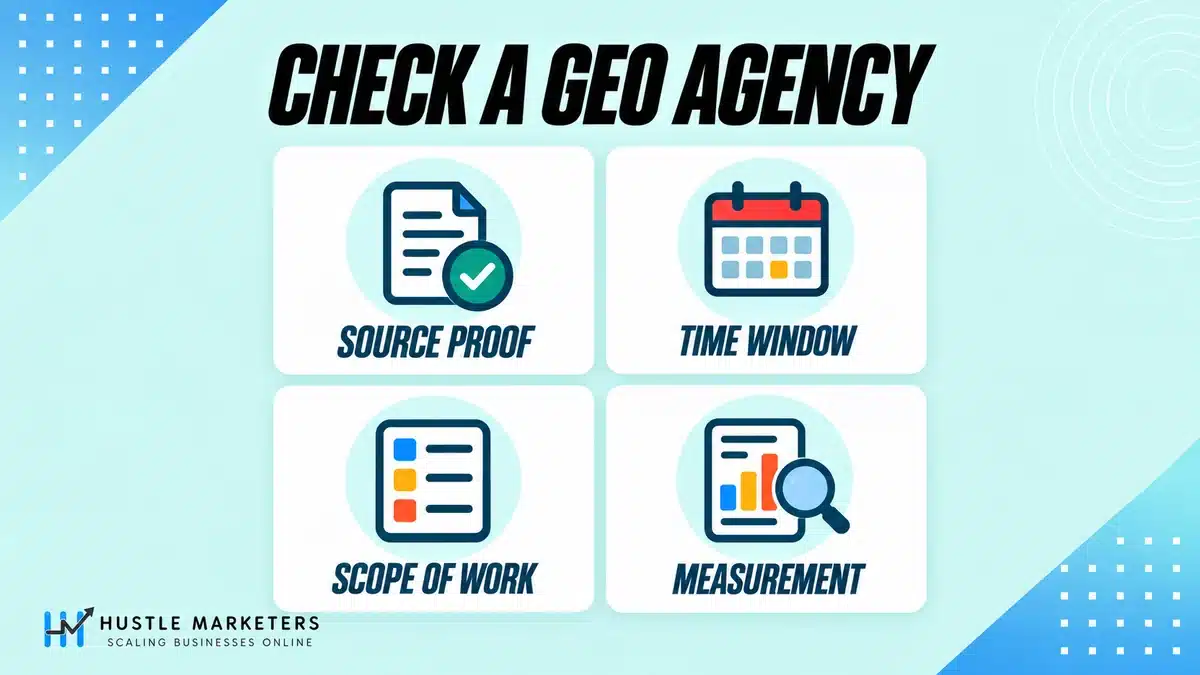
Six checks, in this order, because each one filters out a different failure. Two of them are specific to answer engine work rather than to SEO generally, and those are the two to press hardest.
- Ask them to define GEO, AEO and LLM optimization, and ask where the definition comes from. You are not testing vocabulary. You are testing whether they read primary sources or trade blogs.
- Ask what they will measure and how they will report it. For AEO specifically the answer should be inclusion in answers, not traffic. If the answer is traffic, push back, for the reason in the attribution section below.
- Ask for one client result with the data source and the measurement window named. Not a percentage. The source and the window.
- Ask what they will not promise. An agency that promises a citation in ChatGPT or a place in an AI Overview is either misunderstanding the mechanism or hoping you do not. Both surfaces are assembled at the moment of asking and neither is a slot anyone can buy or guarantee.
- Ask who owns the prompt set and the baseline if you leave. It is the main asset the work produces, so get the answer in writing.
- Ask them to name a client they have turned down and why. It tells you whether they have a view of fit.
If the agency cannot answer four of those six without reaching for a case study PDF, keep looking.
Why do best GEO agency lists so often rank the company that wrote them?
Because the list is a marketing asset and the ranking is the pitch. A ranked list is the cheapest way to place your own name above your competitors on a page a buyer will actually read. Nothing obliges the author to disclose that they compete for the same work, so look for that disclosure yourself before you trust the order.
Check the sources under a list as well as the order. Some lists lean on directories that disclose they may earn a fee for certain placements, which makes a paid placement platform the evidence behind a best-of ranking.
The quickest test takes five minutes. Read two or three lists side by side and note who appears first on each. If the publisher tops its own list every time, you know what the list is for.
How do you find agencies that specialize in AI search optimization?
Not through a ranked list, for the reason set out above. A sourcing method works better than somebody else’s ordering. Four channels produce candidates whose incentives you can actually see, and each one can be checked in an afternoon without taking anyone’s word for anything, including ours.
Where should you look for generative engine optimization companies?
Start with the layer you are trying to appear in, then work outwards to the evidence. If you are searching for agencies who specialize in AI search optimization, the ordering of a search result page is the least informative signal available to you. That ordering is exactly what the companies on it are selling.
| Channel | What it gives you | How to verify it yourself | What it will not tell you |
|---|---|---|---|
| Your own AI answers. Ask three assistants who does this work in your category | A candidate set drawn from the same retrieval layer you want to appear in | Run the prompt at least ten times per assistant and keep only the names that recur. A single run is noise, for the reasons measured further down this page | Anything about quality. Recurrence proves they sell visibility well, which is the product rather than the outcome |
| Case studies naming the client and the measurement window | The only claim type a third party can independently check | Contact the named client. If there is no client name, no date and no stated data source, it is a testimonial wearing a case study’s layout | Whether the result transfers to your category or was a one-off |
| Conference talks, published research, public documentation | Evidence that someone does this work rather than reselling somebody else’s tool | Look for a method you could reproduce, and for a figure they later corrected in public. A correction is the strongest single signal on this list | How they behave on a retainer once the interesting problems are solved |
| Directories and marketplaces | Volume, and on platforms that hold the money, a reviewable transaction history | Read only the one and two star reviews. Check whether a published price band belongs to the agency or is the directory’s own default field | Much about the work, since listings are paid, self-reported, or both |
That last check matters more than it sounds. A price or statistic repeated across several pages often traces back to one directory listing rather than to any agency’s own rate card. If four sources quote the same number for four different companies, you have found one source repeated four times.
Should you hire a generative engine optimization expert or an agency?
It depends which of the four work buckets you actually need filled. A single expert is usually the better purchase for diagnosis and strategy, because that work rewards judgment. An agency is the better purchase for sustained production and outreach, because that work is hours, and hours do not scale inside one person however good they are.
| What you need | Individual expert | Agency |
|---|---|---|
| A diagnosis of why you are absent | Usually better. One senior person reading your logs and crawl beats a junior team working a checklist | Risk of a templated audit with your domain name substituted in |
| Technical remediation across hundreds of URLs | Capped by available hours | Better. This is volume work and volume is what an agency is for |
| Outreach to earn third-party source mentions | Capped by relationships and hours | Better, and this is the most expensive honest line in any GEO scope |
| Ongoing measurement against a frozen prompt set | Fine, provided they hand you the raw data and not a screenshot | Better, provided the reporting is not a rented dashboard you lose on exit |
| Accountability when it does not work | You can reach the person who made the decision | Depends entirely on who is still on your account in month four |
The failure modes are different and both are predictable. Hiring an individual fails on capacity. Hiring an agency fails when the person who impressed you in the pitch is not the person doing the work.
There is one question that surfaces the second one early: who will hold this account in month four, by name, and what percentage of their week does it get. Ask for the answer in writing and put it in the contract.
What should a shortlist of leading GEO agencies be able to show you?
Three documents, and not one of them is a case study deck. Any agency that cannot produce all three inside a week is not a shortlist candidate, whatever list recommended it and however well it ranks for its own name. Ask for them in the first email rather than the third meeting. If you are still building the shortlist, see our list of the best AI SEO agencies.
- A scope that assigns every deliverable to an engine. Use the four buckets set out earlier on this page. If a line item cannot be placed in one of them, ask which engine it is supposed to move and what would count as it having worked.
- A measurement definition in writing. The prompt set, the run count behind each reported number, who owns the prompt set and the baseline if you leave, and what specifically happens if nothing has moved by the reassessment date.
- One result with its data source named. The measurement window stated, the tool identified, and a client willing to take a fifteen minute call. One checkable result outranks a deck of unnamed ones.
One caution on the phrase best GEO services, and we would want it given to us. There is no independent body ranking providers in this market, no audited performance data, and no agreed definition of the service being ranked. Every superlative here is either self-applied or applied by a publisher with a commercial relationship to the companies it ranks. That includes any list that happens to feature us.
What should you ask a prospective agency?
Beyond the six filters above, these are the questions that produce the most information per minute. Each is built so that a vague answer is itself the answer. You are not testing whether an agency knows the material. You are testing whether it will commit to something specific in writing before you have paid it anything.
| Question | What a good answer sounds like | What a bad answer sounds like |
|---|---|---|
| What is the first thing you will do? | An audit of crawler access and a baseline prompt set | A content calendar |
| How many prompts will you track, and who decides them? | A number, and the client signs them off | We monitor your brand |
| How often will I see a report, and what is in it? | A named cadence and a fixed metric set | Monthly updates |
| What will you do if nothing moves in 90 days? | A stated reassessment, in writing | Reassurance |
| Which crawlers will you check? | Named user agents | We will check your robots file |
| Do you work with my competitors? | A direct answer and a conflict policy | Deflection |
| What do you need from us? | Specific access and a named internal owner | Very little, we handle everything |
The last row matters more than it looks. An agency that says it needs almost nothing from you is either doing something shallow or is about to be blocked in month two.
How do you evaluate a GEO agency’s tech stack?
Ask what the tools are for, not what they are called. There are only four jobs in this stack and you can check each one.
- Crawler access verification. Do they check named retrieval user agents against your robots file and your CDN rules, or do they just glance at robots.txt? Blocking a retrieval crawler while meaning to block a training crawler is an easy mistake to make and it removes you from the answer entirely.
- Prompt monitoring. Do they run a fixed prompt set on a schedule and store the history, or do they screenshot ChatGPT when someone asks? Storage is the difference between a baseline and an anecdote.
- Citation capture. Can they show you whether you were cited, mentioned, recommended, misrepresented or absent? Those five outcomes need different responses, and a tool that only reports present or absent cannot tell you which you are in. Our guide to citations versus mentions sets out why the difference changes what you should count.
- Reporting. Is the pipeline automated and the reading human, or is the whole thing a dashboard with no narrative? Our guides to tracking brand visibility in AI search and automated SEO reports cover how we build both halves, and SEO automation covers which parts of this work survive being automated at all.
A stack question worth asking: who owns the account for each tool. If every subscription is in the agency’s name, your baseline leaves with them.
How do agencies handle multiple clients in the same category?
Three ways, in practice: written exclusivity for a defined category, a stated policy of no exclusivity, or silence. You will usually have to ask, so ask before you sign. In this discipline the conflict is sharper than in classic SEO.
Two clients can both rank on page one of a search result. In an AI answer, the model usually names a handful of brands. If your agency works for three companies in your category and all three are chasing the same prompt set, they are competing for the same small number of slots in the same answer, using the same playbook.
What a workable policy looks like: a written category exclusivity clause for a defined vertical and geography, or a clear statement that there is no exclusivity so you can price that in. What is not workable is a verbal assurance.
Our own position, so you can hold us to it: we will tell you before you sign whether we hold a conflict in your category, to the extent our existing agreements allow us to name it, and we will agree exclusivity in writing where the category is narrow enough for it to matter.
What are the best AI tools for generative engine optimization?
There is no single best tool, because the category does two unrelated jobs and most buyers do not know which one they are paying for. Some tools watch what assistants say about you. Other tools change what your site says about itself. Only the second kind performs optimization, and neither kind can read Google’s ranking data.
That distinction is worth more than any brand comparison, so here is the whole category sorted by what each type can and cannot actually establish. When an agency shows you a stack, place every logo into one of these five rows and ask what the row on its own would prove.
| Tool category | What it can establish | What it cannot establish | The question that tests it |
|---|---|---|---|
| AI visibility monitors | How often your brand appears across a defined prompt set, sampled repeatedly | A rank or position, because there is no persistent index to hold a position in | How many runs per prompt sit behind each number, and does the report show the spread or only the average |
| SEO suites with AI reporting added | Your crawl, link and ranking baseline joined to prompt-level citation sampling | Anything drawn from Google’s internal ranking data, in Google’s own words | Which figures in this dashboard are measured and which are modeled |
| Crawlers and technical auditors | The indexation, rendering, internal-link and schema faults that stop any engine parsing you. This is where optimization actually happens | Anything at all about what an assistant said | Does it render JavaScript, and does it crawl as the agents that fetch your pages |
| Google’s own first-party data | Real impressions and clicks, and via the BigQuery bulk export, the row-level detail the interface hides | A clean split of AI surfaces, and the queries behind anonymized clicks | Has the agency set up the BigQuery export, or are they screenshotting the interface |
| Log file and AI crawler analysis | Which AI user agents fetched which URLs, and when. The only first-party evidence of retrieval you will ever own | That a fetch became a citation, or that a citation became a customer | Can the agency name the user agents it filters for, and show you last month’s fetch log |
Row five is the one almost nobody sells, and it is the row we would keep if we had to drop the other four. Every other line in this table is somebody’s sample of somebody else’s output. Your server logs are a record of what actually happened on your own infrastructure, they cost nothing beyond the effort of reading them, and no vendor can revise them next quarter.
Row four carries a limit worth knowing before you build a report on it. Ahrefs analyzed one month of Search Console data across 146,741 websites and nearly nine billion clicks and found that 46.08 percent of clicks arrive with no query attached. One site in that sample was missing 90.3 percent of the query data behind 100 million clicks.
That study is from June 2022 and the mechanism has not changed. Any keyword-level attribution built on Search Console is built on roughly half the data.
Why can no tool give you a ranking position in AI?
Because the same prompt does not return the same answer, so there is nothing stable for a position to describe. Rand Fishkin published the measurement on January 28, 2026, built from 600 volunteers running 12 prompts across ChatGPT, Claude and Google AI for a total of 2,961 runs.
His two findings: “there’s a <1 in 100 chance that ChatGPT or Google’s AI, if asked 100X, will give you the same list of brands in any two responses.”
On ordering he found it is “more like 1 in 1,000 runs before you’d see two lists in the same order.” His conclusion on the tooling: “any tool that gives a ‘ranking position in AI’ is full of baloney.”
Now put that next to how vendors actually meter the tracking. This is where the statistics and the commercial model collide.
AgencyAnalytics documents its AI Tracker credit as “one prompt query, tracked on one AI platform, for one location”. Its own worked example reads “5 Prompts x 1 Location x 2 Platforms = 10 Credits a Week / 10 Credits x 4 Weekly checks in a month = 40 Credits a Month.” Credits list at ten cents each.
Do the arithmetic that the sales page does not. A weekly cadence is four samples per prompt, per platform, per month. Fishkin’s research says two responses to the same prompt rarely match even once in a hundred tries.
So a month-on-month line built from four samples is four coin flips drawn as a trend. We are not singling that product out, and its documentation deserves credit for being clear enough to check. Every credit-metered tracker has the same arithmetic underneath, and most vendors do not publish theirs.
Two questions settle it before you sign anything. How many runs per prompt sit behind each number in this report. Does the report show the spread across those runs, or only the average. If the answers are four and only the average, the movement in that chart is mostly noise, and an agency presenting it as performance either has not done this arithmetic or is hoping you will not.
What should a GEO agency measure instead of AI rankings?
A share, not a place. The researcher who demolished AI ranking positions named the replacement in the same piece. His metric: “visibility % across dozens to hundreds of prompts run multiple times is a reasonable metric.” Dozens to hundreds of prompts, each run several times, reported as a percentage of appearances. That is a defensible number, and it is cheap to produce once you stop paying for precision that does not exist.
Around that one headline number, four measurements are worth more than any vendor score, and all four are things you can own rather than rent.
- Appearance share across a fixed prompt set, with the run count printed. Freeze the prompt list for a quarter. Changing prompts mid-quarter makes the trend meaningless, which is a convenient way for a report to always improve.
- AI crawler fetch logs by URL. First-party, unrevisable, and the earliest signal that new content has been picked up. If a page was never fetched, no amount of optimization explains its absence.
- Referral sessions and assisted conversions from assistant domains. Small numbers, but real ones, and the only place in this entire discipline where revenue actually attaches.
- Third-party source presence. Since most assistant citations do not come through your Google position, track whether you appear on the comparison, listing and review pages the assistants quote. That is an outreach metric, not a technical one, and it is usually the biggest gap in a GEO scope.
Which AI tools have the best generative engine optimization features?
Judge the feature list rather than the brand, because brands in this category churn every few months and features tell you what a tool can honestly claim. Six features separate a platform that supports the work from one that only reports on it. Score anything a vendor shows you out of six before you look at the price.
| Feature | Why it matters | How to test it during a trial |
|---|---|---|
| Prompt sets you own and can export | You need a frozen set to trend against, and you need to keep it when the contract ends | Export the prompt set on day one. No export means your entire trend line is hostage to the subscription |
| Multiple runs per prompt, with the spread shown | One run is a single sample from a distribution that almost never repeats | Ask it to show variance rather than the average. A tool that only shows an average is concealing its own weakest number |
| Raw response capture, not just a brand-mention flag | The wording is where the objection, the competitor comparison and the misstatement about you actually live | Read three complete captured responses. A yes or no on your brand name is not something you can act on |
| Source URL capture per response | Tells you which third-party pages to go and earn a mention on. This is the one genuinely actionable output of the category | Check it lists the cited URLs, not merely which platform did the citing |
| Crawl and render diagnostics, or a clean export into a tool that has them | Absence from an answer is usually technical before it is editorial | Feed it a JavaScript-rendered page and see whether it reports the rendered content or the empty shell |
| AI crawler and bot log visibility | The only first-party evidence available anywhere in this discipline | Ask whether it ingests server logs or identifies AI user agents at all. Most do not, and few are asked |
On the question of the top generative engine optimization platforms for AI, the rankings you will find mostly reflect marketing budget and affiliate program, not feature depth. The AI tools with the best generative engine optimization features are rarely the ones sitting at the top of those lists.
Score them yourself against those six rows in a trial. A tool scoring four with an honest data export beats one scoring six inside a dashboard you cannot take with you, because the second one stops being yours the month you stop paying.
Which generative engine optimization platform should you buy?
Probably fewer than you have been quoted. The honest sequence is to buy the crawler first, because that is the only category in the table that changes an outcome rather than observing one. Then connect the free first-party data, Search Console with its BigQuery export, Bing Webmaster Tools, and your own server logs. Only then add a monitor.
Buying the monitor first is the common mistake, and it is expensive in a way that does not show up on the invoice. A monitor tells you that you are absent. It does not tell you why, and it cannot fix it.
Agencies lead with monitors because a dashboard demonstrates well in a pitch and a crawl report does not. If a proposal’s tooling line is mostly monitoring, the engagement is mostly reporting, and you should price it as reporting.
What does a GEO or AEO engagement cost?
Treat any average GEO cost figure you find as one company’s number rather than a market benchmark, unless it states a sample and a method. Two quotes for “GEO” can describe very different amounts of work, so compare the scope before you compare the price.
We are not going to invent a benchmark. What we will say is what drives the number: the size of the prompt set, whether content production is included or only the strategy, how many markets and languages, whether a developer is available on your side, and whether reporting is a dashboard or a written read.
If a quote arrives with no scope attached to it, the number is meaningless in either direction.
How much do GEO agencies actually charge per month?
We said above that we would not invent a benchmark, and we are not going to. There is something more useful available: an agency that publishes its figures for generative engine optimization services with its name attached. Here they are in full, with the gaps named. WebFX published its GEO cost page on May 26, 2026 and last modified it on September 11, 2026.
| Engagement type | Published range |
|---|---|
| Agency services, overall | $1,500 to $50,000+ per month |
| Small business, basic strategy | $1,500 to $5,000 per month |
| Medium-sized business, advanced strategy | $5,000 to $25,000+ per month |
| Enterprise, complex strategy | $25,000 to $50,000+ per month |
| Project based | $5,000 to $50,000 per project |
| Hourly consulting | $50 to $300 per hour |
| DIY tools and software | $10 to $250+ per month |
| AI visibility tracking software | $50 to $1,000+ per month |
Now the part a pricing page will not tell you about itself. Those bands carry no sample size, no method and no source.
They are one agency’s rate card presented as a market range. Use them the way you would use a quote from a single builder: proof that a number in that neighborhood can be said out loud, not proof of what the work is worth.
The useful comparison is inside the table rather than against it. Tools run $10 to $250 a month. A small-business retainer runs $1,500 to $5,000. Almost the entire difference is labor, so the only question that turns a quote into an estimate is how many hours it buys.
Ask for the hour count in writing. If an agency will not put one on the page, you are buying a subscription rather than a service, and you will find that out in month four.
Three variables should move a GEO price. If a proposal’s number does not change when you change these, it is a package with a strategy document stapled to the front.
- How many prompts and platforms are in scope. “All AI platforms” is not one thing. AgencyAnalytics alone tracks ChatGPT, Claude, Gemini, Google AI Mode, Google AI Overviews and Perplexity, and its credits multiply per platform and per location. Six platforms is six times the sampling cost of one, before anybody has done any work.
- Whether third-party source work is included. Since most assistant citations do not arrive through your Google position, earning mentions on the comparison and listing pages assistants quote is outreach labor. It is the most expensive honest line in a GEO scope and the one most often missing.
- Whether the technical base already exists. If your pages cannot be fetched, rendered and parsed, the first two months are SEO remediation billed as GEO. That is legitimate work and usually necessary work, but it should be named as remediation in the scope rather than counted as generative engine optimization.
What can an agency actually promise?
Short list, and it is short for a reason. An agency can promise the work it controls and the process it will follow. It cannot promise an outcome a model decides fresh on every query. Everything in this section sorts into one of those two piles, and a good proposal sorts them for you before you ask.
An agency can promise process and reporting. It can commit to a named prompt set, a measurement cadence, a defined baseline, specific technical fixes, and a written reassessment if nothing moves.
An agency cannot promise a citation. Nobody controls whether an assistant names you. Models update, retrieval changes, and the same prompt can return a different answer on rerun. An agency offering guaranteed AI visibility is selling something it does not control.
So ask for those process commitments in the proposal itself, as undertakings rather than marketing copy: the prompt set size, the reporting cadence and the metric set, all three together.
Can a GEO agency guarantee AI visibility?
No, and you do not have to take that from us. Google’s guidance on third-party tools puts it plainly: “They can’t guarantee performance. Any predictions are their own and like predictions generally, may not happen.” That sentence is written about tools, and tools are what almost every visibility guarantee in this market is quietly underwritten by.
There is a cleaner mechanical reason underneath the guidance. A guarantee needs an outcome that is measurable and repeatable. Here the measurement moves while your website sits still.
Roughly three quarters of ChatGPT’s cited domains turned over between two reasoning modes on the same prompt set, and an identical prompt returns the same list of brands fewer than once in a hundred attempts. You cannot guarantee a number that changes on its own.
So the useful conversation is not whether an agency will guarantee something. It is which half of the scope is a deliverable, which half is an outcome, and whether the proposal is honest about the difference. Here is the line, drawn where we would want it drawn if we were the ones signing.
| Promise in the proposal | Can it be promised? | Why | What to accept instead |
|---|---|---|---|
| A citation in ChatGPT for a named term | No | The source set changes between runs and between reasoning modes of the same product | Appearance share across a frozen prompt set, with the run count printed next to it |
| Position one in AI Overviews | No | There is no persistent position to hold, and no third-party tool reads Google’s ranking data | Presence rate across a defined query set, tracked over months not weeks |
| A percentage traffic lift from AI search | No | AI surfaces are not cleanly separable in Search Console, and 46 percent of clicks arrive with no query attached | Referral sessions and assisted conversions from assistant domains, reported as the small real numbers they are |
| Your pages will be fetchable, renderable and parseable | Yes | Verifiable on your own server, in your own logs, without anyone’s dashboard | Accept it, and ask for the before and after on a named URL list |
| These pages will carry sourced, dated claims and correct entity markup | Yes | It is a deliverable, not an outcome, and either it shipped or it did not | Accept it, with the page list and the date attached to the scope |
| We will pursue mentions on these third-party pages | Yes, as effort | Placement sits with a third party, so the effort can be promised and the result cannot | Accept a named target list and a monthly contact report, not a placement count |
One last thing about guarantees, offered without cynicism. A guarantee in this market is a refund policy, not a forecast, and a refund policy is not a bad thing to have. Read what triggers it, what evidence settles it, and above all who picks the measuring instrument.
If the agency picks the tool, and the tool is one whose numbers move by themselves between runs, then the guarantee is decoration and the clause exists to close the deal rather than to protect you.
Why can’t an agency prove the traffic it claims?
This part cuts against us as much as anyone.
When someone reads about you inside an assistant and then visits your site, the visit frequently arrives with no referrer and lands in your analytics as direct traffic. When they read about you and do not visit at all, there is nothing to see.
Half of this argument flatters agencies: missing referrers mean an agency gets less credit than it deserves.
The other half is the one you should hear before you sign anything. The same gap means an agency cannot prove the credit it claims. If direct traffic rises during an AI visibility engagement, that is consistent with the work having succeeded and equally consistent with a dozen other things. An agency presenting a direct traffic rise as proof of AI citations is overstating what the data can carry, and so would we be.
What you can measure honestly is inclusion. Agree a fixed prompt set, run it on a schedule, and record whether you are cited, mentioned, recommended, misrepresented or missing. That is repeatable and it is checkable. Traffic is a secondary signal at best.
What should be in the contract?
Contract length matters less than the four clauses below. For a service whose main output is a prompt set and a citation baseline, they decide what you keep when the work ends.
- Who owns the prompt set. It should be you, in writing, exportable on request.
- Who owns the baseline and the historical citation data. Same answer, and ask for the export format.
- Notice period and what happens to in flight work. Thirty days is normal. What matters is whether the data leaves with you.
- The assessment point. A date, written down, at which both sides look at the baseline and decide whether to continue. Without it, a twelve month contract is twelve months of hope.
Add one more if your category is narrow: the conflict policy from the section above, in the agreement rather than in an email.
Who should not hire a GEO agency?
Here is our answer, and it will cost us some inquiries. There are situations where hiring a GEO agency is the wrong purchase, and in most of them the money is better spent somewhere else. If you recognize your business below, say so on the call and watch how the agency responds.
- If your classic SEO is broken, fix that first. Google’s AI features are built on the index. If you cannot be crawled and indexed, there is nothing for an AI answer to use. Start with our technical SEO checklist.
- If you have no content that answers real buyer questions, an agency cannot optimize absence.
- If nobody internally can approve a page change inside two weeks, the engagement will stall and you will pay for the wait.
- If your category has almost no AI answer surface yet, measure for a quarter before you buy a retainer.
- If you need attributable revenue this quarter to justify the spend, this is the wrong channel for that deadline. Paid search is the honest answer to that brief.
Which statistics in this market can you actually check?
Two figures come up again and again in GEO pitches, and we traced both. Both are real. The bigger risk with statistics in this market is staleness and paraphrase drift, so check the date and the original wording before you rely on one. Every other statistic on this page comes from the thirteen sources we fetched and checked ourselves, listed at the end.
The Gartner figure, which is the single most cited number in this category, is real. Gartner published it on February 19, 2024 under the headline “Gartner Predicts Search Engine Volume Will Drop 25% by 2026, Due to AI Chatbots and Other Virtual Agents”. The prediction reads:
By 2026, traditional search engine volume will drop 25%, with search marketing losing market share to AI chatbots and other virtual agents, according to Gartner, Inc.
Three things follow. Gartner states no method, no survey and no sample anywhere in the release, so this is an analyst prediction rather than measured data. It was published in February 2024 about 2026, so by October 2026 it can be checked against real search volume data.
We have not run that check, so we make no claim either way. When you see the figure quoted, compare it with the prediction sentence above. “Losing market share to AI chatbots” is a narrower claim than AI agents replacing Google, although the release’s own analyst commentary does use replacement language.
The research paper’s 40 percent figure is real, but it is an upper bound from a research evaluation, as covered at the top.
Be careful with figures sourced to an affiliate aggregator rather than to the company concerned, such as ChatGPT weekly user counts that do not cite OpenAI, and with AI conversion rate figures quoted without the baseline they were measured against.
We have not repeated any figure on this page that we could not trace to its source.
The same goes for client retention percentages. An unsourced retention figure on an agency page is a claim, not a statistic, so ask where it comes from.
How does Hustle Marketers approach generative engine optimization?
We treat GEO as SEO plus three lines a ranking report does not cover: a prompt set you own, work on the third-party sources assistants cite, and Bing coverage for Copilot. It runs as part of our AI SEO agency service, with SEO from $500+ a month as a starting range and fuller strategist-led engagements quoted separately.
Two of our published case studies show the work with the data source attached:
- Hobby store SEO and AI search case study: P-Rex Hobby, a Shopify store in Vancouver, where SEO and AI search work began in April 2026. GA4’s AI Assistant channel recorded 2,807 sessions from 8 July to 5 October 2026, up from 489 in the previous 90 days, and ChatGPT sent most of them. The study also lists what its numbers do not show, including that the GA4 channel launched inside the comparison period.
- Rec Hall SEO and AI visibility case study: a family entertainment center in St. Charles, Missouri. Organic clicks rose from 980 to 2,131 over a 3 month Search Console comparison, and the study records 8 mentions and 13 cited pages across ChatGPT, Google AI Overview, Google AI Mode and Gemini. It also notes that AI platforms cited TripAdvisor more often than the venue’s own site.
Applying this page’s own tests to those two studies: both name their data sources and date ranges. The Rec Hall AI figures do not state a run count, so read them as a snapshot rather than a trend.
Why choose Hustle Marketers or Ishant Sharma as your GEO agency
Ishant Sharma has worked in Google Ads, Microsoft Ads, Meta Ads, SEO and ecommerce PPC since 2013, and Hustle Marketers runs paid search, paid social and ecommerce SEO with results published rather than described.
How we answer the same questions, so you can apply them to us as well.
- We disclose that we compete for this work in the summary at the top of this page and again before the first section.
- Where we publish a client result, it names the data source and the measurement window. The Judaica ecommerce SEO case study reports organic clicks up about 31 percent, from 9.96K to 13.1K, on a Google Search Console 28 day comparison against the previous 28 days in late September 2026, and the client listed first under The Megastores in a Google AI Mode answer.
- We tell you what we cannot attribute. Referrer stripping is real and we will not present direct traffic as proof of an AI citation.
- We agree the prompt set in writing, it is yours, and we will export the baseline to you in a documented format on request, within a turnaround written into the agreement.
- We will not promise a citation, because nobody controls whether an assistant names you.
- We will tell you before you sign whether we hold a conflict in your category, as far as our existing agreements let us name it.
- We say who should not hire us, in the section above, in public.
If you want the service page rather than the buying guide, our AI SEO agency page sets out scope and what the engagement includes. For stores, AI SEO for ecommerce is the version of this work with a product catalog attached. For classic organic alongside it, see SEO agency, enterprise SEO for sites where every change goes through a release cycle, and white label SEO if you are an agency buying this to resell.
About the author
This page was researched and written by Ishant Sharma, founder of Hustle Marketers, who has worked in Google Ads, Microsoft Ads, Meta Ads, SEO and ecommerce PPC since 2013, including SEO engagements for Greenbelt Homes and JBL Construct.
We fetched all thirteen external sources directly from the publisher and re-checked every quoted sentence against its source before drafting. The table at the end lists each one with its date and exactly what we verified.
If something here is wrong, tell us and we will correct the page rather than leave it.
Generative engine optimization agency FAQs
What does a generative engine optimization agency actually do?
An agency that works to get your pages used as a source when an AI system answers a question, rather than only ranking in a list of links. The term comes from a 2023 research paper by Aggarwal and colleagues, published at KDD 2024, which measures visibility “in generative engine responses”. Note what that means: the paper is about retrieval time, not about getting into training data.
Is an answer engine optimization agency different from a GEO agency?
In most cases it is the same service under a different name, and agencies do not agree on where one ends and the other begins. Compare the deliverable rather than the acronym: the prompt set, the reporting cadence and what happens if nothing moves.
How do you pick an SEO agency for AEO work?
Ask six things. Where their definition of GEO and AEO comes from. What they will measure and how they will report it. One client result with the data source and measurement window named.
What they will not promise. Who owns the prompt set and baseline if you leave. And a client they have turned down, and why.
What should a GEO agency cost?
There is no reliable market benchmark. WebFX, which publishes its GEO rates with its name attached, lists $1,500 to $5,000 a month for small business work and $5,000 to $25,000+ for medium-sized businesses, with no method stated.
Treat any price as one company’s number, and ask for the scope and the hour count before you compare quotes.
Can a GEO agency guarantee I will be cited in ChatGPT?
No. Nobody controls whether an assistant names you, models update, and the same prompt can return a different answer on rerun. What an agency can commit to is process: a named prompt set, a defined baseline, a reporting cadence, specific technical fixes and a written reassessment date.
How do I evaluate a GEO agency’s tech stack?
By what each tool is for, not what it is called. Crawler access verification against named retrieval user agents. Prompt monitoring on a schedule with stored history. Citation capture that distinguishes cited, mentioned, recommended, misrepresented and missing.
And reporting where the pipeline is automated and the reading is human. Then ask whose name each subscription is in, because if it is the agency’s, your baseline leaves with them.
Why do agency lists so often rank the agency that wrote them?
Because the list is a marketing asset, and a ranked list is a cheap way to put your own name first. Read two or three lists side by side and note who appears first on each. It takes five minutes and it tells you most of what you need.
How do agencies handle working with my competitors?
Ask directly, and get the answer in writing. In an AI answer the model typically names a handful of brands, so an agency serving three companies in one category is competing for the same slots with the same playbook. A workable policy is written category exclusivity for a defined vertical and geography, or a clear statement that there is none so you can price it in.
How long does generative engine optimization take to show results?
There is no fixed timeline, because AI answers change between runs and model updates. As one dated example, in our hobby store case study the SEO and AI search work began in April 2026, Search Console clicks lifted about four months into a six month window, and AI assistant sessions were measured over the 90 days to 5 October 2026. Agree a reassessment date in writing rather than a promised result.
Does a GEO agency replace your SEO agency?
Usually not. Google’s AI optimization guide, last updated July 10, 2026, says that from Google Search’s perspective, optimizing for generative AI search is still SEO. The lines that sit outside a normal SEO scope are the prompt set, work on the third-party sources assistants quote, and Bing coverage. If your SEO agency already covers those, a second retainer adds little.
Can a small business afford a GEO agency?
Often, if the scope stays narrow. WebFX, which publishes its GEO rates, lists $1,500 to $5,000 a month for small business work, with no method stated. Hustle Marketers prices SEO from $500+ a month as a starting range and adds the GEO lines to that scope, so ask any agency how many prompts, platforms and hours a quote covers.
Sources and how we researched this
Everything above is either something verified directly or something labeled as unverified. This section says which is which, where each number came from, what could not be reached, and what this page does not claim. If you find an error here, that is a fair thing to hold against the rest of it.
Which sources did we verify first-hand?
Thirteen, each fetched directly from the publisher and checked line by line rather than lifted from another page’s summary of it. Where a figure below differs from the number you have seen elsewhere, the number in circulation is usually an older version of the same study, and we have said so in the text.
| Source | Date on the source | What we verified first-hand |
|---|---|---|
| Google, AI optimization guide, Search Central | Last updated Jul 10, 2026 | The “still SEO” sentence in full, the llms.txt sentence, the structured data sentence, and that the page carries exactly three recommendation headings |
| Google, guidance on third-party SEO tools | Last updated Jun 5, 2026 | The internal ranking data sentence and the guarantee sentence, both quoted in full |
| arXiv 2311.09735, GEO: Generative Engine Optimization | Submitted Nov 16, 2023, KDD 2024 | Title, full author list, the 40 percent sentence, the black-box framework wording, and that the abstract does not mention training data |
| Ahrefs, AI Overview citations update, Linehan and Guan | Mar 2, 2026 | 863,000 SERPs and 4 million URLs, 37.1 percent in the top 10 and 36.7 percent outside the top 100 on organic results, and the 76 versus 38 percent sentence |
| Ahrefs, overlap between AI assistants and search, Linehan and Guan | Aug 11, 2025 | 15,000 long-tail prompts, the 12 percent average, the 11 percent overlap figure, the roughly 10 percent Bing average and Perplexity’s 28.6 percent. The other per-engine Google figures in our table are read from the study’s chart |
| Ahrefs, anonymized Search Console queries, Stox | Jun 24, 2022 | 46.08 percent of clicks arriving without a query, 146,741 sites, close to nine billion clicks, and the 90.3 percent worst case |
| SparkToro, Fishkin | Jan 28, 2026 | 600 volunteers, 12 prompts, 2,961 runs across ChatGPT, Claude and Google AI, both consistency findings, and the ranking position sentence |
| Semrush, ChatGPT reasoning modes | Jun 30, 2026 | 100 prompts run twice, 25.6 percent domain overlap, citation rate moving from 50 to 68 percent, 2.6 to 4.5 sources per response, 4.6 times more sub-queries |
| Semrush, technical SEO factors and AI search | Jan 2026 | The schema type shares we quote, and that they are correlations measured on URLs that were already cited |
| Trellner Research source audit, corroborated independently by GIGAZINE | Sep 2026 | 215,128 generated pages across three sites, and 59.8 percent of supporting sources outside the top 100,000 |
| AgencyAnalytics, AI Tracker documentation | Accessed Sep 2026 | The credit definition, the weekly cadence, the published worked example, and the six supported platforms |
| WebFX, generative engine optimization cost page | Published May 26, 2026, modified Sep 11, 2026 | Every price band reproduced in our table, and that no method, sample or source is stated behind them |
| Gartner press release | Feb 19, 2024 | The headline, the date, the prediction sentence in full, and that no method, survey or sample is stated anywhere in it |
Where we did our own arithmetic rather than quoting somebody else’s. Two places, and both are flagged in the text above. The four samples a month figure is our calculation from AgencyAnalytics’ published worked example, not a number that company publishes.
The claim that labor accounts for most of the gap between a tool subscription and a retainer is our inference from two bands on WebFX’s own page, not a figure either company states. If you disagree with either calculation, both are reproducible from the sources in the table in under five minutes, which is the point of showing the working.
What could we not verify or reach?
Any figure we could not trace to its origin has been left off this page. The per-engine Bing figures in the Ahrefs study appear only in a chart we could not read reliably, so we report the Bing average instead.
What this page does not draw on: forum threads, LinkedIn or X posts, and video transcripts.
What we did not claim. We have not said we are the first or the only page to make any of these points, and we are not.
What we did not do. We did not check whether the Gartner forecast came true, which is the most obvious open question on this page.