Ecommerce SEO Consultant for Every Major Store Platform
Catalog Audits, Roadmaps and Release Checks
An ecommerce SEO consultant finds what is holding back your category and product pages in search, ranks the fixes by the revenue at stake and checks each one after it ships. Ishant Sharma leads every engagement on Shopify, Magento, BigCommerce, WooCommerce and Webflow stores, and our SEO work starts from $500+ a month on a written scope.
The Performance Marketing Agency Behind $780M+ in Client Sales
Founded by Ishant Sharma, Hustle Marketers is a Google Partner, Meta Business Partner, and Microsoft Advertising Partner. We earned six 2026 Clutch awards across PPC, Google Ads, Retail PPC, and global digital marketing. 591+ client reviews combined across platforms, averaging 4.9 out of 5. Every number in this section comes from real accounts, named clients, and published case studies, not industry averages.
What Does an Ecommerce SEO Consultant Actually Do?
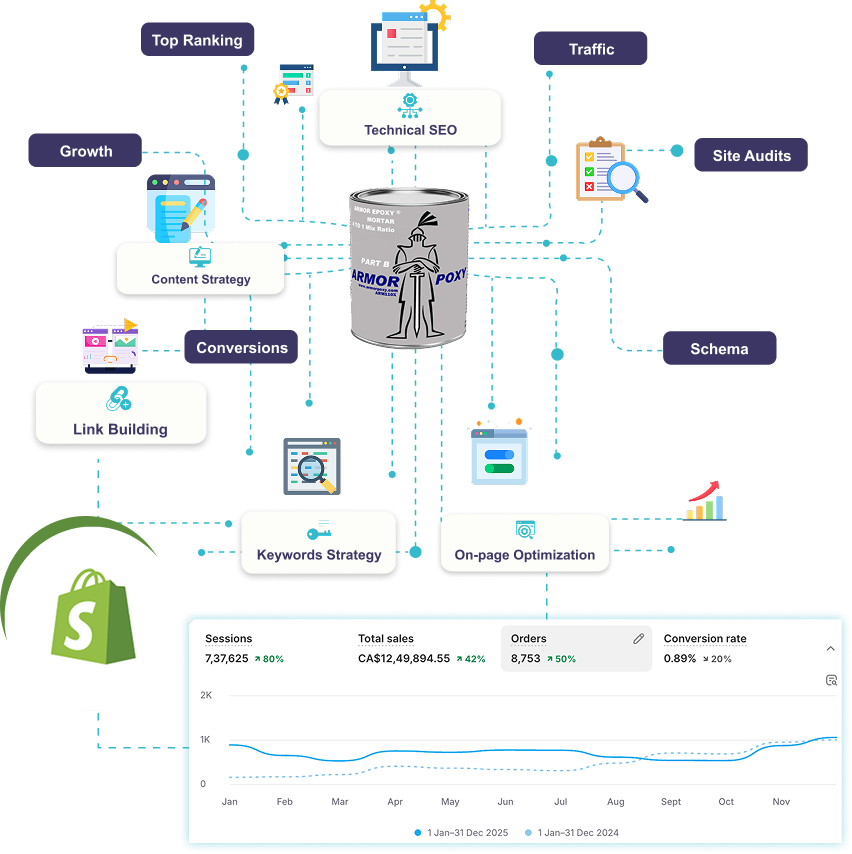
An ecommerce SEO consultant works out why your categories and products are not earning the organic traffic they should, then decides which fixes come first. On most stores the causes sit in a few places: filter and variant URLs using up crawl time, thin category pages, product data that differs between the page and the feed, and redirects lost in past migrations. Each fix is written as a ticket and checked once your developer ships it. Want the fixes built for you? Our ecommerce SEO agency team handles implementation.
Ecommerce SEO Consultant vs Agency vs Specialist: Which Fits?
Choose a consultant when you have a developer or in-house marketer who can ship changes and you need someone senior to decide what they work on. Choose an ecommerce SEO specialist when the gap is hands-on hours inside your platform admin and theme. Choose an agency when nobody on your side has the time, because the agency writes the plan and does the work. Many people call all three an ecommerce SEO expert, so ask who will plan, who will build and who will check, and get those answers in the written scope.
Can an Ecommerce SEO Consultant Help Products Show in AI Answers?
Mostly through the same work that ranks products in Google. Google says AI Overviews and AI Mode have no extra requirements and need no special files or schema; it asks for crawlable pages, key content in text, structured data that matches the page and current Merchant Center data. OpenAI says ChatGPT product results are not ads and draw on structured product data from first and third party providers. So the audit checks that specs, price and stock sit in the page HTML, that your feed matches each product page, and which agreed prompts name your store.
What Does an Ecommerce SEO Consulting Engagement Include?
Every engagement opens with an audit of your own data. These are the nine areas a roadmap can cover, each written as a task with an owner and a check.

Ecommerce SEO Audit & Roadmap
A crawl of the full catalog plus your Search Console data, turned into a ranked list of fixes with the revenue at stake and effort for each.

Faceted Navigation & Crawl Control
Which filter, sort and parameter URLs Google should crawl, which it should skip, and the robots.txt and canonical rules that enforce it.

Category & Product Page SEO
Target searches, copy briefs, specifications in text and internal links for the categories and products that carry your margin.

Keyword & Buyer Intent Mapping
Searches grouped by intent and mapped to one category, product or guide each, so your pages stop competing for the same query.

Product Data, Schema & Feeds
Product and variant structured data, GTINs and a Merchant Center feed that matches the page, for free listings and AI answers.

AI Search Visibility
Agreed buying prompts checked in AI assistants, with the pages they cite and the product facts they get wrong about your store.

Migrations & Replatforming
URL maps, redirect testing and launch checks when you change platform, theme or domain, so rankings carry across.

Link Building Plan
Editorial placements and digital PR aimed at category pages and guides, with every target site reviewed first. No paid links.

Monthly Reviews & Release Checks
Each release rechecked after it ships, plus a monthly review of non-brand clicks and revenue that reorders the roadmap.
Which AI Assistants Do We Check for Ecommerce Stores?
Shoppers now ask AI assistants what to buy and where. We run a prompt list agreed with you and record where your store and products are named or cited, and which competitor pages appear instead.

ChatGPT
We check whether ChatGPT names your store for the agreed prompts, and whether its shopping results show your products correctly.

Google Gemini
Google lists Gemini among the places Merchant Center free listings can appear, so we check prompts alongside your feed status.

Perplexity AI
We record which of your category, product or guide pages Perplexity cites for the agreed prompts, and which stores it cites instead.

Microsoft Copilot
We run the agreed prompts in Copilot and review your store's indexing in Bing Webmaster Tools alongside the results.

Claude AI
We run the agreed prompts in Claude and record whether your store is named and how your products are described.

Google AI Mode
Google counts AI Mode traffic inside the Web search type in Search Console, so we pair prompt checks with that data.
What Happens in an Ecommerce SEO Consulting Engagement?
Ishant Sharma runs the engagement from the first call to the monthly review. The six steps are the same on every platform; only the place each fix is made changes.

01.
Access & Baseline
We take read-only Search Console and analytics access, then record clicks, revenue and indexed pages before anything changes.

02.
Catalog Crawl & Audit
We crawl categories, filters, variants and products, and compare what Google indexes with what you want indexed.

03.
Ranked Roadmap
Every fix is ranked by revenue at stake and developer effort, so the first sprint goes where it pays.

04.
Tickets for Your Team
Each fix becomes a ticket with the exact change, the URLs affected and how we will test it.

05.
Release Checks
After each release we recrawl the affected URLs and confirm the change works before the next one ships.

06.
Monthly Review
Each month we report non-brand organic clicks and revenue from your own data, then reorder the roadmap.

01.
Access & Baseline
We take read-only Search Console and analytics access, then record clicks, revenue and indexed pages before anything changes.
02.
Catalog Crawl & Audit
We crawl categories, filters, variants and products, and compare what Google indexes with what you want indexed.
03.
Ranked Roadmap
Every fix is ranked by revenue at stake and developer effort, so the first sprint goes where it pays.
04.
Tickets for Your Team
Each fix becomes a ticket with the exact change, the URLs affected and how we will test it.
05.
Release Checks
After each release we recrawl the affected URLs and confirm the change works before the next one ships.
06.
Monthly Review
Each month we report non-brand organic clicks and revenue from your own data, then reorder the roadmap.
Why Choose Hustle Marketers as Your Ecommerce SEO Expert?
Hustle Marketers was founded in 2020 by Ishant Sharma, a Google Ads, Microsoft Ads and SEO specialist working in digital marketing since 2013. Our delivery team is in Zirakpur, India, and we work with online stores in the US, the UK, Canada, Australia and beyond.
- Ishant Sharma leads your engagement, from the first audit call to the monthly review.
- Hands-on work on Shopify, Magento, BigCommerce, WooCommerce and Webflow stores.
- 4.9 out of 5 from 591+ reviews across Google, Trustpilot, Clutch, Upwork and more.
- SEO from $500+ a month, starting with an audit and a ranked roadmap.

One Named Consultant
Ishant Sharma leads your engagement from the first audit call to the monthly review, so you always know who is accountable.

Platform Neutral Advice
Shopify, Magento, BigCommerce, WooCommerce or Webflow: the advice fits the platform you have, not a push to move.

Pages and Feeds Planned Together
We also run Google Shopping and Merchant Center work, so feed fixes and page fixes are planned as one job.

Case Studies With Sources
Our ecommerce SEO case studies name their data sources and comparison periods, so you can see what was measured.
4.9 Out of 5 From 591+ Reviews
Rated 4.9 out of 5 across 591+ reviews on Google, Trustpilot, Clutch, G2 and other platforms, and 5.0 on Clutch.
Google, Meta and Microsoft Partner
Hustle Marketers holds Google Partner, Meta Business Partner and Microsoft Advertising Partner status.

One Named Consultant
Ishant Sharma leads your engagement from the first audit call to the monthly review, so you always know who is accountable.

Platform Neutral Advice
Shopify, Magento, BigCommerce, WooCommerce or Webflow: the advice fits the platform you have, not a push to move.

Pages and Feeds Planned Together
We also run Google Shopping and Merchant Center work, so feed fixes and page fixes are planned as one job.

Case Studies With Sources
Our ecommerce SEO case studies name their data sources and comparison periods, so you can see what was measured.

4.9 Out of 5 From 591+ Reviews
Rated 4.9 out of 5 across 591+ reviews on Google, Trustpilot, Clutch, G2 and other platforms, and 5.0 on Clutch.

Google, Meta and Microsoft Partner
Hustle Marketers holds Google Partner, Meta Business Partner and Microsoft Advertising Partner status.
Which Ecommerce Categories Do We Plan SEO For?
How shoppers search changes by category, so the category tree, the filters worth indexing and the content plan change too. These are the store types we plan for most often.

Fashion & Apparel
Size, color and fit variants, seasonal ranges, and a clear rule for which filter combinations earn an indexed page.

Beauty & Skincare
Searches by skin type, ingredient and concern, with ingredient lists as text and product claims you can support.

Home & Furniture
Categories by room, style and material, dimensions in text, and buying guides for slow, considered purchases.

Electronics & Parts
Model numbers, compatibility and specification tables in text, with GTINs and MPNs matched across pages and feed.
Jewelry & Gifts
Metal, stone and occasion searches, gift guides timed to the calendar, and detail written for high-value buys.

Pet Supplies
Searches by pet, size and need, with categories and guides that make repeat orders easy to find.

Hobby & Collectibles
Code-style product names, series and scale searches, pre-order pages and the trust signals collectors check first.

B2B & Industrial Supplies
Part numbers and specification searches, with category structures built for trade buyers who search by exact model.

Large Multi-Category Stores
Crawl rules, category depth and internal links that keep thousands of SKUs discoverable without index bloat.

How Do We Report Ecommerce SEO Results?
Every report comes from your own Google Search Console and analytics accounts, so you can check each number yourself. We report non-brand organic clicks and revenue apart from brand searches, because brand demand tends to move with ads, email and word of mouth rather than SEO. Google says traffic from AI Overviews and AI Mode is included in the Search Console Performance report under the Web search type, so it sits in the same report. Each month you also see what shipped, what passed its release check and what moves up the roadmap.
How much does an ecommerce SEO consultant cost?
Hustle Marketers SEO work starts from $500+ a month. That entry scope is defined in writing; larger catalogs, several store views or migration support are scoped and quoted after we review the store. You can compare our ecommerce SEO packages.
Market figures, not our prices: in an Ahrefs survey of 439 SEO providers (last updated August 2024), consultancies averaged $171.18 an hour and $3,250 a month on retainer, and the most common consultant retainer was $2,501 to $5,000 a month. Clutch’s SEO pricing guide (updated September 2026) says most SEO agencies listed on Clutch charge $100 to $149 an hour. Budget separately for developer time, because a roadmap still has to be built.
How do you choose an ecommerce SEO consultant?
Start with Google’s own checklist in Do you need an SEO?: ask for past work, how success will be measured and over what timeframe, and find someone else if a consultant guarantees a first place ranking. Google also suggests giving an auditor read-only Search Console access. Then ask questions only ecommerce experience can answer:
- Which of my filter pages should be indexed, and how would you stop the rest being crawled?
- Who writes the tickets, who ships them and who checks them after release?
- Can you show a dated ecommerce case study with its data source and caveats?
- How will you separate non-brand organic revenue from brand demand?
- What will you need from my developer in the first month?
Be wary of unsolicited offers. One store owner on the Shopify Community reported more than ten messages from self-described experts within a day of listing a new store, and Google warns about SEOs who email out of the blue.
Which ecommerce platforms do we consult on?
The audit method is the same on every platform. Where each fix is made, and what the platform allows, is not.
- Shopify: Shopify adds canonical tags and generates sitemap.xml and robots.txt automatically. Storefront filters are capped at 25 per store and hidden on collections with more than 5,000 products, and editing robots.txt.liquid is an unsupported customization. See our Shopify SEO consultant service.
- Magento and Adobe Commerce: Adobe recommends enabling canonical tags for categories and products, and changing a URL key creates a 301 redirect by default. Generating those rewrites when a large category is saved can slow the store, which matters before bulk changes. See our Magento SEO consultant service.
- BigCommerce: filter facets are only returned when the merchant enables product filtering and marks each facet visible in its settings, so which facets exist is a store decision we review. See our BigCommerce SEO agency service.
- WooCommerce: product URLs follow the permalink base you pick, and WooCommerce warns that changing it breaks existing product links unless redirects are added. See our WordPress and WooCommerce SEO service.
- Webflow: Ecommerce plans cap items at 500, 5,000 and 15,000 on Standard, Plus and Advanced, which shapes how far a catalog and its content can grow. See our Webflow SEO consultant service.
Should every filter page on your store be indexed?
No. Google’s faceted navigation guide says filter URLs can cause overcrawling and slow the discovery of new pages, and names robots.txt as the main way to stop crawling filters you do not need indexed. For the few filter pages that match real searches, such as a color or material category, Google asks for the standard & separator, a consistent filter order and a 404 status when a combination returns no products. Google’s crawl budget guide is written for sites with 1 million+ pages that change weekly or 10,000+ pages that change daily. In our experience, most stores need cleaner filter rules before they need crawl budget work.
How should product variants be set up for SEO?
Google’s ecommerce URL guidance recommends a distinct URL for each variant, as a path or a query parameter, and when the parameter is optional the canonical is the URL without it. Variants that only change after a # in the URL are treated as one page. Google’s product variant markup groups variants under a ProductGroup that states what they vary by, such as color, size or material, and Google asks for product markup in the initial HTML, because markup added by JavaScript can make Shopping crawls less frequent and less reliable.
Why does Merchant Center matter for organic search?
Google recommends sharing product data two ways: structured data on your pages and a Merchant Center feed. Free listings run through Merchant Center at no cost, new accounts are opted in by default, and Google says they can appear on Search, Google Maps, Gemini and YouTube. Because feeds and pages update at different speeds, Google suggests letting Merchant Center update its copy from your website when price or stock disagree. We plan feed fixes and page fixes together; our guide to free listings in Google Merchant Center covers the setup.
How do you protect rankings during a migration or replatform?
Most of the risk sits in the URL map. Google’s site move guide says to map every old URL to its new equivalent, use permanent 301 or 308 redirects straight to the final page, keep them for at least a year and expect rankings to fluctuate for a while. Before launch we test the map against your top organic landing pages; after launch we recrawl the old URLs and watch Search Console for errors. It is a worry store owners raise on the Shopify Community when they merge or move stores.
What ecommerce SEO results have we published?
- Magento specialty retailer: $8.05M in total store sales and 70,000 orders from 2023 to 2025, with work on faceted URLs, canonicals, category content and product data. The case study notes these are total store sales that also reflect pricing, promotions and repeat customers, not SEO alone.
- US Judaica store: organic clicks up about 31% over 28 days against the previous 28, and free listing clicks up 36.6% to 10.59K in Merchant Center. Both periods include Rosh Hashanah and Yom Kippur, so part of the lift is seasonal.
- Australian pet brand on Shopify: organic clicks up 56.3%, from 6,517 to 10,189, comparing three-month periods after collection page rewrites and technical cleanup.
- Hobby store on Shopify: Google organic clicks up 45%, from 71.2K to 103K, comparing the last six months with the previous six, and AI assistant sessions in GA4 up 474% between two three-month periods.
Each case study names its data sources and comparison periods. More are collected in our ecommerce SEO case studies.
2013

Read-Only Access
Audits start with view access to your data.

No Ranking Guarantees
We commit to the work, never to a position.




Top Rated On Upwork

Verified Review

5-star Rated

What Do Our Clients Say?
Video and written reviews from store founders and marketing leads. Hustle Marketers holds a 4.9 out of 5 rating from 591+ reviews across review platforms and 5.0 on Clutch from more than 50 reviews. Any figures a reviewer mentions are their own results, in their own words.
Get an Ecommerce SEO Audit From a Senior Consultant
Send your store URL, your platform and what changed recently: a redesign, a migration, new filters or a feed problem. We will reply in plain language with what we would check first and what a consulting scope would cost. See what an ecommerce SEO audit covers.

Ecommerce SEO Consultant FAQs
What does an ecommerce SEO consultant do?
An ecommerce SEO consultant audits your store, decides which fixes matter most for revenue and writes them as tasks for your developer or team. The work covers crawl control for filters and variants, category and product pages, structured data, Merchant Center feeds and migrations. After each release the consultant checks that the change works, then reports results from your own Search Console and analytics data.
How much does an ecommerce SEO consultant cost?
Hustle Marketers SEO work starts from $500+ a month on a written scope, and larger catalogs or migrations are quoted after a store review. For market context, an Ahrefs survey of 439 SEO providers, last updated August 2024, found consultancies averaged $171.18 an hour and $3,250 a month. Those are market figures, not our prices. Budget separately for the developer time needed to ship the roadmap.
Should I hire an ecommerce SEO consultant or an agency?
Hire a consultant if you have a developer or in-house marketer who can make changes and you need senior direction, an audit and release checks. Hire an agency if nobody on your side has the time, because the agency also does the work. Our ecommerce SEO agency service covers implementation, and many stores start with a consultant audit to see how much of the work is decisions and how much is development.
What is the difference between an ecommerce SEO expert, specialist and consultant?
The titles overlap, so judge by the work. A consultant plans, prioritizes and reviews. An ecommerce SEO specialist works hands-on inside your platform, theme and admin. Expert is a label any of them may use. Ask each candidate who writes the plan, who ships the changes and who checks them after release, and make sure the answers appear in the written scope.
Who is the best ecommerce SEO expert for my store?
Ecommerce SEO consultants vary widely, so look for someone who has worked on your platform and catalog size and can explain your filter, variant and feed problems in plain terms. Before you hire, ask for dated ecommerce case studies with data sources, and check reviews on independent platforms. Google advises finding someone else if an SEO guarantees a first place ranking, and being wary of SEOs who contact you out of the blue.
How long does ecommerce SEO take to show results?
It depends on what is being fixed. In our experience, technical fixes can show in Search Console within weeks of Google recrawling the pages, while category and product ranking gains usually take a few months. Competitive categories and new content take longer. After a site move, Google says to expect temporary ranking changes. We agree milestones from your own data at the start.
Can you guarantee first page rankings?
No, and nobody honest can. Google states that no one can guarantee a number one ranking, and tells site owners to find someone else if an SEO promises first place. We commit to the agreed scope, the quality of the roadmap, release checks and clear monthly reporting from your own Search Console and analytics data.
Do you work with enterprise ecommerce catalogs?
Yes. Large catalogs need crawl rules, category depth and internal links planned before new content. Google’s crawl budget guidance is written for sites with more than a million pages that change weekly, or 10,000+ pages that change daily, and filter and variant URLs can multiply a store’s page count quickly. We work with your developers through tickets, release checks and staged rollouts.
Which ecommerce platforms do you consult on?
Shopify and Shopify Plus, Magento Open Source and Adobe Commerce, BigCommerce, WooCommerce and Webflow. The audit method stays the same, but the fixes differ: Shopify limits filters and robots.txt edits, Magento relies on canonical and URL rewrite settings, WooCommerce depends on your permalink base, and Webflow caps catalog items by plan. Each platform also has its own service page on our site.
Should every filter page on my store be indexed?
No. Google says faceted filter URLs can cause overcrawling and slow the discovery of new pages, and recommends robots.txt for filters you do not need indexed. Keep indexable only the filter pages that match real search demand, such as a material or color category, give them clean URLs and their own copy, and return a 404 for filter combinations with no products.
Can an ecommerce SEO consultant help products show in ChatGPT and AI Mode?
Partly. Nobody controls AI answers, but the inputs can be improved. Google says AI Overviews and AI Mode need no special files, only indexable pages, text content and accurate Merchant Center data. OpenAI says ChatGPT product results are not ads, that Shopify product data reaches it through Shopify Catalog and that other merchants can apply for product feed access. We check both and track agreed prompts monthly.
Can you protect rankings during a platform migration?
We reduce the risk, but no one can promise zero change. Google’s site move guidance says to map every old URL to its new one, use permanent server-side redirects, keep them for at least a year and expect temporary fluctuation. We build and test the redirect map against your top organic landing pages before launch, then recrawl old URLs and watch Search Console after launch.
What access do you need, and where is your team based?
To start, read-only Search Console access and viewer access to analytics, which matches Google’s advice for audits. Platform admin access comes later, only if you want us to make changes, and every account stays in your name. Ishant Sharma leads each engagement, and our delivery team is in Zirakpur, India, working with online stores in the US, UK, Canada, Australia and elsewhere.