Magento SEO Case Study: $8.05M in Sales and 70,000 Orders From 2023 to 2025

Ishant
Published : June 1, 2026 at 3:48 am
Updated : October 14, 2026 at 2:05 pm
Ishant
Client: Confidential (Specialty E-commerce Retailer)
Niche: Specialty E-commerce
Platform: Magento (Adobe Commerce)
Timeline: 36 Months, Ongoing
Services Used: SEO (Technical, On-Page, Content)
A specialty e-commerce retailer running on Magento came to Hustle Marketers with a familiar problem. The catalog was deep, the customer base was loyal, and traffic was steady, but growth had plateaued. Order volume wasn’t scaling with the size of the store, and organic visibility was thin for a site carrying thousands of SKUs. They needed a Magento SEO consultant who understood the platform’s technical quirks and could turn search visibility into revenue. That’s where Ishant Sharma and the Hustle Marketers team stepped in.
What was holding the store back
The store had volume but no momentum. Lifetime sales had accumulated to a respectable base, yet year-over-year growth was flat and the numbers told the story clearly. In 2023 the store processed 21,194 orders for $2,402,138.83 in sales. In 2024 that moved to 23,783 orders and $2,726,612.00. By 2025 it reached 25,023 orders and $2,922,812.14. Steady, but the growth curve was softening rather than compounding the way a healthy Magento store should.

| Interval | Orders | Sales Items | Sales Total |
|---|---|---|---|
| 2023 | 21,194 | 87,271 | $2,402,138.83 |
| 2024 | 23,783 | 94,523 | $2,726,612.00 |
| 2025 | 25,023 | 100,926 | $2,922,812.14 |
| Total | 70,000 | 282,720 | $8,051,562.98 |
Two problems sat underneath the plateau. First, the Magento technical foundation was leaking equity. Faceted navigation was generating thousands of crawlable parameter URLs, duplicate content was diluting category rankings, and page speed on a heavy Magento build was hurting both rankings and user experience. Second, organic visibility didn’t match the catalog depth. The store ranked for branded terms and a handful of products but was nearly invisible for the high-intent category and comparison queries that drive new customer acquisition.
The average order value, $113.34 in 2023 ($2,402,138.83 across 21,194 orders), also signaled merchandising and cross-sell opportunity sitting right there in the data, waiting to be surfaced through better category structure and internal linking.
Why Magento SEO is different from other platforms
Magento SEO isn’t WordPress SEO with a different logo. The platform’s architecture creates problems that generic SEO playbooks never account for. Layered navigation spawns near-infinite URL combinations that bleed crawl budget. Default canonical handling is inconsistent across category and product pages. Catalog price rules, multi-store views, and CMS block structure all influence how Google crawls, renders, and indexes the store. A Magento SEO consultant has to work at the template and configuration level, not just the content level.
This is the work most agencies skip because it’s slow and unglamorous. It’s also the work that separates a store stuck at flat growth from one that compounds. Hustle Marketers treats the Magento layer as the foundation, then builds content and visibility on top of a technically sound base. The full process is mapped in our Magento 2 SEO on-page checklist, and where the build needed extra capability we leaned on the right SEO extensions for Magento 2 rather than bolting on plugins that bloat the page.
How Hustle Marketers approached the Magento SEO program
We structured the engagement around the platform first, then organic visibility, then revenue capture.
1. Fixing the Magento technical foundation
We audited the full crawl, isolated the parameter URLs generated by faceted navigation, and implemented proper canonical and robots handling so Google stopped wasting crawl budget on duplicate filter combinations. We cleaned up canonical logic across category and product templates, resolved indexation bloat, and worked through Core Web Vitals on the heavier category pages. This recovered the equity the store had been leaking and gave every content effort a stable base to rank from.
2. Building category-level organic visibility
With the technical base sound, we rebuilt category page content to target the high-intent queries the catalog deserved to rank for. Instead of thin category descriptions, we mapped real search demand to the store’s taxonomy and wrote content that matched how buyers actually search. We strengthened internal linking from the cleaned-up architecture so authority flowed to the pages that mattered, working through the same ecommerce SEO checklist we apply to every store: product page optimization, technical SEO, and AI search readiness.
3. Capturing research-stage and comparison demand
We built supporting content that captured comparison and research-stage queries upstream of the purchase, then linked it down to the relevant category and product pages. This pulled in new customers at the top of the funnel and routed them toward the SKUs most likely to convert, the same internal-linking discipline behind our organic growth work for clients like P-REX Hobby.
4. Lifting average order value through structure
We addressed average order value through on-site merchandising and internal linking that surfaced higher-value and bundle-friendly products inside category and related-product placements. Average order value moved from $113.34 in 2023 to $114.65 in 2024 and $116.81 in 2025. The wider playbook here follows our ecommerce store optimization tips.
How product data and feed quality fed organic visibility
Clean product data is an SEO asset. The same structured attributes that describe a product clearly also help search engines understand a Magento catalog: accurate titles, complete product identifiers, consistent categorization, and rich structured data. We treated the product data layer as part of the SEO foundation.
We standardized product titles and attributes across the catalog, fixed missing and malformed GTINs and product identifiers, and made sure the data behind every product page was accurate and complete. That same discipline supports Google Shopping feed optimization, and it increasingly overlaps with AI feed optimization as AI search starts pulling product data directly into answers. For a Magento store with thousands of SKUs, getting this layer right meant search engines could finally read and surface the full catalog instead of a fraction of it.
The results from organic search
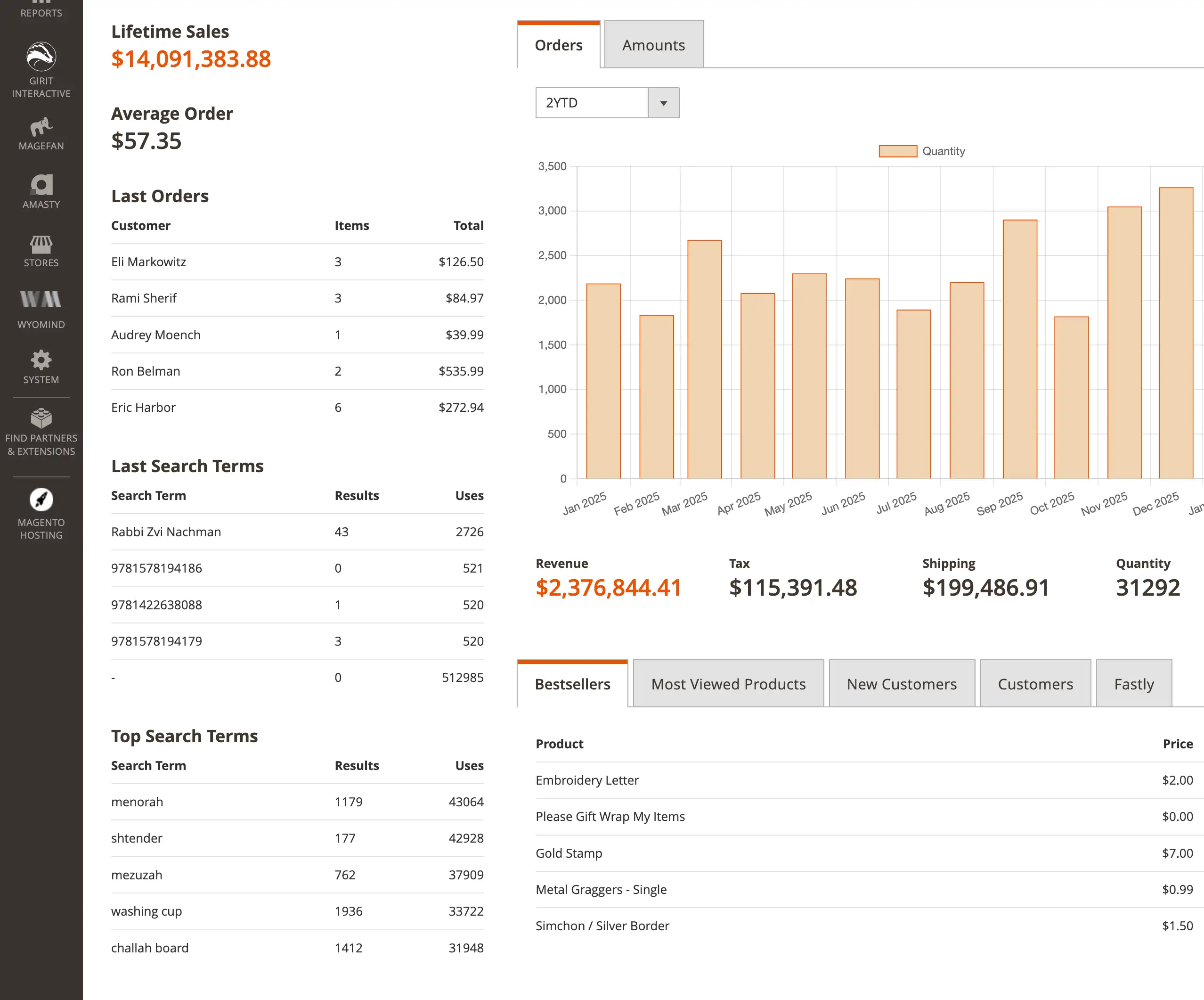
The strategy moved the numbers that matter. From 2023 to 2025 the store processed 70,000 orders worth $8,051,562.98. The store’s all-time lifetime sales, which include years outside that table, stand at $14,393,355.12. More telling than either total is the trajectory. Annual sales climbed from $2.40M in 2023 to $2.73M in 2024 to $2.92M in 2025, and the order curve steepened into 2026. The store moved roughly 1,800 units in both January and February 2026, then jumped to nearly 2,900 units in March, the strongest single month in the store’s tracked history.
The headline numbers:
- $8,051,562.98 in sales from 2023 to 2025 ($14,393,355.12 in all-time store sales)
- 70,000 orders processed from 2023 to 2025
- Sales growth from $2.40M to $2.92M (2023 to 2025)
- March 2026 unit volume up roughly 60% over the January and February run rate
- $464,952.08 year-to-date revenue with the quarter still building
- A cleaned Magento architecture that stopped leaking crawl budget
The growth shows up across the funnel. Items per order improved as the merchandising and internal-linking work took hold, and the technical SEO recovery brought category pages back into competitive ranking positions for the high-intent queries that drive new customer acquisition rather than just repeat branded traffic.
Why work with a dedicated Magento SEO consultant
Most agencies treat Magento like any other CMS, run a generic on-page checklist, and wonder why the rankings never move. The platform punishes that approach. Crawl budget waste, canonical chaos, and faceted-navigation bloat will quietly cap a store’s growth no matter how good the content is. Hustle Marketers works at the configuration and template level first, so the content and internal linking built on top actually compounds. That’s how a store goes from flat year-over-year growth to an accelerating curve. As a full-service SEO agency, we bring that same platform-first discipline to every ecommerce SEO engagement.
Ishant Sharma · Magento SEO Consultant & Google Ads Specialist
Ishant Sharma has worked in digital marketing since 2013 and leads Hustle Marketers, a Google Partner, Meta Business Partner and Microsoft Advertising Partner agency. He combines platform-level technical SEO with content strategy for ecommerce, restaurant and lead generation clients in the US, UK, Australia and India.
Frequently asked questions
What makes Magento SEO different from other platforms?
Magento’s architecture creates platform-specific issues like faceted navigation URL bloat, inconsistent canonical handling, and crawl budget waste that generic SEO can’t fix. It needs configuration and template-level work.
How long does Magento SEO take to show results?
Technical fixes can recover lost equity within weeks, while category ranking gains typically build over three to six months as content and internal linking take effect.
Can Hustle Marketers handle large Magento catalogs?
Yes. We’ve managed SEO for catalogs with thousands of SKUs, concentrating effort on the categories and products that drive the most revenue.
What drove this growth?
Our work covered technical SEO, category content and internal linking. The figures above are the store’s total sales from its Magento reports, so they also reflect pricing, promotions and repeat customers, not SEO alone.
Ready to scale your Magento store?
Get a free audit from Hustle Marketers and see exactly where your store is leaking revenue and ranking potential. Get Free Audit Worth $500.