How Hustle Marketers Runs Restaurant Marketing for a Multi-Location Restaurant Chain

Ishant
Published : June 30, 2026 at 6:04 pm
Updated : October 13, 2026 at 1:45 pm
Ishant
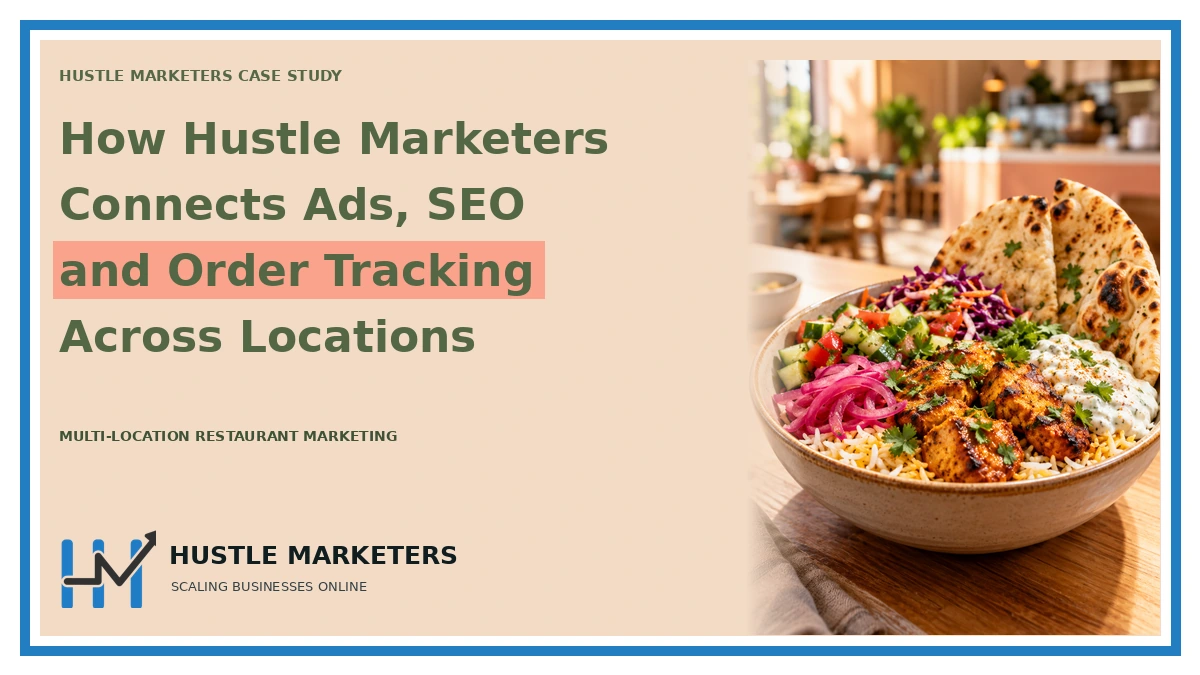
Client: A multi-location Indian street food restaurant group (name withheld at client’s request)
Niche: Multi-location quick-casual restaurant and catering
Locations covered: Several U.S. markets, each running its own Google Ads account and online ordering integration
Services used: Google Ads (Search, Performance Max), Meta Ads, conversion tracking and attribution (GA4, GTM, Olo, Thanx), local SEO, catering pages, blog content, negative keyword management
Engagement type: Ongoing multi-location retainer
This client runs Indian street food across several markets, each with its own mix of dine-in, online ordering through Olo, and catering. That mix sounds simple until you try to measure it. Multi-location restaurant groups usually find out their tracking is broken months after it breaks, once someone notices a location’s ad spend climbing with conversions flat. This case study covers what we found and fixed, and what the group’s order volume looks like with that tracking actually working.
The Challenge: One Brand, Multiple Locations, No Single Source of Truth
Every location for this client runs its own Google Ads account, its own Olo online ordering integration, and its own mix of dine-in versus delivery demand. Before this engagement, that meant three separate problems stacking on top of each other.
First, conversion data wasn’t reliable. One location was reporting zero tracked purchases against real weekly ad spend, which meant Google’s bidding algorithm had nothing to optimize toward. Second, where tracking did fire, it sometimes fired twice. Another location had two separate purchase tags live in the same GTM container, one pulling from Olo and one from the Thanx loyalty platform, both claiming the same transaction. Third, budget was leaking to people who were never going to order. Search campaigns were picking up clicks on national casual-dining competitor names at $6 to $18 a click, plus repeated waste on one specific competitor term that alone burned over $19 across two campaigns.
None of that shows up as an obvious red flag in a weekly performance glance. It shows up as a slow erosion of budget efficiency that compounds across every location running the same flawed setup.
What We Did
Rebuilt conversion tracking location by location. We audited the shared GTM container, found the broken purchase tag at one location, and traced it back to a tracking implementation gap rather than a Google Ads settings problem. We resolved the double-count at another location by separating the Olo and Thanx data layers so each transaction gets attributed once, not twice. We cover the exact mechanics of that collision, and the five ways adding loyalty tracking can silently break existing Olo data, in our Olo Google Tag Manager tracking guide and our Thanx loyalty tracking guide.
Restructured Performance Max around actual customer value. One location’s PMax campaign had a “new customers only” setting suppressing repeat diners from the audience. For a restaurant, repeat customers carry the highest lifetime value in the account. We removed that restriction and let PMax bid for the customers who actually drive recurring revenue.
Cleaned up search waste with a brand-specific negative keyword framework. We built negative keyword lists at the account level rather than just the campaign level, covering every competitor brand name across every market this client operates in, so the fix scales as new locations come online instead of getting rebuilt one campaign at a time.
Separated catering intent from general dining intent. Catering searches convert differently and carry a different average order value than someone searching for lunch nearby. We built dedicated catering search structure instead of letting one PMax asset group try to serve both intents at once.
Layered SEO on top of paid. Location pages, catering pages, and a blog content cluster give each market organic visibility that doesn’t depend on ad spend, with schema markup tying location, menu, and catering data together for search engines. This runs through our dedicated restaurant SEO agency practice rather than a generic SEO retainer.
The Numbers: What the POS Shows Once Tracking Is Trustworthy
Toast is a point of sale system, not a marketing platform, so we’re not claiming these figures as an ad campaign result. What they show is the scale of revenue running through a multi-location group whose tracking infrastructure Hustle Marketers now owns end to end. Year-to-date, verified directly from the Toast dashboard across the group:
- Net sales: $2,824,629.13
- Gross sales: $2,887,616.98
- Total transaction volume: $3,119,480.93

For a marketing partner, that’s the difference between optimizing toward clicks and optimizing toward a restaurant group whose revenue infrastructure actually holds up to scrutiny. Every dollar of it now traces back to a location and, where the ad data supports it, a campaign, instead of disappearing into a tracking gap.
Why Toast-Native Tracking Matters for Restaurant Groups
Most restaurant marketing agencies treat the POS as someone else’s problem. We don’t, because Toast hosts the ordering page itself, which means a generic Google Ads or GA4 setup misses order-level data unless someone connects it on purpose. We cover the mechanics of that connection, including how Toast Loyalty’s card-linked enrollment changes what you can and can’t track in standard analytics, in our Toast POS guide. If you’re running Toast across more than one location, that’s the place to start before touching ad budget. Tracking only matters once people are actually finding you in the first place, which is the other half of this engagement, covered on our restaurant SEO agency page.
What Clients Say
“Highly recommend for your marketing needs. Ishant knows what he’s doing, has experience, and is using technology to get better every day.”
5.0 stars · Endorsed by client · Committed to Quality, Solution Oriented, Accountable for Outcomes
Restaurant Marketing FAQ
Does Toast revenue prove a marketing campaign worked?
No. Toast shows what got sold, not what drove the sale. Use it to validate scale and ticket trends, and use ad platform or GA4 data for actual attribution.
Why does multi-location restaurant tracking break more than single-location?
Each location often runs a separate ad account and a separate Olo or POS integration, so a fix applied to one location doesn’t automatically apply to the next unless someone builds it at the account-group level.
Should repeat customers be excluded from restaurant PMax campaigns?
No. Repeat diners carry the highest lifetime value in most restaurant accounts, so excluding them from targeting usually hurts more than it helps.
Ready to Audit Your Restaurant’s Tracking?
If your restaurant group is running Google Ads, Meta Ads, or Toast online ordering across more than one location, there’s a good chance at least one location has a tracking gap nobody’s caught yet. Hustle Marketers runs a dedicated Google Ads agency for restaurants practice built around exactly this problem. Request a free marketing audit and we’ll tell you what we find, no obligation either way. See more verified results on the Hustle Marketers case study page.