Google Dynamic Search Ads: When They Work and When They Don’t

Ishant
Published : October 1, 2026 at 10:12 am
Updated : October 16, 2026 at 12:14 pm
Ishant

Written by Ishant Sharma, Founder, Hustle Marketers | Published October 1, 2026
Most articles about Dynamic Search Ads explain how to set them up. Almost none of them tell you whether you should. That is the question people actually type into Google, and it is the question we get from clients during nearly every audit.
We have run DSAs across lead gen, ecommerce and SaaS accounts for years. We have seen them quietly become the most profitable campaign in an account, and we have seen them burn roughly a third of a monthly budget on queries that had nothing to do with the business. Both outcomes are common. Which one you get is predictable, and that is what this guide is about.
Quick answer: Dynamic Search Ads work best as a controlled discovery layer for a large, well-structured site. Use a page feed, conversion-quality data, negative keywords and URL exclusions. Judge DSA by incremental qualified conversions and search-term value, not by cheaper clicks. Avoid it when pages are thin, inventory is unstable or nobody will review matching quality.
One more reason to read this now: Google delayed the automatic DSA upgrade to AI Max for Search until February 2027 and restored DSA creation in June 2026. If you run DSAs today, use the extra time for a controlled side-by-side test rather than waiting for automatic migration. The checklist is below.
Table of Contents
- Key Observations
- What DSAs Actually Do
- When DSAs Work
- When DSAs Fail
- The DSA Fit Scorecard
- DSA vs RSA vs Performance Max vs AI Max
- The February 2027 AI Max Auto-Upgrade
- How to Set Up DSAs Properly
- DSAs by Vertical: Lead Gen vs Ecommerce vs SaaS
- FAQs
- Not Sure DSAs Fit Your Account?
Key Observations
- Run DSAs if you have a large site (roughly 100+ indexable pages), strong page content, stable inventory, and existing keyword campaigns generating conversion data. In accounts like this, DSAs are one of the best query-mining and coverage tools in Google Ads.
- Avoid DSAs if your site is small, thin, templated, or changes constantly. Google writes your headlines from your pages. Weak pages produce weak ads, and you pay for every click on them.
- Do not assume DSAs will have cheaper clicks or CPAs. Compare incremental conversions, search-term quality and landing-page fit against the account’s standard Search baseline.
- Use a bounded test budget. Around 5 to 10 percent of Search spend is our starting range in suitable accounts, not a Google recommendation.
- The biggest failure mode is neglect. DSAs need regular search-term reviews, URL exclusions and negative keywords.
- February 2027 is the current migration date. Google delayed DSA auto-upgrades and restored creation in June 2026, giving advertisers time to test AI Max deliberately.
What DSAs Actually Do
Google owns the definition, so keep it precise. With Dynamic Search Ads, you target website content instead of building the ad group around a conventional keyword list. Google uses eligible pages to match searches, generate the headline and select the landing page, while the advertiser supplies descriptions and controls such as dynamic targets, exclusions, negatives, bids and budget. See Google’s current DSA setup instructions.
That is the trade: you give up direct keyword and headline control in exchange for coverage based on page content. DSAs can capture long-tail or newly phrased queries that a static keyword list misses. Microsoft Advertising offers a similar format, but verify platform-specific controls before copying a Google structure across.
If you are still building your foundational campaigns, start with our guide on how to advertise on Google first. DSAs assume you already have a working account around them.
When DSAs Work
Large, well-structured sites with strong content
DSAs read your pages. A site with hundreds of well-written category pages, product pages or service pages gives the system rich material to match against and to write headlines from. In the accounts we manage, the best DSA performers are consistently ecommerce catalogs and large multi-service sites where every page answers a clear commercial intent.
The rough threshold we use: if your site has fewer than 50 to 100 pages worth advertising, DSAs rarely find enough coverage to matter.
Query mining: finding keywords you missed
This is the most underrated use of DSAs, and for many of our accounts it is the primary reason we run them. A DSA campaign is a paid research tool. Every week, the search term report shows you real queries that converted, which you then promote into your keyword campaigns as exact match keywords with proper ads. Over months, this systematically closes the gaps in your keyword coverage.
If you are stuck in the mindset that a bigger keyword list is the answer, read our piece on keyword obsession in Google Ads. DSAs plus a tight core list beat a bloated keyword list almost every time.
Catch-all coverage alongside keyword campaigns
Structured properly, a DSA campaign sits behind your keyword campaigns and only catches what they miss. You add your existing keywords as negatives in the DSA campaign (or rely on Google’s same-account deduplication, which we trust less), and the DSA sweeps up long-tail queries at lower CPCs. This is the classic catch-all campaign architecture, and it still works in 2026.
Ecommerce catalogs with stable inventory
DSAs and ecommerce are a natural fit. Product and category pages have exactly the kind of structured, intent-rich content the system needs, and a page feed lets you control precisely which URLs are eligible. The key word is stable. If products stay in stock and URLs persist, DSAs perform. Pair them with Shopping campaigns and watch the search term overlap. If your Shopping visibility is the weak point rather than search coverage, our guide to fixing and strengthening your Google Shopping feed is the better starting place.
What results to expect (honestly caveated)
There is no dependable cross-account DSA benchmark that should become your target. Page quality, query mix, vertical, geography, bidding and conversion definitions make a universal CPC or CPA misleading. Use a controlled diagnostic instead:
| Question | Compare against | Decision signal |
|---|---|---|
| Is DSA adding reach? | New non-brand queries not already covered by keyword campaigns | Incremental qualified query volume |
| Is the traffic valuable? | Qualified conversions and revenue, not raw leads | CPA, value per lead and profit after sales qualification |
| Is the page match useful? | Search term, generated headline and chosen landing page | High-intent query matched to the correct commercial page |
| Is DSA stealing credit? | Query overlap with exact, phrase, broad, PMax and AI Max | Add negatives or restructure before scaling |
| Has the test matured? | Conversion-cycle length and weekly query volume | Judge only after enough qualified outcomes, often four to six weeks |
In our accounts, DSA sometimes produces cheaper clicks and sometimes does not. The repeatable advantage is discovery: it reveals commercial queries and page gaps that keyword research missed. Maintenance is the variable most benchmark tables ignore.
Query-to-page-profit triage: a worked example
Most DSA audits stop at the search term. That misses half the decision. Review each row as a chain: query -> generated headline -> selected page -> qualified outcome -> profit. Score four questions from 0 to 2:
| Dimension | 0 points | 1 point | 2 points |
|---|---|---|---|
| Commercial intent | Research or support | Mixed | Ready to buy or inquire |
| Landing-page fit | Wrong page | Relevant but broad | Exact offer and intent match |
| Outcome quality | No useful outcome | Raw conversion only | Qualified sale or lead with value |
| Incrementality | Already owned by core Search or brand | Unclear | Net-new non-brand demand |
A hypothetical ecommerce query for “bulk stackable office chairs with arms” might score 2 for intent, 1 when Google chooses a generic office-furniture page, 2 after producing profitable orders and 2 when no keyword campaign covered it. At 7 out of 8, promote the query into a deliberate keyword campaign, build or improve the exact category page and keep the DSA as discovery. A score of 3 might mean exclude the query or URL. A score of 5 usually means fix the page before raising bids.
This prevents a common false win: DSA reports a conversion, but the landing page was wrong, the lead never qualified or the query was already being captured elsewhere. The scoring model forces commercial and incremental evidence into the decision.
When DSAs Fail
This is the section nobody writes, because most DSA content is published by people selling setup services. Here is where the money actually gets burned.
Thin or templated site content = junk headlines
Google writes your headlines from your pages. If your pages are thin, duplicated or stuffed with boilerplate, your auto-generated headlines will be too. We have audited accounts where the auto-generated headline was literally the page’s CMS template title, complete with a pipe character and the brand name repeated twice. Users clicked out of confusion and bounced. The advertiser paid for every one of those clicks.
If a human cannot read your page and immediately understand what is being sold, do not let a machine write ads from it.
Fast-changing inventory and out-of-stock landing pages
The Google crawl of your site lags reality. If your inventory turns over quickly, DSAs will happily send traffic to products that sold out yesterday, seasonal pages that expired, or URLs that now redirect. Flash-sale retailers, event businesses and marketplaces with high listing churn are structurally bad fits. A page feed with tight control helps, but it does not fully solve the crawl lag.
Cannibalizing your keyword campaigns
Google’s help page says that when a search term exactly matches one of your keywords, the keyword ad may show instead of the DSA. A DSA can still win when the search is only a broad or phrase match to your keyword and the DSA has the higher Ad Rank. In practice, we regularly see DSA traffic on queries that are close variants of active keywords, especially with broad match in the account. The DSA takes the click at a lower bid, the keyword campaign loses volume, and your reporting tells you the DSA is a hero when it is partly eating traffic you already owned. The fix is boring and non-negotiable: add your converting keywords as negatives to the DSA campaign and review overlap monthly.
Junk queries and wasted spend: a real example
Here is a pattern we see over and over in audits, most recently in a lead gen account we took over. The previous manager had launched a DSA campaign targeting “all web pages” on a site that included a blog, a careers page and a large help center. No negative keywords beyond a starter list. No search term reviews for months.
The result: roughly a third of the DSA spend was going to queries with zero commercial intent. Job-seeker searches matching the careers page. “How to” support queries matching help articles. Competitor brand names matching comparison blog posts, which triggered expensive clicks from people looking for someone else entirely. Not one of these query groups had produced a single lead.
The fix took an afternoon: switch from all-pages targeting to a page feed of service pages only, add negative keyword lists for careers, support and competitor terms, and set a weekly search term review. Within a month the same campaign was producing leads below the account’s average CPA. The campaign type was never the problem. The neglect was. This is exactly the kind of thing our Google Ads audit checklist is built to catch.
The same account-hygiene principle appears in our local signage Google Ads case study: search-term cleanup, clearer campaign structure, conversion tracking and landing-page alignment worked together. That case is not presented as a DSA experiment, but it shows why no automated campaign should be evaluated without clean queries, goals and pages.
Small sites: why coverage stays low
On a 10-page site, DSAs have almost nothing to match against. Website coverage stays low, impression volume follows, and the queries that do match tend to be loose. Small sites are better served by tight keyword campaigns where every dollar is deliberate. Run DSAs when you have a content footprint worth mining, not before.
The DSA Fit Scorecard
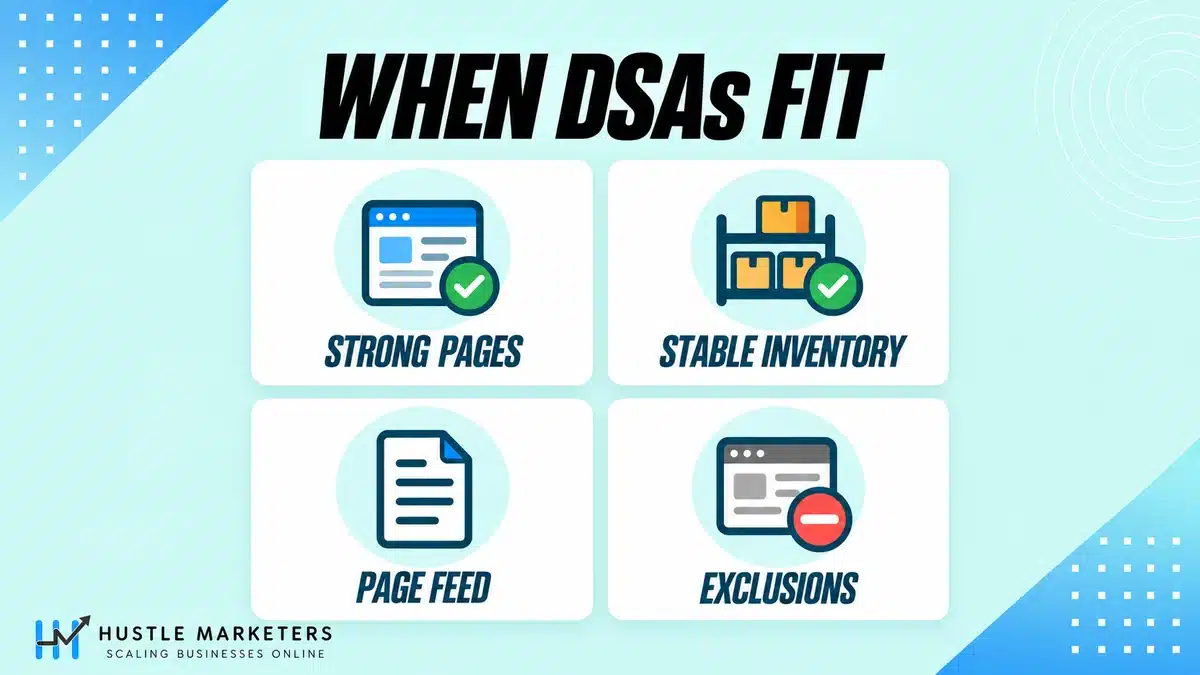
Score your account honestly. This is the framework we use before switching DSAs on for any client.
| Factor | 2 points | 1 point | 0 points |
|---|---|---|---|
| Site size | 100+ strong commercial pages | 30-100 pages | Under 30 pages |
| Content quality | Unique, descriptive, intent-rich pages | Mixed quality | Thin or templated |
| Inventory churn | Stable URLs and stock | Moderate turnover | Fast churn, frequent out-of-stocks |
| Account maturity | Established keyword campaigns with conversion history | Some history, patchy tracking | New account, weak tracking |
| Management capacity | Weekly search term reviews will happen | Fortnightly at best | Set and forget |
8-10 points: Run DSAs. Start at around 10% of search budget and scale on results. 5-7 points: Test with a tight page feed, strict negatives and a capped budget. Re-score in six weeks. 0-4 points: Avoid for now. Fix the site, the tracking, or the management gap first. DSAs amplify whatever account you already have, including the problems.
DSA vs RSA vs Performance Max vs AI Max
| Dimension | Dynamic Search Ads | Responsive Search Ads | Performance Max | AI Max for Search |
|---|---|---|---|---|
| Targeting input | Your website pages or page feed | Keywords you choose | Feeds, audiences, assets; no keywords | Keywords plus AI-expanded matching from your site and assets |
| Headline control | None (auto-generated); you write descriptions | Full (you supply up to 15 headlines) | Partial (assets supplied, mixed by Google) | Partial (your RSA assets plus AI-generated variants) |
| Landing page control | Google picks the page | You pick the page | Mostly Google, URL expansion optional | URL expansion with controls, brand and location controls |
| Search term visibility | Search-term reporting, subject to privacy thresholds | Search-term reporting, subject to thresholds | More aggregated and channel-dependent | Search-term and match reporting, subject to product controls |
| Channels | Search only | Search only | Search, Shopping, YouTube, Display, Discover, Gmail, Maps | Search only |
| Best for | Query mining and coverage on large content-rich sites | Core, deliberate keyword coverage | Full-funnel ecommerce with strong feeds | Accounts ready to hand Search matching to AI with guardrails |
| Biggest risk | Junk queries from weak pages and neglect | Missed coverage of new queries | Opacity and cannibalisation of brand | Early-days reporting, loss of DSA-style simplicity |
Two notes from running all four side by side. First, PMax and DSAs can overlap on search demand, so review query and landing-page evidence instead of assuming one format is incremental. Our Performance Max negative keywords strategy covers how to keep PMax fenced in. Second, RSAs are not an alternative to DSAs; they answer different questions. RSAs cover the queries you know about. DSAs find the ones you do not.
The February 2027 AI Max Auto-Upgrade
Google originally announced a September 2026 automatic upgrade, then delayed DSA auto-migration to February 2027 and restored new DSA creation from June 15, 2026. That June post said creation would be removed in January 2027. The August 2026 timeline moves the removal into the February 1 to 28, 2027 window, alongside the automatic upgrade. The updated timeline gives advertisers a longer voluntary testing window. Read Google’s August 2026 AI Max migration timeline before changing a live account because rollout details can change again. Search Engine Journal’s timeline summary adds useful context: the DSA deadline moved, while the planned September 2026 transitions for Automatically Created Assets and campaign-level broad match were not included in that delay.
What changes for existing DSA campaigns
Under AI Max, the DSA mechanic (matching queries to your pages) becomes one input into a broader AI-driven matching and creative system rather than a standalone campaign type. Expect AI-generated ad text drawing on your site and assets, expanded query matching beyond page-content matching, and new controls (brand inclusions and exclusions, geo intent controls, URL controls) replacing some old DSA settings. Reporting moves to AI Max’s format, so historical DSA comparisons will get messy.
Treat the AI Max version as a new evaluation period even when settings and history are ported: keep a fresh baseline, preserve guardrails, and do not assume legacy performance carries over unchanged. For a wider view of where Google is pushing accounts, see our take on Google Ads automation.
Pre-migration audit checklist
Do this during the extended 2026 testing window, before February 2027:
- Export your full DSA search term history. This is your query-mining asset. Download it now in case reporting formats change post-upgrade.
- Promote proven queries to keywords. Anything with consistent conversions should live in your keyword campaigns before the migration, where you keep control.
- Clean and consolidate negative keyword lists. Junk you tolerate today becomes junk the AI learns from tomorrow. Apply account-level negatives where possible.
- Rebuild page feeds deliberately. Remove dead URLs, out-of-stock pages, blog posts and support content. Feed only pages you want ads matched to.
- Verify conversion tracking end to end. AI-driven matching is only as good as the conversion signal. Audit your tags, values and attribution settings.
- Set brand controls. Decide now which brand terms AI Max may and may not match, especially competitor names. Our guide to branded vs non-branded search explains why this split matters so much for reporting and profit.
- Screenshot current settings and baselines. CPCs, CPAs, coverage, top queries. You will want a before-and-after picture.
Verify the current rollout details in your account’s announcements before acting. Google has shifted automation timelines before, and the exact upgrade mechanics may differ by account.
A controlled DSA vs AI Max crossover test
Do not compare this month’s AI Max performance with last year’s DSA average and call the difference causal. Seasonality, inventory and demand changed too. A higher-quality test uses matched, non-overlapping cohorts:
- Group eligible pages into comparable page-feed labels, such as two product categories with similar margin, traffic and conversion volume.
- Keep DSA on cohort A and use the voluntary AI Max setup on cohort B for one full conversion cycle.
- Record qualified conversions, contribution after refunds or cancellations, net-new non-brand queries, chosen landing-page accuracy and overlap with other Search and PMax campaigns.
- Swap the cohorts for a second period when volume supports it. The crossover reduces the risk that one stronger category makes the campaign type look better.
- Roll out only when the combined periods show a meaningful commercial lift, not just more conversions at an unchanged or hidden quality rate.
Low-volume accounts should not force statistical theatre. Use the same scorecard, preserve baselines and wait for enough completed outcomes to make a business decision.
How to Set Up DSAs Properly
The setup itself takes twenty minutes. The choices below are what separate profitable DSAs from the failure cases above.
Targeting options: URL contains, page feeds, categories
You have four ways to define your dynamic ad targets, the rules that tell Google which pages to use. In order of our preference:
- Page feed: a spreadsheet of exact URLs, uploaded to Business Data. Maximum control. This is our default for every client.
- URL contains: target URLs containing a string like /services/ or /category/. Good middle ground for well-structured sites; the URL equals rule does the same job when you want one exact page.
- Categories targeting: Google’s auto-grouped themes from your site. Convenient but loose.
- All web pages: the option behind most DSA horror stories. Only defensible on a site where literally every page is commercial.
Whichever you choose, exclude careers, support, blog, legal and account pages explicitly.
Use labels as business controls, not filing labels
A two-column feed of URL and “included” leaves money on the table. Add labels that express business facts you may need before and after migration:
margin_high,margin_mid,margin_lowinventory_stableandinventory_volatileservice_core,service_optional,support_excluderegion_us,region_uk, or other real fulfillment boundariesai_max_test_aandai_max_test_b
Labels make it possible to pause low-margin or unstable groups without rebuilding the feed, compare matched migration cohorts and diagnose whether performance follows the ad system or the underlying inventory. Google documents the mechanics in its page-feed setup guidance; the commercial taxonomy is the layer the advertiser has to design.
Negative keywords and search term hygiene
Launch with negative lists for: competitor brand names (unless deliberately conquesting), job and career terms, “free”, support and how-to terms, and any product lines you do not sell. Then review search terms weekly for the first six weeks, every two weeks after that. This single habit is the difference between the success and failure sections of this article. It is also step one in our PPC best practices playbook for a reason.
Bidding and budget: the 10% budget rule
Start DSAs at roughly 10% of your total search budget. Use Maximize Conversions or Target CPA once the account has conversion volume; set the initial tCPA 10 to 20% looser than your keyword campaigns and tighten as data comes in. DSAs feed on volume, and strangling them with an aggressive target on day one just produces no data. Scale the budget only after the search term report has earned your trust.
DSAs by Vertical: Lead Gen vs Ecommerce vs SaaS
Lead gen: Works when service pages are strong and distinct. The risk is lead quality, not volume. DSA queries skew long-tail and sometimes informational, so watch lead-to-sale rates, not just CPA. Careers and support negatives are mandatory.
Ecommerce: The best structural fit. Category and product pages are ideal DSA fuel, and the search term report doubles as merchandising research. Use page feeds tied to in-stock inventory, keep them consistent with your Merchant Center feed, and check overlap with Shopping and PMax weekly. Our Google Shopping guide pairs well here, since DSA and Shopping fix different halves of the coverage problem.
SaaS: The hardest vertical for DSAs. Most SaaS sites have a handful of commercial pages and a huge blog, which means thin matching material and a high risk of ads matching informational content. Feed only product, feature, pricing, integration and comparison pages. If that list is under 30 URLs, skip DSAs and spend the effort on RSAs and intent-led content instead.
FAQs
What are Dynamic Search Ads and what does the advertiser provide?
Dynamic Search Ads are a Google Ads format where Google matches searches to your website pages instead of your keywords, then auto-generates the headline and selects the landing page. You provide the targeting (site, URL rules or a page feed), the description lines, and the budget and bidding settings. Everything else is generated from your site content.
When should you use Dynamic Search Ads?
Use them when you have a large, content-rich site, stable inventory, existing keyword campaigns and the capacity to review search terms regularly. In that context they can add incremental coverage and act as a query-research engine. Start with a bounded test budget alongside keyword campaigns, then scale only after qualified outcomes and overlap checks justify it.
When are DSAs a bad idea?
Avoid them on small sites, thin or templated content, fast-churning inventory, and accounts nobody actively manages. Google builds your ads from your pages, so weak pages produce weak ads at your expense. If you scored under 5 on the fit scorecard above, fix the underlying issues first.
Do DSAs cannibalize my keyword campaigns?
They can. Google says your keyword ad may show instead of a DSA when the search term exactly matches a keyword, but close variants and broad match create real overlap in practice. Add your converting keywords as negatives in the DSA campaign and review query overlap monthly to keep each campaign in its lane.
Will my DSA campaigns stop working after February 2027?
They keep serving, but not as DSA. Between February 1 and 28, 2027, Google will permanently remove the ability to create new DSA ad groups and will automatically upgrade unmigrated DSA campaigns to standard Search ad groups with AI Max enabled. Until then, existing campaigns run normally while you audit, export baselines and test AI Max. Verify the current account notice before acting because rollout details can change.
DSA vs Performance Max: do they compete?
They can overlap on Search demand. Do not assume a fixed priority rule will make the traffic incremental. Give each campaign a defined role, review the available query and landing-page evidence, use negative controls where supported and measure combined account profit rather than each campaign’s attributed conversions in isolation.
Do DSAs work for small websites?
Rarely. With few pages there is little for Google to match against, so coverage stays low and matching gets loose. Under roughly 30 to 50 commercial pages, put your budget into tightly managed keyword campaigns instead and revisit DSAs as the site grows.
What is the minimum budget for a DSA campaign?
Google publishes no universal minimum. The practical requirement is enough budget and time to observe qualified outcomes across at least one normal conversion cycle without starving the core Search campaigns. A small bounded share of Search spend is safer than a catch-all launch, but the exact amount should follow CPC, conversion lag and the number of eligible pages in that account.
How do I stop DSAs matching junk queries?
Three controls: tight targeting (a page feed of commercial pages only, never “all web pages” on a mixed site), pre-loaded negative keyword lists for careers, support, free and competitor terms, and a standing weekly search term review. Every junk-query horror story we have audited was missing at least two of the three.
How long before a DSA campaign shows results?
Give it four to six weeks minimum. The first two weeks are mostly data collection, and Smart Bidding needs conversion volume before efficiency settles. Judge the campaign on its second month, not its first, and judge the search term quality before you judge the CPA.
Can I run DSAs with Smart Bidding?
Yes. Maximize Conversions, Target CPA and value-based bidding can be appropriate when tracking and outcome volume support them. Do not copy a target from another campaign blindly. Start from the account’s real conversion lag and value quality, then tighten only after the campaign has enough qualified data.
Should I turn off Dynamic Search Ads before the AI Max upgrade?
Not automatically. If a DSA campaign is profitable and incremental, keep the baseline while you export search-term history, promote proven queries, clean negatives, rebuild page feeds and run a controlled AI Max test. Pause only when the evidence says the campaign is wasteful or no longer incremental. The upgrade rewards prepared accounts, not empty ones.
Are Dynamic Search Ads still worth running in 2026?
Yes, on the right site. For large, content-rich sites they remain useful for coverage and query mining, but do not assume cheaper CPC or CPA. The mechanic is scheduled to move into AI Max from February 2027, and the underlying value is still matching real queries to useful commercial pages. Small or thin sites were never a fit and still are not.
Why are my DSA headlines so bad?
Because Google writes them from your page titles and content, so weak or templated pages produce weak headlines. There is no setting that fixes this; the fix is restricting your page feed to well-written commercial pages and improving the titles on the pages you keep. If a page’s title tag reads like CMS boilerplate, that is what searchers will see as your ad.
Can I run Dynamic Search Ads on Bing?
Microsoft Advertising offers a similar DSA format that crawls site content, matches queries and generates headlines. Do not assume the same economics or control behavior. Import the structure only after checking platform-specific targeting, negatives, conversion tracking and query quality.
Why is my DSA campaign spending money on job seekers and support questions?
Because your targeting includes careers or help-center pages, so Google happily matches job-search and how-to queries to them. Switch from all-pages targeting to a page feed of commercial pages only, then add negative keyword lists for careers, support and “free” terms. In audits, this change often removes clearly irrelevant traffic, but the amount recovered depends on how broadly the original campaign targeted the site.
Do Dynamic Search Ads use keywords at all?
Not for targeting. Matching comes entirely from your website content and the dynamic ad targets you set, which is the whole point of the format. Negative keywords still apply, though, and they are essential: they are your only word-level control over which queries the campaign can enter.
Not Sure DSAs Fit Your Account?
The scorecard above will get you most of the way. If you want a second pair of eyes, we will check. We audit DSA and search structures every week as a PPC agency, and we will tell you plainly whether DSAs belong in your account, what the February 2027 upgrade means for you, and where your current spend is leaking. No pitch deck, just the verdict.