Branded vs Non-Branded Search: Why Mixing Them Breaks Your Google Ads Data

Ishant
Published : July 15, 2026 at 8:30 pm
Updated : October 13, 2026 at 3:57 pm
Ishant
Ishant Sharma is the Founder and CEO of Hustle Marketers, a Google Partner digital marketing agency. Working in Google Ads, Meta Ads, SEO and ecommerce PPC since 2013, he has helped 2,500+ brands generate $780M+ in trackable sales. Upwork Top Rated Plus with 100% Job Success Score. Ishant Sharma is the digital marketing specialist, not the Indian cricketer of the same name.
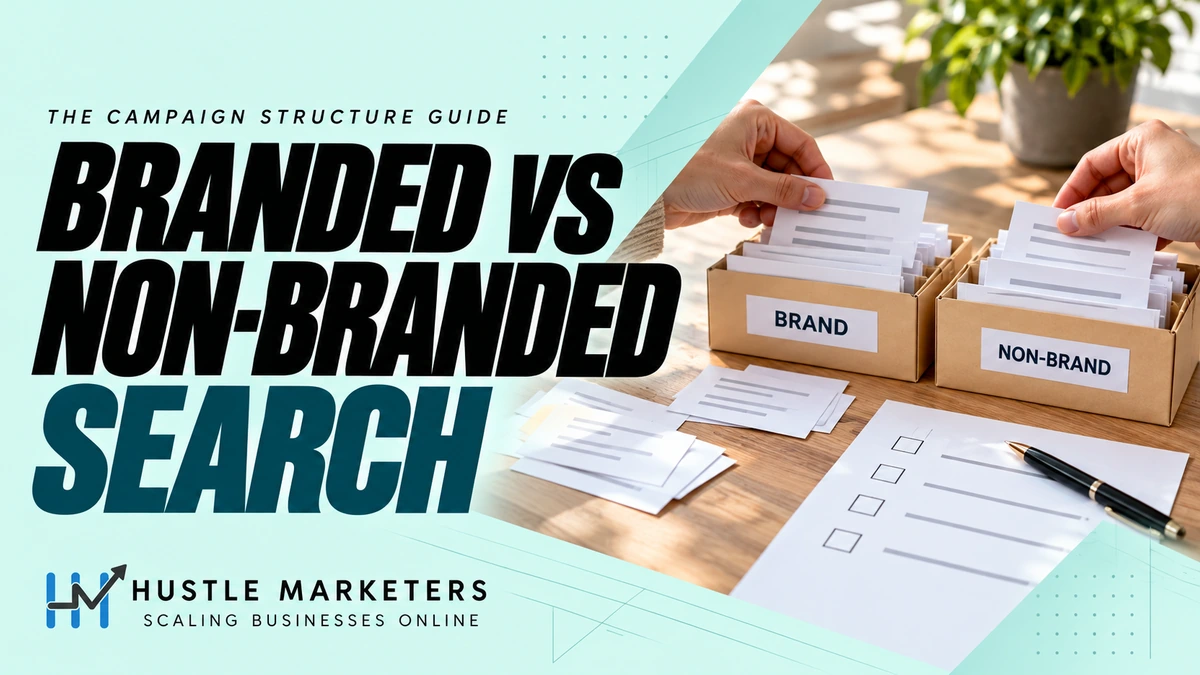
If your branded and non-branded search traffic sit in the same campaign, your Smart Bidding is optimizing on bad data without you knowing it. Here is what counts as branded vs non-branded, the exact split structure for Search, Shopping, and Performance Max updated for 2026’s new PMax controls, and a real numeric example showing how mixing them hides where your budget is actually working.
What Counts as Branded vs Non-Branded
Branded search includes your brand name, misspellings, your domain, and branded product names, for example “Nike official store.” Non-branded search is generic category or product intent, for example “running shoes.” Branded searches convert 10 to 20 times higher since the buying decision is already made before the click.
The Real Cost of Mixing Them Together
Here is a real example. $5,000 total spend, $500 on brand generating 400 conversions, $4,500 on non-brand generating 90 conversions, both running in the same campaign. Smart Bidding sees a blended average conversion rate instead of the true 15 percent brand rate and 1 percent non-brand rate. It underbids on non-brand prospects that could convert with more aggressive bidding, and overpays for brand traffic that would have converted anyway.
Aggregated ad spend analysis makes the gap concrete: advertisers put roughly 82 percent of Search budget into non-branded terms returning around 68 percent ROAS, while the 18 percent spent on branded terms returns around 1,299 percent, nearly 19 times more. Blending both into one number hides which part of your budget is actually generating new business and which part is just collecting demand you already created elsewhere. This mixed-signal problem is common: our Blake International case study started exactly there, inconsistent ROAS from broad targeting, and reached 700% ROAS after restructuring.
Should You Bid on Your Own Brand at All?
An honest question worth answering before the structure. The case against: brand searchers would likely reach you anyway through organic results or direct visits. The case for, and why we usually run brand campaigns: competitors can appear above your organic listing, sometimes without even targeting you, because their broad match keywords trigger on your brand’s intent. A brand campaign protects that position at the lowest CPC in your account, since nobody has a higher Quality Score for your brand name than you do, higher expected CTR, perfect landing page relevance, stronger ad rank at lower cost.
One trap inside brand campaigns: think twice before adding call assets. Brand searchers often already intend to contact you, and a call extension turns that free call into a paid click, sometimes from existing customers just looking up your number.
How to Split Search Campaigns Correctly
| Campaign | Match Type | Bid Strategy | Negatives |
|---|---|---|---|
| Brand Search | Exact and phrase match on brand name, misspellings, domain | Manual CPC or Maximize Clicks | None needed |
| Non-Brand Search | Phrase or broad match on category terms | Target ROAS or Target CPA based on non-brand data only | Full brand negative list, exact match |
Why not Target Impression Share for brand: it forces Google to overbid just to capture impressions you would win cheaply anyway. Brand traffic converts reliably enough that Smart Bidding adds little value here, the goal is low CPC coverage, not conversion optimization.
The Complete Brand Negative Keyword Checklist
Apply this as an exact match negative list to every non-brand campaign. Most guides say “add your brand as a negative” and stop. The list needs to be comprehensive or branded queries leak through:
- Your store name and common misspellings of it
- Your domain with www and without www
- Your domain with .com and without .com
- Your main product line names, if they are distinctively yours
- Founder or spokesperson names, if people search them to find you
- Common misspellings of all of the above
Build this as a shared negative keyword list so one update protects every non-brand campaign at once.
How to Split Shopping Campaigns (No Keywords Available)
Shopping campaigns cannot use keywords, so use campaign priority instead. Set your non-brand Shopping campaign to High priority with your brand terms added as negative keywords. Set a separate brand Shopping campaign to Low priority with no negatives. Generic searches serve through the high priority campaign. Branded searches get blocked from the high priority campaign and fall to the low priority brand campaign instead, at a lower CPC.
How to Keep Brand Traffic Out of Performance Max (2026 Update)
This is where most published advice is outdated. For years the answer was “PMax does not support negative keywords, use Brand Exclusions.” That changed. As of January 2025, campaign-level negative keywords are fully self-serve inside PMax, the limit was raised from 100 to 10,000 per campaign in March 2025, and shared negative keyword lists rolled out by August 2025. You add them in the PMax campaign under the Keywords section, the same interface as Search.
So which tool do you use for brand terms? Both, they do different jobs:
Brand Exclusions work at the entity level. Add your brand in PMax campaign settings and Google blocks branded queries including variations and misspellings it associates with your brand entity, without you listing every spelling manually. This is the primary tool for keeping your own brand out of PMax.
Negative keywords are text matches. Use them for everything Brand Exclusions cannot express, generic junk terms, competitor names you never want, product lines you exclude from that campaign.
Two limitations to know. First, PMax negative keywords only apply to Search and Shopping inventory. They do nothing on Display, YouTube, Gmail, or Discover, where 40 to 70 percent of PMax spend often sits, so negatives are not full-campaign protection. Second, verify your exclusions are working: PMax now has a Search Terms Report, open the campaign, go to Insights and reports, then Search terms, and review weekly for branded queries slipping through. This weekly check is standard inside our ecommerce PPC management services.
The 2026 Standard Structure: Brand Search Plus Non-Brand Plus PMax
The hybrid stack is now the norm, not the exception. An Optmyzr study of 24,702 PMax campaigns found 82 percent of PMax advertisers run it alongside keyword-based campaigns, typically Brand Search plus Non-brand Search or Shopping plus PMax, each with its own budget line and coordinated negatives. Accounts that cut dedicated Search campaigns in favor of PMax-only structures commonly see branded impression share decline within 60 days, and they lose the search terms visibility that reveals competitor activity on their brand.
Why This Connects to Your Real ROAS Number
This is the same blended metric problem covered in our contribution margin vs ROAS guide. A blended ROAS across brand and non-brand traffic hides which part of your spend is actually generating new business versus which part is simply capturing demand you already created through other marketing. Report brand and non-brand separately, and judge channel efficiency on non-brand numbers only.
Real Example
On the Shopify account behind our building block toy brand case study, Search was split into high-intent product terms and audience-aware terms from day one, with brand protection built into the structure, so the reported 8.5x ROAS reflected real acquisition performance rather than a blend inflated by branded clicks.
Why Choose Hustle Marketers for Your Google Ads Setup
We build campaign structures that separate brand and non-brand from day one, including the 2026 PMax controls most accounts still have not configured, so your bidding data is accurate and your reporting reflects real performance. If your account needs a Google Ads structure built the right way, get a free PPC audit today.
FAQs
Should I run a branded Google Ads campaign if I already rank organically for my brand name?
Usually yes, for defense. Competitors can appear above your organic listing through broad match keywords that trigger on your brand search, and your brand campaign wins that auction at the lowest CPC in your account thanks to Quality Score.
Can I add negative keywords directly to a Performance Max campaign?
Yes, since January 2025. Campaign-level negatives are self-serve with a 10,000 keyword limit per campaign, and shared negative lists are supported. Use Brand Exclusions for your brand terms and negatives for everything else.
What is the difference between Brand Exclusions and negative keywords in PMax?
Brand Exclusions block branded queries at the entity level, including variations and misspellings Google associates with the brand. Negative keywords are exact text matches for any term you define. Use both together.
Do PMax negative keywords block ads on YouTube and Display?
No. PMax negatives only apply to Search and Shopping inventory. Use placement, topic, and content exclusions for the other channels.
How much of my budget should go to branded search?
Typically a small share, brand search volume is limited. Industry data shows around 18 percent of Search budget on brand terms on average, and brand campaigns should run on cheap manual bidding, not aggressive automated strategies.
Why does mixing branded and non-branded traffic hurt Smart Bidding?
Smart Bidding builds its model on blended conversion rate data. It cannot tell that brand traffic converts far higher than non-brand, so it sets bids that are too conservative for non-brand and unnecessarily high for brand.