How Hustle Marketers Delivered 700% ROAS for Blake International Through White Label PPC

Ishant
Published : January 28, 2024 at 11:50 am
Updated : October 22, 2026 at 1:06 am
Ishant
Ishant Sharma is the Founder and CEO of Hustle Marketers, a Google Partner digital marketing agency. Working in Google Ads, Meta Ads, SEO and ecommerce PPC since 2013, he has helped 2,500+ brands generate $780M+ in trackable sales. Upwork Top Rated Plus with 100% Job Success Score. Ishant Sharma is the digital marketing specialist, not the Indian cricketer of the same name.
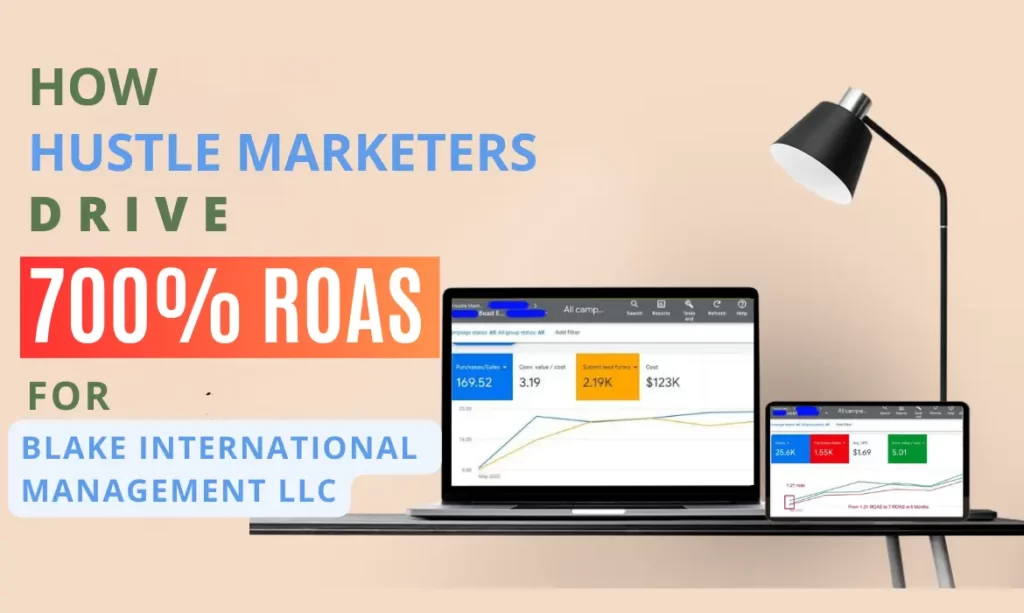
Client: Blake International Management LLC (BIM) · CEO: Falan Blake · Partnership Type: White Label PPC · Services: Google Ads, LinkedIn Ads, Campaign Architecture, Keyword Strategy · Markets: E-commerce, Hair Extensions, Legal Services · Result: 7x ROAS, up from 1.21x, for one e-commerce client
Case Study Summary: Hustle Marketers, a Google Partner and Meta Business Partner agency led by Ishant Sharma, provided white label PPC services to Blake International Management LLC (BIM), a USA-based digital marketing agency led by former Google consultant Falan Blake. Hustle Marketers rebuilt BIM’s client campaign architecture, keyword strategy, and audience targeting across multiple accounts. Results include a 700% ROAS result (7x ROAS, up from a starting point of 1.21x, an increase of about 478%) for an e-commerce client within six months. Lead generation quadrupled and purchases doubled for a hair extension company. A legal firm saw a 30% increase in qualified leads. Falan Blake publicly credited Ishant Sharma as her right hand and a dynamic asset to her agency on Clutch and in a video testimonial.
About the Client: Falan Blake and Blake International Management LLC
Falan Blake is a former Google consultant and advertising expert who founded Blake International Management LLC (BIM) to serve clients seeking performance-driven digital advertising. With direct experience inside Google’s own ecosystem, Falan understands paid media strategy at a level most agency founders do not. BIM specialises in developing creative ad campaigns and bringing them to life across Google, LinkedIn, and social media platforms.
Even with that background, BIM faced a challenge that affects almost every growing agency: client delivery at scale. Falan had the strategic vision and the client relationships. BIM needed a reliable execution partner who could manage campaign-level technical work across a growing client portfolio. No complexity could appear in client-facing communications. This is the definition of white label PPC done correctly, and it is exactly the model Hustle Marketers operates under for agency partners. Read the complete guide on what white label digital marketing is and how it works operationally for agencies at different growth stages.
Why Growing Agencies Need White Label PPC Partners
Agency Growth Outpaces In-House Delivery Capacity
Digital marketing agencies that grow through referrals and reputation consistently face a delivery bottleneck. Winning a new client is a sales and relationship achievement. Delivering results for that client is a technical execution challenge. The two rarely scale at the same rate. Agencies that hire in-house to meet demand face higher fixed costs, longer ramp-up times, and ongoing management overhead. White label PPC partnerships solve this by adding delivery capacity instantly with experienced specialists who operate at full productivity from day one.
According to industry research, 73% of agencies already use some form of white label service. Agencies that outsource 40 to 60% of their service delivery grow 2.3 times faster than those that keep everything in-house. They also run profit margins 20% higher. For an agency like BIM, the white label model allowed Falan’s expertise to stay in the client-facing and strategy-setting role. Hustle Marketers handled campaign execution behind the scenes. Read more about how the Hustle Marketers white label digital marketing model works for agency partners.
Inconsistent Campaign Performance Loses Clients
BIM was experiencing a specific problem that is common across growing performance marketing agencies: inconsistent ROAS across client accounts. Some campaigns performed well. Others underperformed despite similar budgets and targeting approaches. The root cause was the same in every underperforming account. Broad targeting reached too many unqualified users. Keyword selection prioritised impression volume over purchase intent.
For an agency whose reputation depends on client results, inconsistent performance is an existential risk. One strong case study wins referrals. One poor result loses a client and a referral source simultaneously. Falan needed her campaigns to perform consistently across every account, not just in the ones where the conditions happened to be favourable. That required a systematic methodology rather than account-by-account improvisation.
White Label Means the Client Relationship Stays With the Agency
A critical requirement for any white label engagement is that the end client must never know a third party is involved. In the BIM engagement, all communication with BIM’s clients went through Falan and her team. All campaign reporting carried BIM’s branding. All strategy recommendations were presented under BIM’s name. Hustle Marketers operated entirely in the background, delivering the technical execution that BIM’s clients experienced as the agency’s own work.
This arrangement is only commercially viable when the white label partner operates with the same standards they would apply to their own direct clients. Every BIM client account received the same keyword research methodology, campaign architecture approach, and performance monitoring Hustle Marketers applies to its own direct client engagements. Read more about white label PPC agency standards and what to verify before choosing a white label partner.
What BIM’s Campaigns Needed Before Hustle Marketers
Broad Targeting Reached the Wrong Audiences
The initial campaign audit revealed that BIM’s client accounts were using demographic targeting and interest-based segments that were too broad to deliver cost-efficient results. Wide targeting produces large impression volumes and low conversion rates. For clients comparing their performance to industry benchmarks, broad targeting creates the appearance of high activity with low ROI. The gap between ad spend and revenue made it difficult for BIM to demonstrate clear value to its clients.
Hustle Marketers conducted thorough market research and audience segmentation for each client account to build precise customer profiles. Each audience segment was defined by behaviour signals, search patterns, and intent indicators that correlated with purchase or inquiry completion. This replaced demographic guessing with behavioural targeting grounded in platform data.
Broad Keywords Attracted Unqualified Traffic
BIM’s client accounts were also using broad match keywords without sufficient negative keyword lists. Broad match in Google Ads is a powerful tool when managed correctly. Without negative keyword sculpting, it attracts search queries that share words with target keywords but carry completely different intent. A hair extension business using broad match for “hair extensions” will receive clicks from DIY tutorial seekers, wholesale suppliers, and extension removal searchers. None of these are prospective retail buyers.
Hustle Marketers replaced the broad keyword approach with a structured combination of phrase match and long-tail keywords. Phrase match captured the core intent while controlling which query variations triggered the ads. Long-tail keywords targeted buyers with specific product, style, or service intent that indicated high purchase readiness. Negative keyword lists were built to filter out irrelevant traffic systematically rather than reactively. Read more about PPC best practices for keyword strategy and how match type selection determines the quality of traffic a campaign attracts.
Campaign Structures Were Difficult to Optimise
The campaign structures across BIM’s client accounts made data-driven optimisation difficult. When products, services, audiences, and intent levels are mixed within the same campaign and ad group, performance data becomes impossible to interpret cleanly. A campaign that mixes high-intent and low-intent keywords produces average performance data for both. Optimisation decisions based on averages consistently produce mediocre outcomes.
Hustle Marketers restructured and reorganised each client’s campaign architecture to create clean data at every level. Separate campaigns for each major product or service category. Separate ad groups for each intent signal within those categories. Clear naming conventions and consistent tagging that made performance data accessible and actionable. This restructuring enabled real-time optimisation and continuous improvement rather than periodic guessing.
How Hustle Marketers Rebuilt BIM’s Client Campaigns
Precise Audience Targeting Built From Behavioural Data
For each client account, Hustle Marketers built audience profiles based on behavioural data rather than demographic proxies. Platform data revealed the specific search patterns, engagement behaviours, and conversion signals associated with buyers in each client’s niche. These profiles formed the targeting foundation for every campaign. Ad spend reached people actively demonstrating purchase intent, not just people who statistically resembled the target demographic.
Custom intent audiences were built where platform tools allowed. First-party data from each client’s existing customer base informed Lookalike audience construction. Remarketing lists were segmented by engagement depth so that high-intent visitors received different messages from general site visitors. This audience architecture delivered higher conversion rates at lower cost per acquisition across all three client project categories. Read the guide on Google Ads for lead generation for the audience strategy applied to BIM’s lead generation clients.
Strategic Keyword Selection and Negative Keyword Sculpting
The keyword strategy rebuild applied the same methodology across all accounts. Phrase match and long-tail keywords captured purchase-intent traffic. Structured negative keyword lists prevented irrelevant clicks. For the e-commerce client, product-specific long-tail keywords captured buyers at the moment of category search intent. For the hair extension client, style-specific and occasion-specific terms targeted buyers with defined purchase needs. For the legal client, practice-area-specific queries targeted prospective clients with immediate legal service needs.
Negative keyword lists were built from historical search term data and industry-specific exclusion patterns. These prevented budget from reaching informational searches, competitor brand queries, job seekers, and other non-buyer query types. The switch from broad to structured keyword targeting reduced wasted clicks and increased the proportion of ad spend reaching buyers with genuine purchase intent.
Streamlined Campaign Architecture for Continuous Optimisation
Campaign restructuring created clean, interpretable data at every level of the account hierarchy. Each client account was rebuilt with logical campaign and ad group segmentation that separated buyer intents, product categories, and audience types into their own data containers. This made it possible to identify exactly which campaign, ad group, keyword, and audience combination was producing results and which was wasting budget.
The restructuring also enabled faster real-time optimisation. When data is clean and segmented correctly, a daily performance review can identify underperforming elements and redirect budget within hours. When data is mixed across broad campaigns, the same review produces ambiguous signals that require weeks of data accumulation before meaningful conclusions are possible. Clean campaign architecture is the operational foundation that makes all other optimisation work faster and more effective. See how this methodology is applied across different client types in the dedicated media buyer white label case study covering 20+ client accounts across multiple niches.
Results Across Three Client Projects
Project 1: E-Commerce Client – From 1.21x to 7x ROAS in Six Months
The first project was an e-commerce brand that had been struggling to produce profitable returns from its paid search campaigns. Within six months of campaign restructuring, the brand achieved 7x ROAS, up from a starting position of 1.21x ROAS. That is a near 6x improvement in returns from the same ad spend. This came from three simultaneous improvements. First, intent-based campaign segmentation separated product-specific purchase searches from general category searches. Second, Shopping campaign feed optimisation improved product visibility for high-intent queries. Third, a remarketing layer recovered visitors who had shown purchase intent but not completed their order.
The climb from 1.21x to 7x ROAS reflects a starting position where campaigns were structured around the wrong intent signals. For the full methodology behind e-commerce campaign intent segmentation, read the guide on mastering Google Shopping for ecommerce. The brand was spending on traffic that looked active but was not converting at profitable rates. The structural fixes released performance that the product and market demand could support but the campaign architecture had been preventing. Read the guide on calculating break-even ROAS to understand what performance targets make ecommerce campaign scaling viable at different margin levels.
Project 2: Hair Extension Company – Quadrupled Leads and Doubled Purchases
The hair extension client needed both lead generation for B2B wholesale buyers and direct purchase campaigns for retail customers. These two audiences have different search patterns, different purchase timelines, and different conversion goals. Running both through the same campaign structure produced poor results for both.
Hustle Marketers separated the audiences into distinct campaign architectures. The retail purchase campaigns used style-specific and occasion-specific keyword targeting to reach buyers with defined purchase intent. The wholesale lead generation campaigns used industry-specific terminology and longer-tail queries that reflected B2B procurement searches rather than retail browsing. New retargeting banner creatives were also produced to re-engage site visitors who had browsed but not purchased. This is a frequently missed step for retail and beauty product brands. Read more about how ecommerce PPC management handles retargeting creative strategy for high-repeat-purchase product categories. Style-specific negative keywords prevented retail queries from triggering wholesale campaigns and vice versa. The result: lead generation quadrupled and website purchases doubled. Read the guide on ROAS vs ROI to understand how to track performance across both purchase and lead generation goals within the same client account.
Project 3: Legal Firm – 30% Increase in Qualified Leads
Legal lead generation has a specific challenge that makes keyword and audience precision more important than in most other categories. Read the full guide on PPC for law firms for the strategy and budget benchmarks that govern legal paid search campaigns specifically. Law firms pay high CPCs for legal queries, making every unqualified click expensive. A personal injury attorney, for example, should not be appearing for searches about car insurance, legal self-help resources, or general legal information queries. Every irrelevant click in legal PPC costs real money.
Hustle Marketers rebuilt the legal client’s campaigns around practice-area-specific queries that indicated prospective clients with immediate legal service needs rather than general information seekers. Negative keywords eliminated research queries, law school queries, and other non-commercial legal searches. Call tracking was configured to measure actual consultation requests rather than general contact form submissions. The result was a 30% increase in qualified leads, meaning leads representing genuine prospective clients rather than information-seekers. For a deeper look at this niche, see the dedicated law firm case study. A separate engagement delivered 20x leads at lower CPL for an employment law firm. Phone call volume to the firm also increased alongside form-based inquiries. For legal firms, both channels together confirm that campaign quality has genuinely improved.
What Falan Blake Said
Falan Blake’s review of the engagement is direct and specific: “Ishant is my right hand at my agency. Because of his support and corrections on past employees’ mistakes, I was able to grow my agency enough to build my own brand. I look forward to working with Ishant on my personal brand this fall. He is a dynamic asset to have. I hope to have him on my team long-term.”
This review matters for what it says beyond the results. Falan Blake is a former Google consultant who understands paid media deeply. Her assessment reflects a peer-level evaluation from someone who understands paid media execution technically, not just a satisfied client. Falan also shared her experience in a video testimonial, making this one of the most directly validated white label engagements in the Hustle Marketers portfolio.
Key Lessons for Agencies Using White Label PPC Partners
The White Label Partner Must Operate at Direct Client Standards
A white label engagement is only commercially viable when the partner delivers work at the same standard they would apply to their own direct clients. Agencies that use white label partners as a cost-reduction measure, selecting on price rather than quality, consistently find that client results suffer and client retention falls. Falan Blake’s experience demonstrates the opposite model. A partner who applies methodology-driven campaign management to every account, regardless of budget size or niche complexity, is what white label should look like. The rise from 1.21x to 7x ROAS and the quadrupled lead generation came from exactly the same campaign methodology Hustle Marketers applies on its own direct client accounts.
Campaign Structure Is the Foundation of Consistent Performance
BIM’s inconsistent results before the engagement had a structural cause. Mixed campaign architectures produced ambiguous data. Ambiguous data produced inconsistent optimisation decisions. Inconsistent optimisation produced inconsistent results. Fixing the structural foundation made consistent performance possible rather than accidental. Separating buyer types, intent levels, and conversion goals into distinct campaign containers was the specific change. This is the same structural fix that produced consistent results across three very different client niches: ecommerce, beauty, and legal.
Precise Targeting Reduces Wasted Spend Across Every Niche
The single most impactful change across all three BIM client accounts was the move from broad targeting to precise audience and keyword targeting. In e-commerce, this meant product-specific and category-specific keyword separation. In hair extensions, this meant style-specific and occasion-specific retail targeting alongside B2B wholesale query segmentation. In legal, this meant practice-area queries with research and information queries excluded. The principle is the same in every niche: reach buyers who are demonstrating intent, not people who statistically resemble your target audience.
White Label Enables Agencies to Offer More Than They Could Build In-House
The BIM engagement demonstrates what white label PPC enables at the agency level. Falan Blake could offer Google Ads, LinkedIn advertising, e-commerce strategy, and multi-niche expertise because Hustle Marketers provided the technical execution depth across all those areas. Building that in-house across a small to mid-size agency is not commercially viable. White label makes it operationally possible while keeping the agency’s client relationships and strategic positioning intact. Read more about white label marketing agencies in 2026 and how the leading partnerships structure delivery, reporting, and confidentiality standards.
Frequently Asked Questions: White Label PPC for Digital Marketing Agencies
How did Hustle Marketers help BIM achieve 700% ROAS for its e-commerce client?
Hustle Marketers rebuilt the e-commerce client’s campaigns from the ground up through three simultaneous changes. First, precise audience segmentation replaced the broad demographic targeting that had been reaching too many unqualified users. Second, phrase match and long-tail keywords replaced broad match terms, ensuring ads appeared for purchase-intent searches rather than general category interest. Third, campaign architecture was restructured to separate product categories and intent levels into distinct campaigns. This made performance data interpretable and optimisation decisions data-driven rather than reactive. All three changes worked together to take ROAS from 1.21x to 7x within six months.
Why did Falan Blake choose white label PPC rather than hiring in-house?
BIM chose white label PPC because it solved the delivery capacity problem without the fixed costs of in-house hiring. Building an in-house team capable of managing e-commerce, beauty, and legal campaigns at specialist level requires multiple hires at significant cost. White label provided immediate access to that specialist capability without the recruitment time, onboarding period, or ongoing management overhead. Falan Blake stated that Hustle Marketers’ involvement allowed her to grow her agency enough to build her own brand. This is the direct business outcome that white label PPC is designed to produce.
What does the white label PPC process look like for agency partners?
For BIM and all Hustle Marketers white label partners, the process follows the same sequence. First, account access goes through the partner agency’s MCC. No Google or Meta interface displays Hustle Marketers in any client-visible location. Second, Hustle Marketers completes a full audit of each client account and presents a restructuring proposal to the agency’s account managers for sign-off. Third, campaigns are rebuilt and managed according to the approved structure. Fourth, weekly and monthly reports are delivered in the agency’s own format, carrying the agency’s branding throughout. The partner agency’s clients experience a seamless service. No indication of third-party involvement appears anywhere. Read the guide on how the Hustle Marketers white label engagement model works for a full operational breakdown.
What niches can Hustle Marketers manage under white label PPC?
Hustle Marketers manages white label PPC across e-commerce, legal and professional services, home services, healthcare, hair and beauty, education, B2B lead generation, SaaS, and other verticals. The BIM engagement covered three different niches under one partnership: e-commerce, hair extensions, and legal services. Each received niche-specific campaign architecture rather than a generic template. See the dedicated media buyer case study for a white label engagement covering 20+ client accounts across healthcare, ecommerce, legal, home services, and professional services simultaneously.
Is white label PPC the right model for growing digital marketing agencies?
For agencies growing through referrals faster than they can build in-house delivery capacity, white label PPC is almost always the right model. The alternative, hiring in-house for every niche and platform, creates fixed cost structures that limit profitability on smaller or seasonal work. White label turns delivery into a variable cost that scales with revenue. BIM’s experience demonstrates the result: Falan Blake grew her agency enough to build her own personal brand while maintaining consistent client results across three different niches. Read the complete guide on what white label digital marketing is and whether it is the right model for your agency’s stage of growth.
Why Hustle Marketers for White Label PPC
Hustle Marketers is a Google Partner and Meta Business Partner performance marketing agency led by Ishant Sharma. The team is led by Ishant Sharma, who has run paid media since 2013 for both direct clients and agency partners across the US, UK, UAE, and Australia. The agency has generated $780M+ in trackable client revenue across 2,500+ brands. White label PPC delivery for partner agencies is a core part of the Hustle Marketers service model, with 40+ active agency partnerships across multiple markets. Legal is one of the verticals covered. Hustle Marketers ranks among the top lawyer PPC agencies for delivering qualified leads at lower CPL for law firm clients.
The BIM engagement demonstrates what a white label partnership produces when the partner operates at direct client standards across every account. Falan Blake, a former Google consultant, publicly credited Hustle Marketers as her right hand and a dynamic asset to her agency. That assessment carries weight from someone who understands paid media execution at a technical level. The move from 1.21x to 7x ROAS, quadrupled lead generation, and 30% qualified legal lead improvement were the direct business outcomes of a white label model executed correctly. For agencies evaluating white label partners, see the full ranking of top white label PPC agencies. Also see the companion white label case study showing 600% ROI delivered for a marketing agency client.
If your agency is winning more clients than your team can service at the required quality level, white label PPC is the operationally correct answer. Get in touch with Hustle Marketers for a confidential conversation. We will outline what the white label partnership looks like for your specific portfolio and growth targets.