How Ishant Sharma Generated $1.58M at 12.84x ROAS for Armorpoxy Through Multi-Platform PPC

Ishant
Published : December 26, 2023 at 11:37 am
Updated : October 22, 2026 at 1:06 am
Ishant

Client: Armorpoxy · Industry: Industrial Epoxy Flooring and Coatings · Services: Google Ads, Microsoft Ads, Meta Ads, HubSpot CRM Integration · Business Type: Manufacturer and Distributor · Engagement: Ongoing · Total Ad Spend: $150K+ across platforms
Case Study Summary: Hustle Marketers, a Google Partner and Meta Business Partner agency led by Ishant Sharma, managed a full multi-platform paid media strategy for Armorpoxy, a manufacturer and distributor of commercial epoxy flooring systems, industrial coatings, and interlocking floor tiles. Across $123K+ on Google Ads, $13.6K on Microsoft Ads, and $14K on Meta Ads, Hustle Marketers generated $1.58M+ in total revenue at 12.84x blended ROAS. Highlights include 12.84x ROAS on Google, 1,741% ROAS on Microsoft Ads, and 42x+ ROAS on Meta retargeting campaigns. The engagement also involved HubSpot CRM integration that connected closed sales data back into Google Ads for real revenue optimisation rather than form-fill optimisation.
About Armorpoxy
Armorpoxy is a US-based manufacturer and supplier of commercial epoxy flooring systems, epoxy flooring kits, industrial coatings, and interlocking floor tiles. Their products serve warehouses, factories, garages, aircraft hangars, and food processing plants. All require flooring built to withstand heavy machinery, forklift traffic, chemical exposure, and long-term abrasion. The brand sells direct to commercial buyers and through retail channels. This creates a mixed B2B and B2C audience requiring different advertising approaches on the same platforms.
Armorpoxy had a strong product catalogue and real brand recognition in the industrial coatings space. Beyond paid media, Hustle Marketers also helps epoxy flooring brands grow through organic search. Read the complete guide on the epoxy flooring SEO services that complement the paid media strategy documented in this case study. The challenge was not product quality or market demand. It was paid media structure. The campaigns were not capturing buyers at the right moments. Purchase cycles span weeks for commercial buyers and just days for residential garage customers. Both audiences are valuable and both require a specific campaign architecture to reach efficiently. Hustle Marketers rebuilt the entire acquisition structure to serve both.
Why Industrial Epoxy Flooring Is a Complex Niche to Advertise In
A Fast-Growing Market With High-Value Orders and Long Purchase Cycles
The North America epoxy flooring market was valued at $1.92 billion in 2024. According to Intel Market Research, it is projected to reach $3.1 billion by 2030 at an 8.3% annual growth rate. The United States accounts for over 80% of the North America market. Epoxy commands a 42.35% share of the US floor coatings market according to Mordor Intelligence. The industrial and institutional segment accounts for 53.47% of total floor coatings revenue. US commercial construction spending grew 17.6% year-over-year in 2023, directly increasing demand for the type of durable flooring systems Armorpoxy manufactures.
The commercial buyer in this market makes a large, considered purchase. A warehouse epoxy flooring project can represent tens of thousands of dollars in product spend. The decision involves multiple stakeholders, comparison shopping across suppliers, and often a sample or consultation request before purchase commitment. The residential buyer, typically a homeowner doing a garage floor project, makes a faster, lower-value decision but converts at a higher volume. Both segments are served by Armorpoxy. Running both through the same campaign structure produces averaged performance that serves neither well. Read more about the ecommerce PPC management methodology Hustle Marketers applies to industrial and specialty product brands with mixed B2B and B2C audiences.
B2B and B2C Buyers Search Differently and Convert Differently
A facilities manager searching “epoxy flooring systems for warehouses” is a different buyer from a homeowner searching “garage floor epoxy kit.” Each needs different treatment. Both may be valuable Armorpoxy customers. Both need different ad copy, different landing pages, different bid strategies, and different attribution windows. The B2B buyer may submit a contact form that does not close for 30 days. The residential buyer may add to cart and purchase within 24 hours.
Without intent segmentation at the campaign level, the algorithm cannot tell which buyer type a click is. It averages performance data across both segments. The result optimises toward a blend that is too slow for the residential buyer and too aggressive for the B2B buyer. Separating them into distinct campaigns with different goals, bid strategies, and attribution windows changes conversion economics for industrial ecommerce brands.
Microsoft Ads Captures the Industrial Buyer That Google Misses
In corporate and industrial environments, Microsoft Edge is often the default browser on company-issued devices, making Bing the default search engine for employees doing procurement research. A facilities manager researching epoxy flooring suppliers at work is more likely to be using Bing than a residential garage customer. This creates a real segmentation opportunity. Google captures the broad audience including residential buyers. Microsoft Ads over-indexes specifically on the corporate and industrial buyer profile. Lower CPCs on Microsoft Ads and higher average order values from corporate buyers together produce exceptional returns for industrial brands running both platforms.
What Was Broken Before Hustle Marketers
Lead Quality Problem: Form Submissions Without Sales Data
The most significant structural problem in the Armorpoxy account was a disconnect between marketing data and CRM data. Campaigns were optimised for form submissions. A form submission counted as a conversion regardless of whether it led to a closed sale, a spam submission, or a disqualified inquiry. This meant Smart Bidding was allocating budget toward the keywords, audiences, and times that produced the most form submissions, not the most revenue.
For an industrial brand, the gap between a qualified commercial inquiry and a spam submission can represent $20,000 in potential revenue. Optimising for form fills alone is therefore expensive and structurally flawed. The algorithm learns to produce more of whatever you measure. When you measure form fills, you get more form fills. When you measure closed deals and revenue, you get more of that instead. The HubSpot CRM integration was the fix that made real revenue optimisation possible. Read the Google Ads audit checklist for the full diagnostic process Hustle Marketers runs on every account. It identifies conversion tracking problems before any campaign optimisation begins.
Campaigns Lacked Intent Segmentation and Cross-Platform Coverage
The campaign structure at the start of the engagement mixed different buyer types, different intent levels, and different product categories in the same campaigns. None of these audiences were being served well. Keyword targeting was too broad, pulling in irrelevant traffic alongside purchase-intent searches. Negative keyword lists were insufficient. Shopping campaigns were not structured around margin tiers or product priority. Microsoft Ads and Meta were either absent or underdeveloped, leaving profitable acquisition channels untapped.
Retargeting was not systematically deployed. Potential buyers who visited the site, viewed product pages, or started an inquiry without completing were not being followed with relevant creative across Meta’s platforms. For a product category where buyers compare options before committing, no retargeting means losing the warm audience that Search campaigns already paid to acquire.
The Multi-Platform Strategy Ishant Sharma Built for Armorpoxy
Google Ads: Full Campaign Architecture Rebuild
The Google Ads rebuild created a campaign architecture that separated buyer intent, product category, and audience type into distinct campaigns with distinct goals. Intent-based keyword segmentation separated purchase-ready queries from research-phase queries and from competitor comparison queries. Each segment received different ad copy, different landing page destinations, and different bid strategies matched to the conversion data available.
Shopping campaigns were rebuilt and structured to prioritise Armorpoxy’s highest-margin products while ensuring full catalogue coverage for long-tail product searches. Performance Max campaigns were implemented alongside standard Shopping campaigns with correctly configured audience signals, asset groups segmented by product type, and exclusions preventing brand cannibalisation. Negative keyword sculpting removed irrelevant traffic that had been consuming budget without purchase intent. Read the complete Performance Max checklist and the guide on Google Shopping feed optimisation for the technical setup Hustle Marketers applies to industrial ecommerce accounts.
HubSpot CRM Integration: From Form-Fill to Revenue Optimisation
The HubSpot CRM integration was the single change that produced the most impact on long-term campaign performance. Hustle Marketers connected HubSpot’s deal pipeline directly to Google Ads. Closed deal signals and qualified lead signals then passed back into Google as offline conversion events. This meant the bidding algorithm was no longer optimising toward form fills. It was optimising toward the specific keywords, audiences, and ad groups that had historically produced deals that closed.
The practical impact was significant. Budget shifted away from keywords that produced high form-fill volume and toward the keywords that produced qualified commercial inquiries. Campaign attribution became accurate at the revenue level rather than the lead level. The 882% ROI on the initial campaign phase was only possible because CRM data was correctly connected to campaign performance data. That phase tracked 321 form submissions and 184 closed deals against $24K in ad spend. Without that connection, the 184 closed deals would have been invisible to the advertising platform.
Microsoft Ads: A New High-Value Acquisition Channel
Microsoft Ads were identified as an untapped channel for the corporate and industrial buyer segment specifically. A dedicated Microsoft Ads campaign captured industrial procurement searches from buyers using Bing as their default corporate browser. CPCs on Microsoft Ads for industrial flooring queries ran below Google equivalent terms. This reflects lower advertiser competition on the platform. The buyer quality, however, was comparable or higher for corporate inquiries. The platform’s user demographics skew toward professional and corporate internet users.
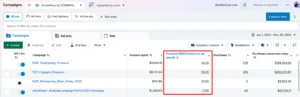
The Microsoft Ads results for Armorpoxy became one of the strongest performance channels in the account on a returns basis. On $13,600 in ad spend, the campaigns generated $238,000 in revenue and 417 conversions at a 1,741% ROAS. Lower competition, lower CPCs, and a buyer profile that aligns with industrial purchasing made this channel produce returns that exceeded the Google Ads ROAS on a percentage basis, even if Google remained the higher-volume channel. Read the guide to managing Microsoft Syndicated Search Partners for the technical setup that prevents wasted spend from low-quality syndication traffic in industrial Microsoft Ads campaigns.
Meta Ads: Retargeting Layer That Recovered Lost Revenue
Meta Ads were deployed as a retargeting layer rather than a primary acquisition channel. Industrial flooring buyers research extensively before purchasing. A commercial buyer may visit the site multiple times, download a product specification sheet, and compare other suppliers before returning to purchase. Without retargeting, every visitor who left without buying was lost after the initial visit. With structured retargeting, those visitors encountered Armorpoxy product ads on Facebook and Instagram during the consideration period.
The retargeting campaigns served the specific products each visitor had viewed through dynamic product ads, rather than generic brand ads. Hustle Marketers segmented engaged audiences who had interacted with the site separately from cold audiences. Seasonal promotional campaigns ran on top during periods of peak commercial construction activity. The structured retargeting approach produced ROAS above 42x on Meta campaigns and generated over $286,000 in revenue from retargeting alone. Read the guide on calculating break-even ROAS to set correct performance targets for retargeting campaigns. Audience costs are a fraction of cold traffic acquisition cost, which changes the viable ROAS floor entirely.
Results Across All Platforms
Google Ads: $1.58M Revenue at 12.84x ROAS
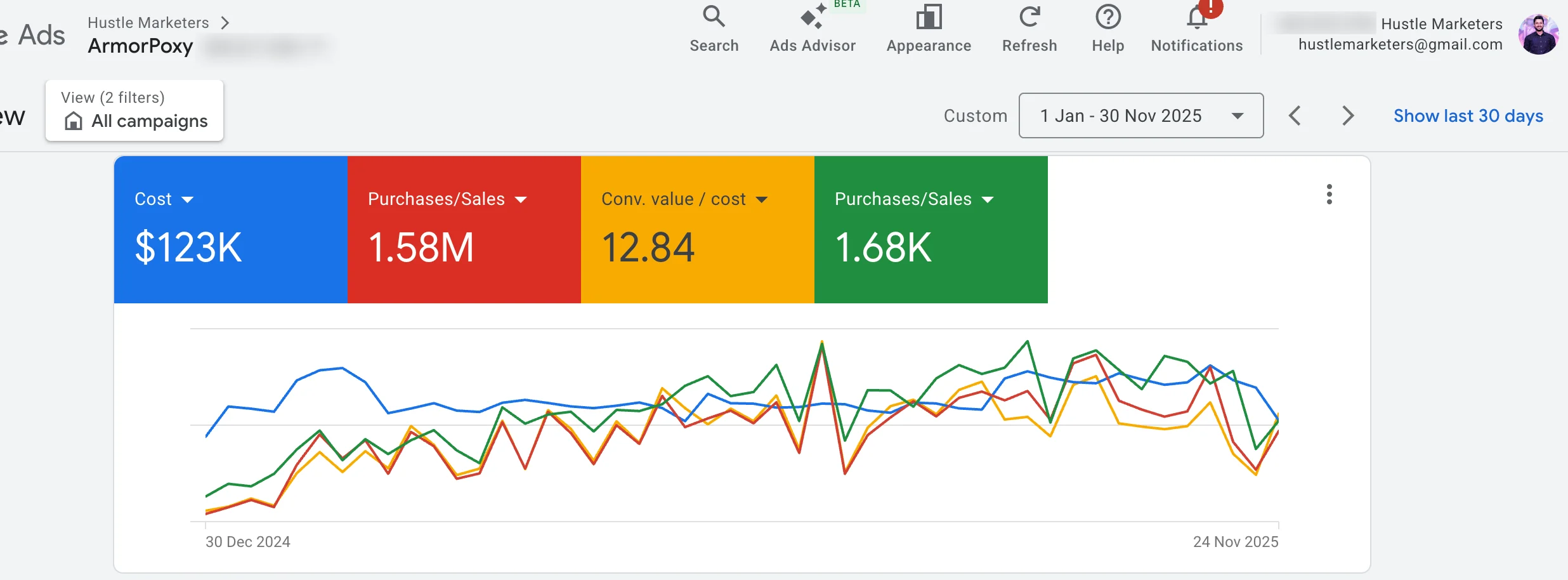
Google Ads became Armorpoxy’s primary revenue driver at scale. On $123,000 in ad spend, the campaigns generated $1.58M in revenue, 1,680+ purchases, and 31,000+ clicks at a 12.84x blended ROAS. The result came from three combined improvements: a rebuilt Search campaign structure, Shopping campaign optimisation, and correctly configured Performance Max deployment. Read the full methodology in the guide on mastering Google Shopping for ecommerce.
Lead Quality: 184 Closed Deals From 321 Form Submissions, 882% ROI
The lead quality metrics from the initial campaign phase tell a different story from the top-line ROAS. On $24,000 in ad spend during the initial structured period, 321 form submissions produced 184 closed deals. A 57% submission-to-close rate for commercial inquiries is a strong lead quality signal. The 882% ROI on that ad spend reflects what happens when campaign optimisation is driven by closed deal data rather than form submission data. The HubSpot integration made this attribution possible and the bid strategy improvements made it repeatable.

Microsoft Ads: 1,741% ROAS on $13.6K Spend
Microsoft Ads produced $238,000 in revenue from $13,600 in spend at a 1,741% ROAS across 417 conversions. Returns on Microsoft exceeded the Google ROAS percentage. Lower CPCs for equivalent industrial intent combined with stronger conversion rates from the corporate buyer demographic. For a brand with Armorpoxy’s commercial buyer audience, Microsoft Ads is not optional. It captures a segment Google underweights and that represents high-value commercial orders.
Meta Retargeting: 42x ROAS and $286K Revenue
Meta retargeting campaigns produced ROAS above 42x and generated over $286,000 in revenue from visitors who had already been acquired through Google and Microsoft search campaigns. The retargeting layer effectively monetised traffic that would otherwise have been lost after the first visit. Dynamic product ads, engagement-based segmentation, and seasonal promotional overlays combined to make Meta retargeting one of the highest-ROI components in the full multi-platform architecture. Read the guide on ROAS vs ROI for ecommerce brands to understand multi-platform attribution when each channel plays a different role in the purchase journey.
What the Client Said
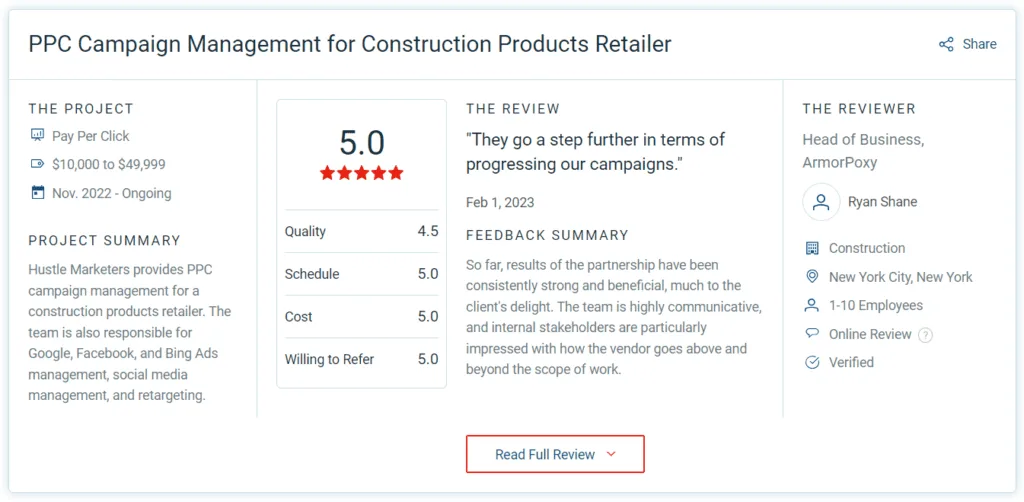
Armorpoxy reviewed Hustle Marketers on Clutch and noted: “Working with Hustle Marketers is one of the best decisions. Overall, our results have been very strong. They go a step further in advancing our campaign with new tools and strategies.” This review reflects the ongoing partnership model, not a one-time engagement. The results documented above represent a sustained performance relationship, not a short-term spike.
Key Lessons for Industrial and Epoxy Ecommerce PPC
CRM Integration Is Not Optional for B2B Industrial Brands
For industrial brands where a deal may close weeks after the initial form submission, optimising without CRM integration means optimising for vanity metrics. The HubSpot integration changed the campaign’s optimisation target from “submit a form” to “close a deal.” That shift produced better lead quality and better budget allocation. Performance improved across every metric that actually matters for business growth. Any industrial ecommerce brand running Google Ads without CRM integration is leaving major performance improvement unrealised.
Microsoft Ads Is Undervalued for Industrial and Corporate B2B
Most industrial brands advertise exclusively on Google. This creates an opportunity on Microsoft Ads for brands willing to invest the setup time. Lower CPCs, a corporate-skewing user base, and lower advertiser competition combine to produce returns that frequently exceed Google on a percentage basis for B2B industrial queries. Armorpoxy’s 1,741% ROAS on Microsoft Ads is the documented proof. For an industrial brand generating $100,000+ in Google Ads revenue, adding Microsoft Ads typically produces a 15 to 25% revenue increase at a higher ROAS. For brands that also want organic visibility alongside paid, see the epoxy flooring SEO guide covering how paid and organic work together for industrial flooring brands.
Retargeting Recovers the Revenue That Search Campaigns Paid to Attract
Industrial buyers research before purchasing. A commercial buyer evaluating epoxy flooring systems may visit three or four suppliers’ websites before committing. Without retargeting, ad spend that brought a buyer to the site on the first visit is wasted if they leave and purchase elsewhere. With structured Meta retargeting, the brand stays visible during the consideration period. The 42x ROAS on Armorpoxy’s retargeting campaigns reflects the efficiency of serving warm, pre-qualified audiences rather than cold prospecting traffic.
Performance Max Requires Correct Setup to Produce Industrial Results
Performance Max campaigns are powerful but misconfigured PMax campaigns in the industrial space can spend budget on irrelevant placements and low-intent audiences. The correct setup for an industrial ecommerce brand requires audience signals from existing commercial customer data. Asset groups must be segmented by product category. Exclusion lists prevent brand cannibalisation. A learning period with manual oversight is also needed before budget is scaled. Read the complete Performance Max checklist for the specific configuration steps that determine whether PMax serves industrial brands effectively.
Frequently Asked Questions: Industrial Ecommerce and Epoxy Brand PPC
How did Hustle Marketers achieve 12.84x ROAS for an industrial epoxy brand?
Hustle Marketers achieved 12.84x ROAS for Armorpoxy through four simultaneous changes on Google Ads. First, the campaign structure was rebuilt around intent segmentation. B2B commercial buyers and residential DIY buyers received different campaigns, bid strategies, and ad copy. Second, HubSpot CRM was integrated with Google Ads. Closed deal signals passed back as offline conversion events, shifting optimisation from form fills to actual revenue. Third, Shopping and Performance Max campaigns were rebuilt with feed optimisation and correct audience signal configuration. Fourth, negative keyword sculpting removed irrelevant traffic that had been consuming budget without purchase intent. All four changes were implemented before any budget was increased.
Why does HubSpot CRM integration matter for Google Ads performance?
HubSpot CRM integration matters because it changes what Google’s algorithm optimises for. Without integration, campaigns optimise for form submissions. With integration, campaigns optimise for closed deals and revenue. Without CRM data, a $15,000 commercial inquiry and a spam submission look identical to Google Ads. Optimising for form volume alone directs budget toward the wrong audiences. The Armorpoxy engagement showed a 57% submission-to-close rate and 882% ROI on the initial phase. This happened because the bidding algorithm targeted keywords and audiences that had historically produced real revenue, not just contact forms.
Should industrial brands run both Google Ads and Microsoft Ads?
Yes, for industrial and commercial B2B brands, running both platforms is strongly recommended. Microsoft Ads reaches the corporate and industrial buyer through Bing, which is the default search engine on many company-issued devices. This audience skews toward corporate procurement and professional buying decisions. Armorpoxy’s Microsoft Ads result, 1,741% ROAS on $13,600 in spend, demonstrates what lower CPCs and professional user demographics produce for industrial keywords. The setup time is modest relative to the revenue potential for any brand with an established Google Ads account.
Does Hustle Marketers work with other industrial or epoxy brands?
Yes. ArmorGarage, a related epoxy flooring brand, achieved 1,500% ROAS through Performance Max restructuring and Google Shopping feed optimisation by Hustle Marketers. Both epoxy brand engagements demonstrate Hustle Marketers’ expertise in the industrial coatings niche. This includes the product feed structures, audience segmentation approaches, and CRM integration requirements that this category needs. Hustle Marketers also works with industrial brands across C7 Carbon (carbon fibre automotive parts) and other specialty manufacturing ecommerce businesses.
How does Hustle Marketers approach Performance Max for industrial ecommerce?
Hustle Marketers approaches Performance Max for industrial brands with specific configuration requirements that differ from standard consumer ecommerce. Audience signals are built from existing commercial customer lists rather than broad demographic signals. Asset groups are segmented by product category. Warehouse flooring, garage floor kits, and commercial coatings each have dedicated creative and signals rather than competing in the same asset group. Brand exclusions prevent PMax from cannibalising higher-intent Search campaigns. The learning period is managed with manual spending limits until 50 to 100 conversions are recorded. Read the full Performance Max checklist for the exact setup sequence applied to industrial ecommerce accounts.
Why Hustle Marketers for Industrial Ecommerce and Epoxy Brand PPC
Hustle Marketers is a Google Partner and Meta Business Partner performance marketing agency led by Ishant Sharma. The team is led by Ishant Sharma, who has managed paid media since 2013 for industrial, specialty, and ecommerce brands across the US, UK, UAE, and Australia. The agency has generated $780M+ in trackable client revenue across 2,500+ brands. The Armorpoxy engagement is one of the most technically complex in the portfolio. It involved a mixed B2B and B2C audience and a multi-platform strategy across three ad platforms. HubSpot CRM integration also redefined what the campaigns optimised for. Total result: $1.58M in revenue from a $150K investment.
For comparison, the sister epoxy brand engagement with ArmorGarage produced 1,500% ROAS through a Performance Max and Shopping feed rebuild. Both epoxy brand results demonstrate the same core methodology. Fix the structure, integrate real revenue data, then expand to every platform where the buyer profile is reachable. Read the Shopping feed management guide and the Performance Max feed optimisation guide for the technical detail behind the Google Ads results. Also see the ecommerce PPC management services page for how Hustle Marketers approaches multi-platform industrial campaigns.
If your industrial products or epoxy ecommerce campaigns are not producing returns at this level, the cause is almost always structural. Note that Hustle Marketers also delivered organic SEO results for ArmorPoxy separately. See the ArmorPoxy SEO case study showing 35% organic click growth through technical SEO, content clusters, and AI search optimisation alongside the paid media work documented here. The problems Armorpoxy faced before this engagement are common: campaigns optimised for wrong conversion events, no CRM integration, missing cross-platform coverage, and insufficient intent segmentation. All of these are diagnosable and fixable. Get in touch with Hustle Marketers for a free audit that shows exactly what your industrial ad account needs to reach performance at this level.