The Future of SEO: Scoring the Last Round of Predictions
Most future-of-SEO writing cannot be wrong because it never says anything checkable. We traced the decade’s most repeated SEO prediction to its source, and make five dated ones of our own.
Most future-of-SEO writing cannot be wrong because it never says anything checkable. We traced the decade’s most repeated SEO prediction to its source, and make five dated ones of our own.

How ChatGPT ads work for online stores: who sees them, product feed and Shopify app setup, reported CPCs, the $25 US daily minimum, the creative enhancements default and a four-week test plan tied to break-even ROAS.
Product page SEO for 2026: how Google, ChatGPT, Perplexity and Copilot read each part of a product page, the schema it needs, and a 15-minute AI test.
Sixteen AEO tools with prices read from each vendor’s own page on 2 October 2026, what Google and Bing actually report, and who publishes the competing lists.
Google shipped a Generative AI performance report and a Search generative AI control on 31 August 2026. Zero of the 39 competitor pages we read mention the control, and nine contradict each other on the report. We read 15 trackers at source: 13 cover both Google surfaces, only 2 will say in writing that they report them separately, and 6 charge extra for AI Mode.

We checked 28 AI visibility tools on their own pricing pages. Twenty-one track Claude, but only 13 include it at no premium, four hide it behind Enterprise, and seven do not offer it at all. Plus what Anthropic documents about citations and crawlers, the Consumer Terms clause governing automated tracking, and a free way to check your own visibility.

AI content optimization means two things. Google publishes a list of what you do not need to do for AI search. Microsoft Bing recommends the opposite. Both quoted at the source.

We read 28 pages ranking for SEO content agency and 63 buyer accounts. None publishes a revisions count, none states a per-article word count, none dates a result, and one in 28 tells you who owns the content. Here is what the work costs, who writes it, what Google actually says about AI content, and who owns it afterwards.
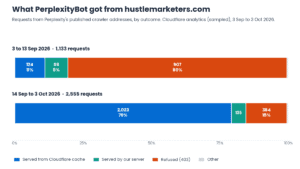
How Perplexity picks the sources it cites, what PerplexityBot and Perplexity-User really do, and what 30 days of our own Cloudflare data showed about crawler access. A sourced guide to getting cited in Perplexity.

Google requires AI-generated product titles to be declared with structured_title, and silently ignores them if you also send title. The rule, the trap, and whether AI titles actually perform.

Nine of the 13 AI SEO tool roundups we read are published by a company selling one of the tools, and eight of those nine rank themselves first. Not one dates a price. Here are verified 2026 prices read on each vendor’s own page, and what Google actually documents about SEO tools.

Every guide says DeepSeek’s API returns no citations. They are testing the wrong endpoint. The free tracking method, verified tool coverage across 23 platforms, and the referral data on when not to bother.

Info@hustlemarketers.com

H-15 C, Zirakpur,
Punjab 160104, INDIA