Perplexity SEO: How to Get Your Site Cited in Perplexity

Ishant
Published : October 10, 2026 at 2:30 pm
Updated : October 7, 2026 at 10:15 am
Ishant
Perplexity SEO means making your pages easy for Perplexity to reach, retrieve and cite. Perplexity runs its own search index, splits pages into self-contained passages, and ranks those passages against each question. So the work is crawler access first, then clear passages that answer real questions, then the off-site reputation that makes your page the safer citation.
Most advice on this topic repeats the same five tips without a source. This guide separates what Perplexity has documented from what people claim, and adds something you rarely see: 30 days of our own Cloudflare traffic data, showing what Perplexity’s crawler actually did on our site.
Key Observations
- Perplexity says its own search index tracks over 200 billion URLs, and that it splits pages into “self-contained spans” and reranks them per question. That is the closest thing to an official ranking explanation.
- Its two bots behave differently. PerplexityBot builds the index and obeys robots.txt. Perplexity-User fetches pages when someone asks a question and, in Perplexity’s words, “generally ignores robots.txt rules.”
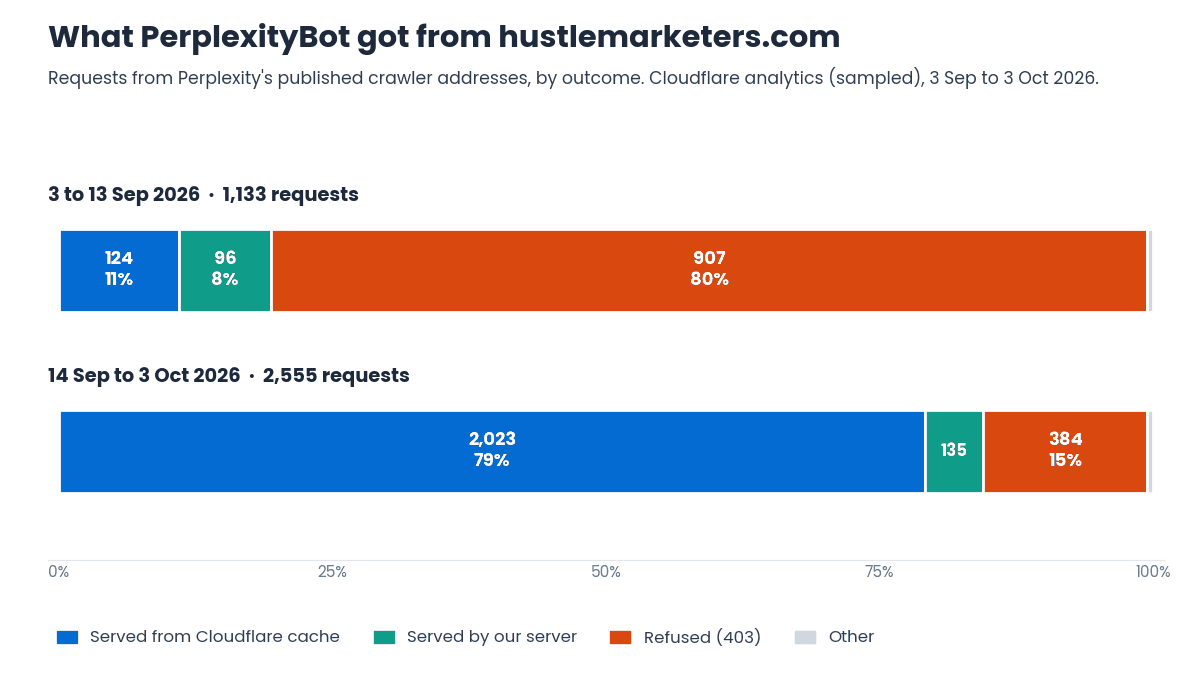
- In our own Cloudflare data, Perplexity’s crawler made 3,688 requests in 30 days. Before 14 September, Cloudflare’s edge or our server refused 80 percent of its requests, most of them at the edge. Since then our server has still refused most uncached requests from Perplexity’s main address range.
- Every request in our data that claimed to be Perplexity-User came from an address Perplexity does not publish, and all but a handful went looking for files like /.env and /.git/HEAD.
- The widely shared “leaked ranking factor” numbers do not appear in the original analysis people trace them to.
- Schema markup and llms.txt have no Perplexity documentation behind them. Product detail does: Perplexity says it is more likely to recommend merchants with fuller product information.
What is Perplexity SEO, and how is it different from Google SEO?
Perplexity SEO is the work of getting your pages cited in Perplexity’s answers. It overlaps with Google SEO, because both reward crawlable pages that answer a question well. The difference is the unit that wins: Google ranks pages in a list, while Perplexity picks passages from several pages and cites them by number inside one answer.
Perplexity’s help center describes answers with “numbered citations linking to the original sources.” A searcher may read your sentence inside the answer and never click. So a citation is the result you are working toward, and the click is a bonus.
Google rankings still matter, but less than some guides suggest. In an Ahrefs study of 15,000 long-tail queries published in August 2025, 28.6 percent of the URLs Perplexity cited also ranked in Google’s top 10. That was about three and a half times the rate for ChatGPT, Gemini and Copilot. It also means most cited URLs were not top-10 Google results.
| Google search | Perplexity | |
|---|---|---|
| What it returns | A ranked list of pages | One written answer with numbered citations |
| What competes | Whole pages | Passages, which Perplexity calls self-contained spans |
| Index | Google’s index | Perplexity’s own index, plus live fetches when a user asks |
| Crawler to allow | Googlebot | PerplexityBot for the index; Perplexity-User for live fetches |
| Success measure | Position and clicks | Being cited, and how often across repeated runs |
| Official guidance | Search Central documentation | Crawler docs, help center articles and one engineering post |
For how Perplexity fits beside ChatGPT, Gemini and Google’s AI features, read our guide on improving brand visibility in AI search. This page goes deep on Perplexity alone.
How does Perplexity choose which sources to cite?
Perplexity’s own engineers describe a pipeline: crawl and index pages, split each page into passages, retrieve candidates with keyword and semantic search together, then rerank them with stronger models before writing the answer. They have not published the signals inside the reranker. Everything beyond that pipeline comes from outside studies, and those disagree.
What Perplexity has documented
In September 2025, Perplexity published an engineering post about its search API. It is the most detailed description of how it finds sources, and it says more than most guides quote.
- The index “tracks over 200 billion unique URLs.” Machine learning decides what to crawl and when to come back, based on a page’s importance and how often it is likely to change.
- Pages are split “into self-contained spans, each of which can be individually retrieved and ranked at query time.” Your page competes paragraph by paragraph, not as a whole.
- Retrieval is hybrid, mixing keyword matching with semantic matching. A final stage uses “more powerful cross-encoder reranker models.”
- When deciding which documents to keep ready, Perplexity says it prioritizes “authoritative domains” and “undercovered topics.” That describes index storage, not a stated answer ranking factor.
Perplexity’s Search API announcement, published the same day, says the API runs on “the same global-scale infrastructure that powers Perplexity’s public answer engine.” You can read the engineering post in full.
One detail matters for anyone hoping to opt out. Perplexity’s robots.txt help article says it “partners with third-party crawlers to help build our search index.” It does not name them, and no Perplexity page we found names Google or Bing as a source.
What the studies show, and their limits
Outside studies fill the gap, but each looked at one slice of Perplexity at one moment. Read them as direction, not rules.
| Study | What it found about Perplexity | Limit |
|---|---|---|
| Ahrefs, August 2025, 15,000 long-tail queries | 28.6 percent of cited URLs ranked in Google’s top 10 | July 2025 data, long-tail queries only |
| Ahrefs, July 2025, about 17 million cited URLs | Pages Perplexity cited averaged 1,166 days old, against 1,416 days for Google organic results | Cited pages were still about three years old on average |
| Profound, June 2025, 680 million citations across three engines | Reddit was 6.6 percent of all Perplexity citations, and 46.7 percent of the share held by its top 10 domains | Vendor dataset. The 46.7 percent has been misquoted as a share of answers |
| SE Ranking, April 2025, 2,000 keywords | 1,980 of 1,999 Perplexity answers, about 99 percent, cited exactly five sources | One week of data |
| Search Engine Journal, July 2026, eight captured answers | Perplexity retrieved more sources than it cited, for example 10 retrieved and 6 cited on one commercial query | One account in one location |
Two lessons follow from them. First, being retrieved is not the same as being cited, so the passage itself has to win. Second, a single check proves little. Answers change from run to run, which is why we track citation rates over repeated runs, as explained in our guide to Perplexity rank tracking.
Are the leaked Perplexity ranking factors real?
They are unconfirmed, and the most quoted numbers are not in the source. In August 2025, an SEO named Metehan Yesilyurt published an analysis of request patterns he saw in Perplexity’s web app. It named settings such as curated domain lists, time decay and topic multipliers. Perplexity has not confirmed any of it.
Since then, several guides have repeated specific figures, such as a new post needing about 1,000 impressions and a 4.2 percent click-through rate within 30 minutes, a 0.75 quality score, or a 3x topic multiplier. We read the original analysis and did not find those numbers in it. Two guides go further and publish percentage weights for each factor, with no source at all.
Here is how the common claims stand against what Perplexity has published.
| Claim you will see | Status | What the evidence says |
|---|---|---|
| Perplexity runs its own index | Documented | Perplexity’s engineering post describes an index tracking over 200 billion URLs |
| Pages are scored in passages, not as a whole | Documented | Same post: pages are split into self-contained spans |
| PerplexityBot obeys robots.txt | Documented | Crawler docs, with a note that changes can take up to 24 hours |
| Perplexity uses the Bing index | Not documented | No Perplexity page names Bing. It says it uses unnamed third-party crawlers |
| Perplexity updates its index daily | Not documented | No fixed daily cycle is documented. Perplexity says machine learning schedules each URL, and that its systems process tens of thousands of index update requests every second |
| Fixed impression and click thresholds for new posts | Unconfirmed | From one reverse-engineering analysis; the specific numbers are not in it |
| Percentage weights per ranking factor | No source | Not in any Perplexity document or the original analysis |
| Schema markup helps you get cited | Not documented | No Perplexity statement; small tests disagree |
| llms.txt helps you get cited | Not documented | Perplexity publishes llms.txt files for its own docs but says nothing about reading yours |
| Fresher content gets cited more | Partly supported | An Ahrefs study in 2025 found cited pages somewhat newer; no Perplexity statement |
None of this means the leak was wrong. It means nobody outside Perplexity can verify it, and the version going around has grown in the retelling. Build on what is documented, and test the rest on your own pages.
Can PerplexityBot reach your pages?
Check access before anything else, because Perplexity cannot cite the full text of a page it cannot fetch. Allow PerplexityBot in robots.txt, then confirm your CDN, firewall and server let it through. Robots.txt alone tells you nothing about the last two, and that is where we found our own problems.
What PerplexityBot and Perplexity-User do
Perplexity runs two named agents, and they follow different rules. Perplexity describes both in its crawler documentation.
| PerplexityBot | Perplexity-User | |
|---|---|---|
| Job | Builds the search index that answers draw on | Fetches a page live when a user’s question needs it |
| Robots.txt | Obeys it. Changes can take up to 24 hours to apply | “Generally ignores robots.txt rules,” because a user requested the fetch |
| User agent contains | PerplexityBot/1.0 | Perplexity-User/1.0 |
| Published IP list | perplexitybot.json | perplexity-user.json |
| Used to train AI foundation models | No, per Perplexity’s crawler docs | No, per Perplexity’s crawler docs |
Blocking is also less complete than it sounds. Perplexity’s help center says a blocked PerplexityBot “will not index the full or partial text content” of your site. The same article adds that it “may still index the domain, headline, and a brief factual summary.” So a block keeps your text out, not necessarily your name.
What we found in 30 days of our own Cloudflare data
While writing this guide, we pulled 30 days of Cloudflare data for hustlemarketers.com, from 3 September to 3 October 2026. Our robots.txt allows PerplexityBot, and PerplexityBot fetched it successfully 181 times in the period. Cloudflare samples its analytics, so treat the counts below as close estimates rather than exact totals.
| What we measured | Result |
|---|---|
| Requests from Perplexity’s published PerplexityBot addresses | 3,688, all using the documented user agent |
| Robots.txt fetches by PerplexityBot | 182 |
| Different URLs it fetched successfully | 550 |
| 3 to 13 September: requests refused | 907 of 1,133, 811 of them at Cloudflare’s edge |
| 14 September to 3 October: requests served | 2,158 of 2,555, and 2,023 of those came from Cloudflare’s cache |
| Since 14 September: uncached requests from the main crawler range | 379 refused by our server, 34 served |
| Requests claiming to be Perplexity-User from its published addresses | 0 |
| Requests claiming to be Perplexity-User from other addresses | About 350, all but a handful probing for files like /.env, /.git/HEAD, private keys and cloud credentials |
| Page views referred by perplexity.ai | 9, against 41 from chatgpt.com and 23 from gemini.google.com |
Three things stood out.
First, robots.txt was not the problem. Until 13 September, Cloudflare’s edge refused 811 of PerplexityBot’s requests before they reached our server. Those edge refusals all but stopped, with 5 since, after a Cloudflare ruleset change on our account on the evening of 13 September. Nothing in robots.txt would have shown it.
Second, a site can look reachable while new pages are not. After 14 September, PerplexityBot mostly received cached copies.
When a request missed the cache and reached our server, the server answered Perplexity’s main crawler range with a 403 refusal 379 times and served it 34 times. Perplexity’s single published addresses got through on all 101 of their uncached requests.
In practice, any page not already in Cloudflare’s cache, a newly published one included, was the page Perplexity’s main crawler range most often failed to get. At the time of writing we had not identified what on the server returns those refusals.
Third, the name in a user agent proves nothing. Every request that called itself Perplexity-User came from an address Perplexity does not publish, and all but a handful were scanners hunting for secrets. Another few hundred used PerplexityBot’s name from unlisted addresses. If your firewall trusts the name alone, attackers get the pass meant for Perplexity.
The referral numbers matter too. About 3,688 crawler requests produced 9 referred page views in the same period. Cloudflare reported a similar pattern across a fixed set of its customers, with Perplexity’s crawl-to-referral ratio rising from 54.6 to 194.8 between January and July 2025, in its crawler analysis. Cloudflare is not neutral on Perplexity, as the section on blocking explains, but the direction matches what we saw.
How to check your own logs in 15 minutes
You can run the same check on almost any site behind Cloudflare, or from raw server logs.
- Download Perplexity’s two IP lists, perplexitybot.json and perplexity-user.json, linked in the table above. They change, so fetch them fresh each time.
- Filter your logs to requests whose user agent contains PerplexityBot or Perplexity-User.
- Split those requests into two groups: from a published address, and from anywhere else. Treat the second group as impostors.
- For the published addresses, count responses by status code. Anything other than 200, 301 or 304 needs a reason.
- For refused requests, check where the refusal came from. In Cloudflare, an origin status of zero means the edge refused it. Otherwise your server, host or security plugin did.
- Look for your newest URLs. If PerplexityBot has not fetched them successfully, Perplexity cannot cite them from their text.
- Recheck 24 hours after any robots.txt change, because that is how long Perplexity says changes can take.
If you use Cloudflare, Perplexity’s documentation gives example firewall rules that pair the user agent with the published IP ranges. That combination is the safe way to allow it, because a rule that trusts the user agent alone also lets in impostors. Our technical SEO checklist covers the wider crawler checks for every AI bot.
Should you block PerplexityBot?
Block it only if you do not want your text in Perplexity’s answers. Blocking stops PerplexityBot from indexing your text, but Perplexity may still show your domain, headline and a short summary. It also does not stop Perplexity-User, which generally ignores robots.txt. For most businesses that want customers, allowing it is the better trade.
The trust question is real, and both sides have stated their case. In August 2025, Cloudflare reported that Perplexity used undeclared crawlers when its declared bot was blocked, and removed Perplexity from its verified bot list. Perplexity replied the same day that Cloudflare had misattributed traffic from a third-party browser service to it. Several publishers are also suing Perplexity over how it uses their content.
So the practical answer depends on what you sell. A business that wants to be recommended should allow PerplexityBot, verified by IP. A publisher that sells its content may decide differently, and Perplexity runs a publishers program and Comet Plus, a $5 reader subscription that shares its revenue with participating publishers.
Want this check run on your site? Send us your domain. With read access to your Cloudflare or server logs, we can show which pages PerplexityBot fetched and which it was refused.
How do you rank in Perplexity? What to change on the page
Write passages that answer one question completely, in the words people use, with facts a reader can check. Perplexity retrieves and ranks passages, so a strong page with its answer buried in paragraph nine competes poorly. Put the answer first, name the source of every number, and keep each section readable on its own.
Write passages that stand on their own
Because Perplexity scores self-contained spans, each section should make sense if it is the only part a reader sees. In practice that means:
- Use the question as the heading, in the searcher’s own words.
- Answer it in the first two or three sentences, before any background.
- Repeat the subject instead of writing “it” or “this” across section breaks.
- Put numbers, dates and named sources next to the claim they support.
- Use tables for comparisons, since each row is a compact, quotable fact.
The research on content edits points the same way, with a caveat. The 2023 GEO paper from Princeton and partners found that adding quotations and statistics raised visibility by up to 40 percent in its main benchmark, which used GPT-3.5 answering from Google results. Its separate test on Perplexity showed gains of up to 37 percent, with mixed results across tactics. Treat those figures as a reason to add evidence, not a promise.
Does freshness matter in Perplexity?
Somewhat, but not in the way most guides claim. The largest study we found, by Ahrefs, showed pages Perplexity cited averaged about 1,166 days old, roughly 18 percent newer than pages in Google’s organic results. That is a mild lean toward fresher pages, not a rule that old pages lose.
Perplexity’s own engineering post treats freshness as an indexing job, keeping each document’s latest version in the index. It does not describe freshness as an answer ranking signal. Its search API also lets developers filter results by publish date or last-updated date, which shows dates are stored, not how much they weigh.
So update a page when the facts change, and say what changed. Changing only the date teaches readers to distrust it and adds nothing for Perplexity to cite.
Do schema markup and llms.txt help?
There is no Perplexity documentation saying either one helps. Schema is still worth having for Google, and for clean product data. Just do not expect it to change Perplexity citations on its own.
The evidence is thin and conflicting. A 2026 Ahrefs study of pages that added JSON-LD found no significant citation lift on the engines it measured, but it did not include Perplexity. A small test reported by Search Engine Roundtable suggested Perplexity reads schema as ordinary page text. For llms.txt, Perplexity publishes the files for its own documentation but has said nothing about reading yours.
Our guide to structured data SEO covers which schema types still earn something in Google.
Does being mentioned elsewhere help you get cited in Perplexity?
Probably, though no study has tested it directly. Every large citation study shows Perplexity citing forums, review sites, directories and other publishers heavily, so a brand that is described well on those sites gives Perplexity more passages to draw on. Your own site still matters, but it is one of several places your answer can come from.
The source mix varies by query type, but some patterns repeat across studies:
- Reddit was the most cited domain among Perplexity’s top 10 in Profound’s 680 million citation dataset, at 6.6 percent of all Perplexity citations.
- In a Semrush study of over 230,000 prompts, Perplexity’s most cited domains from July to October 2025 were Reddit, LinkedIn, NIH, Microsoft and Google.
- An Ahrefs analysis of about 953,500 Perplexity prompts found it drew on a broader, more international set of sources, with more local and regional brands, than ChatGPT or Google’s AI Overviews.
The practical takeaway is to make sure people describe you accurately where your buyers already look: review sites in your category, relevant directories, industry publications and community threads where you can genuinely help. Do not post promotional comments. Communities remove them, and a thread that calls you spam is also a passage Perplexity can cite.
Our post on citations versus mentions in AI search explains why we measure being named and being linked separately.
What are Perplexity’s Trusted, Academic and Government labels?
They are shield icons Perplexity adds to some citations to describe the kind of site behind them. Perplexity’s help center lists three labels: Government, Academic and Trusted. Trusted marks sites with domain expertise that appear frequently in results. The labels describe a whole website, not a single article.
The criteria Perplexity lists in its source labels article read like basic publishing standards. They include whether a site will “correct its mistakes,” “say who wrote each piece,” and keep news separate from advertising and opinion. Perplexity also says payments and partnerships “do not affect a site’s label.”
Perplexity has not said labels change which sources it cites. Still, the criteria are worth meeting anyway: a named author on every page, a visible corrections approach, and a clear line between editorial content and anything you sell.
How do products show up in Perplexity Shopping?
Perplexity is more likely to recommend merchants whose product information is detailed. Its help center says it is “more likely to recommend merchants who provide deeper product details such as availability, reviews, pricing, and specifications.” Advertisers cannot pay to list products in its related products section. That makes complete, accurate product data the main lever.
Perplexity’s shopping features have changed several times, so check the current state before you plan around one.
- November 2024: Perplexity launched shopping with product cards it said “aren’t sponsored,” plus a free merchant program.
- November 2025: it relaunched shopping free for all US users, with checkout powered by PayPal and retailers staying the merchant of record.
- Instant Buy works only with merchants compatible with its checkout. A Perplexity help article written for the 2025 PayPal launch named Wayfair, Abercrombie and Fitch, and thousands of merchants on BigCommerce, Shopware and Wix.
One study is worth knowing if you sell on marketplaces. LLM Pulse analyzed about 391,000 shopping citations from April to July 2026 and found Perplexity cited Amazon.com zero times, leaning instead on brand sites and editorial reviews.
Retailers took a smaller share of Perplexity’s shopping citations than of any other AI engine it measured. The sample leaned toward the categories its clients track, but it suggests your own product pages carry more weight in Perplexity than in the other AI engines.
For the product data side, see our guide to product schema markup, or our ecommerce SEO service if you want it handled.
How do local businesses show up in Perplexity?
Local answers in Perplexity lean on listings and reviews more than on your own website. Perplexity has partnered with OpenTable for restaurant bookings, and outside tests show directories such as Yelp appearing across industries. So consistent listings and real reviews come first, then a website that states your services and areas clearly.
The evidence is thinner here than anywhere else:
- Perplexity announced in August 2025 that restaurant queries can surface choices from OpenTable’s restaurant partners, with booking inside Perplexity.
- Maginative reported in March 2024 that Perplexity had integrated Yelp data, including maps, reviews and photos, into local searches.
- A BrightLocal test in July 2025 found Perplexity drew on Yelp in every industry it tested, along with legal directories for lawyer searches. The test covered only 20 searches.
For a local business, that means three jobs:
- Keep your name, address, phone and categories identical across major listings.
- Earn reviews that describe the work you actually did.
- Give each service and area a page that answers the questions customers ask.
Our local SEO services page covers the reviews and service-page work in detail.
How do you measure Perplexity traffic and citations?
Measure three things separately: whether Perplexity can crawl you, how often it cites you, and what visitors it sends. Logs answer the first, repeated prompt checks the second and analytics the third. No single tool covers all three well.
For traffic, Perplexity visits usually arrive in Google Analytics 4 as referrals from perplexity.ai. Create a custom channel group that matches sources containing “perplexity,” so the visits are not lost in general referrals. MarTech reported that visits from Perplexity’s Comet browser often appear the same way, though results varied across test sites.
For citations, run the same set of real customer questions on a schedule and record how often you are cited, not just whether you appeared once. Our Perplexity rank tracking guide gives a free manual method and current tool prices.
The tools you will find for “Perplexity SEO” fall into three groups, and they measure very different things.
| Tool type | What it does | What it cannot tell you |
|---|---|---|
| Readiness checkers | Audit a page for structure, crawler access and markup | Whether Perplexity actually cites you, because most never query Perplexity |
| Keyword tools | Suggest phrases from Perplexity’s autocomplete | Which answers cite whom |
| Citation trackers | Run prompts in Perplexity on a schedule and log citations | Why you were or were not cited; one run is also not a trend |
One caution for trackers that use Perplexity’s API: the API and the app are configured separately. According to Perplexity’s API changelog, Pro Search reached the API, for Sonar Pro, only in November 2025, and in July 2026 Perplexity moved Sonar Chat Completions onto its Agent API. Check which mode a tracker uses before comparing its results with what people see in the app. For a wider comparison, see our review of AI visibility tools.
Perplexity SEO FAQs
Does Perplexity use Google’s results?
Perplexity says it runs its own index and also “partners with third-party crawlers,” without naming them. No Perplexity page we found says it uses Google or Bing results. Reddit’s October 2025 lawsuit alleges that third-party scrapers harvested Reddit content from Google search results and that Perplexity bought it from at least one of them. That is an allegation in an ongoing case, not a finding.
Can I submit my site to Perplexity?
Perplexity documents no submission form for websites. Allow PerplexityBot in robots.txt, make sure your firewall and server let its published addresses through, and link new pages from pages that already get crawled. Then confirm in your logs that PerplexityBot fetched the new URLs.
How often does Perplexity crawl websites?
Perplexity says machine learning schedules crawls based on a page’s importance and how often it is likely to change, so there is no fixed interval. On our site, PerplexityBot fetched robots.txt 182 times in 30 days, about six times a day, and made 3,688 requests in total.
Does Perplexity respect robots.txt?
PerplexityBot does, and Perplexity says changes can take up to 24 hours to apply. Perplexity-User, which fetches pages when a user asks a question, “generally ignores robots.txt rules,” according to Perplexity’s crawler documentation. To block Perplexity’s declared agents regardless of robots.txt, block their user agents and published IP ranges at your firewall. That will not catch traffic Perplexity does not declare, which is what Cloudflare and Perplexity dispute.
Can you pay to appear in Perplexity answers?
No. Perplexity’s 2024 ad test sold sponsored follow-up questions and placements beside answers, and it pledged that advertisers would not influence the answers themselves. Its help center says advertisers cannot pay to list products in its related products section, and its source labels are not for sale. The Financial Times reported in February 2026, citing Perplexity executives, that the company had phased out those ads, as covered by Search Engine Land.
How fast can new content get cited?
Site owners report pickup within hours to a couple of days, but those are reports, not a documented promise. Our own Cloudflare data shows why timing varies: a page has to be fetched successfully first, and a firewall or server rule can delay that without any warning in robots.txt.
Does Perplexity SEO help in ChatGPT and Google’s AI features too?
Partly. Clear, sourced, self-contained passages help in every AI answer engine. Crawler access does not transfer, because each engine has its own bots and rules. Our guide to answer engine optimization covers the shared ground.
Is Perplexity worth optimizing for?
On our site it is a small traffic source: perplexity.ai referred 9 page views in 30 days, against 41 from chatgpt.com. The work that helps Perplexity mostly helps other engines too, so it is worth doing as part of wider AI search work rather than as a separate project.
Do I need a Perplexity SEO agency?
Not for the basics. Crawler access, passage-first writing and accurate listings are jobs most teams can do with this guide. An agency earns its fee when the problem is technical, like the firewall and server issues in our own logs, or when you need repeated measurement across several AI engines.
Get your Perplexity access checked
Most sites never check what Perplexity’s crawler actually receives. We can review your robots.txt and, with read access to your CDN or server logs, show which of your important pages PerplexityBot fetched and which it was refused.
Send us your domain, or see our answer engine optimization services if you want the full AI search program handled. Tell us which AI engines matter most to your buyers.
About the author and how this guide was built
Ishant Sharma has worked in digital marketing since 2013 and runs Hustle Marketers, which delivers SEO, Google Ads, Microsoft Ads and Meta Ads for businesses and for other agencies. The delivery team is in India, and clients are in the United States, the United Kingdom, Australia and India.
For this guide, we read 20 of the top pages returned in US searches for Perplexity SEO and related terms, along with Perplexity’s own documentation, help center and engineering posts. We checked claims against Perplexity’s own pages first and labeled outside studies with their dates and limits.
The log figures come from Cloudflare analytics for hustlemarketers.com, covering 3 September to 3 October 2026, matched against Perplexity’s published IP lists on 3 October 2026. Cloudflare samples its analytics, so the counts are close estimates.
Summarise this article with: