Perplexity Rank Tracking: Tools, Real Prices and a Free Method

Ishant
Published : October 2, 2026 at 2:30 pm
Updated : October 13, 2026 at 5:13 am
Ishant

By Ishant Sharma, founder of Hustle Marketers. Google Partner, Microsoft Advertising Partner and Meta Business Partner. Working in search since 2013. Published October 2, 2026. Researched September 26, 2026.
Key Observations
- Perplexity numbers its citations, so your page holds an actual position in each answer. That is what makes real rank tracking possible here.
- You can track it yourself for roughly 25 cents a month using Perplexity’s own Sonar API. We read the published rates and show the arithmetic. Of the 36 ranking pages we read, one named the API as an option and then dropped it with no cost, no code and no detail.
- The completely free manual method takes about 20 minutes a month and we give you the exact prompt structure and the five fields to log.
- Google Search Console cannot report Perplexity at all. Bing’s AI report does not name it. GA4’s built in AI Assistant channel does not name Perplexity either, so check whether Perplexity visits land there or in ordinary referral traffic, and build a rule if needed.
- Six tools put Perplexity behind a higher tier or a paid add-on, and one popular tool does not cover Perplexity at all. We name them.
Table of Contents
- How do you track brand mentions in Perplexity?
- Can you track Perplexity rankings for free?
- Does Google Search Console or GA4 show Perplexity traffic?
- Which tools track Perplexity, and what do they really cost?
- How often should you run the check, and how many prompts?
- What is PerplexityBot, and how do you verify it?
- What else affects Perplexity visibility that nobody writes about?
- Who should just do this manually?
- How we do this at Hustle Marketers
- Related guides
- Perplexity rank tracking FAQs
How do you track brand mentions in Perplexity?
Three ways, and they differ enormously in cost. You can run a fixed set of prompts by hand and log the results in a spreadsheet, which is free and takes about twenty minutes a month. You can script the same prompt set against Perplexity’s Sonar API, which costs well under a dollar a month at published rates. Or you can pay a monitoring tool between $20 and $599 a month to do it on a schedule and chart it for you.
Most guides on this subject only tell you about the third one, usually because they are selling it.
We will build your Perplexity prompt set, run the baseline, and send you the spreadsheet. Free, and yours to keep whether you work with us or not.
Get a free AI visibility reviewWhy is Perplexity different from ChatGPT and Google AI for tracking?
Because Perplexity numbers its sources. When it answers, it attaches numbered citations to specific claims, so a source has an actual position in a list. For the ChatGPT side of the same job, see our guide to the best ChatGPT SEO tracking tool.
That sounds small. It is the whole reason the phrase “Perplexity rank tracking” makes sense while “ChatGPT rank tracking” is a loose metaphor. On ChatGPT and Google AI Overviews you can measure whether you appear and roughly how prominently. On Perplexity you can measure where you sit in an ordered list of sources. Our guide to getting cited in Perplexity covers how to move up that list.
Three practical consequences:
- Your metric here can be a position, not just a presence flag.
- You can see exactly which competitor URLs outranked you as a source, which is the most actionable output of any AI tracking exercise.
- Perplexity retrieves live from the web on most queries, so what it cites can change within a day, which makes single measurements even less meaningful than usual.
Worth knowing. A word on vocabulary, because the tools blur it. A mention is your brand name appearing in the answer text. A citation is your page appearing in the numbered source list, usually linked. On Perplexity you should track both separately, because you can be mentioned without being cited and cited without being named. Our guide to citations and mentions sets the distinction out in full.
Can you track Perplexity rankings for free?
Yes, and there are two genuinely free or near free routes. Neither needs a subscription.
The manual method, about twenty minutes a month
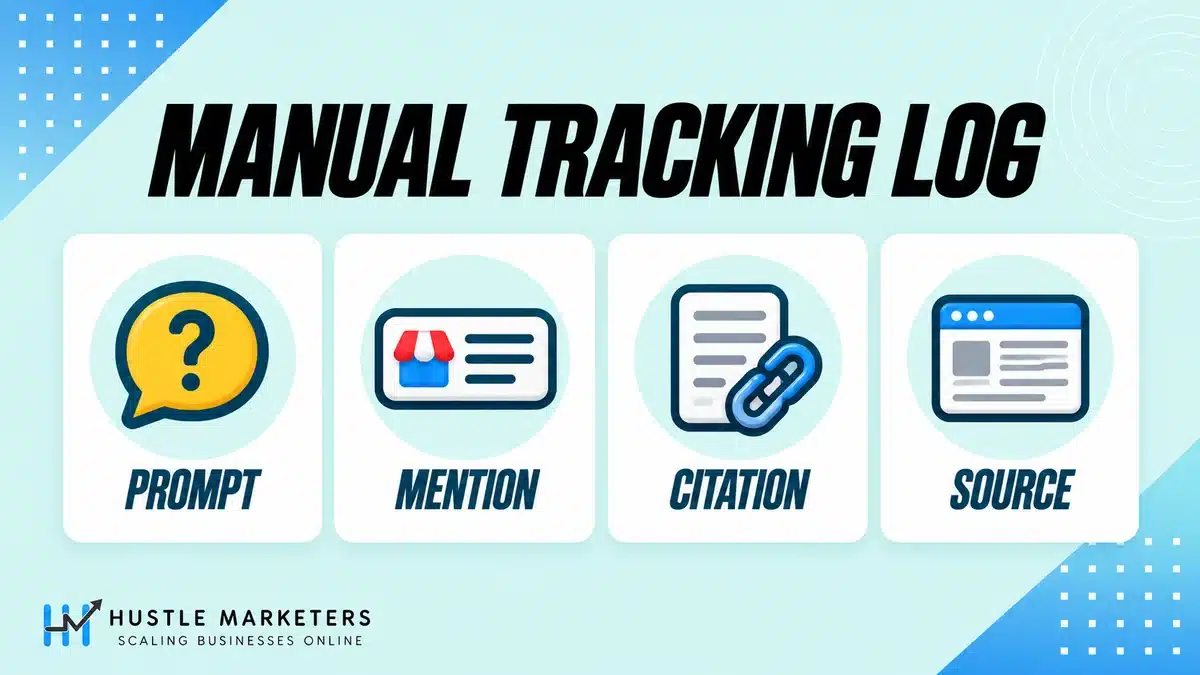
This is the whole method. It is not complicated and it is not a teaser for a paid tool.
- Write 20 to 30 prompts a real buyer would type. Split them across four types: category questions (“best CRM for small law firms”), comparison questions (“X vs Y”), problem questions (“how do I stop invoices going unpaid”), and branded questions (“is X any good”). Keep them short and neutral. Do not write them the way your marketing team talks.
- Use a clean, logged out browser profile. Perplexity personalizes on account history. If you run your prompt set from the account you use every day, you are measuring your own reading habits as much as your visibility.
- Run the whole set on the same day each month, in the same mode. Quick, Pro and Deep Research behave differently, so pick one and stay with it.
- Log five fields per prompt. Whether your brand was named in the answer text. Whether your page was in the numbered citations. Which citation number, if so. Which competitor domains were cited. Whether anything said about you was wrong.
- Convert to rates, not snapshots. Citation rate is the count of prompts where you were cited divided by total prompts. That percentage is the number worth charting. A single prompt result is noise.
That is the same loop a $300 a month tool runs. The tool does it more often and draws the chart.
If you want help with the logging, our free AI visibility checker speeds up this loop. It writes the prompts, opens each one in Perplexity with the prompt filled in, and when you paste the answer back with its source links, it counts which brands were named and whether your site was cited, with a 95% range around every rate. There is no sign-up, and nothing you paste leaves your browser.
The Sonar API method, about 25 cents a month
This is the part nobody tells you, and it is the strongest reason to be skeptical of the pricing in this category.
Perplexity publishes an API called Sonar, and it returns citations. You can point a short script at it, run your prompt set on a schedule, and log the results yourself. Here are the published rates as of September 26, 2026:
| Model | Input per million tokens | Output per million tokens | Request fee per 1,000 requests, low / medium / high context |
|---|---|---|---|
| sonar | $1 | $1 | $5 / $8 / $12 |
| sonar-pro | $3 | $15 | $6 / $10 / $14 |
| sonar-reasoning-pro | $2 | $8 | $6 / $10 / $14 |
| sonar-deep-research | $2 | $8 | $5 per 1,000 search queries |
Now the arithmetic for a 30 prompt monthly check, run once a month on the base sonar model at medium context. The request fee is the published constant. The token count is our assumption, because the length of an answer is not fixed, so we are stating it rather than hiding it.
- Request fee: $8 per 1,000 requests, so $0.008 per prompt.
- Tokens: assume roughly 450 tokens in and out combined, which at $1 per million is $0.00045 per prompt.
- Per prompt: about $0.00845.
- Thirty prompts: about 25 cents a month.
On sonar-pro at medium context the same 30 prompts come to roughly 53 cents. Double every token assumption and you are still under a dollar and a half.
Worth knowing. The barrier to DIY Perplexity tracking is writing the script, not paying for the queries. Anyone quoting you a subscription for Perplexity monitoring is selling you the dashboard, the scheduling and the storage, not the data access. That can be a perfectly fair trade. It is a different trade from the one most pricing pages imply.
One caution we will not gloss over. Answers from the Sonar API and answers from the Perplexity web interface are not guaranteed to match, because they are different products against different retrieval paths. If your goal is to replicate exactly what a customer sees in the app, the manual method is closer to the truth. If your goal is a consistent, cheap, repeatable trend line, the API is better.
Does Google Search Console or GA4 show Perplexity traffic?
Search Console does not, and cannot. Google’s documentation is clear that the generative AI performance reporting covers AI Overviews and AI Mode inside Google Search. Perplexity is a different company’s product. There is no path by which Search Console could report it.
Bing Webmaster Tools added an AI Performance report that covers, in Microsoft’s words, “Microsoft Copilot, Bing, and select partner AI experiences”. Perplexity is not named anywhere in that documentation. We are not going to tell you whether Perplexity is one of the unnamed partners, because Microsoft does not say.
GA4 is the one that catches people out. Google’s own support documentation defines the built in AI Assistant channel as covering ChatGPT, Gemini, Deepseek, Copilot and Grok. Perplexity is not in that list, and Google does not publish the full matching rule.
| Source | Reports Perplexity? | What the documentation says |
|---|---|---|
| Google Search Console | No | Covers AI Overviews and AI Mode in Google Search only |
| Bing Webmaster Tools | Not stated | Covers Copilot, Bing and unnamed “select partner AI experiences” |
| GA4 AI Assistant channel | Not named | Google’s list names ChatGPT, Gemini, Deepseek, Copilot, Grok |
| GA4 referral traffic | Check your property | Not documented. Perplexity visits not classed as AI Assistant show as a perplexity.ai referral |
So the practical answer is to check where Perplexity clicks land in your own GA4 property; if they show as ordinary referral traffic, separate them with a rule. Build a custom channel group rule matching the perplexity.ai referrer and you will separate them out. Expect small numbers, and expect some AI referrals to arrive with no referrer at all and land in direct, which caps how far this method can be trusted.
Not sure whether your Perplexity numbers are real or noise? Send us the site and we will tell you what is measurable and what is not.
Ask us to check your setupWhich tools track Perplexity, and what do they really cost?
We went to each vendor’s own site and checked whether Perplexity is covered and on which plan, rather than taking it from another comparison article. Checked September 26, 2026.
Tools where Perplexity is included on the entry plan
| Tool | Entry price | Note |
|---|---|---|
| Rankscale | $20 per month | Credit based, roughly 0.25 credits per query |
| Trackerly.ai | $27 per month | 4,500 credits at entry |
| Otterly.ai | $29 per month | 15 prompts at entry, up to $489 per month |
| ZipTie.ai | From $42.75 per month | Usage based |
| Nightwatch | 79 euro per month | Up to 399 euro per month |
| Semrush AI Toolkit | $99 per month, annual billing | 25 prompts, one domain |
| Similarweb AI Search | $99 per month, annual | 150 prompts on every tier |
| Advanced Web Ranking | $139 per month | Has a dedicated Perplexity tracking feature, available in the US and 12 more countries |
| Scrunch AI | $250 per month, annual | $500 month to month |
| Goodie AI | $399 per month | 120 prompts, 5 models |
| AthenaHQ | Free Essential tier upward | Credit based, one credit is one AI response |
| Ahrefs Brand Radar | From $50 per month as an add-on | Platform coverage by tier not broken out on the pricing page |
Tools where Perplexity is gated behind a higher tier or a paid add-on
This is the list worth having, because none of the 36 pages we read separates it out.
| Tool | Where Perplexity actually sits |
|---|---|
| Knowatoa | Not on the $59 Starter plan. Growth at $199 per month and above. |
| SE Ranking | Not in any base plan. Separate AI Search add-on, from about $71 to $89 per month on top. |
| Writesonic | Not on Starter, Basic or Growth at $79, $199 or $399. Custom Enterprise only. |
| Profound | Not on the free trial. Custom Enterprise only. |
| Surfer | On the $82 AI Search Analytics plan, but not on the $99 Standard plan. Different product lines. |
| Gauge | No plan below $599 per month exists. |
One tool that does not cover Perplexity at all
AmIOnAI’s pricing page lists ChatGPT and Google AI Overview on every tier, at $100, $349 and $2,500 per month. Perplexity does not appear.
Two we could not verify from the vendor’s own page: Peec AI publishes tier names and prompt limits but the dollar figures did not render on two attempts, and Evertune confirms Perplexity coverage on its homepage without breaking down which models sit on which tier. We are not going to guess either.
Worth knowing. Prices in this category move fast and every figure here was read on the vendor’s own pricing page on September 26, 2026. Check before you quote any of them to a client. Most comparison articles in this space carry no date at all, which is how the same tool ends up quoted at four different prices across four pages.
How often should you run the check, and how many prompts?
Monthly, on a fixed set of 20 to 50 prompts, run on the same day in the same mode.
We are giving you a range rather than a single number because nobody has published a sample size that makes a Perplexity citation rate statistically trustworthy, and we are not going to invent one. What the wider research on AI answer variability shows is that breadth across many prompts matters far more than depth on a few, because the signal only appears in aggregate. Our post on AI visibility tools works through that evidence in detail, including the studies that measured how much the same prompt changes between runs.
The practical rule: more distinct prompts beats more repeats of the same prompt. If you have to choose between 20 prompts run three times and 60 prompts run once, choose 60.
What is PerplexityBot, and how do you verify it?
Perplexity publishes two crawlers and they do different jobs. Getting this wrong is how sites accidentally make themselves invisible in Perplexity.
| Agent | What Perplexity says it does | Robots.txt |
|---|---|---|
| PerplexityBot | “designed to surface and link websites in search results on Perplexity. It is not used to crawl content for AI foundation models.” | Respected. Perplexity’s help center states it “will not index the full or partial text content of any site that disallows it via robots.txt”. |
| Perplexity-User | “supports user actions within Perplexity”, visiting a page to help answer a specific user question | “Since a user requested the fetch, this fetcher generally ignores robots.txt rules.” |
So blocking PerplexityBot removes you from Perplexity’s index. That is a decision some publishers make deliberately. Make sure it is a decision and not an accident, and check the CDN and firewall as well as robots.txt, because that is where accidental blocks usually live. Our technical SEO checklist covers the crawler access checks.
To see what your robots.txt does with both agents, paste it into the crawler access tab of the same free checker. It lists PerplexityBot and Perplexity-User separately and flags that the second one generally ignores robots.txt.
How do you verify a crawler claiming to be PerplexityBot?
Perplexity publishes its IP ranges as JSON, at perplexity.com/perplexitybot.json for PerplexityBot and perplexity.com/perplexity-user.json for Perplexity-User. Match the requesting IP against the published list before you trust the user agent string, exactly as you would with Googlebot. The user agent alone is trivial to spoof, and none of the 36 pages we read explains this step.
What else affects Perplexity visibility that nobody writes about?
Four surfaces and programs that got zero mentions across all 36 pages we read. We are flagging them as things to be aware of, not as tactics we can prove work.
- The Perplexity Publishers Program. Perplexity runs a revenue share partnership with named publishers including TIME, Der Spiegel, Fortune, Entrepreneur and the Texas Tribune, later expanded with more partners. Perplexity does not disclose the revenue share percentage anywhere we could find, and there is no self serve application, only an email address. We do not know whether participation affects citation frequency, and neither does anyone else writing about this.
- Perplexity Shopping. Perplexity’s merchant program is free for merchants and Perplexity states its product cards are “not sponsored”. If you sell products, this is a separate surface from the answer engine and your tracking should treat it separately.
- Perplexity Pages. The help center currently says the Create page feature is “temporarily retired”.
- The Comet browser. An agentic browser changes what a visit even means. No page we read discusses what that does to citation as a concept.
On advertising, Perplexity has stated that ads appear as sponsored follow up questions and paid media positioned beside an answer, and that “the content of the answers will not be influenced by advertisers”. Reports that Perplexity paused ad testing trace back to press coverage citing unnamed executives rather than to any Perplexity statement we could find, so we are not going to assert it either way.
Who should just do this manually?
Most people reading this, honestly, and we sell AI search work.
- Under about 25 prompts. Twenty minutes a month beats a subscription.
- Perplexity only. If Perplexity is the single surface you care about, a monthly spreadsheet is enough. Tools earn their price when you are tracking six platforms.
- You have someone who can write a small script. The Sonar API route is cheaper than any tool by two orders of magnitude.
- You need a number for a board deck next week. No method here will give you one you can defend. Say so rather than presenting a snapshot as a trend.
Buy a tool when the prompt set is large, when you are tracking several platforms, when several people need the same dashboard, or when nobody internally has the twenty minutes.
How we do this at Hustle Marketers
Disclosure first. We sell AI search services, so read this as a disclosure as much as a description. We do not resell any tool named on this page and we take no affiliate commission from any of them.
We run a fixed prompt set monthly per client, log the five fields listed above, report citation rate rather than a best month screenshot, and show the variation alongside the average. We treat Perplexity as one surface among several rather than a headline, and we use the free and first party sources first. For the Claude surface specifically, see our guide to the best Claude SEO tracking tool.
What we will not do is show you a before and after citation count and call it proof. One measurement is not evidence, citation sets move on their own, and nobody in this market can currently demonstrate that a specific set of citations was caused by their work. That includes us.
We will build the prompt set, run the baseline across Perplexity and the other surfaces that matter to you, and hand you the spreadsheet.
Book a free AI visibility reviewRelated guides
- AI visibility tools, verified prices and the accuracy problem, the hub this page sits under, with pricing checked on 28 vendor sites.
- How to track brand visibility in AI search, the cross platform measurement method.
- Free AI visibility checker, which runs the manual method with you and checks your robots.txt for AI crawlers.
- Citations against mentions in AI visibility, which defines the outcomes you should be logging.
- Answer engine optimization, the evidence on what actually moves AI visibility once you can measure it.
- Answer engine optimization services, if you would rather we ran it.
- AI SEO company, the wider service this sits inside.
- Technical SEO checklist, for the crawler access checks that come first.
Perplexity rank tracking FAQs
How do I check if Perplexity mentions my brand?
Open Perplexity in a logged out browser profile, run 20 to 30 buyer questions from your market, and for each one record whether your brand is named in the answer, whether your page appears in the numbered citations, which citation number it holds, and which competitor domains were cited. Repeat on the same day each month and chart the percentage, not the individual results.
Is there a free Perplexity rank tracker?
There is no free tool we would recommend, but there are two free or near free methods. The manual spreadsheet method costs nothing and takes about twenty minutes a month. Scripting Perplexity’s own Sonar API costs roughly 25 cents a month for 30 prompts at published rates. Several paid tools offer free trials, which is not the same thing. Our own free AI visibility checker speeds up the manual method, though you still run the prompts yourself.
How much does Perplexity rank tracking software cost?
Entry prices where Perplexity is included on the cheapest plan run from $20 to about $399 a month. Watch for tools that gate Perplexity behind a higher tier: Knowatoa puts it on the $199 plan rather than the $59 one, SE Ranking charges a separate add-on, and Writesonic, Profound and Gauge only cover it on custom or $599 and up plans.
Does Perplexity show my ranking position?
Yes, in a way that ChatGPT and Google AI Overviews do not. Perplexity numbers its sources, so a cited page has an actual position in an ordered list. That position is still unstable between runs, so treat it as a sample rather than a rank you hold.
Why do my Perplexity results change every time I search?
Because Perplexity retrieves live from the web on most queries and the model does not produce identical output for identical input. Your account history and location also personalize results. This is why you run a fixed prompt set from a clean profile and report a rate across many prompts instead of a single result.
Does blocking PerplexityBot remove me from Perplexity?
Yes. Perplexity’s help center states that PerplexityBot will not index the full or partial text content of any site that disallows it in robots.txt. Note that Perplexity-User, which fetches a page in response to a specific user request, generally ignores robots.txt, so the two agents behave differently and should be considered separately.
Can Google Analytics track Perplexity traffic?
Only as referral traffic, and only if you set it up. Google’s documentation names ChatGPT, Gemini, Deepseek, Copilot and Grok in its built in AI Assistant channel. Perplexity is not named, so Perplexity clicks arrive as an ordinary perplexity.ai referral. A custom channel group rule will separate them. Some AI referrals arrive with no referrer and land in direct, so treat the number as a floor.
What is the difference between PerplexityBot and Perplexity-User?
PerplexityBot indexes pages so they can be surfaced and linked in Perplexity search results, and Perplexity says it is not used to train foundation models. Perplexity-User fetches a page in response to a specific question from a specific user. PerplexityBot respects robots.txt. Perplexity-User generally does not, because a person asked for that fetch.
How many prompts should I track in Perplexity?
Between 20 and 50 for most businesses. Nobody has published a sample size that makes a citation rate statistically trustworthy, so treat any tool that implies precision with caution. Prefer more distinct prompts over more repeats of the same prompt.
Can I use the Perplexity API to track my own brand?
Yes. The Sonar API returns citations, and at published rates a monthly 30 prompt check costs well under a dollar. The work is in writing and maintaining the script, not in the query cost. Be aware that API answers and web interface answers are different retrieval paths and may not match.
Sources, and how we researched this
What we did. On September 26, 2026 we ran eight searches on Perplexity tracking terms and read 36 ranking pages in full, then checked Perplexity coverage and pricing directly on 21 vendor websites rather than taking figures from other articles. Every count on this page refers to those 36 pages, not to the market as a whole.
Where the figures come from. All Perplexity crawler and API quotations are from Perplexity’s own documentation and help center. The Sonar pricing table is the published rate card; the per prompt arithmetic uses our stated token assumption, which we have shown rather than buried. Every tool price is from that vendor’s own pricing page on the date above. The Google Analytics channel definition is from Google’s own support documentation. Primary sources: Perplexity crawlers, Sonar API pricing, GA4 default channel groups and Bing AI visibility insights.
What we could not verify. Four ranking pages were unreachable, two of them returning only metadata and two blocked by robots.txt. One of the unreachable pages was, by its title, the closest thing in the whole results page to a free manual method, which we would rather tell you than pretend we had read everything. No Reddit thread informed this page. Peec AI’s prices and Evertune’s per tier model coverage could not be read from the vendors’ own pages.
A note on who writes about this. Of the 36 pages we read, roughly 30 were published by a company selling a tool in the list, and exactly one carried a written conflict of interest disclosure while ranking its own product first. One page appeared to be independent of any vendor. We are in the same position, which is why the disclosure on this page is its own section rather than a line in a bio.
About the author. Ishant Sharma is the founder of Hustle Marketers and has worked in search since 2013, across Google Ads, Microsoft Ads and SEO for ecommerce, local service, SaaS and white label agency clients. Hustle Marketers is a Google Partner, a Microsoft Advertising Partner and a Meta Business Partner. This page was researched on September 26, 2026. If a price or a finding on it stops being true, tell us and we will date the correction.