AI Visibility Tools: Verified Prices and the Accuracy Problem

Ishant
Published : October 2, 2026 at 10:30 am
Updated : October 14, 2026 at 7:21 am
Ishant

By Ishant Sharma, founder of Hustle Marketers. Google Partner, Microsoft Advertising Partner and Meta Business Partner. Working in search since 2013. Published October 2, 2026. Researched September 26, 2026.
Key Observations
- We checked pricing on 28 vendor sites directly. 24 publish a real price. Entry points run from $20 a month to $800 a month, and the published comparison articles disagree wildly with each other on the same tools.
- The measurement itself is unstable. SparkToro ran about 3,000 prompt repeats and found less than a 1 in 100 chance of getting the same brand list twice.
- An independent audit of 4,500 responses found a single query surfaces only 62 to 77 percent of the brands that five runs would surface.
- In a survey of 163 practitioners, only 44 percent said these platforms are worth the money. The top complaint was not price at 7 percent. It was trust in the methodology at 24 percent.
- Google Search Console reports AI impressions and Bing Webmaster Tools reports AI citations, both free. We did not find either mentioned in any of the 18 comparison articles we read.
- Buy a tool for the sampling and the time it saves, not for a number you can defend to a client.
Table of Contents
- What is an AI visibility tool, and what does it actually measure?
- Why do three AI visibility tools give three different answers?
- How many times must a prompt run before the number means anything?
- How much do AI visibility tools cost?
- Can you track AI visibility for free?
- Which AI platforms should you prioritize tracking?
- What should you ask a vendor before you buy?
- Who should not buy an AI visibility tool?
- Is the complaint about these tools really about price?
- Is there a case for buying one?
- How do you know if the work is actually improving anything?
- How we handle this at Hustle Marketers
- Related guides
- AI visibility tools FAQs
What is an AI visibility tool, and what does it actually measure?
An AI visibility tool runs a fixed list of questions through ChatGPT, Google AI Overviews, AI Mode, Perplexity, Gemini and Copilot on a schedule, records whether your brand appears in the answers, and charts the result over time. We cover the engines one by one too, including ChatGPT rank tracking.
That is the whole product. Everything else in the category is packaging on top of that loop.
The important part is what it does not do. It does not tell you your rank, because there is no ranking to read. It does not tell you why you were included or left out, because no platform publishes that. And it does not give you a stable number, for reasons we will go through with actual data further down.
We will run a prompt set across six AI platforms, record your baseline, and send you the spreadsheet. No tool purchase needed, and no obligation.
Get a free AI visibility reviewWhat is the difference between a mention, a citation and a visibility score?
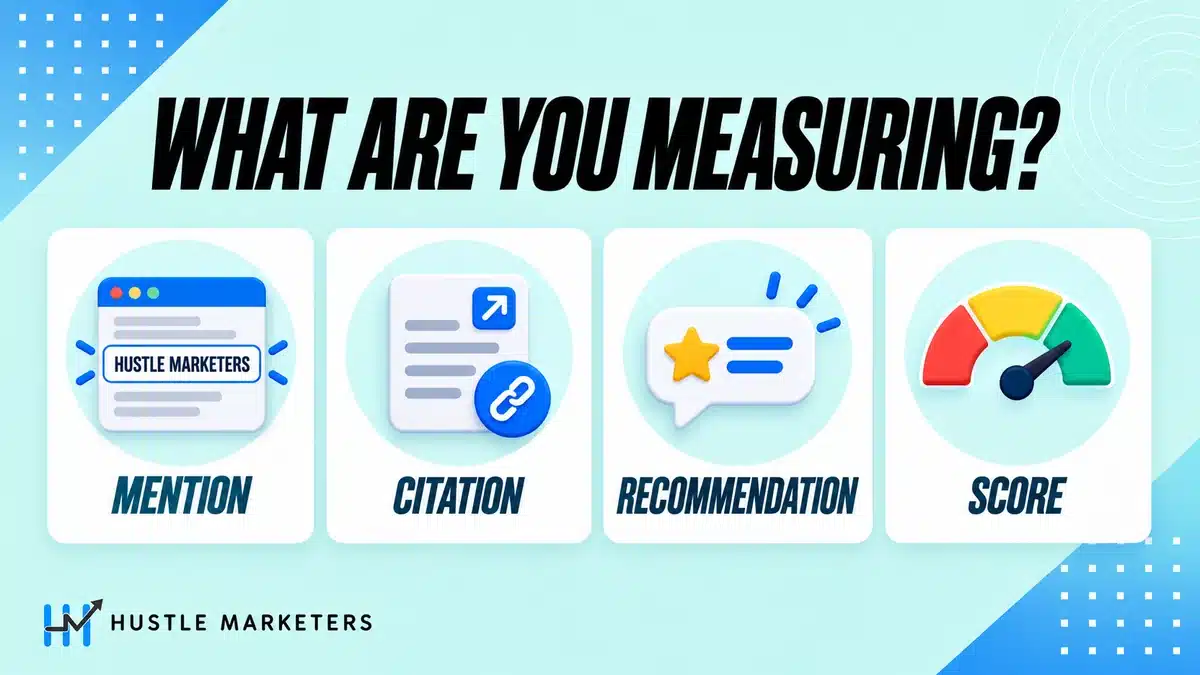
These three words get used interchangeably in this market, including by vendors, and that is the single biggest source of confusion when you compare two dashboards.
| Term | What it means | Why it matters |
|---|---|---|
| Mention | Your brand name appears in the text of the answer | No link. The user has to search for you separately. Good for awareness, invisible in analytics. |
| Citation | Your page is listed as a source, usually with a link | This is the one that can send traffic and the one you can partly verify in Search Console and Bing. |
| Recommendation | The answer actively suggests you, rather than just naming you | The highest value outcome and the rarest. Almost no tool separates this out. |
| Visibility score | A vendor’s own composite number | Not comparable between tools. Each vendor weights and calculates it differently, and none publishes the formula in full. |
Two of the pages that currently rank raise this distinction in their own FAQ sections and then never apply it consistently to the tools they are reviewing. We wrote a full breakdown of citations and mentions because the difference changes what you should measure.
Worth knowing. A visibility score is a vendor’s opinion expressed as a number. Two tools can watch the same brand on the same day and produce scores that are not on the same scale, because they are not measuring the same thing. Never put two vendors’ scores in the same chart.
What does a brand sentiment score measure?
Sentiment answers a different question from the four terms above. It is not about whether an AI answer names you, but how it talks about you. A raw mention count treats a mention inside a complaint the same as a mention inside a recommendation, which is why some tools now score sentiment separately.
Vendors measure it differently. Promptwatch scores it on a 100 point scale where about 50 is neutral. Search Atlas classifies how each model describes your brand as positive or negative and tracks the share of positive mentions. The tool we use for this, Boostifai, has given us the most detail so far: a sentiment score for each of ChatGPT, Gemini, Claude and DeepSeek with the reasoning behind it, a credibility score, and an average brand sentiment across all models based on tone, brand loyalty and customer feedback. The reasoning is the useful part, because it shows why one model describes a brand less favorably than another.
Treat it like the visibility score. A model is judging another model’s answers, so the score moves between runs. You can only compare it within one tool over time, never between tools.
Why do three AI visibility tools give three different answers?
Because the thing they are measuring changes between one run and the next, and because each tool asks the question in a slightly different way.
This is not a complaint about product quality. It is a property of how these systems generate text, and no amount of vendor engineering removes it.
The clearest statement of it came from an agency CEO rather than a vendor. Paul Dyer of the agency /prompt told Digiday on May 1, 2026:
The same thing that bedeviled SEO analytics, like Semrush and social media listening, is now bedeviling GEO. If you use three different tools and give them the same prompts, you get three different answers.
How much does the same prompt change between runs?
Four separate pieces of research have now measured this, and they agree with each other.
| Study | Date | Scale | What it found |
|---|---|---|---|
| SparkToro and Gumshoe | Jan 28, 2026 | 600 volunteers, about 3,000 runs, each prompt run 60 to 100 times | Less than a 1 in 100 chance of an identical brand list. Roughly 1 in 1,000 for identical order. |
| Martin Kulawik, independent consultant | Aug 8, 2026 | 3,313 control pairs | Brand list overlap between identical repeat calls: 69 percent ChatGPT, 48.5 percent Perplexity, 40.7 percent Gemini. |
| Finite-sample audit, Zatuchin | Sep 2026 | 4,500 responses, six engines, 1,470 organizations | A single query surfaced only 62 to 77 percent of the brands that five runs surfaced, on engines without live retrieval. |
| Northwestern and Boston University, Malthouse and others | Sep 7, 2026 | 2,400 recommendation lists, six models | Large incumbent brands scored 0 percent prevalence on plain prompts, then 35 to 89 percent when the prompt added needs-based language. |
Read those four rows together and the picture is consistent. One measurement of one prompt tells you very little. The SparkToro study is the most quotable of the four, and Rand Fishkin’s conclusion is worth keeping, because it is not the cynical one you might expect. Visibility measured as a percentage across dozens or hundreds of prompts, run many times, is a reasonable metric. A tool that reports your specific ranking position inside an AI answer is selling you something that is not there.
A smaller hands-on test makes the same point in a way you can picture. A developer ran “best email marketing app for Shopify” three times, minutes apart, same settings, and published what changed on August 18, 2026. Sixteen distinct domains appeared across the three runs. Only four appeared in all three. Mailchimp held position four in two runs and was absent from the third entirely.
Why do the tools disagree with each other as well as with themselves?
Three mechanical reasons, and only the first is widely discussed.
- Sampling. A tool that runs your prompt once a week and a tool that runs it three times a day are not doing the same experiment, so of course they disagree.
- How they reach the model. Some tools call the API. Some drive the real web interface. Kulawik’s analysis found the two routes produce materially different results, and Surfer says on its own site that it sees up to a 25 percent difference between interface and API results. Surfer does not publish the methodology behind that figure, so treat it as their observation rather than a finding.
- Answer length. Kulawik measured average response length at 3,363 characters for Gemini against 1,462 for Claude. A longer answer names more brands by default. Any dashboard that counts raw mentions is partly measuring how talkative the model is.
Worth knowing. There is a fourth reason almost nobody states. Web grounding behavior differs by engine. Some make a live web search mandatory, some decide case by case, some are web-grounded by design. So “the same prompt across six engines” is not one experiment repeated six times. It is six different experiments.
How many times must a prompt run before the number means anything?
This is the question every buyer should ask and the one no page we read answers. So here is the honest answer, which is that the research points in an uncomfortable direction.
A variance decomposition published in July 2026 broke down where the movement in these answers actually comes from:
| Source of variance | Share |
|---|---|
| Resampling noise within the same prompt | 34.8 percent |
| The language the query is written in | 31.6 to 32.0 percent |
| Brand interacting with context | 29.6 percent |
| The brand itself | 0.7 to 1.5 percent |
The brand, which is the only variable you control, accounts for under 2 percent of the movement. The same paper found that going from five repeat samples to six reduces error variance by 0.0003, which it calls roughly fifteen times less useful than simply testing in another language.
The finite-sample audit is bleaker still. After fifteen runs of the same prompt, 86 to 92 percent of test cells were still turning up brands they had not seen before. The sampling had not saturated.
Worth knowing. What this means in practice. Do not ask how many times a tool runs a prompt and expect a magic number. Ask how many distinct prompts it covers. Breadth across a large prompt set beats depth on a few, because the brand signal only emerges in aggregate. A tool selling you three runs a week on twenty prompts is giving you a number with almost no signal in it.
Only one vendor practice we found even engages with this properly. Surfer states that it runs multiple queries per day per model and averages them specifically to cut through the noise. ZipTie says its score is aggregated over time rather than taken from a single snapshot. Otterly has a blog post stating plainly that ChatGPT uses probabilistic methods and does not always produce the same output for identical inputs. Every other vendor page we read said nothing about rerun variability at all.
How much do AI visibility tools cost?
We went to 28 vendor sites and read the pricing page on each one, on September 26, 2026. Twenty-four publish a real figure. Seven publish nothing and route you to a demo.
We did this because the published comparisons contradict each other badly. Across the articles we read, Ahrefs Brand Radar’s entry price is stated as $129, $199, $398, $699 and “$828 minimum”. Profound’s starting price is given as both $99 and $499, in two articles written by the same author at the same company.
Every figure below came from the vendor’s own page, not from another comparison article.
| Tool | Entry price | Top published tier | Prompt allowance at entry |
|---|---|---|---|
| Rankscale | $20 per month | $780 per month | Credit based, about 0.25 per query |
| Trackerly.ai | $27 per month | $247 per month | 4,500 credits |
| Otterly.ai | $29 per month ($25 annual) | $489 per month | 15 prompts |
| ZipTie.ai | From $42.75 per month | Not published | 7 engines tracked |
| Knowatoa | $59 per month | $199 per month | Not stated |
| Writesonic | $79 per month | $399 per month | Not stated |
| Surfer AI Tracker | $82 per month | $299 per month | Not stated |
| SE Ranking AI add-on | $89 per month | $345 per month | 200 checks |
| Semrush AI Toolkit | $99 per month, annual only | Custom | 25 prompts, 1 domain |
| Similarweb AI Search | $99 per month, annual | $542 per month | 150 prompts on all tiers |
| AmIOnAI | $100 per month | $349 per month | 150 prompts |
| Ahrefs Brand Radar | Inside Ahrefs Lite, $129 per month | AI Visibility Index $199 per month | 5 prompts, 150 checks |
| Advanced Web Ranking | $139 per month | $980 per month | Does not name its AI platforms |
| Nightwatch | 79 euro per month | 399 euro per month | Not stated |
| Scrunch AI | $250 per month, annual | $500 per month monthly | Not stated |
| AthenaHQ | $295 per month | Custom | 3,600 credits, 1 credit is 1 AI response |
| Goodie AI | $399 per month | $999 per month | 120 prompts, 5 models |
| Gauge | $599 per month | Custom | 600 prompts per day |
| Evertune | $800 per month | Custom | 100,000 prompts, 11 models |
| Profound | Publishes no standard price | Custom, sales led | 50 prompts on the 7 day trial |
Profound is worth a note of its own, because it is the most cited tool in this market and it publishes no standard price. Digiday reported a Starter tier at $99 a month and a Standard tier at $399 a month in May 2026. A customer writing about his own use of it in 2025 put his bill at “$499 USD / £370 a month”. One agency source in the Digiday piece said they pay $1,000 a month. All three can be true at once, which is exactly why a comparison article quoting one figure as the price is not telling you much.
Publish no price at all, checked on their own sites: Brandlight, Conductor, seoClarity, BrightEdge, Authoritas, Bluefish AI and Daydream. Peec AI publishes tiers with prompt limits of 50, 150, 350 and unlimited, but the dollar figures were not shown when we checked on October 7, 2026, so we are not going to guess them.
Worth knowing. Prices in this category move fast and every figure above is dated September 26, 2026. Check the vendor page before you quote any of these to a client. That caution applies to every other comparison article too, and most of them are not dated at all.
What does it actually cost to track a proper prompt set?
The sticker price is not the number that matters. Prompt allowance is.
Work backwards from the research instead. If a useful reading needs breadth across a large prompt set rather than depth on a handful, then 15 prompts at $29 a month is not a cheaper version of 400 prompts at $489. It is a different product that will not answer the question.
A realistic set for a single service business is 30 to 50 prompts. For an ecommerce brand with several categories, 150 to 300. Price the tiers against that number first, then look at the monthly fee. On most of the tools above, the tier that actually fits a mid-sized brand sits between $200 and $500 a month, not at the advertised entry price.
Watch for three things that inflate the real bill: per-platform add-ons, where Otterly charges separately for Claude, Gemini and AI Mode on top of the base plan; per-domain pricing, where Semrush charges $99 a month for one domain; and overage, where Ahrefs charges $0.02 per check above the included allowance. If Claude is one of the engines you care about, our guide to Claude rank tracking covers it on its own.
Can you track AI visibility for free?
Yes, partly, and this is the section we most expected to find elsewhere and did not. We did not find either of the two free first-party reports mentioned in any of the 18 comparison articles we read.
What does Google Search Console’s AI report show, and what does it miss?
Search Console now reports impressions from Google’s generative AI features. In Google’s own words, the report lets you “See how your organic impressions from Search generative AI features changes over time”, where an impression counts “how many times links to your site were shown to a user in a generative AI feature on Google Search.”
It currently covers AI Overviews and AI Mode, and Google says it expects “to update this list over time as we develop Google Search.”
The limits are documented and you should know them before you rely on it:
- Google says “As of August 31, 2026, we’ve rolled out these insights to all websites worldwide,” but the same page still warns that some properties may not see the report yet, including sites with too few AI impressions.
- Search Labs experiments are excluded.
- The standard 1,000 row limit applies.
- Recent data is marked preliminary.
- It reports by page, country and device, but it will not tell you which prompt produced the impression.
Worth pairing with one more line from Google’s own AI features documentation, because it frames the whole category: “There are no additional requirements to appear in AI Overviews or AI Mode, nor other special optimizations necessary.”
What is Bing’s Citation Share, and why is it not a ranking score?
Bing Webmaster Tools added an AI Performance report that answers, in Bing’s framing, “Where is my content being cited in AI-generated answers?” It covers citations across “Microsoft Copilot, Bing, and select partner AI experiences”, and it reports at page level, as Search Console now also does for AI Overviews and AI Mode.
It gives you four things: Intents, Topics, Compare, and Citation Share. Bing is unusually direct about what the last one is not:
Citation Share is designed as an observational metric – not a ranking system or a competitive scoreboard. It does not expose competitor domains, represent traffic share, or assign quality scores.
That is a more honest caveat than anything we found on a vendor pricing page, and it is free.
What does the manual method cost you in time?
About thirty minutes a month, which is the honest comparison a paid tool should be measured against.
Write 20 to 30 questions a real customer would type. Run them by hand on the same day each month across the platforms you care about. Log one of five outcomes per prompt per platform: cited, mentioned, recommended, misrepresented, absent. That is the entire method, and our guide to tracking brand visibility in AI search sets it out step by step, free, whether you hire anyone or not.
A tool automates that loop and runs it far more often than you would. That is a real benefit and it is worth money. It does not make the underlying number more reliable.
If you want help with the manual loop without paying for a tool, our free AI visibility checker writes buyer prompts for your category, opens each one in ChatGPT, Gemini, Perplexity, Google AI Mode and five more assistants, and counts the brands in each answer you paste back. It shows a 95% range around every share, so you can see how much of a month-to-month change is noise, and it checks which AI crawlers your robots.txt blocks. There is no sign-up, and nothing you paste leaves your browser.
Not sure whether you need a tool at all? Send us your site and we will tell you honestly, including when the answer is that a spreadsheet does the job.
Ask us before you buy a toolWhich AI platforms should you prioritize tracking?
The practitioner consensus is clearer here than on anything else in this market. In the 163-person survey run by Duane Forrester in July 2026, respondents rated Google AI Overviews and AI Mode at 95 percent priority and ChatGPT at 94 percent, with Gemini at 75 percent and Claude at 64 percent.
That maps to a sensible buying rule. If a tool covers Google AI Overviews, Google AI Mode and ChatGPT properly, it covers most of what matters. Treat Perplexity, Gemini, Copilot and Claude as useful additions rather than requirements, and be careful about paying per-platform add-on fees for engines you do not need. If Perplexity is one of those additions for you, see our guide on how to track brand mentions in Perplexity, and our Perplexity SEO guide on improving them.
One trap to avoid: AI Overviews and AI Mode are different surfaces and several tools cover one and not the other. Check which you are getting.
What should you ask a vendor before you buy?
One of the pages we read poses exactly the right diligence questions and then answers none of them for any of the 15 tools it lists. Here they are, with what a good answer looks like.
| Ask this | What a good answer sounds like |
|---|---|
| How many times do you re-run each prompt, and how often? | A specific number and cadence, not “regularly” |
| Do you reach the model by API or by the live interface? | A straight answer, because the two give different results |
| Do you flag when an answer changed, or only show the trend line? | Change flags exist in good tools |
| How do you deduplicate the same answer appearing several times in a week? | They should have a stated rule |
| How do you define a mention against a citation? | They should define both, and apply the split in the dashboard |
| Where does your prompt data come from? | Ask directly if they advertise a large “real user prompt” dataset |
| What is your false positive rate on citation detection? | Nobody publishes this. Ask anyway and see how they respond. |
| Can I export the raw responses, not just the score? | Yes, or walk away. Without the raw text you cannot audit anything. |
That last one matters more than it sounds. A reviewer on G2 noted that Ahrefs Brand Radar’s historical figures change retroactively when the index updates, which means a chart you screenshotted for a client last month may not match the chart today. If you can export raw responses, you can prove what you saw.
Who should not buy an AI visibility tool?
We sell AI search work, so this section costs us something. It is still the right advice.
- You have fewer than about 20 prompts worth tracking. Run them by hand. Thirty minutes a month beats $200.
- Your site is blocked to AI crawlers. Fix that first. The independent consultant Aleyda Solis described on the Humans of Martech podcast in January 2026 how her own AI visibility problem turned out to be her host blocking AI bots, not a content problem. No dashboard would have caught it. Our technical SEO checklist covers the crawler access checks.
- You need the number to justify budget this quarter. It will not hold up to a skeptical CFO, and you should not put yourself in that position.
- Nobody on your side will act on the output. Ryan Mason, President and COO of Markacy, put it bluntly in the Digiday piece: “There’s really not much an AI tool can do or tell you to do. It’s just a benchmarker in my mind.”
Worth knowing. Only 44 percent of the 163 practitioners in Forrester’s survey said these platforms were worth the investment, and nearly a third rated them 1 or 2 out of 5. Note his disclosure: Forrester has built one of these platforms himself, and he ran the survey independently of any vendor customer list.
Is the complaint about these tools really about price?
No, and this is the most useful single finding in our research.
Forrester’s survey collected open text answers from 123 people and coded the themes:
| Complaint | Share of responses |
|---|---|
| Trust, accuracy, opaque methodology | 24 percent |
| ROI and attribution | 20 percent |
| Non-determinism and variance | 15 percent |
| Synthetic against real user demand | 11 percent |
| Not actionable | 9 percent |
| Price | 7 percent |
Trust and ROI together are 44 percent. Price is 7 percent. People are not saying these tools are expensive. They are saying they cannot tell whether the numbers are real. One anonymous respondent asked for exactly the right thing: “Show me where this data comes from and why I should believe it.” Another paying subscriber said that when they pressed platforms to show their math, exactly one pulled back the curtain.
Is there a case for buying one?
Yes, and it would be dishonest to write 4,000 words of caution without it.
The clearest positive account we found is from a VP of Marketing writing on his own Substack in June 2025 about using Profound at Yonder. He reports visibility rising from 11 percent to 21 percent over three months, calls the citation ranking feature a goldmine, is candid that he uses only about 40 percent of the product, and prices it at “$499 USD / £370 a month”. His summary: “£1,000 to understand a completely new channel? I’ve wasted more on worse ideas.”
That is the right frame. Buy one to learn a channel you cannot currently see, to save the manual hours, and to get sampling breadth you would never run by hand. Do not buy one expecting a defensible attribution number, because nobody in this market can give you one yet.
Aleyda Solis summed the category up in one line on the same podcast: prompt trackers are color, not strategy.
How do you know if the work is actually improving anything?
Hold the tool to the same standard you would hold any measurement.
- Fix the prompt set and do not change it, because changing prompts changes the number for reasons that have nothing to do with your work.
- Run it on the same day each month.
- Report the variation alongside the average, not the best month.
- Track the free first-party sources in parallel. Search Console and Bing are the only two numbers in this whole exercise that come from the platform rather than from a sample.
- Judge on a rolling three month view. A single month’s movement sits inside the noise the studies above measured.
- Watch referral traffic segmented by AI source, and expect small numbers.
How we handle this at Hustle Marketers
Disclosure first: we sell AI search work, so read this as a disclosure as much as a description.
We do not resell any tool on this page and we take no affiliate commission from any of them. We run a fixed prompt set monthly, record the five outcomes per prompt per platform, and report the variation rather than the best month. We use Search Console and Bing Webmaster Tools first because they are first-party and free, and we add a paid tool only when the prompt set is large enough that running it by hand stops being sensible.
We will also tell you when the answer is that you do not need us. The method is on this site in full, for free.
What we will not do is show you a before and after citation count and call it proof. One measurement is not evidence by the standard set out above, and given how much citation sets move on their own, nobody can currently show that a specific set of mentions was caused by their work. That includes us.
We will build your prompt set, record the baseline across six platforms, and hand you the spreadsheet. Yours to keep, whether you work with us or not.
Book a free AI visibility reviewRelated guides
- How to track brand visibility in AI search, the method this page is the tooling companion to.
- Free AI visibility checker, which runs that method in your browser and does the counting for you.
- Citations against mentions in AI visibility, which defines the five outcomes.
- Answer engine optimization, the evidence on what actually moves AI visibility.
- Answer engine optimization services, if you want this run for you.
- Generative engine optimization guide, for the GEO side of the vocabulary.
- AI search optimization, what the platforms themselves document.
- Technical SEO checklist, for the crawler access checks that come before any of this.
- AI SEO for ecommerce, if you are tracking product and category visibility.
AI visibility tools FAQs
How much does an AI visibility tool cost?
Published entry prices run from $20 a month to $800 a month, based on 24 vendor pricing pages we read on September 26, 2026. Seven more vendors publish nothing and route you to a demo. The entry price is usually misleading, because it buys a very small prompt allowance. The tier that fits a real mid-sized brand typically sits between $200 and $500 a month.
Can I track brand mentions in AI search for free?
Yes, three ways. Google Search Console reports impressions from AI Overviews and AI Mode. Bing Webmaster Tools reports citations by page across Copilot and Bing. And you can run a prompt set by hand in about thirty minutes a month. None of those needs a paid tool. We also have a guide to free DeepSeek rank tracking if that engine is on your list.
How reliable are AI visibility metrics if the answers keep changing?
Reliable in aggregate, unreliable per prompt. SparkToro found less than a 1 in 100 chance that the same prompt returns an identical brand list. A variance study found the brand itself accounts for only 0.7 to 1.5 percent of the movement in these answers. Percentage visibility across a large prompt set over months is a reasonable metric. A specific ranking position inside an AI answer is not.
How often should a tool re-run the same prompt before I trust the score?
There is no published number that makes a score trustworthy, and any vendor giving you one confidently is overclaiming. A finite-sample audit found that even after fifteen runs, 86 to 92 percent of test cells were still discovering new brands. The better question is how many distinct prompts the tool covers, because the signal shows up in breadth, not depth.
Why do manual checks show different results than my AI visibility tool?
Several reasons at once. Your manual check is one sample and the tool is averaging many. Your account has history and personalization that the tool’s session does not. And the tool may be calling the API while you are using the web interface, which gives measurably different results.
What is the difference between AI Overviews and AI Mode?
They are two different Google surfaces. AI Overviews is the generated summary at the top of a normal results page. AI Mode is a separate conversational experience. Several tools cover one and not the other, so check before you buy. Google Search Console reports both.
Do I still need Semrush or Ahrefs if I buy an AI visibility tool?
Yes, in almost every case. AI visibility tools measure whether you appear in generated answers. They do not do keyword research, backlink analysis, site audits or rank tracking. Ahrefs and Semrush have both added AI visibility features to their existing platforms, which for many teams is the cheaper route than a second subscription.
Can these tools tell me why a competitor is recommended instead of me?
Not reliably. They can show you which sources were cited in answers where a competitor appeared, which is a useful clue. No tool can tell you the actual selection logic, because no platform publishes it. Anyone claiming otherwise is inferring, not reporting.
Is AI visibility tracking the same as AEO or GEO?
No. Tracking is measurement. AEO and GEO are the work you do to change what is being measured. A tracker tells you where you stand. It does not tell you what to fix, which is the complaint practitioners raise most often about the category. If you want help with the fixing part, see how we work as an AI SEO agency.
Should I trust a comparison article that ranks the publisher’s own tool first?
Read it, but check the disclosure. Of the 18 comparison articles we read for this piece, roughly half were written by a company that sells one of the tools in the list, and most of them carried no disclosure beyond a job title in the author bio. A few were straightforward about it. One stated plainly that the tool being ranked was its own platform and that it had applied the same criteria to everyone.
Sources, and how we researched this
What we did. On September 26, 2026 we read 21 pages that currently rank for these terms, of which 18 were comparison articles, and we checked pricing directly on 28 vendor websites rather than taking figures from other articles. We read four pieces of primary research on answer variability in full, including two arXiv preprints and one independent academic paper, plus one practitioner survey of 163 people and one trade press article with five named marketers on record. Every count on this page refers to those 18 comparison articles, not to the market as a whole.
Where the numbers come from. Every price is from the vendor’s own pricing page on September 26, 2026. Every study figure is attributed to the study that produced it, with its date. Both Google quotations and the Bing quotation were taken directly from the official documentation.
Conflicts we are flagging, including our own. We sell AI search services, so this page is not neutral, and we have said so in its own section. Duane Forrester, whose survey we cite, discloses that he has built one of these platforms. Both arXiv preprints are by Dmitrij Zatuchin, who discloses that he is CEO of Rankfor.AI, which sells AI visibility measurement. The co-author of the SparkToro study is CTO of an AI answer tool. We have named these rather than quietly using the numbers.
What we could not reach. No Reddit thread informed this page. Several YouTube reviews and three LinkedIn posts were unreachable, and one practitioner piece that tested the same prompt across six tools was blocked by robots.txt. We could not get transcripts for any video. We would rather list those gaps than imply a wider study than we ran.
One thing we looked for and did not find. No practitioner source we could reach directly addresses whether Search Console’s AI data makes paid tools unnecessary. It looks like a genuinely open question rather than a settled one, so we have not claimed an answer.
About the author. Ishant Sharma is the founder of Hustle Marketers and has worked in search since 2013, across Google Ads, Microsoft Ads and SEO for ecommerce, local service, SaaS and white label agency clients. Hustle Marketers is a Google Partner, a Microsoft Advertising Partner and a Meta Business Partner. This page was researched on September 26, 2026. If a price or a finding on it stops being true, tell us and we will date the correction.