ChatGPT Rank Tracking Tools: What the Data Actually Shows

Ishant
Published : October 3, 2026 at 10:30 am
Updated : October 4, 2026 at 7:21 pm
Ishant
By Ishant Sharma, founder of Hustle Marketers. Google Partner, Microsoft Advertising Partner and Meta Business Partner. Working in search since 2013. Published 3 October 2026. Researched 26 September 2026.
Key Observations
- ChatGPT cites external brands far less often than people assume. One independent test of 200 plus queries found ChatGPT cited brands in 0.59 percent of them, against 13.05 percent for Perplexity. Before you buy a tracker, know what there is to track.
- ChatGPT has no numbered citation positions. You can measure whether you appear, not where you rank. We read 48 pages on this topic and not one states that plainly.
- Automated querying of the ChatGPT web app can get your account actioned. One developer documented 28 requests in seven minutes ending in an invalidated session and a removed Pro subscription.
- OpenAI publishes no first-party visibility data. Google Search Console and Bing Webmaster Tools both report AI citation data. OpenAI reports nothing, so every ChatGPT number you will ever see is somebody’s sample.
- We take no affiliate commission from any tool on this page. Of the 48 pages we read, none made that statement and one disclosed the opposite.
Table of Contents
- What is a ChatGPT rank tracking tool, and what can it actually measure?
- How often does ChatGPT actually cite anyone?
- Is there a free way to track ChatGPT mentions?
- Can you get banned for automated ChatGPT rank tracking?
- Does the ChatGPT API give the same answers as the app?
- Does OpenAI publish any first-party data?
- Which ChatGPT tracking tools are worth looking at, and what do they cost?
- What is the difference between ChatGPT, AI Mode and AI Overviews?
- Which OpenAI crawler do you need to allow?
- Who should not buy a ChatGPT tracking tool?
- How do you know the tracking is working?
- How we handle this at Hustle Marketers
- Related guides
- ChatGPT rank tracking FAQs
What is a ChatGPT rank tracking tool, and what can it actually measure?
A ChatGPT rank tracking tool runs a fixed set of prompts through ChatGPT on a schedule and records whether your brand appears in the answer and whether your page is linked as a source. It charts that over time so you can see a trend.
What it cannot do is tell you your rank, because ChatGPT does not have one.
We will run a prompt set through ChatGPT and the other AI surfaces, record your baseline and send you the spreadsheet. Free, and yours to keep.
Get a free AI visibility reviewDoes ChatGPT have ranking positions like Perplexity?
No, and this is the single most confused point in the category.
Perplexity attaches numbered citations to an answer, so a source genuinely has a position in an ordered list. ChatGPT does not do this. It may link sources, but there is no numbered slot to occupy and therefore no position to track.
We read 48 pages ranking for these terms. Not one states that comparison directly. One page gets close by saying ChatGPT has no position one, just whether you appear, and then never compares it to Perplexity. Another page in the same results set asserts the opposite, that Perplexity has no numbered rank either, which is wrong.
Worth knowing. So the honest metric for ChatGPT is a rate, not a rank. Citation rate is the share of your prompts where ChatGPT linked your page. Mention rate is the share where it named you without linking. Anything presenting a ChatGPT “position” is presenting a number the platform does not produce. Our guide to citations and mentions sets out the outcomes worth logging.
How often does ChatGPT actually cite anyone?
Less than almost every article on this subject implies, and this matters before you spend anything.
An independent builder published a comparison in June 2026 after running more than 200 queries across platforms. ChatGPT cited brands in 0.59 percent of them. Perplexity cited brands in 13.05 percent. That is roughly a 46 times gap, and domain overlap between the two platforms was only 11 percent.
| Platform | Brand citation rate in that test | Note |
|---|---|---|
| ChatGPT | 0.59 percent of 200 plus queries | Rarely surfaces external brands in the sample |
| Perplexity | 13.05 percent | Numbered citations, far more frequent |
| Overlap between them | 11 percent of domains | Being cited on one says little about the other |
One test on one prompt set is not the whole market, and we are presenting it as a single data point rather than a law. But it points the same direction as everything else we found, and it has a consequence: if you run 30 prompts through ChatGPT and see very few citations, the most likely explanation is the platform, not your content.
Worth knowing. Read that alongside the adoption statistics every competitor page opens with. Pages in this results set repeat “2.5 billion prompts a day”, and another asserts “over 1 billion daily queries”, both circulating as fact. Neither figure tells you anything about how often ChatGPT sends a click to a business, and no page we read connects the two. Big usage and low citation rates are both true at once.
Is there a free way to track ChatGPT mentions?
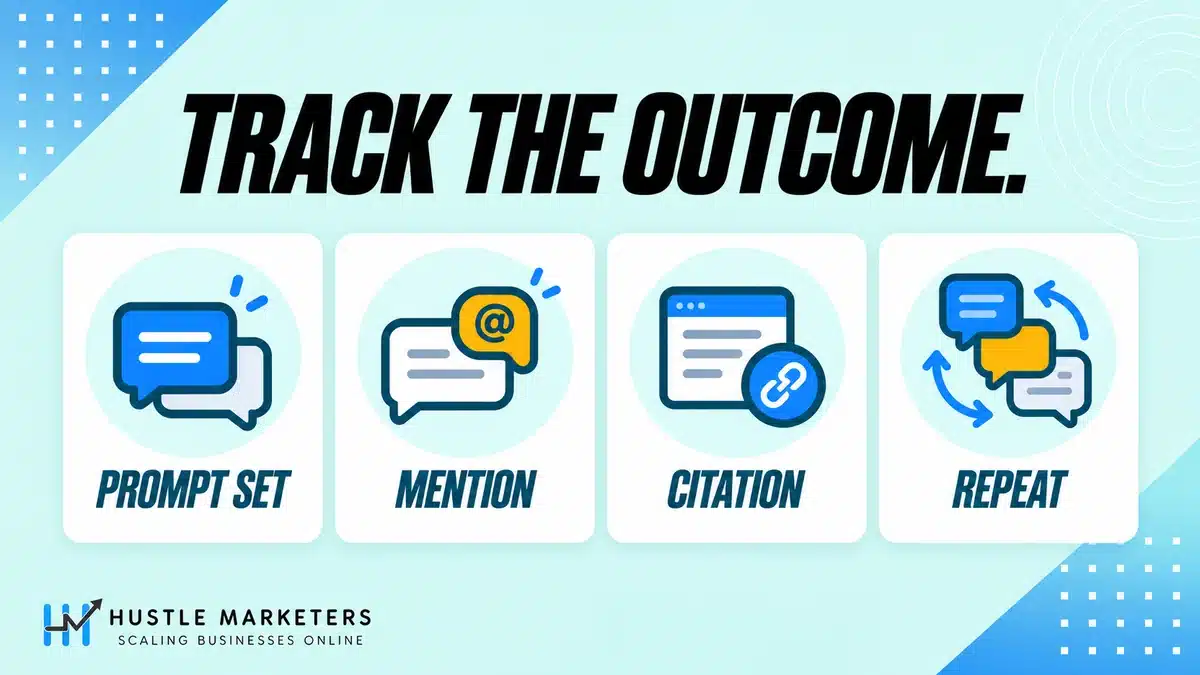
Yes, and it is the same loop the paid tools run. Of the 40 article pages we read, 16 gave a free or manual method and 24 gave none at all. One stated flatly that no reliable free tool exists for continuous tracking.
Here is the method.
- Write 20 to 30 prompts a real buyer would type. Category questions, comparison questions, problem questions and branded questions. Short and neutral.
- Use a logged out session in a clean browser profile. This is not optional on ChatGPT, for the reason in the next section.
- Run the whole set on the same day each month, in the same mode.
- Log four fields per prompt. Brand named in the answer, page linked as a source, which competitors appeared, and whether anything said about you was wrong.
- Report rates, not snapshots. Citation rate and mention rate as percentages of the prompt set.
A spreadsheet formula does the scoring for you. One vendor blog publishes a workable version, checking whether the answer text contains your brand name:
=IF(ISNUMBER(SEARCH(D1,C1)),"Yes","No")Where C1 holds the pasted answer and D1 holds your brand name. That is the whole scoring mechanism a dashboard wraps in a chart.
If you would rather skip the spreadsheet, our free AI visibility checker does the same scoring in your browser. It writes the prompts, opens each one in ChatGPT with the prompt filled in, and counts your brand and your competitors in every answer you paste back, with a 95% range around each rate. Run it from the same clean, logged out browser profile. There is no sign-up, and nothing you paste leaves your browser.
Why must you be logged out?
Because ChatGPT personalizes, and the personalization silently changes the question you asked.
Named practitioners have documented this. Lily Ray, VP of SEO Strategy at Amsive, recorded ChatGPT rewriting her prompt based on her location before answering it, reported by PPC Land in November 2025 alongside Andrea Volpini of WordLift and Gael Breton of Authority Hacker on the same problem. An independent consultant reproduced the session personalization effect separately in July 2025.
If you track from your own logged in account, you are measuring your own history as much as your visibility.
Not sure whether your ChatGPT numbers mean anything? Send us the site and we will tell you what is measurable and what is not.
Ask us to check your setupCan you get banned for automated ChatGPT rank tracking?
This risk is real, it is documented, and not one of the 48 pages we read mentions it.
A developer published a GitHub issue on 26 September 2026 reporting that 28 automated requests inside seven minutes triggered OpenAI’s anti-abuse detection. The outcome was an invalidated session and a removed Pro subscription.
That is one report, not a published policy, and we are not going to extrapolate a rule from it. But it has practical consequences you should weigh:
- If you script the ChatGPT web app yourself, you are taking that risk with your own account.
- If a vendor scrapes the web app on your behalf, the risk sits with their infrastructure, which is part of what you are paying for.
- If a tool uses the official API instead, the risk goes away and a different problem appears, which is the next section.
Does the ChatGPT API give the same answers as the app?
No, and this is the fault line that explains why two tools watching the same brand report different things.
A thread in OpenAI’s own developer community in April 2025 reported the API returning broken links at a failure rate above 50 percent compared with the web interface, and an OpenAI product manager confirmed in that thread that the discrepancy was known. An independent consultant ran a controlled API against web against app comparison in February 2026 and found the same direction of difference.
| Tracking method | What it reflects | Trade-off |
|---|---|---|
| Official API | A model response, not the consumer product | Safe and cheap, but not what your customer sees |
| Scraping the web app | Closer to the real user experience | Fragile, and carries account and blocking risk |
| Browser extension on your own session | Exactly what you see | Personalized, so not a clean measurement |
There is no option here that is both safe and faithful. Any vendor implying otherwise has not told you which method they use. Ask them, and ask in writing.
Does OpenAI publish any first-party data?
No. This is the structural difference between ChatGPT and the surfaces Google and Microsoft run.
| Platform | First-party reporting available | What it gives you |
|---|---|---|
| Google AI Overviews and AI Mode | Yes, Search Console | Impressions from generative AI features, site level |
| Microsoft Copilot and Bing | Yes, Bing Webmaster Tools | Citations by page, plus Citation Share |
| ChatGPT | No | Nothing. Every number is a third-party sample. |
Search Engine Journal put it plainly in December 2025: publishers cannot currently see how many impressions they receive in ChatGPT. That was framed as a gap the industry wants closed, not as something OpenAI has announced.
Worth knowing. This is why the accuracy question bites harder on ChatGPT than anywhere else. On Google and Bing you can check a vendor’s number against a first-party report. On ChatGPT there is nothing to check it against, so you are trusting the vendor’s method without any way to audit it.
Which ChatGPT tracking tools are worth looking at, and what do they cost?
We checked pricing on each vendor’s own site rather than taking it from another comparison article, because the published comparisons contradict each other badly. Checked 26 September 2026.
Every tool below covers ChatGPT. The prices are entry level and the prompt allowance usually matters more than the headline figure.
| Tool | Entry price | Prompt allowance at entry | Note |
|---|---|---|---|
| Rankscale | $20 per month | Credit based, about 0.25 per query | Cheapest real entry point we found |
| Trackerly.ai | $27 per month | 4,500 credits | Credit cost varies by model |
| Otterly.ai | $29 per month | 15 prompts | Claude, Gemini and AI Mode are paid add-ons |
| ZipTie.ai | From $42.75 per month | 7 engines tracked | Scores aggregated over time, not single snapshots |
| Knowatoa | $59 per month | Not stated | Perplexity only from the $199 tier |
| Writesonic | $79 per month | Not stated | Daily refresh |
| Surfer AI Tracker | $82 per month | Not stated | Runs multiple queries per day per model and averages them |
| SE Ranking AI add-on | $89 per month | 200 checks | Separate add-on, not in any base plan |
| Semrush AI Toolkit | $99 per month, annual only | 25 prompts, one domain | Per domain pricing |
| Similarweb AI Search | $99 per month, annual | 150 prompts on every tier | Same allowance across tiers |
| AmIOnAI | $100 per month | 150 prompts | ChatGPT and Google AI Overview only |
| Ahrefs Brand Radar | Inside Ahrefs Lite at $129 per month | 5 prompts, 150 checks | AI Visibility Index at $199, overage $0.02 per check |
| Nightwatch | 79 euro per month | Not stated | Up to 399 euro |
| Scrunch AI | $250 per month, annual | Not stated | Daily for 14 days then every 72 hours |
| AthenaHQ | Free Essential tier upward | Credit based, 1 credit is 1 AI response | |
| Goodie AI | $399 per month | 120 prompts, 5 models | |
| Gauge | $599 per month | 600 prompts per day | No cheaper plan exists |
| Evertune | $800 per month | 100,000 prompts, 11 models | |
| Profound | No standard price published | 50 prompts on the 7 day trial | Sales led |
Publish no price at all on their own sites: Brandlight, Conductor, seoClarity, BrightEdge, Authoritas and Daydream. Peec AI publishes tier names and prompt limits but the dollar figures did not render on two attempts, so we are not guessing them.
Worth knowing. Prices in this category move fast and every figure above was read on the vendor’s own pricing page on 26 September 2026. Check before quoting any of them to a client. Most comparison articles in this space carry no date at all, which is how the same tool ends up quoted at four different prices across four pages.
What do practitioners say goes wrong with these tools?
Three findings from named sources, not from vendor marketing.
- A tool disagreeing with itself. A hands-on reviewer at Position Digital, updated September 2026, reported that OtterlyAI’s main dashboard showed a brand mention while the underlying prompt analysis showed the brand nowhere in the answer.
- Two builders rejecting the same tool for the same reason, independently. Two practitioners published on their own Substacks (one, the other) six days apart in July 2025, both concluding that Ahrefs’ brand tracker searches the term rather than the website, and both building their own tracker instead.
- Trust, not price, is the complaint. In a survey of 163 practitioners published in August 2026, only 44 percent said these platforms were worth the investment. The top complaint was trust and opaque methodology at 24 percent. Price was 7 percent. We work through that survey and the variability research in full on our AI visibility tools page.
What is the difference between ChatGPT, AI Mode and AI Overviews?
They are three different products from two different companies, and several keywords in this space bundle them together as if they were one thing.
| Surface | Owner | Numbered citations | First-party reporting |
|---|---|---|---|
| ChatGPT | OpenAI | No | None |
| Google AI Mode | No | Search Console | |
| Google AI Overviews | No | Search Console | |
| Perplexity | Perplexity | Yes | None |
A tool that advertises AI Mode tracking is not necessarily tracking ChatGPT, and the reverse is equally true. Check which surfaces a plan actually covers before you buy, because several vendors cover one and not the other. Our guide to Perplexity rank tracking covers the one surface where a genuine position exists.
Which OpenAI crawler do you need to allow?
Three crawlers, three jobs. Only one of them decides whether you can appear in ChatGPT’s search answers, and getting this wrong is how sites remove themselves by accident.
| Crawler | What OpenAI says it does | What blocking it costs you |
|---|---|---|
| OAI-SearchBot | Powers ChatGPT’s search features, surfacing websites in results | Blocking removes you from ChatGPT search answers |
| GPTBot | Crawls content that may be used for model training | Blocking excludes you from training, not from search |
| ChatGPT-User | Fetches a page when a user’s request requires it | OpenAI states robots.txt rules may not apply, and it does not affect ranking or training |
Exactly one of the 48 pages we read names all three and explains they serve different purposes. None of them shows you how to confirm which one is actually hitting your site.
How do you check which crawler is visiting?
Filter your server access logs by user agent string and look for the three names above separately, rather than searching for “OpenAI” and treating the result as one number. Then check robots.txt for each agent individually, and check the CDN and firewall too, because that is where accidental blocks usually live rather than in robots.txt. Our technical SEO checklist covers the crawler access checks in order.
For the robots.txt part, the crawler access tab in our free checker lists OAI-SearchBot, GPTBot and ChatGPT-User separately and shows whether your file allows or blocks each one.
Worth knowing. The common mistake is blocking GPTBot to keep your content out of training, believing you have protected yourself, and not realising OAI-SearchBot is a separate decision. The two are independent. You can refuse training and still be eligible for search answers.
Who should not buy a ChatGPT tracking tool?
We sell AI search work, so this section costs us something.
- Anyone who has not first run 20 prompts by hand. Given how rarely ChatGPT cites external brands, do the free check before committing to a subscription. You may find there is very little signal to track yet.
- Anyone tracking ChatGPT alone. A monthly spreadsheet covers one platform fine. Tools earn their price across six. If Claude is one of them, see our guide to the best Claude SEO tracking tool.
- Anyone whose site blocks OAI-SearchBot. Fix the access first. No dashboard will tell you that the reason you are invisible is a rule in your own robots.txt or a CDN setting.
- Anyone who needs a defensible number this quarter. There is no first-party source to validate a ChatGPT figure against. Say so rather than presenting a sample as a fact.
How do you know the tracking is working?
Hold it to the same standard as any measurement.
- Fix the prompt set and leave it fixed. Changing prompts changes the number for reasons unrelated to your work.
- Run on the same day each month, from the same logged out profile.
- Report the variation alongside the average, never the best month.
- Ask your vendor in writing whether they use the API, scrape the web app, or use an extension, because the three do not agree.
- Judge on a rolling three month view.
- Segment AI referral traffic in your analytics separately, and expect small numbers.
How we handle this at Hustle Marketers
Disclosure first, because it belongs at the front rather than in a bio line. We sell AI search services, so this page is not neutral. We do not resell any tool named here and we take no affiliate or referral commission from any of them. Of the 48 pages we read while researching this, none stated that, and one disclosed that it does earn affiliate commissions from the tools it ranks.
We run a fixed prompt set monthly, log citation rate and mention rate rather than an invented position, report the variation alongside the average, and use first-party sources wherever the platform provides one. On ChatGPT there is no first-party source, so we say that in the report rather than implying the number is verified.
What we will not do is show you a before and after citation count and call it proof. One measurement is not evidence, citation sets move on their own, and nobody in this market can currently demonstrate that a specific set of citations was caused by their work. That includes us.
We will build the prompt set, run the baseline across ChatGPT and the other surfaces that matter to you, and hand you the spreadsheet.
Book a free AI visibility reviewRelated guides
- AI visibility tools, verified prices and the accuracy problem, the hub this page sits under, with pricing from 28 vendor sites and the research on answer variability.
- Perplexity rank tracking, the one surface where a numbered position genuinely exists.
- How to track brand visibility in AI search, the cross platform method.
- Free AI visibility checker, which does the scoring for the manual method and checks your robots.txt for AI crawlers.
- Citations against mentions in AI visibility, which defines the outcomes to log.
- Answer engine optimization, the evidence on what moves AI visibility once you can measure it.
- Answer engine optimization services, if you would rather we ran it.
- AI SEO company, the wider service this sits inside.
- Technical SEO checklist, for the crawler access checks that come first.
ChatGPT rank tracking FAQs
What is the best ChatGPT SEO tracking tool?
There is no single best one, and any page telling you otherwise is usually selling it. Entry prices where ChatGPT is covered run from $20 to $800 a month. Match the prompt allowance to your prompt set first, then compare monthly fees, then ask the vendor whether they use the API or scrape the web app, because that decides whether the number reflects what your customers see.
Can I see if ChatGPT mentions my brand for free?
Yes. Run 20 to 30 buyer questions in a logged out ChatGPT session, log whether your brand is named and whether your page is linked, and convert the results to a percentage. It takes about twenty minutes a month. A spreadsheet formula handles the scoring, or our free AI visibility checker does the counting for you.
Does ChatGPT show ranking positions?
No. ChatGPT does not number its sources, so there is no position to hold. The honest metrics are citation rate and mention rate across a prompt set. Perplexity is the exception among major AI surfaces, because it does number its citations.
How often does ChatGPT cite websites?
Less often than most articles imply. One independent test of more than 200 queries found ChatGPT cited brands in 0.59 percent of them against 13.05 percent for Perplexity. That is one test on one prompt set, but it is worth knowing before you buy a tracker.
Can I get banned for automated ChatGPT rank tracking?
It is a documented risk. A developer reported in September 2026 that 28 automated requests in seven minutes triggered OpenAI’s anti-abuse systems, invalidating the session and removing the Pro subscription. If a vendor scrapes the web app for you, that risk sits with their infrastructure rather than your account.
Why do two ChatGPT tracking tools give different numbers?
Mostly because they reach ChatGPT differently. Some call the official API, some scrape the web app, some run a browser extension on your session. OpenAI’s own developer community has reported material differences between the API and the web interface, confirmed there by an OpenAI product manager. Sampling frequency and personalization add further variation.
Does OpenAI have anything like Google Search Console?
No. Google reports AI Overviews and AI Mode impressions in Search Console, and Bing reports citations by page in Webmaster Tools. OpenAI publishes no equivalent, so every ChatGPT visibility number available to you is a third-party sample with no first-party figure to check it against.
Should I block GPTBot?
That depends on whether you want your content used for training, and it is a separate decision from search visibility. Blocking GPTBot excludes you from training. Blocking OAI-SearchBot is what removes you from ChatGPT’s search answers. Many sites block the first believing they have also handled the second.
Is ChatGPT tracking the same as AI Mode tracking?
No. ChatGPT is OpenAI’s product and AI Mode is Google’s, and several tools cover one without the other. Keywords in this space bundle them together, which is why it is worth checking the actual surface list on a plan before buying.
How many prompts should I track in ChatGPT?
Between 20 and 50 for most businesses, and prefer more distinct prompts over more repeats of the same one. Nobody has published a sample size that makes a ChatGPT citation rate statistically trustworthy, so treat any tool implying precision with caution.
Sources, and how we researched this
What we did. On 26 September 2026 we ran eight searches on ChatGPT tracking terms and read 48 ranking pages in full, of which 40 were articles and 8 were tool landing pages. We checked pricing and platform coverage directly on the vendors’ own websites rather than taking figures from other articles. We logged 19 named practitioner sources across communities, developer forums, independent blogs and review sites. Every count on this page refers to those 48 pages, not to the market as a whole.
Where the figures come from. Tool prices are from each vendor’s own pricing page on the date above. The crawler descriptions are from OpenAI’s own bot documentation. The Search Console and Bing Webmaster Tools statements are from Google’s and Microsoft’s own documentation. The citation rate comparison, the account action report, the API against web interface discrepancy and the tool disagreement are each attributed above to the named source and date that published them.
What we could not verify, and what we are not repeating. Two conflicting ChatGPT usage figures circulate as fact across these pages, 2.5 billion prompts a day and over one billion daily queries. We have not repeated either as our own claim. Several widely copied statistics in this results set trace to no named source at all, including one page’s assertion that only 14 percent of URLs cited by AI Mode rank in the top 10, sourced only to “early research”. One vendor’s self-reported accuracy figure is quoted by two competitors as though it were independently established. We have left all of these out.
What we could not reach. Reddit is blocked at the network level in our research environment, so no Reddit thread informed this page, and in this case no Reddit URL surfaced in the searches either. We could not retrieve any YouTube transcript, because the first two attempts hit a rate limit and we stopped rather than working around it. One further article returned a 404.
A note on who writes about this. Roughly 30 of the 40 article pages we read were published by a company selling a tool in the list, and most ranked their own product first. A few disclose that. One discloses that it earns affiliate commissions. We are in the same position as a seller, which is why our disclosure is a section on this page rather than a line in a bio.
About the author. Ishant Sharma is the founder of Hustle Marketers and has worked in search since 2013, across Google Ads, Microsoft Ads and SEO for ecommerce, local service, SaaS and white label agency clients. Hustle Marketers is a Google Partner, a Microsoft Advertising Partner and a Meta Business Partner. This page was researched on 26 September 2026. If a price or a finding on it stops being true, tell us and we will date the correction.
Summarise this article with: