Structured Data SEO: The 25 Types That Still Earn a Rich Result

Ishant
Published : October 9, 2026 at 10:30 am
Updated : October 7, 2026 at 5:45 am
Ishant

Structured data SEO has a currency problem. Plenty of the advice still in circulation tells you to add FAQ or HowTo schema for rich results. Google stopped showing FAQ rich results on May 7, 2026, and HowTo is gone from its supported list entirely.
So the useful thing this page can do is reconcile every claim against what Google currently publishes, and date it. That is the whole design.
What is structured data in SEO?
Code you add to a page that describes the page’s content in a format a machine can parse without guessing. Schema.org is the shared vocabulary everyone uses for it, and JSON-LD is the syntax Google prefers.
Three terms get used interchangeably and should not be. Getting them apart is what stops you buying the wrong thing.
| Term | What it actually means | Who controls it |
|---|---|---|
| Structured data | The general practice of marking content up in a machine-readable format | An open idea, no single owner |
| Schema.org | The specific shared vocabulary of types and properties, such as Product, Article, LocalBusiness | A collaborative project, not Google |
| JSON-LD, Microdata, RDFa | The three syntaxes you can write that vocabulary in | Web standards |
| Rich result | The enhanced search appearance Google may show when it accepts your markup | Google alone decides |
The distinction that matters commercially in structured data SEO is the last row. You can write perfectly valid schema.org markup for a type Google has no rich result for, validate it cleanly, and see nothing change in search. That is not a bug. It is the normal outcome for most types.
Google states the mechanism plainly on its supported markup page: “Google uses structured data to understand the content on the page and show that content in a richer appearance in search results, which is called a rich result.” Understanding and appearance are two different outcomes, and only the second is visible to you.
Which schema types actually earn a rich result in 2026?
Twenty-five, and Google lists them in one place. This table is the reference point for every structured data SEO decision below. Every type outside that list may still be understood, but it will not change how your result looks. We checked the list on September 29, 2026 against Google’s supported markup page, last updated June 15, 2026.
| Feature, as Google names it | What it is typically used for | Worth the effort for most sites? |
|---|---|---|
| Article | News, blog and editorial pages | Yes, low effort, often templated already |
| Breadcrumb | Site hierarchy in the result | Yes, but see the desktop note below |
| Product | Ecommerce product pages | Yes, the highest-value type on a store |
| Review snippet | Ratings on products, recipes, businesses | Yes, where the reviews are genuine and on-page |
| Local business | Physical premises and service areas | Yes for anyone with a location |
| Organization | Company identity, logo, contact points | Yes, and it does double duty for entity work |
| Event | Ticketed or scheduled events | Yes if events are the product |
| Job posting | Career listings | Yes if you recruit at volume |
| Recipe | Food content | Yes in that niche |
| Video | Pages with primary video content | Yes, and often overlooked |
| Image metadata | Licensable images | Situational |
| Q&A | Pages where users post and answer questions | Only for genuine user Q&A, not marketing FAQs |
| Discussion forum | Forum and community threads | Only for real forums |
| Profile page | Author and creator profiles | Useful for author entity work |
| Carousel | Host carousel of your own list items | Situational, pairs with other types |
| Course list | Educational course listings | Education sites only |
| Dataset | Research and open data | See the contradiction noted below |
| Education Q&A | Flashcard style education content | Niche |
| Employer aggregate rating | Ratings of an employer | Pairs with job posting |
| Math solver | Math problem walkthroughs | Very niche |
| Movie | Film listings | Niche |
| Software app | Applications | Niche |
| Speakable | Sections suited to text-to-speech | Niche, news oriented |
| Subscription and paywalled content | Flagging gated content honestly | Yes if you run a paywall |
| Vacation rental | Rental listings | Niche |
Two caveats on that list
Google notes on that page: “The actual appearance in search results might be different. You can preview most features with the Rich Results Test.” And breadcrumbs, per Google’s January 2025 changelog entry, “only appear on desktop search results, not mobile”, which is worth knowing before anyone reports breadcrumb markup as a mobile win.
Which structured data types has Google killed?
At least a dozen since 2024, and Google logs each one with a date. This is the part of structured data SEO that goes stale fastest. It is also why so much older structured data advice is quietly out of date. Every entry below comes from Google’s own documentation changelog.
| Type or feature | What Google said | Date on the entry |
|---|---|---|
| FAQ | “This feature will no longer appear in Google Search starting May 7, 2026.” | May 8, 2026 |
| FAQ documentation | “The FAQ rich result feature is no longer shown in Google Search results” | June 15, 2026 |
| Practice problem | “The practice problem structured data type is no longer shown in Google Search results” | January 6, 2026 |
| Practice problem and Dataset | “we are phasing out the practice problem and dataset structured data types from Google Search results” | November 5, 2025 |
| Course info, estimated salary, learning video, special announcement, vehicle listing | “These structured data types are no longer shown in Google Search results” | September 9, 2025 |
| Book actions, course info, estimated salary, ClaimReview, learning video, special announcement, vehicle listing | “we will be phasing out support for a few structured data features in Search” | June 12, 2025 |
| Special announcement | “This feature will be deprecated starting July 31, 2025” | April 23, 2025 |
| Sitelinks search box | “The sitelinks search box feature is no longer available in Google Search results” | November 29, 2024 |
| Home activity | “The home activity feature no longer appears in Google Search results” | June 11, 2024 |
| Guided recipes | Removed from the recipe structured data documentation | March 6, 2024 |
| Video carousel, limited access | “we ultimately found that it wasn’t useful for the ecosystem at scale” | April 17, 2024 |
On HowTo, we are going to be precise rather than confident. HowTo is absent from Google’s current supported list, and its documentation URL no longer resolves. The changelog we read covers January 2024 onward and contains no HowTo entry, so the removal predates that window and we are not going to publish a date we could not verify at source. What we can say is that HowTo earns nothing today.
The FAQ and HowTo advice still circulating
Much of it traces back to an earlier change. In August 2023 Google published Changes to HowTo and FAQ rich results, which restricted both features. Advice written around then describes that halfway stage, where FAQ and HowTo results were limited rather than gone.
The 2026 change is final. FAQ rich results stopped appearing on May 7, 2026, and Google removed the FAQ documentation on June 15, 2026. A recent “updated” date on a guide tells you very little, so check any type recommendation against Google’s supported list yourself before anyone builds it.
Does structured data help you appear in AI search?
Google says it is not required, in those words. This is the most commercially loaded question in the topic, because an entire category of tooling is sold on the opposite answer.
From Google’s AI features and your website page, last updated December 10, 2025: “You don’t need to create new machine readable files, AI text files, or markup to appear in these features. There’s also no special schema.org structured data that you need to add.”
The same page sets out what does decide eligibility: “To be eligible to be shown as a supporting link in AI Overviews or AI Mode, a page must be indexed and eligible to be shown in Google Search with a snippet, fulfilling the Search technical requirements.” And it closes the door on extras: “There are no additional requirements to appear in AI Overviews or AI Mode, nor other special optimizations necessary.”
Here is how the common claims about schema and AI search hold up against that guidance.
| Claim you will see | What the evidence actually supports |
|---|---|
| Schema is required to appear in AI Overviews | Contradicted by Google directly: “no special schema.org structured data that you need to add” |
| Schema makes LLMs understand your page | Unproven as stated. One published experiment found models read the markup as plain text rather than as structured data |
| Schema increases your chance of being cited | No independent evidence we could find |
| Structured data is irrelevant to AI | Also too strong. Google’s own guidance asks that your structured data match visible text, and reported research suggests Gemini uses it during grounding |
| Schema earns rich results in Google Search | Supported, and this is the honest reason to implement it |
The one nuance worth keeping is Google’s instruction to keep markup and visible text aligned, which appears in the AI guidance as “Making sure your structured data matches the visible text on the page”. That is a consistency requirement, not a visibility lever.
Our position: implement structured data because it earns rich results in Google Search, which is measurable. If it also helps an assistant parse your page, that is a bonus nobody can currently quantify. We cover the wider question in AI search optimization, the AI Overviews mechanics in AI Overviews optimization, and the tooling claims in AI SEO tools.
Is structured data a ranking factor?
No, and Google has never claimed it is. Structured data SEO changes how a result looks, not where it sits. What it can do is change how your result looks, and appearance affects clicks, which is a different mechanism from ranking.
Google publishes four case studies on its introduction to structured data, last updated December 10, 2025. They are the figures quoted most often on this topic, so here they are with the caveat that matters.
Not one of the four carries a date on Google’s page. The Rakuten entry also references AMP, a format Google has since de-emphasized, which suggests these are old. Treat them as directional evidence that rich results lift clicks, not as benchmarks you should forecast against.
The honest version of the benefit is narrower and more useful: markup makes a page eligible for an enhanced appearance, an enhanced appearance tends to earn more clicks, and more clicks at the same position is a real commercial gain. Nothing in that chain is a ranking factor.
What does Google require for structured data to be valid?
Three rules, and breaking them has a real consequence. All of this is from Google’s general structured data guidelines, last updated July 10, 2026.
| Rule, as Google words it | What it rules out in practice |
|---|---|
| “Don’t mark up content that is not visible to readers of the page. For example, if the JSON-LD markup describes a performer, the HTML body must describe that same performer.” | Marking up FAQs that sit in a collapsed block never rendered, or prices that appear only in the markup |
| “Don’t mark up irrelevant or misleading content, such as fake reviews or content unrelated to the focus of a page.” | Self-serving review markup, and aggregate ratings assembled from nothing |
| “Items that are missing required properties are not eligible for rich results.” | Partial Product markup without an offer, which is the most common ecommerce failure |
Now the consequence. Google writes: “If your page contains a structured data issue, it can result in a manual action. A structured data manual action means that a page loses eligibility for appearance as a rich result.”
One thing we checked and want to correct, because it is easy to assume otherwise. Google’s spam policies page, last updated August 28, 2026, contains no structured data section. The rule and the manual action live on the structured data guidelines page, not in the spam policies. If someone tells you bad schema is a spam policy violation, the citation they need does not exist where they think it does.
Should you use JSON-LD, Microdata or RDFa?
JSON-LD for almost all structured data SEO work, unless something in your stack makes it impossible. Google says so directly, and the practical reasons behind the recommendation matter more than the preference itself.
From Google’s introduction to structured data: “In general, Google recommends using JSON-LD for structured data if your site’s setup allows it, as it’s the easiest solution for website owners to implement and maintain at scale.”
| Format | How it works | When you still meet it | Verdict |
|---|---|---|---|
| JSON-LD | A block of JSON in a script tag, separate from the HTML that renders | New builds, and anything you control | Use this |
| Microdata | Attributes such as itemprop sprinkled through the visible HTML | Older themes, legacy ecommerce templates | Migrate when you touch the template |
| RDFa | Attributes in the HTML, from a different standard | Rare, mostly older publishing and academic sites | Migrate |
The reason JSON-LD wins is maintenance, not correctness. All three are valid. But Microdata welds your markup to your markup: change the template, move a div, and the data silently breaks with no error anywhere. A JSON-LD block is one object you can read, diff and test on its own.
Here is the same LocalBusiness data in both, so the difference is concrete. Microdata first.
<div itemscope itemtype="https://schema.org/LocalBusiness">
  <h1 itemprop="name">Example Company</h1>
  <div itemprop="address" itemscope itemtype="https://schema.org/PostalAddress">
    <span itemprop="streetAddress">221 Example Street</span>
    <span itemprop="addressLocality">Austin</span>
    <span itemprop="addressRegion">TX</span>
  </div>
  <span itemprop="telephone">+1-512-555-0100</span>
</div>
And the same thing as JSON-LD, which sits in the head and does not care what the HTML around it does.
<script type="application/ld+json">
{
  "@context": "https://schema.org",
  "@type": "LocalBusiness",
  "name": "Example Company",
  "address": {
    "@type": "PostalAddress",
    "streetAddress": "221 Example Street",
    "addressLocality": "Austin",
    "addressRegion": "TX",
    "postalCode": "78701",
    "addressCountry": "US"
  },
  "telephone": "+1-512-555-0100",
  "url": "https://example.com/"
}
</script>
One detail to copy carefully: the context should be https://schema.org, not http. The http form usually still validates, but it is worth fixing.
Where should the markup go, and does JavaScript injection work?
In the head where you can, and yes for Google, but with a caveat that decides whether AI crawlers ever see it. This is the most actionable thing on this page.
Google is unambiguous that client-side injection is fine for its own crawler: “Google can read JSON-LD data when it is dynamically injected into the page’s contents, such as by JavaScript code.” So schema deployed through Google Tag Manager will generally be picked up by Google.
The other half comes from Ahrefs, in a page updated June 27, 2026: “AI crawlers, including GPTBot, ClaudeBot, and PerplexityBot, don’t execute JavaScript.” We have not tested that ourselves and are reporting it as their finding rather than as established fact, but it is consistent with how those crawlers are generally understood to behave.
| Deployment method | Google sees it | AI crawlers likely see it | Use when |
|---|---|---|---|
| Server-rendered in the page source | Yes | Yes | Default. Always prefer this |
| Rendered by your CMS or plugin into the HTML | Yes | Yes | Normal WordPress, Shopify and Magento setups |
| Injected client side by Google Tag Manager | Yes, per Google’s documentation | Probably not | Only as a stopgap while you wait for a developer |
| Injected by a third-party app after page load | Yes, usually | Probably not | Audit these. Many schema apps work this way |
The check takes a minute. In your browser, view source rather than inspect element, because inspect shows you the page after JavaScript has run. Or fetch the URL with curl and read what comes back. If the markup only appears in the rendered version, it is client side.
How do you test and validate structured data?
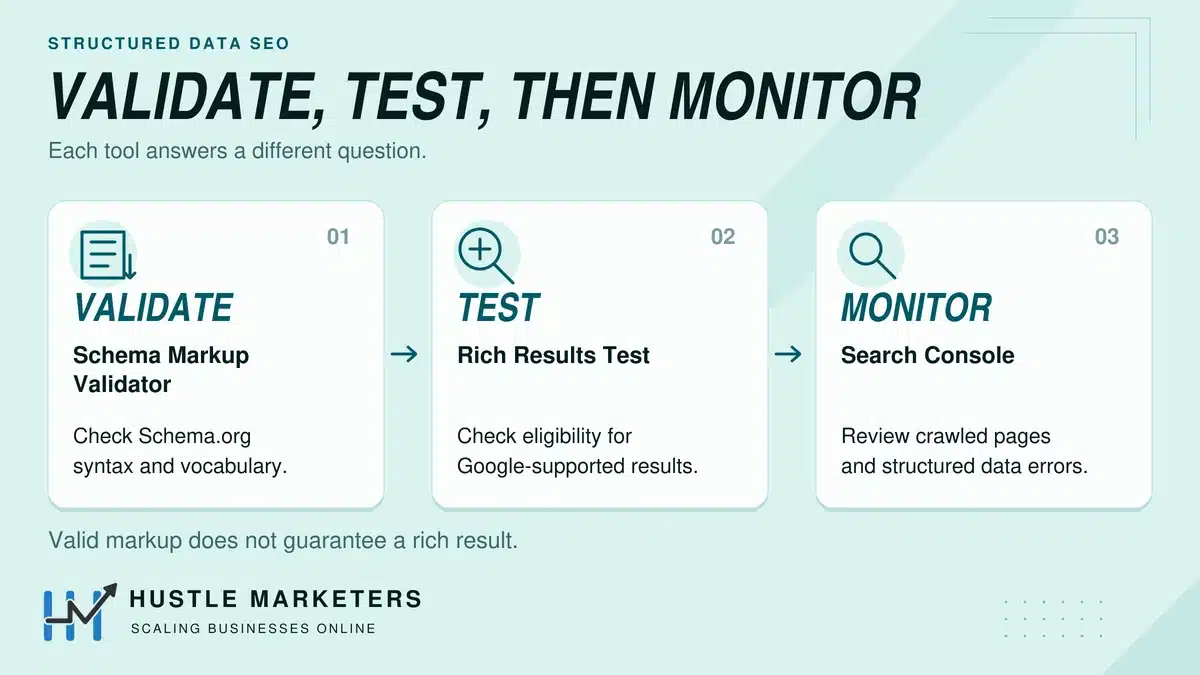
Three stages, and they answer three different questions. Skipping any one of them is the most common structured data SEO mistake we see.
| Stage | Tool | Question it answers | What it cannot tell you |
|---|---|---|---|
| Valid | Schema Markup Validator | Is this legal schema.org syntax? | Whether Google supports the type at all |
| Eligible | Rich Results Test | Does Google see a rich result it could show? | Whether it will actually be shown |
| Serving | Search Console rich result reports | Is Google finding and accepting this across the live site? | Anything about pages Google has not crawled yet |
Google names two of the three on its introduction page: “Be sure to check your structured data using the Rich Results Test during development, and the Rich result status reports after deployment, to monitor the validity of your pages, which might break after deployment due to templating or serving issues.”
Structured data checks sit inside the wider technical pass we set out in our technical SEO checklist. That last clause is the reason stage three exists. Markup that passed on your staging URL breaks in production more often than anyone expects, usually because a template renders differently for a logged-out visitor or a product goes out of stock and a required property disappears.
What does a working entity graph look like?
A few linked objects with stable identifiers, rather than a separate island of markup on every template. It is the part that pays off across a whole site rather than one page.
The idea is simple. Give your Organization a permanent @id, give your WebSite a permanent @id, and have every other object point at them instead of redescribing the company. One definition, referenced everywhere.
<script type="application/ld+json">
{
  "@context": "https://schema.org",
  "@graph": [
    {
      "@type": "Organization",
      "@id": "https://example.com/#organization",
      "name": "Example Company",
      "url": "https://example.com/",
      "logo": {
        "@type": "ImageObject",
        "url": "https://example.com/logo.png",
        "width": 600,
        "height": 60
      },
      "sameAs": [
        "https://www.linkedin.com/company/example",
        "https://www.youtube.com/@example"
      ]
    },
    {
      "@type": "WebSite",
      "@id": "https://example.com/#website",
      "url": "https://example.com/",
      "name": "Example Company",
      "publisher": { "@id": "https://example.com/#organization" }
    },
    {
      "@type": "WebPage",
      "@id": "https://example.com/services/#webpage",
      "url": "https://example.com/services/",
      "name": "Services",
      "isPartOf": { "@id": "https://example.com/#website" },
      "about": { "@id": "https://example.com/#organization" }
    }
  ]
}
</script>
Two things are doing the work here. The @graph array lets one script tag hold several related objects. The @id values are permanent identifiers, so publisher and isPartOf are references rather than duplicated copies. Change the logo once and every page that references the Organization is correct.
The sameAs array is the part that connects to entity work, because it tells search engines which external profiles are the same organization. That is a different discipline from rich results and we cover it separately in entity SEO and Google entities, which owns the knowledge graph side. This page stays on markup that earns search appearance.
Product markup, where most ecommerce sites fail
Product is the highest-value type on a store and the one most often incomplete. Missing a required property means no rich result at all, not a reduced one.
<script type="application/ld+json">
{
  "@context": "https://schema.org",
  "@type": "Product",
  "name": "Stainless Steel Water Bottle 750ml",
  "image": [
    "https://example.com/photos/bottle-1x1.jpg",
    "https://example.com/photos/bottle-4x3.jpg"
  ],
  "description": "Insulated 750ml bottle that keeps drinks cold for 24 hours.",
  "sku": "SB-750-STEEL",
  "gtin13": "0614141999996",
  "brand": { "@type": "Brand", "name": "Example Brand" },
  "offers": {
    "@type": "Offer",
    "url": "https://example.com/products/steel-bottle-750",
    "priceCurrency": "USD",
    "price": "34.00",
    "availability": "https://schema.org/InStock",
    "itemCondition": "https://schema.org/NewCondition"
  }
}
</script>
The offers object is where sites come unstuck. Price and priceCurrency both have to be present, availability has to reflect reality, and every value has to match what a shopper sees on the page. We go into the ecommerce specifics, including how this interacts with your Merchant Center feed, in our ecommerce SEO work.
When is structured data not worth adding?
More often than most people expect. Check the page type against this table before you add anything new.
| Situation | Add markup? | Why |
|---|---|---|
| Your page type has no matching feature in Google’s list of 25 | Usually no | Valid markup with no rich result changes nothing you can see |
| A plugin already outputs correct Article and Breadcrumb markup | No, leave it | Adding a second source creates conflicts and duplicate objects |
| You want FAQ rich results | No, they no longer exist | Mark up an FAQ only if the content genuinely is questions and answers |
| You were told it will get you into AI Overviews | No, not for that reason | Google states no special structured data is needed for AI features |
| Ecommerce product pages without Product markup | Yes, first priority | The clearest commercial return available in this discipline |
| A physical location with no LocalBusiness markup | Yes | Low effort, and it supports the rest of your local work |
| Job listings, events or recipes | Yes | These types still earn prominent, visually distinct results |
| Thin or duplicate pages | No | Markup makes a weak page eligible, not good. Fix the page |
The general test we apply: find the page type in Google’s supported list first, then decide.
If it is not there, the only remaining reason to mark it up is internal data consistency, and that is an engineering decision rather than a structured data SEO one.
What we do not do
Publishing this costs us a few inquiries and prevents the wrong engagement.
- We do not sell structured data as an AI visibility service. Google states plainly that no special schema.org markup is needed for its AI features, and we are not going to invoice against a claim its own documentation contradicts.
- We do not add markup for types that earn nothing. If a page type is not in Google’s supported list, we say so rather than billing for the implementation.
- We do not deploy client-side schema through a tag manager as a permanent solution. It is a stopgap while a developer ships the real thing.
- We do not mark up content a visitor cannot see. Google’s guidelines prohibit it and the consequence is a manual action.
- We do not report a validation pass as a result. Valid markup is the start of the job, not the outcome of it.
- We do not quote a Google case study without saying it is undated. All four on Google’s introduction page are undated.
- We do not recommend schema as a fix for a page that is thin, duplicated or not indexed. Markup does not rescue those.
Frequently asked questions
What counts as structured data?
Code that describes your page’s content in a machine-readable format, almost always written as JSON-LD using the schema.org vocabulary. Google uses it to understand the page and, for 25 specific feature types, to show an enhanced result. Outside those 25 types, valid markup changes nothing visible.
Is structured data a Google ranking factor?
No. It makes a page eligible for a richer appearance, and a richer appearance tends to earn more clicks at the same position. That is a click-through effect, not a ranking effect, and anyone selling it as a ranking lever is overstating it.
Does schema markup help with AI search and AI Overviews?
Google says it is not required. Its AI features documentation, updated December 10, 2025, states: “There’s also no special schema.org structured data that you need to add.” Implement structured data for rich results in Google Search, where the benefit is real and measurable, rather than for AI visibility.
Is FAQ schema still worth adding?
Not for rich results. Google’s changelog says the FAQ feature “will no longer appear in Google Search starting May 7, 2026”, and the documentation was removed on June 15, 2026. Existing FAQ markup is harmless if it describes content genuinely visible on the page, but it earns nothing and is not worth new effort.
What about HowTo schema?
HowTo is absent from Google’s current supported list and its documentation URL no longer resolves, so it earns nothing today. The changelog we read covers January 2024 onward and contains no HowTo entry, so we cannot give you a verified removal date, only the current state.
Which schema types should I add first?
Match your page types to Google’s supported list and start where the commercial return is clearest. A store starts with Product. For a business with premises it is LocalBusiness and Organization, and a publisher wants Article and Video. Everything else can wait.
JSON-LD or Microdata?
JSON-LD. Google recommends it as “the easiest solution for website owners to implement and maintain at scale”. Microdata still works but is woven through your HTML, so it breaks silently when a template changes. Migrate when you next touch the template rather than as a project of its own.
Can bad structured data hurt my site?
Yes, in a specific way. Google’s guidelines say a structured data issue “can result in a manual action” and that the page then “loses eligibility for appearance as a rich result”. The usual causes are marking up content a visitor cannot see and marking up misleading content such as fake reviews.
Do I need a schema plugin or tool?
Usually not a paid one. Most platforms output Article, Breadcrumb and Organization markup already, and the gaps are normally Product or LocalBusiness, which a developer can template once. Check what you already emit before buying anything. We look at the wider tooling question in AI SEO tools.
Sources and how we verified them
Every source below was opened and read on September 29, 2026. Where a secondary source or a research agent paraphrased something, we went to the primary source and used its exact wording instead.
| Source | Date on the source | What we verified |
|---|---|---|
| Google, structured data markup that Google Search supports | Last updated June 15, 2026 | The complete list of 25 features and their exact names, that FAQ and HowTo are both absent, the definition of a rich result, and the note that actual appearance might differ |
| Google, AI features and your website | Last updated December 10, 2025 | That no special schema.org structured data is needed for AI features, the eligibility requirement, that there are no additional requirements or special optimizations, and the instruction that structured data match visible text |
| Google, general structured data guidelines | Last updated July 10, 2026 | The rule against marking up content not visible to readers, the rule against irrelevant or misleading content, that missing required properties means ineligibility, and the structured data manual action |
| Google, introduction to structured data markup | Last updated December 10, 2025 | The JSON-LD recommendation, that Google can read JSON-LD injected by JavaScript, the Rich Results Test and Search Console guidance, and all four case study figures with the fact that none is dated |
| Google, latest documentation updates | Entries dated individually, page covers January 2024 to September 2026 | Every deprecation entry in our changelog table, each quoted with the date Google prints on it, and that no HowTo entry appears within that window |
| Google, spam policies for Google web search | Last updated August 28, 2026 | That this page contains no structured data section, which is why we cite the guidelines page for the manual action instead |
| Ahrefs, Schema Markup: What It Is and How to Implement It | Published May 11, 2026, updated June 27, 2026 | The claim that GPTBot, ClaudeBot and PerplexityBot do not execute JavaScript, and the statement that schema does not directly impact AI answers |
What we could not verify, and did not guess
We have no dated source for when HowTo rich results were withdrawn. Google’s supported list no longer includes the type and its documentation URL no longer resolves, but the changelog we read begins in January 2024 and contains no HowTo entry. Rather than repeat a date from memory we have reported only the current state.
We have not independently tested whether AI crawlers execute JavaScript. That claim is attributed to Ahrefs on the page and in the table above, and labeled as their finding.
Why this page has no FAQPage schema
Because FAQ rich results no longer exist, which is a point this page spends several hundred words making. Adding the markup anyway would be the exact behavior we are asking you to stop. The page carries Article, BreadcrumbList and Organization markup, all of which are in Google’s current supported list.
Written by Ishant Sharma, founder of Hustle Marketers, working in search since 2013. If you want to know which of the 25 types your site is actually eligible for before anyone quotes you for implementation, that is a short conversation and you can start it through contact us. Our technical SEO service covers implementation, and our SEO services and AI SEO work sit alongside it.
Summarise this article with: