AI SEO Tools: Verified Prices and What the Evidence Shows

Ishant
Published : October 8, 2026 at 10:30 am
Updated : October 16, 2026 at 12:13 pm
Ishant

We read 18 pages ranking for this term. Nine of the 13 genuine roundups are published by a company that sells one of the tools, and eight of those nine put their own tool first. Not one page in the 18 puts a date on a price.
So this page does three things the others do not. It says who owns each competing list, it dates every price, and it quotes what Google actually publishes about SEO tools.
What are AI SEO tools?
Software that uses a language model somewhere in the workflow to help you do SEO, plus a newer group that tries to measure whether AI assistants mention your brand. Those two things get sold under one name and they are not the same purchase. The wider practice these tools serve is covered in our guide to generative engine optimization.
Google is unusually blunt that the underlying job has not changed. Its guide to optimizing for generative AI features, updated July 10, 2026, says: “From Google Search’s perspective, optimizing for generative AI search is optimizing for the search experience, and thus still SEO.” The same page defines the acronyms the tool market is built on: “‘AEO’ stands for ‘answer engine optimization’ and ‘GEO’ for ‘generative engine optimization’.”
The three categories, and what each one costs you
None of the 13 roundups we read sorts the market this way. It is the distinction that decides which tool you should buy, so it goes first.
| Category | What it is | What you gain | What you give up |
|---|---|---|---|
| Established suite with an AI module | Semrush, Ahrefs, Moz, SE Ranking. A traditional platform that added AI tracking on top | The AI data sits next to your keyword, backlink and crawl history, so you can ask why something moved | The AI half is usually metered separately and priced as an add-on, and engine coverage is narrower |
| Content optimizer with a score | Surfer, Clearscope, Frase, NeuronWriter, MarketMuse | A concrete editing target and a brief a writer can follow | The score is a third-party opinion Google does not read, and chasing it can bloat the page |
| Native AI visibility tracker | Dedicated tools that only monitor AI assistants | Broader engine coverage and more prompts than a suite add-on | No crawl, keyword or link data, so it tells you that something changed and nothing about why |
Most teams end up buying one from row one and one from row three, then discovering the two disagree. We cover the monitoring category separately in AI visibility tools and the accuracy problem, which prices the dedicated vendors. This page is about the wider software decision.
Worth separating from a fourth thing entirely: general AI tools for marketing work, which we cover in best AI marketing tools. Writing assistants and design tools are a different purchase from SEO software and should not share a budget line.
Who publishes the other best AI SEO tools lists?
Mostly the companies selling the tools. We read 18 pages on September 28, 2026, of which 13 are genuine multi-tool roundups.
Nine of those 13 are published by a company that sells one of the tools listed. Eight of those nine rank their own tool first, and six of the nine say nothing on the page about the connection.
This is not a minor bias. It is the structure of the entire results page, and you are the one paying for it.
| Publisher | Sells a tool on its own list? | Where its tool ranks | Discloses it on the page? |
|---|---|---|---|
| Semrush blog | Yes, Semrush | First of 8 | No |
| Surfer blog | Yes, Surfer | First of 13 | No |
| Rankability blog | Yes, Rankability | First of 15 | No |
| Rankability, second page | Yes, Rankability | First of 15 | No |
| AIOSEO blog | Yes, All in One SEO | First of 8 | Commissions only, not ownership |
| WPBeginner | Yes, by common ownership | All in One SEO first of 17 | No |
| AthenaHQ blog | Yes, AthenaHQ | First of 5 | Partly, in an About block |
| eesel AI blog | Yes, eesel | First of 6 | Yes, plainly |
| Whatagraph blog | Yes, Whatagraph | Seventh of 14 | Yes, and states it takes no commissions |
| Zapier | No | Not applicable | Publishes editorial standards |
The WPBeginner row is the one to understand, because the connection is invisible unless you go looking. Awesome Motive’s own website lists All in One SEO, WPBeginner and LowFruits among the brands it operates. WPBeginner’s roundup places All in One SEO first and LowFruits third, and names neither relationship. We verified that ownership on Awesome Motive’s site rather than taking another page’s word for it.
Only one page in the 18 confronts this directly. A small agency review of All in One SEO opens by naming the problem: “When WPBeginner reviews AIOSEO and declares it excellent, that’s not independent journalism. It’s a company reviewing its own product.” That page is about a different product on a different results page. Nobody had applied the point to AI SEO tools.
The self-consistency test you can run in ten seconds
Before trusting any tool roundup, check whether the page agrees with itself. Internal contradictions were common across the set we read, and they are a fast proxy for how carefully the rest was done.
- The page ranking first says in its body “After testing dozens firsthand, I narrowed it down to seven tools that actually perform”. Its headline says 8 and it lists 8.
- One page’s methodology says the shortlist stayed at 10 because bloated roundups are less useful. That page lists 15.
- One page’s title tag says 17 while its heading and its list both say 19.
- One page still ranking was last updated in August 2025, more than a year before we read it, and its title promises a current edition.
To be fair to the page ranking first, it does something most do not: it admits what it could not test. “Testing note: I was unable to run a hands-on test for Screaming Frog’s AI prompts” is the kind of line that makes the rest of a review more credible, not less.
What do AI SEO tools actually cost?
Between $29 and $1,499 a month for a seat, per Ahrefs’ pricing page, before the AI features, which are usually metered on top. Every figure below was read on the vendor’s own pricing page on September 28, 2026. None of the 13 roundups we read dates a price, sources a price, or adds a stack up.
Dating matters here more than in most categories, because these prices are moving. The same tool appears at five different prices across the pages we read.
Suites, and what the AI half costs on top
| Tool | Base price as printed | AI tracking cost | What the AI tier actually buys | Checked |
|---|---|---|---|---|
| Semrush AI Visibility Toolkit | Sold separately from the main suite | “$99/mo per domain billed annually” | “Track 25 custom prompts (daily AI rankings)”, “1 domain for Brand Performance analysis”, covering “Mentions from ChatGPT, Google AI, Gemini, and Perplexity” | Sep 28, 2026 |
| Semrush add-ons | On top of the above | Additional users “Starting at $45/mo” | Lead Generation “$90/mo”, Base Report “$10/mo”, Pro Report “$20/mo” | Sep 28, 2026 |
| Ahrefs | Starter $29/mo, Lite $129/mo, Standard $249/mo, Advanced $449/mo, Enterprise $1,499/mo | Brand Radar AI “Starting at $199/mo” | Prompt packs on top: Basic $50/mo for 2,500 checks, Growth $100/mo for 7,000, Scale $250/mo for 25,000 | Sep 28, 2026 |
| Ahrefs overage | Applies to all tiers | $0.020, $0.015 or $0.010 per check depending on pack | “Once you enable additional pay-as-you-go credits and data, you’ll be automatically charged when consumption exceeds your plan’s limits.” | Sep 28, 2026 |
Read the Semrush row carefully. The $99 is per domain, and it buys 25 prompts.
An agency with ten clients is not paying $99, it is paying ten times that before anyone writes a word. That per-domain, per-prompt structure is the single most important pricing fact in this category, and no roundup we read states it.
Content optimizers
| Tool | Price as printed | What the tier includes | Seats | Checked |
|---|---|---|---|---|
| Surfer, AI Search Analytics | $82/mo billed yearly | 50 prompts daily | 5 | Sep 28, 2026 |
| Surfer, Discovery | $49/mo billed yearly | 120 documents, 10 pages tracked, 0 prompts | 1 | Sep 28, 2026 |
| Surfer, Standard | $99/mo billed yearly | 360 documents, 50 pages, 25 prompts weekly | 3 | Sep 28, 2026 |
| Surfer, Pro | $182/mo billed yearly | 360 documents, 200 pages, 50 prompts daily | 5 | Sep 28, 2026 |
| Surfer, Peace of Mind | $299/mo billed yearly | Unlimited documents, 500 pages, 100 prompts daily | 10 | Sep 28, 2026 |
| Clearscope, Essentials | $129/mo | 50 tracked queries, 50 pages, 20 topic explorations, 20 drafts | Unlimited | Sep 28, 2026 |
| Clearscope, Business | $399/mo | 300 tracked queries, 300 pages, 50 explorations, 20 drafts | Unlimited | Sep 28, 2026 |
Two details buyers miss. Surfer’s prices above assume yearly billing, and its credits “reset yearly or after changing your plan (upgrades and downgrades)”, so a mid-year downgrade can cost you the balance you already paid for. Separately, Clearscope charges for overflow, at “Additional Pages: $25/mo (Essentials), $15/mo (Business)”.
What a realistic stack costs a month
Nobody adds these up, so here it is. Figures use the printed prices above at the tier named, on September 28, 2026. Your own mix will differ and that is the point: work out the total before you buy the first seat, not after the third.
| Setup | Tools at the tier shown | Monthly total | What it does not cover |
|---|---|---|---|
| Solo consultant | Ahrefs Lite $129 | $129 | No AI visibility tracking at all |
| Solo, wanting AI tracking | Ahrefs Lite $129, Brand Radar $199 | $328 | One brand, and no content optimizer |
| In-house content team | Ahrefs Standard $249, Clearscope Essentials $129 | $378 | AI tracking still absent |
| Agency, five clients, AI tracking each | Ahrefs Standard $249, Semrush AI Visibility five domains at $99 | $744 | 25 prompts per client, and no content optimizer |
| Agency, full stack | Ahrefs Standard $249, Semrush AI Visibility five domains $495, Surfer Pro $182 | $926 | Roughly $185 per client per month before labor |
The bottom row is the number that changes decisions. In our experience just over $900 a month is a junior salary in some markets, and it buys data, not work. If that stack is not producing a decision you would not otherwise have made, it is overhead.
Does Google use AI SEO tool scores?
No, and Google has said so on the record. John Mueller, in an #AskGooglebot video reported by Search Engine Land in August 2023: “No, Google does not use scores from third-party SEO tools or services. It doesn’t matter whether it’s about a website’s authority or a rating about spamminess, Google doesn’t use these scores at all.”
That covers authority scores, spam scores, health scores and content scores alike. It does not make them useless, because a score can still be a workable proxy. It does mean that no score you buy is an input to ranking, and anyone implying otherwise is misrepresenting a vendor metric as a Google metric.
Google went further on its AI guidance page, updated July 10, 2026: “Be wary of third-party tools that promise ranking success or claim to use ‘internal’ Google metrics.” That sentence appears in Google’s own guide to generative AI search, and not one of the 18 pages we read quotes it.
Do content scores actually correlate with rankings?
Weakly, and the vendor’s own research and the independent research agree on that. This is the most useful thing on this page if you are paying for a content optimizer.
| Study | Who ran it | Sample | Finding as published |
|---|---|---|---|
| Do higher content scores mean higher Google rankings? | Ahrefs, Si Quan Ong and Xibeijia Guan, May 21, 2025 | 20 random keywords across Surfer, Frase, NeuronWriter, Clearscope and AI Content Helper | “We found weak correlations everywhere.” |
| Same study, best performers | Ahrefs | Same | “But out of the five tools I tested, NeuronWriter and AI Content Helper fared the best.” |
| Does Surfer’s Content Score still work? | Surfer, Kristavja Caci, last updated September 9, 2026 | 10,000 queries, top 100 results each, 1,000,000 SERP entries | “Surfer’s Content Score correlates with Google rankings at 0.28”, Spearman |
| Same study, by intent | Surfer | Same | Consequence 0.2961, definition 0.2705, comparison and exploratory 0.22 to 0.23, instructional and short fact 0.19 |
A Spearman coefficient of 0.28 is a weak positive relationship. That figure comes from the vendor, on the vendor’s own blog, from a million-row sample. The independent test of five tools reached the same verdict in words. When the seller and the skeptic agree on the number, you can plan around it.
What follows from that is practical rather than dismissive. Both sources say the same thing about targets. Ahrefs: “Just don’t obsess and spend hours trying to get a perfect score; scoring in the same ballpark as top-ranking pages is enough.” Surfer recommends you “aim for a Content Score between 70 and 85”, not 100, and concedes the score matters least on short factual and how-to queries.
Can any tool tell you your ranking inside ChatGPT?
Not reliably, and the best available research says the question is malformed. This matters because rank-in-AI is the headline feature of an entire product category.
SparkToro’s study, published January 28, 2026 and updated June 28, 2026, had 600 volunteers run 12 prompts through ChatGPT, Claude and Google AI Overviews a combined 2,961 times. The finding: “there’s a <1 in 100 chance that ChatGPT or Google’s AI, if asked 100X, will give you the same list of brands in any two responses”.
Rand Fishkin’s conclusions are quotable and blunt. “Measuring your brand’s presence in AI answers with precision is a fool’s errand.” And on the product category specifically: “any tool that gives a ‘ranking position in AI’ is full of baloney”.
The constructive part of the same research is the buying test: “Before you spend a dime tracking AI visibility, make sure your provider answers the questions we’ve surfaced here and shows their math.” That is the standard we apply below.
This does not mean measurement is worthless. It means the unit matters. A share-of-voice figure across many prompts run repeatedly can be informative, and a single integer called your rank in ChatGPT is not.
We go into the distinction in citations versus mentions and in how to track brand visibility in AI search.
What does Google say you actually need for AI search?
Less tooling than the market implies. Google published a guide specifically about this, and it spends a section telling you what to skip. Every quote below is from that page, last updated July 10, 2026.
| What Google publishes | What it rules out |
|---|---|
| “From Google Search’s perspective, optimizing for generative AI search is optimizing for the search experience, and thus still SEO.” | A separate AI SEO discipline needing its own separate toolset |
| “For Google Search, you can ignore tactics like ‘chunking’ content, creating unnecessary AI text files (like llms.txt), or pursuing inauthentic mentions.” | llms.txt generators, chunking features, and mention-building packages, at least as far as Google Search is concerned |
| “There’s no requirement to break your content into tiny pieces for AI to better understand it.” | Tools that restructure your pages into fragments for retrievability |
| “You don’t need to write in a specific way just for generative AI search.” | AI-specific writing modes and prompt-shaped content templates |
| “Be wary of third-party tools that promise ranking success or claim to use ‘internal’ Google metrics.” | Any vendor claiming access to Google internals |
Google also names its own measurement path. One of the guide’s sections is headed “Measure visibility in generative AI features with Search Console”, which is first-party, free, and reports what Google itself observed rather than what a crawler inferred from outside.
Two caveats so this is not overstated. Google speaks only for Google Search, so nothing here tells you how ChatGPT or Perplexity behave. And llms.txt being useless to Google Search does not make it useless to every system. But if a tool’s pitch is that Google needs these things, Google’s own documentation disagrees, and that is worth knowing before the invoice. The Google side of the work is set out in our guide on how to optimize content for Google AI Overviews.
What are the free AI SEO tools worth?
More than the paid trackers admit, because the two search engines that can see their own data now report it to you directly. Both arrived in 2026 and both are free.
| Tool | What it gives you | Cost | Limitation |
|---|---|---|---|
| Google Search Console AI reporting | Impressions and performance inside AI Overviews and AI Mode, from Google’s own logs | Free | Google surfaces only, and no visibility into ChatGPT or Perplexity |
| Bing Webmaster Tools AI Performance | Citation data across Copilot and Bing AI answers, including grounding queries | Free | Bing and Copilot surfaces only |
| Manual prompt testing | Run your own prompt set against each assistant on a schedule and log it | Free except your time | Laborious, and you must design the prompt set carefully |
| Google Keyword Planner and Trends | Demand data straight from Google | Free | Volume is banded unless you spend |
The honest framing is that first-party reports and paid trackers answer different questions. Search Console tells you what Google saw. A tracker estimates what an assistant said to a hypothetical user. The first is measurement and the second is sampling, and the sampling is only as good as the prompt set behind it.
If your visibility question is confined to Google surfaces, start with Search Console and see whether you have a question left over. Our free PPC tools guide applies the same test on the paid side, and automated SEO reports covers what happens when tool numbers and Search Console disagree. If the wider question is how much of this work a tool can run on its own, seo automation sets out what these systems genuinely automate and where a person is still doing the thinking.
When do you not need an AI SEO tool at all?
When nothing the tool reports would change what you do next. That is not our argument. It is the argument of a founder who built one of these tools and then shut it down.
Benjamin Houy closed Lorelight, his AI visibility tracker, in 2025.
He published why on October 31, 2025, and on churn wrote: “Then they’d churn. Not because the tool was bad. Not because the insights were wrong. But because those insights had zero impact on their behavior.”
On what he found actually drove visibility: “There was no secret formula. No hidden hack. No special optimization technique that only applied to AI.” The things that did work were “Quality content that genuinely helped people; Mentions in authoritative publications; Strong reputation in their space; Genuine expertise and thought leadership.”
His conclusion: “After realizing this, I had to ask myself: why am I building a tool for something that doesn’t need a tool?”
Search Engine Land covered the shutdown on November 4, 2025 and the industry reaction split, so treat this as one well-argued position rather than a settled verdict. It is still the most honest thing published in the category, and it came from someone with every incentive to say the opposite.
| Situation | Buy a tool? | Why |
|---|---|---|
| You have no published content worth measuring | No | A tracker will faithfully report that you are absent. You already know |
| Your visibility question is Google-only | Not yet | Search Console reports it free, from Google’s own data |
| Nobody will act on the report | No | This is the Lorelight failure exactly. The cost is the subscription plus the meeting |
| You manage client accounts and must report | Yes | You need a defensible, repeatable number, and per-domain pricing is the cost of that |
| You publish at volume and need editing consistency | Yes, an optimizer | A shared score keeps a team of writers aligned, whatever Google thinks of it |
| You need to know why something moved | Yes, a suite | Only a tool with crawl, keyword and link history can answer why |
How should you compare AI SEO tools before buying?
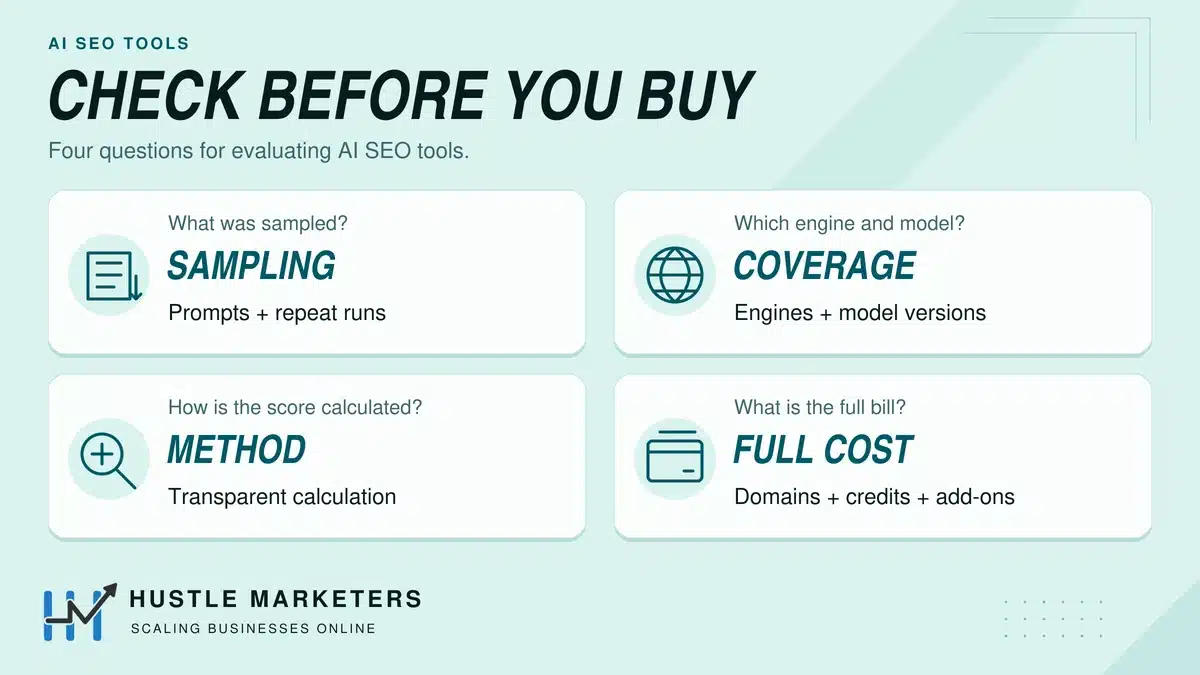
Ask the questions a vendor cannot answer with a screenshot. Every roundup we read compares features. None asks what the number in the dashboard is actually made of, which is the only thing that decides whether it is worth paying for.
The standard comes from the research itself: “Before you spend a dime tracking AI visibility, make sure your provider answers the questions we’ve surfaced here and shows their math.” Here is that turned into a checklist you can send to a sales rep.
| Question to ask | Why it matters | What a bad answer sounds like |
|---|---|---|
| How many prompts do you run, and how often? | A weekly sample and a daily sample are different products at similar prices | “We monitor continuously” with no number |
| Who writes the prompt set, and can I edit it? | Auto-generated prompts often miss what your buyers actually ask | “Our AI generates them for you”, with no editing |
| How many times is each prompt run before you report a number? | Answers vary run to run, so a single run is noise reported as signal | Silence, or a number you cannot find in the docs |
| Which engines, and which model versions? | Coverage varies sharply by tier and models change underneath | “All the major AI platforms” |
| Is this real user data or your own API calls? | Almost always the vendor’s own calls, which is sampling, not observation | Wording that implies it sees real conversations |
| How is the score calculated? | If they will not show the formula, you cannot audit the trend | “Proprietary” |
| Is pricing per domain or per account? | This is what decides agency cost, and it is often buried | A single headline price with no multiplier mentioned |
| Do credits roll over, and what happens on downgrade? | Some plans reset your balance when you change tier | Nothing in writing |
| Do I keep my historical data if I cancel? | Trend data is the only durable asset a tracker builds | No clear answer |
| Does client data go to third-party models? | A procurement and confidentiality question before it is an SEO one | “We take security seriously” |
Two of those get the most useful reactions. Asking how many times a prompt is run before a number is published tends to produce a long pause. Asking whether pricing is per domain turns a $99 headline into the real agency figure before you have signed anything.
Which tools do we use, and what we stopped using
Naming your own stack is the minimum credibility test for a page like this, and 13 of the 13 roundups we read either sell the tool they recommend or list without committing.
| What we use | For what | Why this one |
|---|---|---|
| Semrush | Keyword and competitive research, and AI visibility on client accounts where it is in scope | The AI data sits beside the keyword history, which is what lets us say why something moved, not just that it did |
| Google Search Console | The reference for anything Google surfaced | First-party. When a tool disagrees with it, we believe Search Console |
| Google Merchant Center | Free listing and product visibility on ecommerce accounts | It reports organic product performance no SEO tool can see. Covered in our ecommerce SEO work |
| Screaming Frog | Crawling and rendered output checks | Covered in our technical SEO service |
| Manual prompt logging | Checking AI answers for clients where it matters | Slow, but we know exactly what was asked and how often |
What we do not run: an AI-answer rank tracker as a standing subscription on every account. On the evidence above, a rank position inside a non-deterministic system is not a number we are willing to put in a client report as though it were a ranking.
Where a client needs AI visibility reported, we use share of voice across a prompt set we designed, we state the sample size, and we say which engine and which date. That standard is written up in our reporting integrity standard.
Is there an AI SEO tool that applies the fixes for you?
Most tools on this page tell you what to change and leave the change to you. Boostifai, which we have added to our own stack, makes the change. One line of code on the site lets it push approved fixes to titles, meta descriptions, H1s, image alt text and schema across many pages in one go, without a developer.
Where it has given us deeper insight than the other AI SEO tools we use is AI search. Its AI Insight module scores visibility in ChatGPT, Gemini, Claude and DeepSeek and breaks sentiment down by model, with the reasoning behind each score and an average brand sentiment based on tone, brand loyalty and customer feedback. Many tools stop at mentions and a visibility score. It also tracks organic conversions and sales, so SEO can be reported like ROAS on ads. Pricing is published: from EUR 147 a month for one site, and from EUR 247 a month on agency plans with white label reports (checked 14 October 2026).
Judge it the same way as the tools above: run it against your own Search Console data and check that applied changes show in URL Inspection.
What we do not do
Publishing this costs us a few inquiries and saves everyone the wrong engagement. None of the 13 roundups we read has a section like it, which is unsurprising, because most of them are written by a company whose tool appears at the top of their own list.
- We do not take affiliate commission on any tool named here, so there is no version of this page where a higher payout changes the order.
- A health score or a visibility score is never reported to a client as a result. A number moving is not revenue moving.
- We do not sell an llms.txt file as an AI search deliverable. Google’s own documentation lists it among the things you can ignore for Google Search.
- We do not present a rank position inside ChatGPT as a ranking, because the research says it will not reproduce.
- We do not quote a price without the date we read it. Prices in this category moved enough this year to make undated figures misleading.
- We do not recommend a tool we have not used, and where we have not used one we say so rather than padding the list.
- We do not bill for a tool subscription as though it were work. The stack is our cost of doing business, not a line item.
Frequently asked questions
What are the best AI SEO tools?
It depends which of three jobs you are buying, and most lists blur them. For research and diagnosis, a suite with history behind it. To keep editing consistent across writers, a content optimizer.
For monitoring AI assistants, a dedicated tracker, with the accuracy caveats above. Anyone giving you one ranked list without asking which job you have is selling placement, not advice.
How much do AI SEO tools cost?
Seats run from $29 to $1,499 a month, per Ahrefs, and the AI features are usually metered on top.
Semrush’s AI Visibility Toolkit was “$99/mo per domain billed annually” for 25 prompts on September 28, 2026, and Ahrefs Brand Radar started at $199 a month with prompt packs from $50 to $250 above that. On our own arithmetic a five-client agency stack came to roughly $926 a month on the same date.
Are there free AI SEO tools that are any good?
Yes, and the two best are first-party. Google Search Console now reports impressions inside AI Overviews and AI Mode, and Bing Webmaster Tools reports citations across Copilot and Bing AI answers. Both are free and both report what the engine itself observed, which no external tracker can do.
Does Google use AI SEO tool scores in ranking?
No. John Mueller: “No, Google does not use scores from third-party SEO tools or services. It doesn’t matter whether it’s about a website’s authority or a rating about spamminess, Google doesn’t use these scores at all.” Google’s AI guidance adds that you should “Be wary of third-party tools that promise ranking success or claim to use ‘internal’ Google metrics.”
Do content scores like Surfer’s actually work?
Weakly, by the vendor’s own measurement. Surfer’s study of 1,000,000 SERP entries reports a 0.28 Spearman correlation with Google position, and an independent Ahrefs study of five scoring tools found “weak correlations everywhere”. Use a score as a completeness check against the pages already ranking, not as a target to maximize.
Can a tool tell me my rank in ChatGPT?
Not dependably. SparkToro ran 2,961 prompts and found “a <1 in 100 chance that ChatGPT or Google’s AI, if asked 100X, will give you the same list of brands in any two responses”. A share of voice across many repeated prompts can be meaningful. A single rank number is not.
Do I need an llms.txt file?
Not for Google Search. Google’s guidance, updated July 10, 2026, lists “creating unnecessary AI text files (like llms.txt)” among the tactics you can ignore. Several tools sell an llms.txt generator as an AI search feature, so it is worth knowing Google’s stated position before paying for one.
Is AI SEO different from normal SEO?
Google says not, in its own words: “From Google Search’s perspective, optimizing for generative AI search is optimizing for the search experience, and thus still SEO.” What has changed is where you can measure and how stable the measurement is. Our AI search optimization guide covers the wider question and answer engine optimization covers the terminology.
Sources and how we verified them
Every source below was opened and read on 28 September 2026. Prices were read on the vendor’s own pricing page, not taken from another article. Where an agent or a secondary article paraphrased something, we went to the primary source and used its wording instead.
| Source | Date on the source | What we verified |
|---|---|---|
| Google, guide to optimizing for generative AI features | Last updated July 10, 2026 | The still-SEO sentence, the AEO and GEO definitions, the AEO/GEO hacks line including llms.txt, the no-chunking and no-special-writing sentences, the warning about third-party tools, and that a section is headed Measure visibility in generative AI features with Search Console |
| Search Engine Land, Google: Don’t worry about SEO tool scores | August 2023, by Danny Goodwin | The full Mueller quotation and that it came from an #AskGooglebot video |
| Ahrefs, Do higher content scores mean higher Google rankings? | Published May 21, 2025, by Si Quan Ong and Xibeijia Guan | The 20-keyword sample, the five tools tested, the weak correlations line, the best-performers line, the do-not-obsess line, and that the coefficients appear only in a chart image |
| Surfer, Does Surfer’s Content Score still work? | Last updated September 9, 2026, by Kristavja Caci | The 10,000 query and 1,000,000 SERP entry sample, the 0.28 Spearman figure, the per-intent breakdown, the 70 to 85 recommendation and the concession on short factual queries |
| SparkToro, AIs are highly inconsistent when recommending brands | Published January 28, 2026, updated June 28, 2026, by Rand Fishkin | The 600 volunteers, 12 prompts and 2,961 runs, the under 1 in 100 figure, the fool’s errand line, the baloney line and the show-their-math line |
| Benjamin Houy, Why I’m Shutting Down Lorelight | October 31, 2025 | The churn quotation, the no secret formula quotation, the why-am-I-building-this quotation and the list of what did drive visibility |
| Search Engine Land, GEO startup Lorelight shuts down | November 4, 2025 | That the shutdown was covered in the trade press and that industry reaction was divided |
| Awesome Motive company site | Page modified May 26, 2026 | That Awesome Motive lists All in One SEO, WPBeginner and LowFruits among the brands it operates |
| Semrush AI pricing page | No date printed, read September 28, 2026 | The $99 per domain figure, the 25 custom prompts, the one-domain limit, the four named engines and every add-on price |
| Ahrefs pricing page | No date printed, read September 28, 2026 | Every plan price, the Brand Radar starting price, all three prompt packs with overage rates and the automatic pay-as-you-go charging sentence |
| Surfer pricing page | No date printed, read September 28, 2026 | Every plan price and that they assume yearly billing, the document, page and prompt allowances, the seat counts and the credit reset wording |
| Clearscope pricing page | No date printed, read September 28, 2026 | Both published tier prices, the query, page, exploration and draft allowances and the additional-page charges |
| Semrush blog, 8 Best AI SEO Tools for 2026 | April 1, 2026, by Zach Paruch | That it lists 8 while its text says seven, that Semrush is placed first, that no ownership disclosure appears, and the Screaming Frog testing-note admission |
What we could not reach, and did not work around
Reddit is blocked at our end, so no Reddit discussion informed this page in either direction. YouTube, Quora, LinkedIn and X were also unreachable during the research, which means the practitioner sentiment here comes from blogs, trade press, Trustpilot and Hacker News rather than from social platforms. Google, Bing and DuckDuckGo result pages are not scrapable from our environment either, so we did not collect People Also Ask data and make no claim to have done so.
Two of the pricing pages print no date of their own. We have given the date we read them instead, which is the honest substitute and more than any competing page offers.
How we counted the competitor pages
We read 18 pages in full on September 28, 2026, drawn from the results for “ai seo tools”, “best ai seo tools”, “ai search engine optimization tools” and “best all in one seo tools”. Of those, 13 are genuine multi-tool roundups and the other five are vendor landing pages, a directory, a lead magnet and a single-product review.
Counts phrased as “X of 13” refer to the roundups only. Our search tool returned nine organic results per query rather than ten, so our top-ten coverage is nine per query plus the overlap between them.
One further limit worth stating. On the claim that no page dates or sources a price, we checked that question explicitly on the four most price-heavy pages and found no dating on any of them, and observed none on the remaining nine during full reads. Treat it as verified on four and observed on nine.
Why this page has no FAQPage schema
Google stopped showing FAQ rich results in Search on May 7, 2026, so the markup no longer earns the feature it was built for. Adding it to appear thorough would sit badly on a page about vendors overstating what their tools do. The page carries Article and ItemList markup, which describe what it actually is.
Written by Ishant Sharma, founder of Hustle Marketers, working in search since 2013. If you want help deciding which of these you actually need before you buy any of them, that conversation is free and takes about twenty minutes: contact us. Our AI SEO services, SEO services and white label SEO work sit alongside this, and best AI SEO agencies applies the same disclosure test to agencies rather than tools.