Home Builder SEO: The 2026 Guide for Custom and Production Builders

Ishant
Published : October 8, 2026 at 10:30 am
Updated : October 25, 2026 at 11:46 pm
Ishant
Written by Ishant Sharma, Google Ads, Microsoft Ads and SEO specialist since 2013 | Updated October 2026 | Facts checked September 17, 2026
Home buyers start online. In the National Association of Realtors 2025 Profile of Home Buyers and Sellers, 46% of buyers said their first step was looking online for properties, and 52% found the home they bought on the internet (NAR 2025 Profile highlights). That is why home builder SEO matters. If your communities, floor plans and quick move-in homes are hard to find, buyers see Zillow, NewHomeSource or a competitor first.
Home builder SEO is also different from normal local SEO. Model homes cannot have their own Google Business Profile. Portals republish the listing text you send them and can outrank you for your own community name. Floor plans repeat across communities, sold-out communities leave dead URLs behind, and the pages, profiles and posts that market your homes count as housing advertising under the Fair Housing Act. Most home builder SEO guides skip these problems. This guide covers them, along with keywords, page structure, reviews, AI search, tracking, costs and timelines.
How we researched this guide: we pulled US keyword data for home builder SEO and buyer searches in Semrush on September 17, 2026, and reviewed the 12 top ranking pages for home builder SEO searches plus 4 other in-depth builder guides. We checked Google’s Business Profile, Search Central and Ads policy pages, schema.org, the Fair Housing Act and HUD’s 24 CFR 100.75, the FTC fake reviews rule, NAR, NAHB and US Census data, and BrightLocal’s 2026 review survey. We also read builder and buyer discussions on Reddit, the Local Search Forum, City-Data and Houzz, and builder marketing podcast episodes. This is marketing guidance, not legal advice. Have counsel review advertising and targeting questions.
Summarize this article with:
Key Observations
- Home builder SEO means ranking your company, communities, floor plans and available homes on Google, Google Maps, Bing and AI assistants for the searches buyers make before they visit a sales center.
- Build one strong page per community, a clear floor plan system and live quick move-in pages. Add city pages only when they carry unique inventory and local detail, or they can become doorway pages.
- Model homes are not eligible for a Google Business Profile. A staffed sales office with posted hours is. Keep your business name exactly as buyers see it, with no keywords or cities added.
- Portals such as Zillow and NewHomeSource often reuse your descriptions. Write richer, unique copy for your own site and use different copy in feeds.
- Google has no rich result for new homes for sale. Use schema to describe houses, plans and prices clearly, not to chase SERP features.
- Write copy that describes the home and the community, not the buyer you want. The Fair Housing Act applies to websites, profiles and posts.
- Measure appointments, visits, contracts and closings from organic search, not just rankings. Sales cycles run for months, so capture lead source in your CRM.
Table of Contents
- What is home builder SEO?
- Is SEO worth it for home builders?
- What keywords should home builders target?
- How do home builders rank in the Google Maps local pack?
- How can home builders get more reviews safely?
- Which pages should a home builder website have?
- How do Zillow, NewHomeSource and MLS listings affect home builder SEO?
- How do you handle SEO when a community sells out?
- What advertising rules apply to home builder SEO content?
- How do you do technical SEO for a home builder website?
- How do home builders show up in AI search?
- Which popular home builder SEO tips are wrong or outdated?
- What are builders and buyers saying about home builder SEO?
- How do you track home builder SEO to contracts and closings?
- How long does SEO take for home builders?
- How much does SEO for home builders cost?
- How Hustle Marketers helps home builders with SEO
- Home Builder SEO FAQs
What is home builder SEO?
Home builder SEO is the process of improving how a home building company, its communities, its floor plans and its available homes show up in Google Search, Google Maps, Bing, Apple Maps and AI assistants, so buyers find you, trust you and book a visit or a consultation. It covers seven areas:
- Local SEO: Google Business Profiles for staffed sales offices and your main office, reviews, citations and map pack rankings.
- Community and inventory pages: community, floor plan, quick move-in, city and build-on-your-lot pages.
- Content: buyer guides on building versus buying, incentives, financing, energy efficiency, warranties and the build process.
- Technical SEO: site structure, duplicate plans, sold-out community URLs, sitemaps, image weight and Core Web Vitals.
- Authority: Home Builders Association listings, Parade of Homes, supplier and trade partner mentions, local press and portals.
- AI visibility: clear pricing, specs and community facts that AI Overviews, AI Mode and ChatGPT can understand and cite.
- Measurement: appointments, sales center visits, contracts and closings traced back to search.
How is SEO for home builders different from other local businesses?
- You sell places, not just a service. A plumber has one service area. You may have many communities, each with its own buyers, prices, schools and inventory.
- Your inventory changes every week. Quick move-in homes sell, phases open and communities close out. That creates URL and sitemap problems most local businesses never face.
- Portals compete for your own brand. Zillow, NewHomeSource, Realtor.com and the MLS can outrank you for “[community name] homes”.
- Your marketing is housing advertising. The Fair Housing Act covers the words, photos and targeting you use.
- Buyers take months to decide. Search often starts the journey, but the contract may come three to twelve months later, which makes tracking harder.
What does SEO look like for custom, production and build-on-your-lot builders?
| Builder type | What buyers search | Pages that matter most | Main SEO challenge |
|---|---|---|---|
| Production builder | “new construction homes in [city]”, “quick move in homes near me”, community names, plan names | Community pages, quick move-in pages, floor plans, city hubs | Portal competition and page sprawl across many communities |
| Semi-custom builder | “semi custom home builders [city]”, “new homes with design options [city]” | Floor plans with option menus, community pages, design center page | Explaining choices and price ranges without thin, repeated plan pages |
| Custom builder | “custom home builders near me”, “luxury home builder [city]”, “custom home builders near me with prices” | Portfolio and project pages, process page, pricing ranges, service area pages, reviews | Low search volume, trust and proving quality |
| Build-on-your-lot builder | “build on your lot [state]”, “who builds homes on your own land” | Service area page, lot evaluation guide, plan library, financing page | Wide service areas without a local office in every town |
| Niche builder (barndominium, modular, 55+, ADU) | “barndominium builders [state]”, “modular home builders near me” | Niche service pages, cost guides, plan pages, FAQs | Explaining zoning, financing and cost questions honestly |
Is SEO worth it for home builders?
For most builders, yes. Buyers do a lot of research before they talk to anyone, and the market is competitive:
| Finding | Data | Source |
|---|---|---|
| Where buyers start | 46% of buyers first looked online for properties, 20% first contacted an agent | NAR 2025 Profile highlights |
| Where buyers find the home | 52% found the home they bought on the internet, 27% through an agent | NAR 2025 Profile highlights |
| New home share | 12% to 16% of buyers bought a new home. The report gives 16% in Exhibit 2-1 and 12% in the chapter summary | NAR 2025 Profile highlights |
| Market pressure | In September 2026, 38% of builders cut prices and 66% used sales incentives. The builder confidence index was 32 | NAHB |
| Supply | New single-family home sales ran at a seasonally adjusted annual rate of 607,000 in July 2026, with a 9.6 month supply of new homes for sale | US Census Bureau |
| Marketing spend | Builders in NAHB’s 2024 cost survey spent an average of $5,633 per home on marketing, 0.8% of the average sales price | NAHB Cost of Constructing a Home |
| Reviews | 31% of consumers will only use a business with 4.5 stars or more, and 74% look for reviews from the last three months | BrightLocal 2026 |
Two points matter here. First, when many builders are discounting and offering incentives, the builder buyers find first gets the first visit. Second, SEO works well next to the marketing you already pay for. Organic community pages keep bringing in buyers after a portal campaign or a grand opening budget ends.
Should home builders rely on Zillow and NewHomeSource instead of their own website?
No. Use portals, but do not depend on them. Portals rent you visibility and put your community next to competitors. Your own site is the only place you control pricing, plan details, incentives, lead forms and follow-up. It is also the source that Google, AI assistants and Realtors can check. The best approach is to list on portals and link those listings back to strong community pages on your own domain.
What keywords should home builders target?
Start with real demand. Here is US monthly search volume from Semrush, pulled on September 17, 2026. Keyword difficulty (KD) is Semrush’s 0 to 100 score.
| Keyword | US monthly searches | KD | What it tells you |
|---|---|---|---|
| new construction homes near me | 27,100 | 23 | Huge buyer demand, mostly won by portals and large builders |
| new homes for sale near me | 27,100 | 32 | Same intent, strong portal competition |
| home builders near me | 18,100 | 55 | Map pack and brand competition |
| custom home builders near me | 9,900 | 51 | Map pack driven, reviews and portfolio matter |
| model homes near me | 9,900 | 35 | Buyers ready to visit, sales office profiles and community pages |
| build on your lot | 2,400 | 28 | A real niche for builders who serve buyers with land |
| quick move in homes | 1,900 | 15 | Inventory pages with city modifiers can compete |
| spec homes for sale | 1,300 | 9 | Low difficulty inventory searches |
| how to choose a home builder | 260 | not scored | Content for buyers comparing builders |
| how to choose a custom home builder | 170 | not scored | Trust content for custom builders |
Buyers also search in ways a keyword tool will not fully show:
- Community names: “[community name] homes”, “[community name] [builder name]”, “[community name] HOA fees”.
- Plan names and numbers: on Reddit’s r/RealEstate, a buyer comparing builders in Collin County, Texas listed specific plan names and numbers from two builders. People search plans by name.
- Prices and incentives: Google autocomplete suggests “custom home builders near me with prices” and “new construction incentives [state]”.
- Agent questions: autocomplete also suggests “should I use a realtor for new construction”, often with “reddit” added.
- Schools and commutes: “new homes near [school district]” or “[city] new construction near [employer]”.
How do you map keywords to builder pages?
| Search type | Example | Best page |
|---|---|---|
| Brand | “[builder name] reviews” | Homepage, reviews page, Google Business Profile |
| Community | “[community name] new homes” | Community page |
| City or area | “new construction homes in [city]” | City hub page listing every community and available home in that city |
| Inventory | “quick move in homes [city]” | Quick move-in listing page for the city or community |
| Plan | “[plan name] floor plan” | Floor plan page |
| Custom and niche | “custom home builder [county]”, “barndominium builder [state]” | Service or niche page with a portfolio |
| Buyer research | “is it cheaper to build or buy a house” | Guide or blog post |
| Near me | “home builders near me” | Google Business Profile for your office or sales center, plus a strong homepage |
Should home builders target “home builders near me”?
Yes, but you win it mostly in Google Maps, not with a page that repeats “near me”. Google says local results are mainly based on relevance, distance and how well known a business is (Google Business Profile Help). You cannot change a searcher’s distance, so focus on accurate profiles for real, staffed locations, strong reviews, and pages that make your communities easy to understand.
How do home builders rank in the Google Maps local pack?
Your Google Business Profile is the core of local rankings, and builders run into eligibility rules more often than most businesses.
Can a model home have a Google Business Profile?
No. Google’s eligibility guidelines list “rental or for-sale properties such as vacation homes, model homes, or vacant apartments” as ineligible, and add that “sales or leasing offices, however, are eligible for verification” (Google Business Profile eligibility guidelines). That means:
- A model home that doubles as a sales center with staff during posted hours can have a profile as a sales office.
- An unstaffed model or spec home cannot.
- A lockbox or self-guided tour with no staff on site is unlikely to qualify, because Google requires in-person contact with customers during stated hours.
One of the in-depth builder guides we reviewed tells builders to create a verified profile for every model home. That conflicts with Google’s rules and can lead to suspensions.
How should a builder set up Google Business Profiles for communities?
- Main office: one profile for your corporate or design center office if buyers can visit it.
- Sales offices: one profile per staffed sales office with real hours, a local phone number and signage.
- Custom builders without an office buyers visit: set up a service-area business and hide your address, as Google’s guidelines advise for businesses that serve customers at their locations (Google guidelines for representing your business).
- Link each profile to its community page, not your homepage.
- New sales centers: Google lets you add an opening date up to a year in advance, and once the profile is verified it shows on Google 90 days before that date (Google Business Profile Help: opening date).
- Plan for sell-out: decide in advance whether the sales team moves to the next community, the profile is marked closed, or the listing moves to a permanent amenity center. On the Local Search Forum, one practitioner suggested anchoring a community listing to a durable place such as a clubhouse rather than a model that will be sold. That only works if the location is staffed during posted hours.
What should a home builder name its Google Business Profile?
Use your real business name exactly as it appears on your signs, website and contracts. Google says adding unnecessary information to your name “could result in the suspension of your Business Profile” (Google guidelines). So “Oakridge Homes” is fine, but “Oakridge Homes | Custom Home Builder Austin TX” is not. A sales office can use a name that includes the community only if that is how it is actually branded on site, such as “Oakridge Homes at Willow Creek”.
Which Google Business Profile categories should home builders use?
Pick the category that best describes what you are, such as Home builder or Custom home builder, and add only a few secondary categories that are true, such as General contractor if you also take remodeling work. Google says not to use categories “solely as keywords” (Google guidelines). Check the exact category names in your profile, because the list changes.
What if a new community street is missing from Google Maps?
This is common for new subdivisions. Suggest the road and your sales office location through Google Maps’ “Add or fix a road” and “Add a missing place” edits, and contact your county 911 or addressing coordinator so new streets are added to official records. A builder’s marketer raised this exact problem on the Local Search Forum, and replies pointed to the same two steps.
How can home builders get more reviews safely?
Reviews decide a lot for builders, because buyers worry about build quality. On Reddit’s r/RealEstate, a July 2026 thread about quality problems at mass production builders drew 74 comments. Buyers read reviews looking for how you handle problems.
| Do | Do not |
|---|---|
| Ask every buyer at the same points, such as after the final walkthrough and after the 60 day warranty visit | Ask only buyers you know are happy. Google prohibits selective solicitation |
| Send a direct link to your profile by text or email | Offer gifts, closing credits or upgrades for reviews. Google prohibits incentives |
| Reply to every review with facts about what you fixed | Ask staff, trade partners or family for reviews. That creates conflict of interest reviews |
| Keep reviews honest, including negative ones | Write, buy or suppress reviews. The FTC’s rule on fake reviews has allowed civil penalties since October 2024 |
Sources: Google Maps user contributed content policy and the FTC Consumer Reviews and Testimonials Rule.
Timing matters too. Asking for a review at contract signing, as one popular guide suggests, means the buyer has not yet experienced the build. Ask after closing and again after the first warranty service, when the review reflects the whole experience.
Can home builders show star ratings from their own testimonials in Google?
No. Google’s review snippet rules say that if a business controls the reviews about itself, its pages using LocalBusiness or Organization structured data are not eligible for star ratings (Google Search Central: review snippets). Show testimonials for buyers, and use your Google profile for star ratings.
Which pages should a home builder website have?
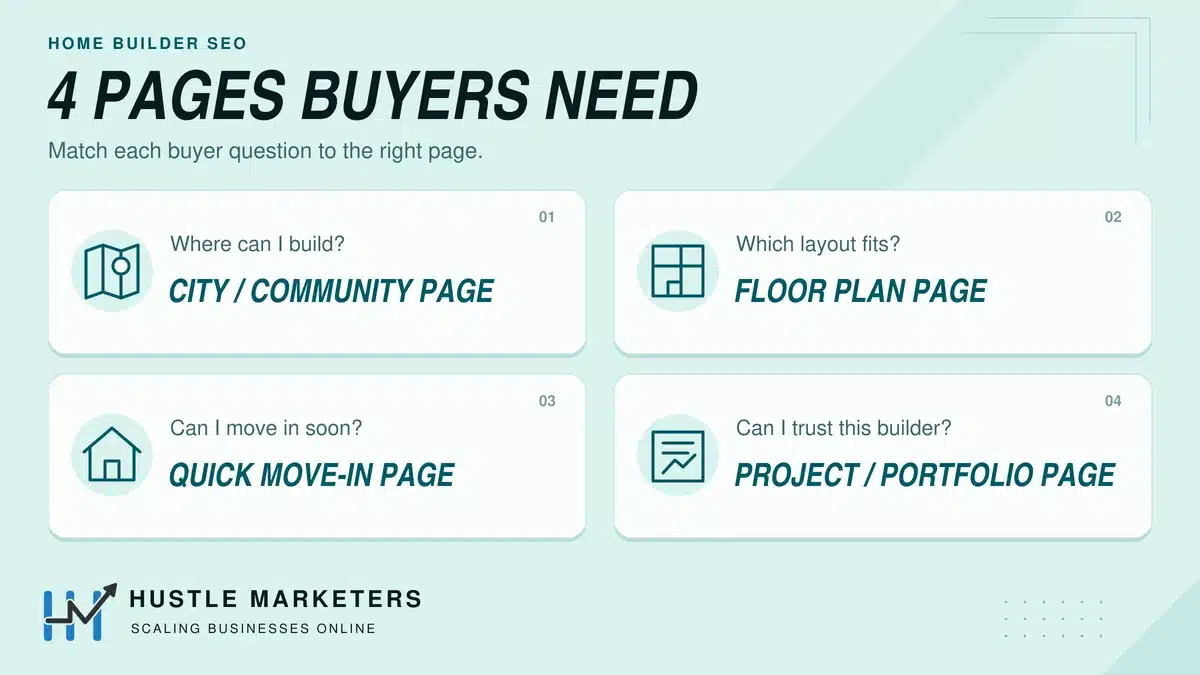
This is where most builder websites lose rankings. Here is the structure we recommend:
| Page type | Purpose | Must include |
|---|---|---|
| Homepage | Brand searches and overview | What you build (production, custom or build-on-your-lot homes), where you build, price ranges, featured communities, reviews |
| City or area hub | “New homes in [city]” searches | Every community and available home in that city, price ranges, schools served, commute notes, map |
| Community page | “[Community] homes” searches and visits | Overview, price range, available plans, quick move-in homes, lot map, HOA fees, amenities, schools, directions, sales office hours, FAQs |
| Floor plan page | Plan name searches and comparisons | Square footage, beds, baths, garage size, elevations, interactive plan, options, where it is offered, starting price by community |
| Quick move-in home page | Ready-now buyers | Address or lot, price, estimated completion, photos or clearly labeled renderings, included features, incentives with dates |
| Build-on-your-lot page | Buyers with land | Service area, lot evaluation steps, site costs, plan library, financing |
| Portfolio or project pages | Custom builder trust | Real photos, project scope, location, timeline, budget range where the client allows |
| Pricing and what is included | Budget research | Price ranges, standard features list, options and upgrade examples |
| Process and warranty | Trust | Build steps, timeline, inspections, warranty coverage |
| Working with Realtors | Agent and buyer questions | Your co-broke or agent policy and agent registration rules |
| Financing and incentives | Affordability | Preferred lender details, current incentives with end dates and terms |
| Reviews page | Trust | Real reviews with context, links to your Google profile |
| About and team | E-E-A-T | Company history, license numbers where required, memberships, key people |
What should a community page include?
A thin community page with a paragraph, a gallery and a form rarely ranks. A strong community page answers what buyers ask your sales team:
- Price range for plans and available homes, not just “from the $400s”. Greg Bray of Blue Tangerine made this point on the Builder Marketing Podcast: price ranges help AI tools match your homes to a buyer’s budget.
- Available plans with beds, baths, square footage and links to plan pages.
- Quick move-in homes with price, status and completion date.
- Lot map or site plan with lot status.
- HOA fees, special district taxes and what the HOA covers.
- Amenities with real photos once built.
- School district and schools served, stated as facts with a link to the district’s boundary tool.
- Commute and nearby places, such as distance to major employers, highways and shopping.
- Sales office hours, address, phone and directions.
- FAQs from real sales team questions.
- Reviews from buyers in that community, if you have them.
How do you avoid duplicate content when the same floor plan is in several communities?
Pick one of two systems and use it consistently:
- One master plan page: a single URL per plan that lists every community where it is offered, with pricing by community. Community pages link to it. This is the simplest option for most builders.
- Community-specific plan pages: one page per plan per community, only if each page carries unique content, such as different elevations, lot types, prices, options or photos. Point near-identical versions to the master page with a canonical tag.
Google treats rel=”canonical” as a strong signal for choosing between duplicate or very similar URLs, but it can still pick a different page (Google Search Central: canonical URLs). Do not canonicalize different homes to one page. In a 2020 r/SEO thread, someone working on a builder’s site planned to canonicalize every quick possession home page to a city quadrant page and asked whether to chain those canonicals. Distinct homes with different addresses, prices and specs are not duplicates, so each live listing should be indexable.
Should home builders create city pages for every town they serve?
Only when the page has something unique for that town. Google’s spam policies list “having multiple domain names or pages targeted at specific regions or cities that funnel users to one page” as an example of doorway abuse (Google spam policies). A city page with the communities, homes, prices, schools and commute facts for that city is useful. Fifty town pages with the same paragraph and a swapped city name are not.
The same question came up in an April 2026 r/SEO thread about a luxury builder in Pittsburgh. Replies pushed toward content built on real buyer questions, and one questioned how many luxury buyers search online at all, recommending networking, home shows and branded signs. We agree. For a custom builder, a few strong area pages with real projects beat a long list of thin ones.
Why should home builders publish a “Working with Realtors” page?
Buyers worry that contacting a builder first will stop their agent from representing them. On Blind and City-Data, buyers and agents say some builders will not add an agent if the buyer visited or registered without one first. A clear page that explains your agent registration rules, plus a note on your inquiry forms, answers the question before it costs you a sale. Since NAR’s August 2024 practice changes, offers of compensation can no longer be published on the MLS but can still be communicated off the MLS (NAR settlement FAQs), so your own site is a natural place for your agent program details.
How do Zillow, NewHomeSource and MLS listings affect home builder SEO?
Most builders send the same community descriptions, plan details and photos to Zillow’s New Home Feed, NewHomeSource and the MLS. Those sites usually have far more authority than a builder website, so they can outrank the builder for the builder’s own community and plan names.
Google’s documentation notes that a canonical link element “is not recommended for those who want to avoid duplication by syndication partners, because the pages are often very different” (Google Search Central: canonicalization troubleshooting). Portals will not add a canonical to your site anyway. What works instead:
- Keep the richest version on your site. Your community page should have more than any portal: HOA details, lot map, school facts, FAQs, video and current incentives.
- Write shorter, different descriptions for feeds. Do not paste the same 400 words everywhere.
- Link portal listings to the matching community page, not your homepage.
- Own your branded search results with the community page, the sales office profile and a YouTube community tour.
- Watch for stale listings. Sold homes and closed communities left live on portals frustrate buyers and send them to competitors.
How do you handle SEO when a community sells out?
Sold-out communities and sold quick move-in homes are where builder sites collect broken links and soft 404 errors. Use this decision table:
| Situation | Best action | Why |
|---|---|---|
| Community sold out, still gets branded searches or has good links | Keep the page live as a past community page with photos, a short history and links to nearby active communities | Homeowners, resale buyers and agents still search the name |
| Community sold out, new phase or next section has a clear replacement page | 301 redirect to the new phase page | Google recommends redirects when a page has moved or has a clear replacement |
| Community sold out, thin page, no searches, no links | Return a 404 or 410 and remove internal links | A redirect to an unrelated page does not help buyers |
| Quick move-in home sold | Keep it live for a short time marked “Sold” with links to similar available homes, then return a 404 or 410. Redirect only if another home with the same plan in the same community is still available | Buyers who saved the link see a clear answer |
| Floor plan retired | 301 to the closest replacement plan, or keep a retired plan page if homeowners still search it | Plan names keep getting searched by owners and resale buyers |
Google’s crawl error documentation recommends 301 redirects when a page “has moved or has a clear replacement” and 404 or 410 for pages that no longer exist (Google Search Central). One detailed builder guide we reviewed recommends redirecting a sold-out community to the nearest active community or turning it into a neighborhood guide. A different community is usually not a clear replacement, so we prefer the past community or neighborhood page.
Keep your XML sitemap clean as inventory changes. Google ignores the priority and changefreq values in sitemaps, but uses lastmod when it is “consistently and verifiably accurate” (Google Search Central: sitemaps). Update lastmod when a price, status or plan actually changes, and remove sold URLs you no longer serve.
What advertising rules apply to home builder SEO content?
Your website, Google Business Profile, blog posts and social posts are advertising for the sale of dwellings. Federal rules at 24 CFR 100.75 make it unlawful to publish an advertisement that indicates a preference, limitation or discrimination based on race, color, religion, sex, handicap, familial status or national origin, including through words, photographs or illustrations (24 CFR 100.75). State and local laws can add more protected classes.
The safest rule is simple: describe the home and the community, not the buyer you want.
| Risky copy | Safer copy |
|---|---|
| “Perfect for young families” | “Four bedrooms, a fenced yard and a community playground” |
| “Ideal for empty nesters” (unless the community qualifies as housing for older persons) | “Single-level plans with a main floor primary suite” |
| “Perfect for young professionals” | “Home office, loft and a 15 minute drive to downtown” |
| “Exclusive neighborhood” | “Gated community with 120 homesites” |
| “Best schools for your kids” | “Served by [district name]. Confirm school assignments with the district” |
Terms that describe the property, such as “family room”, “master bedroom”, “cozy” or “desirable neighborhood”, are generally treated as lawful descriptions under HUD’s 1995 advertising guidance memo (HUD guidance memo copy). That memo does not cover photos of people, but 24 CFR 100.75 lists photographs and illustrations, so show a range of people in lifestyle imagery.
A Federal Register notice published in April 2026 listed HUD’s 2024 guidance on digital platform housing advertising as withdrawn, while stating that actions that do not comply with the Fair Housing Act remain subject to enforcement (Federal Register). The law still applies to how you choose media and audiences. Have counsel review your advertising and targeting.
Why does the Google Ads housing policy make SEO more valuable for builders?
In the US and Canada, Google does not allow housing ads to target by gender, age, parental status, marital status or ZIP code (Google Ads housing policy). Paid campaigns still work, but you cannot narrow them the way many advertisers are used to. Organic pages built around communities, cities, plans and schools reach the same buyers without those targeting settings. We run both, and our Google Ads team plans paid and organic around the same community pages.
How do you do technical SEO for a home builder website?
Builder sites are heavy: large galleries, video tours, interactive lot maps and floor plans. Here is what to check:
| Area | What to check | Fix |
|---|---|---|
| Page speed | Largest Contentful Paint on community and plan pages with big hero images | Compress hero images, serve WebP or AVIF, set width and height, lazy load galleries below the fold |
| Interactivity | Interaction to Next Paint (INP) on interactive floor plans, lot maps and filters. Good INP is 200 milliseconds or less | Load map and plan tools only when a buyer opens them, and reduce heavy third party scripts |
| Layout stability | Pop-ups and chat widgets pushing content | Reserve space for widgets and delay non-essential pop-ups |
| Crawlability | Inventory hidden behind JavaScript filters or iframes | Make sure every community, plan and home has a crawlable HTML link |
| Duplicate URLs | Filter and sort parameters creating thousands of URLs | Canonical filter URLs to the main listing page and keep parameters out of sitemaps |
| Sold inventory | Soft 404s from sold homes returning a 200 “not available” page | Use the lifecycle table above |
| Images | Renderings named IMG_4492.jpg with no alt text | Descriptive filenames, useful alt text, and label renderings as renderings |
| Tracking | Forms and calls not recorded | GA4 key events, call tracking and CRM lead source fields |
Interaction to Next Paint replaced First Input Delay as a Core Web Vital in March 2024 (web.dev). Builder sites should watch it closely, because interactive floor plans and lot maps are the kind of feature that slows the response to a tap or click. Our Core Web Vitals and INP guide covers the fixes in more detail.
Should home builders label renderings on their website?
Yes. Buyers compare what they see online with what gets built. Label artist renderings and model photos with upgraded options clearly, and add real photos once homes are finished. For search, give images short descriptive filenames and alt text, keep them near relevant text, and consider an image sitemap for large galleries (Google Search Central: image SEO).
What schema markup should a home builder use?
Be honest about what schema does. Google’s list of supported rich results has no feature for new homes or real estate listings for sale (Google Search Central: search gallery), and FAQ rich results stopped showing in May 2026. Schema still helps search engines and AI systems understand your business, homes and prices.
Use:
- Organization on your homepage.
- LocalBusiness for each sales office, using the most specific type that fits. Schema.org has no HomeBuilder type, even though one popular builder guide recommends it. GeneralContractor or HomeAndConstructionBusiness are the closest options (Schema.org).
- BreadcrumbList on community, plan and home pages.
- Event for grand openings and model home events.
- VideoObject for community tours.
- RealEstateListing, SingleFamilyResidence and FloorPlan, with an Offer on the listing, to describe available homes, plans and prices (Schema.org: RealEstateListing).
Example for a quick move-in home (replace every value with real data):
{
  "@context": "https://schema.org",
  "@type": "RealEstateListing",
  "name": "The Aspen at 1428 Willow Creek Drive",
  "url": "https://example.com/communities/willow-creek/1428-willow-creek-drive/",
  "datePosted": "2026-09-01",
  "offers": {
    "@type": "Offer",
    "price": 489900,
    "priceCurrency": "USD",
    "availability": "https://schema.org/InStock"
  },
  "mainEntity": {
    "@type": "SingleFamilyResidence",
    "name": "The Aspen at 1428 Willow Creek Drive",
    "address": {
      "@type": "PostalAddress",
      "streetAddress": "1428 Willow Creek Drive",
      "addressLocality": "Georgetown",
      "addressRegion": "TX",
      "postalCode": "78628",
      "addressCountry": "US"
    },
    "numberOfBedrooms": 4,
    "numberOfBathroomsTotal": 3,
    "floorSize": {
      "@type": "QuantitativeValue",
      "value": 2450,
      "unitCode": "FTK"
    },
    "accommodationFloorPlan": {
      "@type": "FloorPlan",
      "name": "The Aspen",
      "url": "https://example.com/floor-plans/the-aspen/"
    }
  }
}
Validate your markup with the Schema Markup Validator and keep prices in the markup identical to prices on the page.
How do home builders show up in AI search?
AI Overviews show up less often on home searches than on many other topics. Ahrefs found AI Overviews on 5.8% of real estate queries and 7.9% of local queries, compared with 20.5% across all keywords, in desktop results from September 2025 (Ahrefs). Semrush also found real estate among the industries with the fewest AI Overviews (Semrush). Where they do appear, clicks tend to fall. Across all topics, Ahrefs found that an AI Overview correlated with a 58% lower average click-through rate for the top ranking page (Ahrefs).
For builders, that means:
- Transactional searches such as “quick move in homes [city]” or “new homes in [community]” still send clicks to community and inventory pages and to the map pack.
- Research questions such as “is it cheaper to build or buy” or “what is a HERS score” are where AI answers take clicks. Answer them briefly and clearly on your site, but do not expect the same traffic.
- Conversational questions are growing. Buyers now ask AI assistants for communities near a school or employer within a budget. Pages that state price ranges, school districts, commute facts, HOA fees and plan specs clearly are easier for these tools to use.
Google says there are no extra requirements or special optimizations needed to appear in AI Overviews or AI Mode, and no special AI text files or markup are required (Google Search Central: AI features). Clear, accurate, crawlable pages do the work. Microsoft Copilot uses Bing, so claim your Bing Places for Business listings too. Our guides on ranking in ChatGPT search and tracking brand visibility in AI search explain how to measure this.
Which popular home builder SEO tips are wrong or outdated?
We checked the top ranking guides against Google’s documentation and current rules. Most advice is sound, but these tips can hurt you:
| Popular tip | Where we saw it | The problem | Better approach |
|---|---|---|---|
| Create a Google Business Profile for every model home | An in-depth home builder SEO guide | Model homes are ineligible. Staffed sales offices are eligible | One profile per staffed sales office with posted hours |
| Use “HomeBuilder” schema | The same guide | Schema.org has no HomeBuilder type | Organization, LocalBusiness subtype, and home, plan and offer types |
| Add FAQ schema for extra space in search results | An in-depth home builder SEO guide | FAQ rich results stopped showing in May 2026 | Keep FAQs for buyers and AI answers |
| Redirect sold-out communities to the nearest active community | The same guide | A different community is rarely a clear replacement | Past community page, clear 301s only for true replacements, or 404/410 |
| Create pages for every major city, subdivision and community you serve | A builder SEO guide in the extended results | Few builders can make every page unique at that scale, and thin, repeated city pages can become doorway pages | City pages only with unique communities, homes and local facts |
| Optimize for “SGE” | A builder SEO agency site | SGE became AI Overviews in May 2024 | Clear, crawlable pages. No special AI markup needed |
| Promises like “Page 1 Rankings in 90 Days” | A builder SEO agency site | Google says no one can guarantee a number one ranking, and timelines depend on the market | Ask for a plan, milestones and lead reporting |
| Case studies from HVAC and plumbing companies on a builder page | A general agency’s builder page | They do not show builder results | Ask for builder or high-ticket local results with dates |
| Calling it “Google My Business” | Several guides | Renamed Google Business Profile in 2021 | A sign the advice may be old. Check the date |
What are builders and buyers saying about home builder SEO?
We read builder and buyer discussions to find the problems that do not show up in keyword tools:
- Profiles for communities are the most confused topic. Local Search Forum threads going back to 2014 ask whether each community can have a listing. In the 2014 thread, a well-known practitioner first asked whether each community office was staffed during business hours, which is the same test Google’s current rule applies.
- Trades and small builders doubt marketing. In an r/Construction thread from February 2026, two carpenters said they had never advertised and got their work through referrals and networking. For custom builders, SEO works best as proof that supports referrals: portfolio pages, reviews, process and price ranges that referred buyers check before calling.
- Buyers want prices and included features up front. On City-Data, buyers advise getting the standard features and upgrade price lists before making an offer. On r/RealEstate, a Denver area buyer asked in June 2026 whether it is normal for a builder not to provide a standard features list. On Houzz, a Texas buyer objected to paying $5,000 to $10,000 for plans before getting a fixed price. Pages that answer these questions earn trust and leads.
- Builders are unsure how to vet agencies. An August 2026 r/Construction post asked contractors how to pick a good marketing agency, and a September 2026 post described an offer of a daily fee plus a share of revenue from closed leads. Owners need clear questions to ask. We cover them below.
- Slow follow-up wastes SEO leads. A mystery shop of 50 builders discussed on the Builder Marketing Podcast in April 2026 reported that only 20% responded within 30 minutes and 42% never called. More traffic will not fix a slow follow-up process.
How do you track home builder SEO to contracts and closings?
Rankings are an early signal. Contracts and closings are the result. Because buyers may sign months after the first visit, set up tracking before you judge SEO:
| Stage | What to track | How |
|---|---|---|
| Visibility | Rankings for community, plan and city searches, map pack rank, AI prompt mentions | Search Console, a local rank grid tool, a monthly prompt sheet |
| Profile actions | Calls, direction requests and website clicks from sales office profiles | Google Business Profile performance |
| Website leads | Appointment requests, contact forms, calls, brochure or plan downloads, agent registrations | GA4 key events and call tracking. See our guide to using GA4 for marketing |
| Visits | Sales center visits and model tours by lead source | Your CRM, with lead source captured at the first visit |
| Contracts | Contracts written by source and community | CRM or sales management software |
| Closings | Closed homes and revenue by source | CRM connected to closing data |
Search Console includes traffic from AI Overviews and AI Mode in the Performance report under the Web search type (Google Search Central). In GA4, create a custom channel group for AI assistant referrals so you can see visits from tools such as ChatGPT and Perplexity.
The math that matters: if one closing brings in $80,000 of gross margin, one extra closing from organic search each quarter covers a strong SEO program many times over. Use your own margin numbers, and check them with our SEO ROI calculator.
How long does SEO take for home builders?
In our local SEO work, and in the timelines builder-focused agencies publish, early movement usually shows in two to four months and steady organic leads in six to twelve months. It depends on your market, your website’s authority, how many communities you have, and how much portal competition you face. A new community page can rank for its own name quickly if it is strong and well linked. City and “new homes near me” searches take longer. Plan community pages before the grand opening, not after, and add the sales office profile with an opening date so it appears before launch.
What does a 90 day home builder SEO plan look like?
| Days | Focus | Output |
|---|---|---|
| 1 to 30 | Audit and tracking | Profile eligibility check, name and category cleanup, keyword and page map, GA4 and CRM lead source setup, technical audit |
| 31 to 60 | Core pages | Rebuilt community pages, floor plan system, quick move-in templates, city hubs where they are justified, schema |
| 61 to 90 | Trust and authority | Review process, Realtor page, pricing and included features page, HBA and Parade of Homes listings, portal description rewrite, first buyer guides |
How much does SEO for home builders cost?
Most published prices come from agencies that sell the service, so use them as ranges, not rules:
| Source | Published price | Link |
|---|---|---|
| Builder SEO guide from a national agency (updated August 2026) | Most builder SEO engagements fall between $1,500 and $3,000 a month depending on scope | HigherVisibility |
| Large agency home builder page | Local SEO starting at $575 a month | WebFX |
| Survey of 439 SEO providers (all industries, 2023, updated 2024) | Average monthly retainer $2,917 | Ahrefs |
| Marketplace data from client reviews (all industries) | Average monthly SEO cost $3,199 | Clutch |
As a rough guide, single-market custom builders usually sit at the lower end, while production builders with many communities and markets need more pages, more technical work and more reporting. Put the budget next to NAHB’s benchmark of $5,633 of marketing per home. For a builder closing 40 homes a year, that benchmark works out to about $225,000 of total marketing a year, so SEO is usually a small share. That figure is our math from NAHB’s average, not an NAHB statistic. Our SEO audit cost guide explains what an audit should include and what it usually costs.
What should home builders look for in an SEO agency?
- Do they know that model homes cannot have Google Business Profiles but staffed sales offices can?
- How will they structure community, floor plan and quick move-in pages without thin or duplicate pages?
- How will they handle portal duplication and sold-out community URLs?
- Do they understand Fair Housing advertising rules?
- Will they report appointments, visits, contracts and closings, not just rankings and traffic?
- Who owns the website, the Google Business Profiles, Search Console and GA4? The answer should be you.
- How do they get reviews without incentives or selective asking?
- How do they build links, and will they avoid paid link schemes?
- Can they show dated results from builders or other high-ticket local businesses?
Walk away from guaranteed rankings, keyword-stuffed profile names, fake reviews and long contracts with no lead reporting.
How Hustle Marketers helps home builders with SEO
I have worked in digital marketing since 2013, and my team runs SEO, Google Ads and Microsoft Ads for local and high-ticket businesses where trust decides who gets the visit. For home builders, that means we build pages around communities, plans and available homes, keep profiles within Google’s rules, write copy with Fair Housing guidance in mind and flag questions for your counsel, and track results to appointments and contracts.
Proof from our local SEO work:
- Two-location, trust-driven service business: CMSC Parker CDL grew organic traffic from under 800 to 1,900 monthly visits (at least 2.4X) and built AI citation presence across ChatGPT, Gemini and Google AI Overviews. Read the case study.
- Bilingual local SEO: CMSC Driving School moved from page 10 to page 1, lifted click-through rate from 2.7% to 4.3% and increased organic leads by 35%. Read the case study.
- Related trades: our guides to real estate SEO, roofing SEO, contractor marketing and home improvement SEO cover the same local search problems from other angles.
Our process for a home builder:
- Audit: profiles, reviews, website structure, portal listings, technical issues, compliance risks and tracking.
- Keyword and page map: community, city, plan, inventory, custom and buyer research searches ranked by value.
- Foundation: profile cleanup, sold inventory handling, technical fixes and CRM lead source tracking.
- Pages: community, plan, quick move-in, pricing, Realtor and process pages written from your sales team’s real questions.
- Reviews and authority: a compliant review process, association and Parade of Homes listings, portal copy rewrites and local links.
- AI visibility: consistent business, pricing and community data, clear answers and monthly prompt tracking through our AI SEO services.
- Reporting: calls, appointments, visits and contracts from search every month.
If you want to see where buyers are finding competitors instead of you, our SEO services team can start with an audit.
Client example: SEO for a Northern Virginia remodeling contractor
- Client: JBL Construct, a remodeling contractor in Northern Virginia, named in our published case study. This is the closest comparable account: remodeling rather than new home building.
- What we did: technical SEO, indexing fixes and a content plan built around how homeowners research a project over weeks rather than in an afternoon.
- Results: the client describes the outcome in its own review, so we do not restate those figures here.
Full breakdown: remodeling contractor SEO case study.
Home Builder SEO FAQs
What is home builder SEO?
Home builder SEO is the work of ranking a home building company, its communities, floor plans and available homes in Google Search, Google Maps and AI assistants, so buyers find them before they find a portal or a competitor, and then book a visit.
Can a model home have a Google Business Profile?
No. Google lists model homes as ineligible. A sales office inside a model home can have a profile if it is staffed during its posted hours.
How do home builders get more leads from Google?
Build strong community, floor plan and quick move-in pages with prices, specs and local facts. Set up eligible Google Business Profiles for staffed sales offices, get honest reviews from every buyer, and follow up with online leads quickly.
Is SEO or Google Ads better for home builders?
Use both. Google Ads can fill a new community quickly, but US housing ads cannot target by age, gender, parental status, marital status or ZIP code. SEO builds lasting visibility for community, city and plan searches that keeps working after ad budgets end.
How do I stop Zillow from outranking my community page?
Make your community page the most complete source, use shorter and different descriptions in portal feeds, link portal listings to the community page, and support the page with a sales office profile, reviews and a video tour.
Should each floor plan have its own page?
Yes, each plan should have one main page with its specs, elevations and where it is offered. Create community-specific versions only when they have unique pricing, lots, options or photos.
What happens to SEO when a community sells out?
Keep a useful past community page if the name still gets searched, redirect only to a clear replacement such as the next phase, or return a 404 or 410 for thin pages with no value. Update your sitemap and internal links.
How much does SEO cost for a home builder?
Published prices vary widely. Builder-focused agencies quote from about $1,500 to $5,000 a month for most programs, entry local SEO packages start from around $575 a month, and multi-market programs can cost $10,000 a month or more. Compare the cost with the margin from one extra closing.
Do Fair Housing rules apply to home builder websites?
Yes. Federal rules cover notices, statements and advertisements for the sale of dwellings, including words and photos that indicate a preference based on a protected class. Describe homes and communities, not the buyers you want.
Sources and verification
Facts that can change were checked on September 17, 2026 against these sources:
- Google Business Profile eligibility guidelines
- Google guidelines for representing your business
- Google Business Profile Help: how local results are ranked
- Google Business Profile Help: opening date
- Google Maps user contributed content policy
- Google Ads housing policy
- Google Search Central: canonical URLs
- Google Search Central: canonicalization troubleshooting
- Google Search Central: crawl errors
- Google Search Central: sitemaps
- Google Search Central: spam policies
- Google Search Central: image SEO
- Google Search Central: structured data search gallery
- Google Search Central: review snippets
- Google Search Central: AI features and your website
- web.dev: INP becomes a Core Web Vital
- Schema.org: HomeAndConstructionBusiness
- Schema.org: FloorPlan
- 24 CFR 100.75
- Federal Register: withdrawal of HUD guidance documents, April 6, 2026
- FTC Consumer Reviews and Testimonials Rule Q&A
- NAR settlement FAQs
- NAR 2025 Profile of Home Buyers and Sellers highlights
- US Census Bureau: New Residential Sales, July 2026 release
- NAHB/Wells Fargo Housing Market Index, September 2026
- NAHB: Cost of Constructing a Home in 2024
- BrightLocal Local Consumer Review Survey 2026
- Ahrefs: what triggers AI Overviews
- Ahrefs: AI Overviews and click-through rates
- Semrush AI Overviews study
- Ahrefs SEO pricing survey
About the author: Ishant Sharma has worked in digital marketing since 2013 and is a Google Ads, Microsoft Ads and SEO specialist. He is the founder of Hustle Marketers, a Google Partner and Meta Business Partner agency serving local service, professional service, lead generation and ecommerce businesses across the US, UK, UAE and Australia. Businesses he and his team have worked with include CMSC Driving School, CMSC Parker CDL, Armorpoxy, Rec Hall, Estelle Bridal and Blake International Management. Trackable client sales across his work have passed $780M, and he is Top Rated Plus on Upwork. More about Ishant.
Related guides
If this one was useful, these cover the same ground for closely related businesses.