Roofing SEO: How Roofing Companies Get More Calls from Google, Maps and AI Search (2026 Guide)

Ishant
Published : September 18, 2026 at 6:30 pm
Updated : October 16, 2026 at 12:15 pm
Ishant
Written by Ishant Sharma, Google Ads, Microsoft Ads and SEO specialist since 2013 | Updated September 2026 | Facts checked September 17, 2026
Roofing is one of the most expensive local services to advertise. LocaliQ’s benchmarks put the average cost per lead for roofing and gutter search ads at $228.15, far above the home services average of $90.92 (LocaliQ). That is why roofing SEO matters: every call that comes from the map pack or an organic page is a lead you did not pay for, from a homeowner who already searched for exactly what you do.
But roofing SEO also has traps most guides skip. Google suspends roofing profiles that break its address and naming rules, templated city pages can fall under its spam policies, and several states make common storm ads illegal. This guide covers the full playbook, including the parts that keep your profile and license safe.
How we researched this guide: we read the 17 pages ranking in Google’s top results for “roofing SEO”, “SEO for roofers” and “roofer SEO”. We also used Semrush keyword and question data, Google’s documentation, state statutes, 13 YouTube videos from roofing marketers, and roofer discussions from the Google Business Profile Community, RoofingTalk, ContractorTalk and Facebook groups. Anything that changes often was checked against the primary source on September 17, 2026. This is marketing guidance, not legal advice. Check advertising questions with your attorney or state licensing board.
Key takeaways
- Roofing SEO means ranking your company in the map pack, organic results, directories and AI answers for the searches homeowners and property managers make before they call a roofer.
- Most roofers work from a shop or home, so Google’s service-area business rules decide whether your profile survives. Hide a home address, never use a virtual office and keep the business name real.
- Build one strong page per service and roof type, and city pages only where you can add real local proof. Hundreds of templated city pages can fall under Google’s spam policies.
- Never advertise that you will pay or waive a deductible. Texas, Florida, Colorado and Minnesota restrict it, and Florida requires specific disclosures on ads that encourage roof insurance claims.
- Google Guaranteed is gone. Local Services Ads now show the Google Verified badge, and the Money Back Guarantee only covers services booked before December 7, 2025.
- Measure signed jobs and cost per signed job, not rankings. Most roofers see steady organic jobs in 6 to 12 months, and competitive metros take longer.
Roofing and electrical often sit in the same portfolio, and the SEO does not transfer cleanly between them. Roofing is storm and insurance driven; electrical is licence driven and far less seasonal. Our electrician SEO guide covers that side. Landscaping is seasonal again in a different way, driven by growing seasons rather than storms, and our SEO for landscapers guide covers that one.
Table of Contents
- What is roofing SEO?
- Is SEO worth it for roofing companies?
- How do roofers rank in the Google Maps local pack?
- What keywords should roofing companies target?
- Which pages should a roofing website have?
- What are the insurance and deductible advertising rules for roofers?
- How do certifications, warranties and project photos help roofing SEO?
- Should roofers publish roof replacement cost and financing pages?
- How is commercial roofing SEO different?
- How do you do technical SEO for a roofing website?
- How do roofers show up in AI search and AI Overviews?
- Is SEO better than buying roofing leads from Angi or HomeAdvisor?
- How do you track roofing SEO leads to signed jobs?
- How long does roofing SEO take?
- How much does roofing SEO cost?
- How Hustle Marketers helps roofing companies with SEO
- Roofing SEO FAQs
What is roofing SEO?
Roofing SEO is the process of improving how a roofing company shows up in search engines so that homeowners and property managers who need a roof repair, replacement or inspection in your service area find you, trust you and call. It covers six areas:
- Local SEO: your Google Business Profile, reviews, citations and map pack rankings.
- Website content: service pages, roof type and material pages, city pages, cost and financing pages, storm response pages and project galleries.
- Technical SEO: site speed, mobile experience, crawlability and schema markup.
- Authority: manufacturer certifications, supplier and association listings, local media and community links.
- Paid and SEO overlap: how Local Services Ads, Google Ads and organic results work together.
- Measurement: calls, inspections booked and signed jobs traced back to search.
Why is SEO for roofers different from SEO for other contractors?
- Demand comes in bursts. A hailstorm can create more roof searches in a week than a normal month, and pages built after the storm are usually too late.
- Most roofers are service-area businesses. You go to the customer, so Google’s rules on hidden addresses and service areas decide how your profile works.
- Insurance jobs are regulated. Several states restrict what roofers can say about deductibles and insurance claims in advertising.
- Lead competition is intense. Angi, HomeAdvisor and Thumbtack buy the same keywords, and some contractors report shared leads being sold to as many as 16 competing businesses, according to Valley Marketing Group.
- Trust decides the job. A roof replacement is one of the biggest purchases a homeowner makes, so reviews, certifications, warranties and real project photos carry more weight than in most trades.
Is SEO worth it for roofing companies?
For most roofers, yes, because the alternatives are expensive. Compare the numbers:
| Lead source | Cost data | Source |
|---|---|---|
| Search ads, roofing and gutters | $228.15 cost per lead, $10.70 cost per click | LocaliQ benchmarks, April 2024 to March 2025 |
| Local Services Ads, roofing | $106.87 average cost per lead in 2026, up from $73.62 in 2025, from one agency’s managed campaigns (April to June each year) | 99 Calls |
| Roofing SEO retainer | $750 to $1,500 a month for a single city, up to $3,500 to $7,500+ for major metros, according to one roofing SEO agency | Built Right Digital |
The data on homeowners supports it too. A 2025 consumer trends report from ServiceTitan, Synchrony and Visa found 80% of homeowners begin their search online (ServiceTitan), and BrightLocal’s 2026 survey found 68% of consumers will only use a business with four or more stars (BrightLocal).
The catch is time. Paid leads start this week. SEO compounds over months, so most roofers run Local Services Ads or Google Ads while SEO builds, then shift budget as organic calls grow.
Should roofers use Local Services Ads or SEO?
Both, for different jobs. Local Services Ads sit at the top of the results and charge per lead. SEO wins the map pack and organic results without paying per call.
| Factor | Local Services Ads | SEO |
|---|---|---|
| Speed | Days to weeks after screening | Months |
| Cost model | Pay per lead | Monthly investment, no cost per call |
| Trust badge | Google Verified | Reviews, certifications and your own proof |
| Control | Limited, Google decides placement | Full control of pages and content |
| Keeps working when you stop paying | No | Yes, rankings fade slowly |
Google replaced the Google Guaranteed badge with Google Verified on October 20, 2025, and the Money Back Guarantee was discontinued (Google, Google Business Profile Community guide). Roofers still go through screening that can include business and owner checks, insurance and state licensing where applicable (Google Local Services help). If your website still says “Google Guaranteed roofer”, update it. Google also no longer gives credits for leads marked “job type not serviced” or “geo not serviced”, so set your services and service area carefully (Google). Our Local Services Ads guide covers setup in more detail.
How do roofers rank in the Google Maps local pack?
The map pack is one of the biggest sources of local roofing calls, and good local SEO is what gets you into it. Google ranks local results on relevance, distance and prominence, which for a roofer means a correctly set up Google Business Profile, a steady flow of real reviews and consistent details across the web.
How should a roofing company set up its Google Business Profile?
Follow Google’s Business Profile guidelines closely. Roofing is a high-spam category, and suspensions are common.
- Name: use your real-world business name as it appears on your trucks, yard signs and website. Google says “Including unnecessary information in your business name isn’t permitted, and could result in the suspension of your Business Profile.”
- Primary category: “Roofing contractor” for most companies, with secondary categories only for services you actually provide, such as gutter or siding work.
- Address: if customers do not visit your office, set up as a service-area business and hide the address. Google says a home-based business should clear its address from the profile.
- Service area: list the cities or ZIP codes you serve. Google says the service area shouldn’t extend farther than about 2 hours of driving time from where you are based.
- No virtual offices: a rented mailing address you do not operate from “isn’t eligible for a Business Profile”. Co-working offices only qualify with clear signage, staff and customers received during business hours.
- One profile per location: Google says not to create more than one profile for each location.
- Photos and updates: real job photos, crews, trucks and finished roofs. Post project updates, storm response notices and seasonal maintenance tips.
For the full walkthrough, see our guide on how to optimize a Google Business Profile.
Why do roofing Google Business Profiles get suspended?
The Google Business Profile Community is full of roofing suspension threads, with titles like “Suspended Roofing SAB”, “We are Roofing Contractor, Suspended” and “Google Support Claims Residential Roofer is ineligible for a Google Business Listing”. The most common causes:
- Keywords added to the business name, or a DBA registered only to add keywords
- Showing a home address instead of hiding it
- Virtual offices or rented suites used to appear in more cities
- Multiple profiles for the same business
- Edits that change the nature of the business, such as switching the name and category to a different trade, which Google says are often fraudulent
- Lead generation profiles, including “rank and rent” listings (Google lists lead generation agents or companies as ineligible) (Google Business Profile policies)
Some roofing marketing videos on YouTube recommend risky tactics, from registering a DBA just to add keywords to asking contractor friends for reviews. If you are suspended, fix the cause, then appeal with your business license, contractor license, insurance certificate and photos of branded vehicles or signage. Do not create a new profile while an appeal is open.
How can roofers get more Google reviews without breaking the rules?
Reviews drive search engine rankings in the map pack and help close jobs with potential customers. BrightLocal’s 2026 survey found 74% of consumers look for reviews written in the last three months, so steady review flow beats a one-off push.
- Ask every customer when the job is complete, by text or email with a direct review link or QR code.
- Never offer incentives. Google says offering free or discounted goods or services for reviews “is considered fake & misleading content and is strictly prohibited” (Google Business Profile Help).
- No reviews from people with a conflict of interest. Google’s policy covers current or former employees and “a contractual or consultory relationship” (Google Maps content policy). That rules out subcontractors, suppliers and contractor friends who have never hired you.
- Ask everyone, not just happy customers. Google bans selectively soliciting positive reviews.
- Reply to every review, thanking customers by first name and mentioning the type of work in natural language, without stuffing keywords.
The FTC’s rule on consumer reviews and testimonials also bans fake and undisclosed insider reviews (FTC), and FTC warning letters sent in December 2025 say courts can impose civil penalties of up to $53,088 per violation (FTC warning letter template).
What keywords should roofing companies target?
Group roofing keywords by the homeowner’s situation. Emergency and replacement searches bring the highest-value calls, while cost and financing searches come from people comparing quotes.
| Intent | Example searches | Best page | Priority |
|---|---|---|---|
| Emergency repair | roof leak repair near me, emergency roof tarp [city] | Roof repair page and Google Business Profile | Highest |
| Replacement | roof replacement [city], new roof cost [city] | Replacement page and cost page | Highest |
| Storm damage | hail damage roof inspection [city], wind damage roof repair | Storm damage page | High, seasonal |
| Roof type and material | metal roof installation [city], TPO roofing contractor, tile roof repair | Material pages | High |
| Commercial | commercial roofing contractor [city], flat roof repair | Commercial roofing pages | High for commercial roofers |
| Cost and financing | how much does a new roof cost, roof financing near me | Cost guide and financing page | High |
| Maintenance and gutters | roof inspection cost, gutter replacement [city] | Service pages | Medium |
| Research | how long does a shingle roof last, signs you need a new roof | Helpful articles that link to service pages | Medium |
Do your keyword research in Semrush, Ahrefs or Google Keyword Planner. Many city-level searches show little volume in tools but still bring in jobs, so check your call logs and form submissions for the exact words customers use.
Which pages should a roofing website have?
Your website needs a clear page for every service, roof type and core city you want to rank for, backed by proof that you do the work.
What should a roofing service page include?
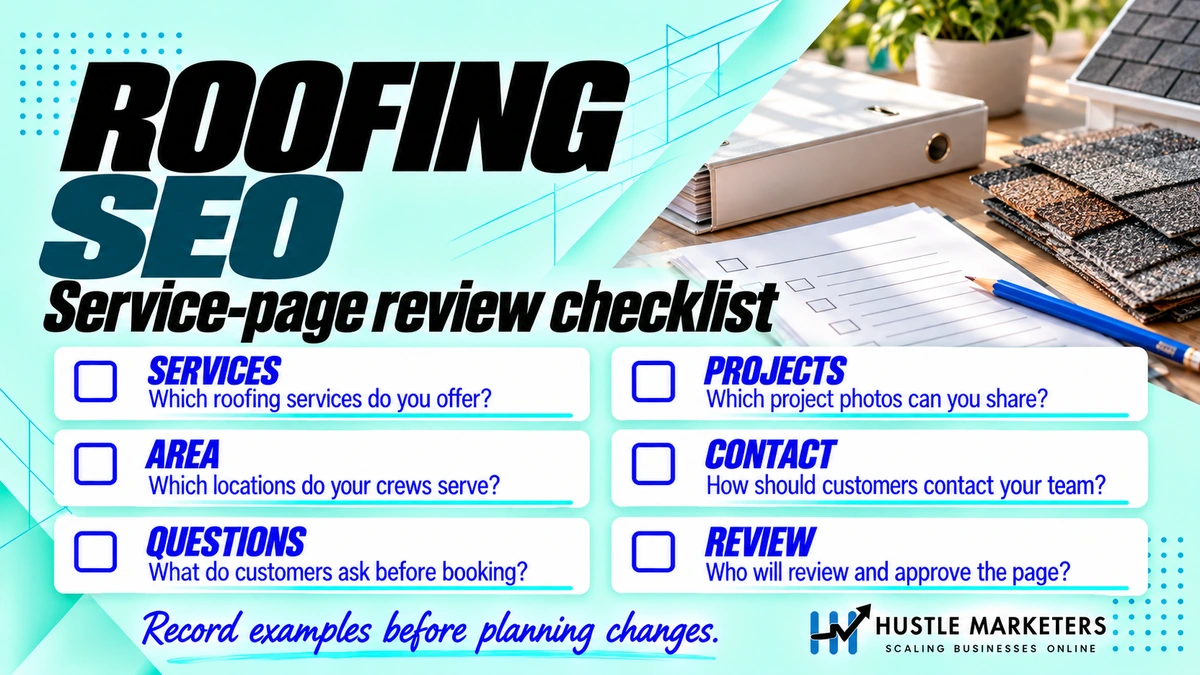
| Section | What to include | Why it helps |
|---|---|---|
| Clear H1 and intro | Service plus main city, who you help and how fast you respond | Relevance and a quick answer |
| Signs you need this service | Symptoms homeowners notice, in plain words | Matches problem searches |
| Process | Inspection, estimate, timeline, cleanup, final walkthrough | Reduces fear of the unknown |
| Materials and options | Shingle lines, metal, tile, TPO, with pros and cons | Expertise and long-tail relevance |
| Cost factors | What changes the price: size, pitch, layers, materials, permits | Answers the most common question |
| Warranties and certifications | Manufacturer certification tier and warranty options you can actually offer | Trust, if accurate and current |
| Project gallery | Real before and after photos from local jobs | Proof that templates cannot copy |
| Reviews | Reviews mentioning this service | Conversion |
| FAQs | Real customer questions from estimates and calls | Question searches and AI answers |
| License and insurance | License number where your state requires it | Compliance and trust |
| Call to action | Phone, text, free inspection form and response time | Conversions, especially on mobile |
Do roofing companies need city pages?
Only where you have a real reason to be in that city. Google’s spam policies list “Having multiple domain names or pages targeted at specific regions or cities that funnel users to one page” as an example of doorway abuse, and scaled content abuse covers pages “generated for the primary purpose of manipulating search rankings”. One roofing marketing video on YouTube describes adding 400 location pages for clients. That volume of software-generated pages is the kind of scaled approach these policies warn about.
Use a simple test before publishing a city page: could this page only be about this city? A strong city page includes:
- Real projects completed in that city, with photos and the type of roof
- Local conditions, such as hail frequency, HOA rules or building permit steps for that city
- Reviews from customers in that area
- Response times and crew locations that serve it
- Links to the relevant service pages
If you cannot add that proof yet, target the city on your main service pages and in your Google Business Profile service area instead. Our programmatic SEO guide explains when large page sets work and when they backfire.
How do roofers prepare for storm and hail searches?
Build storm pages before storm season, not the day after. Roofing marketers on the ranking pages make the same point: a page written the morning after a hailstorm rarely ranks in time.
- Publish an evergreen storm damage hub covering hail, wind and fallen tree damage, what to check, and how your inspection works.
- Add a dated storm update section you can refresh after major local events, with links to official weather sources such as the NOAA Storm Prediction Center.
- Post on your Google Business Profile when a storm hits, with your response times and crew availability.
- Keep your review flow steady, because homeowners compare roofers fast after storms.
- Show local proof, such as your license, years in business and a permanent address or service area history, to separate you from out-of-town storm chasers.
What are the insurance and deductible advertising rules for roofers?
This is the section most roofing SEO guides skip entirely, and it can affect your license. Several states restrict roofing ads that offer to cover a homeowner’s insurance deductible or encourage insurance claims. I am not a lawyer, so review your copy with counsel, but here is what the statutes say:
| State | Rule | What it means for your website, profile and ads |
|---|---|---|
| Texas | Business and Commerce Code 27.02 makes it an offense to advertise or promise to pay, waive, absorb or rebate an insured’s deductible without the insurer’s consent. It is a Class B misdemeanor (Texas statute) | Never write “we pay your deductible” or “deductible assistance” |
| Florida | Statute 489.147 bans ads that encourage a roof insurance claim unless they state three disclosures in at least 12-point font and at least half the size of the largest font, and bans gifts, gift cards or deductible waivers in exchange for an inspection or claim. Fines can reach $10,000 per violation (Florida statute) | Storm pages and ads that mention insurance claims need the disclosures, and “free gift with inspection” offers are out |
| Colorado | C.R.S. 6-22-105 says a roofing contractor “shall not advertise or promise to pay, waive, or rebate all or part of any insurance deductible” (Colorado statute) | Same as Texas: no deductible promises |
| Minnesota | Statute 325E.66 bars residential contractors from advertising or promising to pay all or part of an insurance deductible (Minnesota statute) | No deductible promises, and no offers to pay homeowners for providing any service |
Also avoid phrases like “we handle your insurance claim” or “we negotiate with your adjuster”. In Minnesota, Florida and Colorado, interpreting policies or adjusting claims for a homeowner requires a public adjuster license, or is off limits for roofers. Safer wording focuses on what you do: “We document roof damage with photos and a written report you can share with your insurance company.”
Florida also requires contractors to show their registration or certification number in advertisements, regardless of medium (Florida statute 489.119). Put your license number in your website footer and on your service pages.
How do certifications, warranties and project photos help roofing SEO?
They are the trust signals that turn a ranking into a signed contract, and they give your pages unique content competitors cannot copy.
- Manufacturer certifications: GAF, Owens Corning and CertainTeed all run contractor programs. Claim only your current tier, link to your listing in the manufacturer’s contractor locator as proof, and avoid unsourced claims like “top 1% of roofers” unless the manufacturer publishes that figure for your tier.
- Warranties: explain the difference between manufacturer warranties and your workmanship warranty in plain language, and only list warranties you are certified to offer.
- Project galleries: use your own before and after photos from local jobs, with the city, roof type and material in the caption and alt text. Crew photos and short job videos build trust quickly.
- Licenses and insurance: show license numbers and proof of insurance. It also helps with Local Services Ads screening.
Should roofers publish roof replacement cost and financing pages?
Yes. “How much does a new roof cost” is one of the most searched roofing questions, and many roofing websites never answer it. A good cost page explains price ranges for common roof sizes and materials in your market, what changes the price, and why quotes differ, then invites a free inspection for an exact number.
Financing pages matter too. The same report found 41% of consumers actively seek financing options, and ServiceTitan’s own data shows contractors who offer financing see 12% higher close rates. A clear financing page with terms, partners and eligibility can rank for “roof financing [city]” and help homeowners who are not ready to pay upfront.
How is commercial roofing SEO different?
Commercial roofing buyers are property managers, facility directors and building owners, not homeowners. They search for systems and service contracts, such as “TPO roof replacement”, “commercial roof maintenance program” or “flat roof coating contractor”. Build pages by roof system (TPO, EPDM, PVC, metal, coatings), by building type (warehouses, retail, multifamily, schools) and by service model (maintenance programs, emergency response). Case studies with square footage, system and timeline carry more weight than star ratings, and LinkedIn and industry association listings support authority.
How do you do technical SEO for a roofing website?
Most roofing sites are built on WordPress, Wix or a contractor website platform. Use this checklist:
| Check | What good looks like | Priority |
|---|---|---|
| Indexing | Service, material, city, cost and storm pages indexed in Google Search Console. Tag archives and duplicate pages kept out | Critical |
| Mobile experience | Tap-to-call and text buttons always visible, inspection forms that work on phones | Critical |
| Core Web Vitals | Good Largest Contentful Paint, Cumulative Layout Shift and Interaction to Next Paint (INP), which replaced First Input Delay in March 2024 | High |
| Image weight | Compressed, correctly sized project photos with descriptive file names and alt text | High |
| Site structure | Services, materials and cities organized into hubs within two or three clicks of the homepage | High |
| Internal links | Blog articles link to the matching service page with descriptive anchor text | High |
| Call tracking | Dynamic number insertion that keeps your main number consistent for Google and directories | Medium |
| License and NAP footer | Business name, phone, service area and license numbers on every page | Medium |
Google stopped showing FAQ rich results for all sites in May 2026, so add FAQs because homeowners and AI tools use them, not for dropdowns in search results. Our technical SEO checklist and Core Web Vitals and INP guide go deeper.
What schema markup should a roofing company use?
Schema.org has a specific type for roofers: RoofingContractor, a subtype of HomeAndConstructionBusiness under LocalBusiness (Schema.org). Google recommends using “the most specific LocalBusiness sub-type possible” (Google Search Central). Here is an example for a fictional service-area roofer:
{
  "@context": "https://schema.org",
  "@type": "RoofingContractor",
  "@id": "https://www.example-roofing.com/#business",
  "name": "Summit Ridge Roofing",
  "url": "https://www.example-roofing.com/",
  "telephone": "+1-214-555-0163",
  "address": {
    "@type": "PostalAddress",
    "addressLocality": "Plano",
    "addressRegion": "TX",
    "addressCountry": "US"
  },
  "areaServed": ["Plano", "Frisco", "Allen", "McKinney"],
  "openingHoursSpecification": {
    "@type": "OpeningHoursSpecification",
    "dayOfWeek": ["Monday", "Tuesday", "Wednesday", "Thursday", "Friday"],
    "opens": "08:00",
    "closes": "18:00"
  },
  "hasOfferCatalog": {
    "@type": "OfferCatalog",
    "name": "Roofing services",
    "itemListElement": [
      { "@type": "Offer", "itemOffered": { "@type": "Service", "name": "Roof replacement" } },
      { "@type": "Offer", "itemOffered": { "@type": "Service", "name": "Roof repair" } },
      { "@type": "Offer", "itemOffered": { "@type": "Service", "name": "Storm damage inspection" } }
    ]
  }
}
Only mark up what visitors can see, keep details identical to your Google Business Profile, and skip review star markup for testimonials on your own site. Google says businesses that control reviews about themselves are “ineligible for star review feature” (Google Search Central).
How do roofers show up in AI search and AI Overviews?
AI tools are becoming a local recommendation engine. BrightLocal’s 2026 survey found 45% of consumers now use ChatGPT and similar AI tools for local recommendations. For home services, WebFX found AI Overviews on 17.7% of home service searches overall, rising to 37.1% for informational queries, while local searches triggered them about 12% of the time in July 2025 data (WebFX).
That means “signs of hail damage” style questions increasingly get answered on the results page, which can reduce organic traffic to basic articles, while “roofer near me” searches still send calls through the map pack. Google says there are “no additional requirements to appear in AI Overviews or AI Mode” and no special schema needed (Google Search Central). To improve your chances of being named:
- Keep your Google Business Profile complete and current. Google lists this in its own AI features guidance.
- Keep your business facts identical across your website, manufacturer locator listings, BBB, Angi and Yelp.
- Answer real questions clearly, with a short direct answer under each question heading.
- Publish local proof, such as projects, crews and certifications, that AI tools can cite.
- Track it monthly. Run 20 to 30 prompts such as “best roofer in Plano for hail damage” in ChatGPT, Gemini, Perplexity and Google AI Mode, and log who gets named.
We explain the method in how to track brand visibility in AI search. If you want it handled for you, our AI SEO services help businesses get cited in Google AI Overviews, ChatGPT and Perplexity.
Is SEO better than buying roofing leads from Angi or HomeAdvisor?
Lead platforms can fill gaps, but they rarely build a business you own. Shared leads mean you compete on speed and price, and in January 2023 the FTC issued an order requiring HomeAdvisor to pay up to $7.2 million. The FTC’s complaint alleged that HomeAdvisor told service providers its leads “result in jobs at rates much higher than it can substantiate” (FTC). Threads on RoofingTalk and in roofing Facebook groups keep coming back to the same questions about lead prices and which marketing actually produces signed roofs.
The fair comparison is cost per signed job, not cost per lead. Track both for every source, then move budget toward whatever produces profitable jobs.
How do you track roofing SEO leads to signed jobs?
| KPI | Where to find it | Why it matters |
|---|---|---|
| Map pack visibility across your service area | A local rank grid tool | Shows where you appear, street by street |
| Non-branded organic clicks | Google Search Console, excluding your business name | New demand, not people who already know you |
| Calls, messages and website clicks from Google Business Profile | GBP Performance plus call tracking | Often the biggest organic source |
| Inspections booked from organic | Call tracking, form source fields and your CRM | The first real conversion |
| Signed jobs and revenue by source | JobNimbus, AccuLynx, ServiceTitan or your CRM | The number that pays for SEO |
| Cost per signed job | Monthly SEO cost divided by signed jobs from organic | Compares SEO fairly with Local Services Ads and lead platforms |
| Reviews and rating by month | Google Business Profile | Leading indicator for rankings and close rate |
Add UTM parameters to your Google Business Profile website link, record the lead source on every job in your CRM, and if you also run Google Ads, send signed jobs back as offline conversions. Our enhanced conversions guide covers the tracking foundations.
How long does roofing SEO take?
Most roofers see map pack and long-tail movement in 2 to 6 months and steady organic jobs in 6 to 12 months. Competitive metros and new domains take longer.
| Timeframe | What usually happens |
|---|---|
| Month 1 to 2 | Audit, Google Business Profile fixes, tracking setup, keyword and page plan |
| Month 2 to 4 | Service, material and cost pages built, review process running, map pack movement begins |
| Month 4 to 6 | Rankings for long-tail and nearby city searches, first tracked organic inspections |
| Month 6 to 12 | Growth on core service terms, storm pages ready for the season, links from local sources |
| Month 12+ | Compounding results and lower dependence on paid leads |
How much does roofing SEO cost?
| Option | Typical monthly cost | Source |
|---|---|---|
| Single-city roofer | $750 to $1,500, according to one roofing SEO agency | Built Right Digital |
| Multi-city roofer | $1,500 to $3,500, same source | Built Right Digital |
| Major metro | $3,500 to $7,500+, same source | Built Right Digital |
| Most roofing companies | About $1,500 to $4,000, according to another agency | The Search Sherpa |
| All industries, for comparison | $2,917 average, with $501 to $1,000 the most common retainer | Ahrefs SEO pricing survey (2023, 439 providers) |
Do the break-even math on gross profit, not revenue. If an average replacement leaves you $4,000 in gross profit and SEO costs $2,000 a month, one extra signed roof a month covers it. Try our free SEO ROI calculator to run your own numbers.
What should you ask a roofing SEO company?
- Which roofing or home service companies do you work with, and can I speak to two of them?
- How will you handle my Google Business Profile, service area and suspension risk?
- How many city pages will you create, and what makes each one unique?
- Where do your links come from? Do you buy links?
- Who writes the content, and how will you use my real projects and photos?
- How do you keep storm and insurance content compliant with my state’s rules?
- How will you report inspections and signed jobs, not just rankings?
- Who owns the website, content and Google Business Profile, and what is the contract length?
Walk away from anyone who guarantees first-page rankings, promises hundreds of city pages in a month or sells cheap bulk citations and paid links. Google’s spam policies list “Buying or selling links for ranking purposes” as link spam.
How Hustle Marketers helps roofing companies with SEO
I have worked in digital marketing since 2013, and my team runs SEO, Google Ads and Microsoft Ads for local service and contractor businesses where one signed job can be worth thousands. We have not published a roofing case study, so here is proof from comparable local and contractor work, plus how we would approach your market.
- Two-location, trust-driven service business: CMSC Parker CDL grew organic traffic from under 800 to 1,900 monthly visits (at least 2.4X) and built AI citation presence across ChatGPT, Gemini and Google AI Overviews. Read the case study.
- Bilingual local SEO: CMSC Driving School moved from page 10 to page 1, lifted click-through rate from 2.7% to 4.3% and increased organic leads by 35%. Read the case study.
- Contractor marketing: we build epoxy flooring SEO programs for flooring contractors and run paid search for trades, as covered in our guides to Google Ads for plumbers and HVAC PPC marketing.
Our process for a roofing company:
- Audit: Google Business Profile, service area, reviews, citations, technical health, content gaps, competitors and compliance risks in your ads and pages.
- Keyword and page map: services, materials, cities and storm searches ranked by job value and competition.
- Foundation: profile fixes, tracking into your CRM and technical cleanup.
- Pages: service, material, cost, financing, storm and selected city pages built from your real projects.
- Reviews and authority: a compliant review process, manufacturer and association listings, local links.
- AI visibility: consistent business facts, answer-first content and monthly prompt tracking.
- Reporting: calls, inspections and signed jobs from search every month.
If you want to see where you are losing roofing jobs in search, our SEO services team can start with an SEO audit.
Roofing SEO FAQs
What is roofing SEO?
Roofing SEO is the process of improving how a roofing company appears in Google search, Google Maps, directories and AI answers so that homeowners and property managers who need roofing work find and call them. It combines local SEO, service and city pages, technical SEO, reviews and link building.
Is SEO worth it for roofing companies?
Usually yes. Roofing search ads average more than $200 per lead in LocaliQ’s benchmarks, so organic calls from the map pack and service pages can lower your cost per signed job significantly once rankings build.
How does SEO help roofing companies win more local leads?
It puts your company in the map pack and organic results for searches like “roof repair near me” and “roof replacement [city]”, builds trust through reviews and project proof, and captures storm and cost searches before homeowners call a competitor.
Why is local SEO important for roofers?
Most roofing jobs start with a local search, and the map pack takes a large share of those calls. Local SEO decides whether your Google Business Profile appears across your service area.
Can a roofing company rank in Google Maps without an office?
Yes, as a service-area business with the address hidden. Map pack visibility is strongest near where your business is based, so use organic city pages with real local proof for cities farther out. Never use a virtual office to fake a location.
Why is my roofing SEO not working?
The most common reasons are a suspended or misconfigured Google Business Profile, too few recent reviews, thin or duplicated city pages, no tracking to signed jobs, and slow mobile pages. An audit usually finds the cause within a few days.
How do I make my roofer website SEO friendly?
Give every service and roof type its own page, add real project photos and reviews, make tap-to-call visible on mobile, keep pages fast, use RoofingContractor schema and link your blog articles to service pages.
How do I choose a roofing SEO agency?
Ask for roofing or home service references, how they handle Google Business Profile rules and city pages, where links come from and how they report signed jobs. Avoid guaranteed rankings, paid links and long lock-in contracts.
Can roofers advertise that they help with insurance claims?
Carefully. Several states ban offering to pay or waive deductibles, Florida requires specific disclosures on ads that encourage roof insurance claims, and claim adjusting can require a public adjuster license. Describe how you document damage rather than promising claim outcomes.
Is roofing SEO different in Australia?
The fundamentals are the same, but advertising license rules apply. Queensland’s QBCC requires the licensee’s QBCC license number in advertising for building work valued above $3,300, and for plumbing work at any value (QBCC), and NSW requires the licensee name, license number and phone number in building trade ads. Roof restoration and roof plumbing are also common Australian search terms.
Sources and verification
Facts that can change were checked on September 17, 2026 against these sources:
- Google Business Profile guidelines
- Google Business Profile policies
- Google Business Profile Help: tips to get more reviews
- Google Maps user contributed content policy
- Google Local Services Ads screening requirements
- Google Local Services Ads automated lead credits
- Google Business Profile Community guide: Google Verified badge change
- Google Search Central: spam policies
- Google Search Central: AI features and your website
- Google Search Central: LocalBusiness structured data
- Google Search Central: review snippet guidelines
- Schema.org: RoofingContractor
- FTC Consumer Reviews and Testimonials Rule Q&A
- FTC warning letter template on fake reviews
- Google: Google Verified announcement
- FTC order against HomeAdvisor
- Texas Business and Commerce Code 27.02
- Florida Statute 489.147
- Florida Statute 489.119
- Colorado C.R.S. 6-22-105
- Minnesota Statute 325E.66
- LocaliQ home services search advertising benchmarks
- 99 Calls: LSA cost per lead by industry
- ServiceTitan consumer trends report
- BrightLocal Local Consumer Review Survey 2026
- WebFX: AI Overviews in home services
- Built Right Digital: roofing SEO cost
- The Search Sherpa: roofing SEO cost
- Ahrefs SEO pricing survey
- QBCC advertising requirements
- NSW building trade advertisements
About the author: Ishant Sharma has worked in digital marketing since 2013 and is a Google Ads, Microsoft Ads and SEO specialist. He is the founder of Hustle Marketers, a Google Partner and Meta Business Partner agency serving local service, contractor, lead generation and ecommerce businesses across the US, UK, UAE and Australia. Businesses he and his team have worked with include CMSC Driving School, CMSC Parker CDL, Armorpoxy, Rec Hall, Estelle Bridal and Blake International Management. Trackable client sales across his work have passed $780M, and he is Top Rated Plus on Upwork. More about Ishant.
Related guides
If this one was useful, these cover the same ground for closely related businesses.