Programmatic SEO: How to Build 1,000+ Pages That Actually Rank (2026 Guide)

Ishant
Published : April 3, 2024 at 8:10 am
Updated : September 29, 2026 at 5:03 pm
Ishant

Create high website traffic-oriented website content with the help of Programmatic SEO and up your game of digital competitiveness. Here’s what you should to know about Programmatic SEO. We have well explained here for your assistance and for you to adapt and execute.
Have you ever thought, about why there is so much content on the web?
No matter, whether search on Google or any other search engine platform. You will find a wide range of results to fulfill the information requirement.
High ranking factor is the primary reason why extensive content is created by digital companies. And, most importantly to get more web traffic for conversion and lead generation purposes.
What’s Trending?
A majority of digital brands invest their time, effort, and money to create numerous web pages. Specifically for the purpose of search engine optimization requirements. It’s all about creating pages and getting the same rank on SERP as high as possible. Thus, it provides a way for companies to reach the target audience, gather their attention, and meet a digital marketing objective.
Focussing on data-driven and AI-integrated Programmatic SEO is another successful way of creating numerous webpages on time. And, ultimately fulfilling the search engine platform’s requirement to add more content.
In 2024, it’s time for your brand to leverage the virtues of Programmatic SEO Solutions. And that too with the help of a trusted digital marketing service partner. Here in this blog, you will get to know the insights of Programmatic SEO. What is it? How it works? And why it’s beneficial for you.
So, with no further ado, let’s get to know the components you will find here.
Let’s get started on the same.
Key Takeaways
- Programmatic SEO rarely fails at launch. It fails four months later, when indexation stalls and unrelated pages start slipping too.
- Site quality is judged in bulk. 5,000 thin pages beside 200 strong ones does not add 5,000 chances to rank. It dilutes the 200.
- Indexation rate is the number to watch. Indexed divided by total known. Above 80% is healthy, below 40% means the template itself is the problem.
- Do not noindex thin pages. Noindex still leaves them crawled and still counted toward sitewide quality. Remove them or genuinely improve them.
- Publish in batches of 50 to 200 and check the ratio between batches, rather than pushing thousands live at once.
- If you cannot name what makes each page different beyond a swapped variable, search engines will not find it either.
What is a Programmatic SEO Solution?
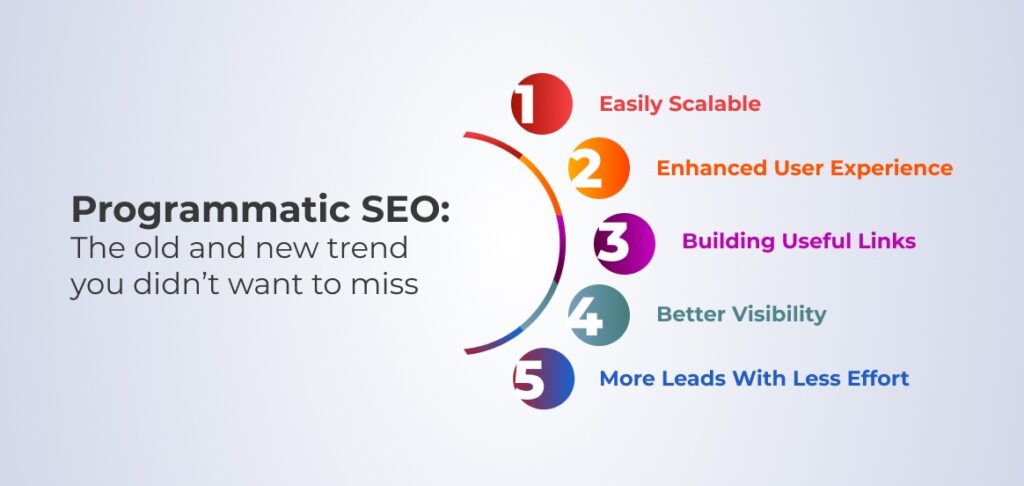
Simply put, Programmatic Search Engine Optimization is an AI-driven tool that creates an extensive number of web pages. Make use of the selected keywords and data algorithms. Certainly programmatic SEO services help your digital brands create an innumerable range of web pages, targeting different services and products. It’s SEO automation applied strategically to a vast pool of content creation. Better to call it your content database to improve SEO factors.
For a better understanding of programmatic SEO, look at the following few points.
- With programmatic SEO, create a vast number of web pages with different keywords and target offerings.
- Create a bulk number of high-traffic generated landing pages, service pages, inner pages, etc.
- Reach a wide spectrum of target audiences with the help of automated generated yet informative and keyword-enriched content.
- Make data-driven decisions to select unique keywords and create bulk content accordingly.
- Build your own database of web pages on the same template but with different keywords and content language.
In short, programmatic SEO assistance offered by a trusted digital marketing company in India. It will help you create content with AI integration. Ultimately, fulfills the purpose of generating high-value factor content with ease and comfort.
Key example of Programmatic SEO for you reference.
One of the ideal ways to understand about programmatic SEO is looking at this example.
For instance, you run an online shoe business that deals in offering wide variety of shoes to customers.
For the same, you work on keywords like “best sports shoes”, or “best formal shoes online”.
Here’s the following set of result to obtain from the search.


Importance of Implementing Programmatic Search Engine Optimization
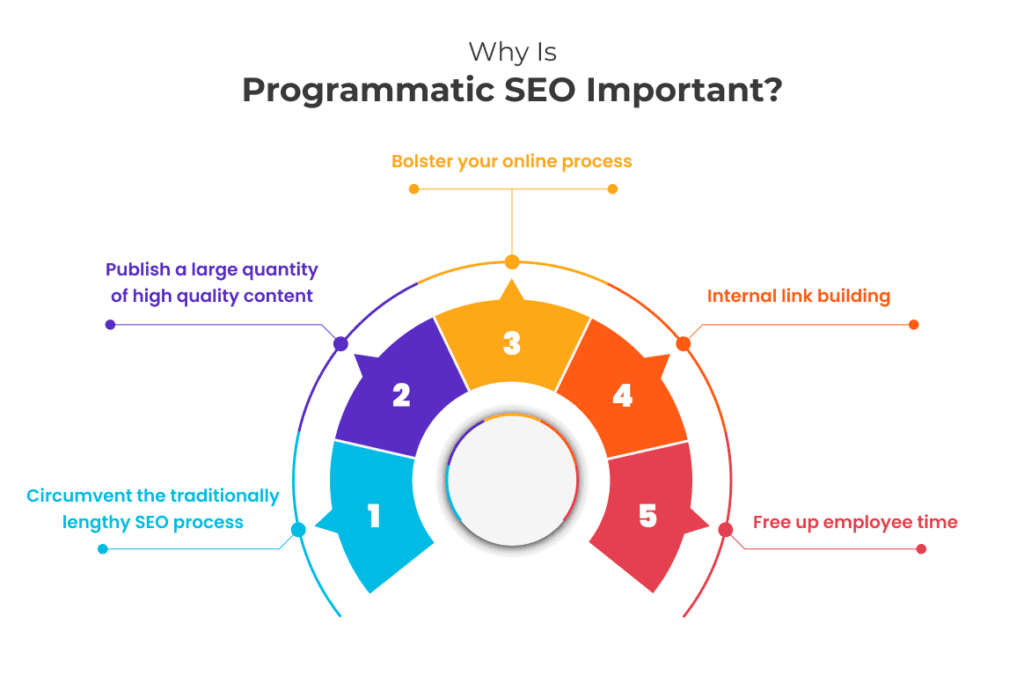
Programmatic SEO guarantees that each of your websites’ categories, products, and/or services will have a dedicated page. You also get a chance to not have each one of these pages constructed individually.
As each of these pages attribute to an annoyingly narrow keyword (or bundle), they will all be able to do well in organic search results.
A quick bit of context: organic search results are the first ones that pop up when a user inputs specific keywords or phrases. The paid elements included in web pages don;t determine as the organic results. What makes them organic It’s the fact that they are not buying their place but getting it with SEO.
As opposed to programmatic SEO which allows you to rank more of your content in those organic search results with much ease. To discover the keywords you want your selected programmatic SEO tool and write the required content with some simple keyword research.
In essence, a programmatic SEO would bear the capacity to generate much traffic in greatly varying volumes towards your website without effort on your company’s part. You won’t have to hire individuals who will go through the immense bother of fundamentally generating content, and later curating it for hundreds or even thousands of possible search page views on web pages and Google snippet trails.
From a cost-saving point of view, its good since you save big bucks in otherwise paying someone to do something that could ordinarily be automated with great efficiency which takes seconds rather
You’ll also be in a position to divert your workers from such forms of work because the creation part of these landing pages is no longer their burden.
Briefly, programmatic SEO is such a major that it becomes an essential asset of your business.
Key Benefits of Programmatic SEO
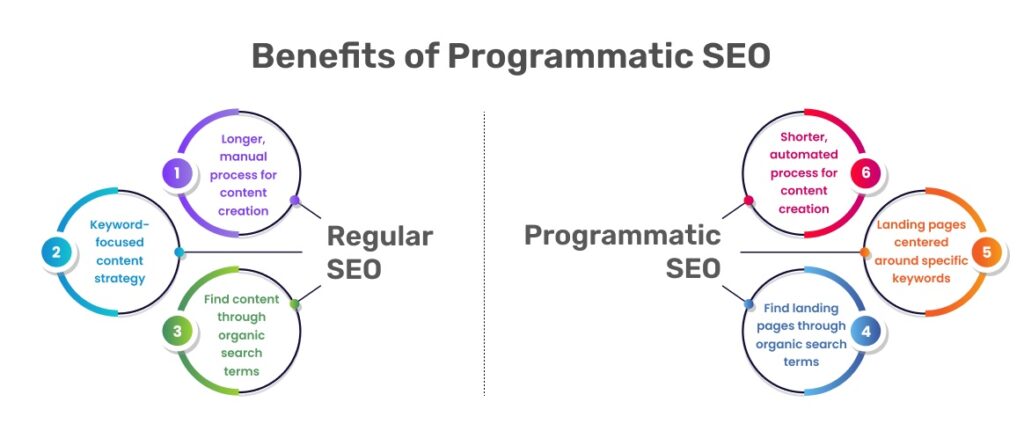
The programmatic SEO opens, as it were, the closets and corners in which traffic was hidden. You no longer need to just choose a few keywords, purchase written content from some freelancer, and then publish your post only hoping it ranks for the bundle of terms. From that point, we can focus on whole categories and triumph over all available searches from one template.
With programmatic SEO, businesses can get benefits as follows:
- Win keywords at scale.
- Produce in-depth content quickly.
- Gain low engineering lift.
- Get faster outcomes
How Does Programmatic SEO Work for Your Website?
Programmatic SEO content creation is all about integrating creativity and computation. It is a process in which planning and execution have to be stringent so that not only the user-generated content should connect with your audience but also attracts search engines. Here’s how to embark on this content creation journey so you can start your programmatically generated pages today:
Certainly, creating content or a page template or page title for programmatic SEO can be distilled into a series of methodical steps to streamline and enhance the process,
Audience Analysis
- Research for conducting data collection to understand the demographics, interests as well as search behavior of your target audience.
- – Player-based audience persona will drive content relevancy.
Keyword Research- Data Driven
- – Use, for example, SEO tools such as Google Analytics Semrush or Ahrefs to find the current trending keywords and topics.
- – Use head terms as well, body keywords, and long-tail phrases.
Content Template Creation
- Make content and page templates containing ordered structure which should contain the following elements: title, metatags; headers as well as call-to-actions.
- Ensure to create a template page that focuses more on flexibility, thereby allowing one enough room in terms of content topic creation with pages beyond the scope of view.
The Artificial Intelligence Content Generation
- Use modern AI copywriting tools such as Jasper and ChatGPT to produce first-pass content drafts quickly, and in high volume.
- Take time to revise the sentences and perfect them in order that they correspond with your brand voice but still maintain a high-quality level.
Programmatic SEO Optimization
- Weave through main and supporting keywords intelligently into the body of your landing page titles.
- Optimize all multimedia elements for SEO by implementing strong linking strategies and optimizing keywords using tools, such as Surfer SEO to ensure the guidelines are followed respectively.
Quality Assurance
– Review and edit the written content to maintain high quality, ensuring readability and relevance of written content.
– Avoid the temptation to sacrifice content quality in favor of volume.
Step 7: Performance Monitoring and Testing
– After publication, track content performance metrics such as traffic, engagement, and conversion rates.
– Employ A/B testing for different content variations to determine the most effective approaches.
By following these structured steps, you can craft programmatic SEO content that not only scales but also supports a positive user experience and drives search engine performance.
Get Going with Programmatic SEO to Increase Business Revenue
Doing SEO on your business website is an integral way to enhance web traffic and increase your target audience. Certainly, it will help you reach a wide spectrum of audiences, increase lead conversions, and boost revenue.
Now, speed up the website traffic and revenue generation process with the aid of programmatic SEO services offered by reliable experts. It’s a useful tool for valuable content creation and definitely helps you meet the marketing purpose.
In conclusion, do not back down try new digital marketing tactics to ensure things run up in your favor. Get started with profitable programmatic SEO services with the help of result-oriented digital marketing partners like Hustle Marketers.
Real Programmatic SEO Examples: What Zapier, Tripadvisor, and Canva Actually Built
The strongest validation of programmatic SEO is not theory. It is what specific companies built, at what scale, and what traffic it generated. These are the most studied programmatic SEO programs in the industry.
Zapier: 56,000 pages, 2.3 million monthly visitors
Zapier’s programmatic SEO is the most referenced case study in the industry for good reason. Every software integration Zapier supports gets its own page. Every combination of two tools gets a page. The keyword pattern is precise: “connect [Tool A] to [Tool B]”, “[Tool A] + [Tool B] integration”, “Gmail to Google Sheets automation.” Each page is not generic. It pulls real integration data: the specific triggers, actions, and workflow configurations available for that exact tool combination. The page for “Gmail + Slack” is substantively different from “Gmail + Notion” because the actual integration capabilities differ. The data differentiation is real and deep, not surface-level variation. According to Zapier’s own data, this strategy drove 2.3 million monthly visitors across approximately 56,000 pages.
Tripadvisor: millions of pages, permanently in top results for location queries
Search “hotels in [any city]” or “restaurants in [any neighbourhood]” and Tripadvisor appears in the top results. Every city, every attraction, every hotel, every restaurant has its own page. The template stays consistent: property name, location, ratings, review excerpts, nearby options. But the data on each page changes completely because it pulls from Tripadvisor’s database of millions of user-generated reviews and verified business listings. No two pages are the same, even though they share a structure.
Canva: 30,000+ template pages
Canva generates pages for every template category and sub-category: “Instagram post template”, “birthday card template”, “business presentation template”, “[colour] [occasion] [format] template.” Each page shows the actual templates available, with a clear CTA to use them. The data driving each page is Canva’s own template library, which competitors cannot replicate. The keyword pattern maps exactly to how people search for design tools: users who want a specific template type search for exactly that.
Nomad List: 1,000 city pages, built by a solo founder
Nomad List proves that programmatic SEO is not only for enterprise companies. The site was built by a solo founder and generates pages for every city in the world, each with structured data about cost of living, internet speed, safety scores, digital nomad community size, and climate. The template is consistent. The data is unique per city. The keyword pattern: “[city name] for digital nomads”, “cost of living [city]”, “best cities for [specific criteria].” The moat is the proprietary data set: no other site has the same structured nomad-specific city data in one place.
The 3 Components Every Programmatic SEO Program Needs
Across every successful programmatic SEO program, three things are consistently present. Remove any one of them and the program either fails to rank or gets penalised by Google for thin content.
- A repeatable keyword pattern: The program needs a scalable head term with a modifier that produces hundreds or thousands of distinct search queries. “[Service] in [City]”, “[Tool A] + [Tool B] integration”, “Best [Product Type] for [Use Case]” are classic patterns. The test: can you generate 500 unique, plausible keywords from your pattern? If not, the pattern is too narrow for programmatic SEO to justify the build investment.
- A structured dataset that differentiates each page: This is the single most important factor in whether a programmatic SEO program succeeds or gets penalised. The dataset must produce genuinely different content on each page, not minor word substitutions. Zapier’s integration database produces substantively different pages because real integration capabilities differ. A dataset that generates pages like “[City Name] is a great place to buy [Product]. Buy [Product] in [City Name] today” is thin content that Google will demote. The data has to change the content meaningfully, not just fill in blanks.
- A template that answers the specific search intent for every variation: The template must satisfy the query, not just match the keyword. A page for “plumber in Manchester” must provide the information a Manchester homeowner looking for a plumber actually needs: verified services, contact methods, service area, trust signals. A template that provides generic plumbing information regardless of city fails the intent even if the title contains “Manchester plumber.”
Programmatic SEO Tools: What to Build With in 2026
- Webflow (CMS collections): The most popular no-code platform for programmatic SEO builds. CMS collections allow you to create one template connected to a database, and Webflow generates individual pages for each row automatically. Best for sites with 100 to 10,000 programmatic pages. No developer required for basic setups.
- WordPress with custom post types: For programmatic SEO on WordPress, custom post types combined with a data import plugin (WP All Import works well for CSV-to-page generation) can build and update pages at scale. Better suited to teams with some technical comfort. More flexible than Webflow for complex templates but requires more setup.
- Next.js (for developers): The preferred framework for developer-built programmatic SEO sites. Static site generation and dynamic routing create thousands of pages that load fast and rank well. Full control over technical implementation. Requires a developer but produces the most optimised output.
- Airtable or Google Sheets as the data layer: Both work as the structured database that feeds your template. Google Sheets is simpler for small to medium datasets. Airtable handles more complex relational data and has better API integration for automated data updates.
- Semrush for keyword pattern research: Before building, use Semrush’s Keyword Magic Tool to confirm that your keyword pattern generates enough search volume to justify the build. Filter for long-tail keywords with your modifier type and check whether the top 10 results include programmatic pages or individual manually-written content.
The Quality Risk That Kills Programmatic SEO Projects
Programmatic SEO fails in a specific way. It rarely fails at launch. It fails four months later, when the pages are live, indexation has stalled, and the rest of the site starts underperforming too.
That second part surprises people. So it is worth explaining the mechanic, because it changes how you should build.
Site Quality Is Judged in Bulk, Not Page by Page
Search engines do not evaluate your pages in isolation and add up the scores. They form a view of the site as a whole, and that view then influences how individual pages perform.
The consequence for programmatic work is direct. Publish 5,000 thin pages beside 200 strong ones and you have not added 5,000 chances to rank. You have diluted the average, and the 200 strong pages now carry a worse sitewide signal than they did before you started.
This is why programmatic projects so often coincide with unexplained drops on unrelated pages. The blog did not break. The site it lives on changed.
A great page on a weak site is scored as part of the weak site. A weak page on a strong site borrows credibility it did not earn. Neither is judged alone.
Jairo Guerrero of AirOps describes a client where roughly 80 percent of crawled pages carried no value at all. The damage was not confined to those pages. It pulled down the whole-site assessment, including pages that were performing fine before the expansion.
Measure Your Indexation Rate and Band the Result
The single most useful number in a programmatic project is your indexation rate. Most guides mention the Search Console status. Very few give you a formula or tell you what a given number means.
Indexation rate = indexed pages divided by total known pages, expressed as a percentage.
Pull both figures from the Search Console Page indexing report. Then band the result and act accordingly.
| Indexation rate | What it means | Action | Keep publishing? |
|---|---|---|---|
| Above 80% | Google broadly agrees with your URL set | Continue, monitor monthly | Yes |
| 60% to 80% | Early bloat, usually a template or data quality issue | Find the pattern in the non-indexed set before adding more | Pause new batches |
| 40% to 60% | Google is rejecting a large share of what it crawls | Prune the weakest tier, improve the template | No |
| Below 40% | The template itself is the problem | Stop, rebuild the page model, then relaunch in small batches | No |
Check the ratio at every batch, not at the end of the project. That is the whole point of publishing in batches of 50 to 200 pages rather than pushing 5,000 live at once.
Do Not Noindex Thin Pages, Remove Them or Improve Them
This is where we disagree with most published advice. The common recommendation is to noindex low-value programmatic variants. We think that is the wrong instrument, and the reasoning matters more than the conclusion.
A noindex tag does one thing. It removes the page from search results. It does not remove the page from your site, and search engines still crawl it. So the page continues to consume crawl budget, and it continues to exist as part of the body of content that informs the sitewide quality view.
In other words, noindex solves the symptom you can see and leaves the cause you cannot.
| Approach | Removed from results | Still crawled | Counts toward sitewide quality | Verdict |
|---|---|---|---|---|
| Noindex | Yes | Yes | Yes | Temporary holding measure only |
| Delete and 410 | Yes | No, after processing | No | Correct for genuinely worthless pages |
| Delete and 301 to parent | Yes | No, after processing | No | Correct where a relevant parent exists |
| Improve the page | No, it stays | Yes | Yes, positively | Correct where real data exists to add |
There is one legitimate use for noindex here. If you need to stop the bleeding today while you decide what to do, apply it as a holding measure. Just put a date on the decision, because a noindex that becomes permanent is simply a quality problem you agreed to stop looking at.
The Decision Sequence for a Struggling Programmatic Set
- Calculate the indexation rate and band it using the table above.
- Export the non-indexed URLs and look for the shared pattern. It is usually one data field being empty or one template section being identical.
- Ask whether real, distinguishing data exists to fill that gap. If yes, improve the template and republish.
- If no such data exists, the pages should not exist either. Delete and 410, or 301 to the parent where one is genuinely relevant.
- Relaunch in batches of 50 to 200, checking the indexation rate between batches.
Step three is the honest test of a programmatic project. If you cannot name what makes each page different beyond a swapped variable, search engines will not find it either. The technical SEO checklist covers the crawl budget and indexation checks that sit underneath this process.
When Programmatic SEO Is the Wrong Strategy
Programmatic SEO gets misapplied when the underlying motivation is “publish a lot of pages quickly” rather than “provide genuine value at scale.” Google’s quality systems in 2026 are significantly better at detecting thin programmatic content than they were in 2022. A programmatic build that generates pages without real data differentiation will get a Helpful Content penalty and hurt the rest of the site’s rankings, not just the programmatic pages.
Do not use programmatic SEO if: your data does not meaningfully differentiate pages (substituting city names into generic copy is not differentiation), if you cannot maintain the data quality over time as records change, if your site is under 12 months old with limited domain authority, or if the keyword pattern you are targeting is dominated by established players with proprietary data that you genuinely cannot match. Programmatic SEO is a scale strategy for businesses with genuine data assets. It is not a shortcut to traffic for sites without them.
Professional digital marketing experts at Hustle Marketers are always available to help your brand get the digital recognition it deserves. Connect with our digital marketing expert and ensure your business success ahead.
Summarise this article with:
Frequently Asked Questions
1. What is the difference between SEO and Programmatic SEO?
2. Is Programmatic SEO a kind of advertising?
3. What is the cost involved in starting with programmatic SEO?