SEO for Landscapers: How Landscaping and Lawn Care Companies Get More Calls from Google, Maps and AI Search (2026 Guide)

Ishant
Published : September 24, 2026 at 11:30 am
Updated : October 16, 2026 at 12:15 pm
Ishant

Written by Ishant Sharma, Google Ads, Microsoft Ads and SEO specialist since 2013 | Updated September 2026 | Facts checked September 17, 2026
Landscaping is one of the hardest trades to win with paid search alone. In LocaliQ’s home services benchmarks, landscaping had the lowest click-through rate of 16 home services categories at 4.69%, and an average cost per lead of $117.92, well above the home services average of $90.92 (LocaliQ). SEO for landscapers is how you stop renting every lead. When your company shows up in the map pack and on page one for “lawn care near me” or “patio installation”, the calls keep coming without a per-click bill.
It also has traps the popular guides skip. Google can suspend service-area profiles that break its address and naming rules. California requires your contractor license number in every ad, Texas requires an irrigator license number on every irrigation ad, and lawn treatment claims such as “safe for kids and pets” can create legal problems. This guide covers the full playbook, including the parts that keep your profile and license safe.
How we researched this guide: we checked the current top results for “SEO for landscapers”, “landscaping SEO”, “landscaper SEO” and “lawn care SEO” in Semrush on September 17, 2026, and read all 18 ranking pages. We also used Semrush keyword data, Google’s Business Profile, Local Services Ads and Search Central documentation, state licensing statutes, BLS and industry data, 13 YouTube videos from landscaping marketers, and landscaper discussions on LawnSite, Reddit and the Google Business Profile Community. This is marketing guidance, not legal advice. Check licensing and advertising questions with your state board.
Key takeaways
- SEO for landscapers means ranking your company in the map pack, organic results, directories and AI answers for the searches homeowners and property managers make before they call a landscaper.
- Lawn care, design/build, commercial maintenance and snow removal are different businesses with different searches. Build pages and measure results for each model you actually run.
- Most landscapers are service-area businesses. Hide your address if customers do not visit you, keep service areas within about two hours’ drive, and never add keywords or cities to your business name.
- Never offer anything for reviews, never send only happy customers to Google, and never ask friends and family to post reviews.
- Show license numbers where your state requires them, and avoid “safe”, “non-toxic” or unqualified “eco-friendly” claims for lawn treatments.
- Keep seasonal pages live all year and refresh them before each season. Do not switch your primary Google category every season.
- Measure signed contracts and customer lifetime value, not rankings or traffic.
Table of Contents
- What is SEO for landscapers?
- Is SEO worth it for landscaping companies?
- How do landscapers rank in the Google Maps local pack?
- How can landscapers get more reviews without breaking Google’s rules?
- Do landscapers need license numbers in ads and on their website?
- What keywords should landscapers target?
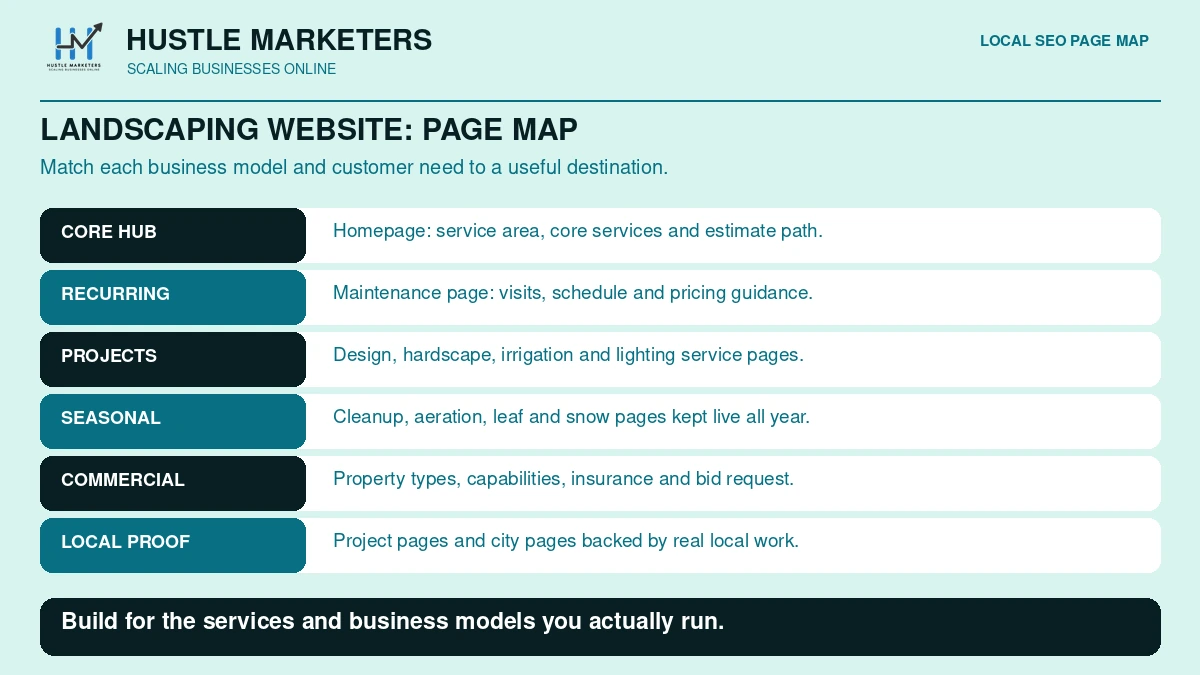
- Which pages should a landscaping website have?
- How do you plan landscaping SEO around the seasons?
- How is commercial landscaping SEO different?
- How do you do technical SEO for a landscaping website?
- How do landscapers show up in AI search?
- How do you track landscaping SEO to signed contracts?
- How long does SEO take for landscapers?
- How much does landscaping SEO cost?
- What landscaping SEO mistakes should you avoid?
- How Hustle Marketers helps landscapers with SEO
- SEO for Landscapers FAQs
What is SEO for landscapers?
SEO for landscapers is the process of improving how a landscaping or lawn care company shows up on Google, Bing, Apple Maps, directories and AI assistants, so that homeowners, HOAs and property managers who need lawn care, landscape design, hardscaping, irrigation or snow removal in your service area find you, trust you and call. It covers six areas:
- Local SEO: your Google Business Profile, reviews, citations and map pack rankings.
- Website content: service pages, project pages, seasonal pages, city pages, cost guides and commercial pages.
- Technical SEO: speed, mobile experience, image optimization, tracking and schema markup.
- Authority: associations, supplier and manufacturer listings, community sponsorships and local links.
- Paid and organic overlap: how Local Services Ads, Google Ads and lead platforms fit alongside SEO.
- Measurement: calls, estimates and signed contracts traced back to search.
How is lawn care SEO different from landscaping SEO?
The top ranking guides treat every green industry company the same. They are not the same. The search behavior, page types and success metrics change with your business model:
| Business model | How customers search | Pages that win | What to measure |
|---|---|---|---|
| Lawn care and maintenance | “lawn care near me”, “lawn mowing service near me”, price comparisons | Service pages, pricing guide, neighborhood proof pages | Recurring customers, cost per signed maintenance agreement, retention |
| Design/build and hardscape | “patio installation”, “retaining wall installation”, “landscape design”, research over weeks | Project pages with photos, cost guides, design process page | Consultations booked, proposals sent, close rate, average project value |
| Commercial maintenance | “commercial landscaping”, property manager and HOA referrals, bid lists | Commercial capability pages, property type pages, case studies | Bid invitations, contracts won, contract value |
| Snow and ice | “snow removal near me”, commercial snow contracts sold before winter | Snow service page kept live all year | Seasonal contracts signed before the first storm |
| Irrigation and lighting | “sprinkler repair near me”, “landscape lighting installation” | Individual service pages with license details where required | Service calls, installs, upsells to maintenance |
| Tree care | “tree removal near me”, storm damage | Tree service and emergency pages | Jobs booked, arborist consultations |
If you run more than one model, build pages for each one. A patio buyer and a weekly mowing customer should not land on the same page.
Is SEO worth it for landscaping companies?
For most landscapers, yes. Demand is large, paid leads are expensive and customers compare reviews before they call. The data:
| Finding | Data | Source |
|---|---|---|
| Search ad cost for landscaping | 4.69% click-through rate, $8.76 cost per click, 6.42% conversion rate, $117.92 cost per lead (campaigns from April 2024 to March 2025) | LocaliQ |
| Industry size | US landscaping services estimated at $188.8 billion in 2025, with 692,777 businesses, according to IBISWorld figures cited by NALP | National Association of Landscape Professionals |
| Workforce growth | Grounds maintenance jobs projected to grow 5% from 2025 to 2035 | US Bureau of Labor Statistics |
| Reviews | 97% of consumers read reviews for local businesses, and 74% look for reviews from the last three months | BrightLocal 2026 |
| AI in local search | Use of ChatGPT and other AI tools for local recommendations rose from 6% to 45% in a year | BrightLocal 2026 |
Search demand is also large for the jobs landscapers want. “Lawn care near me” gets 246,000 US searches a month in Semrush, and “landscaping near me” gets 201,000. More on keywords below.
The catch is time and seasonality. SEO compounds over months, and a page that ranks in May was usually built the winter before. Many landscapers run paid ads or Local Services Ads at the start and shift budget as organic leads grow. Our SEO ROI calculator helps you check whether the numbers work for your business.
Should landscapers use Local Services Ads, Google Ads, lead platforms or SEO?
Each channel does a different job:
| Channel | How you pay | Who owns the customer | Best for |
|---|---|---|---|
| Local Services Ads | Per valid lead | You | Lawn care, landscaping, tree and snow calls |
| Google Ads (search) | Per click | You | High-value work such as patios, retaining walls and lighting |
| GreenPal | 5% of each successful customer payment, plus card processing fees | Shared with the platform | Filling mowing routes |
| LawnStarter and TaskEasy | The platform sets the price and keeps a portion | The platform | Extra route work, little brand building |
| Thumbtack and Angi | Pay to respond to requests or to advertise | Shared, often with competitors | Gaps in a slow season |
| SEO | Monthly investment, no per-lead fee | You | Lowest long-term cost per customer |
On Local Services Ads, Google’s US screening page lists Lawn care, Landscaping services, Tree service and Snow removal as categories, with liability insurance checks for all but Snow removal and state license checks where local law requires them and an average screening time of three to four weeks (Google). Since late 2025, verified providers show a single Google Verified badge instead of Google Guaranteed. Our Local Services Ads guide covers setup and lead credits.
Be careful with lead platform promises. In 2023 the FTC finalized an order requiring HomeAdvisor to pay up to $7.2 million over claims about the quality and source of the leads it sold.
What do landscapers say about SEO and lead platforms on forums?
Forum discussions give a more mixed and practical view than agency pages. A few themes from LawnSite and Reddit:
- LSA results vary. In a LawnSite thread on Local Services Ads, a marketing agency owner said they are low risk because you only pay for leads, a lawn care owner said they got almost zero results, and a landscape company owner compared them to other poor lead-gen services.
- Platform leads are uneven. LawnStarter users in a 2021 LawnSite thread described leads arriving in bursts and prices set by the platform.
- Seasonality is real. A former lawn care owner in Texas, in a 2025 LawnSite thread said spring brought several organic leads a week that dropped sharply once summer arrived.
- Start with the profile. In a Reddit r/SEO thread from a lawn care owner, the top reply said to set up a Google Business Profile first, and a follow-up reply added posting photos and updates several times a week.
How do landscapers rank in the Google Maps local pack?
Google says local results are based mainly on relevance, distance and prominence (the page also calls the third factor popularity), and that there is no way to pay for a better local ranking. You cannot move closer to every searcher, so your work goes into relevance (accurate categories, services and matching website pages) and prominence (reviews, links, citations and how well known your business is).
How should a landscaping company set up its Google Business Profile?
Use this checklist. Our guide on how to optimize a Google Business Profile covers each step in depth.
| Profile field | What to do | Common mistake | |
|---|---|---|---|
| Business name | Your real-world name as used on your trucks, invoices and website | “Green Lawn Care Dallas | Mowing and Landscaping” |
| Address | If customers do not visit your yard, remove the address and set service areas | Using a PO box, an unstaffed virtual office or a friend’s address in a bigger city | |
| Service areas | Up to 20 cities or postal codes, within about two hours’ drive of your base | Listing every town you might ever drive to | |
| Primary category | The category that best describes your main business, such as Landscaper or Lawn care service | Picking a category because it seems less competitive | |
| Secondary categories | Only true ones, such as Landscape designer, Lawn sprinkler system contractor, Tree service or Snow removal service | Adding every green industry category | |
| Services | Each service with a plain description | Services you do not offer, or city names stuffed into descriptions | |
| Hours | Real hours, and seasonal hours where they change | Leaving summer hours up all winter | |
| Photos | Real before and after photos, crews, trucks and equipment | Stock photos | |
| Posts | Seasonal updates, project spotlights and service reminders | Nothing for months | |
| Website link | Your homepage or main service page, with UTM tags for tracking | A link to a lead platform profile |
Google’s guidelines say business names must not include service or location information, and that adding unnecessary information to your name can lead to suspension (Google). Google also says to use as few categories as possible to describe your core business.
Should you change your Google Business Profile category every season?
No. One ranking guide suggests switching your primary category by season, for example from lawn care to snow removal in winter. That is risky. Google’s guidelines say categories should describe what your business is, and your primary category should match your main business all year, not just this month’s service. Your reviews and history were also earned under that main business. A safer approach:
- Keep your primary category matched to your main year-round business.
- Add a true secondary category, such as Snow removal service, if you offer that service.
- Update your services list, posts, photos and seasonal hours before each season.
- Keep your seasonal website pages live all year, and refresh them a month or two before the season starts.
Why do lawn care Google Business Profiles get suspended?
Service-area businesses, including lawn care and turf companies, show up often in suspension threads. Recent examples in the Google Business Profile Community include a turf company suspended since June 2024 that simplified its name only after two appeals were denied, and a service-area business suspended the day after creation with a phone number that did not match its website. The common causes:
- Keywords, cities or taglines in the business name.
- Address problems, such as PO boxes, unstaffed virtual offices or a visible address where you do not serve customers.
- Inconsistent details, such as a different phone number on your website, profile and social pages.
- Duplicate profiles. A LawnSite reply told a suspended owner to delete the profile and start again. Do not do this. Google’s guidelines allow one profile per location, and Google’s suspension help page says not to create a new profile for the same business while an appeal is under review.
- Category and service mismatches. Only list services and categories you are licensed and set up to provide. Even then, Google may ask for license documents: a commenter in a Reddit r/SEO lawn care thread said Google asked for proof of a state pesticide application business license during verification, although they had not selected any pesticide or weed control services.
Keep a verification kit ready: business registration, license or certification documents where your state requires them, insurance, photos of branded trucks and equipment, and a short continuous video showing your vehicle, tools and paperwork.
Does geotagging photos help landscaping rankings?
Probably not, and it can hurt. A study published in Search Engine Land by an SEO agency that tested 27 of its lawn care clients over 10 weeks found geotagged photos helped some “near me” searches in the targeted areas but hurt rankings in other areas. Upload real, recent job photos because they help customers, not because of hidden location data.
How can landscapers get more reviews without breaking Google’s rules?
Reviews drive both rankings and calls. But the review tactics shared in trade forums often break Google’s rules. In one 2025 LawnSite thread on collecting reviews, owners described asking customers for a “5-star review”, paying crews a bonus when named in reviews, pre-screening customers and routing 5-star ratings to Google while sending 4 stars or fewer to a private form. Several of those tactics conflict with Google’s policies.
The rules that apply:
- Ask every customer the same way. Google’s Maps content policy says merchants should not “selectively solicit positive reviews from customers.” The FTC says asking only happy customers could violate the FTC Act.
- No incentives. Google prohibits offering discounts, free services or payment in exchange for reviews (Google). Referral discounts are fine. Discounts for reviews are not.
- No review gating. Software that sends only happy customers to Google breaks Google’s policy, even if your CRM has it built in.
- No friends, family or staff reviews. Google treats these as conflicts of interest. One ranking guide still tells landscapers to ask friends and family. Do not follow it.
- Do not script the rating. Ask for honest feedback, not a 5-star review.
A compliant process that works: send every customer a same-day text with your direct Google review link after a project is finished, or after the first few visits for maintenance customers, with at most one or two reminders. Reply to every review, and use negative reviews as a chance to show future customers how you fix problems.
Do landscapers need license numbers in ads and on their website?
In several states, yes, and we did not find this covered in any of the 18 ranking pages we read. The rules depend on the work you do:
| State | Rule | What it means online |
|---|---|---|
| California | C-27 Landscaping Contractors must include their license number in “all forms of advertising” under BPC 7030.5. Unlicensed operators may advertise only jobs under $1,000 and must say they are not licensed (BPC 7027.2), and since January 1, 2026 the under $1,000 exemption does not apply to anyone who employs others to do the work (BPC 7048) | Put your CSLB number on your website, ads and vehicles. Routine gardening such as mowing and weeding generally does not need a contractor license, but construction work does |
| Texas | 30 TAC 344.70 requires all irrigation advertising, in any media, to show the irrigator’s license number in the form “LI” plus the number, and vehicles to show it too | Every sprinkler repair page, post and ad needs the LI number |
| Arizona | A.R.S. 32-1124 requires the license number with “ROC” on published advertising, and on internet ads unless they link directly to a site that prominently shows it | Show your ROC number on your website |
| North Carolina | G.S. 89D-12 bars advertising with a title that implies licensure as a landscape contractor unless you hold the license | Do not call yourself a “licensed landscape contractor” without the license |
| Maryland | COMAR 09.08.01.09 requires home improvement ads to include the contractor’s MHIC license number, and Maryland’s home improvement definition includes landscaping on land next to a home | Show your MHIC number on landscaping and hardscape ads |
Lawn treatments have their own licensing. Florida, for example, requires anyone applying commercial fertilizer to an urban landscape to be certified, with a narrow exemption for yard workers using the homeowner’s fertilizer and equipment, and pesticide applications for hire need the right state license in most states. If you advertise weed control, grub control or fertilization, make sure your license covers it before you build the page.
Can lawn care companies advertise treatments as safe, non-toxic or organic?
Be very careful. Federal pesticide labeling rules treat claims such as “safe”, “harmless” or “nontoxic to humans and pets” as false or misleading, even with a phrase like “when used as directed” (40 CFR 156.10). That rule governs product labels, but lawn care ads that contradict the label invite trouble. Florida can discipline pest control businesses for misleading advertising, and the FTC’s Green Guides tell marketers not to make unqualified general environmental claims such as “eco-friendly” and say it is deceptive to misrepresent that a product or service is non-toxic.
Safer wording describes what you actually do: “we follow label directions and local watering restrictions”, “we use products listed by the Organic Materials Review Institute” (if true), or “ask us about low-impact options for your lawn”.
What keywords should landscapers target?
Start with real demand. Here is US monthly search volume for common landscaping and lawn care searches, pulled from Semrush in September 2026:
| Keyword | US monthly searches | Keyword difficulty | Avg. CPC |
|---|---|---|---|
| lawn care near me | 246,000 | 58 | $9.40 |
| landscaping near me | 201,000 | 50 | $4.30 |
| lawn mowing service near me | 110,000 | 45 | $4.01 |
| landscape design | 40,500 | 65 | $2.47 |
| tree removal near me | 33,100 | 45 | $6.65 |
| sod installation | 18,100 | 27 | $4.71 |
| snow removal near me | 18,100 | 29 | $3.58 |
| sprinkler repair near me | 14,800 | 48 | $4.74 |
| hardscaping near me | 12,100 | 27 | $5.91 |
| commercial landscaping | 9,900 | 8 | $8.69 |
| patio installation | 9,900 | 40 | $6.19 |
| landscape lighting installation | 5,400 | 34 | $5.59 |
| retaining wall installation | 4,400 | 37 | $5.40 |
| weed control service | 4,400 | 36 | $15.34 |
| mulch installation | 3,600 | 10 | $3.54 |
| lawn care prices | 1,600 | 36 | $2.40 |
| landscaping cost | 880 | 33 | $1.97 |
| lawn fertilization service | 880 | 32 | $12.68 |
Three things stand out. “Commercial landscaping” has a keyword difficulty of just 8 with a high cost per click, so a strong commercial page can be a comparatively easy organic win. “Weed control service” and “lawn fertilization service” have the highest CPCs in the list, which is why treatment programs are worth a dedicated page if you are licensed for them. And the huge “near me” terms are mostly won in the map pack, not on blog posts.
Group your keywords by what the customer wants, then give each group the right page:
| Intent group | Example searches | Best page |
|---|---|---|
| Provider search | lawn care near me, landscapers near me, landscaping company [city] | Google Business Profile, homepage, city page |
| Recurring service | lawn mowing service, weekly lawn care, weed control service | Maintenance and treatment program pages |
| Project | patio installation, retaining wall installation, sod installation, landscape lighting | Individual service pages with project galleries |
| Seasonal | spring cleanup, aeration and overseeding, fall cleanup, snow removal | Seasonal service pages kept live all year |
| Cost research | lawn care prices, landscaping cost, patio cost | Cost guides |
| Commercial | commercial landscaping, HOA landscaping, commercial snow removal | Commercial pages |
| Local problems | drought tolerant landscaping, xeriscaping, watering restrictions [city] | Local guides and service pages |
Keywords to keep off your service pages and add as negatives in ads: landscaping jobs (6,600 searches a month), lawn care business, DIY terms such as “how to aerate your lawn”, and product searches such as “mulch near me” if you do not sell materials.
Which pages should a landscaping website have?
Build around services you want more of, and around the business models you run:
| Page | Purpose | Key content |
|---|---|---|
| Homepage | Brand and “landscaper [city]” searches | Service area, core services, reviews, license numbers where required, call and estimate buttons |
| Lawn care and maintenance | Recurring revenue | What is included, visit frequency, seasonal schedule, pricing guidance |
| Treatment programs | Fertilization and weed control | Program steps, licensing, how you follow label directions |
| Design and installation | High-value projects | Design process, timeline, project gallery, financing if offered |
| Hardscaping services | Patios, walls, walkways | One page per major service with materials, cost factors and projects |
| Irrigation and lighting | Service and install calls | Repairs, installs, water efficiency, license numbers where required |
| Seasonal services | Spring cleanup, aeration, leaf removal, snow removal | Timing, what is included, how to book before the rush |
| Commercial landscaping | Property managers and HOAs | Property types, crews, insurance, response times, contract options |
| Project pages | Proof for design/build | Location, scope, materials, timeline, before and after photos |
| Cost guides | Early research | Honest price ranges and what changes them |
| About and credentials | Trust | Team, certifications, licenses, insurance, years in business |
| Careers | Crew hiring | Roles, pay ranges, seasonal and year-round positions |
What should a landscaping service page include?
- A clear first paragraph that says what the service is, where you offer it and how to get an estimate.
- Who it is for, such as busy homeowners, new builds or HOA common areas.
- What is included and what is not.
- Timing, such as the best months for aeration or when to book spring cleanup.
- Price guidance with the factors that change the price.
- Before and after photos from real jobs in your area.
- Local details, such as common grass types, soil, watering restrictions or HOA rules in your market.
- Credentials such as license numbers and certifications, where relevant.
- Questions customers ask about that service.
- A call button and estimate form near the top and bottom.
Should landscapers build city pages?
Only where you have real work. Google’s spam policies describe “pages targeted at specific regions or cities that funnel users to one page” as doorway abuse, and blocks of city names on a page as keyword stuffing. Several ranking guides recommend city pages without mentioning either rule.
Use route density as your guide. Build pages first for the neighborhoods and towns where your routes are already dense, because that is where you have the proof and the profit:
- Real jobs and before and after photos from that area
- Reviews from customers there
- Local details such as HOA rules, soil or watering restrictions
- The crew or route day that serves the area
- Nearby projects linked from the page
If a page would only swap the town name, skip it and list the area in your Google service areas instead. A landscaper with six strong neighborhood pages will usually beat one with sixty thin ones.
How do project pages and before and after galleries help landscaping SEO?
Design/build buyers want proof before they call, and a single gallery page with 80 photos does not rank for much. Turn your best jobs into individual project pages: “Paver patio and fire pit in Plano” with the scope, materials, timeline, a cost range, before and after photos with descriptive file names and alt text, and a short client comment if they agree. Link each project from the related service page and city page. Project pages give Google fresh, specific, local content that nobody else can copy.
Should landscapers publish pricing pages?
Yes. “Lawn care prices” gets 1,600 searches a month and “landscaping cost” gets 880, and customers who understand the price range waste less of your estimating time. You do not need fixed prices. Give ranges for your area, explain what raises or lowers them (lawn size, slope, access, materials, frequency) and say when you give a firm quote. AI tools also pull clear price ranges into their answers.
How do you plan landscaping SEO around the seasons?
Seasonal demand is where landscaping SEO is won or lost, and the pages have to be ready before the searches start. This example calendar suits a northern market with cool-season grass. Shift it for southern and western markets:
| Months | What customers search for | SEO and profile actions |
|---|---|---|
| January to February | Snow removal, spring cleanup planning, landscape design | Refresh spring cleanup and design pages, publish project pages from last season, sell maintenance agreements |
| March to April | Spring cleanup, mulch, lawn care programs | Update Google posts and services, push review requests from early customers |
| May to June | Mowing, sprinkler repair, patios, lighting | Promote installation work, add new project photos weekly |
| July to August | Irrigation, drought and watering questions | Refresh fall aeration and overseeding pages, start selling commercial snow contracts |
| September to October | Aeration and overseeding, fall cleanup, leaf removal, holiday lighting | Update seasonal hours and posts, publish fall cost guides |
| November to December | Snow removal, holiday lighting | Keep snow pages current, ask season-end reviews from maintenance customers, plan next year’s content |
Keep every seasonal page live all year. A snow removal page that disappears in April has to rebuild its rankings every November.
How is commercial landscaping SEO different?
Commercial buyers such as property managers, HOA boards and facility managers compare vendors carefully and often buy through bids. In Semrush, commercial landscaping also has the lowest keyword difficulty of the terms in our list. What helps:
- Property type pages only where you have real clients, such as HOAs, apartments, office parks, retail centers or medical campuses.
- Capability details buyers check: crew size, equipment, insurance limits, response times, safety practices and snow capacity.
- Case studies with property type, scope, contract length and results.
- A bid request form that accepts site maps and specs.
- Maintenance contract information, because recurring agreements drive this market. In Aspire’s 2026 State of the Commercial Landscape Industry report (a 2025 survey of 1,015 commercial landscape professionals), 59% said most of their revenue comes from maintenance contracts.
Track commercial leads separately. One HOA contract can be worth more than dozens of residential mowing accounts.
How do you do technical SEO for a landscaping website?
Landscaping sites are image-heavy, so speed and image handling matter more than in most trades. Use this checklist, and our full technical SEO checklist for the details:
| Check | What good looks like |
|---|---|
| Image compression | Project photos resized and compressed, served in modern formats |
| Core Web Vitals | Good LCP, CLS and INP on mobile. See our Core Web Vitals and INP guide |
| Mobile calls and forms | Tap-to-call button and short estimate form visible on phones |
| Page titles | Service plus location, such as “Paver Patio Installation in Plano, TX” |
| Indexing | Service, project and real city pages indexed. No thin tag or duplicate city pages |
| Image file names and alt text | “flagstone-patio-fire-pit-plano.jpg” instead of “IMG_4032.jpg” |
| Footer | Business name, service area, phone and license numbers where required |
| Internal links | Service pages link to projects, cost guides and city pages |
What schema markup should a landscaping company use?
Schema.org has no Landscaper or lawn care type. The closest fit is `HomeAndConstructionBusiness` (a LocalBusiness subtype), or `LocalBusiness` itself, with your services described as `Service` items. Two things to know:
- FAQ rich results are gone. Google stopped showing them on May 7, 2026. FAQ content still helps customers and AI answers.
- Your own reviews will not earn stars. Google says businesses that control reviews about themselves are ineligible for star ratings.
An example for a service-area landscaper:
{
  "@context": "https://schema.org",
  "@type": "HomeAndConstructionBusiness",
  "@id": "https://www.example-landscaping.com/#business",
  "name": "Example Landscaping Co.",
  "url": "https://www.example-landscaping.com/",
  "telephone": "+1-916-555-0187",
  "address": {
    "@type": "PostalAddress",
    "addressLocality": "Sacramento",
    "addressRegion": "CA",
    "postalCode": "95816",
    "addressCountry": "US"
  },
  "areaServed": [
    { "@type": "City", "name": "Sacramento" },
    { "@type": "City", "name": "Elk Grove" },
    { "@type": "City", "name": "Folsom" }
  ],
  "openingHours": "Mo-Sa 07:00-18:00",
  "hasCredential": {
    "@type": "EducationalOccupationalCredential",
    "credentialCategory": "license",
    "name": "California C-27 Landscaping Contractor License 000000",
    "recognizedBy": {
      "@type": "GovernmentOrganization",
      "name": "Contractors State License Board"
    }
  },
  "hasOfferCatalog": {
    "@type": "OfferCatalog",
    "name": "Landscaping services",
    "itemListElement": [
      { "@type": "Offer", "itemOffered": { "@type": "Service", "name": "Weekly lawn maintenance" } },
      { "@type": "Offer", "itemOffered": { "@type": "Service", "name": "Paver patio installation" } },
      { "@type": "Offer", "itemOffered": { "@type": "Service", "name": "Sprinkler repair" } }
    ]
  }
}
If you hide your street address on Google because you work from home, do not publish it in schema either. Make sure every value matches what is visible on the page.
How do landscapers show up in AI search?
Google says there are no additional requirements or special optimizations needed to appear in AI Overviews or AI Mode, and its guide to generative AI features says you do not need special AI files or markup. Be wary of anyone selling guaranteed AI placement. What helps:
- A complete Google Business Profile. Google’s AI guide says Business Profiles can help your services appear in AI responses.
- Consistent details on Google, Bing Places, Apple Business Connect, Yelp, BBB, Nextdoor, Houzz and Angi.
- Reviews that describe the work, such as “they rebuilt our retaining wall”, because AI summaries often draw on review themes.
- Clear answers on cost, timing and seasonality, such as “when should I aerate my lawn in Denver?”
- Mentions on trusted local sites, such as local news, garden clubs, suppliers and association directories.
- Monthly prompt tracking. Ask ChatGPT, Gemini, Perplexity and Google AI Mode “best landscaper for a paver patio in [city]” and record whether you appear. Our guide to tracking brand visibility in AI search shows how.
AI local packs are still small in Google Search. Sterling Sky found them on about 7% of the keywords it tracks, showing far fewer businesses than regular map packs, so the map pack is still the main battle.
How do you track landscaping SEO to signed contracts?
Rankings are an early signal. Signed contracts and lifetime value are the result. Track this chain every month:
| Stage | What to track | How |
|---|---|---|
| Visibility | Map pack rank across your service area, organic rankings, AI prompt mentions | Local rank grid tool, Search Console, a monthly prompt sheet |
| Profile actions | Calls, website clicks, direction requests | Google Business Profile performance report |
| Website leads | Calls, estimate forms, online bookings | GA4 key events and call tracking. See our guide on how to use GA4 for marketing |
| Estimates and proposals | Estimates booked and proposals sent by lead source | Lead source field in Jobber, Aspire, LMN, Service Autopilot, RealGreen or your CRM |
| Signed work | Maintenance agreements and projects signed, average value | CRM and invoices |
| Lifetime value | Retention and renewals by lead source | Customer history in your CRM |
A $40 lead that becomes a five-year maintenance customer is worth far more than a $20 lead that asks for a one-time price and never books. That is why landscapers should judge channels by cost per signed contract and lifetime value, not cost per lead.
How long does SEO take for landscapers?
Many landscapers see early movement in two to three months and steady organic leads in six to twelve months. Timing depends on:
- Your starting point. A company with years of reviews and an established website moves faster.
- Your market. A small town with a handful of landscapers is very different from a large metro.
- Seasonality. Pages built in winter are ready for spring. Pages built in May may not rank until late summer.
- What needs fixing. Profile and technical fixes can help quickly. Project pages, reviews and links take longer.
Our guide on how long local SEO takes covers the timeline factors in more detail (it uses Australian examples, but the factors apply in the US too).
How much does landscaping SEO cost?
Prices vary widely, and most published numbers come from agencies selling the service:
| Source | Published price | Link |
|---|---|---|
| Landscaping SEO agency survey of seven agencies | Small local landscapers $1,200 to $1,500 a month, medium companies $1,950 to $3,750, large firms $3,250 to $8,300+ | GreenUp SEO |
| Landscaping marketing agency cost guide | SEO $750 to $2,500 a month, Local Services Ads $400 to $1,500 a month | Watson and Co |
| Agency listicle | Retainers for small and mid-sized landscaping companies typically run $1,000 to $5,000 a month | Thrive |
| Survey of SEO providers (2023, all industries) | Local SEO averaged about $1,557 a month | Ahrefs |
What drives cost: how many business models and services you need pages for, how competitive your metro is, how far behind competitors you are on reviews, and whether the work includes project pages, links and contract-level tracking.
To judge the investment, work backwards from customer value. If a maintenance customer is worth $2,000 a year and stays three years, one extra signed customer a month adds $6,000 in lifetime revenue every month. Use your own margins and retention numbers.
What should landscapers ask an SEO company?
- What will you do in the first 90 days, and what do I own if we part ways?
- Will you report estimates and signed contracts, or only rankings and traffic?
- How will you handle our seasonal services and off-season months?
- How do you get reviews without incentives, gating or friends and family?
- Will you build city pages, and how do you avoid doorway pages?
- Do you know the license and advertising rules for our state and services?
- Can you show dated results from landscaping or other home service businesses?
Walk away from guaranteed rankings, guaranteed AI placement, bought links, keyword-stuffed business names and anyone promising page one in 90 days.
What landscaping SEO mistakes should you avoid?
- Adding keywords or city names to your Google Business Profile name
- Showing an address customers cannot visit, or using a PO box or virtual office
- Switching your primary category every season
- Deleting a suspended profile and creating a new one
- Asking only happy customers for reviews, or routing low ratings away from Google
- Offering discounts, gift cards or crew bonuses tied to reviews
- Building dozens of city pages that only swap the town name
- Advertising treatments as “safe” or “non-toxic”, or making unqualified “eco-friendly” claims
- Leaving license numbers off ads in states that require them
- Removing seasonal pages when the season ends
- Measuring success by rankings instead of signed contracts
How Hustle Marketers helps landscapers with SEO
I have worked in digital marketing since 2013, and my team runs SEO, Google Ads and Microsoft Ads for local service and trade businesses where reviews, photos and trust decide the job. For landscapers, that means we plan pages around the business models and seasons that bring the best customers, follow Google’s service-area rules, and track results to signed work.
Proof from our local SEO work:
- Two-location, trust-driven service business: CMSC Parker CDL grew organic traffic from under 800 to 1,900 monthly visits (at least 2.4X) and built AI citation presence across ChatGPT, Gemini and Google AI Overviews. Read the case study.
- Bilingual local SEO: CMSC Driving School moved from page 10 to page 1, lifted click-through rate from 2.7% to 4.3% and increased organic leads by 35%. Read the case study.
- Trades marketing: our guides to roofing SEO, electrician SEO and epoxy flooring SEO show how we plan around trade customers’ intent.
Our process for a landscaping company:
- Audit: Google Business Profile, service areas, reviews, citations, website, license disclosures, competitors and tracking.
- Keyword and page map: maintenance, project, seasonal, commercial and cost searches ranked by customer value.
- Foundation: profile cleanup, citation consistency, technical and image fixes, call and form tracking.
- Pages: service, project, seasonal and commercial pages, plus city pages only where routes and proof exist.
- Reviews and authority: a compliant review process, supplier and association listings, local links.
- AI visibility: consistent business data, answer-first cost and timing content, monthly prompt tracking.
- Reporting: calls, estimates and signed contracts from search every month.
If you want to see where your company is losing customers in search, our SEO services team can start with an audit, and our AI SEO services cover visibility in ChatGPT and Google AI Mode.
SEO for Landscapers FAQs
What is SEO for landscapers?
SEO for landscapers is the process of improving a landscaping or lawn care company’s visibility in Google Maps, organic search results, directories and AI answers so more local customers find the business and ask for an estimate. It includes Google Business Profile optimization, reviews, service and project pages, seasonal content, technical fixes and tracking signed contracts.
How do I get my landscaping business to show up on Google Maps?
Create and verify a Google Business Profile with your real business name, choose the category that matches your main business, set service areas if customers do not visit your location, add real services and job photos, and earn reviews from every customer consistently. Keep your name, phone number and service area the same on your website and other directories.
Is SEO worth it for a small lawn care business?
Usually yes, especially if you want recurring customers in specific neighborhoods. A small lawn care company can compete well locally with a strong profile, steady reviews, a clear maintenance page and a few neighborhood pages backed by real jobs. Start with the profile, because it costs nothing but time.
What keywords should a landscaping company use?
Use service and location searches that match what you offer, such as “lawn care near me”, “patio installation”, “sprinkler repair near me”, “snow removal near me” and “commercial landscaping”, plus cost searches like “lawn care prices”. Put each major service on its own page and avoid job, DIY and product searches.
Should landscapers use Local Services Ads?
Local Services Ads can work for lawn care, landscaping, tree service and snow removal because you pay per valid lead instead of per click. Expect insurance and license checks, answer calls quickly because responsiveness affects ranking, and judge results by signed customers, not lead count.
How long does it take for landscaping SEO to work?
Many landscapers see early changes in two to three months and steady organic leads in six to twelve months. Build seasonal pages well before the season, because rankings take time to build.
Do I need a separate page for every service?
For your main services, yes. A dedicated page for lawn maintenance, patios, retaining walls, irrigation or snow removal gives Google and customers a clear match for each search. Small add-on services can share a page.
Can I do landscaping SEO myself?
You can handle the basics: your Google profile, review requests, job photos, accurate listings and a few strong service pages. An agency makes sense when you need technical fixes, project and city pages at scale, link building, AI visibility tracking or reporting tied to signed contracts.
Is landscaping SEO different in Australia?
The fundamentals are the same, and Google’s Business Profile rules apply everywhere, but licensing differs. In New South Wales, for example, a contractor licence is required for residential structural landscaping work valued over $5,000 including GST, such as retaining walls, paving, decks and pergolas. Check your state’s rules, use Australian spelling and target local terms such as “landscape gardener”.
Sources and verification
Facts that can change were checked on September 17, 2026 against these sources:
- Google Business Profile guidelines
- Google Business Profile Help: service areas
- Google: how local results are ranked
- Google Business Profile Help: get more reviews
- Google Maps user contributed content policy
- Google Local Services Ads: screening and verification requirements
- Google Local Services Ads: Google Verified badge
- Google Search Central: spam policies
- Google Search Central: AI features and your website
- Google Search Central: optimizing for generative AI features
- Google Search Central: review snippet guidelines
- Google Search Central: documentation updates
- Schema.org: HomeAndConstructionBusiness
- California Business and Professions Code 7030.5
- California Business and Professions Code 7027.2
- Texas 30 TAC 344.70
- Arizona Revised Statutes 32-1124
- North Carolina Landscape Contractors’ Licensing Board statute
- Maryland COMAR 09.08.01.09
- Florida Statute 482.1562
- 40 CFR 156.10
- FTC Green Guides
- FTC Consumer Reviews and Testimonials Rule Q&A
- LocaliQ home services search advertising benchmarks
- US Bureau of Labor Statistics: grounds maintenance workers
- BrightLocal Local Consumer Review Survey 2026
- Sterling Sky: the state of local SEO in 2026
- Search Engine Land: geotagging photos study
About the author: Ishant Sharma has worked in digital marketing since 2013 and is a Google Ads, Microsoft Ads and SEO specialist. He is the founder of Hustle Marketers, a Google Partner and Meta Business Partner agency serving local service, contractor, lead generation and ecommerce businesses across the US, UK, UAE and Australia. Businesses he and his team have worked with include CMSC Driving School, CMSC Parker CDL, Armorpoxy, Rec Hall, Estelle Bridal and Blake International Management. Trackable client sales across his work have passed $780M, and he is Top Rated Plus on Upwork. More about Ishant.
Related guides
If this one was useful, these cover the same ground for closely related businesses.