Pest Control SEO: The Complete 2026 Guide to Ranking and Growing Your Business

Ishant
Published on November 9, 2026
Ishant
Summarize this article with:
Written by Ishant Sharma, Google Ads, Microsoft Ads and SEO specialist since 2013 | Facts checked September 18, 2026
Termites cause an estimated $6.8 billion in property damage in the United States every year, according to the National Pest Management Association. That means when a homeowner types “termite treatment near me” at 7pm on a Tuesday, they are not browsing. They are ready to call.
The problem is that most pest control websites are not ready to be found.
The US pest control industry generated $13.4 billion in 2025, up 6 percent on the year, according to NPMA research by Specialty Consultants. Every city has dozens of licensed operators competing for the same emergency and seasonal searches. Your Google Business Profile, your service pages, and your content strategy determine whether that homeowner calls you or your competitor three blocks away.
This guide covers everything that actually moves rankings for pest control companies in 2026: technical SEO, local SEO, Google Local Services Ads, seasonal content strategy, franchise-specific considerations, schema markup, AI search optimization, and how to balance paid and organic to maximize revenue across every season.
Why Pest Control SEO Is Different From Every Other Local Business
Most local business SEO follows the same playbook. Pest control does not.
Emergency intent changes everything
A homeowner who sees a termite swarm does not read blog posts. They type “termite control emergency [city]” and call the first trusted result. This emergency intent means 30 to 40 percent of your organic traffic has near-zero research tolerance. They need phone number, reviews, and service confirmation above the fold within seconds.
Compare this to a plumber (they may get quotes) or a landscaper (they plan weeks out). Pest control straddles emergency response and preventive subscription, and these two customer types need completely different pages, different content, and different CTAs.
Seasonality creates extreme traffic swings
Pest control search volume can spike 300 to 400 percent from January to June as mosquito and ant season arrives. This creates an SEO challenge: content written in June cannot rank fast enough to capture June traffic. You need to publish 6 to 8 weeks before each seasonal peak and refresh content annually.
Thin content at scale is the industry’s biggest technical problem
A pest control company serving 12 pests across 20 locations mathematically generates 240 near-duplicate pages if they use template content. Google recognizes this pattern. The solution is not to avoid building service-area pages. It is to build them correctly with differentiated content, local pest data, and proper schema.
Franchise and independent operators face completely different SEO challenges
An Orkin franchisee competes against orkin.com itself. An independent operator in the same market competes only against local competitors. These require entirely different strategies, and it is the split most pest control SEO advice skips over.
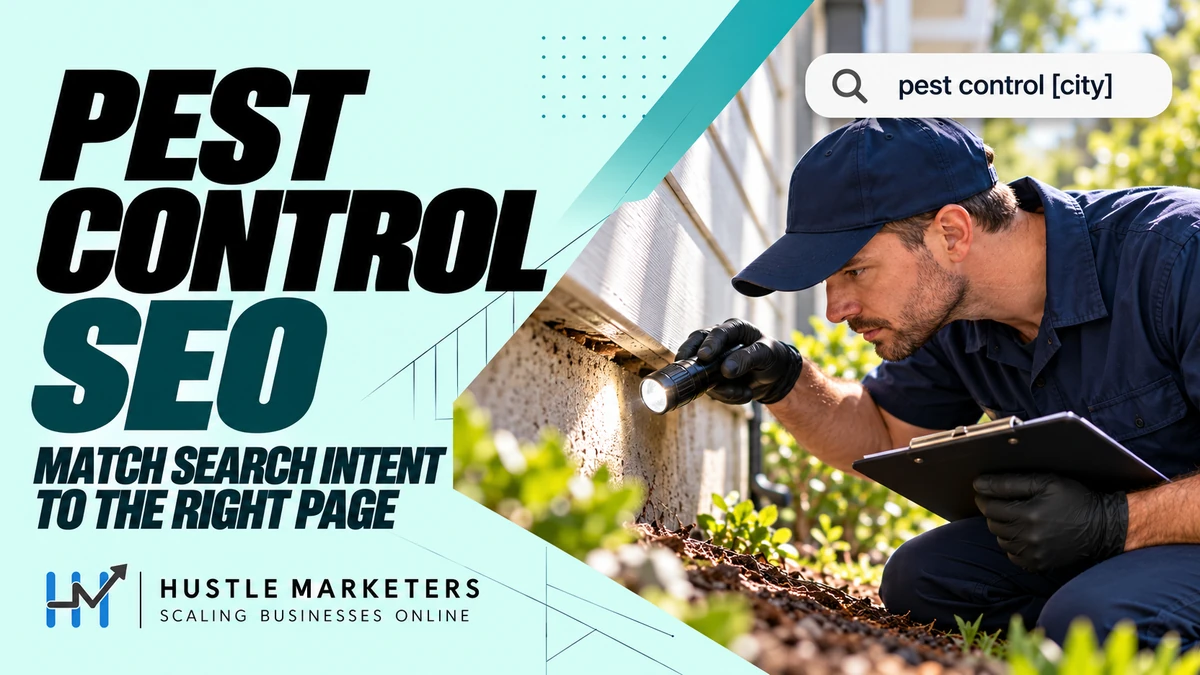
Pest Control Keyword Strategy: Four Intent Types
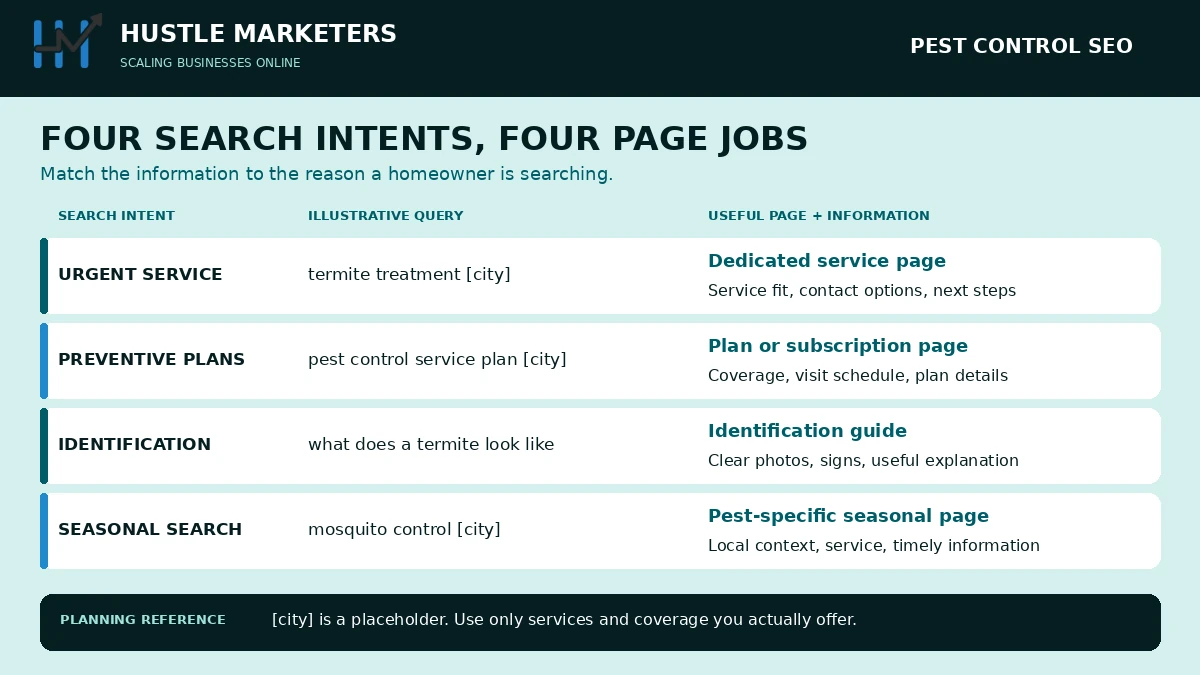
Effective pest control keyword research maps to four distinct search intents.
Emergency and transactional keywords
These are high-intent, high-value, and should be your primary service page targets.
- pest control [city]
- exterminator near me
- termite treatment [city]
- bed bug exterminator [city]
- same day pest control [city]
- emergency rodent removal [city]
- mosquito control service [city]
- how to get rid of termites fast
Target these on dedicated service pages with click-to-call above the fold, trust signals (Google rating, years in business, licensed/insured), and clear pricing or “free inspection” CTA.
Preventive and subscription-focused keywords
Homeowners searching preventive terms are planning, not panicking. They convert at higher lifetime value.
- pest control service plan [city]
- quarterly pest control [city]
- year-round pest protection
- pest control maintenance plan cost
- [pest] prevention tips
These keywords support blog content, subscription landing pages, and email marketing capture. Conversion from these is slower but customer retention is significantly higher.
Identification and informational keywords
High volume, low commercial intent, but they seed your authority and feed emergency searches.
- what does a termite look like
- signs of bed bugs
- how to identify rodent infestation
- what do termite droppings look like
- different types of ants in [state]
Optimizing these pages for featured snippets and People Also Ask placement builds topical authority and captures the research phase before it converts. Pest identification content is largely unoptimized by the industry, a significant opportunity.
Seasonal and pest-specific keywords
These are time-sensitive and tied to pest biology. They must be built before the season arrives.
- mosquito control [city] (peak: May–August)
- termite swarm season [state] (peak: March–May in Southeast)
- rodent control fall [city] (peak: August–October)
- stink bug prevention (peak: September–October)
- wasp nest removal [city] (peak: June–August)
Build seasonal content by pest type with a 6 to 8 week publishing lead time before each spike.
Technical SEO for Pest Control Websites
The thin content problem at scale
The most common and damaging technical SEO issue for pest control companies is near-duplicate service pages. A company offering 10 pest types across 15 service areas has 150 potential pages. Most website builders and CMS platforms auto-generate these pages from templates, identical content except for swapped pest name and city name.
Google’s quality guidelines treat these as thin doorway pages. The fix is content differentiation at scale:
- Add 100 to 200 words of genuinely local content per location page (local pest prevalence, regional pest names like “palmetto bug” in the Southeast)
- Include location-specific customer reviews pulled from GBP
- Add local pest data from state extension offices or NPMA regional reports
- Use unique H1 structures: “Termite Control in Austin, TX” vs “Austin Termite Treatment and Inspection”
- Build unique FAQs per location page using city-specific questions
Service area pages vs. location pages
These are two fundamentally different page types that most competitors conflate.
A location page is for a city where you have a physical office. It can be verified on Google Business Profile, include a real address, embed a Google Map, and show interior/exterior photos of your actual location.
A service area page (SAP) is for a city you serve but do not physically operate from. No GBP verification for this location. Key differences in implementation:
- SAP schema uses `areaServed` property instead of physical address fields
- SAP content must be more education-heavy (local pest info, service descriptions) since you cannot include address trust signals
- SAPs should not have their own GBP listing. Google’s guidelines for representing your business are clear that a service-area business “should have one profile for the central office or location with a designated service area,” and that if you are a service-area business “you should hide your business address from customers”
- There is a hard boundary on that service area that almost nobody cites: Google says “the boundaries of your profile’s overall service area shouldn’t extend farther than about 2 hours of driving time from where your business is based.” If you have set a 200-mile radius to chase volume, you are outside Google’s own guidance, and it is a plausible contributor to weak map pack performance
- The canonical tag on each SAP should point to itself (not the main location page)
- Internal link structure: main service page → location page → all SAPs in that radius
The SAP vs. location page distinction matters because Google treats these pages differently in local pack ranking. A SAP will not appear in the Google Maps pack for that city, only your verified GBP location can do that.
Core Web Vitals for pest control sites
Pest control websites are image-heavy by nature, pest photos, before/after treatment photos, technician team photos. This creates specific Core Web Vitals challenges.
For pest control sites:
- Largest Contentful Paint (LCP): target under 2.5 seconds. Hero images of technicians are often the LCP element. Compress to WebP, serve via CDN, and lazy-load below-the-fold images
- Interaction to Next Paint (INP): contact forms and click-to-call buttons must respond under 200 milliseconds
- Cumulative Layout Shift (CLS): keep under 0.1. Image dimensions must be declared in HTML to prevent layout shifts on load
Emergency pest searches happen disproportionately on mobile. A site that takes 4 seconds to load loses the call to whoever loads in 2.
Schema Markup for Pest Control: Complete JSON-LD Example
Schema markup is the most underutilised technical SEO tool in the pest control industry, and most of the example code published for it is wrong. Here is a complete JSON-LD block for a pest control company location page, followed by the three mistakes to avoid:
{
  "@context": "https://schema.org",
  "@type": "HomeAndConstructionBusiness",
  "name": "Acme Pest Control Austin",
  "url": "https://acmepest.com/locations/austin/",
  "telephone": "+15125550100",
  "address": {
    "@type": "PostalAddress",
    "streetAddress": "1234 Oak Street",
    "addressLocality": "Austin",
    "addressRegion": "TX",
    "postalCode": "78701"
  },
  "geo": {
    "@type": "GeoCoordinates",
    "latitude": 30.2672,
    "longitude": -97.7431
  },
  "openingHoursSpecification": [
    {
      "@type": "OpeningHoursSpecification",
      "dayOfWeek": ["Monday","Tuesday","Wednesday","Thursday","Friday"],
      "opens": "07:00",
      "closes": "18:00"
    },
    {
      "@type": "OpeningHoursSpecification",
      "dayOfWeek": ["Saturday"],
      "opens": "08:00",
      "closes": "14:00"
    }
  ],
  "hasOfferCatalog": {
    "@type": "OfferCatalog",
    "name": "Pest Control Services",
    "itemListElement": [
      {"@type": "Offer", "itemOffered": {"@type": "Service", "name": "Termite Treatment"}},
      {"@type": "Offer", "itemOffered": {"@type": "Service", "name": "Rodent Control"}},
      {"@type": "Offer", "itemOffered": {"@type": "Service", "name": "Mosquito Treatment"}},
      {"@type": "Offer", "itemOffered": {"@type": "Service", "name": "Bed Bug Extermination"}}
    ]
  },
  "areaServed": {
    "@type": "GeoCircle",
    "geoMidpoint": {
      "@type": "GeoCoordinates",
      "latitude": 30.2672,
      "longitude": -97.7431
    },
    "geoRadius": "50000"
  }
}
Three things to note about this block, because most pest control schema you will find published online gets them wrong.
There is no `PestControlService` type. Schema.org has never defined one. Use `LocalBusiness` or, more specifically, `HomeAndConstructionBusiness`, which is the closest real subtype. A made-up type is silently ignored by Google, so the whole block stops earning you anything.
Do not put `aggregateRating` on your own pages. Google’s LocalBusiness documentation says aggregateRating “is only recommended for sites that capture reviews about other local businesses,” and the review snippet policy states that a business marking up reviews about itself is ineligible for the star review feature. Self-declared ratings buy you no stars and carry manual action risk. Let your Google reviews do that job on your Business Profile instead.
Skip `FAQPage` and `HowTo` schema for rich results. Google stopped showing FAQ rich results in Search on 7 May 2026 and removed the documentation on 15 June 2026. HowTo rich results were wound down earlier. Neither type appears in Google’s current structured data gallery, and neither has ever driven People Also Ask placement. Keep writing FAQ sections, because they still win AI citations and answer real buyer questions, just do not expect markup to produce a SERP feature. `Person` schema on licensed technician profile pages is still worth adding for E-E-A-T and entity clarity.
Local SEO for Pest Control Companies
Google Business Profile optimization
Your GBP listing is the single highest-leverage local SEO asset for a pest control company. The map pack (3 listings that appear above organic results for local searches) is where emergency pest searches convert.
GBP optimization priorities for pest control:
Category selection: Primary category must be “Pest control service.” Be careful with secondary categories here, because most pest control guides list categories that do not exist. There is no “Termite Control Service,” “Mosquito Control Service” or “Wildlife Control Service” category in Google Business Profile. The pest-adjacent categories that genuinely exist are Animal control service, Bird control service, Bee relocation service and Wildlife rescue service. Add one of those only if you actually run that service line.
Termite, mosquito, bed bug and rodent work belongs in the Services section, not in Categories. Google’s category guidance is to describe what your business is, not everything it does. Adding categories for services you do not offer dilutes relevance signals.
Services section: Add each pest type as a service with a description and price range where possible. Google uses this data to match your listing to specific pest queries.
Photos: The often-quoted “42 percent more direction requests and 35 percent more website clicks” comes from Google My Business marketing material circa 2017 and appears on no current Google help page, so treat it as directional rather than as a benchmark. The underlying point holds and is worth acting on. For pest control, upload: technician headshots with names, branded truck photos, before/after treatment evidence, equipment, and office exterior. Update photos monthly, recency signals matter.
Seasonal GBP updates: Update your GBP description and posts seasonally. A description mentioning “mosquito control services” does you more good in May than in December. Use GBP posts to announce seasonal offers 4 to 6 weeks before each pest season.
Q&A management: Google discontinued the Business Profile Q&A API on November 3, 2025, so check whether your profile still shows a Q&A section before planning around it. Wherever you can publish answers, cover your 5 to 8 most common questions covering pricing, service areas, response time, what to expect on the first visit, and treatment safety around children and pets. Put the same answers on your service pages, where you control the wording.
One compliance warning on that last one, because it is the single most common way a pest control company creates a real legal problem with its own marketing. 40 CFR 156.10(a)(5)(ix) prohibits “claims as to the safety of the pesticide or its ingredients, including statements such as ‘safe,’ ‘nonpoisonous,’ ‘noninjurious,’ ‘harmless’ or ‘nontoxic to humans and pets’.” That prohibition holds even when you add a qualifier like “when used as directed,” and 156.10(a)(5)(x) separately bars “contains all natural ingredients” style claims. State lead agencies enforce this against pest control advertising, not just product labels.
So do not write “safe for kids and pets” on your website, your GBP Q&A, your Google Ads copy or your service pages, however much your competitors do. Write what is actually true and still reassuring: describe the products you use, your re-entry intervals, what you ask homeowners to do before and after a treatment, and that your technicians are state-licensed and apply products according to the label. That answers the real question a parent is asking, and it does it without handing a regulator a screenshot.
Citation consistency for pest control
NAP (Name, Address, Phone) consistency across directories remains a foundational local SEO signal. For pest control, prioritize these citation platforms:
- Google Business Profile (primary)
- Yelp (high visibility for pest services)
- Angi / HomeAdvisor (industry-specific lead platforms)
- BBB (trust signal for pest control, where scams are common)
- Nextdoor (hyper-local neighborhood visibility)
- Thumbtack
- Houzz (for wildlife/pest prevention on home improvement queries)
- State pest control association directories (vary by state)
- Chamber of Commerce (local authority signal)
Inconsistencies between these platforms, even minor ones like “St.” vs “Street”, dilute local ranking signals. Audit annually with a tool like BrightLocal or manually via Google searches for your business name.
Google Local Services Ads: The Pest Control Weapon No Competitor Discusses
Most pest control SEO guides skip Local Services Ads entirely, or describe a version of the product that Google retired in 2025. For a lot of pest control companies LSA produces more booked jobs than organic search does, so it belongs in the same plan, not in a separate one.
What LSA is and why pest control is perfectly suited for it
Local Services Ads (LSA) are Google’s pay-per-lead ad format that appears above traditional Google Ads and organic results for local service queries. Pest control is one of the eligible categories, which also makes it eligible for the Google Verified badge, one of the strongest trust signals available in local search.
When a homeowner searches “exterminator near me,” they see:
- LSA listings (Google Verified badge, phone number, star rating, review count)
- Traditional Google Ads (text ads)
- Google Maps pack (3 GBP listings)
- Organic results
Google describes the Local Services unit as appearing “prominently in Google Search results.” In practice it usually sits at the very top, but the unit does not render for every query or every location, so treat it as a strong placement rather than a guaranteed one.
The Google Verified badge (and what happened to Google Guaranteed)
If you read a pest control SEO guide written before late 2025, it will tell you about the Google Guaranteed badge and a $2,000 money-back guarantee. Both are gone. In late 2025 Google folded Google Guaranteed, Google Screened and License Verified by Google into a single Google Verified badge, and in the same announcement said it “will be discontinuing the Money Back Guarantee associated with the Google Guarantee badge.” Consumers had until 7 December 2025 to file reimbursement requests. Nothing replaced it. The badge now signals screening only.
This matters for your sales copy. If your website, your LSA profile or your ad creative still promises customers a Google-backed $2,000 guarantee, you are advertising a benefit that no longer exists. Audit your site for it.
To earn the Google Verified badge for pest control in the US, Google’s screening requirements are:
- A state-level business license and a state-level owner license for pest control
- General liability insurance and professional liability insurance. Note that commercial auto is not the requirement here, which is the detail most guides get wrong
- Business and owner background checks (applied to select advertisers)
- No technician-level background checks. Those apply only to a handful of verticals such as electricians, HVAC, plumbers, locksmiths and garage door services, not pest control
Verification typically takes a few weeks. Existing advertisers were migrated to the new badge automatically.
LSA cost dynamics vs. traditional Google Ads
Understanding the cost comparison helps you allocate budget correctly:
Traditional Google Ads: $8 to $40 per click (varies heavily by market and pest type). Termite and bed bug clicks are the most expensive. Click-to-conversion rate depends on your landing page, typically 5 to 15% for pest control.
Local Services Ads: $20 to $60 per verified lead (a homeowner who called or messaged through the LSA listing). You only pay for leads, not clicks. Spam and solicitation calls are credited automatically, but Google no longer credits wrong-area or wrong-job-type leads (see below).
Compare the two on the same basis, because most published comparisons quietly do not. At $30 per LSA lead with a 40 percent close rate, your cost per acquired customer is $75. At $20 per click with a 10 percent click-to-lead rate, your cost per lead is $200, and applying the same 40 percent close rate gives $500 per acquired customer. The comparison you see elsewhere, $75 against $200, is comparing an LSA customer to a Google Ads lead.
Two caveats on the input numbers. Google publishes no LSA lead prices, so any range you read is estimated from advertiser accounts. Current third-party estimates for pest control sit higher than the $20 to $60 figure that has circulated for years, closer to $60 to $65, and WordStream’s 2026 dataset puts average cost per lead across Home and Home Improvement search campaigns at roughly $91. Budget from your own account data, not from a blog range.
LSA ranking factors for pest control
Google documents its LSA ranking factors as:
- Your bid. Google lists this first, and most pest control guides omit it entirely
- How likely your ad is to result in a lead, which explicitly includes your responsiveness to inquiries. Google says “missed calls may negatively affect your responsiveness”
- Relevance and location of what customers search for, which is where proximity and category match actually sit
- Whether message and booking leads are enabled on your profile
- Profile quality, which Google defines as your rating, number of reviews, average response time, use of high-quality images, and the verification checks you have completed
Two factors you will see listed elsewhere are not in Google’s documentation: review recency as a distinct LSA ranking input, and billing standing. Both may be true, but neither is stated by Google, so do not build a strategy around them.
Review generation strategy directly impacts LSA performance. This is the single most important reason to prioritize pest control reviews. They affect both organic GBP ranking and paid LSA placement simultaneously.
Managing bad LSA leads (disputes are largely automated now)
Manual lead disputes have been superseded by automated lead credits. Google’s models score lead quality at the moment of contact and re-score over time, and credits land in your account balance within 30 days. That 30 days is when the credit arrives, not a deadline you have to file inside.
Two grounds that older guides still list no longer earn a credit. Google states it “no longer supports credits for ‘job type not serviced’ and ‘geo not serviced’ leads.” So if you are getting calls from outside your service area or for pests you do not treat, you cannot claim those back. The fix is upstream: tighten your service area radius and prune the service categories on your profile, because Google is now charging you for the mismatch rather than refunding it.
Spam, bots and accidental calls are still handled by the automated credit system. You do not need to chase them individually.
Local Services Ads are moving into Performance Max, and pest control is in phase one
This is the biggest change to pest control paid search in years, and it is already happening as you read this.
Google is migrating Local Services Ads into Google Ads as a Performance Max campaign with pay-per-lead goals. The first phase began in August 2026 for select home and storefront service advertisers in the United States, and pest control is named in that first group alongside plumbing, HVAC, electrical, appliance repair, house cleaning, lawn care, roofing and moving. Late 2026 expands it to service-area businesses without a storefront and to accounts with custom bidding or booking setups. Non-US accounts and the remaining categories follow in 2027.
Three consequences that change how you run the channel:
Manual bidding is gone. Google states plainly that “manual bidding (such as setting a maximum cost-per-lead) is no longer supported in Google Ads.” Every piece of advice telling you to maximize your LSA bid or make weekly bid adjustments stops applying the moment your account migrates. Vertical-level Target CPA is also deprecated, so an account running termite, rodent and mosquito as separate categories under one campaign gets a single unified campaign-level Target CPA instead of one per service.
The standalone LSA dashboard goes away. After migration, visiting the old interface redirects you to your campaign overview in Google Ads, and Google warns that “previous performance reports will no longer be accessible.” Export your historical LSA lead and spend data before your account moves. Once it is gone you lose your own seasonal baseline, which for a pest control company is the most valuable data you own.
Your seasonal budget mechanics change. Pest control lives and dies on seasonal surges. If you have been handling your April to July mosquito peak by raising LSA bids manually, you now need to plan it as budget and Target CPA adjustments inside a Performance Max campaign, with enough lead time for the bidding model to learn. Start that transition before your next peak, not during it.
If your account has not migrated yet, the practical move is to export everything, document your current cost per lead by service category and by month, and build your seasonal plan around campaign-level targets rather than per-lead bids.
Pest Control Seasonal SEO: Anchored to Pest Biology
Seasonal content is the highest-leverage content play in pest control SEO. But effective seasonal content is not just “write about mosquitoes in summer.” It is anchored to actual pest biological cycles and published 6 to 8 weeks before each peak.
The pest control seasonal calendar
Late Winter / Early Spring (February – April)
- Termite swarm season: Eastern subterranean termites swarm on warm, gusty days, often after rain, from late spring through late summer in the Carolinas per NC State Extension, and earlier in Florida and the Gulf states. Check your own state extension service for local swarm timing rather than trusting a national rule of thumb. This is your most time-sensitive content window, so publish “termite swarm season [state]” content at least six weeks before your local window opens.
- Ant colony establishment: Carpenter ants and fire ants resume activity as temps rise. Ant-related searches spike in March and April across most of the US.
- Mosquito season onset: Adult mosquito activity picks up once temperatures hold consistently above about 50°F, which is February and March across much of the South. Aedes eggs hatch on inundation rather than on a temperature threshold, so a wet spring moves your peak forward regardless of the thermometer.
GBP actions: Update your GBP description to feature termite inspections and spring pest control plans. Create a GBP post announcing your seasonal inspection offer.
Late Spring / Summer (May – August)
- Mosquito and tick peak: This is the highest search volume period for mosquito control. Tick queries follow a similar curve, driven by Lyme disease awareness.
- Bed bug surge: NPMA’s Bugs Without Borders research found more than half of pest control professionals receive their heaviest bed bug complaint volume in summer. Hotels, college move-ins and vacation properties drive the seasonal demand.
- Wasp and hornet nest building: Yellowjacket and paper wasp searches peak in June–July as colonies grow large enough to be noticed.
- Fire ant peak: Active across the South from spring through fall; peak activity in June–July heat.
- Flea season: Pet owners see flea infestations peak in summer heat and humidity.
Late Summer / Fall (August – October)
- Rodent entry season: Mice and rats begin seeking warmth indoors when overnight temperatures drop below 50°F. This typically begins in August in northern states, October in the South. Rodent-related searches spike dramatically in late September and October.
- Stink bug migration: Brown marmorated stink bugs seek winter shelter in structures in September–October, primarily in Mid-Atlantic and Mid-West states.
- Yellow jacket aggression: Yellowjacket colonies are largest in late summer and are most aggressive in August–September as food becomes scarce.
- Spider mating season: Spiders are more visible in fall as males seek mates, drives identification and removal queries.
Winter (November – January)
- Drywood termite activity: Active in warm climates (Florida, Gulf Coast, California) year-round; less seasonal than subterranean termites.
- Rodent infestation peak: Interior rodent activity peaks in winter, mice found in walls, attic, kitchen.
- Cockroach interior activity: German cockroaches are year-round but infestations are more visible in winter when they concentrate indoors.
- Content angle: frame winter content around prevention and detection rather than treatment.
How to execute the seasonal content calendar
- Build a 52-week content calendar mapped to pest biology cycles
- Publish each seasonal piece 6 to 8 weeks before the predicted peak
- Update the same URL each year rather than creating new URLs (preserves accumulated authority)
- Refresh statistics, local pest data, and current service offers annually
- Cross-promote seasonal content via GBP posts and email to existing customers
- Target pest-specific and city-specific combinations: “mosquito control Austin May 2027” will not exist. “mosquito control Austin” with seasonal freshness signals will capture it
Review Management for Pest Control SEO
Reviews are not just a trust signal for homeowners. They are a ranking signal for both Google Maps pack placement and Local Services Ads position.
Review velocity and recency signals
Review velocity is the rate at which your business receives new reviews. Google documents no specific velocity threshold, so ignore anyone who tells you the magic number is two or three a week. What Google does say is that “more reviews and positive ratings can help your business’s local ranking,” and steady recent volume is what keeps that signal fresh. A business with 500 reviews but none in the last 90 days sends a different signal than one with 150 reviews and 10 in the last month.
Review recency matters even more than total count. PowerReviews found that 64 percent of consumers would rather buy from a listing with fewer, more recent reviews than one with a large volume of reviews older than three months. That research covers ecommerce product reviews rather than local services, so treat it as directional, but the recency preference it measures shows up in local search behavior too. This means you cannot “win” reviews once and coast. You need a continuous ask process.
Building a review generation system for pest control
The optimal review request timing for pest control is within 4 to 24 hours of service completion, when the homeowner has just experienced relief (their pest problem is solved) but before the feeling fades.
Recommended ask sequence:
- Technician verbal ask: Train technicians to ask for a review as they wrap up. “If you’re happy with the service today, a Google review really helps us out, I’ll send you a link.”
- SMS within 2 hours: Send a direct link to your Google review page via SMS (highest open rate). Keep the message short: one sentence of thanks + one sentence asking for the review + the link.
- Email within 24 hours: Follow up with email for customers who did not respond to SMS. Include your review link prominently.
Avoid review gating, the practice of asking customers to rate their experience before directing them to Google (sending happy customers to Google and unhappy ones to a private form). Google’s prohibited and restricted content policy bars merchants from “discourage or prohibit negative reviews, or selectively solicit positive reviews from customers,” and this can get your profile penalised.
It is also now a federal issue, not just a platform one. The FTC’s Consumer Reviews and Testimonials Rule (16 CFR Part 465) reaches review suppression, fake reviews and undisclosed insider reviews, with civil penalties attached. If you are running a review funnel that filters by rating, retire it.
One more detail from the same Google policy that catches technicians out: merchants “should not require or pressure users to leave ratings or write reviews while on the premises, nor should they request that specific content be included.” A technician standing in the kitchen watching a homeowner type is pressure. Send the review request by text after the truck leaves.
Review platform strategy for pest control
Not all review platforms are equal for pest control companies.
| Platform | Priority | Why |
|---|---|---|
| Google Business Profile | Critical | Map pack ranking, LSA ranking, most visible |
| Yelp | High | High organic visibility for “exterminator near me” on Yelp’s own platform |
| Angi (formerly Angie’s List) | High | Pest control is a primary category; homeowner trust |
| BBB | Medium | Trust signal, important where pest control scams are common |
| Nextdoor | Medium | Hyper-local, neighbors trust neighbor recommendations |
| Thumbtack | Medium | Lead generation + review visibility |
| Low-Medium | Social proof for community members |
Focus 80 percent of your review generation effort on Google. Diversify the remaining 20 percent across Yelp and Angi.
Franchise vs. Independent Pest Control SEO: Completely Different Playbooks
The franchise versus independent divide changes almost every recommendation in this guide, and it is rarely addressed directly.
SEO for Orkin, Terminix, Rollins, and other franchise operators
Franchise operators face a unique challenge: they compete against their own parent brand in local search results. Orkin.com is a high-authority domain that appears in local results for “Orkin [city]” searches. Your local franchise website may struggle to outrank your own franchisor.
Key challenges for pest control franchisees:
- Website control limitations: Many franchise agreements restrict what you can change on your local website, including title tags, meta descriptions, and schema markup. You may be operating on a subdomain (austin.orkin.com) rather than a standalone domain. Which means your link building benefits the parent domain, not you specifically.
- GBP ownership: Who owns the GBP listing for your franchise location? If corporate manages it, you may have limited ability to respond to reviews, update photos, or optimize the Q&A section. Clarify ownership before investing in GBP optimization.
- Co-op marketing rules: Many pest control franchise agreements have co-op marketing requirements that restrict where you can advertise, what you can claim, and what budget is controlled centrally.
- Brand term searches: Searching for “Orkin near me” will surface your location, but corporate may be bidding on those terms and capturing the top LSA/PPC positions. Understand your franchise’s paid advertising terms.
Franchise SEO opportunities:
- Local content creation: corporate sites rarely have truly local content. Your blog can cover regional pest issues, local pest biology, local climate impact on pest cycles, content that a national brand cannot replicate at scale.
- Review velocity: corporate cannot control how many reviews your specific location gets. Out-reviewing competitors in your market gives your location GBP ranking advantage even within the franchise ecosystem.
- Local link building: your chamber of commerce, local business associations, and local news links are available to you, not just corporate. These build authority specific to your location.
SEO for independent pest control operators
Independent operators face the opposite challenge: they lack the brand authority of a national franchise but have complete SEO control and genuine local advantage.
Independent operator advantages:
- Full website control: You can implement any technical SEO change, schema markup, content structure, or CRO test without approval.
- Authentic local content: Your personal story, your technicians’ names and photos, your service history in the community. These are genuine E-E-A-T signals that a franchise template cannot replicate.
- Hyperlocal content authority: A deep, thorough guide to termites in your specific metro, including local pest pressure data, local climate conditions, local building stock characteristics, is something no national brand will invest in building for your market.
- Niche pest specialization: Independents can own categories (e.g., the go-to bat removal specialist in your market) that franchise operators cannot pursue if it falls outside their service menu.
Independent operator challenges:
- Domain authority builds slowly from zero
- No brand recognition to shortcut trust signals
- Must build review volume from scratch (no inherited reviews from corporate rollout)
Strategy: Start with Google LSA immediately (no domain authority required for LSA placement). Build GBP reviews aggressively in Year 1. Use the domain authority lead time to build hyperlocal content that will outlast franchise SEO efforts in the long run.
PPC vs. SEO: The Revenue Strategy No Competitor Addresses
Pest control SEO guides universally avoid the paid vs. organic channel discussion. This leaves operators making suboptimal decisions about where to put their money each quarter.
Why pest control needs both channels
Organic SEO cannot respond to seasonal traffic spikes in real time. A termite swarm article needs 60 to 90 days to rank for competitive terms. But the swarm happens in March, and your organic content may not have the authority to rank yet.
Google Ads and LSA fill this gap by delivering visibility immediately, on demand, at higher cost.
The two-funnel approach
Paid (PPC + LSA): Delivers immediate revenue. High cost per acquisition. Best for: emergency queries, seasonal peaks, new service launches, geographic expansion before organic presence is established. PPC is your emergency revenue engine.
Organic (SEO + GBP): Delivers compounding returns after month 6. Lower cost per acquisition over time. Best for: preventive and subscription service queries, brand building, long-term content authority. SEO is your sustainable growth foundation.
Seasonal budget allocation
The optimal paid-organic balance shifts throughout the year for pest control:
Spring (March–May): Increase PPC budget 30 to 40 percent above baseline. Termite swarm season, ant season, and mosquito season all collide. Raise LSA budgets and targets for the season, since manual per-lead bids are not available once your account moves to Performance Max. Organic content for these queries should already be live from February publishing.
Summer (June–August): Maintain elevated PPC. Mosquito, bed bug, and wasp queries are at peak. Competition for LSA placement is highest, so plan budget and Target CPA changes before the peak.
Fall (September–November): Transition budget toward rodent content. PPC can be slightly reduced as competition decreases. Organic content for rodent season should be live by August.
Winter (December–February): Reduce overall PPC spend. Increase content investment for the following spring. This is when to publish termite swarm content, mosquito prevention guides, and spring service pages that need 6 to 8 weeks to rank before peak season.
Bidding on competitor brand terms
For independent operators: targeting “Orkin [city]” or “Terminix [city]” can capture homeowners who have name recognition but no franchise nearby or who had a bad experience. Cost-per-click for these terms is lower than category terms. Quality of customer may vary, test before committing budget.
For franchise operators: your franchise agreement likely prohibits bidding on competitor brand terms. Check before running these campaigns.
Content Marketing for Pest Control: The Pest Harm Economics Angle
Pest control content marketing has an untapped angle: homeowners respond to harm and risk more than to service descriptions. Framing content around actual economic and health consequences of pest infestations generates significantly more engagement than “here are our services” content.
Pest harm economics as a content hook
Termite economic damage: Termites cause an estimated $6.8 billion in property damage annually in the United States, according to the National Pest Management Association. Homeowners’ insurance does not typically cover termite damage. This is a compelling lead-in for termite content and a shareable statistic that earns backlinks from home improvement publications.
Rodent fire risk: Mice and rats chew through electrical wiring, a widely cited industry estimate suggests rodents may contribute to 20 percent or more of fires with undetermined causes in the US. This “mice cause house fires” angle converts browsers because it escalates perceived urgency from nuisance to safety risk.
Mosquito-borne illness: The CDC tracks mosquito-borne illness cases (West Nile, Eastern equine encephalitis) by state. Linking local content to state-specific illness data creates genuinely local authority and newsworthy angles.
Tick disease prevalence: The CDC reports more than 80,000 Lyme disease cases a year through surveillance, and estimates roughly 476,000 Americans are diagnosed and treated annually. Avoid the widely repeated line that cases have tripled over two decades. The CDC explicitly warns that the national case definition changed in 1996, 2008, 2011, 2017 and 2022, and that those changes affected how cases were counted, so trend claims across that period are not reliable. State-level surveillance data is public and anchors tick content to real local risk without the shaky trend claim.
Pest identification content: the underutilized traffic source
Pest identification queries (“what do termite droppings look like,” “how to tell if I have bed bugs”) drive significant organic traffic and feed treatment intent.
Key characteristics of pest identification content:
- High search volume relative to commercial queries
- Frequently appear in People Also Ask boxes
- Often trigger Google Image Search results, making image SEO (alt text with pest name + image context) particularly valuable
- Lead to conversion when the identification content properly links to the treatment service page
Build a pest identification hub page that links to individual species identification pages, which then link to treatment service pages. This hub-and-spoke structure builds topical authority while guiding homeowners from research to conversion.
Content cluster architecture for pest control
Hub pages (primary service pages):
- /pest-control-[city]/ (main local page)
- /termite-control/ (primary pest category)
- /rodent-control/
- /mosquito-treatment/
- /bed-bug-extermination/
Spoke content (feeding each hub):
- /what-do-termites-look-like/ → links to /termite-control/
- /termite-swarm-season-[state]/ → links to /termite-control/
- /termite-vs-flying-ant/ → links to /termite-control/
- /termite-damage-cost/ → links to /termite-control/
This architecture builds topical authority that tells Google your site is the most comprehensive resource on termite control, which elevates your hub page rankings.
AI Search and GEO Optimization for Pest Control
AI-generated answers (Google AI Overviews, ChatGPT, Perplexity) are changing how some pest control queries are answered, but the impact is smaller than in many other industries.
AI Overviews are already on 4 in 10 local queries
You will see it claimed that AI Overviews only appear on about 8 percent of local business searches, which would make local pest control queries largely safe. That figure is a misreading of the source, and it is worth correcting because it leads to the wrong budget decision.
Local Falcon’s whitepaper measured 60,000 queries across 4,423 businesses in 20 countries and found AI Overviews appearing in 40.2 percent of local business queries as of 7 April 2025. There is no 7.9 percent figure in it. The study’s more actionable finding: queries that do not name a location in the text are 11.1 percentage points more likely to trigger an AI Overview than queries that do.
The practical implication is the opposite of the comfortable version. “How do I get rid of carpenter ants” is far more exposed than “pest control Austin TX.” Your near-me and city-qualified terms still lean on the map pack, which is why GBP fundamentals stay the priority. But your informational and pest identification content, the same content this guide recommends building for topical authority, is where AI Overviews are already intercepting the click. Write it to be quoted rather than to be clicked, and treat the citation as the win.
Where AI does affect pest control: identification and informational queries
AI Overviews appear more frequently for informational queries like “what causes termites,” “how to prevent mosquitoes,” and “signs of a rodent infestation.” These are the same queries that drive your pest identification content.
When an AI Overview appears for an identification query:
- The AI summarizes the answer, reducing click-through rate on organic results
- However, the homeowner reading the AI answer is now in the awareness stage. They know they have a pest problem
- If your brand is cited in the AI answer, you capture awareness before intent crystallizes
To appear in AI Overview citations for pest content:
- Structure answers as direct, factual 40 to 60 word responses to the exact question
- Use question-based H2 and H3 headings: “What Do Termite Droppings Look Like?” not “Termite Droppings”
- Keep FAQ sections on the page in plain HTML with a clear question heading and a short direct answer. FAQ schema no longer produces a rich result, but the on-page format is what AI answer engines quote
- Cite authoritative sources (NPMA, CDC, university extension offices) in your content
- Structured data signals help AI systems parse and attribute content, making schema implementation a priority for GEO alongside organic SEO
Optimizing for AI voice search
Voice search queries for pest control tend to be emergency-intent: “call an exterminator near me,” “find pest control open now,” “get rid of mice fast.” These queries primarily trigger LSA listings and GBP pack results in Google Assistant, not text-based organic results.
Optimize for voice by:
- Ensuring your GBP hours are current (especially “open now” filter)
- Having LSA active for pest control categories
- Ensuring click-to-call is prominently placed above the fold on mobile
Measuring Pest Control SEO Performance
Primary KPIs
| KPI | What to Track | Target |
|---|---|---|
| GBP calls | Calls from Google Business Profile | Track week-over-week, compare season vs season |
| Map pack impressions | Visibility in 3-pack for target queries | Increasing month-over-month |
| Organic ranking | Position for primary [pest] [city] terms | Top 5 for primary terms |
| LSA leads | Verified leads from Local Services Ads | At or below your own target cost per lead |
| Organic traffic | Sessions from Google organic | 15–20% growth quarter-over-quarter |
| Review velocity | New Google reviews per week | A steady flow; Google sets no threshold |
| Average star rating | GBP aggregate rating | Maintain above 4.7 |
| Conversion rate | Phone calls / form fills per 100 visitors | 8–15% for pest control |
Seasonal benchmarking
Never compare March traffic to December traffic. Always compare season to season (spring 2026 vs. spring 2025). Pest control businesses that do not account for seasonality misread performance, a 40 percent traffic drop from August to November is not decline, it is normal seasonality.
Track by quarter:
- Q1 (Jan–Mar): Building spring content, measuring termite swarm content performance
- Q2 (Apr–Jun): Peak traffic season, measuring mosquito and seasonal service content
- Q3 (Jul–Sep): Sustained peak, begin rodent content publishing
- Q4 (Oct–Dec): Off-season, measuring rodent and winter content, investing in spring 2027 content
ROI calculation for pest control SEO
Monthly revenue from organic = Monthly organic leads × Close rate × Average job value
Net monthly value = Monthly revenue from organic – Monthly SEO investment
Return multiple = Monthly revenue from organic ÷ Monthly SEO investment
Example: 80 organic leads × 35% close rate × $350 average job = $9,800 in revenue. Against $2,500/month in SEO spend that is $7,300 net and a 3.9x revenue-to-spend multiple. Keep the two separate when you report to an owner, because revenue is not profit and a multiple is not a return. If your gross margin on a job is 45 percent, the same month produces $4,410 in gross profit against $2,500 in spend, which is the number that actually decides whether to keep investing.
SEO takes 3 to 6 months to show meaningful results. The return is not linear. It is front-loaded with work and back-loaded with compounding traffic. Plan a 12-month commitment before evaluating ROI.
How Hustle Marketers helps pest control companies with SEO
Pest control is seasonal, local and pest specific all at once, and that combination breaks most SEO plans. Termite season, ant season and rodent season are three different businesses with three different urgency levels, and a single services page cannot rank for all of them.
The commercially important part is that the recurring contract, not the one off treatment, is where the money is. Most sites are built entirely around the emergency call and say almost nothing to a property manager sourcing a quarterly agreement. That split needs separate pages, separate language and usually separate campaigns. We do the same audience separation work in commercial cleaning, where it produced 5.3x more leads at a 73% lower cost per lead.
Ishant Sharma has worked as a Google Ads, Microsoft Ads and SEO specialist since 2013. For pest control the local organic work sits under our SEO services, the AI search side under AI SEO, and the seasonal paid layer under PPC management.
Pest Control SEO FAQs
How long does it take for pest control SEO to show results?
Most pest control companies see measurable improvement in local rankings within 3 to 4 months of starting SEO work, particularly for GBP and map pack visibility. Competitive organic rankings for primary city-level keywords typically take 6 to 9 months. LSA and Google Ads deliver visibility immediately but require ongoing budget. A realistic SEO roadmap for pest control companies is: months 1–3 for technical and GBP foundation, months 4–6 for first ranking improvements, months 7–12 for compounding organic traffic growth.
What is the most important ranking factor for pest control local SEO?
For map pack (GBP) rankings, the three most influential factors are proximity to the searcher, review score and volume, and relevance of your GBP categories and services section to the query. Review recency also matters. For organic rankings, on-page relevance, technical quality, and backlink authority are the primary factors.
Should a pest control company run Google LSA or Google Ads?
For most pest control companies, LSA should come first because you pay per verified lead rather than per click, and the Google Verified badge (which replaced Google Guaranteed in October 2025) lifts call conversion. Google Ads are better for seasonal campaign surges, geographic expansion and brand term defence. The usual answer is LSA as the primary paid channel with Google Ads used tactically for seasonal peaks and high-value pest categories. Note that this distinction is closing: Google began migrating US pest control advertisers from the standalone LSA product into Performance Max pay-per-lead campaigns inside Google Ads in August 2026, so both will increasingly live in one account.
How many reviews does a pest control company need to rank in the map pack?
There is no minimum review count for map pack eligibility, but competitive markets typically require 100+ reviews to appear consistently in the top 3 positions. More importantly, review recency and velocity matter as much as total volume. Google publishes no review-velocity threshold, so aim for a steady flow of recent reviews rather than a weekly quota. For LSA placement, Google counts your rating and number of reviews as part of profile quality.
What causes a pest control website to have thin content issues?
Thin content in pest control websites typically comes from template-generated location pages that only change the city name across hundreds of near-identical pages. A company with 15 pest types × 20 service areas = 300 pages of near-duplicate content that Google may classify as doorway pages. The solution is adding 100 to 200 words of genuinely local information to each page, local pest prevalence data, regional pest names, local customer reviews, and location-specific FAQs.
What schema markup should pest control websites use?
The most impactful schema types for pest control sites are LocalBusiness (or the HomeAndConstructionBusiness subtype) for location pages with address, hours and service area; Service schema nested inside the LocalBusiness for each pest type you treat; Organization for the company entity; and Person for licensed technician profile pages. Two types you will see recommended everywhere but should skip: FAQPage and HowTo. Google stopped showing FAQ rich results on 7 May 2026 and wound HowTo down earlier, and neither appears in the current structured data gallery. There is also no `PestControlService` type in schema.org, despite how often it is published. Do not add aggregateRating for your own reviews, because Google treats self-serving ratings as ineligible for star display. JSON-LD is the format Google recommends.
Is SEO worth it for a small independent pest control company?
Yes, particularly through Google Local Services Ads (which requires no website authority) and GBP optimization. An independent operator with a well-optimized GBP listing, an active LSA account, and 50+ Google reviews can compete directly with franchise operators in local pack results regardless of their website’s domain authority. Website SEO compounds over time and provides sustainable traffic that paid channels require ongoing investment to maintain. The combination of LSA (immediate revenue) and organic SEO (long-term compounding) is the highest-ROI channel mix for most independent pest control operators.
How should pest control companies handle service area pages without creating duplicate content?
Each service area page needs at least 100 to 200 words of unique content that cannot appear on any other page. Strategies: add local pest prevalence data from state extension services, include local climate information and its impact on pest cycles, use regional pest terminology (palmetto bug vs. cockroach in the Southeast), embed a map of the service area, include testimonials from customers in that specific area, and add city-specific FAQs. Do not canonical service area pages to your main location page, each SAP should self-canonical. Use `areaServed` in your schema rather than a physical address for SAPs.
What is the difference between Google LSA and Google Ads for pest control?
Google LSA (Local Services Ads) is a pay-per-lead format where you pay only when a homeowner contacts you through the ad. It carries the Google Verified badge after screening, which replaced the Google Guaranteed badge and its $2,000 money-back guarantee in October 2025. Google Ads is pay-per-click, so you pay for every click regardless of whether it converts. Google publishes no lead prices, but third-party 2026 estimates put pest control LSA leads in the $60 to $65 range and average search CPC across Home and Home Improvement at roughly $8. LSA is usually more cost-efficient per acquired customer, and Google Ads gives you more control over targeting and creative. The two are converging: US pest control accounts began migrating from the standalone LSA product into Performance Max pay-per-lead campaigns in August 2026, and manual per-lead bidding is not supported after that move.
Hustle Marketers is a digital marketing agency specializing in SEO and paid advertising for service businesses. To discuss a pest control SEO strategy for your market, visit our SEO services page or learn about how we use AI-powered SEO tools to accelerate rankings.
About the author: Ishant Sharma has worked in digital marketing since 2013 as a Google Ads, Microsoft Ads and SEO specialist, across ecommerce, local service, SaaS and white label agency accounts in the US, UK, UAE and Australia. He leads SEO services and AI SEO at Hustle Marketers. He founded Hustle Marketers, a Google Partner and Meta Business Partner agency, and one of the best digital marketing agency options for ecommerce and local service brands. Trackable client sales across his work have passed $780M, and he is Top Rated Plus on Upwork. More about Ishant.
Related guides
If this one was useful, these cover the same ground for closely related businesses.