Home Improvement SEO for Remodeling Companies

Ishant
Published : October 9, 2026 at 10:32 am
Updated : October 16, 2026 at 12:13 pm
Ishant

Written by Ishant Sharma, Founder, Hustle Marketers | Published October 9, 2026
A kitchen remodel is not an impulse buy. Homeowners think about it for months, save screenshots, argue about budgets, and search dozens of times before they ever fill out a contact form. That long, expensive decision cycle is exactly why home improvement SEO works differently from SEO for emergency trades. A plumber wins the moment of panic. A remodeler has to win a research journey.
At Hustle Marketers, we work with remodelers, builders, and specialty contractors, and the pattern is consistent: the companies that rank did not just optimize a homepage. They built a library of project pages, cost guides, and proof that meets homeowners at every stage of a decision worth 30, 80, sometimes 150 thousand dollars. This guide shows you how to build that library, in the order that pays off fastest.
If you run a broader trades business, our contractor marketing guide covers the full channel mix. This post goes deep on one channel: organic search for home improvement and remodeling companies.
Key Observations
- Home improvement buyers research for months. Your SEO must cover early stage cost questions, mid stage comparisons, and late stage “[service] [city]” searches.
- Every project type needs its own page: kitchen remodel, bathroom renovation, basement finishing, additions. A single “Services” page cannot rank for any of them.
- Your portfolio is an SEO asset, not a photo dump. Individual project pages with location, scope, cost range, and before and after photos rank and convert.
- Cost content (“kitchen remodel cost in [city]”) captures buyers 6 to 12 months before they hire. Publish honest ranges even though every job is custom.
- For 30k plus jobs, reviews and trust signals do more converting than any copywriting. Build review velocity and show real projects.
- Winter is your content season. Homeowners plan in January through March and build in spring and summer.
- AI assistants now shortlist remodelers. Detailed project pages, consistent citations, and strong reviews decide whether you get named.
Table of Contents
- Why Home Improvement SEO Is Different
- The Home Improvement Keyword Map
- Service Pages: One Per Project Type
- Portfolio and Project Page SEO: Your Unfair Advantage
- Cost Content: The Strategy for Early Stage Buyers
- Reviews and Trust for 30k Plus Jobs
- Seasonal Patterns in Home Improvement Search
- AI Search: Getting Named When Homeowners Ask
- A 6 Month Home Improvement SEO Roadmap
- Turn Project Pages Into Local Proof
- FAQ
- Turn Your Finished Projects Into Your Best Salesperson
- Sources and Verification
Why Home Improvement SEO Is Different
Three things separate remodeling from most local service SEO:
Ticket size changes buyer behavior. Nobody reads six articles before hiring someone to unclog a drain. Everybody reads six articles before spending 60 thousand on a kitchen. High ticket means high research, and high research means content has a real job to do.
The sales cycle is long. From first search to signed contract can run three to twelve months. The remodeler a homeowner discovers during early research has a massive advantage when the shortlist forms. SEO is how you get discovered early.
Proof is visual. Rankings get you the visit. Photos of real completed work get you the inquiry. Search and portfolio have to be built together, which most remodeling sites get wrong by burying their best work in an unlabeled gallery.
This also means patience is part of the deal. We wrote honestly about how long local SEO takes, and for remodelers the answer stretches further because the buyer cycle itself is long. Plan in quarters, not weeks.
The Home Improvement Keyword Map
Map keywords to the three stages a remodeling buyer moves through.
Stage 1: Dreaming and budgeting (6 to 12 months out). Searches: “kitchen remodel cost,” “bathroom renovation cost [city],” “how much does a home addition cost,” “small bathroom remodel ideas,” “kitchen remodel before and after.” Content that wins: cost guides, idea galleries, before and after showcases.
Stage 2: Scoping and comparing (2 to 6 months out). Searches: “kitchen remodel timeline,” “do I need a permit for a bathroom remodel in [city],” “design build vs general contractor,” “how to choose a remodeling contractor.” Content that wins: process explainers, permit guides, comparison content, project pages.
Stage 3: Hiring (0 to 2 months out). Searches: “kitchen remodeling contractor [city],” “bathroom remodelers near me,” “home addition contractor [city],” “[your company] reviews.” Content that wins: service pages, city pages, reviews, portfolio.
| Stage | Example keyword | Intent | Page type that should rank | Priority |
|---|---|---|---|---|
| Dreaming | “kitchen remodel cost” | Research | Cost guide with local ranges | High |
| Dreaming | “bathroom remodel before and after” | Inspiration | Project gallery and project pages | High |
| Scoping | “kitchen remodel permit [city]” | Research | Local permit guide | Medium |
| Scoping | “how long does a kitchen remodel take” | Research | Process and timeline page | Medium |
| Hiring | “kitchen remodeling [city]” | Hire | Service page | Highest |
| Hiring | “remodeling contractor near me” | Hire | GBP plus homepage | Highest |
Most agencies only chase stage 3. Stage 3 is where the competition is thickest and the map pack takes a large share of the clicks. The remodelers we see grow fastest own stage 1 and 2 in their market, then convert that early trust when the homeowner reaches stage 3.
Service Pages: One Per Project Type
The foundation is identical to what we recommend across trades in our home builder SEO guide: a dedicated, substantial page for every project type you want jobs in.
For a typical remodeler:
- Kitchen remodeling
- Bathroom remodeling
- Basement finishing
- Home additions
- Whole home remodeling
- Exterior work you offer (siding, decks, windows)
- Aging in place or accessibility remodels, if relevant
Each page needs: what is included, your process from design to punch list, realistic cost ranges and what moves them, timeline expectations, financing options, three to five featured projects with photos, reviews mentioning that project type, and an FAQ.
Specialty contractors should go even narrower. We have seen niche depth win repeatedly, whether that is flooring companies or something as specific as epoxy flooring SEO. A page that is exactly about what the buyer wants beats a broader page almost every time.
City pages follow the same rule as any local trade: build them for the suburbs that produce your best jobs, make each genuinely local with projects completed there, and never mass produce thin duplicates. For remodelers, city pages have a bonus advantage: affluent suburb names attached to project types (“kitchen remodeling in [wealthy suburb]”) are lower competition and higher ticket than metro wide terms.
Portfolio and Project Page SEO: Your Unfair Advantage
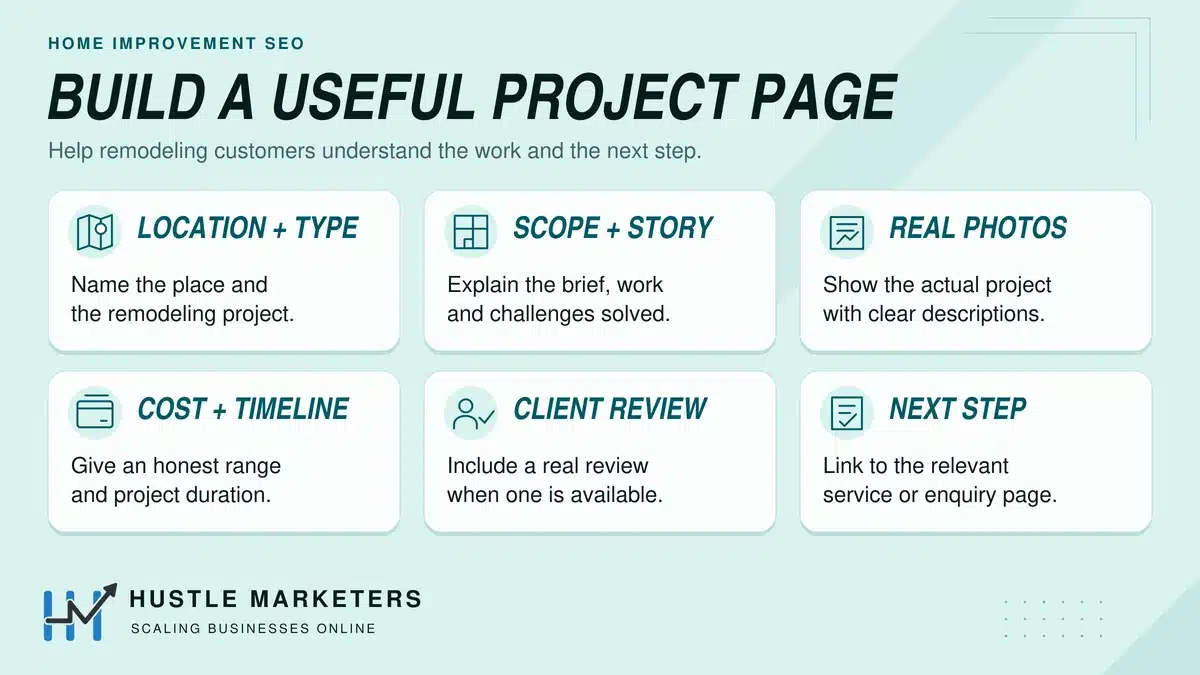
Here is the biggest missed opportunity on nearly every remodeling site we audit: the portfolio is a wall of unlabeled photos. Beautiful work, invisible to Google, unhelpful to buyers.
Turn each significant completed job into its own project page:
- A descriptive URL and title: /projects/modern-kitchen-remodel-lakewood/ with title “Modern Kitchen Remodel in Lakewood”
- The story: what the client wanted, what the space was before, what you did, what challenges came up
- Scope details: cabinets, countertops, flooring, layout changes, structural work
- Cost range and timeline: even a band like “85k to 100k, completed in 10 weeks” is gold. Buyers crave this and competitors hide it.
- Before and after photos with descriptive alt text (“before photo of 1990s oak kitchen in Lakewood” and “after photo of white shaker kitchen with island”)
- A review from that client if you have one
- A call to action pointing to the matching service page
Twenty project pages like this become a ranking engine for long tail searches (“galley kitchen remodel [city],” “split level basement finishing”), the proof layer for your service pages, and the raw material AI assistants quote when someone asks what a kitchen remodel costs in your area.
Before and after content deserves its own note. “Before and after” is a search behavior of its own, with buyers explicitly looking for transformations similar to their home. Pair every after shot with its before shot, shot from the same angle when possible. Name files descriptively before upload. Reuse the pairs on GBP, social, and in cost guides.
Cost Content: The Strategy for Early Stage Buyers
Remodelers resist publishing costs. “Every job is different.” True, and irrelevant. Homeowners search cost questions constantly, and someone in your market is answering them. If it is not you, it is a national site with numbers that do not reflect your market, or a competitor who now owns the first conversation.
The cost content playbook:
- One cost guide per major project type: “How Much Does a Kitchen Remodel Cost in [City/Region]?” and the same for bathrooms, basements, and additions.
- Answer first. Open with the real range in your market for your typical scope. Then break it down: what a budget, mid range, and high end version includes.
- Explain the drivers. Layout changes, plumbing moves, material tiers, structural surprises in older homes. This is where your expertise shows and where AI tools quote you.
- Use your own projects as examples. “This Lakewood kitchen came in at 92k. Here is where the money went.” Link to the project page.
- End with next steps: a consultation offer or a budget worksheet download for lead capture.
Cost guides rarely convert right away. They get you into the homeowner’s research folder months before your competitors know the project exists. When the shortlist forms, the company that already answered the scary money question honestly is on it.
Reviews and Trust for 30k Plus Jobs
At remodeling ticket sizes, trust is the conversion bottleneck. A homeowner will hand a stranger a six figure budget and keys to their house. Rankings alone do not overcome that.
What builds it:
- Review velocity over volume spikes. Remodelers complete fewer jobs than repair trades, so ask every single client, at the emotional peak: reveal day, when the space is finished and photographed. A steady handful of detailed reviews per month signals an active, busy company.
- Detail in reviews. Coach the ask: “It helps us if you mention what we built and your city.” A 150 word review describing a bathroom renovation in a named suburb is worth ten “Great company!” reviews for both rankings and persuasion.
- Respond to everything, including the rare bad review, calmly and specifically. Prospects read your responses as a preview of how you handle problems mid project.
- Trust signals on every page: license numbers, insurance, associations (NARI, NAHB), years in business, warranty terms, and photos of your actual team. Stock photos of models in hard hats do measurable damage to credibility.
- Google Business Profile matters here like every local business. Categories (“Remodeler,” “Kitchen remodeler,” “Bathroom remodeler”), project photos uploaded monthly, and posts featuring completed work.
The compounding effect of trust plus visibility is real. When we tightened targeting and landing experience for a local signage company, the account produced the kind of return we documented in our signage company case study. Different channel, same principle: high ticket local buyers convert when proof and presence line up.
Seasonal Patterns in Home Improvement Search
Remodeling demand has a rhythm, and it usually starts earlier than owners expect. The calendar below is the common pattern for remodeling, not a published benchmark, so check it against your own market before you plan around it:
- January to March: Planning season. Cost and idea searches tend to rise after the holidays, and this is when many of next summer’s clients start researching.
- April to June: Decision season. Contractor searches peak. Outdoor project searches (decks, siding, additions) climb with the weather.
- July to September: Build season. Search shifts to late deciders and fall interior projects. Some kitchen projects are timed to finish before the holidays.
- October to December: Quietest for new searches, but “kitchen remodel before Thanksgiving” style urgency exists, and December planning for new year projects begins.
The implication mirrors what we tell HVAC clients: publish ahead of the wave. Your cost guides and idea content should be refreshed in November and December to catch January planners. Your outdoor project pages should be strong by February. If you publish a deck content hub in June, you wrote it for next year.
To check the calendar for your area, open Google Trends, set the region to your state, set the time range to the past five years, and compare terms such as “kitchen remodel cost”, “bathroom remodel” and “deck builder”. Peaks that repeat in the same months every year are your real calendar. If your site already gets traffic, the Search Console Performance report with a 16 month date range shows the same rhythm for your own queries.
AI Search: Getting Named When Homeowners Ask
Homeowners now ask ChatGPT and Gemini things like “how much should a kitchen remodel cost in [city]” and “best bathroom remodelers near me with good reviews.” Two separate battles:
The cost and advice battle. AI models answer remodel cost questions by synthesizing published content. Local, specific, well structured cost guides are exactly the source material they favor over vague national averages. Every guide should state its market and year plainly: “In [city], as of 2026, most full kitchen remodels run between X and Y.” Clear, dated, quotable claims get cited.
The recommendation battle. When asked for actual companies, AI tools lean on Google Business Profile data, review aggregate and sentiment, directory consistency (Houzz matters in this vertical, along with Yelp, BBB, and Angi), and structured data on your site. Add LocalBusiness or HomeAndConstructionBusiness schema, keep citations identical everywhere, and maintain a Houzz profile with your best projects. Google says no special schema is needed to appear in its AI features, so treat markup as a consistency step, not a shortcut.
One more practical step: add an answer first FAQ to every service page. The questions people type into AI assistants are conversational (“is it worth remodeling a bathroom before selling”), and pages that answer conversational questions directly are the pages that get pulled into answers.
A 6 Month Home Improvement SEO Roadmap
Month 1: Foundation. Full audit using our SEO audit template. Fix technical basics, titles, schema. Rebuild GBP with correct categories and 30 plus project photos. Start the review ask system.
Month 2: Service pages. Write or rebuild pages for your top four project types with cost ranges, process, and featured projects.
Months 3 and 4: Portfolio engine. Build 10 to 15 project pages from past jobs. This is the heaviest lift and the highest compounding asset. Add before and after pairs to GBP and service pages.
Month 5: Cost content. Publish cost guides for your top three project types, each linking to project pages as evidence.
Month 6: Local expansion and links. Build city pages for your three best suburbs. Pursue local links: supplier partnerships, parade of homes coverage, local press on notable projects, Houzz and NARI profiles.
Then keep feeding the machine: every completed job becomes a project page, a review, GBP photos, and an example inside a cost guide. That loop is the whole strategy.
Turn Project Pages Into Local Proof
A strong project page is both a conversion asset and evidence that the business does the work it claims. Use original before-and-after photos, the real project area, scope, materials, constraints, timeline, permit considerations when relevant and a client quote you are authorized to publish. Link the project to the related service and location page.
Do not mass-produce city pages by swapping place names. A location page should contain distinct local proof, service realities, project examples, team coverage, FAQs and internal links. If the business has no meaningful evidence for a page, it probably does not need that page yet.
Real local proof is a better authority signal than a hundred thin city pages. Learn how our SEO agency approaches the work, then compare the method with the evidence in our local signage Google Ads case study.
FAQ
What is home improvement SEO?
Home improvement SEO is optimizing a remodeling or home improvement company’s website and local presence to appear in Google and AI search results when homeowners research and hire for projects like kitchen remodels, bathroom renovations, and additions. It combines local SEO, project portfolio content, and cost focused content for early stage buyers.
How long does SEO take for a remodeling company?
Expect early movement in three to four months and meaningful lead flow in six to twelve months. Remodeling adds a wrinkle: buyers research for months before contacting anyone, so leads lag rankings. Our post on how long local SEO takes breaks down the timeline stage by stage.
What keywords should a home improvement company target?
Three layers: hiring keywords (“kitchen remodeling [city],” “bathroom remodel contractor near me”), research keywords (“kitchen remodel cost [city],” “bathroom renovation timeline”), and inspiration keywords (“kitchen remodel before and after”). Most competitors only target the first layer.
Should remodelers publish pricing on their website?
Publish ranges, not quotes. Honest cost bands with explanations of what moves price capture months of early stage searches, pre qualify leads, and feed AI answers. Hiding costs does not stop buyers from finding numbers. It just means someone else provides them.
Do before and after photos help SEO?
Yes, when structured properly. Photos alone do little. Photos inside dedicated project pages with descriptive text, alt attributes, locations, and scope details rank for long tail searches and dramatically improve conversion.
How important are reviews for a remodeling company?
For jobs above 30 thousand dollars, reviews are usually the deciding factor. They influence map pack rankings, conversion, and AI recommendations. Ask every client at project completion and coach them to mention the project type and city.
How do I rank for “kitchen remodeling” in my city?
A dedicated kitchen remodeling service page with cost ranges and featured projects, supporting project pages, reviews mentioning kitchens, a GBP with the kitchen remodeler category, and internal links from your cost guide. Metro wide terms take time. Suburb level terms fall faster.
Can a small remodeler outrank big franchise competitors?
Yes. Local project pages, genuine photos, and owner involvement produce content depth that national franchises cannot match at the local level. Google’s local results and AI recommendations both favor demonstrated local work.
Is SEO worth it for a company that only takes 20 jobs a year?
Especially then. When each job is worth 50 thousand plus, two or three additional jobs a year from organic search is a large return, and SEO keeps working while you are on the tools.
How do AI assistants like ChatGPT choose which remodelers to recommend?
They aggregate your GBP, reviews, directory profiles (Houzz, Yelp, BBB), and site content. Consistent information, strong review sentiment, structured data, and specific project content make you quotable and recommendable.
Should I do SEO or paid ads for my remodeling company?
Both have roles. Ads produce inquiries fast but compete expensively for late stage buyers. SEO owns the long research phase where remodeling decisions are actually made. If cash flow allows only one long term, remodeling economics favor SEO because the research cycle is long and content compounds. See our contractor marketing guide for the full mix, and how trades like plumbing balance it differently.
How Hustle Marketers helps home improvement businesses with SEO
Home improvement is a high consideration, high ticket purchase where the buyer researches for months and then chooses on trust. That makes it one of the few local niches where content genuinely outperforms bidding, provided the content is project photography and real job detail rather than blog filler.
We have documented this in two directions. Our JBL Construct case study covers the technical SEO, indexing and content structure work for a Northern Virginia remodeler. On the paid side, our epoxy flooring Microsoft Advertising case study covers the channel most home improvement businesses ignore entirely.
Ishant Sharma has worked in search and paid media since 2013 across remodeling, flooring, HVAC and signage accounts. The organic side sits under our SEO services, the paid side under PPC management, and where Microsoft Ads is the gap we cover it through Microsoft Ads management.
Turn Your Finished Projects Into Your Best Salesperson
You already have the raw material: completed jobs, happy clients, and real numbers. Home improvement SEO is the system that turns that into rankings and inquiries. If you want a plan built for your market and project mix, our SEO agency team does this every day. Start with an audit and see exactly where the gaps are.
Sources and Verification
Facts that can change were checked on October 7, 2026 against these primary sources:
- Google Search Central: structured data guidelines
- Google Search Central: LocalBusiness structured data
- Google Search Central: ranking systems guide
Related guides
If this one was useful, these cover the same ground for closely related businesses.