Entity SEO: What Google Entities Are and How to Use Them

Ishant
Published : October 4, 2026 at 10:30 am
Updated : October 16, 2026 at 12:14 pm
Ishant

By Ishant Sharma, founder of Hustle Marketers. Published October 4, 2026. Hustle Marketers is a Google Partner, a Microsoft Advertising Partner and a Meta Business Partner, and I have worked in search since 2013.
Key Observations
- An entity is a thing, not a word. Google’s own definition, from a patent assigned to Google LLC and published December 22, 2016: “an entity is a thing or concept that is singular, unique, well-defined and distinguishable”.
- The most useful sentence Google has published on this is in its Organization structured data documentation, updated September 8, 2026: organization markup “can help Google better understand your organization’s administrative details and disambiguate your organization in search results”. Disambiguation is the job. Not citations, not rankings.
- The same page says “There are no required properties; instead, we recommend adding as many properties that are relevant to your organization”, and says the markup can influence which logo appears in Search results and in your knowledge panel. So Google does connect this markup to the panel, for that one element.
- Google says to put that markup on your home page or a single about page. Not site-wide. One page, one place, one identity.
- The salience score everyone uses to measure entities is a Google Cloud product metric describing “the importance or centrality of that entity to the entire document text”. Google’s documentation does not connect it to Search ranking anywhere, and I checked for that specifically.
- The Knowledge Graph Search API that guides tell you to use is documented by Google as “not suitable for use as a production-critical service” and is being migrated to a different product. Two of the 8 pages I read name that API; neither of those caveats came up in what I read of them.
- Knowledge panels are “automatically generated” from “various sources across the web”, and Google documents no way to request one. You can claim one that exists. You cannot order one.
- The only Knowledge Graph size figure Google has published is from May 2020: over 500 billion facts about five billion entities. Two pages ranking for this topic give figures that differ from each other by more than ten times on entities.
- Google’s own How Search Works page does not use the words entity, entities, Knowledge Graph or knowledge panel anywhere. I checked that twice with different prompts. That is a limit on what anyone can claim from Google’s documentation, not proof that entities do not matter.
- We sell SEO. That is disclosed here and in the section describing how we do this work.
Table of Contents
- What is an entity in SEO?
- What does Google actually say about entities?
- How does Google know what your brand is?
- How do you check whether Google has resolved your brand as an entity?
- What does entity work look like on the page?
- How does entity work relate to AI search?
- What can entity work not do?
- How much does entity SEO cost, and how long does it take?
- How we do this at Hustle Marketers
- Entity SEO FAQs
Entity SEO is the work of making it unambiguous, to a machine, who you are and what you are about. If you have been asking what are Google entities and whether your brand is one, that is the same question asked from the other end.
That is the whole idea. It is not a replacement for keywords, and almost nobody credible says it is. It is the layer underneath: before a search engine or an AI assistant can decide whether to show you for a query, it has to work out which thing in the world you are, and whether the various mentions of you around the web are all the same thing.
I read 8 of the pages that rank for entity SEO and its close variants on September 26, 2026, and I fetched Google’s own documentation, one Google patent, Google’s Cloud reference for the metric everyone measures with, and Google’s pages on knowledge panels and the Knowledge Graph. The gap between those two bodies of writing is the reason for this page.
Two disclosures before we start. Hustle Marketers sells SEO, so I have something to gain from you reading this. And this research pass was narrower than usual: I read 8 competitor pages, not the 18 I read for our answer engine optimization guide, because the tooling I normally use for bulk research was unavailable on the day. Every count on this page is out of those 8 pages. None of them is a claim about the market.
What is an entity in SEO?
An entity is a thing or a concept that can be identified on its own, separately from the words used to describe it.
Google’s own definition is worth quoting because it is the one the whole category rests on. It appears in a patent assigned to Google LLC, titled “Question answering using entity references in unstructured data”, published December 22, 2016 with a priority date of March 15, 2013:
an entity is a thing or concept that is singular, unique, well-defined and distinguishable. For example, an entity may be a person, place, item, idea, abstract concept, concrete element, other suitable thing, or any combination thereof.
Three of the 8 pages I read cite a Google patent, and the ones citing this patent quote it accurately. Credit where it is due: that definition is real, it is Google’s, and the industry did not invent it.
What the patent is not is a statement about ranking. It is a definition inside a question-answering patent with a 2013 priority date. Keep that distinction, because it is the one that gets lost everywhere else on this topic.
What are Google entities?
Google entities are the things Google has resolved and stored in its Knowledge Graph: people, places, companies, products, concepts, each held as a distinct item with its own set of facts and its own relationships to other items.
The phrase is industry shorthand rather than Google’s own term. Google documents the Knowledge Graph and it documents entities in patents and in its Cloud natural language products, but it does not market a product called Google entities. What people mean by it is whichever things Google already knows about, as opposed to the strings people type.
Your brand is a Google entity if Google has resolved it as one thing and attached facts to it. It is not one if Google still treats your name as an ambiguous string. That difference is the whole of the work described on this page.
What is the difference between an entity and a keyword?
A keyword is a string. An entity is the thing the string points at.
“Apple” is one string and at least two entities. “Jaguar” is one string and at least three. A search engine that only matched strings would have to guess. A search engine that resolves entities can tell which one you meant from the rest of the query, and can then bring in what it already knows about that thing.
| Keyword | Entity | |
|---|---|---|
| What it is | A string of characters someone typed | A thing in the world, with an identity |
| How many meanings | Often several | One, by definition |
| Where it lives | In a query and on a page | In a knowledge base, connected to other entities |
| What you optimize | Relevance of a page to a phrase | Clarity about which thing you are |
| Does it replace the other | No | No |
Is entity SEO replacing keyword SEO?
No, and most of the better pages on this topic agree.
Of the 8 pages I read, one states the two should be treated differently in strategy. Two explicitly reject the replacement framing, one of them putting it as keywords being the signals and entities being the destination. The rest treat entity work as a layer on top of ordinary relevance rather than a substitute for it.
So if you have seen the claim that keywords are dead and entities replaced them, that is not what the pages ranking for this term actually say. It is a summary of them that got repeated until it sounded like the consensus.
What does Google actually say about entities?
Less than the category implies, and the parts it does say are more specific and more useful than the parts it does not.
Here is the honest picture, from Google’s own documentation, fetched directly.
Does Google say entity markup helps?
Yes, for one specific job, and this is the most useful sentence I found in the whole research pass. From Google’s Organization structured data documentation, last updated September 8, 2026:
Adding organization structured data to your home page can help Google better understand your organization’s administrative details and disambiguate your organization in search results.
Read the verb. Disambiguate. Not rank, not cite, not recommend. Help a machine tell you apart from the other things with your name.
That is a narrower claim than most entity SEO pages make, and it is also the claim that survives scrutiny. It is the reason entity work is worth doing even though the surrounding hype is not.
Two more sentences from the same page, because leaving them out would flatter my own argument. Google says “There are no required properties; instead, we recommend adding as many properties that are relevant to your organization.” And it says the markup “can influence visual elements in Search results (such as which logo is shown in Search results and your knowledge panel)”. So this is not a required field and it is not a lever with a guaranteed output, and Google does connect it to the knowledge panel for that one visual element. All three of those things are true at once.
Where does Google say to put Organization markup?
On one page. Again from the same documentation:
We recommend placing this information on your home page, or a single page that describes your organization, for example the about us page.
I did not see that placement guidance stated on any of the 8 pages I read, but I was not specifically counting for it when I read them, so treat that as an impression rather than a count.
The habit I do see in audits, on client sites and our own, is Organization markup injected into every template so it appears site-wide. Google’s guidance is one page. If you are declaring your identity in forty places, you are not being clearer, you are being repetitive, and you are giving yourself forty places for the details to drift out of sync.
Which Organization properties actually do the disambiguating?
The identifier ones, and they are the part of this topic I see discussed least. Google’s recommended property list includes all of these. I put the question of which properties they name directly to one of the 8 pages I read and got two back, neither an identifier; I did not put the same question to the other seven, so I am not going to give you a count, only the observation that no identifier property came up in what I read of them.
| Property | What it pins down |
|---|---|
| legalName | The registered name, as distinct from the trading name |
| alternateName | The other names people use for you |
| sameAs | The other profiles that are you, which is how separate mentions get joined up |
| duns | Dun and Bradstreet number |
| leiCode | Legal Entity Identifier |
| naics | Industry classification code |
| iso6523Code | An ISO organization identifier |
| taxID and vatID | Tax registration identifiers |
| globalLocationNumber | GS1 location identifier |
| foundingDate, numberOfEmployees, address, contactPoint | The administrative details Google’s sentence names |
The implementations I see in practice usually stop at name, logo, url and sameAs. If the documented job is disambiguation, the identifiers are the part doing it, because they are the fields that cannot be true of two different companies. And Google’s own instruction is to add as many relevant properties as you have, which is a direct argument for filling them in.
A caution, and it matters. Do not invent any of these. A wrong tax identifier or a made-up DUNS number is worse than an absent one, and Google’s general structured data guidance is that markup should match reality. Fill in what you have and leave the rest out.
Does Google’s own explanation of Search mention entities?
No, and this is the finding I found most useful for calibration.
Google’s How Search Works page does not use the words entity, entities, Knowledge Graph or knowledge panel anywhere. I checked twice, with two differently worded prompts, and got the same answer both times. Its five sections are a preamble, an introduction to the three stages, then crawling, indexing and serving search results. The nearest sentence on understanding is:
After a page is crawled, Google tries to understand what the page is about.
Be careful what you take from that. It is not evidence that entities do not matter to Search, and I am not claiming it is. Google publishes documentation selectively and its public explanations are simplified; the Knowledge Graph plainly exists and Google describes it elsewhere. What it does mean is that anyone telling you Google has confirmed entity signals as a ranking factor cannot point at Google’s own explanation of Search to prove it, because the vocabulary is not there. I did not find any page in the set making this point, though I was not counting for it.
How does Google know what your brand is?
Through a knowledge base of its own, and through agreement between the independent sources that mention you. Google stores what it has resolved about a thing in the Knowledge Graph, then leans on whether your site, your profiles, directories, registries and press all describe the same business the same way. Consistency is the signal. Contradiction is the problem.
Google’s About knowledge panels page defines the surface where this becomes visible:
Knowledge panels are information boxes that appear on Google when you search for entities (people, places, organizations, things) that are in the Knowledge Graph.
And on how they come about:
Knowledge panels are automatically generated, and information that appears in a knowledge panel comes from various sources across the web.
Can you get a knowledge panel for your business?
Not on request. I asked that page directly, twice, whether it describes how to create, request, apply for or add a new knowledge panel, and got the same answer both times: it does not. What it does describe is claiming one that already exists, and only if you qualify:
If you are the subject of or official representative of an entity depicted in a knowledge panel, you can claim this panel and suggest changes.
Note the wording. Depicted in a knowledge panel. Claiming presupposes the panel.
That is the single most oversold thing in this category, so it is worth being blunt. If someone offers to get you a knowledge panel, ask them to show you where Google documents the mechanism they are using. What they can legitimately do is improve the consistency and coverage of information about you across the web, which is an input. It is not a lever with a documented output.
How big is the Knowledge Graph, actually?
The only figure Google has published that I could find is from May 2020. From Google’s own post about the Knowledge Graph and knowledge panels, dated May 20, 2020:
It has amassed over 500 billion facts about five billion entities.
Here is why I am labouring a six-year-old number. Two of the pages I read give Knowledge Graph size figures. One gives 500 billion plus facts and 5 billion plus entities and presents them as current for 2025 to 2026, which matches Google’s figure but not its date. The other gives 1.6 trillion facts about 54 billion entities attributed to May 2024. I searched for the source of that second figure and found only SEO publications repeating it, with no Google source. The two numbers differ by more than ten times on entities.
I am not saying either is fabricated. I am saying that if you are about to repeat a Knowledge Graph statistic in a client deck, the only one you can stand behind is Google’s, and it is from 2020.
How do you check whether Google has resolved your brand as an entity?
This is the practical heart of the topic, and it is where the standard advice needs two corrections before you act on it.
What does the Knowledge Graph Search API actually give you?
It queries Google’s Knowledge Graph for matching entities. From Google’s Knowledge Graph Search API documentation, last updated April 26, 2024:
The Knowledge Graph Search API lets you find entities in the Google Knowledge Graph.
The Knowledge Graph Search API returns only individual matching entities, rather than graphs of interconnected entities.
Now the two sentences on the same page that entity SEO guides leave out:
To support our customers with additional enterprise requirements and high QPS use cases, we are migrating this API to Cloud Enterprise Knowledge Graph.
This API is not suitable for use as a production-critical service. Your product should not form a critical dependence on this API.
Two of the 8 pages I read name this API. Neither of those caveats came up in what I read of them, though I did not put the question to them directly, so take that as an impression rather than a count.
That does not make the API useless. It is still the fastest way to see whether an entity with your name exists in the Knowledge Graph and what type Google has assigned it, and that is a genuinely useful one-off check. What it means is: use it as a spot check, do not build a reporting workflow or a client dashboard on top of it, and do not promise anyone a monitoring service that depends on it.
What does the salience score mean, and what does it not mean?
Salience is the metric five of the 8 pages I read name for measuring entities. None of them, in what I read, told me what Google’s documentation does and does not say about it. So here it is.
From Google Cloud’s Natural Language API reference for the Entity object:
The salience score associated with the entity in the [0, 1.0] range. The salience score for an entity provides information about the importance or centrality of that entity to the entire document text. Scores closer to 0 are less salient, while scores closer to 1.0 are highly salient.
So it is a measure of how central a thing is to one document. That is all it claims to be.
I checked both the reference page and the Natural Language basics documentation specifically for any statement connecting salience to Google Search ranking. There is none. Neither page mentions Search ranking at all.
This still leaves salience useful, and I want to be precise about how, because dismissing it would be as sloppy as overselling it. It tells you what your own text is centrally about, as judged by a machine reading it cold. If you have written a page you believe is about industrial parts washers and the top entity by salience is your city, the page is about your city. That is real, checkable editorial feedback about your own writing. It is not a Search signal, and nobody should sell it as one.
The most honest treatment of this I found in the set was the Search Engine Land guide, which walks through pasting text into the API and reorganizing it to watch the scores move. It is from April 6, 2023, so some of the surrounding context has aged, but the method is sound and it is the only page in the set that shows the test being run rather than just naming the tool.
Is there a method you can run without buying anything?
Yes. Here is the one I use, and every step is either free or already in your stack.
- Search your brand name in an incognito window and note whether a knowledge panel appears, and if it does, whether the type and the details are right.
- Query the Knowledge Graph Search API once for your brand name and note whether an entity exists, what type Google assigned, and what description it carries. Spot check only, for the reason above.
- Run your home page and your about page through the Cloud Natural Language entity analysis and read the top entities by salience. If your own organization is not among them, your identity page does not say who you are clearly enough.
- List every place on the web that describes your business: your own site, your Google Business Profile, LinkedIn, Crunchbase, industry directories, your state business registration (the Secretary of State filing in the US, or Companies House in the UK). Check the name, legal name, address, phone and founding date agree across all of them. Disagreement is the actual problem entity work solves.
- Check your Organization markup exists once, on your home page or your about page, and that every field in it matches what a human sees on the page.
- Repeat in 90 days. Knowledge Graph changes are not fast and nothing you do will show up in a week.
That is it. Four free checks, one piece of markup and a spreadsheet. Anyone charging you for an entity audit should be doing something more than this, and should be able to say what. For the AI side of the same monitoring, see our guide on how to track brand mentions in AI search.
We will run the entity checks on this page against your brand and send you what we find, including whether Google has resolved you as one thing, what it thinks you do, and where the web disagrees with itself about you.
Ask us to check your entity footprintWhat does entity work look like on the page?
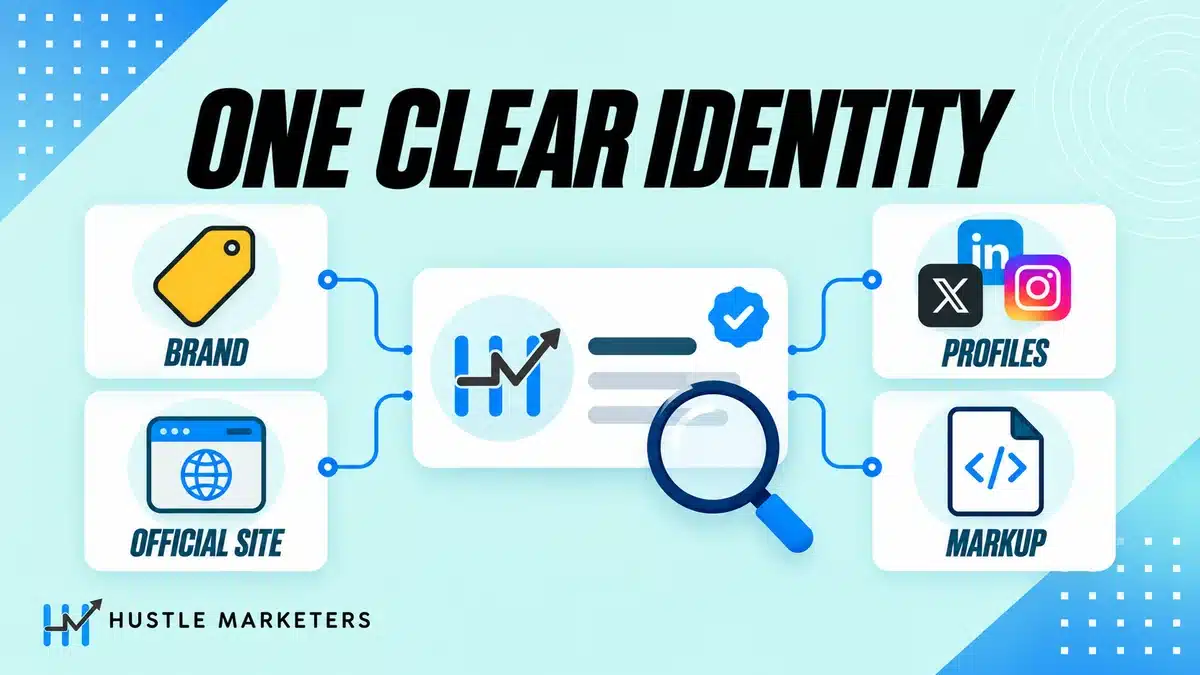
Ordinary, which is the point. There is no special entity tactic, only doing identity work deliberately instead of by accident. One page carries the markup, the description is consistent everywhere the business appears, the identifiers are real, and the content names the things in the subject rather than circling them with adjectives. Here is the order I work in.
- Pick one page to be the identity page. Home page or about page, per Google’s guidance. That page is where the Organization markup lives and where the fullest description of the business sits in visible text.
- Put the identifiers in. legalName, alternateName, the registry identifiers you actually hold, foundingDate, address, contactPoint. Only what is true.
- Use sameAs properly. It is the field that tells a machine that the LinkedIn company page, the Crunchbase profile and the Google Business Profile are the same thing as you. This is the single highest-value property for disambiguation and it costs nothing.
- Make the visible text say it. Structured data that contradicts the page is worse than none, and Google’s guidance across its documentation is consistently that markup should match visible content.
- Fix the disagreements off site. If three directories have three different addresses for you, no markup fixes that. Go and correct them.
- Write about the things, not around them. If your subject has named parts, name them. A page about parts washer sizing that never names a single process, solvent or standard is not about anything a machine can pin down.
- Interlink the pages that share a subject, with anchors that name the subject. Our technical SEO checklist covers the crawl and indexation side of that.
- Leave it alone for a quarter, then re-check.
Notice what is not on that list. No llms.txt. No injecting Organization markup site-wide. No buying a knowledge panel. No entity salience target to hit. None of those survived contact with the documentation.
Do you need schema markup for entity SEO?
You need it for disambiguation, and that is a smaller and firmer claim than the one usually made.
Google’s position, gathered across its own pages, is consistent if you read all of it rather than the convenient half. From the mythbusting section of Google’s AI optimization guide, under the heading “Overfocusing on structured data”:
Structured data isn’t required for generative AI search, and there’s no special schema.org markup you need to add. However, it’s a good idea to continue using it as part of your overall SEO strategy, as it helps with being eligible for rich results on Google Search.
Then the Organization documentation adds the disambiguation job, and says there are no required properties.
Put those together and you get something usefully specific. Schema is not a magic input and it is not mandatory. Organization markup is the one piece whose documented job matches what entity work is actually for. One of the 8 pages I read says schema is helpful but not required for entity SEO, which is closer to Google’s position than the schema-first framing used elsewhere in the set, and that page deserves the credit for it. Our page on structured data SEO covers the markup side beyond entities.
Our worked examples on Magento schema markup and restaurant schema markup show how we implement markup that reflects a page rather than decorating it.
Does Wikidata or Wikipedia help?
They are among the sources that describe things on the web, and Google says knowledge panel information comes from various sources across the web. That is as far as Google’s documentation takes it, and further than that is inference.
Practically: a Wikidata item is free to create and is a durable, machine-readable statement of identity with identifiers attached, so it is a reasonable thing to have if your organization genuinely qualifies. Wikipedia applies notability requirements that most businesses do not meet, and writing about your own organization there runs into its conflict of interest guidance, so it is not a channel to plan around. I would not spend money chasing either, and I would be wary of anyone selling either as a deliverable.
How does entity work relate to AI search?
It is the part of AI search optimization with the firmest ground under it, which is exactly why it is worth separating from the rest.
The honest case is this. Before an AI assistant can describe you accurately, something has to have resolved who you are. Disambiguation is a documented job that Google says organization markup helps with. Being described consistently across the web is an input to every system that reads the web. Neither of those depends on a tactic anyone invented in the last two years. Where that surface is Google’s, we cover how to optimize content for Google AI Overviews on its own page.
The dishonest version is to take that and sell it as a way to win citations. Our answer engine optimization guide goes through what the evidence actually supports there, including the one study that tried to isolate whether adding schema changes AI citation rates and found effects too small to separate from noise. The short version: entity identity has an argued case, citation amplification does not.
If you want the wider picture, our AI search optimization guide works through what Google documents, our guide to improving brand visibility in AI search engines sorts every tactic by how strong the evidence is, our guide to generative engine optimization covers GEO on its own terms, and if you are hiring rather than doing this yourself, our generative engine optimization agency page is our own page on that market and says so.
Is entity SEO the same as semantic SEO?
They overlap and they are not the same thing.
Semantic SEO is about meaning in content: covering a subject properly, using the language of the subject, answering the related questions. Entity SEO is about identity: making sure a machine knows which thing you are. You can write beautifully semantic content and still be confused with a company that shares your name, and you can have immaculate identity markup on a page that says nothing useful.
Our older post on semantic search covers the meaning side. It predates most of what is on this page and we are going to update it rather than let it compete with this one, because two pages fighting over the same subject is a self-inflicted wound.
What can entity work not do?
Entity work cannot make Google rank you, cannot get you a knowledge panel, and cannot manufacture facts about a business that has not earned any. What it can do is remove ambiguity, so that whatever you have earned gets attached to the right thing. That is a narrower promise than the category usually makes.
Three of the 8 pages I read state a limit of some kind, and none is a full account. One says a single page cannot teach Google a vague concept and that it takes many articles and references sustained over time. One says schema is helpful but not required. One labels its vendor-sourced statistics as directional rather than guaranteed and flags the commercial interest behind them, which deserves naming as good practice, because labeling vendor studies is rarer than it should be in this field.
Here are the limits as I see them.
- It cannot get you a knowledge panel. Google documents no request mechanism.
- It cannot make Google confirm anything. There is no published ranking factor to point at, and Google’s own explanation of Search does not use the vocabulary.
- It cannot be measured with a single number. Salience measures one document’s centrality, not Google’s opinion of you.
- It cannot be monitored reliably on the free API, which Google says is not for production-critical use.
- It cannot fix a business with no presence. If nothing on the web describes you, there is nothing to disambiguate.
- It cannot be rushed. Every mechanism in it depends on other sites and on recrawling.
- It cannot be proved by a before and after screenshot, for the same reason as every other search intervention: you have no control group.
How much does entity SEO cost, and how long does it take?
I did not see a cost figure or a time-to-results figure on any of the 8 pages I read, and I was not asking either question specifically, so that is an impression rather than a count. Either way I am not going to invent either, so here is what I can tell you instead.
The work splits into a one-off part and an ongoing part, and they price differently. The one-off part is the identity page, the Organization markup with real identifiers, the sameAs set and the off-site consistency sweep. For most businesses that is days, not months, and it does not recur. The ongoing part is writing about your subject properly and keeping your details current as the business changes, which is just publishing and housekeeping.
On timing, the honest answer is that I do not have a measured figure and neither does anyone whose figure I could find. What I can say is structural: every step depends on other sites being corrected and on Google recrawling, so nothing here is a two-week play. If a proposal gives you a date for a knowledge panel, that is the thing to question.
If you get a quote for entity SEO, ask for the one-off technical work and the ongoing content work to be priced separately. If they cannot be separated, the proposal is not specific enough to compare.
How we do this at Hustle Marketers
We sell SEO, so treat this as a disclosure as much as a description. What follows is what we actually do on an entity engagement, written so you can judge whether it is worth paying for or whether you could run it yourself from the method above. Most of it you could. The part that takes practice is deciding what to leave alone.
What we do: one identity page per client with Organization markup carrying the identifiers they actually hold, a sameAs set built from profiles we have verified exist, an off-site consistency sweep across their own listings and registry records, content that names the things in their subject, and a re-check at 90 days rather than 9 days.
What we do not promise: a knowledge panel, an entity salience target, or a position in an AI answer.
On evidence, I have to hold myself to the standard I just applied to eight other pages. I do not have a controlled test isolating entity work from everything else we do for a client. We do not run one intervention at a time, and no agency honestly can.
What I can point at is our published case studies, where the work and the numbers are set out with their sources named. There is a CDL school engagement that earned AI citations in ChatGPT, Gemini and Google AI Overviews, and an anonymized Shopify pet supply brand. Read them as what they are: outcomes from a program of work, not proof that one part of it caused them.
If you want the service rather than the guide, our technical SEO agency page covers the markup and crawl side of this work, our AI SEO company page sets out what is included, and my profile has the background and the certifications.
If you want this done rather than explained, we will scope the markup, the consistency work and the disambiguation, and tell you honestly if we think your constraint is somewhere else entirely.
Talk to us about entity SEOEntity SEO FAQs
What is an entity in SEO, in one sentence?
A thing or concept that can be identified on its own, separately from the words used to describe it. Google’s patent language is that an entity is singular, unique, well-defined and distinguishable, and can be a person, place, item, idea or abstract concept.
What is entity SEO?
The work of making it unambiguous to a machine who you are and what you are about, so that separate mentions of you around the web get joined up to the same thing. In practice it is one identity page, Organization markup with real identifiers, a verified sameAs set, consistent details off site, and content that names the things in your subject.
Does entity SEO replace keyword SEO?
No. Of the 8 pages I read, two explicitly reject the replacement framing and the rest treat entity work as a layer on top of ordinary relevance. Keywords are how a query arrives. Entities are how a machine works out what it is about.
Does Google confirm entities are a ranking factor?
Not in its own explanation of Search. Google’s How Search Works page does not use the word entity or mention the Knowledge Graph. That is not proof entities do not matter, because Google documents selectively, but it does mean nobody can cite Google’s own explanation of Search to prove they do.
What schema do I need for entity SEO?
Organization markup, once, on your home page or a single page describing your organization, which is where Google’s documentation says to put it. Google states there are no required properties and recommends adding as many relevant ones as you have, so include the identifiers you genuinely hold: legalName, alternateName, sameAs, and registry identifiers such as duns, leiCode, naics or vatID. Never invent one. Google also says the markup can influence which logo appears in Search results and in your knowledge panel.
What is entity salience and should I optimize for it?
It is a Google Cloud Natural Language API score from 0 to 1.0 describing how central an entity is to one document. Google’s documentation does not connect it to Search ranking anywhere. Use it as editorial feedback on whether your own page is about what you think it is about. Do not treat it as a ranking target and do not let anyone sell you a salience score.
Can I get a Google knowledge panel for my business?
Not on request. Google documents that knowledge panels are automatically generated from various sources across the web, and documents claiming an existing panel if you are its subject or official representative, rather than creating a new one. You can improve the consistency and coverage of information about you, which is an input, and Organization markup can influence which logo shows in a panel you already have. Nobody can order you a panel.
Should I use the Google Knowledge Graph Search API?
As a one-off spot check, yes. It will tell you whether an entity with your name exists and what type Google assigned it. Do not build a monitoring workflow on it: Google’s own documentation says the API “is not suitable for use as a production-critical service” and that it is being migrated to another product.
How big is the Google Knowledge Graph?
The only figure Google has published that I could find is from May 2020: over 500 billion facts about five billion entities. Larger figures circulate in SEO writing without a Google source. Use the 2020 number and date it.
How long does entity SEO take to work?
I do not have a measured figure and I did not find one in the pages I read. Structurally, every mechanism depends on other sites being corrected and on Google recrawling, so treat this as a quarterly cycle rather than a monthly one, and treat any promised date for a knowledge panel as a warning sign.
Sources and how I researched this
This page makes counts and absence claims, so here is exactly what sat behind them and what I did not check.
What I read
I ran five searches on September 26, 2026 and read 8 of the pages that came back, plus seven Google properties.
The 8 pages were the Search Engine Land entity SEO guide, the Ahrefs glossary entry, the Schema App entity SEO page, the Similarweb Google entities guide, the HubSpot entity-based SEO explainer, the Digital Applied 2026 entity SEO and Knowledge Graph guide, the Neil Patel entity-based SEO post, and the Stackmatix entity-based SEO and topical authority guide.
Every count on this page is out of those 8. None of them is a claim about the market.
What I verified myself, and how many times
Every quotation on this page was pulled by me directly, with narrow verbatim-only prompts.
Three pages I read twice, with differently worded prompts, and got the same answers both times: Google’s Organization structured data documentation, Google’s How Search Works page and Google’s About knowledge panels page. Those three carry the load-bearing quotes and the two absence claims, which is why they got a second read.
Five I read once, and I am saying so rather than implying more: Google’s Knowledge Graph Search API documentation, Google’s 2020 post on the Knowledge Graph, the Google Cloud Natural Language API reference for the Entity object, the Natural Language basics page, and Google patent US20160371385A1.
A single read rules out nothing except my own paraphrase. No number of reads through a text extraction tool independently re-verifies a live page. If a quotation here matters to a decision you are making, open the link.
What is a count and what is an impression. Where I write a number out of 8, I asked that question of each of those pages and the answer is a count. Where I write that I did not see something, I was not asking for it specifically, and I have said so at each point rather than letting an impression read as a tally. The distinction matters because an absence I did not look for is not a finding.
Where this pass was thinner than usual. Our normal process runs two parallel research agents and reads 16 to 18 competitor pages. That tooling was unavailable on the day, so this page rests on 8. I have said so rather than presenting a narrower pass as a wider one, and anything described here as absent is absent from those 8 pages on that date.
What I could not establish. Whether Google uses entity salience, or any entity signal, as a ranking factor: not documented, and the Cloud salience score is a separate product’s document-level metric. The source of the larger Knowledge Graph size figures in circulation: not traced to Google. Any cost or timing benchmark for entity work: not published by anyone in the set, and not measured by me.
Where I credit the pages I read. The Search Engine Land guide is the only one in the set that demonstrates the salience test being run rather than naming the tool, and the only one that states a limit on how quickly entity understanding can be built. The Digital Applied guide labels its vendor-sourced statistics as directional, flags the commercial interest behind them, and notes when a cited study’s methodology is unstated, which is better sourcing hygiene than most pages in this category. HubSpot and Neil Patel both refuse the entities-replace-keywords framing. Those are three different pages doing three things the rest of the set does not.
What I am not claiming. I am not the first person to make any of these points, and Google made the main one itself in documentation updated on September 8, 2026. What I could not find in the 8 pages was one page carrying the disambiguation framing, the placement guidance, the identifier properties, the honest reading of salience and the API caveat together, with the primary sources attached. That is the only claim I make about it.
About the author. I am Ishant Sharma, founder of Hustle Marketers. I have worked in search since 2013, on Google Ads, Microsoft Ads and SEO for ecommerce, local service, SaaS and white label agency clients. Hustle Marketers is a Google Partner, a Microsoft Advertising Partner and a Meta Business Partner. This page was researched and written on September 26, 2026. If something on it stops being true, tell me and I will date the correction.