Thin Content on an Ecommerce Site: How to Find It and What to Actually Do

Ishant
Published : October 9, 2026 at 9:30 am
Updated : October 7, 2026 at 1:16 pm
Ishant

Key Observations
- Thin content is not a Google algorithm. It is the name of a manual action in Search Console. Google’s spam policies do not define the phrase at all, and three of the things they do define are what the manual action actually points at.
- There is no word count. Google’s own self assessment asks whether you are writing to a word count because you heard Google has a preferred one, and answers its own question with no, we do not.
- There is no duplicate content penalty in Google’s documentation either. What is documented is non indexing. John Mueller’s version of the test is the cleanest one anywhere: if your content is essentially the same as what others already have, why should search engines even index it.
- Do not block indexed thin pages in robots.txt. It is the one action that stops you getting them out of the index, because Google cannot crawl a blocked page to see its noindex.
- You already own the measurement tool. Crawled currently not indexed in Search Console, read against your sitemap, is a thin content instrument, and nobody in the forty community threads we read is using it as one.
- The question worth answering is not which pages are thin. It is which thin pages are worth money. This page gives you a triage method for that and a decision for everything else.
Table of Contents
- What does Google actually mean by thin content?
- What is the actual test, if it is not length?
- Is there a duplicate content penalty?
- What actually goes wrong when a product page is thin?
- How do you actually measure thin content on your own store?
- Which product pages are actually worth writing for?
- What do you do with the pages that are not worth writing for?
- Do near identical products each need their own description?
- Do supplier and manufacturer descriptions hurt you?
- Are AI written product descriptions safe?
- What about repeated blocks like shipping, warranty and returns text?
- How many words should a collection or category page have?
- How long does recovery take?
- What should you fix first?
- How we approach this on a real store
- Which thin content advice should you ignore?
- Why work with Hustle Marketers on ecommerce content quality
- Thin content ecommerce FAQs
Somebody tells you your store has thin content. Usually it is a crawler. One store owner we read had Ubersuggest flagging low word count across 289 pages. Another had Ahrefs reporting duplicate content on hundreds of URLs. The number is always big enough to feel like an emergency.
Then you go looking for what to do about it, and the standard advice is to write unique, valuable descriptions for every product. Which is not advice. It is a restatement of the problem, addressed to somebody who has already told you they cannot do it.
This page is written for the version of the problem you actually have. You have more products than description budget. Some of your products are nearly identical to each other. Some of your copy came from a supplier. You want to know which pages matter, how to tell, and what to do with the rest.
Everything Google says here is quoted from Google, with the page it came from and the date that page was last updated. Where Google has not said something, this page says so rather than filling the gap.
What does Google actually mean by thin content?
Less than the industry implies, and the gap is worth understanding before you spend money.
Thin content is not a defined term in Google’s spam policies. Search the spam policies for Google web search and you will not find it as a policy. Where the phrase officially survives is as the name of a manual action, listed in the Manual Actions report documentation, and even there it is a pointer rather than a definition:
Google has detected low-quality pages or shallow pages on your site. Here are a few common examples of pages that often have thin content with little or no added value: Thin affiliate pages. Content from other sources. For example: scraped content or low-quality guest blog posts. Doorways. These techniques don’t provide users with substantially unique or valuable content, and are in violation of our spam policies.
Read that list again, because it is narrower than the way the phrase gets used. Affiliate pages. Scraped content. Doorways. Google calls these a few common examples rather than a closed list, and all three are tactics rather than descriptions of a short product page.
That matters commercially. If you are a retailer with brief product descriptions, you are not doing any of the three things in that list. You may still have a problem, and this page will get to it, but the problem is not the one the manual action is named after, and the fix is not the one that gets sold for it.
The three things Google does define
Each of these is a real, named, current policy with exact wording. The spam policies page was last updated on August 28, 2026.
| Policy | Google’s wording | Does it apply to a normal retailer? |
|---|---|---|
| Thin affiliation | Publishing content with product affiliate links where the product descriptions and reviews are copied directly from the original merchant without any original content or added value | Only if you are running affiliate links. The mechanism named, copied merchant descriptions with nothing added, is worth noting anyway |
| Scaled content abuse | When many pages are generated for the primary purpose of manipulating search rankings and not helping users | Only if the pages exist to rank rather than to sell. A catalog is not this |
| Doorway abuse | When sites or pages are created to rank for specific, similar search queries. They lead users to intermediate pages that aren’t as useful as the final destination | This one can catch ecommerce. Near duplicate location or variant category pages built purely for query coverage are the risk |
Two of the three are about intent, not length. Google’s own definition of spam opens by describing techniques used to deceive users or manipulate its systems. A short product page written by a person trying to sell a product is not an attempt to deceive anybody.
What Google says about the word count
This is the one people most want a number for, and Google has published the answer in the form of a question it asks you to ask yourself, on the creating helpful content page, last updated October 5, 2026:
Are you writing to a particular word count because you’ve heard or read that Google has a preferred word count? (No, we don’t.)
That parenthesis is Google answering its own question. There is no minimum. There is no 300 words, no 500 words, no 1,000 words for a category page, and the separate question of which template should hold the keyword at all is covered in category page vs product page SEO. Every number you have been given for this came from a third party correlation study or from somebody repeating one.
Which leaves you needing a different test, because “no minimum” is not the same as “anything goes”.
What is the actual test, if it is not length?
The best one line version of it comes from Google, in a September 2023 SEO Office Hours answer. Somebody who had hired content writers and been handed AI content instead wanted to know what to do. John Mueller’s framing was:
if your content is essentially the same as what others already have, why should search engines even index it
That is a duplication of value test, not a length test, and it reframes the whole problem correctly. The question is not whether your page is long. It is whether your page adds anything that is not already in the index.
A 40 word product description that names the exact fitment, the exact dimensions and the one thing customers get wrong about the product passes that test. A 400 word description that restates the manufacturer’s marketing copy in different words does not.
The self assessment questions that actually apply to a catalog
Google publishes a long list of self assessment questions on the creating helpful content page. Most of them are written for editorial content. These are the ones that translate cleanly to a product page, quoted exactly:
- Does the content provide original information, reporting, research, or analysis?
- If the content draws on other sources, does it avoid simply copying or rewriting those sources, and instead provide substantial additional value and originality?
- Does the content provide substantial value when compared to other pages in search results?
- Does your content clearly demonstrate first-hand expertise and a depth of knowledge (for example, expertise that comes from having actually used a product or service, or visiting a place)?
- Is the content mass-produced by or outsourced to a large number of creators, or spread across a large network of sites, so that individual pages or sites don’t get as much attention or care?
- After reading your content, will someone leave feeling they’ve learned enough about a topic to help achieve their goal?
Notice what the fourth one gives a retailer. First hand expertise that comes from having actually used a product. You do not have to have manufactured anything to have that. You have handled the product, packed it, taken the returns and answered the questions. That is the only thing on your product page that a competitor selling the same SKU cannot copy.
Is there a duplicate content penalty?
No, and the documentation is unusually clear about it, which matters because the fear of a penalty is what drives most of the bad decisions in this area.
Google’s page on consolidating duplicate URLs, last updated July 10, 2026, describes duplication as a selection and consolidation problem:
If you don’t specify a canonical URL, Google will identify which version of the URL is objectively the best version to show to users in Search.
It helps search engines to be able to consolidate the signals they have for the individual URLs (such as links to them) into a single, preferred URL.
Selection. Consolidation. Signals being combined into one preferred URL. The page does not mention a penalty, because there is not one to mention.
What there is instead is worse in a quieter way, and Google described it directly in a March 2023 Office Hours answer to somebody asking why their site was not being indexed:
The good news is that your robots.txt file is not holding your site back. The bad news is that there’s very little on your site that I suspect is worth indexing for search… The text seems to be copied from other sites.
Not a penalty. Not a demotion. Just a decision not to index the site. One qualification that matters: the site Mueller was looking at was an affiliate site of video and music descriptions, not a retailer, so this is not a ruling about your store. But the reason he gave, that the text is copied from other sites, is the one a dropshipper running supplier copy should plan around, and it is the honest answer to a question the forums answer wrongly in both directions.
Three problems that get lumped together
People tend to treat these as one problem. They are three different mechanisms with three different fixes.
| Mechanism | What actually happens | Who it applies to | What fixes it |
|---|---|---|---|
| No penalty for duplication | Google picks one URL, consolidates the signals, and moves on | Everybody with variants, filters and parameters | Canonicals, or nothing at all. This is routine housekeeping |
| Non indexing | Google crawls the page, decides there is nothing in it that is not already indexed, and leaves it out | Resellers and dropshippers running supplier copy | Adding something that is not in the index elsewhere |
| A named spam policy | Thin affiliation, scaled content abuse or doorway abuse. Can carry a manual action | Affiliates, mass page generators, and stores building near duplicate query pages | Removing the tactic |
Most stores worrying about thin content are in row two. Almost nobody is in row three. And row one is not a problem at all.
What actually goes wrong when a product page is thin?
Four things, in rough order of how often we see them. None of them is a ranking problem, which is why arguing about penalties misses the point.
It does not get indexed
This is the common one. The page is crawled, assessed, and left out. In Search Console it shows as Crawled currently not indexed, which was the dominant phrasing across the forty community threads we read and was never once named there as a thin content signal.
It eats crawl that your good pages need
Google’s crawl budget guide for large sites, last updated July 22, 2026, says what decides how much Google crawls:
Google determines the crawling resources allocated to each site by factoring in elements that are relevant to the specific Google product. For example, for Google Search, this includes things like popularity, overall user value, content uniqueness, and serving capacity.
The same page names uniqueness as one of the four inputs to how much crawling Google gives a site, alongside popularity, user value and serving capacity. That is a documented link between duplicate catalog content and crawl demand, and it is the argument to use when a developer asks why this matters.
One correction worth making, because it is repeated everywhere including in content published this year. The phrase low value add URLs no longer appears on that page. Google reworded the guidance, which now sits under the heading Manage your URL inventory. The list of URL types survives. The label does not. If a page or an audit quotes low value add URLs at you as current Google wording, it has not checked the source recently.
Your rich results get filled in from the wrong page
This is the consequence that persuades people, and it is Google’s own. In an August 2024 Office Hours answer, somebody asked why their rich results were showing the wrong currency. John Mueller’s answer:
Often this is a side-effect of Google’s systems seeing the page as being mostly duplicate…One approach is to make sure the pages are not that similar…
Mueller’s worked example is a store running almost identical pages for Germany and Switzerland, where the systems treat them as duplicates even though the price differs. The same mechanism is available to any store running near identical pages, including color and size variants. The consequence is not a ranking problem. It is a merchandising one, visible to every person who sees your listing.
Nobody buys
Worth saying out loud, because the SEO framing buries it. A Diamond Product Expert answering a store with 480,000 products put it plainly:
Will consumers buy a product with so little descriptive text? Seems like sales will suffer until you can get the pages populated with useful content.
If a page cannot sell the product to a person who arrived ready to buy, its ranking is a side issue.
How do you actually measure thin content on your own store?
This is the part you need. What follows is a method, not a tool recommendation, and you can run the first part in twenty minutes with things you already have.
Step one, the indexing gap, which is free
Your sitemap says how many URLs you think should be in the index. Search Console says how many are. The difference, split by reason, is where your thin content measurement lives. It is not purely a thin content number, because the same gap also holds canonicalized duplicates, redirects, 404s and pages you deliberately noindexed, which is why the reason column matters more than the total.
- In Search Console, open the Page indexing report, then the Not indexed section.
- Read the Crawled currently not indexed row. Google’s definition is that the page was crawled but not indexed, and that it may or may not be indexed in the future. On the catalog sites we work on this bucket is overwhelmingly product and variant URLs, which is our observation rather than a published figure.
- Read the Discovered currently not indexed row, but read it differently. Google’s own definition is that the page was found but not crawled yet, and that typically Google wanted to crawl it and expected that to overload the site, so it rescheduled the crawl. That is a serving capacity signal rather than a content one. Treat it as context for the row above, not as evidence of thin content.
- Filter each by your product URL pattern, then export.
- Express it as a ratio. Product URLs indexed, against product URLs submitted. That single number is your baseline, and it moves when you fix things.
This is the instrument. It is Google’s own assessment of your pages, not a third party tool’s word count heuristic, and it costs nothing.
Step two, find out what a crawler actually sees
Before you rewrite anything, check that your copy is in the HTML at all. A store owner on a Shopify thread this year gave the fastest version of this test:
Open a product page, view source, search for your price. If it’s not in there, some assistants aren’t seeing it either.
Do the same for your product description. If the description is injected by an app after load, you may not have a thin content problem. You may have a rendering problem, which is a different job and a cheaper one. The same check matters for AI answer engines, which is covered in our post on AI SEO for ecommerce.
Step three, sample rather than crawl
You do not need to audit 40,000 pages to know what is happening on 40,000 pages. Take fifty product URLs at random, stratified across your top categories, and record four things for each:
| What to record | Why it matters | What good looks like |
|---|---|---|
| Words of unique body copy, excluding shipping, warranty and nav boilerplate | Not a ranking threshold. A proxy for whether anything was written at all | Something rather than nothing. Zero is the number that matters |
| Whether the description also appears on another site, checked by pasting one full sentence into Google in quotes | This is the non indexing risk, measured directly | Your page is the only result, or the first result |
| Whether the page is indexed, checked in the URL Inspection tool | Turns the theory into a fact for that URL | Indexed |
| Sessions and revenue in the last 90 days | Decides whether it is worth fixing | Anything above zero changes the answer |
Fifty rows gives you a percentage you can defend. It also gives you the thing step four needs.
What not to measure
Word count alone, as a pass or fail. Every tool that flags low word count is applying a threshold that Google has explicitly said it does not have. The flag is not useless, because zero words is genuinely a problem, but the number it gives you is not a target and chasing it produces exactly the padded, repeated blurbs that Google has asked stores to stop writing.
Which product pages are actually worth writing for?
This question is asked in at least five of the forty community threads we read, and answered in none of them. One store owner with 480,000 products said it as clearly as it can be said, in a Search Central Help Community thread from March 2023:
We have an ecommerce site with 480,000 product pages. Roughly half of those pages have thin product descriptions – 1 sentence or less. We are concerned about site quality. Writing product descriptions for 240,000 products is not an option. Should we noindex thin product pages? If not, any suggestions?
The thread has two replies. Neither answers it. The first lists content types Google likes. The second suggests robots.txt, which is wrong, and we will come back to that. Nobody tells them how to choose.
So here is how to choose.
The triage, in the order you should run it
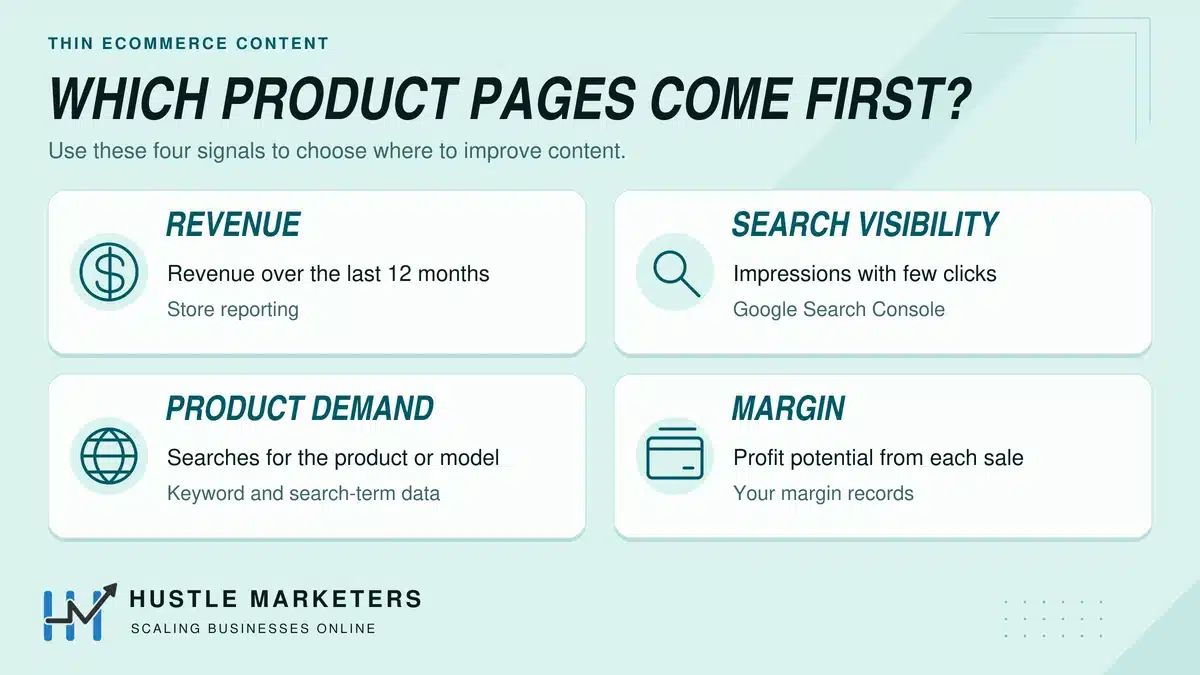
Score each product URL on four axes. You already have all four in Analytics, Search Console and your platform’s reporting.
| Axis | Where to get it | Why it is on the list |
|---|---|---|
| Revenue in the last 12 months | Platform reporting | A page that makes money already deserves the copy. This outranks everything else on the list |
| Impressions with low clicks in Search Console | Performance report, filtered to the URL | Google is already showing the page. It is being seen and not chosen. Copy is the cheapest lever left |
| Search demand for the specific product name or model number | Keyword tool, or your own Google Ads search terms report if you run ads | Demand that exists and is not being served is the clearest case for investment |
| Margin | You | Two products with identical traffic are not identical investments |
Write the copy for the top band. Ignore the score for the bottom band and go to the next section.
One thing that makes this cheaper than it looks. If you run Google Ads, your search terms report is already a list of the exact phrasings people use for your products, paid for and validated by clicks. Using it to prioritize organic copy is free, and it is one of the arguments for keeping ecommerce PPC and SEO in the same place rather than in two agencies.
Where the rule comes from
A version of this triage already exists in the forums, applied backwards. On a Shopify Community thread about deleting products, a poster called KieranR wrote:
It affects SEO more if the pages you are removing were/are getting a lot of traffic
and
If the pages you’re deleting get near-zero traffic, and has no backlinks then I almost wouldn’t even bother with a redirect.
That is traffic and links as the axis for deciding what to delete. Run it forwards and it is the axis for deciding what to invest in. It is obvious once written down, and in the forty community threads we read across this topic cluster, thirty six of which returned their replies, nobody had written it down.
What do you do with the pages that are not worth writing for?
Four options. Pick per band, not per page.
| Option | When it is right | What it actually does | The catch |
|---|---|---|---|
| Leave it alone | Low traffic, low revenue, but a real product somebody might buy | Nothing. The page stays crawlable, and in our experience usually stays unindexed | Costs you nothing and fixes nothing. This is the correct answer far more often than the industry admits |
| Consolidate | Near identical products that differ only by a color, a size or an engraving | One strong page instead of eight weak ones, with the options on it | You lose the ability to target each variant name. Check your search demand first |
| Noindex | Pages that must exist for shoppers but should not be in search, for example internal search results or filtered views | Removes them from the index while keeping them usable and crawlable | Google has to be able to crawl the page to see the tag. See below |
| Remove | Discontinued products with no traffic and no links | A 404 or 410, and the crawl budget back | Redirect anything with links or traffic. Do not bulk redirect everything to the homepage |
Pruning deserves more respect than it gets. In a December 2022 Office Hours answer, a store migrating its site described going from 30,000 products down to 2,500 and asked whether to move to a clean URL. Google’s Alan Kent recommended keeping the existing domain where possible, and said that it is fine to clean up old pages and either have them return a 404 or redirect to new versions, even if this affects lots of pages on your site. He was answering a migration question rather than endorsing pruning as a content strategy. The point still carries: removing pages at scale is not something Google treats as a problem in itself.
The robots.txt mistake
The reply that store with 480,000 products received was:
Perhaps blocking with robots.txt makes more sense in the short term.
Do not do this to pages that are already indexed. Robots.txt prevents crawling. It does not remove a URL from the index, and because Google cannot fetch a blocked page, it cannot see a noindex tag on it either. Blocking an indexed thin page is the one action that removes your ability to get it out of the index deliberately. Google documents that a URL blocked in robots.txt can still appear in search results, without a description, and that a crawler will never see a noindex rule on a page it is not allowed to fetch.
The order is: noindex first, wait for it to be picked up, then block crawling later if you want the crawl savings. Never the other way around.
The second thing in that reply worth flagging
The same answer says that once Google sees a noindex, it will be reluctant to return, so reindexing later may be harder. We could not find that in Google’s documentation. Treat it as a practitioner’s caution rather than a documented behavior. It is a reasonable thing to be careful about and it is not something Google has published.
Do near identical products each need their own description?
This came up in three of the threads we read and it has a real answer, which is usually no, but not for the reason people expect.
The situations are always the same shape. Five crystal prism suncatchers that differ by size. Ten t-shirts where eight are the same base garment with different prints. A paint range where the only difference is the color name. One store owner described their set precisely: eight of the ten are very similar, different designs of the same base idea, and the other two are sufficiently different to deserve targeted keywords and descriptions.
That last sentence is the whole method, and they arrived at it themselves.
The question to ask is about demand, not duplication
Do not ask whether the products are different. Ask whether people search for them differently.
- If people search for the specific color, size or model by name, it deserves its own page, because there is a query for it that a combined page will struggle to own.
- If people search for the parent product and then choose, it should be one page with options, because eight pages splitting the same demand are competing with each other for it.
Your Google Ads search terms report answers this directly if you run ads, because it shows you the actual phrasings that converted. A keyword tool’s estimate is the fallback, not the first choice.
What changes when you split them
Splitting near identical products into separate pages is a real decision with real costs, and the forums discuss the SEO side while ignoring the rest.
| Consequence | Separate pages | One page with variants |
|---|---|---|
| Query targeting | Each color or size can own its own query | You target the parent term and rely on the page to convert |
| Description effort | Multiplied by the number of variants, which is the problem you started with | Written once |
| Duplication risk | High, and it is the case John Mueller described in the August 2024 Office Hours | None |
| Rich results | Near duplicate pages can get the wrong price or currency pulled into the SERP | One clean source |
| Shopper experience | Fragmented. People land on the blue one and cannot see the red one | Everything in one place |
| Merchant Center | Variants have their own documented handling, which we would take over splitting the site | Supported directly |
If the only reason you are considering separate pages is that you want more indexable URLs, that is the wrong reason, and the pages you create will be the thin ones you are here to fix.
The one thing not to do
One store asked Google whether it was acceptable to show all product variants to Googlebot on a category page while showing a reduced set to shoppers. John Mueller’s answer was that this would be considered cloaking and would be considered in violation of the spam policies, and that variants should go to Merchant Center instead.
That is worth knowing because the idea sounds harmless when a developer suggests it.
Do supplier and manufacturer descriptions hurt you?
Here the honest answer requires separating what Google has said from what everyone infers.
Google has not published a statement about retailers using manufacturer supplied product descriptions. We looked for one and could not find it. Anyone telling you Google says do not use manufacturer descriptions is quoting something that does not exist.
What does exist is adjacent and points the same way:
- The thin affiliation policy condemns product descriptions copied directly from the original merchant without any original content or added value. The context is affiliate links rather than retail, but the mechanism named is exactly yours.
- The self assessment asks whether content that draws on other sources avoids simply copying or rewriting those sources, and instead provides substantial additional value and originality.
- The March 2023 Office Hours answer quoted earlier is Google looking at a site of copied text and saying there is very little worth indexing.
So the inference is sound and we are labeling it as an inference. Supplier copy does not get you punished. It gets you left out, because there is nothing on the page that is not already in the index under somebody else’s domain.
What a reseller can add that the manufacturer cannot
This is the practical part. You do not need to out write the manufacturer. You need to write the things the manufacturer has no way of knowing.
| What to add | Why only you can | Effort |
|---|---|---|
| Which of your other products it fits, works with or replaces | You hold the catalog. The manufacturer does not know what else is on your shelf | Low, and it builds internal links at the same time |
| The question customers actually ask before buying it | It is in your support inbox and your live chat logs | Low. Two sentences per product |
| What arrives in the box, photographed by you | The manufacturer’s render is on forty other sites. Your photograph is not | Medium |
| The most common reason this one gets returned | Only you have the returns data | Low, and it cuts returns as well as thin content |
| Sizing, fitment or spec that the spec sheet gets wrong in practice | You have handled it | Low |
| A comparison with the two products people also consider | You sell both | Medium, and it answers the question that otherwise sends the shopper back to the search results |
Every row in that table is original information measured against Google’s own self assessment question, and none of it requires a copywriter.
Are AI written product descriptions safe?
Safe, yes, with a real line to stay behind. Effective, unproven.
Google has superseded its 2023 blog position with a documentation page, guidance on generative AI content, last updated October 1, 2026. The line it draws:
using generative AI tools or other similar tools to generate many pages without adding value for users may violate Google’s spam policy on scaled content abuse
The policy target is scaled content abuse, not AI. The spam policy defines that as pages generated for the primary purpose of manipulating search rankings and not helping users. Generating a description for a product you actually sell, so that a shopper can understand it, is not that. Generating 2,000 collection descriptions overnight so the pages have text on them is closer to it, and it is also exactly what Google asked stores to stop doing.
Asked in a June 2024 Office Hours whether AI drafts with human editors are against the guidelines, John Mueller’s answer was that what matters is the overall quality that you end up publishing.
The part nobody will tell you
Across four community threads on AI written content, product descriptions among them, containing roughly twenty replies, we found one person claiming a result and they gave no number, and their claim was about blog posts rather than product pages. When one store owner asked directly whether anyone had seen a real lift from AI assisted content, anything measurable, nobody replied.
That is not evidence that it does not work. It is an absence of evidence that it does, in the places where people are most likely to boast. Treat AI drafting as a way to produce a first pass cheaply, and assume the value comes from what you add afterwards, because the only thing anyone can actually demonstrate is the cost saving.
What about repeated blocks like shipping, warranty and returns text?
Nothing. This is a false alarm and it causes real damage.
A store owner asked Google how to stop Googlebot crawling one repeated section of his product pages, an also bought module of small add ons. John Mueller’s answer, from June 2023:
The short version is that you can’t block crawling of a specific section on an HTML page… If this is just for content that’s reused across your pages, I wouldn’t worry about it—there’s no need to block Googlebot from seeing that kind of duplication.
Mueller’s condition is content that is reused across your pages, which is exactly what a shipping block, a warranty block, a size guide and a returns policy are. His answer was that he would not worry about it, and that there is no need to block Googlebot from seeing that kind of duplication.
We found a WooCommerce store owner one reply away from putting his shipping and warranty text into an image so that Google could not read it, in order to avoid a duplicate content problem that was never a problem. That would have made the text invisible to Google, to screen readers and to AI answer engines, all to solve nothing.
If a crawler flags your boilerplate as duplicate content, the crawler is measuring string similarity. Google is not.
How many words should a collection or category page have?
Fewer than you have been told, and Google has been direct about this since 2023.
Asked in a September 2023 Office Hours whether content on an ecommerce category page is valuable for rankings, Gary Illyes answered:
You can add whatever content you like to your pages, they are your pages after all. But please don’t do those auto-generated low-quality repeated, blurbs of text over and over again on all your category pages. It just looks silly, even for the average person. If you need content on your pages add content that people will actually find useful, don’t add content because search might require it or so you think.
Three years on, the advice circulating in store owner communities is still specific word counts above and below the product grid, offered without a source and contradicted by the person who was asked. In one thread this September, two people gave different numbers four minutes apart and neither cited anything.
Write a category description when there is something a shopper needs before choosing between the products. Sizing conventions. What the difference between the sub types actually is. Which one suits which use. If there is nothing like that to say, the grid is the content and the page is fine. Category page structure in more depth is covered separately in ecommerce SEO by platform.
How long does recovery take?
Longer than the fix, and Google will not give you a threshold.
Somebody asked, in a December 2022 Office Hours, how much of a site’s content has to be updated before an algorithmic thin content demotion lifts. The question asks how much. The answer gives a timescale and not a threshold:
For algorithmic actions, it can take us several months to reevaluate your site again to determine that it’s no longer spammy.
So Google has not published a proportion either. Anyone who tells you the number is guessing. Plan on several months for a site wide reassessment, and, in our experience rather than on any published figure, faster than that for individual URLs once they are re crawled.
Track it with the ratio from step one rather than with rankings. Product URLs indexed against product URLs submitted is a cleaner signal than a position tracker, and it moves earlier.
What should you fix first?
| Priority | Action | Why it comes here |
|---|---|---|
| Critical | Check whether your descriptions are in the HTML at all, using view source | If it is a rendering problem, everything below is the wrong project |
| Critical | Baseline the indexed against submitted ratio for product URLs in Search Console | Without it you cannot tell whether anything you do works |
| Critical | Find any indexed thin page currently blocked in robots.txt and unblock it, then noindex it | This is the one configuration that removes the fix, because the noindex can never be seen |
| High | Run the fifty URL sample and get a defensible percentage | Stops the project being run off a crawler’s word count threshold |
| High | Score the catalog on revenue, impressions, demand and margin, then write for the top band only | The only step that makes money |
| High | Consolidate near identical variants where search demand does not justify separate pages | Removes the duplication at the source instead of writing around it |
| Medium | Add the reseller specific content: fitment, returns reasons, real photographs, comparisons | Original information measured against Google’s own self assessment question, and it converts |
| Medium | Decide what happens to discontinued products, and apply it as a rule rather than page by page | Crawl budget, and it stops the problem regrowing |
| Medium | Check that near duplicate variant pages are not corrupting your rich results | Visible in the SERP, and usually nobody is watching for it |
| Low | Remove padded category blurbs added because somebody said the page needed 500 words | They were never helping and Google has asked stores to stop |
How we approach this on a real store
Gifts To Engrave sells personalized laser engraved gifts on Shopify, with 94 products in Merchant Center. It is a useful example for this subject precisely because it is small, and because personalization tends to create the near identical product problem in its purest form.
The client’s own assessment, in September 2026, was that the product descriptions were not managed well. The work started on the Merchant Center side, building a supplemental feed with rewritten descriptions and AI attributes, drawing the language from the site itself and from the Google Ads search terms report, the same source of data described earlier on this page, used here to decide what the copy should say. The Bing Shopping feed is part of the same engagement.
Two honest notes about using this as evidence.
The first is that the feed and the product page are different surfaces. Fixing descriptions in a supplemental feed improves what Shopping and free listings show. It does not on its own rewrite the page a shopper lands on, and this post is about the page.
The second is that we have not published ranking or revenue figures for this account, so we are not going to imply any here. What the example demonstrates is the method: a small catalog, a description quality problem the client identified themselves, and search terms data used to decide what the copy should say rather than guessing.
If you want the numbers version, our published pet store case study has them, though it is an SEO and AI search engagement rather than a content quality one and does not report on indexing or product descriptions.
Which thin content advice should you ignore?
Most of the thin content advice a store owner hears arrives as an audit flag, a plugin warning or a line in a sales pitch. Five pieces of it come up again and again. Each one fails against Google’s own documentation, and each one costs money if you act on it.
| Advice you will hear | What Google’s documentation says | What to do instead |
|---|---|---|
| Product descriptions need at least 150, 200 or 300 words | The creating helpful content page asks whether you are writing to a word count because you heard Google has a preferred one, and answers: No, we don’t | Write what a shopper needs to choose. Zero words is the problem, not short copy |
| Thin content is a Panda or Helpful Content Update problem | Thin content is the name of a manual action, with thin affiliate pages, content from other sources and doorways as its common examples | Open the Manual actions report in Search Console. If it is empty, there is no penalty to lift, so start from the indexing gap in step one |
| Duplicate content gets your store penalized | The page on consolidating duplicate URLs describes Google picking one URL and combining the signals into it. It does not mention a penalty | Canonicals for variants, filters and parameters, then move on |
| Block thin pages in robots.txt | A URL blocked in robots.txt can still appear in results, and Google cannot see a noindex on a page it is not allowed to fetch | Noindex first, wait for the pages to drop out, then block crawling if you want the crawl savings |
| Rewrite every product description | John Mueller’s test is whether your content is essentially the same as what others already have. A supplier description in new words still is | Run the triage on revenue, impressions, demand and margin, and write for the top band only |
A quick test for any audit you are handed: ask where each threshold comes from. If the answer is a tool’s default setting rather than a Google page, treat the flag as a reason to look at the page, not a number to hit.
Why work with Hustle Marketers on ecommerce content quality
Ishant Sharma has worked in digital marketing since 2013 as a Google Ads, Microsoft Ads and SEO specialist, and Hustle Marketers works with ecommerce, local service, SaaS and white label agency clients. Three reasons this particular job suits us.
We run the ads as well as the SEO. The triage step on this page uses your Google Ads search terms report to decide which products deserve copy and what that copy should say. An agency that only does SEO does not have that data and will use a keyword tool’s estimate instead. An agency that only does PPC has the data and no reason to look at it.
We work at catalog scale on the feed side every week. Merchant Center descriptions, supplemental feeds and attribute mapping across stores from 94 products upwards, which means the question of how to improve product data without writing 40,000 descriptions by hand is not theoretical here. If your immediate problem is disapprovals rather than rankings, start with Google Merchant Center errors.
We will tell you when the answer is to do nothing. A large share of the thin content flagged by crawlers needs no action, and a project that starts by rewriting everything is a project that spends your money on the rows in the table above that say leave it alone. If you want that conversation, we work with stores on Shopify, Magento, BigCommerce and WooCommerce, and at enterprise catalog sizes. The full scope of that work is on our ecommerce SEO agency page.
Thin content ecommerce FAQs
Is thin content a Google penalty?
Not usually. Thin content is the name of a manual action in Search Console. Google describes it as low quality or shallow pages, and gives three common examples: thin affiliate pages, content from other sources such as scraped content, and doorways. Those examples are not an exhaustive list, but they are narrower than the way the phrase gets used, and a normal retailer with brief product descriptions is doing none of them. What actually happens to a short or duplicated product page is that Google declines to index it, which is a different outcome with a different fix.
How many words should a product description be?
There is no number. Google’s own self assessment asks whether you are writing to a particular word count because you heard Google has a preferred one, and answers its own question in the parenthesis that follows with no, we do not. The useful test is whether the page adds something that is not already in the index. Forty words of fitment detail, returns reasons and a real photograph will beat four hundred words of restated marketing copy.
Will Google penalize me for using manufacturer product descriptions?
Google has not published a statement about retailers using manufacturer descriptions, and we could not find one. What Google does say is that content drawing on other sources should provide substantial additional value and originality rather than copying or rewriting, and in one Office Hours answer it described a site of copied text as having very little worth indexing. So the risk is not a penalty. Our inference, and we are labeling it as one, is that the risk is non indexing: Google has no reason to index a page whose text is already in the index under somebody else’s domain.
Does duplicate content hurt my ecommerce site?
Duplication between your own URLs, from variants, filters and parameters, is routine and Google handles it by picking a canonical and consolidating the signals. Its documentation describes this as selection and consolidation and does not mention a penalty. Duplication between your site and every other site selling the same product is the one that costs you, and it costs you indexing rather than ranking.
Should I noindex thin product pages?
Sometimes, and never by blocking them in robots.txt. Noindex is right for pages that shoppers need but search does not, such as internal search results and filtered views. For genuine products with low traffic, leaving them alone is usually the better answer, because they stay available to buy and they rarely cost you anything. If you do use noindex, make sure the page stays crawlable, because Google cannot see a noindex tag on a page it is not allowed to fetch.
How do I find thin content on my site?
Start with Search Console rather than a crawler. Open the Page indexing report and read the Crawled currently not indexed row, which is Google having fetched the page and not indexed it. Read Discovered currently not indexed alongside it for context only, because Google defines that one as a page it found but rescheduled crawling for, usually to avoid overloading the site. Filter to your product URL pattern and express the result as a ratio of product URLs indexed against product URLs submitted. Then sample fifty product URLs and record unique word count, whether the description appears on another site, indexing status, and sessions and revenue. That gives you a defensible percentage and the data you need to decide what to fix.
Are AI generated product descriptions bad for SEO?
Not in themselves. Google’s current guidance says that using generative AI to generate many pages without adding value for users may violate its spam policy on scaled content abuse, and that policy is about pages generated to manipulate rankings rather than to help users. A description written for a product you actually sell is not that. Two thousand collection descriptions generated overnight to fill space is closer to it. Also worth knowing: in the community threads we read on this, nobody could point to a measurable result from AI assisted product copy.
Does repeated shipping and returns text on every product page count as duplicate content?
No. Asked how to block Googlebot from one reused section of a product page, Google’s John Mueller said you cannot block a section, and that if it is content reused across your pages he would not worry about it, because there is no need to block Googlebot from seeing that kind of duplication. Crawlers flag it because they are measuring string similarity across your pages. Google is not. Do not hide it, and definitely do not put it into an image to stop it being read.
How long does it take to recover from thin content?
Google has said that for algorithmic actions it can take several months to reevaluate a site, and it has not published a threshold for how much content has to change first. Individual URLs, in our experience, can return much faster once they are re crawled, though Google has not published anything on that either. Track the indexed against submitted ratio rather than rankings, because it moves earlier and it is not affected by the rest of the SERP.
Should I delete products instead of writing descriptions?
For discontinued products with no traffic and no links, yes. Pruning is a legitimate decision, not an admission of failure. In one Office Hours answer a store migrating from 30,000 products to 2,500 was told to keep its existing domain where possible, and that it is fine to clean up old pages and either 404 them or redirect them to new versions, even at that scale. Redirect anything that has links or traffic. Do not bulk redirect the rest to the homepage.
Do category pages need a block of text to rank?
No, and Google has asked stores to stop adding one for its own sake. Gary Illyes said not to add auto generated low quality repeated blurbs of text across category pages, and not to add content because search might require it. Write a category description when a shopper needs something before choosing between the products. Otherwise the grid is the content.
What is the difference between thin content and low quality content?
Thin content is the name of a manual action and, in practice, describes pages with little or nothing on them that is not available elsewhere. Low quality is broader and covers pages that are substantial but inaccurate, unhelpful, or produced without care. Google’s spam policies define specific tactics rather than either phrase in general, which is why the practical test is the duplication of value one: does this page add something that is not already in the index.
Sources and verification
Everything in this post was checked in September 2026. Definitions, policy wording, thresholds and dates come from Google’s own documentation and from Google’s published SEO Office Hours transcripts, not from summaries of them. Each Google page cited is named in the text along with the date it was last updated, where the page shows one.
Some things are deliberately absent. There is no word count recommendation here, because Google has explicitly denied having a preferred one. There is no percentage of ecommerce pages that are thin, because no primary source for such a figure exists. There is no claim about Google using a specific number of ranking factors. There is no statement that Google says not to use manufacturer descriptions, because that sentence could not be sourced to any Google page, and the inference is labeled as an inference where it appears.
The community observations come from 40 threads on Shopify Community, the WordPress.org support forums and the WooCommerce GitHub issue tracker, plus one Search Central Help Community thread read in the browser. Six of those threads were marked solved. Four returned partial content and are excluded from any claim about what their replies said. Everything taken from a forum is an individual’s unverified report and is described that way in the text. The Stack Exchange network, the BigCommerce community and the Adobe Experience League community could not be reached and contributed nothing. Reddit and Quora were not attempted, and are recorded here as not covered rather than as failures.
Quotations from Google staff come from the published Office Hours transcripts on developers.google.com, reached at their own URLs, not from third party reports of what was said.
This is one piece of a bigger job. Our ecommerce SEO guide covers the rest, from crawl waste on faceted URLs to which pages actually deserve unique content.