SEO Content Agency Services: What This Category Does Not Put In Writing

Ishant
Published : October 11, 2026 at 10:30 am
Updated : October 16, 2026 at 12:13 pm
Ishant

An SEO content agency researches what your buyers search for, writes the pages that answer those searches, and measures whether those pages earn traffic and revenue. The work is straightforward. The buying is not, because almost nothing that decides whether it works is written on the pages selling it.
The most common thing that goes wrong is not bad writing. It is that the work comes back needing so much editing that it costs more time than doing it yourself. That was the single most repeated complaint in everything we read, from nine separate buyers across five platforms.
It was meant to take work off my hands but ended up being more work.
Marketing manager at a mid-market company, reviewing a content service on G2, January 5, 2026
This page is written for the person deciding whether to hire out their SEO content. It covers what the work involves, what it costs according to the vendors who publish figures, and the eight things this category does not put in writing. Where we commit to something, we say so plainly. Where we cannot answer, we say that too.
On this page
What the work is and what it costs first, then the eight things this category does not put in writing, then what to ask before you sign.
What does an SEO content agency actually do?
Five jobs. Most agencies sell the third one and quietly skip the first, second and fifth.
- Decide what to write. Keyword and intent research that ends in a list of pages worth building, ranked by commercial value rather than search volume. Our method for the paid side, which feeds the organic side, is in the keyword research guide.
- Write the brief. The heading structure, the questions to answer, the sources to cite, the internal links and the schema. A brief is what makes a writer who is not an expert in your business produce something that is not generic.
- Write and edit the page. The part everyone sells.
- Publish it properly. Title, meta, headings, internal links from existing pages, image alt text and structured data. Content that is published badly does not rank, however well it is written.
- Measure it and update it. Which pages moved, which did not, and what changes next quarter.
The gap between a content service and an SEO content service is jobs one, two and five. A writing marketplace will do job three well and none of the others. That is not a criticism of marketplaces, it is what they are built for, and if you already have a strategist then a marketplace is often the cheaper correct answer.
How is this different from your SEO agency or your content writer?
| You are buying | What you get | What you still have to do | When it is the right call |
|---|---|---|---|
| A freelance writer | Drafts on topics you choose | Research, briefs, publishing, measurement, editing | You have a strategist and just need hands |
| A content marketplace | Drafts at volume, ordered per piece | All of the above, plus quality control at scale | You have an editor and a clear brief template |
| An SEO content agency | Research, briefs, drafts, publishing and measurement as one loop | Approve the plan and give access to people who know your product | You want the whole loop owned by one team |
| A full SEO agency | All of the above plus technical SEO and links | Approve and resource the technical fixes | The site has technical problems as well as a content gap |
If the site has crawling, indexing or speed problems, content will not fix them, and a content engagement will underperform for reasons that have nothing to do with the writing. That is covered on our technical SEO page. If you want the full program, that is our SEO agency service, and if you want organic and paid search run as one channel it is our search engine marketing service.
For ecommerce catalogs the content problem is different again, because category and product pages carry most of the commercial intent. That is covered on our ecommerce SEO page, and the B2B version, where the buying committee matters more than the search volume, is on our B2B SEO page.
What does an SEO content agency cost?
Published figures run from $175 for a single article to $30,000 a month for a B2B retainer. Most of the market publishes nothing at all. Sixteen of the 28 pages we read show no price of any kind, and 13 of the 16 agency service pages do not publish their own fee. Here is everything that is actually on the record.
| Published figure | What it buys | Who published it | Date shown |
|---|---|---|---|
| “Prices for each piece of content range between $175 and $350.” | One piece of content | Blue Media Marketing, its own rate | None shown |
| “Get started for $1,500 with a sample of 2-4 units of content from the full content recommendation.” | A paid sample of 2 to 4 pieces | seoClarity, its own entry offer | None shown |
| “our pricing starts at $599/month … and scales up to $3,499/month” | Entry tracking up to full service | Embarque, its own rate | Last updated December 17, 2025 |
| “Our base package is $10k/month and can scale up depending on how many keywords/articles you want per month.” | A full content program | Grow and Convert, its own rate | None shown |
| “Most B2B content retainers fall between $5,000 and $30,000 per month.” | Category range, not one vendor | Campfire Labs | Published January 29, 2026, updated August 24, 2026 |
| “The cost of SEO marketing typically ranges from $500 to $10,000+ per month.” | Category range for SEO overall | Thrive | None shown |
| “Content-Only Packages | $500 – $3,000”, “Full-Stack SEO Content Services | $1,500 – $5,000+”, “Enterprise SEO Content Campaigns | $6,000 – $20,000+” | Tiers by service type | Embarque | Last updated December 17, 2025 |
We read every figure above on the publisher’s own page and checked each one again on September 29, 2026. Where a page shows no date, we say so rather than imply the figure is current.
Why does the range run from $175 to $30,000?
Because those numbers are buying different things, and the biggest driver is not word count. It is how much research goes in before anyone writes.
Campfire Labs puts the split plainly: “Per-article pricing typically ranges from a few hundred dollars for commodity content to several thousand for researched, interview-based pieces.” An article assembled from the top ten results costs a few hundred dollars because it takes a few hours. An article built on an interview with your head of product takes days and cannot be produced at volume.
The second driver is whether strategy is included. A per-piece rate buys writing. A retainer usually buys the research, the briefs, the publishing and the measurement as well, which is jobs one, two, four and five from the list above. What we include is listed on our SEO packages page.
What happens at the cheap end?
The rate becomes the quality ceiling, and buyers say so in specific terms. A project manager reviewing a large content marketplace on G2 in April 2025 described the mechanism rather than the symptom: “Due to very low compensation, many writers rush through assignments, often skipping deeper research. This leads to content that’s typically subpar and not suitable for direct publishing without heavy editing.”
A second reviewer of the same platform, in a review titled “Waste of money”, reached the same conclusion independently: “Writers are paid a pittance so they aim to get as much done in the quickest possible time. They don’t have time to do much research either. The result is poor quality work that does more harm than good if published as-is.”
This was the second most repeated theme in everything we read, raised by eight separate buyers across five platforms. The pattern is consistent: the cheap rate is real, and the editing cost that follows is the part nobody quotes for.
So what do we charge?
Our entry tier starts at $500 a month, and it buys a gap-driven publishing program rather than a batch of individually commissioned articles. We are putting the number here because 13 of the 16 agency service pages we read will not, and because you are entitled to know before a call whether we are in your range.
Now the question you are probably asking. This page has just said that below about $100 a piece you are usually buying a first draft that someone else has to finish, so how does a $500 tier work? Because the entry tier is not selling bespoke researched articles at a per-piece rate. It is a bounded scope, and the table below sets out what is in it and what is not.
| What the entry tier is | What it is not |
|---|---|
| One prompt set and one AI visibility baseline, re-read monthly | A kickoff interview with your team for every piece |
| Briefs generated from prompt gaps where a competitor appears and you do not | Original research, surveys or interview-led thought leadership |
| Volume publishing against those briefs, written by people | A named senior writer dedicated to your account |
| Titles, metas, internal links and schema applied on publish | Custom design, illustration or data visualization |
| Monthly reporting against the same prompt set | A guarantee that any specific prompt will return you |
If what you need is the interview-led version, the kind where someone talks to your head of product and the piece contains things only your business knows, that is a different tier and it costs several times more. We will tell you which one you need on the call, and we have talked people out of the expensive one.
Either way the fee is fixed and scoped in writing before any work starts, with the number of pieces and the publishing work named in it. You can sanity check any quote you receive, ours included, against the published figures in the table above.
What actually goes wrong when you outsource SEO content?
The work comes back needing enough editing that it costs more time than it saves. Nine separate buyers across five platforms described this, more than any other complaint we found, and none of them was talking about typos.
The editing cost nobody quotes for
The marketing manager quoted at the top of this page explained the trap in one sentence: “You end up either having to send things back for major revisions or do those revisions yourself, which defeats the purpose of hiring a freelancer at a certain point.”
One buyer put a number on it, which almost nobody does. A co-founder reviewing a content service in September 2022 reported: “About 20% of our content needs to be revised by our team before publishing.” That is the only quantified revision rate we found in the entire research set, and it is the buyer’s own measurement rather than anything the vendor published.
A forum member described the same thing as a change in the job rather than a reduction in it: “You go from creating and running the system yourself to managing the person you hired to run the system.” If you are buying to get time back, that sentence is the risk you are actually taking.
Writers who do not know your product
Six buyers across four platforms raised this, and the phrasing is worth noting because it is what you should listen for in a sales call. One described content that “went over their head”. Another, asking for recommendations before buying, named the fear directly: “I’m worried about how to get decent quality rather than rehashes of e.g. Wikipedia content.”
The failure is structural rather than lazy. A consultant on Quora explained why: “for someone to write in an area they have no steeping can be difficult and require a lot of research and often a lead in time before they can really pump out an article.”
A writer who joined your account this week cannot know your product, and no brief fully closes that gap. Talking to someone inside your business closes it. That costs time you have to agree to spend.
The plagiarism check that does not check
This is the one failure mode with a first-hand account attached, and it is the most useful thing we read. A site owner who had spent, in her words, “around $7500 on content” at one agency published this in May 2021:
Imagine my surprise when she informed me that one of the articles had an opening sentence that was almost identical to a competitor’s site.
Shawna Newman, Skipblast, May 15, 2021
The content had passed a plagiarism checker. Her explanation of why: “Apparently, you can just change only one to two words with a synonym and you get 100% passing.” And the sentence that should worry any buyer who is not a subject expert in their own niche: “And I may never have known if I’d just posted the article without knowing the niche or having someone check it.”
The point is not that checkers are worthless. It is that “we run everything through a plagiarism checker” is a weaker assurance than it sounds, and it is the assurance most often offered. Ask instead who reads the draft who knows the subject.
Sources for this section: buyer reviews on G2 between September 2022 and January 2026, a Quora answer thread, an Indie Hackers thread from March 2019, a Warrior Forum thread, and Shawna Newman’s account on Skipblast, May 15, 2021. We copied every quote from the original page and checked it on September 29, 2026. We name a reviewer where the platform shows a full name, and describe them by role where it shows only a first name and initial.
Does Google penalize AI-generated content?
No, not for being AI-generated. Google penalizes content produced at scale for the purpose of manipulating rankings, whoever or whatever produced it. The distinction is in Google’s own words and it matters, because most of what agencies tell buyers about this is either too reassuring or too alarming.
Google’s spam policies, last updated August 28, 2026, define the offense under the heading “Scaled content abuse”: “Scaled content abuse is when many pages are generated for the primary purpose of manipulating search rankings and not helping users.” The listed examples include “Using generative AI tools or other similar tools to generate many pages without adding value for users”.
Read the conditions. Many pages, primary purpose of manipulating rankings, without adding value. A single well-researched page that helps a reader does not meet that description, whatever tool touched it. Ten thousand thin pages do, whether a person or a model wrote them.
Google’s guidance on creating helpful content, last updated October 5, 2026, says the same thing from the other direction: “If you use automation, including AI-generation, to produce content for the primary purpose of manipulating search rankings, that’s a violation of our spam policies.”
What Google actually asks you about AI
This is the part almost nobody quotes, and it is the reason this page states our own practice. Among the self-assessment questions in that same guidance, Google asks: “Is the use of automation, including AI-generation, self-evident to visitors through disclosures or in other ways?”
It goes further and encourages the disclosure: “Sharing details about the processes involved can help readers and visitors better understand any unique and useful role automation may have served.”
So Google is not asking whether you used AI. It is asking whether you told anyone. Six of the 28 pages we read say plainly whether AI is used to write client content. The other 22 are silent on a question Google explicitly raises.
The same guidance sets the bar the content has to clear regardless of tooling: “Does your content clearly demonstrate first-hand expertise and a depth of knowledge (for example, expertise that comes from having actually used a product or service, or visiting a place)?” and “Is this content written or reviewed by an expert or enthusiast who demonstrably knows the topic well?”
Those two questions are the whole test. They are also the reason a writer who has never used your product struggles, which is the failure described in the section above.
What do the agencies actually say?
Six of 28 take a position. They do not agree with each other, and the differences are worth seeing because they show what the words are hiding.
| Who | What they say, verbatim | What it actually commits to |
|---|---|---|
| Grow and Convert | “All of our content is produced ourselves, by humans not AI, and informed via detailed interviews with people on your team” | A flat no-AI claim on production, plus interviews as the research method |
| Blue Media Marketing | “The effective workflow is human written, AI supported, not the other way around.” and “At Blue Media, AI is a tool for efficiency, not a substitute for thinking.” | Humans write, AI assists. The clearest statement of a mixed workflow we found |
| SEO Content Hero | “Our writers are from the USA. We provide 100% human-written content and AI-assisted options.” | Read the full sentence. It offers both, so “100% human-written” describes one option rather than the service |
| Textbroker | “Scale production with AI-assisted workflows and human editing, designed for efficiency and quality.” | AI-assisted by default, with human editing after |
| Coalition Technologies | Links to a page labeled “Our AI Policy” | A policy exists. The service page does not say what is in it |
| Impression Digital | “Oapy, our bespoke, in-house generative AI tool. Powered by the latest GPT models” | Discloses a named in-house AI tool without saying which step it performs |
The third row is the one to learn from. “100% human-written content” and “100% human-written content and AI-assisted options” mean very different things, and the first is a fragment of the second. When you read an AI claim on any agency page, read the whole sentence and then ask which of your pieces the claim applies to.
None of the six says which production step used which tool. That is the question to ask, because “we use AI” and “we do not use AI” are both too coarse to be useful. Research, outlining, drafting, editing and QA are five different steps and an agency can answer for each one.
How can you tell if what you were sent was written by AI?
Not reliably by using a detector, and nobody selling you content will tell you that. AI detectors produce false positives on human writing and false negatives on edited AI writing, so a score is evidence of nothing on its own. What works better is a short acceptance test you run on the draft, and we could not find a single page in this category that publishes one.
The acceptance test we use
- Pick the three most specific factual claims in the piece. Ask the writer for the source of each one. A person who researched it answers in minutes. A generated draft usually cannot, because the claims were produced to sound right rather than found.
- Check one statistic against its primary source yourself. Not the article that cites it, the original. Fabricated or drifted statistics are the most common tell and the most damaging to publish.
- Look for a detail that could only come from your business. A number from your own data, a phrase your sales team uses, an objection your buyers actually raise. If the piece would read identically on a competitor’s site with the brand swapped, it was written about your category rather than about you.
- Read the opening of each section aloud. Generated prose front-loads transitions and hedges. A forum member put the tell well in December 2022: “I cant remember the last time I had a conversation with someone that began a sentence with ‘additionally’, a topic with ‘there are many’ or finished the conversation with ‘finally’.”
- Ask who wrote it, by name, and what they read to write it. Then ask the same question again in three months. Consistency of answer matters more than the answer.
Steps one and two catch the failure that actually hurts, which is not style but accuracy. A practitioner on the same forum thread described the risk precisely: “It’s also often wrong, or right but for the wrong reasons. When it is, it’s confidently wrong.” Confidently wrong copy published under your brand is worse than no copy.
The buyer we quoted earlier only discovered near-duplicate content because someone who knew the niche read it. That is the control that works. A detector is not a substitute for a subject-aware read.
Who owns the content after you stop paying?
Whoever the written contract says, and if the contract is silent it is probably not you. One page in 28 tells you this. Zero of the 16 agency service pages do. It is the single most expensive thing on this page to get wrong, because you find out at the moment you are already leaving.
What the law actually says about commissioned writing
There is a common belief that paying for work buys the copyright. For a commissioned writer that is not automatically true in the United States, and the mechanism people reach for often does not fit.
The US Copyright Office publishes the rule in Circular 30, revised August 2024. A work made for hire is either “A work prepared by an employee within the scope of his or her employment” or “A work specially ordered or commissioned for use” in one of nine listed categories, and only “if the parties expressly agree in a written instrument signed by them that the work shall be considered a work made for hire.”
Two things follow that matter commercially. First, the agreement must be written and signed. An invoice is not an agreement. Second, look at the nine categories the Circular lists: “as a contribution to a collective work”, “as a part of a motion picture or other audiovisual work”, “as a translation”, “as a supplementary work”, “as a compilation”, “as an instructional text”, “as a test”, “as answer material for a test”, or “as an atlas”.
A blog post or a service page is not obviously any of those. So for most SEO content, a work-for-hire clause may not even be the mechanism that transfers the rights. What reliably transfers copyright is a written assignment. If your contract says work for hire and nothing else, that is worth a question.
We are an SEO agency, not a law firm, and this is general information about a published US Copyright Office circular rather than legal advice. Have your own contract reviewed by a lawyer in your jurisdiction, and note that the rules differ outside the United States.
The only agency in 28 that states it
Textbroker, a content marketplace rather than an agency, publishes this: “All articles from Textbroker become your property once you accept them for publication.” That is one sentence, and it is one sentence more than any of the 16 agency service pages we read.
What to ask, and what we do
- Ask for the clause that transfers copyright, in writing, before the first invoice. Read whether it says assignment or work for hire.
- Ask when it transfers. On payment, on publication, or at the end of the engagement are three different answers with three different consequences if you leave mid-month.
- Ask what happens to work in progress. Drafts commissioned and paid for but not yet published are the most commonly disputed items.
- Ask about the working documents as well as the pages: briefs, keyword research, content plans. These are what make the next agency cheap or expensive.
- Ask who holds the CMS and analytics logins. Content you own but cannot reach is a rebuild.
Our position: everything we produce for you is yours on payment, in writing, before we start. That covers drafts, published pages, briefs, keyword maps and content plans.
If you leave, you take all of it, and you do not need our permission to keep using, editing or republishing any of it. We keep no license, and we never resell or reuse your content. We take the same position on ad accounts, which our PPC agency page sets out.
What should actually be in the deliverable?
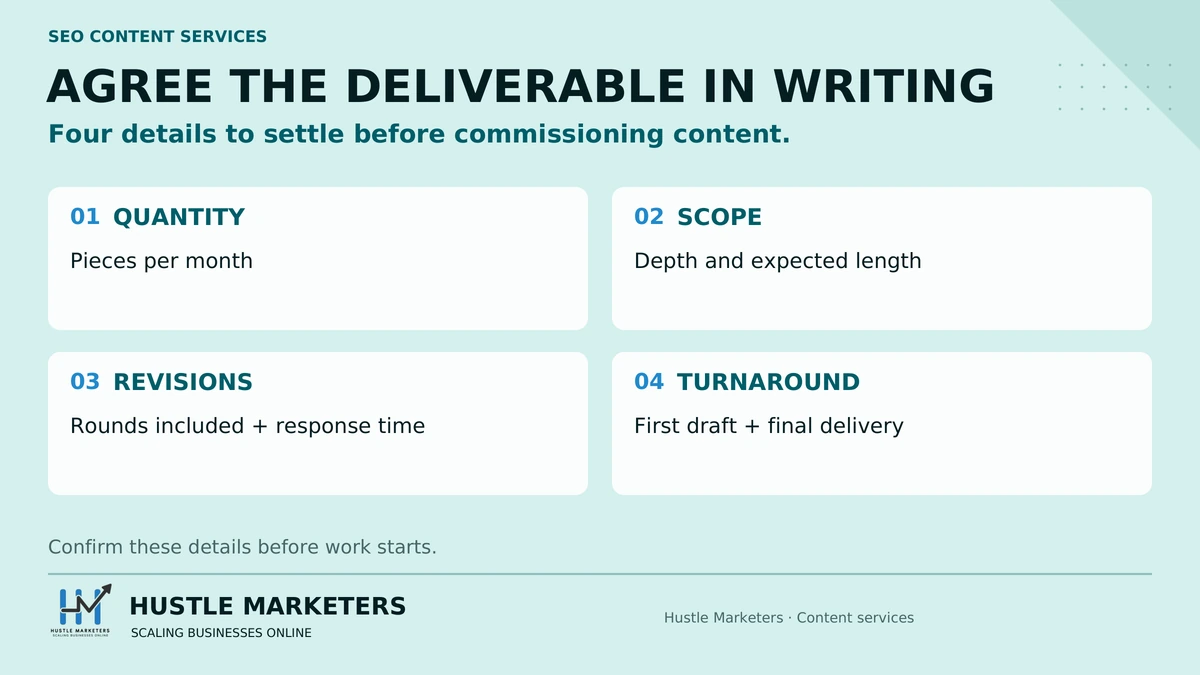
A number of pieces, a word count per piece, a number of revision rounds and a turnaround time. Those four numbers decide whether you got what you paid for, and this category leaves all four vague.
None of the 28 pages we read publishes a revisions count. None publishes a per-article word count. Two publish a turnaround. Two publish a monthly quantity.
| What you should get in writing | How many of the 28 publish it | The only examples we found |
|---|---|---|
| Number of revision rounds included | 0 of 28 | None. Textbroker publishes mechanics but not a count: “When you request a revision, the author has 24 hours to complete it.” |
| Word count per piece | 0 of 28 | None. Growth Marketing Pro gives a monthly total instead: “Most of our engagements target 12,000+ words of content per month” |
| Production turnaround | 2 of 28 | SEO Content Hero: “Expect a 3-6 business day turnaround for projects under 10,000 words.” Textbroker: “Our system automatically accepts standard orders after three days unless you request revisions.” |
| Pieces per month | 2 of 16 service pages | seoClarity on its entry offer: “a sample of 2-4 units of content”. Growth Marketing Pro as above |
| Who the writer is, by name | 0 of 28 | None. The closest is Growth Marketing Pro: “We have a fleet of 20+ specialized writers.” |
Why the revisions number matters more than it sounds
Because the revision process is where the editing cost from the earlier section actually lands, and because some systems quietly discourage it. A managing director reviewing a large writing marketplace described the incentive problem: “Many writers would rather not get paid for an order than revise as the system penalizes revisions. That means you need to start over and hope next writer gets it right”.
Unlimited but slow revisions give you a schedule problem. Fast revisions capped at one give you a quality problem. When nobody said, you have both, and month two is when you find out. Ask for the number, the turnaround on each round, and what happens when the second round is still wrong.
How many pieces a month is the right number?
Fewer than most people are sold. The most useful published guidance we found is from Omniscient Digital, and note that it is advice to buyers rather than a deliverable promise: “Most B2B companies see results with 4-8 well-written, comprehensive articles each month. Startups might do 2-4. If you’re in a competitive niche and want to dominate, aim for 12-20+.”
Our view, and it is a view rather than a finding: four researched pieces beat twelve assembled ones in almost every account we have worked on, because the four get read and linked and the twelve get crawled and forgotten. Google’s own scaled content abuse language, quoted earlier, points the same way. If an agency leads with volume, ask what the research step is.
Does the agency update old posts, or only publish new ones?
Ask, because the answer is almost never on the page. Eleven of the 28 pages mention content refresh. Not one says how often it happens, whether it is inside the retainer, or what it costs. We also found no buyer discussion of it anywhere in the community research, which means it is not something people know to ask about until it is too late.
This matters more than adding another new post once a site has fifty of them. Rankings decay, facts go stale, and the page that ranked eighteen months ago is usually a cheaper win than a page that does not exist yet. If every month adds new pieces and never revisits old ones, the library ages and the traffic curve flattens no matter how good this month’s work is.
The three questions that settle it
- Is refresh inside the retainer or billed separately? If separately, at what rate?
- What triggers a refresh: a schedule, a ranking drop, a traffic drop, or a factual change? A trigger you can check beats a promise to keep an eye on it.
- How many existing pages get reviewed per month, and who decides which ones?
Our answer: refresh is inside the scope, not an extra line, and it is triggered by measurement rather than by the calendar. Each month we look at which existing pages lost position or impressions and fix those before writing anything new. The scope document names how many pages that covers.
How do you check an agency’s results claim?
Ask for the date range and the measurement source. Neither is usually there. Of the 28 pages we read, not one attached an absolute date range to a result, and on a focused check of the four most content specific service pages, none named the tool the number came from.
Eight of the 28 attach some window, and every one is a relative duration rather than dates. Coalition Technologies publishes “Increased organic revenue by 239% in the first year.” TopSpot has “online leads increasing by 317.65% in the first three months”. Campfire Labs has “Engagement 220+% in 8 Months”.
Those beat nothing. They still do not let you check anything, because you cannot compare a percentage over an unnamed year against anything else.
The five questions that make a result checkable
| Ask this | Why | What a weak answer sounds like |
|---|---|---|
| What were the start and end dates? | A duration without dates cannot be placed against algorithm updates, seasonality or the client’s own funding | “Over about a year” |
| What was the starting number? | A 400% rise from 50 visits is 250 visits | “We tripled their traffic” |
| Which tool produced the figure? | Analytics, Search Console and a rank tracker will disagree with each other on the same site | “Our reporting dashboard” |
| Is it organic only, and is brand included? | Brand traffic inflates organic totals and is often not the agency’s doing | “Total traffic” |
| What else changed in that period? | A site migration, a funding round or a PR push moves the same numbers | “Just our content” |
We hold ourselves to the same test. Every result figure we show carries the date range it was measured over and the source it came from. Our full list of what we will and will not do in a report is published at the reporting integrity standard.
One honest note about competitor proof. The page in our sample with the best AI disclosure and the only named author byline also renders its four result figures as empty animated counters. They show “0 K+” and “0 %” next to the labels “After 12 Months” and “After 3 Months”.
We are not naming it to score a point, and it looks like a build fault rather than dishonesty. It is still a reminder to read the numbers on a proof page rather than the impression of numbers.
How long before SEO content works?
Six to twelve months for competitive commercial terms, and the agencies that publish a figure broadly agree. Campfire Labs says: “Plan on six to twelve months before organic content contributes meaningfully to pipeline.” Grow and Convert says it is “very upfront and honest about how long SEO takes to work (6+ months minimum)”.
Lower competition and long tail terms move faster, often inside three months. The variable is not effort, it is how many sites are already answering the query well.
| Period | What is realistic | What to look at |
|---|---|---|
| Month 1 | Research, briefs approved, first pieces written | The briefs, not the rankings. If the briefs are generic the pages will be |
| Month 2 to 3 | First pages published and indexed, early impressions | Impressions in Search Console, not position. Position is noisy this early |
| Month 3 to 6 | Long tail and low competition terms start ranking, first conversions | Which pages moved and which did not, and why |
| Month 6 to 12 | Competitive terms move, the library starts compounding | Revenue and leads from organic, and the refresh queue |
| Month 12 onward | Refresh becomes as valuable as new publishing | Decay on older pages as much as growth on new ones |
Two honest caveats. Nothing above happens if the site cannot be crawled and indexed properly, which is a separate problem with a separate fix. And a brand new domain with no links is slower than this table, sometimes much slower, regardless of who writes the content.
Who writes your content, and does anyone use AI?
Every published sentence is written by a person. We use AI in the research step, for keyword clustering, prompt-set analysis and finding the gaps described below, and we do not use it to generate the drafts we hand you.
We are stating it that precisely rather than claiming no AI anywhere, because the second claim is easy to make and hard to keep. If you ask us which tool touched which step on a given piece, we will tell you.
We publish this because Google asks for it. As quoted earlier, its guidance on helpful content asks whether “the use of automation, including AI-generation, self-evident to visitors through disclosures or in other ways”, and says that “Sharing details about the processes involved can help readers and visitors better understand any unique and useful role automation may have served.” Twenty-two of the 28 pages we read answer neither question.
How we decide what to write
Most content plans start with a keyword tool. Ours starts with the prompts your buyers put into AI assistants, and with the ones where a competitor comes back and you do not.
- We build a prompt set from the questions your buyers actually ask, not invented ones, and we include the prompts in your category where you currently do not appear at all.
- We run that set across AI visibility tools and record which brands come back for each prompt. Where we appear and you do not, that is a content gap with a named cause.
- We read the pages that currently rank and get cited for those prompts, in full, and record the entities and subtopics they treat as mandatory. More on that in our guide to entity SEO.
- We add the real questions from your search terms report, Search Console queries and sales objections, where you can give us access to those.
- The brief names the sections, the questions, the sources, the internal links and the schema before anyone writes a sentence.
- Every factual claim carries a source, checked at the original rather than at an article citing it.
Step two is the part nobody else sells. A keyword gap tells you a page is missing. A prompt gap tells you which competitor is being recommended in your place, and for which question. That is a sharper brief and it is the reason the publishing volume is worth anything.
We re-run the same prompt set monthly, so the question is not whether traffic moved in general but whether the specific prompts we targeted now return you. How we track that is covered in our review of AI visibility tools and the guide to improving brand visibility in AI search.
On tooling generally, we have published verified prices and the evidence behind the claims in our review of AI SEO tools, and what can and cannot sensibly be automated in the SEO automation guide.
What should you ask an SEO content agency before you sign?
Fourteen questions, each tied to a gap we found in the 28 pages. Ask them in writing and keep the answers. The ones a good agency answers instantly are the ones most of this category cannot answer at all.
| Question | What a good answer sounds like | Why it is on this list |
|---|---|---|
| Who writes it, by name, and what else do they work on? | A named person and a client load | 0 of 28 name a writer |
| Do you use AI in producing my content, and at which step? | A step by step answer, not yes or no | 22 of 28 are silent |
| How many revision rounds are included? | A number, plus the turnaround on each | 0 of 28 publish a count |
| What is the word count per piece? | A range per piece, tied to the brief | 0 of 28 publish one |
| How long from brief to first draft? | A number of business days | 2 of 28 publish a turnaround |
| How many pieces per month, and can it flex down? | A number and a mechanism | 2 of 16 service pages state quantity |
| Who owns the content, and when does it transfer? | On payment, in writing, assignment not just work for hire | 1 of 28 states ownership |
| What happens to drafts in progress if I cancel? | Paid work transfers, in writing | Not addressed anywhere we looked |
| Is content refresh included, and what triggers it? | Inside scope, triggered by measurement | 11 of 28 mention refresh, 0 quantify it |
| Does every result you show carry dates and a source? | Yes, on every figure | 0 of 28 show absolute date ranges |
| Will you interview someone in my business? | Yes, and here is the time it needs from you | The fix for generic content |
| Who checks facts, and against what? | A named step, sources checked at origin | The plagiarism and accuracy failure |
| What is the minimum term and the notice period? | Stated plainly | 1 of 28 states any contract term |
| What do I get in month one? | A named deliverable with a date | Vagueness here predicts vagueness later |
Which answers should end the conversation?
- A guaranteed ranking, or a guaranteed position by a date.
- A refusal to say whether AI is used, after you have asked directly.
- Content ownership that transfers only at the end of the engagement, or not at all.
- A result figure they will not date or source when asked.
- Volume pricing with no research step described.
- No named writer and no interview with anyone in your business.
What do you get when you work with us, and what is out of scope?
Research, briefs, writing, publishing and measurement as one loop, with the content yours on payment and a flat fee against a written scope. Here is what that includes and, more usefully, what it does not.
| Included | Detail | Not included |
|---|---|---|
| Keyword and intent research | One list of pages worth building, ranked by commercial value | Keyword tool subscriptions in your name |
| Content briefs | Headings, questions, sources, internal links and schema, before writing | Briefs for content we are not writing, unless agreed |
| Writing and editing | Written by people, from the brief. A named writer and a kickoff interview come with the higher tier, not the entry tier | Volume beyond the agreed monthly count |
| Fact checking at source | Every claim checked at the original, not at an article citing it | Legal, medical or financial review by a qualified professional |
| Publishing | Titles, metas, headings, internal links, image alt text, schema, where we have CMS access | Theme or template development |
| Content refresh | Existing pages reviewed monthly and updated when measurement says so | Rewriting a back catalog we did not write, unless scoped |
| AI visibility tracking | An agreed prompt set, a baseline reading before anything ships, and the same prompts re-read monthly | A guarantee that a given prompt will return you |
| Competitive prompt gaps | Which competitor is named in your place, for which question, and what we publish about it | Access to our own tool licenses |
| Measurement | What moved, what did not, and what changes next, every figure dated and sourced | Dashboards that replace your own platform access |
| Content ownership | Yours on payment, in writing, before we start |
What we will not do
- Keep any rights to your content, resell it, or reuse it for another client.
- Publish a result figure without the date range and the measurement source.
- Guarantee a ranking or a position.
- Quote for a volume we cannot research properly.
- Hold your CMS, analytics or Search Console access in our name.
- Present a percentage without the absolute number underneath it.
Where our own experience sits
Ishant Sharma has been working in search since 2013, across ecommerce, local service, SaaS and white label agency clients. The specific things on this page come from that work rather than from a positioning exercise.
- We wrote the acceptance test after inheriting content libraries where nobody could say where a statistic came from.
- Ownership is on this page because handovers fail on it and the client finds out last.
- We date every result because we got tired of reading reports that had quietly moved the goalposts.
Where the AI citation claim comes from
Three published case studies show what our SEO and AI visibility work has produced, each with its own numbers, period and method. They cover the wider program rather than the prompt-gap step on its own.
- CDL school: organic traffic up at least 2.4x from July 2025 to May 2026, with pages cited in ChatGPT, Gemini and Google AI Overviews. This is the one that matters for AI visibility, because it documents citations rather than just traffic.
- Rec Hall: organic clicks up 117% over a three-month Search Console comparison, and ranking keywords nearly doubled in six months (Semrush).
- Judaica ecommerce: about 31% more organic clicks in the 28 days to late September 2026 against the previous 28 days, 10,590 free listing clicks from August 28 to September 24, 2026, and AI search visibility.
Each case study sets out the period, the starting point and the method, so you can check every figure for yourself. That is the same test this page asks you to apply to everybody else.
We also run this as white label SEO for other agencies, under the same ownership terms, because an agency that would not accept those terms itself should not be offering them to you.
SEO content services FAQs
What is the difference between SEO content writing and SEO content marketing?
SEO content writing is the drafting. SEO content marketing is the whole loop: deciding what to write, writing it, publishing it properly, promoting it and measuring it.
Most vendors selling “writing” mean job three from the list at the top of this page. Most buyers who say “writing” mean all five. Name that gap before you agree a price. It causes more scope arguments in month two than anything else.
Can ChatGPT write SEO content?
It can produce text that reads like SEO content. Whether that ranks comes down to the same test as anything else.
Google’s spam policies target “many pages … generated for the primary purpose of manipulating search rankings and not helping users”. One genuinely useful page is not the problem. A hundred thin ones are.
Practitioners report two practical limits: accuracy and specificity. It does not know your product, your customers or your data, and it gets facts confidently wrong often enough that somebody has to check all of it anyway.
Should I hire an agency or a freelance writer?
A freelancer if you already have the strategy, the briefs and an editor. An agency if you want those as well as the drafts.
The mistake is hiring a freelancer expecting the loop, then finding out you are now the strategist and the editor. One buyer described exactly that: “You go from creating and running the system yourself to managing the person you hired to run the system.” A freelancer costs less per word and more per hour of your time.
Is free or very cheap SEO content worth it?
Below about $100 a piece you are usually buying a first draft that someone else has to finish. That is a legitimate purchase if you have an editor. It is a false economy if you do not, and buyers say so consistently: the recurring complaint is not that cheap content is badly spelled, it is that it is unresearched and needs rewriting before it can be published.
What is an SEO content brief, and what should be in one?
A brief is the document that lets someone who is not an expert in your business write something that is not generic. A usable one names the target query and the intent behind it, the heading structure, the specific questions to answer, the sources to cite, the internal links to include, the schema to add, and what the page should get the reader to do. If your agency will not show you a sample brief before you sign, ask why.
Is SEO content still worth it now that AI answers the question?
For queries where someone is deciding what to buy, yes. For queries where someone wants a fact, the click was already going away before AI answers existed.
The value moved toward pages that answer a commercial question with something an AI cannot synthesize from ten other pages: your pricing, your process, your data, your customers. Google’s guidance asks for the same thing when it looks for content that “clearly demonstrate[s] first-hand expertise”. How the AI surfaces themselves work is covered in our AI Overviews guide and the answer engine optimization guide.
Who owns the copyright if a freelancer writes it rather than the agency?
The same question applies one level down, and that is where ownership quietly breaks. An agency that subcontracts needs a written transfer from each writer before it can pass anything to you.
Ask whether the agency employs its writers or subcontracts. If it subcontracts, ask to see that the chain of rights is written down. The US Copyright Office requires a signed written instrument for work made for hire, so a verbal arrangement in the middle of the chain leaves a gap.
How do I measure whether the content is working?
Impressions first, then position, then clicks, then conversions, in that order and on that timeline. Conversions in month two tell you nothing, because there is not enough data yet. Position in week three tells you less.
Use Search Console for impressions and queries, and your analytics for behavior and conversions. Keep the two apart rather than blending them, because they count differently. Our piece on automated SEO reports explains why the numbers rarely match, and the SEO report guide covers what belongs in a monthly report.
How this page was researched
Research completed September 29, 2026. We read 28 pages ranking for “seo content agency”, “seo content services” and related terms, in full. For each one we recorded whether it published a price, a quantity, a turnaround, a revisions count, an ownership position, an AI disclosure, a byline and a date. Every count on this page comes from that record.
For buyer evidence we read 63 accounts across G2, Quora, WebmasterWorld, Warrior Forum, Indie Hackers, Trustpilot, Clutch and YouTube, plus one first-hand blog account. We copied every quote from the original page. Where a platform shows only a first name and an initial, we describe the reviewer by role and date rather than invent a fuller attribution.
We take facts about Google’s position from Google, not from articles about Google. Spam policy wording comes from the Search spam policies, last updated August 28, 2026. Disclosure and expertise questions come from the helpful content guidance, last updated October 5, 2026. For copyright we use US Copyright Office Circular 30, revised August 2024.
Two gaps we would rather name than paper over. Reddit was unreachable throughout this research, both at the network level and in the browser, so no Reddit material appears on this page even though it is where a lot of candid agency discussion happens. And on content refresh we found no buyer discussion at all, on any platform, which is why that section is written from what agencies fail to publish rather than from what buyers report.
A note on the older sources. Some of the outsourcing complaints we quote come from forum threads that are several years old. We have weighted the page toward evidence from 2025 and 2026, and where an older quote appears it is because the same complaint still recurs in recent reviews, not because it was the best we could find.