Google Ads Keyword Research: The Complete Guide for 2026

Ishant
Published : October 6, 2026 at 10:19 am
Updated : October 7, 2026 at 8:26 am
Ishant

Written by Ishant Sharma, Founder, Hustle Marketers | Published October 6, 2026
Most Google Ads accounts do not fail because of budget. They fail because the keyword work underneath them is wrong. Wrong keywords, wrong grouping, wrong match types, no negatives, and a structure that fights Google’s automation instead of feeding it.
I have run keyword research for 2,500+ brands at Hustle Marketers, working in Google Ads since 2013. This guide is the full process we use today: how to find keywords, sort them by intent, group them into ad groups, map them to landing pages, protect them with negatives, and manage them in an account where Smart Bidding does most of the bidding. Everything here is what we do in real client accounts, including the exact restructures behind our P-REX Hobby case study and our CMSC lead growth case study.
Key Observations
- Google Ads keyword research in 2026 treats keywords as intent signals for automation, not bid-control levers. Tight thematic grouping tells the algorithm what each campaign is for.
- Start research in Google Keyword Planner with your own URL and your top three competitor URLs, then verify volumes against Semrush or GSC because Keyword Planner ranges are too wide on their own.
- Group keywords with the shared-headline test: if two keywords cannot honestly share the same headline 1, they need separate ad groups.
- Use SERP overlap to confirm clusters: 5 or more shared URLs in the top 10 means one target, fewer than 3 means separate targets.
- Launch with 20 to 50 tightly themed keywords, not 500. Segment only as far as your conversion volume supports, then consolidate.
- Build the negative keyword list before launch, then mine the search terms report weekly at first and monthly once stable.
- Broad match plus Smart Bidding works when conversion tracking is solid and negatives are maintained. It is not a replacement for keyword research. It raises the stakes on it.
Table of Contents
- 1. Google Ads Keyword Research in the Intent and Automation Era
- 2. Finding Keywords: The Keyword Planner Workflow We Use for Every Client
- 3. Search Intent Taxonomy for Paid Search (Plus a Modifier Cheat Sheet)
- 4. Match Types in 2026: What Broad, Phrase and Exact Actually Do Now
- 5. Grouping Keywords Into Ad Groups: The Method That Actually Works
- 6. Clustering Methodology: The SERP Overlap Rule and the Tools That Do It
- 7. How Many Keywords Do You Actually Need?
- 8. Mapping Keywords to Ad Groups to Landing Pages: A Worked Template
- 9. The Negative Keyword Workflow: Lists, Architecture, Cadence
- 10. Search Terms Report Mining: Where Keyword Research Actually Continues
- 11. Keywords in the Smart Bidding Era: Fewer, Smarter, Paired With Automation
- 12. PMax Search Themes and AI-Search Question Clusters
- 13. Proof: What This Looks Like in Real Accounts
- 14. Frequently Asked Questions
- 2026 Platform Check: PMax Search Themes and AI Max
- Sources and Verification
1. Google Ads Keyword Research in the Intent and Automation Era
Keyword research used to mean building the biggest possible list, splitting it into tiny ad groups, and controlling every bid by hand. That playbook is dead, and the advertisers still running it are the ones watching CPCs climb while conversions fall.
Here is what changed. Google no longer matches words. It reads meaning. It looks at what the user actually wants, how likely they are to act, and dozens of signals beyond the query itself: device, location, time, past behavior, and conversion history. Several different keywords can express the same intent, and one keyword can trigger many different queries. Keywords are now one signal among many that feed Smart Bidding and campaign automation.
That does not make keywords less important. It changes their job. Instead of micromanaging every bid, tight thematic keyword grouping now helps the algorithm understand what each campaign is for, so it can find the right customers with less wasted spend. Feed the machine a messy account with hundreds of overlapping keywords and you dilute the data, slow the learning, and pay for it in performance. Feed it a clean, intent-organized structure and the automation compounds your advantage.
So the honest position for 2026 is this: keyword obsession is dead, keyword research is not. You research keywords to understand demand and intent. You organize them to send clear signals. You stop pretending the keyword list itself is the strategy.
Account structure is the foundation this all sits on. If your campaigns are messy, no amount of keyword sorting will save performance, which is why we fold keyword review into every Google Ads audit checklist run we do.
2. Finding Keywords: The Keyword Planner Workflow We Use for Every Client
Google Keyword Planner is still the starting point because it draws on Google’s own auction data and it is free. Here is the exact workflow we run for every new account at Hustle Marketers.
Step 1: Start with the client URL, not keywords. The first Keyword Planner search for any new client is their own website URL, using the “Start with a website” option. This shows what Google currently associates with their content, which often reveals gaps between what the site says and what the client wants to sell.
Step 2: Run the same for the top three competitors. Enter competitor URLs and export the combined keyword lists. Sort by volume descending. The keywords appearing for competitors but not for the client are the gaps your campaigns need to fill.
Step 3: Use the Forecasts tab to set realistic budgets. Before recommending a budget for any campaign, we run Forecasts for the target keyword list. It projects clicks, impressions, and spend at different bid levels using actual auction data. This turns budget conversations from guesswork into projections clients can trust.
Step 4: Cross-reference against Semrush and GSC. Keyword Planner volume ranges are notoriously wide. A “1,000 to 10,000” range could mean 1,100 searches or 9,800 searches, which is a completely different scale for planning. We cross-reference Keyword Planner ideas against Semrush volume data and Google Search Console impressions to narrow the real estimate before making campaign decisions.
Two more things worth knowing. You can access Keyword Planner without spending anything by creating an account in Expert Mode and pausing the setup campaign immediately. Volumes can show as wide ranges, so check the keywords you plan to bid on against a second source before you commit budget. The full walkthrough, including hidden features most marketers miss, is in our standalone Google Keyword Planner tutorial.
One filter to apply from day one: separate branded and non-branded demand in your research. They behave differently, price differently, and need different campaigns. We covered why in depth in our guide to branded vs non-branded search.
3. Search Intent Taxonomy for Paid Search (Plus a Modifier Cheat Sheet)
Every keyword you find lands somewhere on an intent spectrum, and where it lands decides whether you bid on it, how much you pay, and what page you send the click to. For paid search we sort every keyword into four buckets.
| Intent type | What the user wants | Example queries | What we do in Google Ads |
|---|---|---|---|
| Transactional | Buy or book now | “buy trail running shoes”, “emergency plumber near me” | Bid aggressively. Send to product or service page. Core of the account. |
| Commercial | Compare before choosing | “best crm for small business”, “semrush vs ahrefs” | Bid selectively. Send to comparison or category page. Watch CPA closely. |
| Local service | Find a provider nearby | “dentist in austin”, “hvac repair near me” | Bid with location targeting and call assets. Send to location page. |
| Informational | Learn something | “what is ppc”, “how to fix a leaky faucet” | Usually exclude or leave to SEO. Only bid with a remarketing plan behind it. |
The fastest way to read intent at scale is by modifier. When we sort a raw list of 2,000 keyword ideas, we filter on these words first.
| Modifier group | Examples | Signal |
|---|---|---|
| Buy-now modifiers | buy, order, book, quote, pricing, cost, near me, same day | Transactional. Highest priority. |
| Comparison modifiers | best, top, vs, alternative, review, cheapest | Commercial. Mid-funnel. Needs the right landing page. |
| Urgency modifiers | emergency, 24 hour, today, open now | Transactional with high urgency. Often your cheapest conversions. |
| Research modifiers | how to, what is, why, guide, ideas, examples | Informational. Exclude from most search campaigns. |
| Wrong-audience modifiers | free, DIY, jobs, salary, course, certification, tutorial | Not your buyer. Straight to the negative list. |
| Brand modifiers | your brand name, competitor brand names | Split into a branded campaign, or exclude competitors deliberately. |
This one table does more for a new account than a week of tool time. Tag every keyword with an intent bucket before you build anything, because intent decides structure, and structure decides everything downstream.
4. Match Types in 2026: What Broad, Phrase and Exact Actually Do Now
Most match type advice online is years out of date. Here is how the three match types actually behave in 2026.
Exact match is no longer exact. [exact match] includes close variants: plurals, misspellings, reordered words, and queries Google decides share the same meaning. It still gives you the tightest targeting available, and it usually carries the highest CPC. Use it for your proven converters where you want maximum message match.
Phrase match absorbed the old broad match modifier behavior. “phrase match” now matches anything Google considers to include the meaning of your keyword, not the literal word order. It is the practical middle ground: meaningfully wider than exact, meaningfully tighter than broad.
Broad match matches on meaning, audience signals, landing page context, and other keywords in the ad group. On its own with manual bidding, it is a budget leak. Paired with Smart Bidding and clean conversion data, it is how Google wants you to buy search traffic in 2026, because the bidding algorithm can price each auction individually. More on that pairing in chapter 11.
| Match type | 2026 behavior | Best use | Risk |
|---|---|---|---|
| Exact [keyword] | Close variants and same-meaning queries | Proven converters, tight message match | Higher CPC, limited reach |
| Phrase “keyword” | Meaning-based, includes the keyword’s intent | Default for new non-brand keywords | Wider than most advertisers expect |
| Broad keyword | Meaning, signals, page context, ad group context | Scale, paired with Smart Bidding only | Wasted spend without negatives and tracking |
Practical rules we follow: never mix match types in the same ad group when you want clean performance reads. Start new themes on phrase or exact, earn conversion data, then test broad against them with the same Smart Bidding strategy. And accept that in every match type, the search terms report is now more important than the keyword list, because the keyword is a fishing net, not a fish.
5. Grouping Keywords Into Ad Groups: The Method That Actually Works
Grouping keywords correctly is the difference between campaigns that learn efficiently and campaigns that produce diluted, inconsistent results. Every keyword in an ad group needs to be close enough in meaning that one ad can speak to all of them. When keywords are too broad or mixed in intent, ad relevance drops, Quality Score drops, and cost per click rises.
Group by intent, not by topic. “Plumber near me”, “emergency plumber”, and “24-hour plumber” belong together because the user intent is identical: find a plumber right now. “Plumbing services”, “plumbing company”, and “local plumbing” suggest a slightly different intent: compare options before calling. Those should be separate ad groups with separate messaging, even though the topic is the same.
The shared-headline test. The single keyword ad group (SKAG) approach was popular before Responsive Search Ads became the standard. With RSAs now the dominant format, tight keyword themes work better than strict one-keyword-per-group rules. The practical test: can you write one headline 1 that is genuinely relevant to every keyword in the group without feeling generic? If “plumber near me” and “emergency plumber Chicago” can both carry the headline “Emergency Plumber Available Now”, they can share an ad group. If the ad copy would need to be different, separate them.
Separate match types deliberately. Having exact match “emergency plumber” and broad match “plumber” in the same ad group makes it impossible to see which match type is generating which conversions. Keep match types in separate ad groups or campaigns so you can read performance and allocate budget cleanly.
Semantic grouping for automated surfaces. “Buy running shoes”, “purchase trail running shoes online”, and “order Nike running shoes” group together because the core action is the same even though the words differ. This meaning-first grouping matters most for Performance Max, where Google matches queries to asset groups by meaning rather than keyword lists. Semantically coherent groups give the algorithm clearer signals.
6. Clustering Methodology: The SERP Overlap Rule and the Tools That Do It
Most clustering guides describe semantic clustering (grouping by similar meaning) or topic clustering (grouping by subject). SERP overlap clustering is different and more reliable for one specific reason: it tells you how Google actually treats the keywords, not how they sound to a human reader.
The method: take two keywords and compare the top 10 search results for each. If 5 or more of the same URLs appear in both result sets, Google is treating them as the same query and returning the same content. Those keywords belong together. If fewer than 3 URLs overlap, Google is treating them as distinct queries that require different content. Those keywords need separate targets.
Why this matters: “PPC agency” and “PPC management company” sound like the same thing. But if Google’s top 10 results for each query include different pages from different sites, Google sees a meaningful intent difference between them. Targeting both with one page or one ad group means trying to satisfy two intents at once, and you may satisfy neither.
Manual grouping beyond 50 keywords is not practical, so here are the clustering tools we actually use across client campaigns and where each one fits.
| Tool | How it clusters | Best for |
|---|---|---|
| Semrush Keyword Manager | Topic and intent, automatic, with volume and difficulty per cluster | Mapping keywords to planned pages and campaigns without extra processing |
| Ahrefs Keywords Explorer | SERP overlap, the most technically rigorous option | Confirming whether two keywords share one target or need separate ones |
| KeywordInsights.ai | Processes large lists fast, thousands of keywords in minutes | Agencies running large-scale programs where clustering speed matters |
| Google Sheets + manual SERP checks | Top 10 URLs per keyword, counted by hand | Lists under 100 terms, and final verification of any automated output |
| Google Ads Editor | Real search term data alongside keyword lists | PPC-specific clustering; the search terms report shows whether ad groups are correctly clustered by intent |
Our own process: run every list through Semrush Keyword Manager for initial clusters, then manually review any cluster with mixed intent signals to confirm whether one target can serve it or whether it needs splitting. The output is a cluster map that assigns every keyword to a specific ad group and landing page before anything gets built.
7. How Many Keywords Do You Actually Need?
This is where most Google Ads advice contradicts itself, so let me reconcile it directly, because we have argued both sides in past posts and both sides are right under different conditions.
On one hand, our P-REX work showed the value of concentrating budget on keywords with the strongest conversion potential. On the other hand, over-segmentation is one of the most common account killers we see in audits: too many ad groups means no group gathers enough conversions, machine learning struggles, and results stay uneven.
The variable that resolves the contradiction is conversion volume. Granularity improves relevance. Consolidation improves learning. The right structure is the most granular one your conversion data can feed.
Here are the working thresholds we use:
| Your situation | Structure guidance |
|---|---|
| New account, no conversion history | Launch with 20 to 50 tightly themed keywords across a handful of ad groups. Starting with 500 keywords spreads budget too thin to learn anything about any of them. |
| Ad group getting conversions every week | Keep it. It is earning its granularity. If it can support a tighter theme split that still converts weekly, you can split further. |
| Ad group with clicks but almost no conversions month after month | Merge it into the nearest intent-matched ad group. It is fragmenting data without adding relevance. |
| Campaign too thin for Smart Bidding to stabilize | Consolidate campaigns first, ad groups second. Bid strategies learn at the level where conversion data pools. |
| Keywords with near-zero impressions | Prune them. Hundreds of dormant keywords add mess, not reach. |
A high-volume ecommerce account can support many ad groups because its sales volume feeds them: if every group keeps earning conversions after a split, the relevance gains come without a learning penalty. A lead-gen account doing 40 conversions a month cannot copy that structure, and should not try. Run the same review quarterly: pause zero-conversion keywords, merge starved ad groups, and expand only where the data supports it.
8. Mapping Keywords to Ad Groups to Landing Pages: A Worked Template
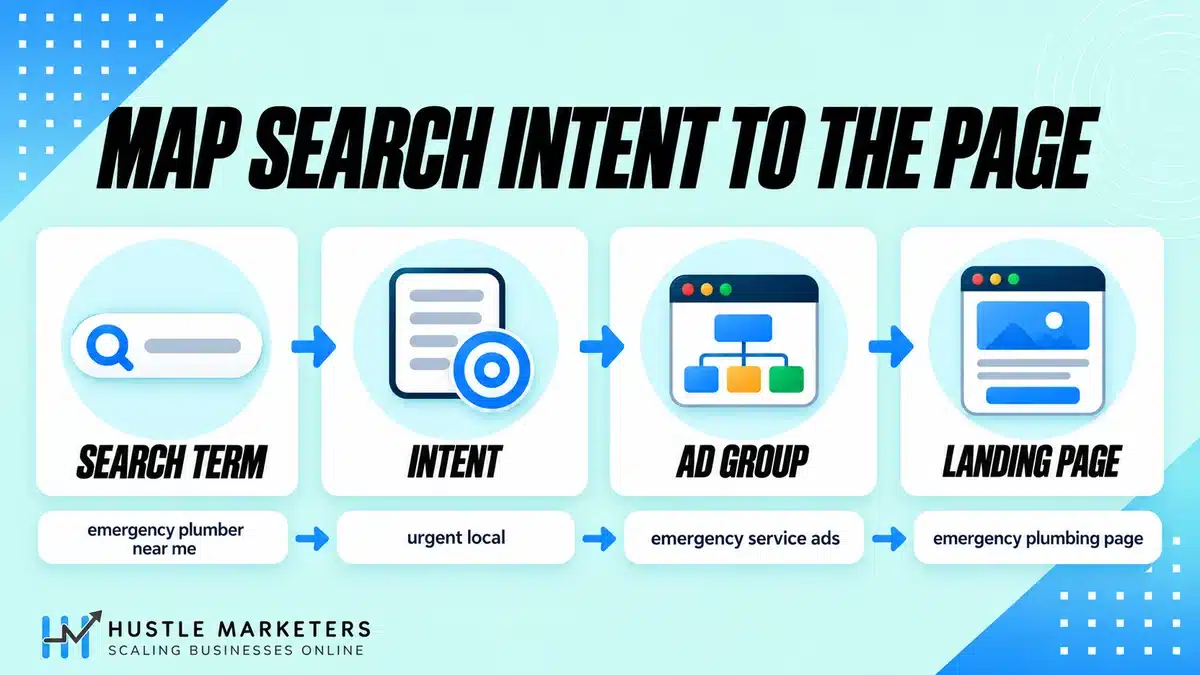
Keyword research is not finished when the list is clustered. It is finished when every keyword has a home: an ad group, an ad message, and a landing page that all say the same thing. Message match across all three is what turns clicks into conversions, and it is the step most DIY accounts skip.
We build this as one mapping table before touching the Google Ads interface. Here is the template, filled in for a plumbing client as a worked example.
| Intent cluster | Keywords (examples) | Match types | Ad group | Headline 1 concept | Landing page |
|---|---|---|---|---|---|
| Emergency call-out | emergency plumber, 24 hour plumber, plumber near me now | Phrase + exact, separate groups | Emergency Plumber | Emergency Plumber Available Now | /emergency-plumbing/ |
| Compare providers | plumbing services, plumbing company, local plumbers | Phrase | Plumbing Services | Trusted Local Plumbing Company | /plumbing-services/ |
| Specific job: boiler | boiler repair, boiler not working, boiler service cost | Phrase + exact | Boiler Repair | Boiler Repair, Upfront Pricing | /boiler-repair/ |
| Specific job: drains | blocked drain, drain unblocking, drain cleaning service | Phrase | Drain Services | Blocked Drain? Fixed Today | /drain-cleaning/ |
| Branded | [your brand] plumbing, [your brand] reviews | Exact | Brand | Official Site headline | Homepage |
How to read the table: each row is one intent, and everything in the row agrees with itself. The emergency searcher sees an emergency headline and lands on an emergency page with a phone number above the fold. The boiler searcher never lands on a generic services page.
Three rules when you build yours:
- One landing page can serve multiple ad groups, but one ad group should never point at multiple landing pages.
- If you cannot name a landing page for a cluster, that is a website gap, not a keyword problem. Build the page or do not bid on the cluster.
- Revisit the map whenever pages change. Products get discontinued, services change, and a mapping table from last year quietly rots.
9. The Negative Keyword Workflow: Lists, Architecture, Cadence
Negative keywords are half of keyword research. Every hour spent choosing what to bid on deserves matching time on what to block, because with today’s looser match types your keywords will reach queries you never typed.
Build the first list before launch, not after. Enter a broad term for your product or service into Keyword Planner’s discovery tool and review the ideas for wrong-audience modifiers: “free”, “DIY”, “how to”, “jobs”, “salary”, “course”, “certification”, “tutorial”, and competitor brand names you do not want to pay for. These are queries from people who are not ready to buy or who are not your customer. We build negative libraries this way for every new account before campaigns go live, and a well-built pre-launch list filters out traffic that was never going to convert before it costs you anything.
Architecture: three levels of negative lists.
| Level | What goes in it | Applied to |
|---|---|---|
| Account-wide list | Universal junk: jobs, salary, free, course, DIY, adult terms, irrelevant industries | Every search campaign |
| Campaign-level list | Cross-contamination blockers: brand terms negated in non-brand campaigns, service A terms negated in service B campaigns | Specific campaigns |
| Ad group level | Traffic-shaping negatives that force queries to the right ad group | Individual ad groups |
The campaign level is where structure gets protected. If you separate branded and non-branded campaigns, as we recommend in our branded vs non-branded guide, the brand negatives in the non-brand campaign are what keep budgets and reporting honest.
Cadence. Weekly search term reviews for the first month of any new campaign, then monthly once the account is stable. Set a recurring calendar block, because this is the maintenance task accounts quietly skip, and phrase match’s wider reach means money slips away silently when you do.
And do not stop at search campaigns. Performance Max spends against queries too, and excluding junk there works differently. We wrote up the full process in our Performance Max negative keywords strategy.
10. Search Terms Report Mining: Where Keyword Research Actually Continues
The keyword list you launch with is a hypothesis. The search terms report is the result of the experiment. Top advertisers treat it as their main insight tool, and the workflow is simple enough to run in 30 minutes.
1. Pull the report at campaign level for the last 30 days, sorted by cost. The expensive queries are where the decisions are.
2. Sort every meaningful query into one of three actions:
- Promote. Converting queries that are not yet keywords get added as phrase or exact keywords in the right ad group, where they get their own stats and message-matched ads.
- Block. Irrelevant queries go to the correct negative list level from chapter 9.
- Watch. Relevant queries without conversions yet stay under observation. Do not react to single-click noise.
3. Run an n-gram check on large accounts. Instead of reading thousands of full queries, count the most frequent one-word and two-word fragments across the report. If “installation” appears in 200 queries and none convert, that is one negative decision instead of 200 individual ones. A pivot table in Sheets is enough to do this.
4. Check your automated surfaces too. Google now exposes search term data for Performance Max campaigns, and if you run Dynamic Search Ads the search terms report is effectively their keyword research engine, showing you the queries Google matched to your pages. Converting DSA queries should graduate into your standard campaigns as real keywords. We cover that loop in our Dynamic Search Ads guide.
The mindset shift that matters: use search terms as insight, not control. You are not trying to approve every query Google matches. You are steering the distribution: promoting winners, blocking junk, and letting the middle breathe.
11. Keywords in the Smart Bidding Era: Fewer, Smarter, Paired With Automation
Everything so far feeds this chapter, because the biggest strategic question in 2026 is how keyword strategy and automation share the work.
What top performers do differently. They use fewer, smarter keywords. They spot the keywords that convert well and convert cheaply, push budget toward them, and move the strongest converters into their own campaigns to scale and control spend. They give Smart Bidding better data instead of trying to out-bid it by hand: cleaner conversion tracking, consolidated structure, room for the system to learn. Clicks mean little to them. They watch CPA, ROAS, and revenue.
The broad match + Smart Bidding pairing. Broad match keywords with a target CPA or target ROAS strategy let Google price every auction individually using signals no manual bidder can see. In our experience this pairing works, with three preconditions:
- Conversion tracking must be accurate, ideally with enhanced conversions and value data. The algorithm optimizes toward whatever you count, so count the right things.
- The negative architecture from chapter 9 must exist first. Broad match without maintained negatives is a donation to Google.
- Enough conversion volume for the strategy to learn. Thin accounts should consolidate before they broaden.
Test it the way we do: duplicate a proven phrase or exact theme into a broad match test with the same bid strategy and the same budget guardrails, then judge on CPA or ROAS after the learning period, not on day three.
What keywords still control. Even with full automation, keywords remain your levers for scope (what themes you compete in at all), negatives (what you refuse to pay for), structure (how conversion data pools for the bidding algorithm), and message match (which ad and page a theme deserves).
AI Max and the direction of travel. Google’s AI Max for Search pushes further: it expands beyond your keyword list to matched queries and generates assets to fit, effectively blending DSA-style expansion into standard campaigns. Treat it like broad match with the same discipline: tracking first, negatives and brand controls in place, judged on conversion outcomes. The stronger your keyword and negative foundation, the safer every new automation layer becomes. Our Google Ads automation guide covers which layers to adopt and in what order.
12. PMax Search Themes and AI-Search Question Clusters
Classic keyword grouping was built for Search campaigns. Two newer surfaces change the rules.
Performance Max search themes. Each asset group accepts up to 50 search themes, and they work like intent clusters, not keywords. Feed one asset group themes from a single intent bucket. Mixing “emergency plumber” themes with “plumbing maintenance plans” themes in one asset group blurs the signal and the algorithm matches both poorly. Treat each asset group like a tight ad group from the old playbook. The same logic applies to Shopping-heavy accounts, where clean feed and theme signals decide how much of the auction you actually see; our guide to improving Google Shopping impression share picks up that thread.
AI search grouping. AI Overviews and answer engines pull from pages that resolve a complete question cluster, not a single keyword. So group question keywords (“how”, “why”, “vs”, “cost”) under the page that answers the parent topic, and answer each in a self-contained section. That is the grouping logic behind getting a client page cited inside Google’s AI Overviews, which we did for CMSC’s Parker CDL program page.
The common principle across both: Google’s systems reward coherent intent clusters everywhere. The clustering skills from chapter 6 are not legacy skills. They are how you brief the machines.
13. Proof: What This Looks Like in Real Accounts
P-REX Hobby: focus spend on keywords with conversion potential. We analyzed the account’s keywords, concentrated budget on the terms with the strongest conversion potential, and reduced spend on weaker traffic. That keyword work supported a broader program that also improved the Shopping feed, retargeting, creative and conversion paths. The case study documents the results of that wider program. See the full P-REX Hobby case study.
CMSC: restructure before scaling. More than 20 campaigns relied heavily on broad and branded terms without adequate negatives. We restructured the keyword strategy, added negative keywords, reduced overlap and expanded into relevant service areas. The case study documents the lead results across the wider program. Structure and measurement came before scaling. See the CMSC case study.
Two different businesses, one pattern: the keyword work came first, and the performance followed. If you want us to run this process on your account, that is exactly what our PPC agency team does, and the fastest starting point is a free account audit. For the wider playbook around it, our PPC best practices guide covers what surrounds the keyword layer.
14. Frequently Asked Questions
How do I do keyword research for Google Ads?
Start in Google Keyword Planner with your own URL and your top competitors’ URLs, export the ideas, tag every keyword by intent, cluster them with the shared-headline test, then verify volumes against Semrush or Search Console. Map every cluster to an ad group and landing page before building anything.
How many keywords should one ad group have?
Enough to share one honest headline, and no more. In practice that is usually 5 to 20 close variants of a single intent. If one headline cannot serve every keyword in the group, the group is too broad. If the group cannot earn conversions regularly, it is too narrow and should be merged.
Are keywords dead in Google Ads?
No. Their job changed. Keywords no longer control individual bids, but they still control which auctions you enter, how your conversion data pools for Smart Bidding, and which message and landing page each searcher gets. Keyword obsession is dead. Keyword strategy is not.
Should I use broad match with Smart Bidding?
Yes, once the account has accurate conversion tracking, a maintained negative keyword architecture, and enough conversion volume for the bid strategy to learn. Test broad match against a proven phrase or exact theme with the same bid strategy and judge it on CPA or ROAS after the learning period.
What is the best free keyword research tool for Google Ads?
Google Keyword Planner. It is free, uses Google’s own data, and its Forecasts tab models clicks and spend from real auction data. Its weakness is wide volume ranges, so cross-reference against Search Console or a paid tool. Our full Keyword Planner tutorial walks through every feature.
How many keywords should I launch a new campaign with?
20 to 50 tightly themed keywords. Launching with hundreds spreads budget too thin to generate decision-grade data on any of them. Earn conversions on the tight set, then expand from the search terms report.
What is SERP overlap clustering?
Compare the top 10 Google results for two keywords. If 5 or more URLs appear in both, Google treats them as the same intent and they belong together. If fewer than 3 overlap, they need separate ad groups or pages. It is the most reliable clustering method because it reads Google’s behavior, not human intuition.
Should match types be separated into different ad groups?
Yes, when you want clean performance data. Mixing exact and broad in one ad group makes it impossible to see which match type drives which conversions. Separate them so budget can follow the winner.
How often should I review search terms and negatives?
Weekly for the first month of any new campaign, then monthly once performance is stable. Promote converting queries to keywords, block irrelevant ones at the right list level, and leave ambiguous ones under watch.
Do keywords matter for Performance Max?
PMax does not use keyword lists, but it uses search themes, up to 50 per asset group, and they behave like intent clusters. Keep each asset group’s themes inside one intent bucket, and use account-level exclusions to block junk. See our PMax negative keywords strategy for the exclusion side.
Is a high-volume keyword always worth bidding on?
No. Volume without intent is expense. A 100-search keyword with buy-now intent routinely outperforms a 10,000-search research query. Prioritize by intent first, volume second, and let the Forecasts tab estimate what the click volume is actually worth.
When should I hire an agency for keyword research?
When the account has spend worth protecting and nobody internally owns the weekly search term, negative, and structure work this guide describes. Keyword research is not a one-time setup, it is an operating rhythm. That rhythm is the core of what our PPC agency runs for clients.
2026 Platform Check: PMax Search Themes and AI Max
Performance Max asset groups can now accept up to 50 search themes, and Google also exposes search-terms reporting for Performance Max. Treat themes as directional signals, not exact-match controls. Keep each asset group commercially coherent, review the search terms it attracts, and fix the feed, landing page or conversion tracking when the system learns the wrong intent.
AI Max for Search expands matching and creative automation, but it is not a reason to skip keyword research. It works best when conversion-based Smart Bidding, clean conversion values, useful landing pages and exclusions are already in place. A practical 2026 workflow is: define intent clusters, launch with controlled match types, inspect search terms, then widen automation only after the account is measuring real business outcomes.
That operating rhythm is more valuable than a one-time export. Learn how our PPC agency approaches the work, then compare the method with the evidence in our local signage Google Ads case study.
Sources and Verification
Facts that can change were checked on October 7, 2026 against these primary sources:
- Google: using Keyword Planner
- Google Ads Help: keyword match types
- Google Ads Help: Performance Max search themes and search terms
- Google Ads Help: AI Max
Summarise this article with: