Technical SEO Requirements: What Google Actually Publishes

Ishant
Published : October 6, 2026 at 10:30 am
Updated : October 7, 2026 at 6:32 am
Ishant

Hustle Marketers is a technical SEO agency. Before writing a word of this page we read the 24 pages currently ranking for that term, and what follows is mostly the things none of them say.
Most technical SEO agency pages open with a list of twelve services and a free audit button. This one opens with what Google actually requires, because the gap between those two things is where the money goes.
The pattern is consistent. Every page names Core Web Vitals. Every page names crawlability.
Not one publishes a scope, a turnaround time, a sample of the audit, or a single sentence about who actually implements the fixes once the report lands.
So this page does those things instead. If you want a ranked comparison of firms including us, that is a different job and it lives on our list of the best technical SEO agencies. This page is what you get if you hire us.
What does a technical SEO agency actually do?
A technical SEO agency makes sure search engines can reach your pages, render them, understand them and choose them. It is the layer beneath content and links. When it is broken, nothing above it works, and when it is fine, more of it does not help.
That last half of the sentence is the part agencies leave out. Technical SEO has a ceiling. Once a site is crawlable, indexable, fast enough and correctly structured, further technical work returns very little. A good agency tells you where that ceiling is instead of billing past it.
| Work | What it actually means | When it matters |
|---|---|---|
| Crawlability | Search engines can reach pages without hitting blocks, loops or dead ends | Always. It is one of Google’s three stated requirements |
| Indexation | Pages that should be in the index are in it, and pages that should not be are not | Always, and it is where most real damage hides |
| Rendering | Content that depends on JavaScript is actually visible to a crawler | Sites built on React, Vue, Angular or heavy client-side templating |
| Site architecture | Internal links create short, sensible paths to important pages | Always, and it is the most under-rated item on this list |
| Structured data | Machine-readable markup that earns search features | Where a feature exists to earn. Not everywhere |
| Performance | Core Web Vitals within Google’s thresholds | As a floor, not a lever. See the section below |
| Migrations | URLs, redirects, canonicals and templates survive a platform or domain change | Before and during any migration. This is where sites die |
| International | hreflang that is bidirectional, self-referencing and uses valid codes | Multi-language or multi-region sites only |
Notice what is not on that list. Meta keywords, keyword density, heading counts and domain keywords are all things Google has published guidance against caring about, and we quote that guidance further down.
Technical SEO agency or technical SEO company: what is the difference?
Nothing, in practice. A technical SEO agency, a technical SEO company and a team of technical SEO experts all sell the same work, and Google treats the three searches as one intent. The difference that matters is not the label on the website. It is whether the provider diagnoses your specific site or runs a generic crawl and sends you the export.
| What you searched | What buyers usually mean by it | What to check instead of the label |
|---|---|---|
| technical SEO agency | A team you retain for ongoing diagnosis and fixes | Who does the diagnosis, and whether it is the person you met on the call |
| technical SEO company | The same thing. Company tends to signal a larger firm | Whether your account is delivered by a named specialist or a rotating pool |
| technical SEO experts | Individual specialists rather than a packaged service | Named people with a public track record, rather than a headcount claim |
| technical search engine optimization agencies | The long form, more common in procurement and tender documents | The scope document. A tender needs deliverables, not adjectives |
We publish the deliverable list, the turnaround and the tool costs further down this page precisely because the label tells you nothing. Every provider in this market calls itself expert. Far fewer will tell you what actually lands in your inbox, or who writes it.
What does Google say is technically required to rank?
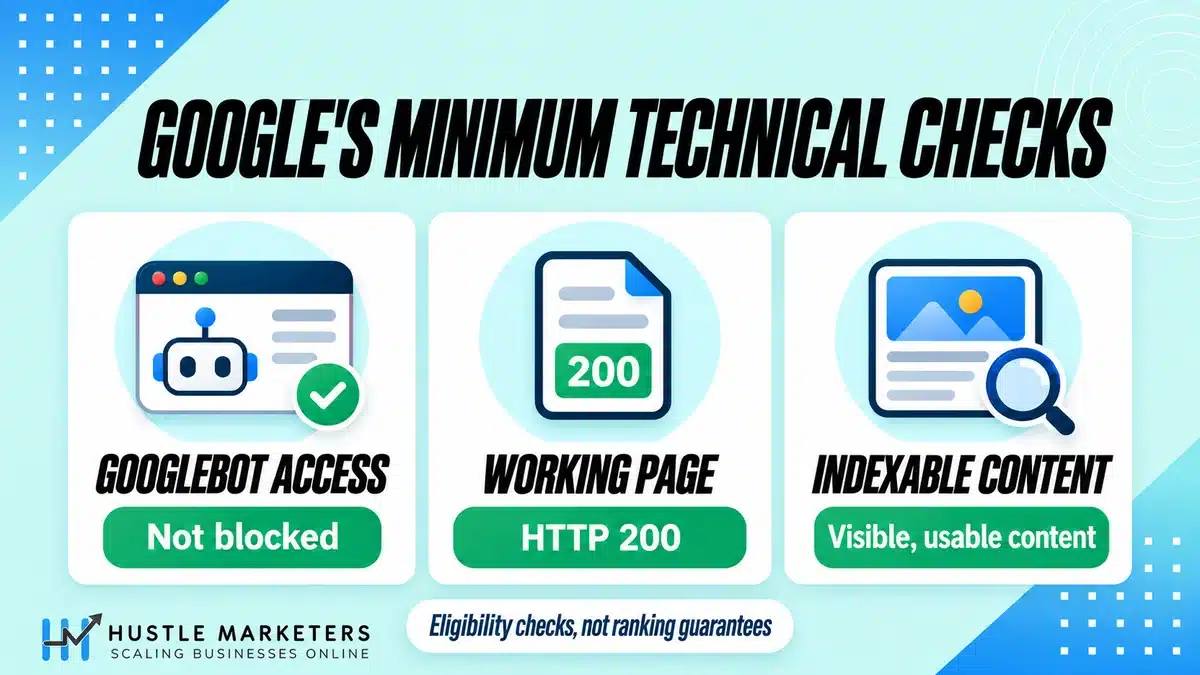
Three things. That is the entire published list, and it is shorter than any service menu you will be shown, including ours.
Googlebot isn’t blocked. The page works, meaning that Google receives an HTTP 200 (success) status code. The page has indexable content.
Google, Search Essentials technical requirements, last updated December 18, 2025
Google adds a caveat on that same page which keeps everyone honest: “Just because a page meets these requirements doesn’t mean that a page will be indexed; indexing isn’t guaranteed.” Meeting the bar makes you eligible. It does not make you visible.
One more sentence on that page aims squarely at anyone who has been sold something: “It costs nothing to get your page in search results, no matter what anyone tries to tell you.”
So why does anyone need an agency?
Because the three requirements are easy to state and easy to break at scale. A single robots.txt line, one wrong canonical template, a migration that drops a redirect map, a filter system generating millions of URLs. Each of those breaks requirement one, two or three across thousands of pages at once, and none of them announce themselves.
The work is not knowing the three rules. It is finding which of your templates violates one of them, on which URL patterns, and in what order to fix them.
What Google says you can stop worrying about
Google’s SEO starter guide, last updated December 10, 2025, contains a list of things it says do not matter. If an audit you have been sent leads with any of these, that tells you something about the audit.
| Claim you may have been sold | What Google actually says |
|---|---|
| Meta keywords tag | “Google Search doesn’t use the keywords meta tag.” |
| Keywords in the domain name | “Keywords in the name of the domain… have hardly any effect beyond appearing in breadcrumbs.” |
| Longer content ranks better | “The length of the content alone doesn’t matter for ranking purposes.” |
| Subdomain versus subdirectory | “From a business point of view, do whatever makes sense for your business.” |
| Duplicate content penalty | “If you have some content… under multiple URLs, it’s fine; don’t fret about it.” |
| Perfect heading order and counts | “It doesn’t matter if you’re using them out of order… no magical, ideal amount of headings.” |
| E-E-A-T is a ranking factor | Google’s own answer is “No, it’s not.” |
| Canonical tags are mandatory | Google: “none of them are required; your site will likely do just fine without specifying a canonical preference.” |
There is one honest tension in that table worth naming. Google says heading order and count do not matter. A controlled split test published June 6, 2025 changed the first H2 into an H1 on pages that had no H1 and measured “a 4.5% increase in organic traffic”, statistically significant.
Both are true. A missing H1 is a different thing from a wrong heading order, and that distinction is the kind of detail a checklist cannot hold.
How do you know if you have a technical SEO problem?
You have a real problem if pages you want indexed are not indexed, if traffic fell after a release or migration, or if Search Console shows a growing Discovered currently not indexed count. You probably do not have one if a tool gave you a health score and nothing else changed.
That distinction matters because of how audit tools work. Ahrefs ran Site Audit across 1,002,165 domains and published the incidence rates. Patrick Stox summarizes it as “There’s a lot that can go wrong on a website, and every site is going to have some issues to fix.”
| Issue flagged | Share of sites affected | What it usually means | Source |
|---|---|---|---|
| 3XX redirect | 95.2 percent | Almost always normal. A site without redirects would be the anomaly | Ahrefs, 1,002,165 domains |
| HTTP to HTTPS redirect | 88 percent | This is correct behavior, not a fault | Ahrefs, 1,002,165 domains |
| Missing alt attributes | 80.4 percent | Accessibility issue worth fixing. Rarely a ranking issue | Ahrefs, 1,002,165 domains |
| Meta description missing or empty | 72.9 percent | Google rewrites most of them anyway | Ahrefs, 1,002,165 domains |
| Slow page | 72.3 percent | Depends entirely on the threshold the tool used | Ahrefs, 1,002,165 domains |
| Page has only one dofollow internal link | 66.2 percent | Genuinely worth investigating. This one is often real | Ahrefs, 1,002,165 domains |
| H1 missing or empty | 59.5 percent | Sometimes real, see the split test above | Ahrefs, 1,002,165 domains |
Source: Ahrefs, the most common technical SEO issues, Patrick Stox, published August 31, 2023 and updated August 12, 2026.
Read that table as a warning about audits, not about your site. When 95 percent of sites trigger a flag, per that sample, the flag describes the internet rather than a defect. An audit that hands you 400 issues sorted by severity score has told you almost nothing about which three are costing you money.
The four symptoms that are usually real
- Indexation is falling or flat while you publish. Check the Page Indexing report first, not a crawler.
- Traffic dropped within two weeks of a deploy, migration or template change. That is a technical cause until proven otherwise.
- Search Console shows a large and growing Discovered currently not indexed bucket. Google names this as one of the three conditions where crawl budget genuinely applies.
- Content you can see in a browser does not appear in the rendered HTML of the URL Inspection tool. That is a rendering gap and it is invisible to most audits.
What is included in a technical SEO audit?
Here is the scope, item by item. None of the 24 competitor pages we read publishes one, which makes this the easiest thing in the world to be better at. Everything below is either in scope or explicitly out of it.
| Area | What we check | What you get |
|---|---|---|
| Crawl and access | robots.txt directives, server response codes across a URL sample, redirect chains and loops, soft 404s, crawl traps from parameters and filters | A list of blocked or wasted URL patterns with the rule causing each |
| Indexation | Search Console Page Indexing by reason, noindex coverage, canonical consistency per template, index bloat from thin or generated URLs | A reconciliation of what should be indexed against what is, by template |
| Rendering | Rendered versus raw HTML on each major template, blocked resources, client-side content and links, soft 404s in single-page apps | Named templates where content or links are not reaching the crawler |
| Architecture | Internal link depth to priority pages, orphan pages, click depth from home, navigation and footer link patterns | A depth map and a specific internal linking change list |
| Structured data | Which types are present, whether they validate, whether they match visible content, whether the feature they target still exists | Markup to keep, fix or remove, with the reason for each |
| Performance | Core Web Vitals field data by template, including INP, against Google’s published thresholds | Templates failing the threshold, and whether the failure is severe enough to matter |
| International | hreflang bidirectionality, self-reference, valid region codes, x-default handling | Broken annotation pairs, listed |
| Migration readiness | Redirect map completeness, canonical and template parity, staging noindex removal checks | A go or no-go with the specific gaps, if a migration is in scope |
What is explicitly not in the audit
Keyword research, content writing, link acquisition and conversion rate work are separate engagements. We will tell you if we think one of them is your actual constraint, and we have ended technical conversations that way before, but they are not technical SEO and pricing them inside a technical audit would be dishonest.
We also do not deliver a tool export with the logo changed. If a deliverable could have been produced by pressing Export in Screaming Frog, it is not an audit.
How long does the audit take and what do you receive?
It depends mostly on the size of the site and how quickly Search Console and analytics access comes through. These are the stages, in the order they happen.
| Stage | What happens |
|---|---|
| Access and scoping | Search Console, analytics and staging access. We agree which templates and URL patterns are in scope |
| Crawl and data collection | Full crawl, rendered HTML sampling, Search Console export, log files if in scope |
| Diagnosis | Reconciling what the crawl says against what Search Console says against what is actually rendered |
| Prioritization and write-up | Issues ranked by expected impact and implementation cost, not by tool severity score |
| Walkthrough | We present it to whoever will implement it, not only to whoever bought it |
What the deliverable actually contains
A prioritized issue list where every item carries five fields, because an issue without these is a ticket nobody can action.
- The problem, stated as observed behavior rather than a tool label.
- The URL pattern or template affected, with a sample and a count.
- The evidence, meaning the Search Console report, the rendered HTML, the response header or the log line that proves it.
- The fix, written for whoever has to ship it, with the specific file, template or rule to change.
- The expected effect and our confidence in it, including where our confidence is low.
That fifth field is the one that matters. Any consultant can list 200 problems. Saying which four are worth your engineering sprint, and admitting where we are guessing, is the job. We hold the same line on every number that reaches a client report, which our reporting integrity standard sets out in full.
Who actually implements the fixes?
This is the question that decides whether an audit was worth buying, and not one service page in the top 24 answers it. An audit that nobody ships is a PDF.
A technical SEO practitioner put it plainly in a HubSpot community thread on March 8, 2026: “Technical SEO audits are easy. Getting clients to act on them is the hard part.”
So we work three ways, and we agree which one before starting.
| Model | How it works | Best when |
|---|---|---|
| We hand off to your developers | Issues arrive as tickets in your format, written for your stack, sized so they fit a sprint. We join your standup or backlog grooming while the work is live | You have engineering capacity and a working backlog |
| We implement directly | We take access and make the changes ourselves, on WordPress, Shopify, WooCommerce, Magento, BigCommerce or Webflow, with changes logged | Your team has no capacity and the platform allows it |
| Mixed | We implement what the CMS allows and hand off what needs a deploy | Most engagements in practice |
The realistic constraint is rarely the fix. It is that your developers already have a roadmap and technical SEO is not on it. A recommendation that ignores that is a recommendation that will not ship, which is why we size issues to fit an actual sprint and drop the ones that are not worth the argument.
Does crawl budget matter for your site?
Probably not, and Google says so on the page that agencies cite when selling crawl budget work. The guide names exactly who it is for, and tells everyone else to stop reading.
If your site doesn’t have a large number of pages that change rapidly, or if your pages seem to be crawled the same day that they are published, you don’t need to read this guide.
Google, Crawl budget management for large sites, last updated July 22, 2026
Google names three conditions where it does apply.
| Condition | Google’s wording | Source |
|---|---|---|
| Very large sites | “Large sites (1 million+ unique pages) with content that changes moderately often (once a week)” | Google, 22 Jul 2026 |
| Fast-changing medium sites | “Medium or larger sites (10,000+ unique pages) with very rapidly changing content (daily)” | Google, 22 Jul 2026 |
| Sites with an indexation backlog | “Sites with a large portion of their total URLs classified by Search Console as Discovered – currently not indexed” | Google, 22 Jul 2026 |
For everyone else Google states what is sufficient: “keeping your sitemap up to date and checking the Page Indexing report regularly is adequate.” That is the whole prescription, from the source.
The one caveat worth taking seriously
Helen Pollitt argued in Search Engine Land on December 6, 2024 that owners routinely underestimate their own URL count: “I would advise caution before dismissing your website as none of the above.” Her point is that faceted navigation and pagination generate far more URLs than anyone assumes.
She is right, and it is a counting problem rather than a disagreement with Google. A 4,000 product store with six filter dimensions is not a 4,000 URL site, as Google’s own faceted navigation guidance makes clear. Count crawlable URLs, not products, then apply the threshold to the real number.
The opposing view is also worth knowing. Rob Truslove argued on April 27, 2026 that crawl allocation follows authority rather than configuration, and cited John Mueller: “IMO crawl-budget is over-rated. Most sites never need to worry”. Between the two positions, counting your actual URLs settles it faster than arguing about it.
Note one thing Google’s crawl budget page never says: that crawl budget is a ranking factor. It does not address ranking at all. Anyone selling crawl budget optimization as a route to higher rankings is going beyond the source.
Do Core Web Vitals affect rankings?
Yes, as a floor rather than a lever, and the popular framing is wrong. Google does not call Core Web Vitals a tiebreaker anywhere in its current documentation. We checked the page that would say so.
There is no single signal. Our core ranking systems look at a variety of signals that align with overall page experience.
Google, Understanding page experience in Google Search results, last updated September 22, 2026
The same page is blunter still: “Google Search always seeks to show the most relevant content, even if the page experience is sub-par.” And on the reports everyone optimizes against, it says good scores do not “guarantee that your pages will rank at the top of Google Search results.”
The tiebreaker claim comes from third parties, not Google. We looked for the word in Google’s current page experience documentation and it is not there.
The thresholds, and the metric most pages still get wrong
| Metric | Google’s threshold | Note |
|---|---|---|
| Largest Contentful Paint | “occur within the first 2.5 seconds of the page starting to load” | Usually the easiest of the three to move |
| Interaction to Next Paint | “INP of less than 200 milliseconds” | Replaced First Input Delay in March 2024. Of the 24 pages we read, the only one that itemized the metrics still listed FID |
| Cumulative Layout Shift | “CLS score of less than 0.1” | Usually caused by images and embeds without reserved space |
Thresholds from Google’s Core Web Vitals documentation, last updated December 10, 2025.
What Core Web Vitals do for AI search
The only study we found with a stated statistical method analyzed 107,352 pages appearing prominently in AI Overviews and AI Mode, using Spearman rank correlation. Dan Taylor, Head of Technical SEO at SALT.agency, published it in Search Engine Land. The page does not display a publication date, so we cannot give you one.
Correlations were weak and negative: Largest Contentful Paint minus 0.12 to minus 0.18, Cumulative Layout Shift minus 0.05 to minus 0.09. His conclusion is the most useful sentence written on this: “Core Web Vitals do not act as a growth lever for AI visibility. They act as a constraint.”
And the corollary: “Good performance does not create an advantage. Severe failure creates disadvantage.” Get inside the thresholds. Then stop, and spend the next sprint on something with a ceiling above zero.
How should faceted navigation be handled?
This is the sharpest live disagreement in technical SEO, and no page in the top 24 explains it. Google updated its guidance in December 2025 and it now prefers a method most agencies still advise against.
Google’s faceted navigation documentation, last updated December 18, 2025, names two harms. Overcrawling, because crawlers “will typically access a very large number of faceted navigation URLs before the crawlers’ processes determine the URLs are in fact useless.” And slower discovery, because “if crawling is spent on useless URLs, the crawlers have less time to spend on new, useful URLs.”
| Method | Google’s current position | Where the industry sits |
|---|---|---|
| Allow only item pages plus a dedicated listing page | Preferred | Rarely offered, because it means changing the navigation |
| robots.txt disallow on facet URLs | Preferred. Google notes “Oftentimes there’s no good reason to allow crawling of filtered items” | Widely advised against, on link equity grounds |
| URL fragments for filters | Neutral, “will have no impact on crawling (positive or negative)” | Uncommon, needs front-end work |
| rel=canonical | Weaker. “may, over time, decrease the crawl volume” | The most common agency recommendation |
| rel=nofollow | Weakest. “generally less effective in the long term” | Still widely recommended |
Botify argued the other way in November 2020, preferring canonicals and noindex first where link equity dilution is the concern, and reserving robots.txt “only for proven low-value facets.” Their correction of a common error still holds: “noindex meta tags send the signal not to index the page, but don’t stop the bots from crawling”.
There is also a trap in combining the two. Martin Splitt of Google, reported by Search Engine Journal on December 4, 2024, recommends using noindex without disallowing the page in robots.txt, because a disallowed page cannot be crawled and therefore its noindex cannot be read.
One more instruction people miss. When a filter combination returns nothing, Google says “don’t redirect to a common ‘not found’ error page” and instead “Return an HTTP 404 status code when a filter combination doesn’t return results.”
Is there a five second JavaScript rendering limit?
No. It is one of the most repeated claims in technical SEO and somebody tested it properly two months ago. Dave Smart of Tame the Bots published the test on July 23, 2026, updated July 29, 2026.
His method is stated in full, which is why it is citable. He built two test pages, one using timer loops with fetch requests delayed three to six seconds server-side, and one making continuous repeated fetch requests. He ran both through Search Console URL Inspection, in live and indexing modes.
The timer page rendered successfully despite the delays. Timestamps inside it showed hundredths of a second elapsed while the real server delays ran three to six seconds each, which he attributes to the fact that “the WRS uses a virtual clock” that pauses during resource fetches.
The continuous fetch page cut off at 16 to 18 calls in live testing and 10 in indexing, roughly 30 to 54 seconds. His conclusion is that rendering completes when the event loop goes idle, not when a timer expires. His full write-up includes the test pages.
What Google does document about rendering
Google’s JavaScript SEO basics, last updated March 4, 2026, describes three phases: “Google processes JavaScript web apps in three main phases: 1. Crawling 2. Rendering 3. Indexing”.
On the render queue it says a page “may stay on this queue for a few seconds, but it can take longer than that.”
Two practical rules follow from that. Google states “Google Search won’t render JavaScript from blocked files or on blocked pages”, so blocking your own JS or CSS in robots.txt breaks rendering.
And on canonicals it says “While we don’t recommend using JavaScript for this, it is possible to inject a rel=’canonical’ link tag with JavaScript.” Possible is not the same as advisable.
Google’s page on fixing JavaScript problems, last updated December 18, 2025, names the specific failures worth checking: soft 404s in single-page apps that still return 200, URL fragments instead of the History API, content held in Local Storage or cookies, aggressive caching serving stale files, and JavaScript paywalls that hide content client-side rather than restricting the server response.
One tested caution before you rewrite your front end
A controlled split test published August 19, 2021 converted internal links that were rendered only through JavaScript into static HTML. The result was “an inconclusive outcome on organic traffic when measured at the 95% confidence interval”.
That does not mean rendering never matters. It means exposing JavaScript-hidden links is not automatically a win, and an agency promising one is promising something a controlled test failed to find.
Do you need technical SEO for AI Overviews and AI Mode?
You need the same technical SEO. Google states there is no separate requirement, in one sentence, on a page most agencies selling AI audits have apparently not read.
There are no additional requirements to appear in AI Overviews or AI Mode, nor other special optimizations necessary.
Google, AI features and your website, last updated December 10, 2025
The actual bar on that page is the ordinary one: “A page must be indexed and eligible to be shown in Google Search with a snippet, fulfilling the Search technical requirements.” Indexed, and snippet-eligible. That is it.
Three of the eleven agency service pages we read sell generative engine optimization as a line item inside technical SEO. We do not, because there is no technical deliverable behind it that is not already in the audit above. What genuinely changes for AI search is content structure and brand presence, and we cover that separately in our guides to Google AI Overviews optimization and answer engine optimization.
The one technical thing that does change is snippet control, because nosnippet and max-snippet now affect AI features as well as ordinary results. That is covered in the next section.
Should you block or allow AI crawlers?
It depends on the bot, and the four controls people treat as interchangeable do completely different jobs. Across all 24 pages we read, exactly one mentioned llms.txt and none explained AI crawler access control at all. This is the largest content gap on the topic.
| Control | What it actually does | What it does not do |
|---|---|---|
| Search Console generative AI control | Excludes the property from AI Overviews, AI Mode and generative AI in Discover. Rolled out to all sites worldwide on August 31, 2026 | Does not affect classic Search. Google states it is not a ranking or inclusion signal |
| Google-Extended in robots.txt | Manages whether crawled content trains future Gemini models | Does not keep you out of AI Overviews. Google: it “does not impact a site’s inclusion in Google Search nor is it used as a ranking signal in Google Search” |
| nosnippet and max-snippet | Limits what can be used as a direct input for AI Overviews and AI Mode | Does not target AI only. It kills or truncates your ordinary search snippet too |
| noindex | Removes the page from Search entirely | Nothing partial about it |
The Google-Extended misconception is the expensive one. Blocking it was widely sold as an AI Overviews opt-out for two years and never was. A site that blocked it for that reason gave up Gemini training coverage and got nothing it was aiming for.
The other engines
Perplexity documents two user agents and the distinction matters. Their documentation states PerplexityBot “is designed to surface and link websites in search results on Perplexity. It is not used to crawl content for AI foundation models.” So blocking it removes you from Perplexity results without protecting anything from training.
Their second agent behaves differently again: Perplexity-User visits a page because a user asked a question, and their docs say “Since a user requested the fetch, this fetcher generally ignores robots.txt rules.” A robots.txt rule will not reliably stop it.
We could not read OpenAI’s crawler documentation on the day we wrote this page. It returned a server error on two attempts and we did not route around it, so we are not quoting OpenAI user agent descriptions here. Check platform.openai.com directly before you write any rule for GPTBot or its siblings.
On llms.txt, Google is unambiguous. Its AI optimization guide, last updated July 10, 2026, says publishing one “will neither harm nor help your site’s visibility or rankings in Google Search, as Google Search ignores them.” Keep the file for other agents if you want it. Do not let anyone bill you for it as a Google tactic.
Which tools do we use and what do they cost?
Not one of the 24 pages we read names a single crawler. Zero mentions of Botify, Lumar, Sitebulb, JetOctopus, Oncrawl or DeepCrawl across the whole set, including pages claiming enterprise-scale capability. Here is ours, with prices we read on each vendor’s own page on September 28, 2026.
| Tool | What we use it for | Published price | Entry limit |
|---|---|---|---|
| Screaming Frog SEO Spider | Primary crawler. Rendered crawls, custom extraction, Search Console and analytics joins | “$279 Per Year” per license, falling to $235 at 20 or more | Free tier crawls up to 500 URLs |
| Screaming Frog Log File Analyser | Verifying what crawlers actually requested, rather than what a crawl simulator predicts | GBP 99 per year | Free tier handles 1,000 log lines |
| JetOctopus | Large catalogs where crawl and log data need to sit together | From EUR 299 (USD 349) a month on the Growth plan, with a discount for annual billing | Entry tier includes 500K URLs and 2M log lines a month |
| Sitebulb | Second opinion crawls and visual architecture mapping | Cloud “start from GBP 95/month”. Lite and Pro prices are rendered in JavaScript and we could not verify them | Lite audits 10,000 URLs, Pro 500,000 |
| Google Search Console | The only first-party source of truth. Page Indexing, URL Inspection, Core Web Vitals field data | Free | No limit that matters for diagnosis |
| Lumar, Oncrawl and Botify | Enterprise platforms we work in when a client already has one | None of the three publishes a price. All are contact sales | Not stated |
That last row is the actual shape of this market. Three of the six publish nothing at all. If an agency tells you enterprise tooling is essential and will not tell you what it costs, that is because the vendor will not tell them either until a call is booked.
When you actually need a cloud crawler
Later than you have been told, and the answer is about hardware rather than marketing. Screaming Frog’s own documentation on crawling large sites, last updated April 2, 2025, says the database mode default of 5 million URLs “isn’t a hard limit”, and that a machine with 16GB of RAM and a 500GB SSD “should allow you to crawl up to 10 million URLs approximately”. It calls an internal SSD “the single biggest upgrade you can make”.
So a desktop crawler handles roughly ten million URLs. Teams buy cloud platforms for scheduling, collaboration, log integration and data retention, which are real reasons. Raw crawl capacity is not one of them for most sites, and we will not put one on your invoice to look serious.
When is log file analysis actually needed?
Four situations, and outside them it is optional. Log files tell you what crawlers actually requested. Everything else, including every crawl tool, tells you what a simulator predicts they would request.
- Verifying real crawler behavior when Search Console and a crawl disagree with each other.
- Crawl budget work on a site that genuinely meets Google’s thresholds.
- Post-migration verification, to confirm crawlers are following the new map rather than hammering the old one.
- Detecting rendering gaps, by seeing which resources crawlers fetched and which they never requested.
The framing above follows the Search Engine Land guide to log file analysis by Kody Wirth, which presents it as conditional rather than universal and notes that “Manual reviews may be doable for smaller sites, but become inefficient and error-prone at scale.” The page shows no publication date, so we cannot give you one.
On cost, the objection usually dissolves. Log analysis at entry level is GBP 99 a year for the tool. The real cost is the hours somebody spends reading the output, which is what you are buying from an agency, and it is worth saying plainly rather than hiding behind tooling.
What does a technical SEO agency cost?
Published ranges run from about $2,000 to $15,000 a month, per the two agencies in the top 24 that state one. Of the 24 pages we read, two gave a range and one gave productized tiers. The rest ask you to book a call.
| Agency | Published figure | What it covers | Source |
|---|---|---|---|
| Victorious | $5,000 to $15,000 per month | Ongoing technical SEO retainer | Victorious service page, read 28 Sep 2026 |
| Ignite Visibility | $2,000 to $10,000+ per month | Broader SEO retainer, technical included | Ignite Visibility service page, read 28 Sep 2026 |
| Softtrix | Three monthly tiers at $200, $300 and $500 | Tier contents are not published | Softtrix service page, read 28 Sep 2026 |
| The other 21 pages | Nothing published | Contact form | Read 28 Sep 2026 |
We are not going to add a fake number to that table. What we will tell you is how we actually build the price, because that is the part you can interrogate on a call.
| Cost driver | Why it moves the price |
|---|---|
| Number of templates, not number of pages | Template count drives the work. We count them on the first call, before quoting |
| Whether logs are in scope | Adds data engineering time and usually a week |
| Whether we implement or hand off | Implementation is priced separately from diagnosis, always |
| Platform | A headless build and a stock WooCommerce install are not the same job |
| Whether a migration is involved | Migration work is time-boxed against your release date, so it prices differently |
One thing we will not do is attach a dollar figure to a free audit as a hook. Google puts it well on its own technical requirements page: “It costs nothing to get your page in search results, no matter what anyone tries to tell you.”
Which platforms and CMS do you work on?
The platform decides which fixes are even possible, which is why a generic audit on a hosted platform wastes half its recommendations. We work on these, and we have written up the platform-specific constraints where they bite hardest.
| Platform | The technical constraint that matters most | Where we go deeper |
|---|---|---|
| Shopify | Fixed URL structure, forced collection and product paths, limited robots.txt editing, duplicate paths between collections and products | Shopify SEO and Shopify SEO issues |
| WooCommerce | Plugin-driven markup conflicts, attribute and filter URL explosion, hosting-dependent performance | WooCommerce technical SEO |
| Magento and Adobe Commerce | Layered navigation URL volume, index management, heavy template rendering | Magento SEO and the Magento 2 checklist |
| BigCommerce | Faceted URL handling and template control limits | BigCommerce SEO |
| Webflow | Static generation limits and collection URL structure | Webflow SEO |
| WordPress | Plugin conflicts, taxonomy bloat from tags and archives, theme-level rendering issues | Covered in the audit directly |
| Headless and custom builds | Rendering strategy, hydration, and whether links exist before JavaScript runs | Covered in the audit directly |
If your build is not on that list, say so on the call. We would rather decline than learn your stack on your budget.
What we do not do
Publishing this costs us some inquiries and saves us more wasted calls. No service page in the 24 we read has a section like it.
- We do not sell a health score. A tool number going from 62 to 94 is not a business outcome and we will not report it as one.
- We do not rebrand a crawl export. If a deliverable could be produced by pressing Export, it is not an audit.
- We do not sell crawl budget work to sites below Google’s own thresholds. We count your real crawlable URLs first, and if the number is small we say so.
- We do not sell a separate AI or GEO technical audit. Google states there are no additional technical requirements for AI Overviews or AI Mode, and we are not going to invoice against a requirement that does not exist.
- We do not guarantee rankings or traffic. Google’s own guidance on hiring an SEO warns about exactly that promise.
- We do not attach a dollar value to a free audit to make it feel like a gift.
- We do not take on implementation we cannot verify. If we cannot get access or a test environment, we hand off instead.
When you should not hire a technical SEO agency
Four situations where the honest answer is no, and we would rather give it in week one than bill for a year first.
| Situation | Why an audit will not help | What to do instead |
|---|---|---|
| Nobody on your side can deploy a change | The audit becomes a PDF. This is the single most common way these engagements fail | Fix the deployment path first, or buy implementation rather than diagnosis |
| Your pages are indexed and your problem is that nobody searches for what you sell | Technical work cannot create demand that does not exist | Keyword and market research, then content |
| You are indexed, fast and structured, and you want more traffic | You are at the technical ceiling. More technical work returns close to nothing | Content and brand. That is where the ceiling is higher |
| You are about to replatform in the next quarter | Any audit findings will be obsolete after the migration | Buy migration support instead, before the build is finished, not after launch |
Google publishes its own guidance on whether you need an SEO, last updated June 5, 2026. It is worth reading before you talk to anyone, including us.
There is a real cautionary case on the record too. A founder documented spending $62,000 on SEO with a detailed account of what went wrong, published on Tinloof on August 6, 2023 and discussed at length on Hacker News. In the same thread a developer describes following Google’s own best practice checklist to perfect scores and reports their traffic going to zero. Checklists are not diagnoses, and that is the entire argument of this page.
Why work with Hustle Marketers
Because you can check everything on this page before you call us. Every Google quote carries its last-updated date, every price links to the vendor’s own page, every study names its sample and method, and where we could not verify something we say so rather than rounding it into a claim.
| Detail | |
|---|---|
| Who does the work | Ishant Sharma, working in search since 2013. Technical diagnosis is not delegated to a junior on this service |
| Certifications | Google Partner, Meta Business Partner and Microsoft Advertising Partner |
| Reviews | 4.9 out of 5 from 591 reviews, and Clutch 5.0 from more than 50 reviews |
| Recognition | 6 Clutch awards in 2026 |
| Scale | More than 2,500 brands worked with. Review counts above are verifiable on our Clutch profile |
| Sectors | Ecommerce, local service, SaaS, and white-label delivery for other agencies through our white label SEO services |
| Named client work | Lynx System Developers, the team behind FinishLynx photo-finish timing systems |
For a comparison that includes other firms rather than only us, our list of the best technical SEO agencies scores nine of them and explains how to vet one. It is a more useful page than this one if you are still deciding whether to hire anybody.
Frequently asked questions
How much does a technical SEO audit cost?
It depends on template count, whether log files are in scope, and whether we implement or hand off. Published market retainers run from about $2,000 to $15,000 a month, based on the two agencies in the top 24 that publish a range. We quote per engagement after looking at your Search Console and a sample crawl.
How long before technical SEO shows results?
Crawling and indexation changes can appear within days to a few weeks once fixes are live, because you are changing what Google can reach. Ranking and traffic effects take longer and depend on competition. Anyone giving you a fixed date is guessing.
Is technical SEO a one-off or ongoing?
The audit is a project. Staying technically healthy is ongoing, but it is light once the foundations are right. Sites that ship frequently, run large catalogs or replatform need monitoring. A stable 200 page brochure site usually does not need a retainer, and we will tell you that.
Do I need technical SEO if my site is small?
Usually much less than you have been told. Google’s crawl budget guidance says if your pages are crawled the same day they are published, “you don’t need to read this guide.” Small sites still get broken by migrations, plugins and noindex left on after a staging push, so the value is in the specific check rather than a program.
Will you fix the issues or just tell me about them?
Either, and we agree which before starting. We implement directly on WordPress, Shopify, WooCommerce, Magento, BigCommerce and Webflow where access allows, or hand off tickets written for your stack and sized for a sprint. Most engagements end up mixed.
Do Core Web Vitals really matter?
As a floor. Google says “There is no single signal” and that Search “always seeks to show the most relevant content, even if the page experience is sub-par.” The largest correlational study on AI surfaces concluded good performance is not an advantage while severe failure is a disadvantage. Get inside the thresholds, then stop.
Can you work with our in-house developers?
Yes, and it is usually the better model. We write issues as tickets in your format, sized to fit a sprint, and join backlog grooming while the work is live. What we need is one named person who can get a change deployed.
Do you work white label for other agencies?
Yes. Technical audits and implementation delivered under your brand, with deliverables written so your team can present them. Details on our white label SEO services page.
Sources and how we verified them
Everything below was opened and read on September 28, 2026. Nothing here comes from another page’s summary of a study, and where a source could not be reached it is listed as such rather than described.
| Source | Date on source | What we verified |
|---|---|---|
| Google, Search Essentials technical requirements | Updated December 18, 2025 | The complete three-item list, the indexing-not-guaranteed caveat, and the costs-nothing sentence |
| Google, Understanding page experience | Updated September 22, 2026 | The no-single-signal sentence, the relevance-over-page-experience sentence, and that the word tiebreaker does not appear |
| Google, Core Web Vitals | Updated December 10, 2025 | The three thresholds as Google words them, including INP at under 200 milliseconds |
| Google, Crawl budget management | Updated July 22, 2026 | All three qualifying conditions, the you-do-not-need-this-guide sentence, the sitemap-and-Page-Indexing sufficiency line, and that the page never calls crawl budget a ranking factor |
| Google, Managing crawling of faceted navigation URLs | Updated December 18, 2025 | Both named harms, the preference order, the weaker rating for canonical and nofollow, and the 404 instruction |
| Google, JavaScript SEO basics | Updated March 4, 2026 | The three phases, the render queue wording, the blocked-resources rule and the canonical-injection sentence |
| Google, Fix JavaScript problems | Updated December 18, 2025 | The named failure modes |
| Google, AI features and your website | Updated December 10, 2025 | The no-additional-requirements sentence and the indexed-and-snippet-eligible bar |
| Google, AI optimization guide | Updated July 10, 2026 | That Google Search ignores llms.txt |
| Google, common crawlers | Updated July 14, 2026 | The Google-Extended definition and that it does not affect Search inclusion or ranking |
| Google, Search generative AI control | Rollout stated August 31, 2026 | That the control exists, what it covers, and that it is not a ranking signal |
| Google, SEO starter guide | Updated December 10, 2025 | Every entry in the things-that-do-not-matter table |
| Google, canonical URLs | Updated July 10, 2026 | That none of the canonicalization methods are required |
| Google, Do you need an SEO? | Updated June 5, 2026 | That Google publishes hiring guidance |
| Ahrefs, most common technical SEO issues | Published August 31, 2023, updated August 12, 2026 | The 1,002,165 domain sample, author Patrick Stox, and every incidence figure quoted |
| SearchPilot, removing self-referential breadcrumb | July 25, 2024 | The 5.5 percent decrease, that it was statistically significant, and the schema mismatch as stated cause |
| SearchPilot, H2 to H1 | June 6, 2025 | The 4.5 percent increase on pages that had no H1 |
| SearchPilot, server-side rendering internal links | August 19, 2021 | The inconclusive result at the 95 percent confidence interval |
| SearchPilot, testing the canonical element | February 1, 2024 | The 22 percent uplift on variation pages |
| SearchPilot, internal linking | August 3, 2020 | The 25 percent uplift across level 2 and level 3 category pages |
| Dave Smart, Tame the Bots | July 23, 2026, updated July 29, 2026 | The full test method, the virtual clock finding and the event loop conclusion |
| Dan Taylor, SALT.agency, in Search Engine Land | No date shown on the page | The 107,352 page sample, Spearman method, both correlation ranges and both quoted conclusions |
| Helen Pollitt, Search Engine Land | December 6, 2024 | The caution against dismissing your own site |
| Search Engine Journal on Martin Splitt | December 4, 2024 | The guidance not to combine disallow with noindex |
| Perplexity, bots documentation | No date printed | Both user agents, that PerplexityBot is not used for foundation model training, and the robots.txt behavior of Perplexity-User |
| Screaming Frog SEO Spider pricing | Read September 28, 2026 | The 500 URL free tier, the $279 annual price and the volume tiers |
| Screaming Frog Log File Analyser pricing | Read September 28, 2026 | The GBP 99 annual price and the 1,000 line free tier |
| Screaming Frog, crawling large websites | Updated April 2, 2025 | The 5 million default, the 10 million figure at 16GB, and the SSD recommendation |
| JetOctopus pricing | Read September 28, 2026 | Entry tier price and the URL and log line allowances |
| HubSpot community thread | March 8, 2026 | The quoted thread title |
| Tinloof, Omar Benseddik | August 6, 2023 | That the account exists and its headline figure |
What we could not reach, and did not work around
OpenAI’s crawler documentation returned a server error on two attempts on September 28, 2026, so this page quotes no OpenAI user agent descriptions. Sitebulb publishes its Lite and Pro prices in JavaScript rather than HTML, so only the Cloud figure appears above.
Google Search Central blog posts serve only an archive shell to our fetcher, so every Google quote here comes from the documentation rather than the blog. Several Google Search Help community threads are JavaScript-rendered and returned no content, so none of their contents appear here. Reddit is blocked at our end, so nothing on this page reflects Reddit discussion either way.
Why this page has no FAQPage schema
Google stopped showing FAQ rich results entirely on May 7, 2026 and removed the documentation on June 15, 2026, so the markup no longer earns the feature it was built for. Adding it to look thorough would contradict the argument of this page. The page carries Service, Organization and Person markup, which describe things that are true about it.
Written by Ishant Sharma, founder of Hustle Marketers, working in search since 2013. If you want to know whether you actually have a technical problem before anyone quotes you for fixing one, that is the first call, and you can book it through contact us. Our broader SEO services and AI SEO work sit alongside this.
Summarise this article with: