How Hustle Marketers Reduced Customer Acquisition Cost by 80% for a Dubai Fitness App Targeting the US

Ishant
Published : May 26, 2026 at 3:47 pm
Updated : October 22, 2026 at 1:05 am
Ishant
Client: FitApp (fitapp.io) · Location: Dubai, United Arab Emirates · Contact: Blake Sinclair, CEO · Services: Meta Ads, Digital Strategy, SEO, Social Media Marketing · Industry: Fitness App / SaaS Subscription · Duration: February 2026, Ongoing
About the Client
FitApp is a Dubai-based subscription fitness app serving users across the UAE and broader Middle East. Blake Sinclair launched it with a clear premise: give people in one of the world’s most competitive fitness markets a better way to access structured workout programmes, track progress, and stay consistent without the cost and rigidity of a gym membership.
The business model is subscription-first. Users start a free trial, experience the product, and convert to a paid plan. Revenue depends entirely on the volume and quality of trial sign-ups, and on the conversion rate from trial to paid. Get the top of the funnel right and the economics work. Get it wrong and you spend heavily on users who trial and leave without subscribing.
When Blake approached Hustle Marketers in February 2026, FitApp had active Meta Ads campaigns running. The cost to acquire each customer was far higher than the app’s subscription economics could sustain at scale. The campaigns were generating impressions and some trial sign-ups, but the cost per acquisition was eating into margin at a rate that made scaling the ad spend impossible without fixing the underlying efficiency first.
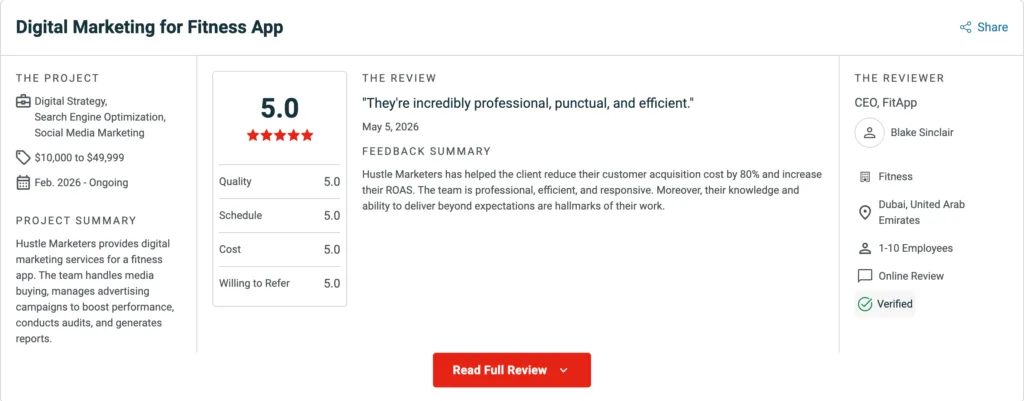
Led by Ishant Sharma, Hustle Marketers took on the account with a full audit and rebuild. Within the first campaign period, customer acquisition cost dropped by 80%. Blake Sinclair reviewed the engagement on Clutch in May 2026 with a perfect 5.0 across every dimension and a quote that summarises how the working relationship felt from his end: “They’re incredibly professional, punctual, and efficient.”
Why the US Fitness App Market Is One of the Hardest to Scale Paid Acquisition In
FitApp is headquartered in Dubai, but the campaigns Hustle Marketers ran were targeted at the United States. The US is the world’s largest app market and the most competitive environment for fitness app paid acquisition. FitApp competes on Meta Ads against Peloton, Beachbody on Demand, Nike Training Club, Daily Burn, Sweat, and dozens of venture-backed fitness startups all bidding for the same health-conscious US audience. These are brands with seven and eight-figure marketing budgets. Getting a lean, Dubai-based startup to a $23.44 cost per trial in that environment is not a default outcome.
This creates specific challenges for paid acquisition that a generic fitness app playbook does not address.
Free trial funnels require precise audience targeting to avoid high churn. A fitness app that targets broadly will fill its trial cohort with people who signed up out of mild curiosity rather than genuine intent to subscribe. These users complete one workout, forget about the app, and never convert to paid. The trial becomes a cost with no return. The only way to acquire trials that convert is to target people who are actively looking for a structured fitness solution and who are predisposed to pay for software that solves a clear problem in their routine.
The US fitness app category on Meta Ads has some of the highest CPMs in consumer software. The cost to reach 1,000 people in a fitness-interested US audience on Meta regularly exceeds $15 to $25 depending on the season and audience size. January is the most expensive month in the fitness category globally because every app and gym runs campaigns targeting New Year resolution audiences simultaneously. Running a campaign from a Dubai-based company targeting US users in this environment required audience precision and creative quality that could justify the CPMs, not a broad spend approach hoping volume would compensate for targeting inefficiency.
iOS 14+ attribution creates a specific problem for subscription apps. Apple’s App Tracking Transparency framework significantly limits Meta’s ability to track user behaviour after the click. For apps where the conversion event (trial sign-up or subscription purchase) happens inside the app rather than on a web page, attribution gaps are wider. Campaigns optimise against incomplete data and make incorrect bidding decisions as a result. Fixing attribution is the prerequisite to fixing performance.
Creative fatigue hits fitness content faster than most categories. Fitness apps that use authentic, relatable content consistently outperform polished brand content in the US market. Read how faceless digital marketing is reshaping how fitness and wellness brands create content that converts at scale. Fitness content is visually familiar. Before-and-after imagery, workout clips, transformation stories. Users in Dubai’s fitness market have seen thousands of these ads. Creative fatigue sets in quickly, frequency rises, and cost per result climbs without any change to targeting or bidding. Maintaining performance requires a continuous creative testing system, not a set-and-forget approach.
US Fitness App Acquisition Benchmarks: How FitApp’s Numbers Compare
Before explaining what changed in the account, it helps to understand where the industry stands so FitApp’s results can be read with proper context.
According to 2026 paid acquisition benchmark data, the industry median cost per acquisition for fitness brands on Meta Ads in the United States is $22.15, down approximately 20% from 2025 as Meta’s automation improved targeting efficiency. The median CPA across all industries on Meta is $38.19, which means fitness is one of the more efficient categories to acquire in, but the competition within fitness is intense enough that reaching the category median still requires a well-structured account.
For subscription apps specifically, independent user acquisition analysis by Airbridge puts a healthy blended cost per trial at $20 to $40 at meaningful scale. Below $12 per trial is considered aggressive and difficult to sustain. Above $60 per trial on a fitness subscription priced at $10 to $30 per month means the payback period exceeds the average subscriber lifetime, making the unit economics impossible to scale. Read the break-even ROAS guide for how these subscription economics are calculated and what targets make paid acquisition viable at different price points.
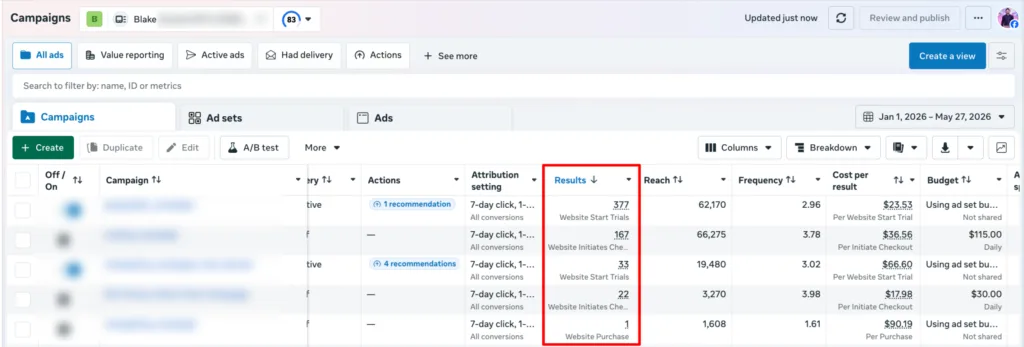
FitApp’s best-performing campaign after the rebuild delivered trials at $23.44. That sits right at the industry category median, which is where a well-run account should operate. The 80% CAC reduction Blake Sinclair cited in his Clutch review means the pre-rebuild cost was approximately five times higher, placing it somewhere around $115 to $120 per trial. At that level, a fitness app subscription at any realistic price point cannot generate a positive return on ad spend. The rebuild didn’t unlock a magic audience. It removed five categories of structural inefficiency that were compounding the cost at every stage of the funnel.
On the funnel conversion side: FitApp generated 409 trials and 189 checkout initiations between January and May 2026. That is a 46.2% trial-to-checkout rate. Industry analysis from Airbridge and Shamanth Rao’s subscription app UA research puts the healthy benchmark at 45 to 50% trial-to-checkout. FitApp sits at the midpoint of that range. This matters because a low trial-to-checkout rate is a signal that the wrong users are being acquired. People who trial the product and find no reason to subscribe. A 46.2% rate indicates the trial cohort has genuine intent and the product is delivering enough value in the trial period for nearly half of users to progress toward payment.
One technical benchmark that explains why the account rebuild was necessary: Meta’s algorithm requires a minimum of 50 conversion events per week per ad set to optimize its bidding accurately. Below 50 events per week, the algorithm does not have enough data to identify patterns in who converts and who doesn’t. It makes bidding decisions based on surface signals rather than actual conversion behavior. An account with too many ad sets splitting conversion events below this threshold will systematically overbid for poor-quality users and underbid for high-value ones. Consolidating ad set structure to ensure each ad set reaches the 50-event threshold is one of the most impactful technical changes available in a Meta Ads rebuild. For more on the metrics that determine whether a paid campaign is actually working, read the guide on key ROAS improvement metrics.
How Ishant Sharma Reduced FitApp’s Customer Acquisition Cost by 80%
The account rebuild started with a full audit before any new spend was committed. The audit covered five areas: pixel and attribution setup, campaign structure, audience strategy, creative performance, and conversion funnel alignment between the ad and the post-click experience.
Attribution fixed first. The Meta pixel was installed but the Conversions API was not set up. The Conversions API sends conversion data directly from FitApp’s server to Meta, bypassing the iOS 14 limitations that affect browser-based pixel tracking. For a subscription app where the most valuable conversion events happen post-click, the Conversions API is not optional. It is the foundation on which every other optimisation depends. Without it, Meta’s algorithm optimises against a partial picture of who converts and makes bidding decisions that consistently overpay for the wrong users.
Campaign structure rebuilt around the subscription funnel. The existing campaigns were structured around general fitness interests. We rebuilt the structure around the three stages of FitApp’s acquisition funnel: trial sign-up, checkout initiation, and subscription purchase. Each stage became its own campaign with its own conversion event, its own audience, and its own creative brief. This separation is critical because the optimal audience for “Website Start Trial” is not the same as the optimal audience for “Website Purchase”. Running them together means the algorithm serves both goals with a compromised targeting signal.
Audience strategy rebuilt from first-party data. FitApp’s existing subscriber list was uploaded to Meta as a Custom Audience. A Lookalike audience was built from it at 1% similarity. This lookalike audience, built from people who had already subscribed and paid, consistently outperforms interest-based targeting for subscription products because the algorithm is looking for people who behaviorally resemble actual paying customers, not people who have expressed interest in fitness content. The distinction matters enormously for cost per trial that actually converts downstream to paid subscriptions.
Creative testing system implemented. Rather than running one or two ad creatives indefinitely, we introduced a weekly creative rotation with clear performance thresholds. Any creative with a CTR below 1.5% after 500 impressions was paused and replaced. Any creative with a cost per trial more than 40% above the campaign average was cut regardless of other metrics. This system kept the ad sets running against fresh creative consistently, which directly controls frequency and cost per result. Read more about the PPC best practices we apply across paid media accounts to maintain performance over time.
Meta Advantage+ Shopping Campaigns tested alongside manual campaigns. As a Meta Business Partner, Hustle Marketers has direct access to platform features and account support from Meta’s team. We tested Advantage+ alongside manually structured campaigns to compare cost per trial and trial quality. The manual campaigns with first-party audience signals outperformed Advantage+ for trial acquisition at FitApp’s current scale. Advantage+ performed better for retargeting users who had already initiated checkout but had not subscribed. The hybrid approach of manual acquisition campaigns with Advantage+ retargeting produced the best combined funnel efficiency.
US audience segmented by intent signal and geography within the market. Not all US states produce the same cost per trial for a fitness app. High-income, health-conscious metro areas converted at lower cost than broad national targeting. Separate campaign structures for the highest-converting audience segments within the US allowed bidding strategies to calibrate against the audiences where FitApp’s messaging landed most effectively.
Landing page and post-click experience aligned to ad creative. A user who clicks an ad about “structured home workouts” and lands on a generic app download page experiences a disconnect that kills conversion rate. We worked with Blake’s team to ensure the post-click landing page reflected the specific promise made in each ad creative. Trial sign-ups improved not from more traffic but from better conversion of existing traffic, which directly contributed to the CAC reduction. For more on how landing page alignment affects conversion, read our guide on conversion rate optimisation.
What the Campaign Data Shows
The Meta Ads account data for January to May 2026 tells a specific story about how the restructured campaigns performed.
The top-performing campaign generated 377 Website Start Trials at $23.44 per trial, spending $8,837.51 total and reaching 62,121 unique accounts at a frequency of 2.96. At 2.96 frequency, creative fatigue was being managed. Industry benchmark for fitness CAC on Meta in 2026 is $22.15 per acquisition. FitApp’s best campaign delivered trials at $23.44, right at the category median, having started from a cost approximately five times higher before the account rebuild.
A second campaign generated 167 Website Initiates Checkout at $36.56 per checkout initiation, reaching 66,275 unique accounts. That is a 46% trial-to-checkout rate across the full account. Industry research from Airbridge puts the healthy benchmark at 45 to 50% trial-to-checkout. FitApp sits at the midpoint of that range, confirming the trial cohort has genuine intent rather than casual curiosity. Total across the account between January and May 2026: 409 Website Start Trials and 189 Website Initiates Checkout, with a total media spend of approximately $17,600.
What Blake Said
Video Testimonial: Blake Sinclair on Working With Hustle Marketers
In August 2026, six months into the engagement, Blake recorded a short video about working with Ishant Sharma and the Hustle Marketers team. In his own words, lead costs came down by around 80%, which matches the drop in customer acquisition cost shown in the account data above.
Video transcript (lightly edited for readability):
“I’ve been using Ishant from Hustle Marketers for God knows how long. It’s been many, many months, and it’s due to his diligent work and assistance that I’ve been able to drastically reduce our lead costs. I believe it came down 80%. Not only is he a wizard at helping us get cheaper leads, but he’s also incredibly responsive, gets everything done efficiently, and he’s been one of the biggest game changers. I cannot recommend him enough. Thank you very much. I’m looking forward to doing a lot more business with you. You are an absolute gem, and I cannot be grateful enough.”
Blake Sinclair, CEO, FitApp (video testimonial, August 2026)
Blake’s Verified Clutch Review
Blake Sinclair, CEO of FitApp, submitted a verified review on Clutch in May 2026, three months into the engagement.
“Hustle Marketers has helped the client reduce their customer acquisition cost by 80% and increase their ROAS. The team is professional, efficient, and responsive. Moreover, their knowledge and ability to deliver beyond expectations are hallmarks of their work.”
Headline quote: “They’re incredibly professional, punctual, and efficient.”
Clutch rating: 5.0 across Quality, Schedule, Cost, and Willingness to Refer. Blake specifically mentions knowledge as a standout quality. In a Dubai fitness tech context, that means understanding both the Meta Ads platform deeply enough to fix attribution and restructure campaigns, and understanding the subscription app growth model well enough to know which metrics actually matter. For how ROAS and CAC relate in subscription businesses, read the guide on ROAS vs ROI.
Results We Delivered
- 80% reduction in customer acquisition cost. Stated directly by Blake Sinclair in a verified Clutch review. Reflects the combined impact of Conversions API implementation, campaign structure rebuild, audience strategy, and creative rotation applied from February 2026.
- 409 Website Start Trials across the campaign account between January and May 2026. Top-performing campaign: 377 trials at $23.44 each from 62,121 unique accounts reached.
- 189 Website Initiates Checkout representing a 46% trial-to-checkout rate, at the healthy industry benchmark of 45 to 50%.
- ROAS increase confirmed. Blake cited increased ROAS alongside the CAC reduction. When acquisition cost falls on a fixed-price subscription product, ROAS improves mechanically.
- 5.0 Clutch rating across Quality, Schedule, Cost, and Willingness to Refer, submitted May 2026.
- Ongoing engagement. Campaigns continue with Hustle Marketers managing media buying, creative rotation, and monthly reporting.
For more on how we approach paid media for subscription and ecommerce businesses, read the guide on ecommerce digital marketing strategy and how the subscription funnel differs from single-purchase ecommerce in terms of what to optimise.
Fitness App Marketing on Meta Ads: Key Lessons
- Fix attribution before touching anything else. A Meta Ads account without the Conversions API is optimising against incomplete data. The attribution fix is not a technical nice-to-have. It is the prerequisite to every other optimisation having its intended effect.
- Trial volume and trial quality are different problems. You can fill a free trial cohort cheaply by targeting broadly. The users won’t convert to paid subscriptions. Measuring cost per trial without tracking trial-to-paid conversion rate is measuring the wrong thing.
- Lookalike audiences from paying customers outperform interest targeting for subscriptions. Interest-based targeting finds people who claim to be interested in fitness. Lookalike audiences built from paying subscribers find people who behaviorally resemble individuals who paid. The difference in conversion rate is consistently significant.
- Campaign separation by funnel stage is not optional. Awareness, trial acquisition, and checkout conversion campaigns each need their own structure, conversion event, and creative brief. Running them together forces the algorithm to serve conflicting objectives with a single signal.
- Creative fatigue is faster in the US fitness app category. The US fitness audience has seen every transformation testimonial in existence. CPM inflation jumped 20% year-over-year in 2026. A creative rotation system with clear performance thresholds is the only way to maintain cost per result without continuously increasing budgets.
- Post-click alignment is half the conversion rate equation. The ad creates intent. The landing page either captures it or loses it. Alignment to specific ad creative improved trial sign-up rates from existing traffic without requiring additional spend. Read more about how account audits surface these landing page gaps as part of a structured account review.
Why Hustle Marketers for Meta Ads Targeting the US Market
Hustle Marketers founder Ishant Sharma has managed paid media campaigns across the US, UK, UAE, and Australia since 2013, working with 2,500 plus brands and generating $780M plus in trackable client revenue. As a Meta Business Partner, Hustle Marketers brings platform-level access, certification-verified expertise, and direct account support for Meta campaign management. Google Partner. Meta Business Partner. Microsoft Advertising Partner.
Running paid acquisition for a Dubai-based app targeting the US market requires understanding both sides simultaneously: the Meta Ads ecosystem in the US where iOS attribution gaps are most acute and competition from well-funded fitness brands is highest, and the startup reality of a lean team operating cross-border. A generalist agency applies the same playbook regardless of context. That playbook does not produce an 80% CAC reduction in three months in the US fitness app category.
Led by Ishant Sharma, the Hustle Marketers team delivered the full account rebuild for FitApp from February 2026 with results confirmed by May. If you run a subscription app, a fitness brand, or any direct-to-consumer product targeting the US market on Meta Ads and the acquisition economics are not working, understand your unit economics first using the break-even ROAS calculator then get in touch with Hustle Marketers. Read more about our ecommerce and subscription PPC management services to understand the depth of what we bring to each engagement.