Customer Acquisition Cost (CAC): Formula, LTV and How to Reduce It

Ishant
Published : October 1, 2026 at 5:52 am
Updated : October 16, 2026 at 12:14 pm
Ishant
By Ishant Sharma | Published: October 1, 2026 | 27 min read
Quick Discussion
Customer acquisition cost (CAC) equals total sales and marketing spend divided by new customers acquired. For example, $50,000 in costs divided by 500 new customers is a $100 CAC.
A lower CAC is not always better. Judge it against customer lifetime value, retention, and payback period, not in isolation.
Table of Contents
- What Is Customer Acquisition Cost?
- The CAC Formula
- How to Calculate CAC Step by Step
- Blended CAC vs. New Customer CAC
- Channel-Specific CAC
- CAC by Marketing Channel (2026)
- Types of CAC to Track Separately
- What Is a Good CAC?
- Average CAC by Industry
- CAC: Startups vs. Established
- LTV:CAC Ratio
- CAC Payback Period
- Is CAC a Fixed or Capitalized Cost?
- CAC vs. CPA vs. CPL
- Why CAC Has Been Rising
- Why Is CAC Increasing?
- How to Reduce Customer Acquisition Cost
- How AI Is Changing CAC
- CAC and ROAS Together
- A Better CAC Dashboard
- Build Your Own CAC Calculator
- Reading Real Company CAC Numbers
- Frequently Asked Questions
CAC
Cost to acquire one new customer
LTV:CAC
Lifetime value vs. acquisition cost
Payback
Months to recover acquisition cost
3+
Commonly cited LTV:CAC benchmark (context-dependent)
What Is Customer Acquisition Cost?
Customer acquisition cost is the average cost a business pays to gain a new customer over a set time.
Depending on the purpose of the analysis, CAC can include:
- Paid advertising spend
- Marketing salaries
- Sales salaries and commissions
- Agency and freelancer fees
- Marketing software and tools
- CRM costs
- Creative production
- Content production
- Events and sponsorships
- Sales development costs
The exact costs included should be defined consistently. A finance team may calculate a fully loaded CAC. A paid-media manager may instead calculate a channel CAC, using only the spend and customers attributable to that channel.
Both are useful as long as each definition is applied consistently.
The CAC Formula
Customer Acquisition Cost Formula
CAC = Total Sales & Marketing Spend / New Customers Acquired
Calculation Example
| Cost Item | Monthly Amount |
|---|---|
| Google Ads | $15,000 |
| Meta Ads | $8,000 |
| Marketing salaries | $12,000 |
| Agency fees | $5,000 |
| Marketing software | $1,500 |
| Creative production | $2,000 |
| Total | $43,500 |
If the business gains 290 new customers during that same time:
Result
$43,500 / 290 = $150 CAC
How to Calculate CAC Step by Step
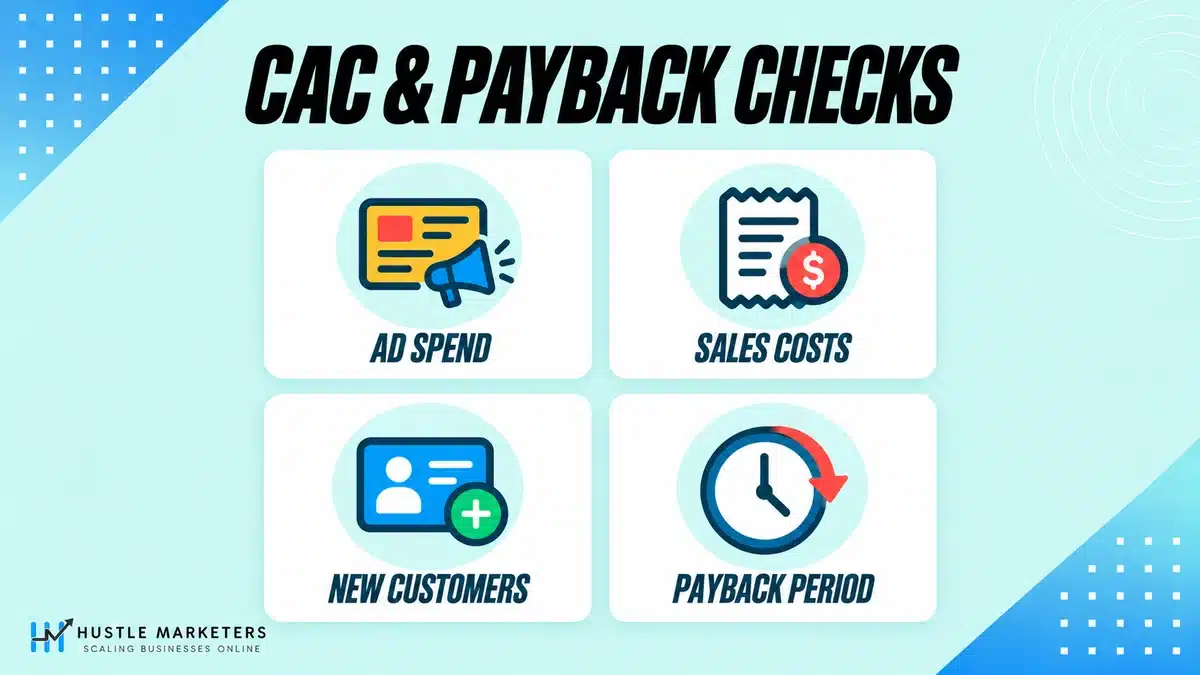
- Choose the measurement period. Monthly works for faster-moving ecommerce brands. Quarterly or cohort-based analysis suits brands with longer sales cycles. The important thing is consistency across periods so you can identify trends.
- Define which costs you are including. Decide whether you are calculating fully loaded CAC (all relevant sales and marketing costs) or marketing CAC (primarily marketing expenditure). Or use channel CAC, which covers one channel only. Do not compare two CAC figures calculated on different definitions.
- Count new customers only. The denominator should represent new customers, not every transaction. Returning purchases should not normally count as newly acquired customers. If 1,000 transactions occurred but only 600 were from first-time buyers, use 600 for acquisition analysis.
- Divide and track over time. CAC = Acquisition Costs / New Customers. Repeat this calculation each period to identify trends and respond to changes.
Worked example
Why the definition matters: Suppose a business spends $40,000 on sales and marketing and reports 500 conversions.
If only 350 were genuinely new customers, the reported $80 CAC ($40,000 / 500) understates the real new-customer CAC of $114 ($40,000 / 350). That is a 43% difference and can significantly affect how you judge campaign economics.
Blended CAC vs. New Customer CAC
These metrics answer different questions and should be tracked separately.
| Metric | Meaning | Best Use |
|---|---|---|
| Blended CAC | Acquisition spend divided by total customer/conversion denominator | Overall business cost analysis |
| New Customer CAC | Acquisition spend divided by first-time customers only | Measuring growth efficiency |
| Channel CAC | Channel-specific spend divided by attributable new customers | Channel optimization and budget allocation |
For acquisition decisions, new customer CAC is usually more informative than a blended figure that mixes new and returning customers.
Channel-Specific CAC
Blended CAC tells you what acquisition costs overall. Channel CAC tells you where the cost is coming from.
Channel CAC = Channel Acquisition Cost / New Customers Attributable to the Channel
| Channel | Spend | New Customers | Channel CAC |
|---|---|---|---|
| Google Ads | $15,000 | 180 | $83 |
| Meta Ads | $8,000 | 60 | $133 |
| SEO (content) | $5,000 | 50 | $100 |
Important Attribution Note
Channel CAC should not be interpreted in isolation. A customer may see a Meta ad, search Google, read organic content, then return directly to purchase.
Assigning 100% credit to one channel distorts the numbers. Channel CAC is most useful when interpreted alongside your attribution method and actual sales data.
Browser tracking limits, consent requirements and Apple’s App Tracking Transparency are also reducing the cross-site data platforms can use for attribution. This makes manual sense-checking more important over time.
CAC by Marketing Channel (2026 Benchmarks)
CAC varies a lot by channel, not just by industry. Some channels reach people who already trust you. Others pay for cold attention, and that gap shows up directly in cost.
Exact dollar figures move constantly and differ by source. Treat any single published number as directional. The relative order below stays fairly consistent across most reports.
| Channel | Typical Relative Cost | Why |
|---|---|---|
| Referral programs | Low | Existing customers do the selling for you |
| Email and SMS | Low | Reaches people who already opted in |
| Organic SEO | Low, after ramp-up | No per-click fee once content ranks |
| Organic social | Low to medium | Free reach, but slow and algorithm-dependent |
| Paid search | Medium to high | High intent, but competitive auctions |
| Paid social (Meta) | Medium to high | Broad reach, usually lower intent than search |
| LinkedIn Ads | High | Precise B2B targeting at a premium price |
This table complements the worked example above, which shows real per-channel numbers for one hypothetical business. The pattern ties to retention: pairing email and SMS with paid acquisition tends to lower blended acquisition cost over time (Klaviyo notes email and SMS drive much of the revenue from loyal customers), since repeat customers need less paid spend to convert again.
Client acquisition cost follows the same pattern in service businesses. Referrals and email nurture cost far less than cold outbound or paid ads, even though the underlying formula stays identical.
Types of CAC You Should Track Separately
Blended CAC and channel CAC are not the only useful splits. Paddle breaks CAC into several distinct types. Each type answers a different business question.
- Initial CAC: cost to acquire a brand-new customer who has never bought before
- Renewal CAC: cost to keep an existing customer renewing a contract or subscription
- Reactivation CAC: cost to win back a customer who already churned
- Market CAC: cost to enter a brand-new market or region
- Product CAC: cost to acquire a customer for one specific product line
- End User CAC: cost per individual user inside a larger team or account
End user CAC matters most for team-based software. Suppose a $6,000 annual contract covers 20 users and cost $1,200 to close. Blended CAC is $1,200 per account, but end user CAC is just $60 per seat.
How do you calculate cost of customer acquisition when a business mixes organic and paid channels, or renewal and new-logo deals? Track each type on its own first. Blend the numbers only for a high-level summary. One blended number can hide which part of the business is actually working.
Paddle’s resource on CAC segmentation walks through a full worked end-user CAC example if you want to see the math in more depth.
What Is a Good CAC?
There is no single answer. A CAC of $100 can be excellent for one business, unprofitable for another, and completely normal for a third. It depends on:
- Average order value and gross margin
- Customer retention and purchase frequency
- Sales cycle and contract value
- Industry and customer segment
- Acquisition channel
A better question than “what is a good CAC” is: Can we acquire customers at a cost that produces acceptable profit and cash flow?
Three Businesses, Same CAC, Very Different Economics
| Business | CAC | Gross Profit Contribution | Retention | Assessment |
|---|---|---|---|---|
| Business A | $50 | $200 | Strong | Potentially healthy |
| Business B | $50 | $30 | Poor | Potentially unsustainable |
| Business C | $1,000 | $5,000 | Long contract | Potentially very attractive |
Use industry benchmarks as context, then build targets around your own unit economics.
Average Cost Per Customer Acquisition by Industry (2026 Benchmarks)
A single national average CAC is not very useful for planning. Because customer acquisition costs by industry vary this much, blended figures hide more than they reveal.
| Business Model | Approximate CAC (2026) | Source |
|---|---|---|
| B2B SaaS | Around $273 | HubSpot Startups, citing First Page Sage |
| B2C Ecommerce | Around $68 | HubSpot Startups, citing First Page Sage |
| B2B (general, cross-industry) | Around $609 | HubSpot Startups |
| B2C (general, cross-industry) | Around $212 | HubSpot Startups |
Treat every figure above as a rough, publicly reported range, not a promise for your business. Real CAC depends a lot on niche, location and competition.
Some industries need more money up front or take longer to close a sale. Real estate, healthcare, insurance and legal services usually cost more than these blended figures. Each sale involves more research and a slower decision. For a full industry-by-industry breakdown, see First Page Sage’s CAC by industry report and Userpilot’s SaaS benchmark data by company size.
Local, low-ticket businesses sit at the other end. Customer acquisition cost for restaurants, for example, tends to run far below SaaS or fintech figures, since acquisition leans on local search, maps listings and repeat visits rather than expensive national campaigns.
CAC Benchmarks for Startups vs. Established Companies
What is the cost of customer acquisition for a brand-new company versus a mature one? The two rarely look alike, so comparing them directly is misleading.
HubSpot’s startup-focused research puts early-stage CAC at roughly these levels, treated here as approximate 2026 figures rather than fixed targets:
| Segment | Approximate Early-Stage CAC |
|---|---|
| B2B (general) | $609 |
| B2C (general) | $212 |
| B2B SaaS | $273 |
| B2C ecommerce | $68 |
The average cost of customer acquisition tends to fall as a company grows up. Older brands gain from name recognition and word of mouth. Years of SEO and content also build up, which lowers blended CAC over time.
Hidden Cost Example
HubSpot’s own example shows how easy it is to understate CAC. A simple calculation using only ad spend gave a $291 per-customer figure. Once salaries, tools and overhead were added in, the true, fully loaded CAC was $667, more than double.
A startup that accepts a higher CAC is not always making a mistake. Early customers often carry extra value through feedback, case studies and referrals. A single dollar figure does not capture that value. See the full HubSpot startup CAC guide for the complete worked example.
LTV:CAC Ratio
Customer acquisition cost becomes much clearer when compared with customer lifetime value.
LTV:CAC Ratio
LTV:CAC = Customer Lifetime Value / Customer Acquisition Cost
Example: LTV = $900, CAC = $150. LTV:CAC = $900 / $150 = 6:1.
Is 3:1 LTV:CAC Always the Target?
No. A 3:1 ratio is commonly cited as a SaaS and growth-business rule of thumb, but it should not be treated as a fixed rule.
The practical caveat is the same. LTV:CAC can be useful, but it is highly sensitive to assumptions, especially when lifetime value is projected far into the future.
A company should weigh the ratio alongside gross margin, retention and churn, and CAC payback period. Growth rate, capital availability, and confidence in the LTV model itself also matter.
Our take
A 5:1 ratio built on an unrealistic 10-year LTV assumption is not necessarily better than a 3:1 ratio based on a conservative, well-supported model. Always interrogate the assumptions behind the LTV before using LTV:CAC as a performance target.
How to Calculate LTV
For a simple ecommerce model:
Revenue LTV (Ecommerce)
LTV = Average Order Value x Purchase Frequency x Expected Customer Lifespan
Example: $80 AOV x 4 purchases/year x 3 years = $960 revenue LTV.
But revenue LTV is not the same as profit. If gross margin is 60%:
$960 x 60% = $576 gross-profit LTV
If CAC is $150: LTV:CAC = $576 / $150 = 3.84:1 (gross-profit basis).
Gross-profit LTV:CAC tells you more than comparing revenue LTV directly with acquisition cost.
CAC Payback Period
LTV:CAC can look attractive while hiding a cash-flow problem. That is where CAC payback becomes important.
CAC Payback Period (Subscription)
Payback = CAC / Monthly Gross Profit per Customer
Payback Calculation Example
| Input | Value |
|---|---|
| CAC | $150 |
| Monthly revenue per customer | $40 |
| Gross margin | 60% |
| Monthly gross profit | $24 |
| CAC payback period | 6.25 months |
The business needs about 6.25 months to recover the acquisition cost through gross profit. This matters most for brands scaling quickly, since growth can consume significant working capital even when LTV:CAC looks healthy.
Key Consideration
There is no fixed “good” payback period. A six-month payback is usually easier to finance than a 24-month payback.
But a longer payback may still work for a business with strong retention, enough capital, and predictable churn. Weigh payback against your own business model and financing situation.
Is Customer Acquisition Cost (CAC) a Fixed Cost or a Capitalized Expense?
This question comes up once CAC starts to affect financial reports, not just marketing dashboards. The short answer: CAC is not a fixed or variable cost on its own. It is a mix of both.
Salaries tend to stay fixed in the short term. Ad spend is variable and can move every week. That mix is why CAC shifts month to month even when your team stays the same size.
Most sales and marketing costs are booked as an expense right when they happen. They are not treated like equipment that loses value over years. A small part of contract costs can sometimes be spread out over time under specific accounting rules. This depends on your industry and method.
Not Accounting Advice
This section explains general practice. It is not formal guidance for your financial statements. Check your exact treatment with a licensed accountant before you apply any of this to real reporting, especially around ASC 606 or IFRS 15 rules.
Booking spend as an expense right away keeps CAC simple to report. But it also means a heavy push on ads can make one quarter look worse than the business really is.
CAC vs. CPA vs. CPL
These metrics are related but should not be used interchangeably.
| Metric | What It Measures | Example | Level |
|---|---|---|---|
| CAC | Cost to acquire a new customer | $150/customer | Business |
| CPA | Cost per defined conversion action | $40/purchase or signup | Campaign/Platform |
| CPL | Cost to generate a lead | $25/lead | Campaign |
| CPC | Cost per click | $2/click | Ad |
A low platform CPA does not guarantee a low CAC, because CPA may count actions that do not become paying customers. Always trace metrics back to actual customers and sales.
This distinction is sometimes phrased as cost per acquisition vs customer acquisition cost, but the two are not interchangeable. CPA lives at the campaign level, while CAC lives at the business level, as the table above shows.
Why CAC Has Been Rising: The Bigger Picture
Before troubleshooting your own account, it helps to see the wider trend. CAC has climbed across most industries over the past several years, not just for one business.
Three forces explain most of the increase. Privacy changes have made tracking and targeting less precise. Auction competition has grown as more brands shift budget into digital. Media costs also keep rising faster than inflation on major ad platforms.
Understanding CAC meaning in digital marketing today starts with one fact: it costs more to win a customer now than it did five or ten years ago. That is not a sign your strategy failed. It is the new baseline most businesses work against.
This context matters because it changes the question you ask. Instead of asking why CAC went up, ask how your CAC is trending against the industry, not just against your own past numbers.
Why Is My CAC Increasing?
If CAC is rising, do not assume ads are automatically the problem. Check each of the following factors:
| Cause | What to Check |
|---|---|
| Higher auction competition | CPM and CPC trends vs. prior periods |
| Lower conversion rate | Landing page conversion rate, offer relevance, site speed |
| Creative fatigue | Ad frequency, click-through rate trends, creative refresh cadence |
| Poor landing-page experience | Bounce rate, time on page, form completion rate |
| Longer sales cycles | Lead-to-customer conversion time, pipeline velocity |
| Attribution changes | Tracking setup, modeled vs. observed conversions, data gaps |
| Customer mix shift | Segment breakdown, AOV by cohort, product mix |
| Lower retention | Repeat purchase rate, churn rate, cohort analysis |
How to Reduce Customer Acquisition Cost
Reducing CAC is not simply about cutting the marketing budget. The better goal is to generate better new customers from the same or lower acquisition spend.
1. Improve Your Conversion Rate
One of the fastest ways to improve CAC is to convert more of the traffic you are already paying for. If the same traffic converts at 3% instead of 2%, the business acquires 50% more customers without increasing media spend.
Focus on clear value propositions, stronger headlines, better CTAs, faster pages, and useful landing pages. Also strengthen trust signals, reviews, case studies, shorter forms, and mobile UX. See our advanced SEO techniques guide for technical improvements that also support conversion.
2. Improve Google Ads Conversion Quality
Google Ads Smart Bidding uses Google AI to optimize bids at auction time based on conversion likelihood and contextual signals. Current Google Smart Bidding strategies include Maximize Conversions, Target CPA, Maximize Conversion Value and Target ROAS.
Google Ads Practitioner Guidance
To use Smart Bidding well, track the right conversion actions, remove low-value conversion events from optimization, and import meaningful offline outcomes for lead-generation brands.
Also use accurate conversion values when revenue varies, watch conversion lag, and give the system enough reliable data before setting aggressive targets.
For ecommerce brands, our ecommerce PPC management services cover this type of paid-search optimization. For a broader PPC plan, see our PPC agency services.
3. Use Better Conversion Data
Your bidding system can only optimize toward the signals you provide. For lead-generation brands, a form submission is not necessarily the final business outcome. The journey typically looks like:
Click → Lead → Qualified Lead → Sales Opportunity → Customer
If Google Ads only receives the initial lead, it cannot tell a $5,000 customer from a low-quality inquiry. CRM integration, offline conversion imports, and accurate conversion definitions can matter more than simply changing bid plans.
4. Improve Meta Ads New-Customer Acquisition
Meta’s current Advantage+ Sales campaign guidance specifically emphasizes using its automation to find new customers and exclude existing customers when optimizing for acquisition. For ecommerce consider:
- Optimizing toward purchases rather than shallow engagement events
- Separating new-customer acquisition analysis from returning-customer revenue
- Excluding existing customers from prospecting campaigns where right
- Testing multiple creative concepts and monitoring for creative fatigue
- Feeding accurate purchase values into the platform
- Evaluating contribution margin rather than platform ROAS alone
Our take
Meta’s current approach places significant emphasis on automation across groups, placements and delivery. The marketer’s role increasingly shifts toward better creative planning, measurement inputs, and business constraints rather than granular manual targeting. Focus on what you feed the system, not on micro-managing delivery.
5. Improve Your Landing Pages
A paid campaign can have excellent targeting and still produce poor CAC if the landing page does not convert. Page speed is often the biggest hidden factor; see Google’s Core Web Vitals guidance for the metrics that matter most. Audit for:
| Area | What to Check |
|---|---|
| Message match | Does the page deliver what the ad promised? |
| Offer clarity | Is the value proposition obvious above the fold? |
| Trust signals | Reviews, credentials, case studies, guarantees |
| Friction | Are forms unnecessarily long? |
| Mobile UX | Is the page usable on a phone? |
| Speed | Does the main content load within 2-3 seconds? |
| CTA placement | Is the next step obvious at multiple scroll points? |
6. Invest in SEO for Long-Term Acquisition Efficiency
SEO can become an important acquisition channel because organic traffic does not require a separate advertising payment for every click. One well-optimized commercial page can continue generating qualified traffic without paying a search-ad click fee for every visit.
Important Clarification
SEO is not free. It requires ongoing investment in strategy, technical SEO, content, link building, tools, and maintenance, guided by Google’s Search Essentials.
The economic advantage is that the added cost of more organic traffic can become fairly low once good content is ranking. Judge SEO economics over a multi-month span, not month-to-month.
For a broader organic search strategy, see our SEO services and SEO strategies guide.
7. Improve Retention and Increase LTV
If you cannot reduce CAC further, increasing LTV improves acquisition economics without changing the cost of acquiring customers.
| Scenario | CAC | Gross-Profit LTV | LTV:CAC |
|---|---|---|---|
| Before retention improvement | $150 | $300 | 2:1 |
| After retention improvement | $150 | $450 | 3:1 |
Retention plans include better onboarding, post-purchase email, subscription programs, loyalty programs, cross-selling, upselling, replenishment campaigns, and churn-prevention flows.
8. Reduce Wasted Paid-Media Spend
Before cutting budget, audit where spend is not producing good customers.
For Google Ads, check: search terms, negative keywords, geographic performance, device performance, conversion quality, landing-page performance, and brand vs. non-brand traffic.
For Meta, check: creative fatigue, group quality, placement performance, new vs. existing customer mix, conversion quality, and product-level profit.
Common Mistake
Do not cut a channel because its platform-reported CPA looks high. First check whether it generates good customers when traced back to actual sales, margin and retention. Platform-reported attribution is a signal, not a final verdict.
9. Fix Attribution Before Making Major Budget Decisions
Attribution is imperfect, partly because frameworks like Apple’s App Tracking Transparency limit how much cross-app activity any single platform can see. A customer may interact with multiple marketing channels before purchasing. Avoid making major budget decisions based solely on one platform’s reported attribution.
Compare: ad-platform conversions, analytics data, CRM customers, actual sales, new vs. returning customers, and cohort performance together.
10. Improve Customer and Lead Quality
Lower CAC is not useful if you are acquiring customers who do not generate sufficient profit. For lead-generation brands, track the full funnel from lead to sale.
For ecommerce, track first purchase through to repeat purchase and contribution margin. This can reveal that a more expensive channel produces substantially better customers.
How AI Is Changing Customer Acquisition Cost in 2026
CAC, the cost to acquire a customer, is changing fast because of AI tools. Bidding, creative testing and lead scoring all now use some form of AI.
Customer Acquisition Cost Optimization With AI Tools
Google and Meta both push AI bidding as the default option now. These systems adjust bids in real time using signals a human cannot track at the same speed.
Predictive lead scoring is another lever. It ranks leads by how likely they are to convert. Sales teams then spend time on the contacts most likely to become paying customers.
AI creative testing can generate and test more ad versions than a small team could make by hand. That can improve conversion rate and lower CAC over time.
Treat Results as Estimates
Some companies report much lower CAC after they adopt AI tools. Results vary a lot by industry, data quality and how well the tools are set up. Treat any specific number you see online as an estimate, not a promise for your account.
The bigger shift is first-party data. As tracking keeps changing, businesses that collect their own customer data have an edge. Email lists, loyalty programs and CRM records all feed that edge, and AI tools can build on it.
Need Help Reducing Your CAC?
Hustle Marketers helps ecommerce and service brands improve acquisition efficiency through SEO and paid media.SEO Services PPC Services Ecommerce PPC
CAC and ROAS Together
ROAS measures sales generated relative to ad spend. CAC measures the cost of acquiring customers. They are related but different metrics.
| Metric | Formula | What It Tells You |
|---|---|---|
| ROAS | Revenue / Ad Spend | Revenue efficiency of advertising |
| New-Customer ROAS | New Customer Revenue / Ad Spend | Acquisition revenue efficiency |
| CAC | Acquisition Costs / New Customers | Cost per new customer acquired |
A strong overall ROAS can mask poor new-customer economics if most sales come from returning customers. For a deeper look, see our guide to how to improve ROAS. It also covers key metrics to improve ROAS.
Ecommerce brands should consider tracking these together: New Customer ROAS, Returning Customer ROAS, New Customer CAC, Blended CAC, and Contribution Margin per cohort.
A Better CAC Dashboard
CAC alone is not enough. A useful acquisition dashboard connects acquisition cost with profitability, retention, and cash-flow metrics.
Sample CAC Dashboard
| Metric | Current Period | Previous Period | Direction |
|---|---|---|---|
| New Customer CAC | $150 | $165 | Improving |
| Google Ads CAC | $83 | $91 | Improving |
| Meta Ads CAC | $133 | $120 | Worsening |
| SEO CAC | $100 | $110 | Improving |
| Gross-Profit LTV | $576 | $540 | Improving |
| LTV:CAC (gross profit) | 3.84:1 | 3.27:1 | Improving |
| CAC Payback Period | 6.25 months | 7.1 months | Improving |
| New Customer Conversion Rate | 3.2% | 2.8% | Improving |
CAC Reduction Strategy: Step-by-Step Process
- Confirm the measurement. Ensure CAC is calculated consistently with a clear definition of included costs and the customer denominator.
- Separate new and returning customers. Confirm you are measuring acquisition, not blended activity.
- Segment by channel. Find where CAC is increasing and by how much.
- Check conversion rate. Determine whether the problem is traffic quality or conversion efficiency.
- Check customer quality. A higher CAC may be acceptable if LTV is also higher.
- Check attribution. Ensure channel performance is not being distorted by measurement gaps.
- Improve the biggest bottleneck. Focus on the part of the funnel with the greatest economic impact.
- Recalculate. Track CAC, LTV and payback period after the change to confirm the improvement.
Build Your Own CAC Calculator
You do not need special software to see how to calculate the cost of customer acquisition. A simple spreadsheet with a few linked cells does the job well.
| Input | What to Enter |
|---|---|
| Total sales and marketing spend | Your defined period, such as monthly |
| New customers acquired | First-time customers only, not repeat orders |
| Average order or contract value | Used to estimate lifetime value |
| Gross margin percentage | Used to convert revenue LTV into profit LTV |
| Monthly gross profit per customer | Used for payback period |
From those five inputs, a spreadsheet can work out CAC, gross-profit LTV, the LTV:CAC ratio, and payback period on its own, using the same formulas from earlier in this guide.
Many teams search for how to calculate cost of customer acquisition and end up with a static spreadsheet instead of a process they can repeat. Build the calculation once. Link it to your real spend and customer counts. Then it updates itself every period.
Pair this calculator with the dashboard format shown above, so you track the direction of change, not just the raw numbers each month.
Reading Real Company CAC Numbers
What is a customer acquisition cost worth, really, when a public company mentions one on an earnings call? Often less than it first appears.
Some public subscription companies share payback period or LTV numbers in investor reports. Full CAC figures, broken down by cost, are rarely shared in complete detail.
When you see a specific number tied to a well-known company, check three things before you compare it to your own business.
- Is it blended CAC or new-customer CAC?
- Does it include salaries and overhead, or only media spend?
- Is it a company-wide average, or one channel or region?
Two companies can report what looks like the same CAC while they measure very different things. That is not dishonesty. It usually just means they use different internal rules. This guide keeps repeating the same point: pick your method, then use it the same way every time.
Ishant Sharma
Founder and CEO, Hustle Marketers
Ishant Sharma is the Founder and CEO of Hustle Marketers, a digital marketing agency. It specializes in SEO, Google Ads, Meta Ads, ecommerce marketing, and performance marketing.
His work focuses on helping brands improve acquisition efficiency, conversion performance, and steady sales growth through data-driven marketing.
Frequently Asked Questions
What is customer acquisition cost?
Customer acquisition cost is the average cost a business pays to gain a new customer over a set time. A basic calculation divides useful sales and marketing costs by the number of new customers gained.
What is the CAC formula?
CAC = Total Sales and Marketing Costs / New Customers Acquired. For example, $50,000 in acquisition costs divided by 500 new customers produces a $100 CAC.
What is a good CAC?
There is no single good CAC. A healthy CAC depends on gross margin, customer lifetime value, retention, business model, sales cycle and cash-flow rules. Judge CAC against your own unit economics, not generic industry benchmarks.
Is a lower CAC always better?
No. A lower CAC is only better if customer quality and profitability remain acceptable. A pricier customer can be worth more if that customer has much higher lifetime value and margin.
What is the LTV:CAC ratio?
LTV:CAC compares customer lifetime value with customer acquisition cost. LTV:CAC = LTV / CAC. A 3:1 ratio is commonly cited in growth businesses.
It should not be treated as a fixed target, though. The right ratio depends on gross margin, retention, payback period, and business model.
What is the difference between CAC and CPA?
CAC is a broader business-level acquisition metric. CPA generally refers to the cost of a defined conversion or acquisition action and is often used at the campaign or platform level. A low CPA does not automatically mean a low CAC.
What is the difference between CAC and CPL?
CPL measures the cost of generating a lead. CAC measures the cost of acquiring a customer. A low CPL does not necessarily mean a low CAC if many leads fail to become paying customers.
How do I calculate CAC by channel?
Divide the useful acquisition cost for a channel by the number of new customers attributed to that channel. Because customers can interact with multiple channels, document your attribution method and interpret channel CAC accordingly rather than treating it as an absolute figure.
Should CAC include salaries?
For a fully loaded CAC calculation, useful sales and marketing salaries can be included. For channel-specific analysis, you may use a narrower cost definition. The important thing is to clearly define and consistently apply your method.
What is CAC payback period?
CAC payback period is the time required to recover the acquisition cost through the gross profit generated by the customer. A simplified formula for subscription brands is: CAC / Monthly Gross Profit per Customer.
Why is my CAC increasing?
Possible causes include higher media costs, declining conversion rates, weaker customer quality, longer sales cycles, creative fatigue, attribution changes, or shifts in customer mix. Check each factor in turn before making budget decisions.
How can Google Ads reduce CAC?
Improve conversion tracking, optimize toward real conversions, and use the right Smart Bidding strategies, including Target CPA and Target ROAS. Also improve landing pages, cut wasted search traffic, and keep checking customer quality against actual sales.
How can Meta Ads reduce CAC?
Improve creative quality, optimize toward purchases or real conversion events, and separate new-customer acquisition from returning-customer activity. Also use Meta’s current automation tools, such as Advantage+ Sales campaigns with existing-customer exclusions for prospecting.
How does SEO reduce CAC?
SEO can reduce dependence on paid acquisition. It generates organic traffic from content and pages that keep attracting visitors after the initial investment.
SEO still requires ongoing investment in strategy, content, technical work, and authority building. But the extra cost of more organic traffic can become fairly low once good content is ranking.
Should I focus on CAC or ROAS?
Use both for different purposes. ROAS checks ad revenue efficiency, while CAC measures customer acquisition cost. Combine them with gross margin, new-customer revenue and LTV to see the full business picture. See our guide to how to improve ROAS for more.
What is fully loaded CAC?
Fully loaded CAC includes every cost tied to acquiring a customer, not just ad spend. It adds salaries, software tools, overhead and agency fees, then divides by new customers.
This gives a more honest number than dividing ad spend alone by customers. Most companies understate CAC because they leave out salaries and tools.
Are customer acquisition costs capitalized or expensed?
In most cases, sales and marketing costs used to acquire customers are expensed as incurred, not capitalized. Some contract-related costs can be capitalized and amortized under specific accounting rules.
This depends on your accounting method and industry. Talk to a licensed accountant before applying this to your financial statements.
Is CAC a fixed cost or a variable cost?
CAC itself is not a fixed or variable cost category. It is a calculated metric built from a mix of both.
Salaries are usually fixed, while ad spend is variable. That mix is why CAC can change month to month even when your team and tools stay the same.
What is the difference between CAC ratio and LTV:CAC ratio?
CAC ratio compares sales and marketing spend to the new annual recurring revenue it generated. It shows efficiency in dollars spent per dollar of new revenue.
LTV:CAC ratio compares a customer’s total lifetime value to the cost of acquiring them. Both matter, but they answer different questions.
What is subscriber acquisition cost (SAC)?
Subscriber acquisition cost is the telecom and media industry’s version of CAC. It measures the cost to acquire one new subscriber, including hardware subsidies, activation costs and marketing.
It works the same way as CAC but carries a different name, since subscription telecom businesses track it separately.
Can customer acquisition cost be negative?
CAC cannot be a negative number in the standard formula, since spend cannot be negative.
Some businesses report an “effective CAC” near zero when referral programs or viral growth bring in customers with almost no direct spend. People sometimes call this negative CAC in casual conversation, which can be confusing.
Does CAC include the founder’s own time for a small business?
Yes, if you want an accurate number. Many small business owners count only ad spend and skip their own hours spent on sales and marketing.
This understates true CAC. Assign yourself a reasonable hourly rate and include that time before deciding whether a channel is actually profitable.
How often should a company recalculate CAC?
Most companies recalculate CAC monthly or quarterly, depending on sales cycle length. A business with a short cycle, like ecommerce, benefits from monthly tracking.
A business with a long B2B sales cycle should use trailing 3 to 6 month averages, since one month can mislead due to timing lags.
What is a realistic CAC payback period for a startup versus a mature company?
Early-stage startups often accept a longer payback period, sometimes 12 to 18 months, since they prioritize growth over near-term profit.
Mature, capital-efficient companies usually target 5 to 12 months. A payback period trending the wrong way over several quarters is a warning sign at any stage.
How is AI changing customer acquisition cost in 2026?
AI tools now help with bid management, ad creative testing and lead scoring. Some companies report much lower CAC after they adopt them.
Results vary a lot by industry and setup quality, so treat any specific percentage as an estimate. The bigger shift is using first-party data more effectively.