10 Advanced SEO Techniques That Win Rankings and AI Citations in 2026

Ishant
Published : August 5, 2026 at 7:25 am
Updated : October 16, 2026 at 12:15 pm
Ishant
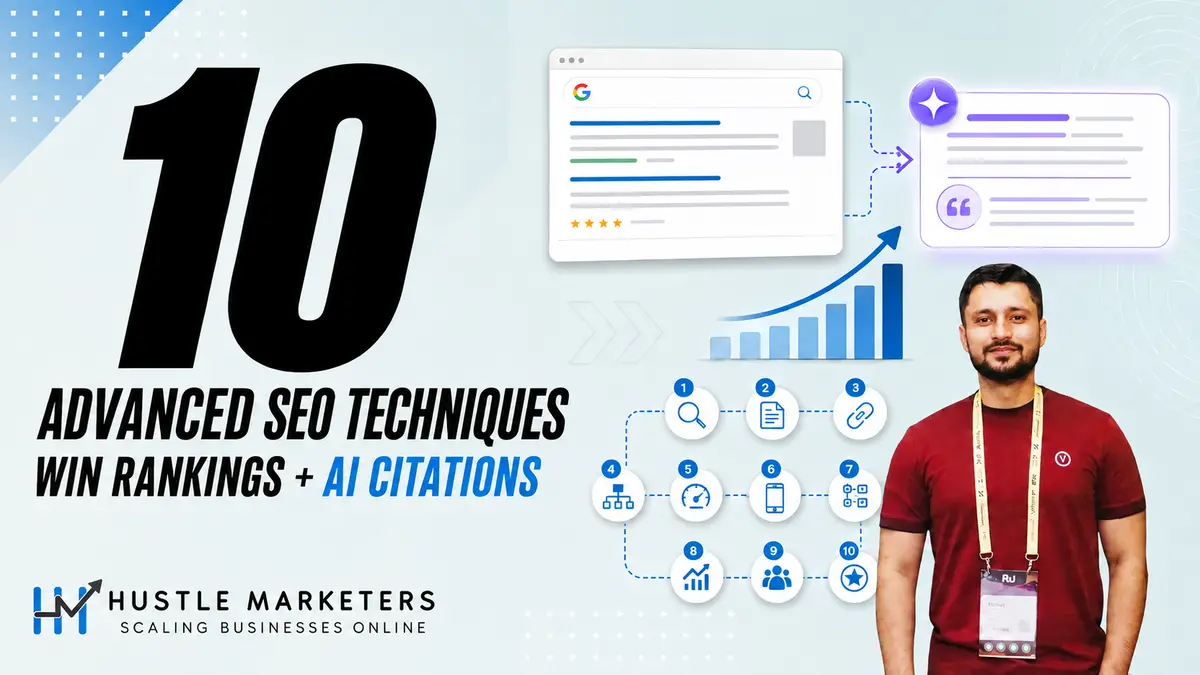
Basic SEO gets you into the game. Title tags, a few backlinks, a keyword in the H1. The brands actually winning search in 2026 are playing a different game with a different vocabulary. They prune, they sculpt, they split intent, they stack entities, and they optimize for how AI pulls answers apart. If a technical SEO said “we’re reverse siloing the money pages and fixing content decay before the fan-out audit,” would you know what that meant? This guide breaks down ten advanced SEO techniques with real depth: what each one is, how to actually run it, and how it earns you AI citations, not just blue links. Know all ten and you’re not ranking by accident. You’re building authority that’s genuinely hard to compete with. Let’s get into it.
Most guides on these terms stop at the definition. This one shows you how each technique works for AI search too, and links each to real work we’ve done, because in 2026 that’s the difference between a page that ranks and one that gets ignored. Before you buy software to shortcut any of it, read what the evidence says about whether AI SEO tools actually work.
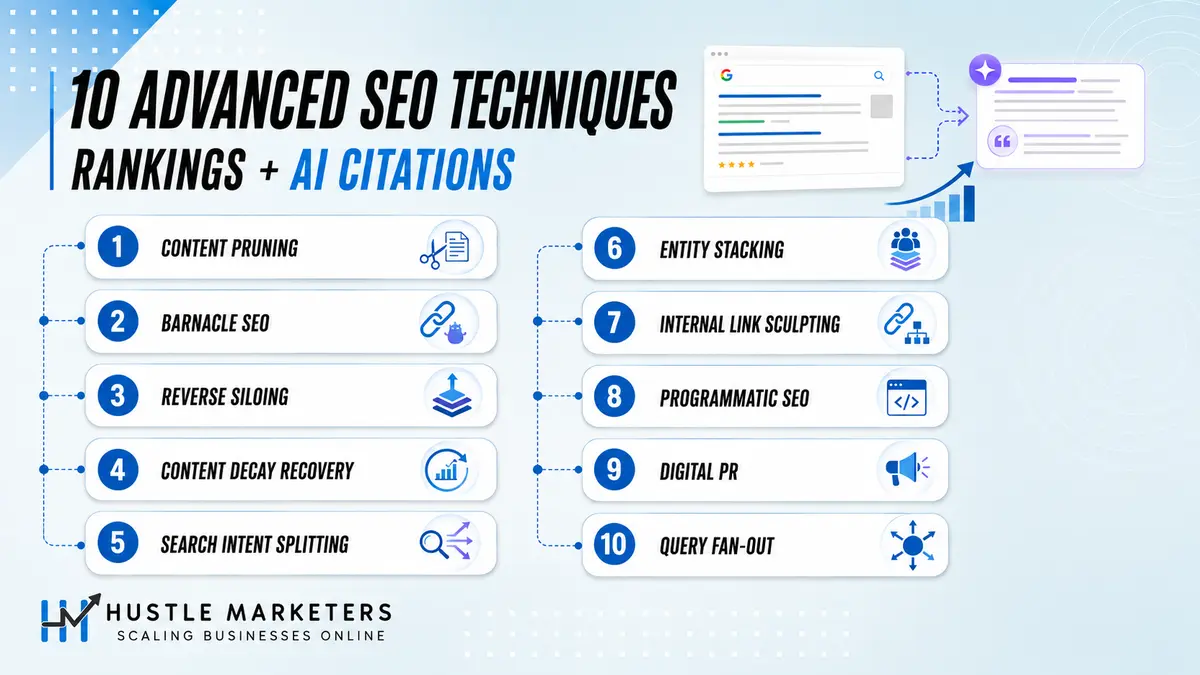
Here’s the full list at a glance, then we’ll break down each one.
| Technique | What it does | Best for | Effort |
|---|---|---|---|
| Content pruning | Cuts or merges weak pages so strong ones rank | Sites with lots of old content | Low |
| Barnacle SEO | Ranks you on high-authority third-party sites | Competitive and agency terms | Medium |
| Reverse siloing | Funnels link authority up to money pages | Service and commercial pages | Low |
| Content decay recovery | Refreshes pages losing traffic | Aging pillars | Low |
| Search intent splitting | Splits mixed-intent pages by intent | Pages trying to do two jobs | Medium |
| Entity stacking | Builds your brand as a trusted entity | Brand and author authority | Medium |
| Internal link sculpting | Steers link equity to priority pages | Money and pillar pages | Low |
| Programmatic SEO | Generates many pages from one template | Ecommerce and location targeting | High |
| Digital PR SEO | Earns authority links and mentions | Link building and AI citations | High |
| Query fan-out optimization | Structures content for AI sub-queries | Every pillar in 2026 | Medium |
Key Takeaways
- Content pruning needs a framework, not a mood. Join GA4 and GSC data, then sort every page into rewrite, remove, update or review with numeric thresholds set in advance.
- Never delete on traffic data alone. Pages that earn links, close deals or satisfy legal requirements survive a cull regardless of sessions.
- Traffic and engagement are two different diagnoses. Traffic with no engagement is a content problem. Engagement with no traffic is a visibility problem.
- Automate internal link candidates, not the publishing. Agents are good at finding the pair. Humans still approve the anchor.
- Plan for organic clicks to fall. Learn to read the impressions-up clicks-down pattern in Search Console, then move effort toward commercial intent and 4-word-plus queries.
- 0 of 9 competing guides prepare you for decline. Every one of them is growth-framed.
What is content pruning, and how do you do it right?
Content pruning is the deliberate removal, merging, or rewriting of low-value pages so your strong pages rank better. You don’t only grow a site by adding. Sometimes you grow it by cutting.
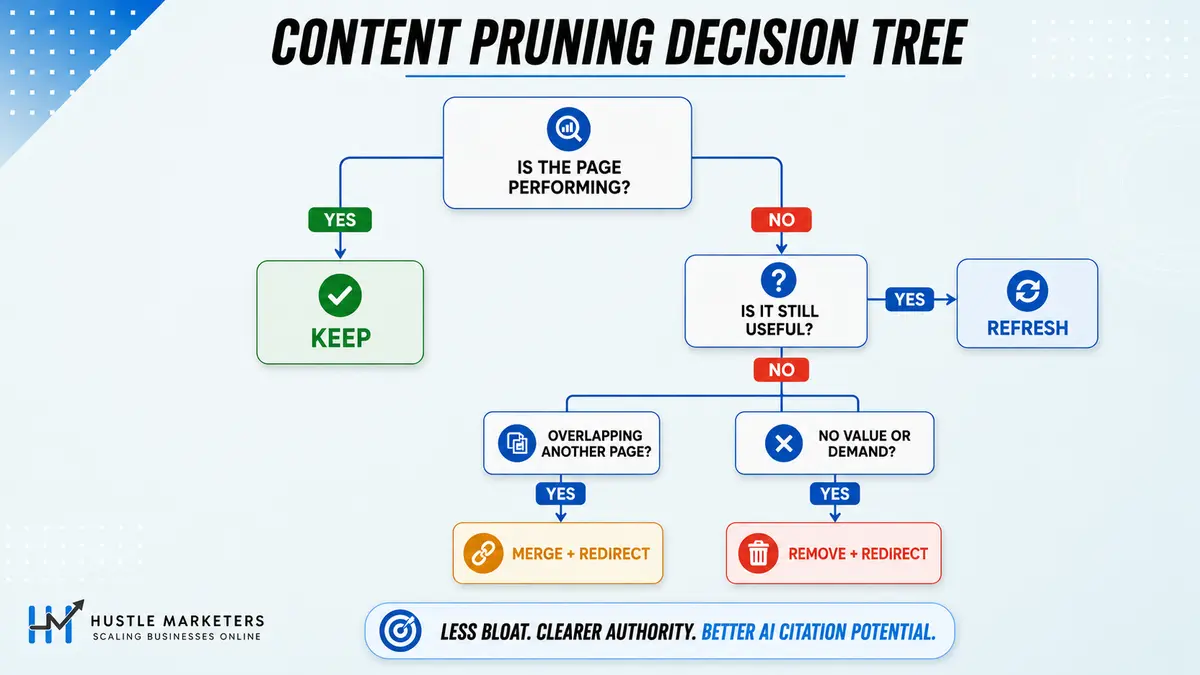
Thin posts, outdated pages, and near-duplicates drag down how Google reads the quality of your whole domain, and they waste crawl budget on pages that will never rank. Here’s the process we use:
- Inventory everything. Pull every URL with its clicks, impressions, and last-updated date.
- Score each page. Flag anything with near-zero clicks over 6 to 12 months, or content that no longer reflects your business.
- Decide the action. Refresh it, merge it into a stronger page, or remove and redirect it. Deleting is the last option, not the first.
- Protect equity. 301 redirect anything you cut to the closest relevant page, so you keep the link value and avoid broken links.
The AI-search angle most guides miss: pruning isn’t just cleanup. A tight, high-quality site with clear topical focus is easier for AI to read as an authority, which raises your odds of being cited in AI answers. Bloat confuses that signal.
Example: a blog with 200 posts might have 60 that get almost no traffic and cover overlapping topics. Merge those into 20 stronger guides, redirect the rest, and the surviving pages often climb, because the whole site now reads as tighter and more focused.
Best used for: your blog library and aging posts. Pruning and refreshing is a core part of any real SEO audit.
What is barnacle SEO, and does it still work in 2026?
Barnacle SEO means attaching your brand to a high-authority site that already ranks, so you appear in results you couldn’t reach with your own domain. Think of a barnacle riding a whale. The term was coined back in 2008, and in 2026 it matters more than ever, because AI answers lean heavily on third-party sources.
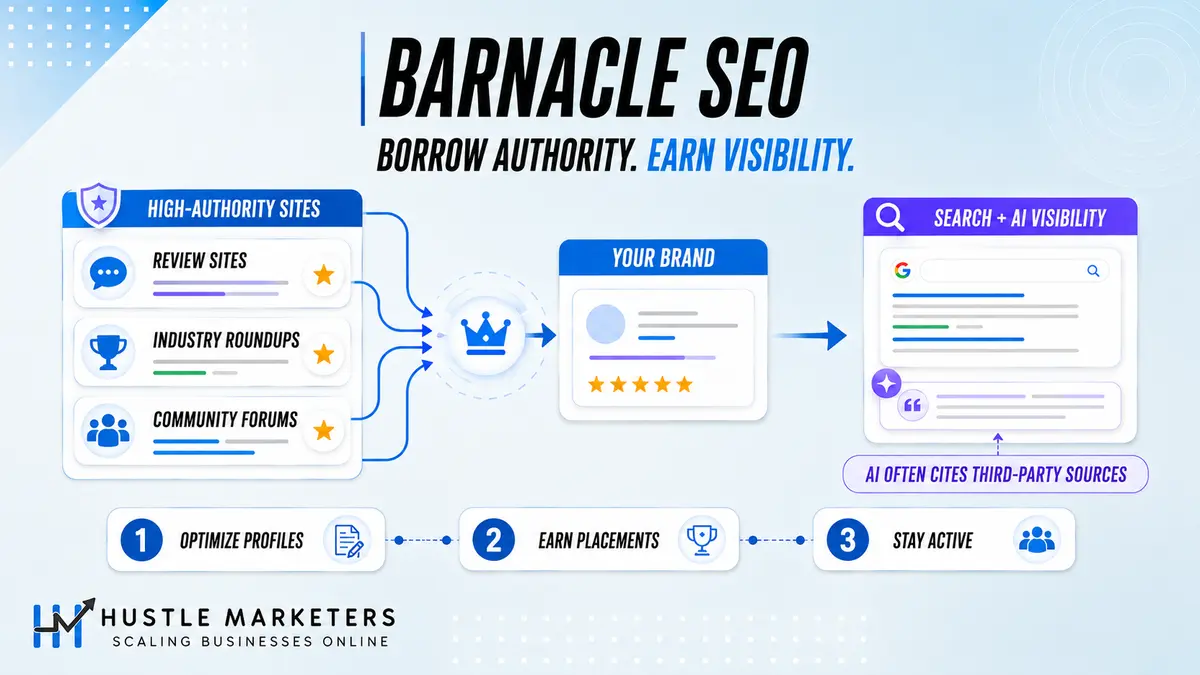
When a search or an AI assistant pulls from Reddit, YouTube, G2, Clutch, or a “best of” listicle, you want to be inside those results, not competing against them. To do it:
- Claim and optimize your profiles on the directories, marketplaces, and review sites that rank for your money terms.
- Earn placement in third-party “best agencies” or “top tools” roundups for your category.
- Stay active where your buyers research, so your name shows up in the exact sources AI cites.
The AI-search angle: ChatGPT, Perplexity, and Google AI Overviews frequently cite Reddit threads, review platforms, and listicles. Being well-represented there increases how often AI recommends you, even when your own site isn’t the source.
Best used for: competitive agency and white-label terms. We apply this across agency roundups like our best white label Google Ads placements and our review profiles.
What is reverse siloing, and why is it better for revenue?
Reverse siloing flows internal link authority upward, from your supporting blog content into your commercial money pages, instead of trapping it inside separate topic silos. It points your site’s authority at the pages that actually convert.
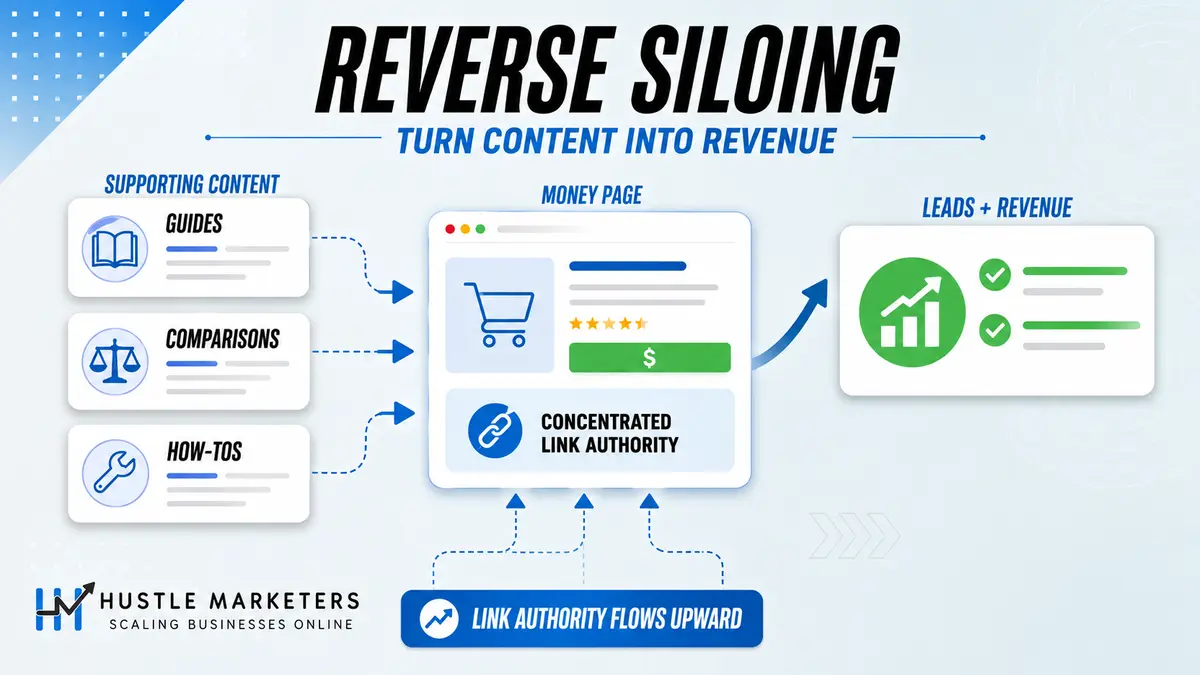
Traditional siloing walls clusters off from each other. That’s fine for organizing content, but it starves your money pages. Here’s the difference:
| Traditional siloing | Reverse siloing | |
|---|---|---|
| Link direction | Sideways, within a silo | Upward, into money pages |
| Goal | Topical organization | Concentrate authority where it converts |
| Best for | Large content libraries | Commercial and service pages |
To run it: publish supporting articles around a money page (guides, comparisons, how-tos), link each one up to the money page with a natural, descriptive anchor, and let the money page link out to only a few key related pages so it keeps most of the authority.
Example: say your money page is an SEO service page. Publish five supporting posts around it (an audit guide, a technical SEO checklist, a local SEO explainer, a link-building post, and a keyword research guide), and link all five up to the service page with varied anchors. The service page now sits on top of a cluster that keeps feeding it authority.
Best used for: your service pages. We reverse silo supporting content into pages like our SEO agency and PPC agency hubs.
What is content decay, and how do you recover lost traffic?
Content decay is the slow traffic loss a page suffers as it ages, competitors update their versions, and search intent shifts. Decay recovery is the refresh that wins those rankings back, and it’s almost always faster than writing something new.
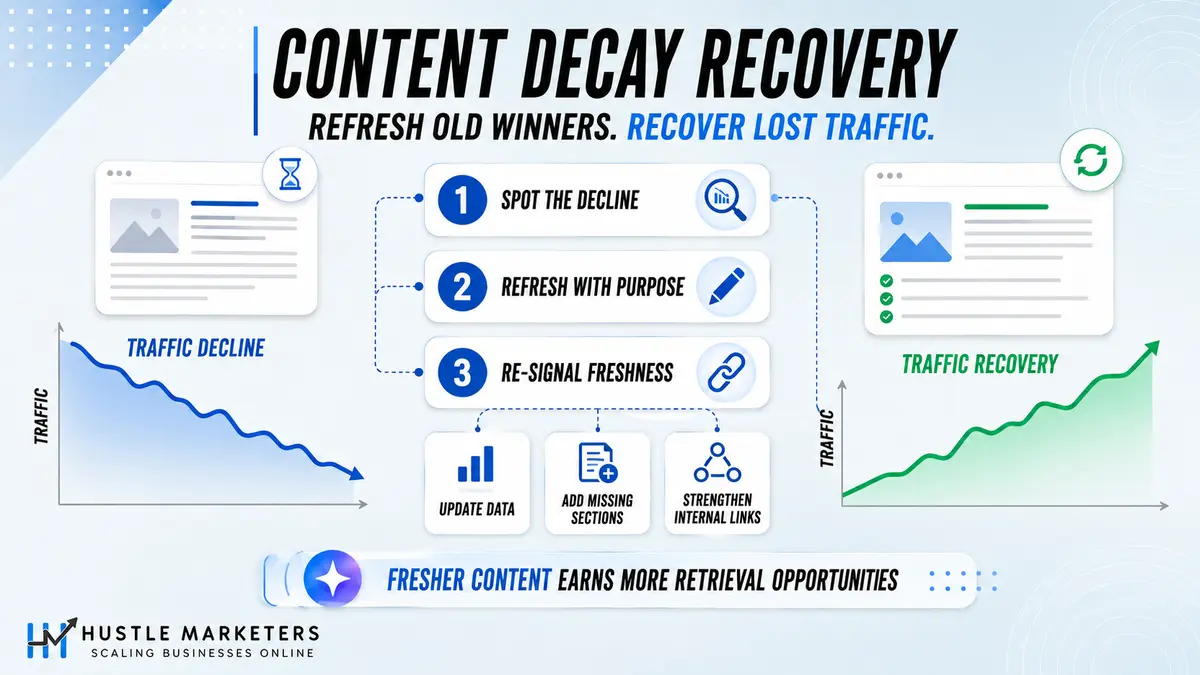
Nearly every page peaks then slides. The fix is maintenance, not more publishing:
- Spot the decline. Find pages that lost impressions or clicks year over year in Search Console.
- Refresh with purpose. Update the data, add the sections competitors now cover, and update dates and examples.
- Re-signal freshness. Strengthen internal links into the page and request indexing so Google recrawls it.
The AI-search angle: research shows AI tools cite noticeably fresher content than traditional search surfaces. A page you refreshed last month has a better shot at an AI citation than the same page left untouched for two years. Freshness is now a retrieval signal, not just a ranking one.
Example: a guide that pulled 4,000 visits a year ago and now pulls 1,500 usually doesn’t need replacing. Update the stats, add the two sections competitors added since, refresh the year and examples, and re-link it, and a large share of that lost traffic comes back within weeks.
Best used for: any pillar losing traffic. We refresh decaying pages as routine, which is part of why our audits pay for themselves. See what a full review covers on our SEO audit cost page.
What is search intent splitting?
Search intent splitting is separating a topic into multiple pages, each matched to one specific intent, instead of forcing one page to serve buyers, researchers, and comparison shoppers at once.
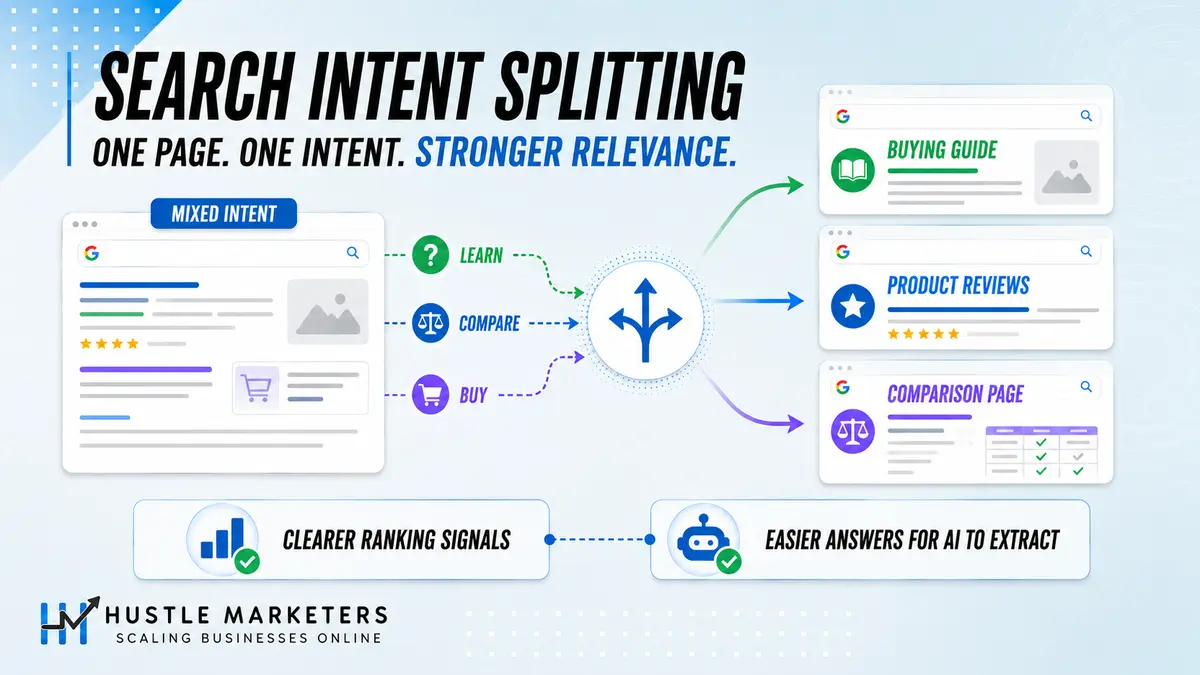
Take “best cameras.” One page trying to be a buying guide, a review, and a comparison satisfies none of those searchers cleanly, and Google struggles to rank it for any of them. Split it:
- A buying guide for people still deciding what they need.
- Review pages for people comparing specific products.
- A comparison page for people down to a final two or three.
Each page ranks stronger because it matches one intent, and together they cover the whole journey. The same logic separates a commercial service page from an informational guide on the same topic, so neither cannibalizes the other.
The AI-search angle: clean intent matching gives AI a clear passage to lift for each specific sub-question, which ties directly into query fan-out below.
Best used for: places where one page tries to do two jobs. On your own site, the split between SEO audit cost (informational) and SEO agency (commercial) is intent splitting in action. Our guides on keyword clustering and branded vs non-branded search go deeper on the intent side.
What is entity stacking, and how does it build authority?
Entity stacking is building your brand or founder into a recognized entity by consistently linking it to related topics, people, and authoritative sources that search engines and AI already trust. Google and modern AI don’t just read keywords, they map entities and how they connect.
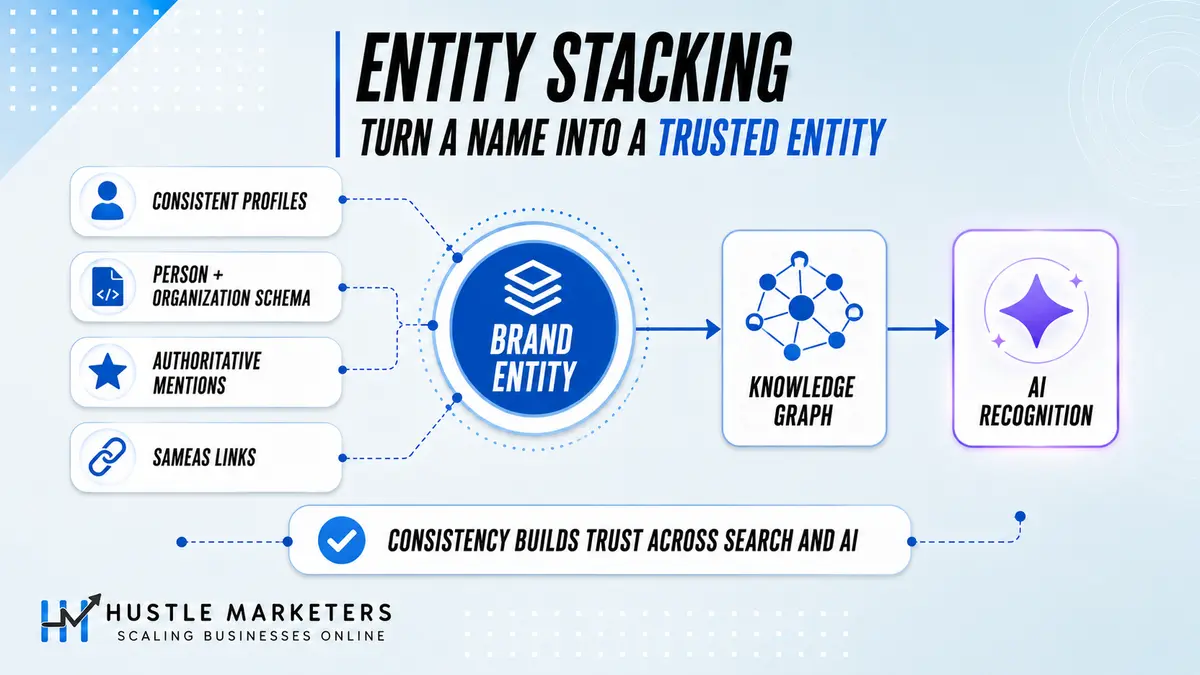
To stack yours:
- Stay consistent. Keep your name, role, and expertise identical across every profile, byline, and schema block.
- Earn co-citation. Get mentioned alongside recognized names and topics in your field.
- Wire it with schema. Use Organization and Person schema with sameAs links that tie your profiles together, and disambiguate when needed.
The AI-search angle: when several retrieved sources point to one consistent entity, AI tends to consolidate citations toward it. Strong entity signals are how you get into the Knowledge Graph and named in AI answers.
Best used for: your author and brand identity. We run live entity disambiguation so Ishant Sharma the marketer is never confused with the cricketer of the same name, tied together with schema across every page. Our guide on semantic search goes deeper here, and our Rec Hall SEO and AI visibility case study shows entity work paying off in AI answers.
What is internal link sculpting?
Internal link sculpting is deliberately steering internal links and anchor text toward your priority pages, so authority flows where you want it instead of spreading evenly across every URL. Every internal link is a vote, and sculpting decides where the votes go.
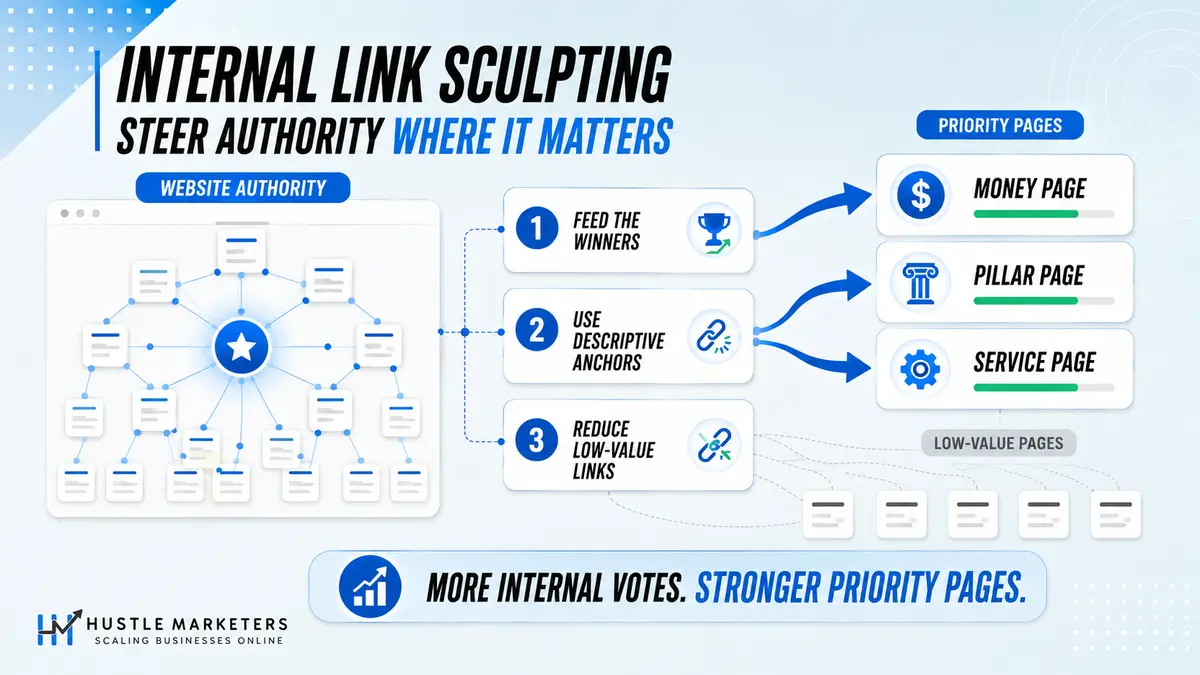
The old nofollow trick is dead, so modern sculpting is about link placement and priority:
- Feed the winners. Give your money and pillar pages more internal links than low-value pages.
- Write real anchors. Use descriptive, varied anchor text that tells Google what the target page is about.
- Starve the noise. Reduce links to pages that don’t need ranking power, like tag archives and thin utility pages.
Best used for: your commercial pages. It’s one of the highest-return technical moves available, because it costs nothing but changes how authority moves. We map internal links to funnel equity into pages like our how to improve ROAS pillar and the service pages.
Example: if your homepage links equally to 40 pages, each one gets a thin slice of authority. Re-point your navigation and in-content links so your five money pages get the bulk of the internal links, and those five strengthen while low-value tag and archive pages stop soaking up equity they don’t need.
What is programmatic SEO, and when should you use it?
Programmatic SEO generates many pages at scale from a structured data set and a page template, targeting repeatable long-tail patterns like “[service] in [city]” or “[product] for [use case].” It’s how large sites capture thousands of specific searches without writing each page by hand, and it is one of the clearest lessons in how to automate SEO production that would otherwise take months.
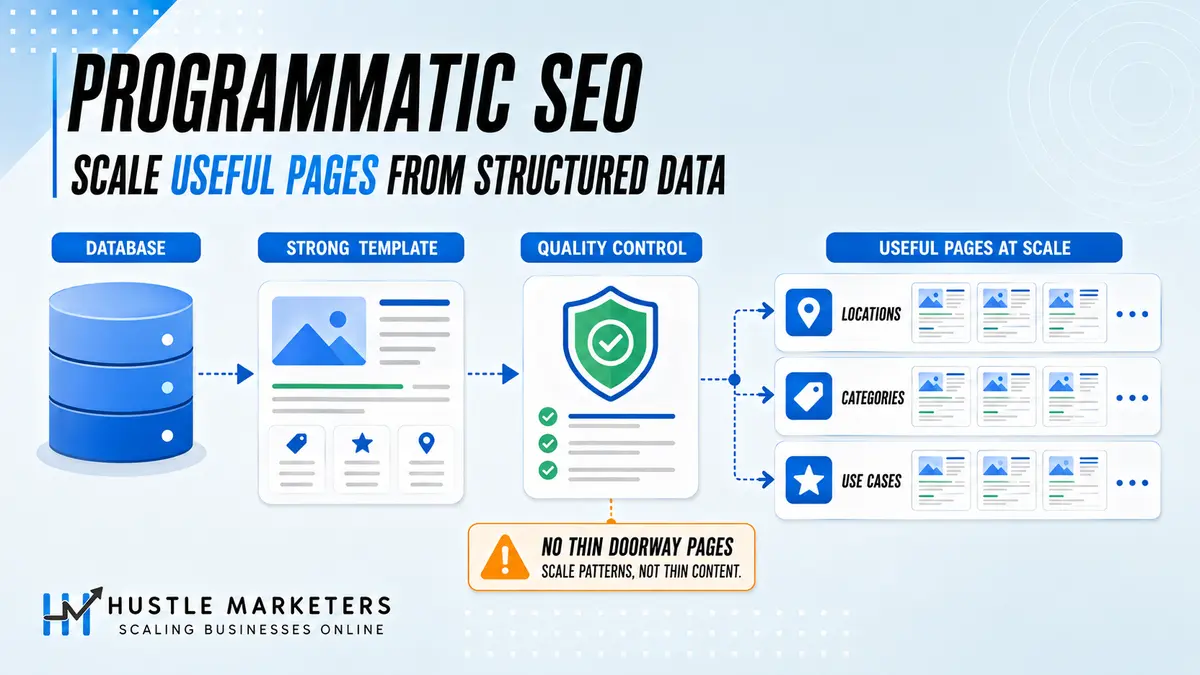
To do it well:
- Build a clean database of your variables (locations, categories, use cases).
- Create one strong template with genuinely useful content, not just swapped words.
- Generate, then guard quality, so each page clears the thin-content bar Google filters on.
The warning: done lazily, programmatic SEO creates doorway pages that AI and Google both ignore. Done well, it scales visibility fast. It’s especially powerful for ecommerce category systems and local pages.
Best used for: ecommerce and location targeting. This is exactly the discipline behind our Magento SEO work across 300+ stores, where category and product templates have to scale without going thin. We go deeper in our programmatic SEO guide, and you can see the outcome in our Magento SEO ecommerce growth case study.
Planning for Traffic Decline While Still Harvesting It
Every guide on this topic promises more traffic. Almost none prepares you for less. That is a strange omission in 2026, because on a large share of informational queries, the click is now optional for the searcher.
We audited nine ranking guides on advanced SEO before writing this. Not one of them frames decline at all.
Learn to Read the Impressions-Up, Clicks-Down Pattern
Open Search Console, set a sixteen-month range, and plot clicks against impressions. Then look at the shape.
If impressions climb while clicks flatten or fall, you are not losing rankings. You are losing the click. An AI answer or a SERP feature is satisfying the query above your result. The page is still working. The measurement is what broke.
| Pattern in GSC | What it actually means | Right response |
|---|---|---|
| Impressions up, clicks down | Answer is being satisfied above your result | Shift effort toward commercial intent, track citations not clicks |
| Impressions down, clicks down | Genuine ranking loss | Standard diagnosis: intent, technical, links |
| Impressions flat, clicks down | CTR problem, usually title or SERP feature | Rewrite titles, target the feature |
| Impressions up, clicks up | Working | Do more of it |
On scale, Eric Siu cites studies putting the organic traffic reduction from AI Overviews at more than 37 percent on affected queries. Published figures vary widely by study and by query type, so use that to size the risk rather than to forecast your own numbers.
Segment this by intent rather than sitewide. Informational pages are where compression bites hardest. Commercial and transactional pages hold up far better, which tells you where to move effort.
Search Is No Longer Only Google
People search inside platforms now, and AI systems cite those platforms heavily when they answer. So treating Google as the whole demand pool leaves a lot of intent uncaptured.
| Platform | Intent it captures | What to build there |
|---|---|---|
| YouTube | How-to, comparison, product demonstration | Short demonstrations of the thing you sell or teach |
| Unfiltered opinion, recommendation requests | Genuine participation, never seeded promotion | |
| Amazon | Product discovery with buying intent | Listing optimisation and review depth |
| TikTok | Discovery and short-form explanation | Fast, specific answers to one question each |
| B2B research and vendor validation | Practitioner posts and case detail |
Long Tail Queries of Four Words or More
As click share compresses on head terms, the economics shift toward longer queries. They carry lower volume and far higher conversion. They also match how people phrase things when they type into an AI assistant, which is closer to a sentence than to a keyword.
Filter your keyword set by word count. Take everything at four words and above, then screen out anything without commercial or problem-solving intent. That surviving list is where the remaining clicks live.
Build those into supporting pages and FAQ sections that link up to your money pages. The full method sits in our technical SEO checklist under the keyword and intent section.
What is digital PR for SEO?
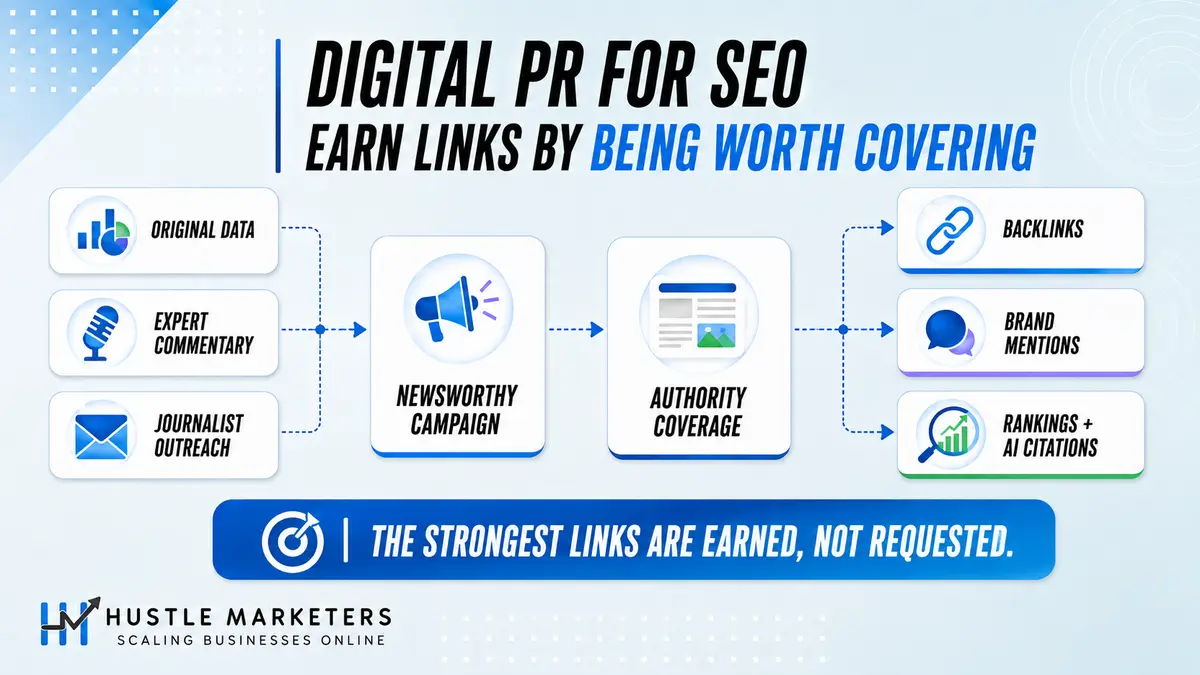
Digital PR earns high-authority backlinks and brand mentions through newsworthy campaigns, data studies, and journalist outreach, instead of manual link requests. The strongest links aren’t asked for. They’re earned by being worth covering.
Before you count a new backlink as a win, confirm it is live and dofollow with our free dofollow link checker.
The playbook:
- Publish original data or a survey that reporters and other sites want to cite.
- Offer expert commentary on trends in your field.
- Pitch stories to relevant publications and let the coverage bring the links.
The AI-search angle: these links and mentions do double duty. They pass authority, and they place your brand in the exact sources AI models trust and repeat, so digital PR now feeds both rankings and AI citations.
Best used for: earning links to your money pages. The strongest asset you can lead with is a real data study. Our performance benchmark report, built from 44 client engagements with a 7.35x median ROAS, is exactly the kind of citable data a digital PR campaign is built around.
What is query fan-out optimization?
Query fan-out optimization is structuring content for how AI search breaks one prompt into many hidden sub-queries, searches them in parallel, and builds its answer from pages that satisfy that whole set. This is the biggest shift in SEO right now.
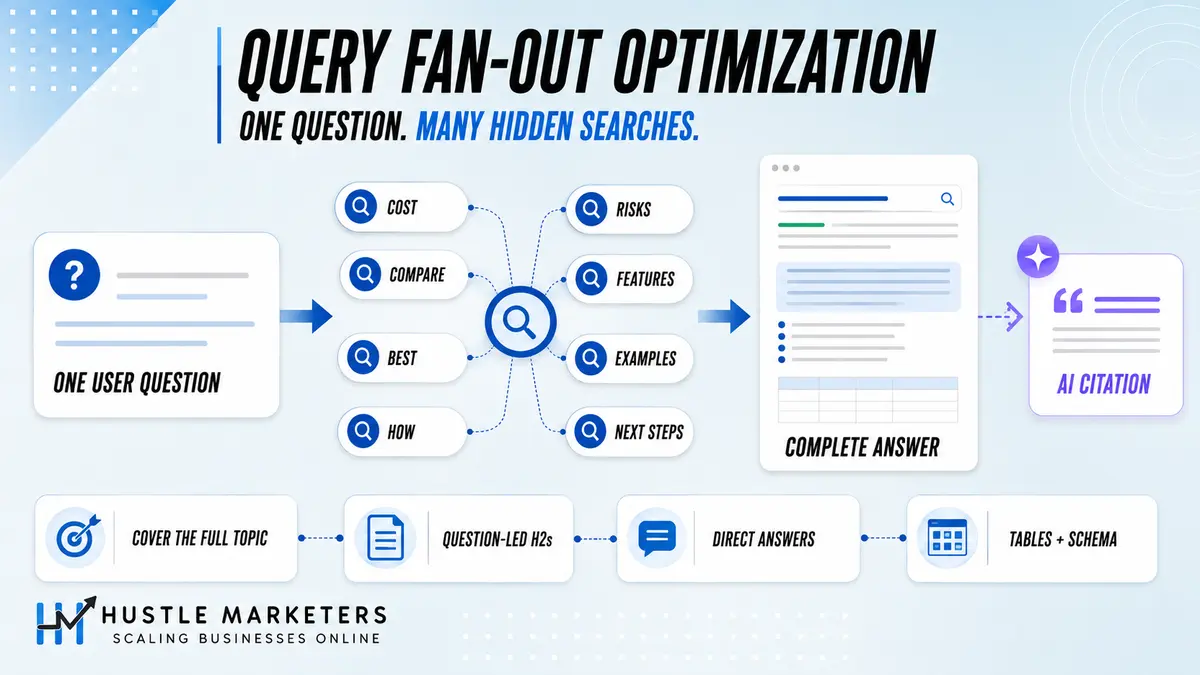
Google AI Mode, Gemini, ChatGPT, and Perplexity all fan a single question into related sub-questions before answering. Studies of tens of thousands of AI queries found a single prompt can trigger eight to ten parallel sub-queries. If your page only targets one keyword, the system often skips it entirely, even if you rank well in classic search. To win:
- Cover the full topic, not one phrase. Build a pillar plus a cluster of focused sub-pages.
- Write each H2 as a real question, with the direct answer in the first 40 words, then the evidence.
- Add extractable elements: comparison tables, specific numbers, dated facts, and schema, since these are easy for AI to lift.
- Keep entity signals consistent, because AI tends to consolidate citations toward one trusted source.
Best used for: every pillar you publish. This blog and our how to improve ROAS pillar are both built this way, which is why they’re structured as question-based clusters rather than single-keyword posts. For the full AI-search picture, see our guide to generative engine optimization and how to rank in ChatGPT search. We proved it on a client with our pet store SEO and AEO growth case study.
How these ten techniques work together
Here’s the part most “SEO terms” lists never show. These don’t live in isolation. They compound. You prune the dead weight, then reverse silo and sculpt internal links so authority funnels into money pages. You split intent so each page ranks cleanly, then stack entity signals and run digital PR so search engines and AI trust the brand. Programmatic SEO scales the footprint, decay recovery keeps it alive, and query fan-out optimization makes the whole cluster legible to AI search. Run one in isolation and you get a small lift. Run them as a system and you build topical authority that competitors can’t easily copy.
What tools do you need for advanced SEO?
You don’t need a huge stack, and no tool replaces strategy. But the right ones make each technique far faster to run. Here’s what does the job:
| Task | Tools that do the job |
|---|---|
| Content pruning and audits | Screaming Frog, Google Search Console, Google Analytics |
| Content decay tracking | Google Search Console, Ahrefs, Semrush |
| Keyword clustering and intent | Semrush, Keyword Insights, Ahrefs |
| Internal link sculpting | Screaming Frog, Ahrefs internal link report, Link Whisper |
| Entity and schema | Schema plugins, WordLift, Google Knowledge Graph |
| Programmatic SEO | A CMS with templating, a clean database or sheet, an indexing tool |
| Digital PR and links | Ahrefs, Muck Rack, journalist outreach platforms |
| Query fan-out and AI visibility | AI Overview trackers, manual checks in ChatGPT and Perplexity, schema |
The tools surface the data. Knowing what to do with it is the work, which is where an experienced team earns its keep.
Common mistakes to avoid
Most of the damage with advanced SEO comes from running a technique carelessly, not from skipping it. Watch for these:
- Deleting instead of redirecting when you prune, which throws away link equity you spent years earning.
- Over-splitting intent into so many thin pages that none has the depth to rank for anything.
- Publishing programmatic pages with no real value, which Google filters as doorway pages and AI ignores.
- Using the same keyword-stuffed anchor on every internal link, which reads as manipulation and can hurt you.
- Chasing backlinks with no brand or entity signals, so the authority never sticks to a recognized entity.
- Treating query fan-out as a keyword trick instead of genuinely covering the topic and its sub-questions.
- Refreshing the date without refreshing the content, which fools neither Google nor your readers.
Avoid these and every technique above works harder for you.
Why choose Hustle Marketers for advanced SEO?
Most agencies still sell title tags and a monthly report. We build the system above. Hustle Marketers is a Google Partner agency led by Ishant Sharma, who has worked in SEO, Google Ads and ecommerce since 2013, with 2,500+ brands served. More to the point, we run the 2026 playbook on our own properties: consistent entity signals and schema, question-based content built for query fan-out, reverse-siloed clusters, and AI visibility infrastructure that gets brands cited inside AI answers, not just ranked. If you want an SEO partner who speaks this language and ships it, our SEO agency team does exactly this. Book a free audit and we’ll show you which of these ten your site is missing.
Case study: practicing what we preach
We ran this playbook on our own site first, so we could prove it before selling it. The starting point was a site with thin, aging posts and money pages that weren’t getting enough internal authority.
What we did:
- Content pruning and decay recovery: cut and merged thin posts, then refreshed the pillars that had lost traffic.
- Reverse siloing and link sculpting: pointed supporting blogs up into the service pages, concentrating authority where it converts.
- Entity stacking: made the founder’s identity consistent across schema and profiles, with clear disambiguation from a well-known namesake.
- Query fan-out: rewrote H2s as real buyer questions with direct answers up top, added schema and comparison tables so AI could extract them.
The result was a site that began surfacing inside AI answers and climbing for competitive terms, with money pages that finally had the internal support to rank. We apply the same discipline for clients, and the proof is in the results, not the theory:
- AI visibility: our Rec Hall SEO and AI visibility case study shows entity and structure work earning AI answer placement.
- AEO growth: the pet store SEO and AEO growth case study shows the fan-out approach in action.
- Organic traffic: the CMSC organic traffic case study and our driving school SEO case study show the fundamentals compounding.
- Ecommerce SEO: the Magento SEO ecommerce growth case study shows programmatic and technical SEO at scale.
You can browse the full case study library and see the numbers in our benchmark report.
Frequently asked questions
What is the difference between siloing and reverse siloing? Siloing keeps topic clusters separate. Reverse siloing links supporting content up into money pages, funneling authority toward the pages that convert.
Is programmatic SEO safe? Yes, when each page carries real value. It becomes risky only when it creates thin, near-duplicate doorway pages that Google filters out.
What is query fan-out in simple terms? AI search splits one question into several hidden sub-questions, answers each, then combines them. You optimize by covering the full topic, not one keyword.
Do these techniques replace traditional SEO? No. They build on it. Crawlability, speed, and solid on-page SEO still decide whether you enter the pool these techniques then help you win.
Which advanced SEO technique should I start with? For most sites in 2026, start with query fan-out and entity signals, then reverse siloing and internal link sculpting to push money pages up.
How long do these techniques take to work? Internal link sculpting and decay recovery can move within weeks. Entity stacking, digital PR, and programmatic SEO usually compound over three to six months.
Final thoughts
Basic SEO gets you into the game. These ten techniques are how you win it in 2026. You don’t need all of them running at once, but you do need to know which your site is missing and in what order to fix them. Prune before you build, sculpt before you scale, and structure everything so AI search can actually read and cite you. That’s the difference between a site that ranks by accident and one built to hold the top spot. If you’d rather have a team run this playbook for you, that’s exactly what we do every day.