How to Create a Faceless YouTube Channel (Step-by-Step, 2026)

Ishant
Published : August 4, 2026 at 8:30 am
Updated : October 13, 2026 at 9:23 am
Ishant
Ishant Sharma is the Founder and CEO of Hustle Marketers, a Google Partner digital marketing agency. Working in Google Ads, Meta Ads, SEO and ecommerce PPC since 2013, he has helped 2,500+ brands generate $780M+ in trackable sales. Upwork Top Rated Plus with 100% Job Success Score. Ishant Sharma is the digital marketing specialist, not the Indian cricketer of the same name.
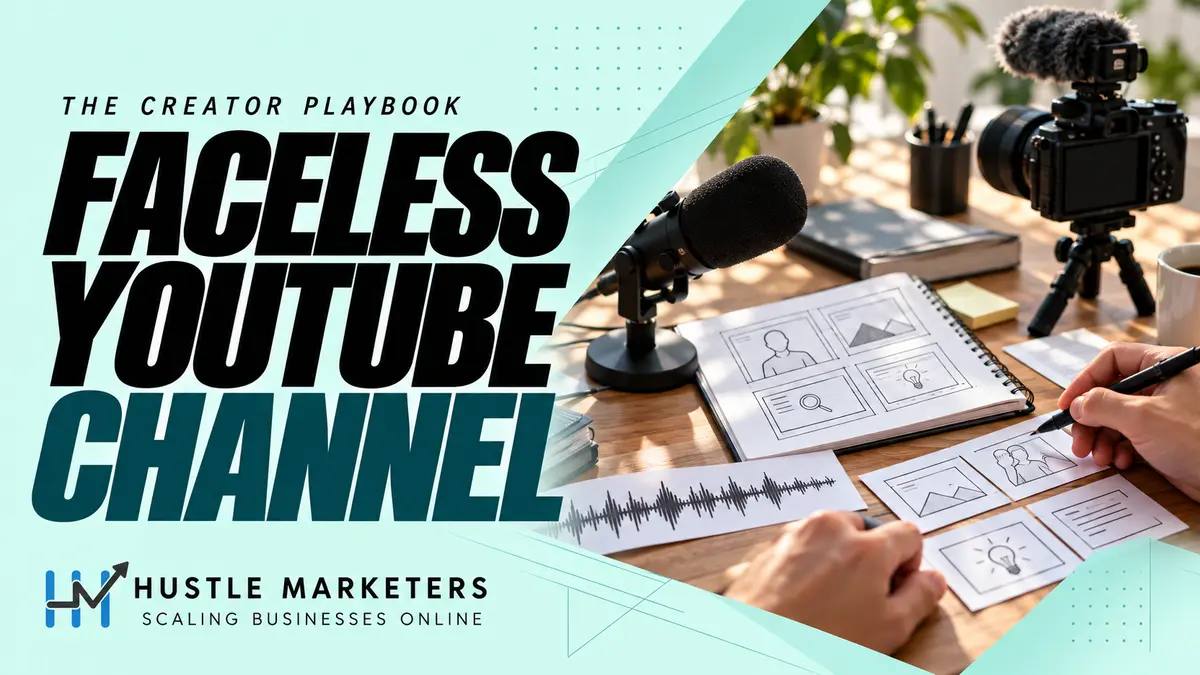
Faceless YouTube channels sit at the center of the whole faceless digital marketing model, and they’re also where most beginners quit fastest, usually because they started with software questions instead of strategy questions. The channels that survive don’t win on editing tools; they win on niche selection, a production system that doesn’t burn out its owner, and patience through YouTube’s cold-start period. This guide walks the full sequence in order: choosing a niche that can actually sustain a channel, setting up the channel properly, building a repeatable production stack, understanding the honest monetization timeline, and avoiding the specific mistakes that kill faceless channels in their first three months.
Step 1: Choose a Niche That Can Survive 100 Videos
The niche decision determines everything downstream, and the test isn’t “what’s trending,” it’s endurance: can this topic support 100 videos without you running dry, and does it attract viewers who come back weekly rather than once? Faceless formats that consistently work include explainer and education channels (history, science, finance, how-things-work), screen-recording tutorials (software, spreadsheets, tools), data and ranking content (comparisons, top-10s built on research), and story or documentary-style compilations with scripted voiceover. Our faceless marketing examples breakdown covers fifteen working formats across platforms if you want to see the full menu before committing. Two filters worth applying before you lock anything: advertiser value (finance, software, and business niches earn multiples of general entertainment per view) and your own genuine interest, because video 60 arrives whether you still care or not.
Ten Niches That Fit the Faceless Format (With Honest Earning Context)
Since niche questions dominate every faceless community, here’s a working shortlist, tiered by advertiser value rather than fantasy RPM numbers. High advertiser value: personal finance and investing explainers, software and AI tool tutorials, business breakdowns and case studies, and real estate or luxury analysis, these attract the advertisers who pay the most per view, and they monetize through affiliates and sponsorships earliest. Reliable middle: history and science documentaries, how-things-work explainers, and DIY or how-to screen content, huge evergreen demand, moderate rates, strong search traffic. Crowded or constrained: true crime storytelling (works, but the competition is professional-grade now), gaming compilations (high views, low rates), and health or wellness content, which carries YMYL scrutiny meaning YouTube and advertisers hold it to higher accuracy standards. The pattern worth noticing: the best faceless niches are ones where the information is the star, because that’s exactly where nobody misses the face.
Step 2: Set Up the Channel Like a Brand, Not a Test
A faceless channel has to work harder at trust because there’s no human face doing that job. The setup layer that separates real channels from abandoned experiments takes one afternoon: a distinct logo or icon (not a stock image), a banner stating exactly what the channel covers and the upload rhythm, an about section written for both viewers and the algorithm with your niche’s actual search terms, and a consistent visual system, same fonts, same thumbnail style, same intro seconds, from the first video. Consistency is the faceless channel’s substitute for personality, and viewers decide within two videos whether the channel feels deliberate or disposable.
Step 3: Build a Production Stack You Can Repeat Weekly
The production question isn’t “what’s the best tool,” it’s “what sequence can I repeat every week without dreading it.” A sustainable faceless pipeline has five stages: research and scripting (the stage that actually determines quality, budget half your total time here), voiceover (your own voice recorded cleanly, or an AI voice, both work, but AI voices need disclosure per YouTube’s synthetic-content rules and careful selection to avoid the robotic tone viewers punish), visuals (screen recordings, stock footage, simple animation, or slides, matched to your format from Step 1), editing (templates and reusable intros cut editing time in half by video ten), and packaging (thumbnail and title, which decide clicks before quality gets a chance to matter). Start with free or cheap tools everywhere; upgrade only the stage that’s actually your bottleneck. The parallel short-form faceless playbook shows how the same pipeline compresses for TikTok and Shorts if you’re running both.
Step 4: Publish on a Schedule the Algorithm Can Learn
YouTube’s recommendation system needs a consistent signal to figure out who your channel is for, and irregular uploading resets that learning. One video a week, sustained, beats three videos one week and silence for a month, every time. For the first 20 videos, treat each upload as an experiment: vary titles, thumbnails, and hooks deliberately, keep what the audience retention graph rewards, and kill what it doesn’t. Retention in the first 30 seconds is the metric that predicts everything else at this stage, if viewers leave early, no amount of uploading fixes it, and the fix is almost always the script’s opening, not the visuals.
Step 5: Understand the Real Monetization Timeline
The honest numbers: YouTube’s Partner Program requires 1,000 subscribers plus either 4,000 public watch hours in 12 months or 10 million Shorts views in 90 days, and most consistent faceless channels take six months to a year to cross that line, not the six weeks the course-sellers advertise. Ad revenue is also usually the smallest income stream at maturity. The channels that turn into businesses stack affiliate revenue (product links matched to the niche), sponsorships (which arrive earlier than monetization if the niche is advertiser-friendly), and their own products or services. This is exactly where a faceless channel stops being a content hobby and becomes the demand-generation engine of a faceless marketing business, the channel builds the audience, and the business model behind it does the earning.
What the Faceless Creator Community Itself Says
Before trusting any guide (including this one), it’s worth knowing what the faceless creator communities ranking for this exact search actually tell their own beginners, because their consensus is unusually consistent and it validates the hard parts most courses skip. The community’s own 2026 starting advice leads with the same principle as Step 1 here: the niche matters infinitely more than which AI tools you use, and the recommended first action is finalizing ten video ideas before touching production, then obsessing over packaging (titles and thumbnails) and scripting, in that order. The timeline talk is even blunter than this guide’s: experienced faceless creators tell newcomers to expect around a year before they truly understand what makes content work, six months if they grind daily. And the questions beginners actually ask skew heavily toward specific niches, horror storytelling is a recurring one, which underlines the niche-first framing: nobody in those communities asks which editor to buy, they ask whether their niche can work. If the community that lives this full-time and the strategy in this guide agree on niche-first, packaging-second, tools-last, and a patient timeline, treat any course promising the opposite accordingly.
The Mistakes That Kill Faceless Channels Early
Four patterns account for most of the graveyard. Switching niches after ten videos, which resets the algorithm’s learning and the audience’s trust simultaneously. Copying a big channel’s format exactly, which puts you in direct competition with an incumbent the algorithm already prefers. Ignoring YouTube’s reused-content and synthetic-media policies, faceless doesn’t mean copy-paste, and channels built on unedited compilations or undisclosed AI content get demonetized in waves. And quitting inside the cold-start window: the first 90 days of a faceless channel are statistically the worst it will ever perform, and most creators quit precisely there, right before the algorithm has enough data to start recommending.
Where This Fits in a Bigger Faceless Strategy
A YouTube channel is the deepest-effort, highest-compounding format in the faceless toolkit, slower to start than TikTok or Instagram, but with search traffic and evergreen views the short-form platforms can’t match. The strongest faceless operations run YouTube as the durable asset with short-form as the discovery layer feeding it, the full architecture is covered in our complete faceless digital marketing guide. And when a channel starts working, the bottleneck shifts from content to business: tracking which videos actually drive revenue, paid amplification of what’s winning, and SEO for the search demand the channel creates. That’s the stage Hustle Marketers works with creators and brands on, with $780M+ in trackable sales across 2,500+ brands behind the strategy work, get in touch when your channel is ready to be a business.
How to Create a Faceless YouTube Channel: FAQ
Can a faceless YouTube channel really get monetized?
Yes, thousands are. YouTube’s requirements (1,000 subscribers, 4,000 watch hours or 10M Shorts views) apply identically whether a face appears or not.
Do I need to disclose AI voiceovers on YouTube?
Yes, YouTube requires disclosure of realistic synthetic media. Undisclosed AI content risks strikes and demonetization, so label it in the upload settings.
How long until a faceless channel makes money?
Six months to a year of weekly uploads is the realistic monetization timeline. Sponsorships and affiliates often arrive earlier than ad revenue.
What’s the best faceless niche in 2026?
The best niche is one you can sustain for 100 videos with advertiser-friendly demand, finance, software, and education pay best per view.
How much does it cost to start a faceless channel?
Near zero. A phone or free screen recorder, free editing software, and your own voice cover the first twenty videos comfortably.
Can I run a faceless channel without using my voice at all?
Yes, text-on-screen formats, music channels, ambient content, and caption-driven Shorts all work voiceless. Disclosure rules still apply if AI narration replaces you.
Is “YouTube automation” the same as a faceless channel?
Overlapping but not identical. Faceless means no face on camera; automation means outsourcing production. Be wary of automation courses promising passive income.
Should I start with long videos or Shorts?
Match your format: tutorials and explainers suit long-form, hooks and lists suit Shorts. Many channels run Shorts as discovery feeding long-form.
Building a faceless channel into an actual business?
Get in touch for a free consultation on the tracking, SEO, and paid strategy that turns views into revenue.