SEO vs PPC: Costs, Click Data and How to Choose the Right Mix

Ishant
Published : September 21, 2026 at 5:30 pm
Updated : October 13, 2026 at 5:14 am
Ishant
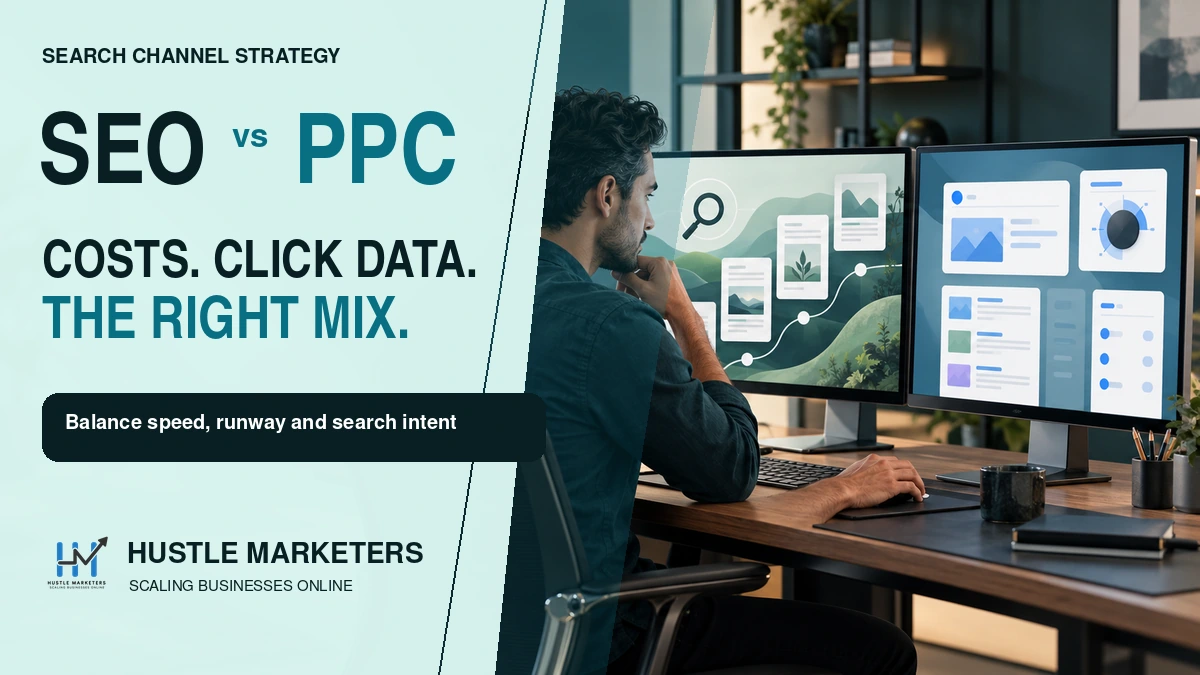
SEO vs PPC comes down to timing and how you pay. PPC (pay-per-click advertising) buys a place at the top of search results today and stops the moment you stop paying. SEO (search engine optimization) earns organic rankings slowly, but that traffic keeps arriving without a fee per click. Most businesses need both, weighted by urgency and budget.
What changed in 2025 and 2026 is the results page itself. AI Overviews and AI Mode answer many queries before anyone clicks, Google now places ads inside those answers, and click-through rates for both channels have shifted. Every third-party statistic below is attributed to a named, dated source.
This guide is for business owners and marketing leads deciding where the next dollar goes. If you run an agency and want to know which service to resell first, read white label SEO vs PPC for agencies instead.
Key takeaways
- PPC delivers clicks within days. SEO takes months: Ahrefs found only 1.74% of new pages reach Google’s top 10 within a year.
- AI Overviews cut clicks for both channels. Seer Interactive saw paid CTR on AI Overview queries fall from 19.70% to 6.34% (June 2024 to September 2025).
- Being cited in an AI Overview is linked to more clicks: cited brands averaged 2.07% organic CTR versus 0.94% for brands not cited (Seer, 2026).
- WordStream’s 2026 search ad benchmarks put average CPC at $5.42, from $1.63 in arts and entertainment to $9.87 in legal.
- Brand bidding pays mainly when competitors bid on your name.
- Start with a stage-based budget split, then move money to the channel with the lower cost per incremental conversion.
What is the difference between SEO and PPC?
The difference between SEO and PPC is how you pay for search visibility. SEO earns unpaid organic rankings through content, technical work and authority, so costs come first and results compound later. PPC buys ad placements in an auction and charges per click, so results start fast and stop when spending stops. Both reach the same searchers.
What is SEO?
Search engine optimization makes your pages the best answer to a query, so Google and Bing rank them in unpaid results and cite them in AI Overviews and AI Mode. You pay for people, content, technical fixes and links, not for each visitor. Here is what an SEO company does with that budget, month by month.
What is PPC?
Pay-per-click advertising, or paid search, means bidding in Google Ads or Microsoft Advertising to show ads on relevant searches. On search campaigns you usually pay only when someone clicks, and Ad Rank weighs your bid alongside ad and landing page quality, so a more relevant ad can beat a bigger bid.
Where does SEM fit in?
Search engine marketing (SEM) is the umbrella term. Some people use it to mean paid search only; others, including this guide, use it to cover both SEO and PPC.
How is ranking different when comparing PPC vs SEO?
Paid positions are bought: every search runs an auction, and Ad Rank weighs your bid alongside ad and landing page quality, so a more relevant ad can beat a bigger bid. Organic rankings are earned through content, technical work and authority, often against pages that have held their positions for years, and Google Ads Help states that paid search investment has no impact on them. Ads appear at the top and bottom of results and in and around AI Overviews, while organic pages appear in listings, the local pack, snippets and AI citations. Paid traffic stops the same day spending stops, while rankings fade gradually.
SEO vs PPC side-by-side comparison table
| Factor | SEO | PPC |
|---|---|---|
| Cost model | Salaries or retainer; no fee per click | Auction cost per click, plus management |
| Speed to results | Months | Days after approval |
| When you stop | Rankings fade gradually | Traffic stops the same day |
| Control over message | Low: Google can rewrite snippets and AI summarizes you | High: you choose copy, landing page, schedule and locations |
| Targeting | Topic and search intent | Keywords, location, device, audiences, customer lists |
| Where you appear | Organic listings, local pack, snippets, AI citations | Top and bottom of results, Shopping, in and around AI Overviews |
| Measurement | Search Console and GA4; AI clicks not separated | Click-level conversions; AI Overview ads not segmented |
| Main risk | Algorithm updates and AI answers absorbing clicks | Rising CPCs and competitor bids |
| Best suited to | Long-term demand, research and comparison queries | Urgent demand, launches, transactional queries |
SEO vs PPC: which is better?
Neither SEO nor PPC is better in general. PPC is better when you need leads within weeks, sell into transactional searches or want to test an offer quickly. SEO is better when you have 6 to 12 months of runway, buyers research before purchasing, or click prices eat your margins. Most growing businesses run both in different proportions.
What are the pros and cons of SEO?
- Pro: no cost per click, so cost per visit falls as rankings grow.
- Pro: results compound and earn citations in AI answers.
- Con: slow and uncertain, especially for new domains.
- Con: exposed to algorithm updates and AI Overviews, and harder to attribute.
What are the pros and cons of PPC?
- Pro: traffic within days, with precise control over copy, budget and targeting.
- Pro: fast feedback for testing offers and messages.
- Con: traffic stops when spend stops, so nothing compounds.
- Con: CPCs rise with competition, and waste grows without tight management and tracking.
So the useful PPC vs SEO question is not which one wins, but which comes first and how much of each. The rest of this guide answers it.
Do organic results or ads get more clicks in 2026?
Organic listings still win the largest share of clicks in the categories studied, but paid click share is rising on commercial searches and fewer searches send any click at all. SparkToro found 68.01% of US Google searches ended without a click in early 2026, and Similarweb data showed text ads gaining click share sharply in four consumer categories.
How many Google searches end without a click?
In SparkToro’s June 2026 study of Similarweb clickstream data (January to April 2026), 68.01% of US Google searches ended with zero clicks, and only 0.34% reached AI Mode. The 2024 edition used Datos panel data instead, so the two are not a clean trend line.
Is paid click share rising on commercial searches?
Yes, in the four consumer categories measured. Aleyda Solis analyzed Similarweb data for the top 5,000 US queries per vertical (956 for greeting cards), published February 2026.
| Category | Text ad share, Jan 2025 | Text ad share, Jan 2026 | Organic share, Jan 2025 | Organic share, Jan 2026 |
|---|---|---|---|---|
| Headphones | 3% | 16% | 73% | 50% |
| Jeans | 7% | 16% | 73% | 56% |
| Online games | 3% | 13% | 95% | 84% |
| Greeting cards | 9% | 16% | 88% | 75% |
Classic organic still has the largest share in all four categories, but on these queries Google is sending more clicks to ads and fewer to classic listings. That is also why the undated “75% organic, 25% paid” split repeated in stats roundups is a poor guide to commercial results pages today.
How have AI Overviews and AI Mode changed organic clicks?
AI Overviews reduce organic clicks, but the size of the drop depends on the query. Pew found users clicked a traditional result on 8% of visits with an AI summary versus 15% without one. Ahrefs linked AI Overviews to a 58% lower position-one CTR. Branded queries, and brands cited inside the AI Overview, hold up better.
What did Pew, Ahrefs and Seer find?
Pew Research Center tracked 68,879 searches by 900 US adults in March 2025. Only 1% of visits with an AI summary included a click on a link inside it, and sessions ended on 26% of those pages versus 16% without a summary.
Ahrefs’ February 2026 study of 300,000 keywords linked AI Overviews to a 58% lower position-one CTR (December 2023 vs December 2025; desktop position-one CTR was 0.016 on AI Overview keywords vs 0.039 on informational keywords without one), up from 34.5% in its April 2025 study. Seer Interactive’s November 2025 update saw organic CTR on AI Overview queries fall from 1.76% to 0.61% between June 2024 and September 2025, while queries without one also fell, from 2.74% to 1.62%.
Do branded searches lose clicks too?
Much less. Amsive’s study of 700,000 keywords found CTR fell 19.98% for non-branded keywords with AI Overviews, while branded keywords that triggered one saw CTR rise 18.68%, although only 4.79% of branded keywords did. Keywords ranking outside the top 3 saw CTR fall 27.04%. In this data, brand demand is the best-protected part of organic search.
Does being cited in an AI Overview increase clicks?
Cited brands get more clicks in Seer’s data, although that shows correlation rather than proof of cause. Seer’s April 2026 update put 2025 informational CTR at 2.07% for cited brands, 0.94% for brands not cited and 3.35% with no AI Overview. Our guide to AI citations vs mentions explains the difference, and our AI SEO services focus on earning those citations.
Are organic clicks recovering in 2026?
There are early signs. The same Seer update (53 brands, 5.47 million queries) found organic CTR on AI Overview pages rose from 1.31% in December 2025 to 2.36% in February 2026. Caveats: it is a regression model, and each query’s latest AI Overview status is applied backward. AI Overviews appeared on 95.4% of comparison queries but only 5% of transactional queries.
Google disputes the decline. In an August 2025 post, Liz Reid, VP and Head of Google Search, said total organic click volume was relatively stable year over year, without publishing data. Meanwhile, AI Mode passed 1 billion monthly active users, per Alphabet’s Q2 2026 earnings remarks.
| Study | Published | Sample | Key organic finding |
|---|---|---|---|
| Pew Research Center | Jul 2025 | 900 US adults, 68,879 searches | 8% clicked with an AI summary vs 15% without |
| Amsive | Apr 2025 | 700,000 keywords | Non-branded CTR down 19.98%; branded up 18.68% |
| Seer Interactive | Nov 2025 | 3,119 queries, 42 organizations | CTR with AI Overview fell from 1.76% to 0.61% |
| Ahrefs | Feb 2026 | 300,000 keywords | Position-one CTR 58% lower |
| Seer Interactive | Apr 2026 | 53 brands, 5.47M queries | CTR rose from 1.31% to 2.36% (Dec 2025 to Feb 2026) |
| Google (first-party) | Aug 2025 | No data published | Total organic click volume “relatively stable” |
How have AI Overviews and AI Mode changed paid search ads?
Paid search now appears inside AI answers, and paid CTR has fallen on queries that show AI Overviews. Seer measured paid CTR on those queries dropping from 19.70% to 6.34%. Google can place Search, Shopping and Performance Max ads above, below or inside AI Overviews, and advertisers cannot opt out or see those placements reported separately.
Can ads show inside AI Overviews?
Yes. Google Ads Help says text and Shopping ads from Search, Shopping and Performance Max campaigns can show above, below or within AI Overviews. You cannot target or opt out of the placement, and the ads are reported as top ads with no separate segment. As of September 2026, ads within AI Overviews run in English in the US and 11 other markets, including Australia, Canada and India.
What happened to paid CTR on AI Overview queries?
In Seer’s November 2025 update, paid CTR fell from 19.70% to 6.34% on queries with an AI Overview and from 19.1% to 13.04% without one (June 2024 to September 2025). Brands also cited in the AI Overview saw 7.89% paid CTR versus 4.14% when not cited. The April 2026 update’s 2025 averages pointed the same way: 15.74% paid CTR when cited, 11.19% when not cited and 19.75% with no AI Overview.
So brands cited in the AI answer also saw higher paid CTR on the same queries. That is an association, not proof that citations lift ads, since strong brands may earn both.
Do ads show in Google AI Mode?
They are arriving in stages. At Google Marketing Live in May 2026, Google announced new formats for AI Mode and Search: Conversational Discovery ads and Highlighted Answers (US tests), AI-powered Shopping ads (US, later in 2026), Business Agent for Leads (US open beta) and expanded Direct Offers, as Search Engine Land reported. Google’s announcement says ads in AI Mode are powered by AI Max and Performance Max.
What do AI Max and broad match upgrades change?
Google’s AI Max update (revised 11 June 2026) keeps automatic upgrades for automatically created assets and campaign-level broad match starting in September 2026, and moves the Dynamic Search Ads upgrade to February 2027. Google claims AI Max campaigns using the full feature suite average 7% more conversions or conversion value at similar CPA or ROAS than search term matching alone. Broader matching means ads can show on more queries, including ones your organic pages already win, so we check search terms for that overlap after every match change.
Are Microsoft Advertising and Copilot ads worth considering?
Often, as a second paid channel. StatCounter puts Bing at 8.92% of US search in August 2026, against Google’s 86.1%. Microsoft reports 73% higher CTR for Copilot ads, 16% stronger conversion rates and 33% shorter journeys than traditional search, but those are its own global first-party figures (February to May 2025).
How much does SEO cost compared with PPC?
PPC costs are variable: you pay per click, and WordStream’s 2026 US benchmark CPC is $5.42 across industries, plus management. SEO costs are mostly fixed and front-loaded: people, content, technical fixes and links, with no fee per visit. PPC cost rises with traffic, while SEO cost per visit falls as rankings grow.
How does PPC pricing work?
Every search runs an auction, so CPC depends on competition, bid strategy and ad quality. The WordStream 2026 Google Ads benchmarks (13,474 US search campaigns in Google Ads and Microsoft Ads, April 2025 to March 2026) report 6.64% average CTR, $5.42 CPC, 8.18% conversion rate and $66.69 cost per lead. Average cost per lead fell for the first time in five years.
A quick starting budget: leads needed x CPC / conversion rate. At WordStream’s 2026 averages, 30 leads a month is 30 x ($5.42 / 0.0818), about $1,988 in media spend. Size yours with the Google Ads budget calculator, then add management, which our PPC management pricing guide breaks down.
How does SEO pricing work?
SEO is priced by effort, not results: audits, technical fixes, content, link earning and reporting, in-house or on retainer. Costs vary too widely for one honest average, and the monthly ranges repeated online often cite no source. See what a first-stage investment covers in our SEO audit cost breakdown, and model the payoff with the SEO ROI calculator.
SEO vs PPC cost comparison table
| Cost element | SEO | PPC |
|---|---|---|
| What you pay for | Strategy, content, technical work, links | Clicks, plus management and creative |
| Main cost driver | Topic competitiveness and content needed | Industry CPC and click volume |
| When costs peak | Early, before rankings arrive | Flat or rising while you advertise |
| Cost per visit over time | Falls as traffic compounds | Tied to CPC, which competitors push up |
| What you keep if you stop | Pages and rankings that decay slowly | Data and learnings only |
| Hidden costs | Developer time, content refreshes, AI Overview click loss | Wasted queries, landing pages, tracking setup |
“SEO is free traffic” is misleading. Organic clicks have no media cost, but someone has to research, write, fix and promote the pages months before the payoff.
How long does SEO take vs PPC?
PPC can send traffic the day ads are approved, though campaigns usually need several weeks of data before bidding and targeting settle. SEO usually takes months: Ahrefs found only 1.74% of newly published pages reached Google’s top 10 within a year, and 72.9% of top-10 pages were more than three years old.
Why does SEO take longer than paid advertising to show results?
Ads are bought, but rankings are earned against pages that have often held their positions for years. Ahrefs’ ranking-age study (updated August 2026) found the average number-one page is 5 years old. The bright side: 40.82% of pages that did reach the top 10 got there within a month, so pages that do break through often do it quickly.
SEO vs PPC time-to-results table
Typical ranges we plan around, not guarantees. PPC clicks start fast, but automated bidding needs conversion data before results stabilize.
| Timeframe | PPC | SEO |
|---|---|---|
| Month 1 | Tracking, launch, first leads within days | Audit, technical fixes, content plan |
| Months 2 to 3 | Bidding stabilizes; wasted queries cut | Pages indexed; early long-tail movement |
| Months 4 to 6 | Scale winners; test offers and landing pages | Commercial terms improve on sites with authority |
| Months 6 to 12 | Efficiency gains flatten | Traffic compounds if content and links continue |
| 12+ months | Still fully dependent on spend | Pages keep earning clicks with maintenance |
Which converts better and costs less per customer over time?
Neither channel reliably converts better, because published conversion rates use different definitions and samples, and intent matters more than channel. On cost per customer, PPC stays roughly flat or rises with auction pressure, while SEO starts expensive and falls as rankings compound. SEO wins over long horizons only if the rankings actually arrive.
Does organic traffic convert better than paid traffic?
The data conflicts. First Page Sage reports 2.4% for SEO versus 1.3% for PPC across 124 clients, but it sells SEO, skews B2B and does not define “conversion”. WordStream’s 2026 PPC average is 8.18%. Intent is a better guide: someone searching “emergency plumber near me” is ready to hire whether they click an ad or an organic listing, so compare channels on the same queries.
What does customer acquisition cost data show?
Even vendor data undercuts “SEO is always cheaper”. First Page Sage’s CAC report, a three-year average including a 4 to 6 month learning period, lists basic SEO at $1,786 (B2B) and $1,201 (B2C), against PPC at $802 and $290. Its “thought leadership SEO” row ($647 B2B, $298 B2C) beats PPC for B2B, so the type of SEO matters as much as the channel.
Illustrative 24-month CAC model
Illustrative model, not data. Assumptions: $4,000 a month per channel; PPC yields 50 customers a month at a flat $80 CAC; SEO ramps as pages rank; equal customer value; no cross-channel halo.
| Period | Spend per channel | PPC customers | PPC CAC | SEO customers | SEO CAC |
|---|---|---|---|---|---|
| Months 1 to 3 | $12,000 | 150 | $80 | 6 | $2,000 |
| Months 4 to 6 | $12,000 | 150 | $80 | 30 | $400 |
| Months 7 to 12 | $24,000 | 300 | $80 | 180 | $133 |
| Months 13 to 18 | $24,000 | 300 | $80 | 330 | $73 |
| Months 19 to 24 | $24,000 | 300 | $80 | 450 | $53 |
| 24-month total | $96,000 | 1,200 | $80 | 996 | $96 |
SEO’s period CAC beats PPC from month 13, yet PPC still wins the 24-month total. If month 19 to 24 results hold through year three, SEO’s cumulative CAC falls to about $76 and passes PPC. If rankings stall, it never does. Test your numbers in the CAC calculator and compare them with what a good marketing ROI looks like.
SEO or PPC first: when should you choose each?
Choose PPC first when you need revenue within 90 days, are launching something new, sell into transactional searches or want to test demand. Choose SEO first when you have a year of runway, buyers research and compare before buying, click prices exceed what your margins allow, or long-term visibility in AI answers matters to you.
When should PPC come first?
- New business or launch: cash flow cannot wait for rankings.
- Seasonal or time-limited offers: the window closes before SEO would move.
- Transactional searches: Seer found AI Overviews on only 5% of them, so ads are rarely pushed below an AI answer.
- Testing demand: a few weeks of ads show which offers and keywords convert before you invest in content.
For a commercial cleaning equipment supplier, our Google Ads lead generation work delivered 5.3x more leads at 73% lower cost per lead. Read the full commercial cleaning equipment case study.
When should SEO come first?
- Tight monthly budget with long runway: you can fund content for a year but not clicks every month.
- Research-led journeys: comparison queries showed AI Overviews 95.4% of the time in Seer’s 2026 data, so being cited matters.
- High-CPC industries: when clicks near $10 and margins are thin, organic can make the economics work.
- Building brand demand: branded keywords with AI Overviews gained CTR in Amsive’s study.
For Rec Hall, our SEO work lifted organic clicks by 117%. Starting from scratch? Our SEO strategies guide shows where to begin.
If you only had $100 a month, SEO or PPC?
At the 2026 average CPC of $5.42, $100 buys about 18 clicks, too few to learn from. Spend the time on your Google Business Profile, clear service pages and answers to real customer questions, then add PPC when you can fund a proper test.
SEO vs PPC by industry: which works for local services, ecommerce and B2B?
Industry changes the math mainly through click prices and query type. Legal averaged $9.87 per click in WordStream’s 2026 benchmarks, while restaurants averaged $2.05. Local services with urgent searches usually lead with PPC, content-led B2B and healthcare lean toward SEO, and ecommerce typically needs both, with Shopping ads carrying product queries.
| Industry | 2026 avg CPC (WordStream) | Query intent | Suggested lead channel | Why |
|---|---|---|---|---|
| Legal | $9.87 (highest) | Urgent and research | Both | High case values can justify PPC; costly clicks make rankings valuable |
| Home improvement | $8.33 | Urgent, local | PPC first | Transactional queries rarely show AI Overviews |
| Dentists | $8.00 | Local | PPC plus local SEO | Reviews and local pack compound; ads fill gaps |
| Personal services | $7.17 | Local | Both | Organic local visibility lowers blended cost |
| Health and fitness | $6.17 | Informational | SEO first | Question queries often trigger AI Overviews |
| Sports and recreation | $2.77 | Mixed | PPC tests, then SEO | Cheap clicks make testing inexpensive |
| Automotive for sale | $2.27 | Transactional | PPC first | Low CPC, inventory-driven demand |
| Travel | $2.14 | Research then booking | Both | SEO for research, ads for booking |
| Restaurants | $2.05 | Local, immediate | Local SEO first | Maps and Business Profile carry discovery |
| Arts and entertainment | $1.63 (lowest) | Event-based | PPC for events | Cheap clicks, fixed dates |
| Ecommerce | $4.14 (shopping, collectibles and gifts) | Product and comparison | Both | Shopping ads win product clicks; category pages win research |
| B2B and SaaS | $5.87 (business services) | Comparison, long cycle | SEO first | Comparison queries are AI Overview heavy; keep PPC on demo and pricing terms |
Local services usually run PPC for immediate calls while building Google Business Profile, reviews and service area pages. Ecommerce stores need Shopping or Performance Max for products and SEO for category and buying guide pages. B2B, SaaS, healthcare and finance buyers research heavily, so SEO and AI citations carry that stage while PPC covers demo, pricing and “alternative to” searches.
How should you split your budget between SEO and PPC?
Start with a split based on your business stage, then rebalance quarterly using evidence. As a starting point, we suggest new businesses put 70 to 80% into PPC, growing businesses split closer to even, and established brands with strong rankings lean toward SEO. Then move money to whichever channel delivers the lower cost per incremental conversion.
SEO and PPC budget split framework
This is Hustle Marketers’ editorial guidance, not study data. Let your own incremental results overrule it.
| Business stage | Signals | PPC share | SEO share | Shift budget when |
|---|---|---|---|---|
| New or launching | No rankings, cash flow pressure | 70 to 80% | 20 to 30% | Non-brand organic leads grow, or PPC CPA exceeds margin |
| Growing | Some rankings, repeatable PPC CPA | 50 to 60% | 40 to 50% | Organic cost per lead drops below paid |
| Established | Page-one rankings, brand demand | 30 to 50% | 50 to 70% | Holdout tests show low-incrementality ads |
| Seasonal | Predictable spikes | Higher in peak weeks | Evergreen pages off-peak | Four to six weeks before peak |
| Market leader | Dominant brand search | Set by tests | Set by tests | Each quarter, from holdout or MMM results |
What is the marginal-cost rule?
Compare what the next dollar buys, not average CPA. If your last $1,000 in PPC converted at a much higher cost than your first, the channel is saturating. Shift budget toward the lower cost per incremental conversion until the two even out.
Quarterly rebalancing checklist
- Pull cost and conversions by channel, split brand and non-brand.
- Check PPC impression share and CPC trends for auction limits.
- Find queries in Search Console where clicks fell while impressions held.
- Review overlapping queries in Google Ads’ Paid and organic report.
- Run or review a holdout test on your largest campaign.
- Shift 10 to 20% of budget toward the lower incremental cost.
- Log the change so next quarter measures its effect.
Set the overall total first with the marketing budget calculator.
SEO vs PPC decision matrix: how do you score your business?
Score eight factors from 1 to 5, where 1 favors SEO and 5 favors PPC, multiply each score by its weight and add them up. A total above 3.5 says lead with PPC, a total below 2.5 says lead with SEO, and anything in between means run both with a deliberate split.
| Factor | Weight | Score 1 (favors SEO) | Score 5 (favors PPC) |
|---|---|---|---|
| Need leads within 90 days | 20% | Low urgency | High urgency |
| Budget runway | 15% | Can fund 6 to 12 months before payback | Needs payback within weeks |
| Category CPC vs margin | 15% | CPC too high for margin | Margin covers CPC |
| Query mix | 15% | Informational or comparison | Transactional |
| Competitors bidding on your brand | 10% | No | Yes |
| Existing rankings and authority | 10% | Medium to high | Low |
| Measurement maturity | 10% | Can measure assisted and organic value | Conversion tracking only |
| Offer changes and seasonality | 5% | Stable | Frequent or seasonal |
Worked examples: plumber, ecommerce brand and B2B SaaS
Hypothetical businesses, scored to show how the matrix behaves.
| Factor (weight) | New local plumber | 3-year-old DTC ecommerce brand | B2B SaaS, 18-month runway |
|---|---|---|---|
| Urgency (20%) | 5 | 3 | 2 |
| Runway (15%) | 4 | 3 | 2 |
| CPC vs margin (15%) | 4 | 3 | 2 |
| Query mix (15%) | 5 | 4 | 2 |
| Brand competitors (10%) | 2 | 4 | 3 |
| Authority (10%) | 5 | 3 | 3 |
| Measurement (10%) | 4 | 3 | 2 |
| Seasonality (5%) | 3 | 4 | 1 |
| Weighted total | 4.20 | 3.30 | 2.15 |
| Verdict | Lead with PPC | Run both, near even | Lead with SEO |
SEO or PPC by stage and monthly budget
Our editorial starting points, not study data.
| Stage | Under $3k per month | $3k to $10k per month | Over $10k per month |
|---|---|---|---|
| New | PPC on top-intent terms, plus Business Profile and technical basics | PPC-led, core commercial pages in progress | PPC at scale, SEO program from day one, test Microsoft Ads |
| Growing | Near even; PPC on exact-intent terms only | Both, with search terms guiding SEO topics | Both, plus brand holdout test and AI citation tracking |
| Established | SEO-led; brand defense only if competitors bid | SEO-led, PPC on high-margin terms | Allocate by incrementality tests or MMM |
How do SEO and PPC work better together?
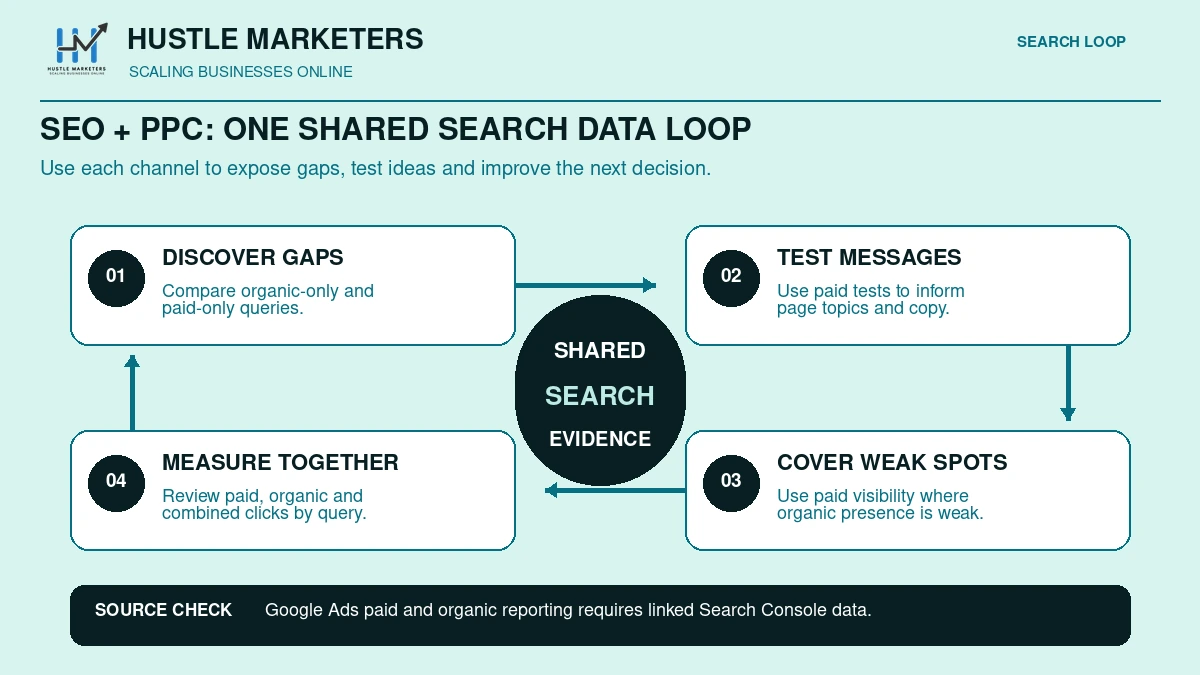
SEO and PPC work best together when each channel’s data improves the other. Use paid search terms to choose content topics, test headlines and offers with ads before rewriting pages, retarget organic visitors, and bid where your organic rank is weak. Google’s own research shows ads are far more incremental when you rank below position one.
Does PPC data help SEO keyword research?
Yes. Converting queries in the search terms report are proven SEO topics. Since September 2020, though, Google shows only terms searched by a significant number of users, as Search Engine Land reported, so low-volume queries stay hidden.
How else can the two channels share data?
- Find overlap: link Search Console to Google Ads for the Paid & organic report. Strong organic queries with heavy ad spend are holdout test candidates; ad-only queries are content gaps.
- Test messaging: run headline and offer variations as ad assets for a few days, then carry the winner into title tags and page copy.
- Retarget organic visitors: add blog and guide readers, the traffic AI Overviews hit hardest, to remarketing audiences.
Where do ads add the most on top of SEO?
Where you rank below first. Google’s 2012 analysis of 390 studies found 50% of ad clicks were incremental when the advertiser ranked first organically, 82% at ranks 2 to 4, 96% at rank 5 or lower and 99% with no organic listing. It also found 66% of ad clicks happened with no matching organic result.
Should you bid on your brand name if you already rank #1?
Bid on your brand if competitors bid on it, and test before paying if they do not. eBay found 99.5% of clicks from paused brand ads came back through organic results, but a study of Bing experiments found competitors captured 18% to 42% of clicks when a brand did not advertise and they did. A holdout test settles it.
What do the brand bidding studies show?
In the eBay experiment by Blake, Nosko and Tadelis (Econometrica, 2015), eBay paused brand ads on Yahoo and MSN in 2012, with Google as the control, and found they had no measurable short-term benefit. But eBay’s brand searchers were largely navigating to eBay, and the Edmunds researchers note Edmunds faced a more competitive market than eBay. When Edmunds switched off branded ads across randomized markets in 2015, only about half of that traffic arrived organically instead, likely because competitors bid on “Edmunds”.
Simonov, Nosko and Rao (Marketing Science, 2018) found brand ads added only 1% to 4% more clicks with no competitors present, while defensive bidding had strongly positive ROI when competitors bid. Haus, an incrementality vendor, reported that 82% of high-competition brands saw significant lift from branded search versus 35% in low competition, without disclosing its test count. Google’s 2011 pause studies, which covered all search ads rather than brand terms alone, found 89% of paid clicks were not replaced by organic clicks.
| Study | Date | Finding |
|---|---|---|
| Google pause studies (400+ studies) | 2011 | 89% of paid clicks not replaced by organic |
| Google organic rank study (390 studies) | 2012 | Only 50% of ad clicks incremental at organic rank 1 |
| eBay (Blake, Nosko, Tadelis) | 2012 test, published 2014 to 2015 | 99.5% of lost brand ad clicks recaptured organically |
| Edmunds (Coviello, Gneezy, Goette) | 2015 data | Only about half of brand ad traffic recovered |
| Bing experiments (Simonov, Nosko, Rao) | 2018 | Competitors take 18 to 42% of clicks when the brand does not advertise and they do |
| Haus (vendor) | 2025 | 82% vs 35% significant lift, high vs low competition |
Our guide to branded vs non-branded search covers how to structure and report the two separately.
How can you find out if brand bidding is stealing organic traffic?
- Check Auction insights to see whether competitors appear on your brand terms.
- Split markets into test and control regions with similar brand search volume.
- Pause brand ads in test regions only, with brand exclusions in Performance Max so traffic does not shift there.
- Run through at least one full buying cycle.
- Compare total brand clicks and conversions, paid plus organic, between groups.
- Or use Google Ads’ built-in incrementality testing, which has started at $5,000 since November 2025, down from about $100,000.
Google’s brand settings help here: inclusions work in Search, exclusions in Search and Performance Max. Google warns they limit traffic, so apply them deliberately.
How do you measure SEO and PPC fairly in 2026?
Measure both channels on incremental conversions, not last-click credit. Google Ads and GA4 now offer only data-driven and last-click attribution, Search Console shows AI Overview and AI Mode impressions but no separate AI clicks, and ads inside AI Overviews are not reported separately. Use holdout tests or marketing mix modeling for big budget decisions.
First-click, linear, time decay and position-based models were retired from Google Ads and GA4 in October 2023. Data-driven and last click both assign credit, but neither proves a channel caused a sale.
Is there any way to identify traffic from AI Mode or AI Overviews?
Only partly. AI Mode data sits inside the Search Console Performance report and cannot be filtered out, per Search Engine Land. The generative AI performance report, which Google says reached sites worldwide by 31 August 2026 (access is still rolling out), shows AI Overview and AI Mode impressions but no clicks. To monitor AI mentions more widely, see how to track brand visibility in AI search.
| Surface or data | Organic reporting | Paid reporting | Gap |
|---|---|---|---|
| AI Overviews | Impressions only in the generative AI report | Counted as top ads | No separate AI Overview click data for either channel |
| AI Mode | Blended into Performance report | New formats in testing | No clean AI Mode click data |
| Queries | Search Console queries | Low-volume search terms hidden | Incomplete paid query data |
| Overlap | Paid & organic report | Same report | Shows overlap, not incrementality |
| Attribution | GA4 data-driven or last click | Same in Google Ads | Neither proves causation |
Use holdout tests for specific questions, like brand ads, and marketing mix modeling for a top-down view across channels. Our digital marketing benchmark report shows how results vary across client engagements.
SEO vs PPC myths vs evidence: what do most guides get wrong?
Several SEO vs PPC guides still quote statistics from 2012 to 2021, before AI Overviews existed, often without dates or sources. The most common errors are citing a 2019 organic traffic share as current, quoting undated CPC and click-share figures, and presenting one vendor’s ROI figures as universal. The table below pairs each myth with dated evidence.
| Myth | Origin | Evidence |
|---|---|---|
| Google Ads boosts organic rankings | Forum belief | Google Ads Help: “Investment in paid search has no impact on your organic search ranking.” |
| 53% of traffic is organic, 15% paid | BrightEdge, 2019 | Measured in May 2019, before AI Overviews; 68.01% of US searches were zero-click in early 2026 (SparkToro) |
| Organic gets 75% of clicks, paid 25% | Undated figure in stats roundups | Text ad click share rose in headphones, jeans, online games and greeting cards (Aleyda Solis, 2026) |
| 64.6% of people click Google Ads when buying | WordStream, 2012 | Over a decade old; do not quote as current |
| Average CPC is about $2 | Old aggregates | $5.42 in WordStream’s 2026 benchmarks |
| SEO is always cheaper per customer | Agency claims | First Page Sage’s CAC data shows PPC cheaper than basic SEO in its sample, though its thought leadership SEO beat PPC for B2B |
| SEO is dead because of AI | Post-AI Overview traffic drops | Seer 2026: organic CTR on AI Overview pages rose from 1.31% to 2.36% |
| Brand bidding always wastes money | eBay study alone | Edmunds and Bing studies show losses when competitors bid |
| “89% of paid clicks are not replaced” proves ads never cannibalize organic | Misreading of Google’s 2011 pause study | That is an average across all search ads; at organic rank 1, only 50% of ad clicks were incremental (Google, 2012) |
| Google has 92.47% share | Old undated global figure | US, August 2026: Google 86.1%, Bing 8.92% (StatCounter) |
Where the data genuinely conflicts
- Google says organic click volume is stable; Pew, Ahrefs, Amsive and Seer measured lower CTR. Google published no data, and CTR can fall while total clicks hold if searches grow.
- Seer 2025 showed steep declines and Seer 2026 a partial recovery, with different samples and a backward-applied model.
- SparkToro’s 2024 and 2026 zero-click studies use different data providers.
- PPC conversion rates range from 1.3% (First Page Sage) to 8.18% (WordStream) largely because definitions and samples differ.
Frequently asked questions
These answers cover the SEO vs PPC questions business owners ask most often, from whether Google Ads helps rankings to how to see AI Overview traffic. Each answer stands on its own, and the sections above hold the full evidence, so you can jump straight to the question that matches your situation.
Is SEO or PPC better for a small business?
It depends on urgency and runway. A small business that needs calls this month should start with PPC on high-intent keywords and build local SEO alongside. One that can wait a year in a high-CPC category usually gets more long-term value from SEO first.
Does running Google Ads help my SEO rankings?
No. Google Ads Help states that paid search investment has no impact on organic rankings. Ads help SEO only indirectly, through search terms data, faster message testing and remarketing.
Is SEO still worth it with AI Overviews and AI Mode?
Yes, but the goal now includes being cited. In Seer’s 2026 data, cited brands earned more than double the organic CTR of brands not cited. Transactional queries showed AI Overviews only 5% of the time in the same data, so classic rankings still carry those searches.
Can I stop my ads from showing inside AI Overviews?
No. Google Ads Help says advertisers cannot opt out of or directly target AI Overview placements. Those ads are reported as top ads with no separate segment.
How much should I spend on Google Ads per month to start?
Multiply the leads you need by your expected CPC, then divide by your conversion rate. At WordStream’s 2026 averages, 30 leads a month needs roughly $2,000 in media spend, before management fees.
What do people spend on PPC vs SEO?
There is no reliable average for SEO spend: costs vary too widely, and the monthly ranges repeated online often cite no source. PPC spend is driven by click prices and volume, with WordStream’s 2026 US benchmark CPC at $5.42 across industries, plus management. As a starting split, we suggest new businesses put 70 to 80% into PPC, growing businesses split closer to even, and established brands with strong rankings lean toward SEO.
Is PPC harder than SEO?
They are hard in different ways. PPC punishes mistakes quickly because wasted clicks cost money, while SEO punishes them slowly through rankings that never arrive.
Which is cheaper in the long run, SEO or PPC?
SEO usually costs less per customer once rankings mature, because there is no fee per click. It is not guaranteed: First Page Sage’s CAC data shows PPC cheaper than basic SEO in its sample, though its thought leadership SEO beat PPC for B2B.
What happens to my traffic if I pause PPC?
On average, most paid clicks are lost: Google’s 2011 pause studies found 89% were not replaced by organic clicks. The exception is queries where you already rank first organically: Google’s 2012 data found only about half of ad clicks were incremental there, and eBay recaptured 99.5% of lost brand ad clicks.
Should I bid on competitors’ brand names?
It can work, but it often costs more per conversion because searchers wanted someone else, and it can invite retaliation on your own name. Test it in a separate campaign with a budget cap and judge it on cost per acquisition.
Is Microsoft Ads worth running alongside Google Ads?
For US advertisers already profitable on Google, it is worth testing. Bing held 8.92% of US search in August 2026 per StatCounter, and importing your best Google campaigns is a low-effort start.
How can I see AI Overview and AI Mode traffic in Search Console?
The generative AI performance report shows AI Overview and AI Mode impressions, but not clicks. AI Mode clicks are counted in the main Performance report without a separate filter.
How long should I run PPC before judging results?
Give a new campaign several weeks and enough conversions for automated bidding to learn. Judge early weeks on query quality and tracking, and later weeks on cost per acquisition against margin.
Need help deciding between SEO and PPC?
If you want a second opinion, Hustle Marketers can review your search visibility, ad accounts and tracking, then recommend where your next dollar should go. We are a Google Partner agency that runs both SEO and PPC, so the recommendation is not tied to one channel, and you always keep ownership of your ad accounts.
Since 2020 we have worked with 2,500+ brands and managed $90M+ in ad spend. Our SEO agency handles organic and AI visibility, and our PPC agency runs Google Ads and Microsoft Ads, with PPC management on month-to-month terms.
Start with our free $500 audit. It reviews your ad account, organic rankings and tracking, and we look for wasted spend and the budget split that fits your stage. Get Free Audit Worth $500.
About the author: Ishant Sharma is a Google Ads, Microsoft Ads and SEO specialist who has worked in digital marketing since 2013, and the founder of Hustle Marketers, a Google Partner agency. Over that time he has worked with ecommerce stores, local service businesses, B2B companies and marketing agencies across both SEO and paid search, and his agency has worked with more than 2,500 brands. He helps business owners decide how to split budget between organic and paid channels.