SEO for Dentists: Filling the Chair From Google

Ishant
Published on October 25, 2026
Ishant

Written by Ishant Sharma, Founder, Hustle Marketers | Published October 22, 2026
When someone searches “dentist near me,” they are not browsing. They are choosing. And they choose from a very short list: the three practices in the map pack, maybe two organic results below it, and increasingly, whatever name ChatGPT gives them. If your practice is not on that short list, the patient books somewhere else and stays there for years. That is what makes search engine optimization for dentists worth taking seriously: you are not competing for one appointment, you are competing for lifetime patient value.
We have already published a broad guide to digital marketing for dentists covering the full channel mix, and a dedicated piece on Google Ads for orthodontists. This post is the SEO deep dive. Everything here is organic: the local 3-pack, procedure pages, reviews, schema, and AI visibility. If you want the paid side or the broader strategy, those two guides are the companions to this one.
Summarize this article with:
Key Observations
- The local 3-pack captures the largest share of dental search clicks. GBP optimization plus review velocity is the highest ROI work in dental SEO.
- Every high value procedure needs its own page: implants, Invisalign, veneers, emergency dentistry. A bullet list “Services” page ranks for nothing.
- Review velocity beats review totals. A steady stream of specific, recent reviews wins the 3-pack and convinces anxious patients.
- Dentistry is healthcare: keep testimonials HIPAA safe and get written authorization before publishing anything identifying a patient.
- Insurance and pricing content captures the highest converting searches most practices refuse to answer.
- Add Dentist schema for the practice and Person markup for each dentist, matching what is visible on the page. FAQ markup is optional now that Google no longer shows FAQ rich results.
- Patients now ask ChatGPT for “the best dentist near me.” Complete profiles, consistent citations, and strong reviews decide who gets named.
Table of Contents
- How Patients Actually Find a Dentist in 2026
- Winning the Local 3-Pack
- Procedure Pages: Where the High Value Patients Come From
- Reviews in Healthcare: Velocity, Specificity, and HIPAA
- Insurance and Pricing Content: The Pages Practices Refuse to Build
- Dental Schema: Making Your Practice Machine Readable
- AI Search: When Patients Ask ChatGPT for a Dentist
- Multi Location Practices and DSO Groups
- What Results Look Like, and How Long It Takes
- Medical Trust and Privacy-Safe Local SEO
- FAQ
- Ready to Fill More Chairs From Search?
- Sources and Verification
How Patients Actually Find a Dentist in 2026
The dental search results page is crowded: an AI Overview at the top for many queries, a few ads, the local 3-pack with its map, then organic results and People Also Ask boxes. Three realities follow:
- The 3-pack is the main prize. For “dentist near me” and nearly every procedure search with local intent, the map pack sits above organic and collects the biggest share of clicks. It is also the one block AI Overviews have not replaced.
- Organic still matters for procedures. Searches like “dental implant cost” or “Invisalign vs braces” trigger fewer map results and more content results. Procedure and cost pages win here.
- AI answers are a third surface. Patients ask assistants for recommendations and procedure explanations. The sources those assistants use are your GBP, reviews, and site content, which means the same SEO work feeds all three surfaces.
Dental is also a YMYL category, meaning Google holds health related content to a higher standard. Pages attributed to a named dentist, with credentials, accurate clinical information, and a review or authorship trail, consistently outperform anonymous content. Put Dr. names, degrees, and bios on the site and attach them to clinical content.
Winning the Local 3-Pack
Google ranks local results on relevance, distance and prominence. You cannot move your office, so the work is on relevance (the right primary category, complete services, and a website that backs them up) and prominence (reviews, local links and mentions).
Choose the primary category that describes what the practice is, such as Dentist, Pediatric dentist or Orthodontist, and keep extra categories to the few that truly apply. Keep the practice name exactly as it appears on your sign. For the full Google Business Profile setup, the rules on individual dentist listings and how to avoid duplicates, see our guide to local SEO for dentists.
Procedure Pages: Where the High Value Patients Come From
A cleaning patient is worth a few hundred dollars a year. An implant case can be worth 30 thousand. The searches that bring those cases in are procedure searches, and they deserve dedicated pages:
- Dental implants (and if volume justifies it, separate pages for All-on-4 and implant dentures)
- Invisalign and clear aligners
- Veneers and cosmetic dentistry
- Emergency dentist
- Root canal treatment
- Crowns and bridges
- Teeth whitening
- Pediatric dentistry
- Sedation dentistry
The single biggest structural mistake on dental websites is one “Services” page listing all of this as bullets. Google cannot rank one page for twelve procedure clusters, so it ranks it for none of them.
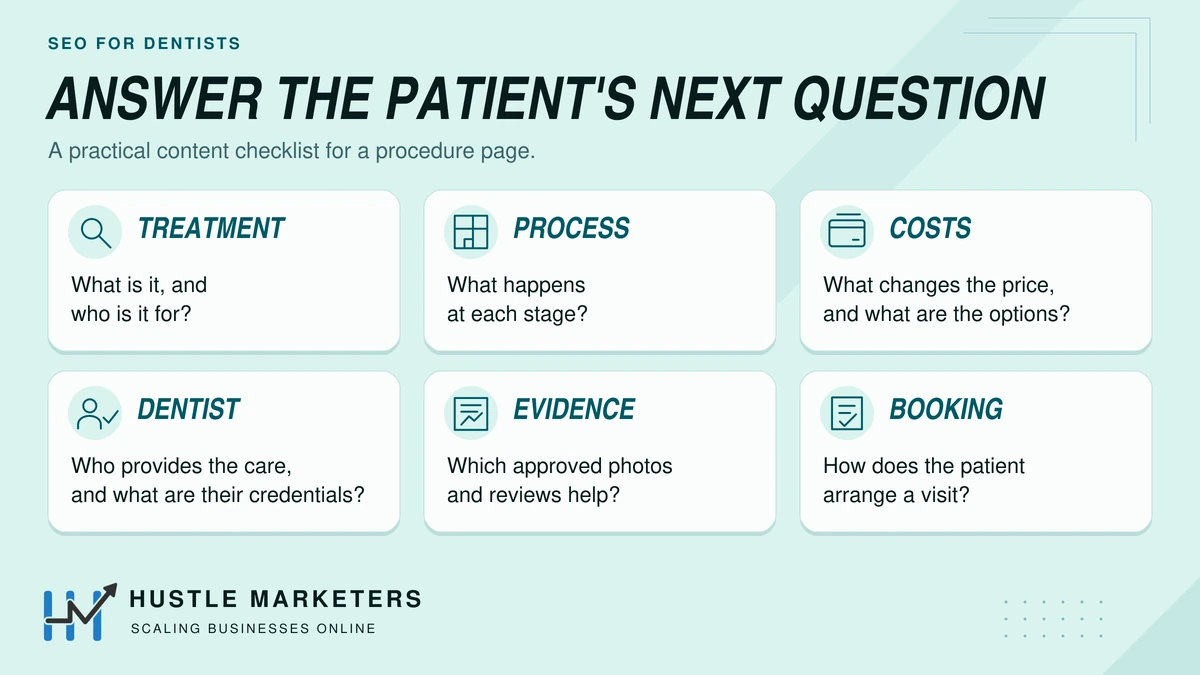
What a procedure page that ranks looks like:
- Answer first opening: what the procedure is and who it is for, in plain language a nervous patient understands
- The process at your practice: consultation, treatment steps, timeline, recovery
- Honest cost information: a range, what changes it, financing and insurance handling
- The provider: which dentist performs it, credentials, cases completed
- Proof: before and after photos (with written patient authorization) and procedure specific reviews
- FAQ: the exact questions patients ask, answered directly
- Booking path: online scheduling or a phone number, visible without scrolling
The emergency dentist page is its own animal, closer to an HVAC emergency page than a cosmetic one: same day availability, what counts as an emergency, what to do right now for a knocked out tooth, phone number everywhere. Emergency searches convert at the highest rate of any dental keyword because the patient is in pain and deciding in minutes.
| Page type | Example target search | Patient intent | Revenue profile | Content priority |
|---|---|---|---|---|
| Emergency page | “emergency dentist near me” | In pain, books within hours | Immediate, plus long term retention | Highest |
| Implant page | “dental implants [city],” “implant cost” | Researching for weeks | Very high ticket | Highest |
| Invisalign page | “invisalign [city],” “invisalign vs braces” | Comparing options | High ticket | High |
| General dentistry | “dentist [city],” “dental cleaning near me” | Choosing a home practice | Lifetime value | High |
| Cost and insurance content | “does insurance cover implants” | Pre decision research | Feeds all of the above | Medium |
Reviews in Healthcare: Velocity, Specificity, and HIPAA
Reviews help prominence, but how you collect and answer them matters more in dentistry than in most trades. Ask every patient the same way, never offer rewards, and never filter who gets asked, because Google’s review policy bans review gating and incentives.
Replies carry HIPAA risk: never confirm that a reviewer is a patient and never mention treatment, dates or insurance. Our local SEO for dentists guide covers the review policy, the HHS enforcement cases and reply templates you can adapt.
Insurance and Pricing Content: The Pages Practices Refuse to Build
Two of the highest intent search patterns in dentistry are ones most practices ignore:
Insurance searches: “dentist that takes [insurance] near me,” “does Delta Dental cover implants,” “[city] dentist accepting new Medicaid patients.” Build a page listing every plan you accept, by name, and explain how you handle out of network benefits if relevant. Patients filter by insurance before anything else, and a page that answers the question captures them at the final step of choosing.
Cost searches: “dental implant cost,” “how much is Invisalign,” “veneers price [city].” Publish honest ranges with what moves them, financing options, and membership plan details if you offer one for uninsured patients. Practices fear cost pages attract price shoppers. Our experience is the opposite: they pre qualify patients, reduce no show consults, and earn the trust that pages hiding prices forfeit. They are also precisely the content AI assistants quote when patients ask cost questions.
Dental Schema: Making Your Practice Machine Readable
Structured data is how search engines and AI systems verify facts about your practice. For dentists the stack is:
- Dentist schema (a subtype of MedicalOrganization and LocalBusiness) on the homepage: practice name, address, phone, geo coordinates, hours, accepted insurance if you like, and links to your profiles
- Person markup for each dentist with credentials and their bio page
- FAQPage schema on procedure pages where visible FAQs exist (optional: Google stopped showing FAQ rich results in 2026)
- MedicalProcedure schema on procedure pages describing what the treatment is
- Review or AggregateRating markup is not worth adding for your own practice: Google does not show star ratings when a business controls the reviews about itself on its own site
None of this is visible to patients. It helps search engines read your practice details reliably, though Google says no special markup is needed to appear in its AI features. Run your homepage and your implant page through a schema validator; if your web team never mentioned schema, assume it is missing. Our SEO audit template includes the structured data checklist we run for healthcare clients.
AI Search: When Patients Ask ChatGPT for a Dentist
“Best dentist near me” typed into ChatGPT returns actual practice names. So do prompts like “gentle dentist in [city] for someone with dental anxiety” and “affordable implant dentist that takes payment plans.” Those recommendations are assembled from public signals:
- Google Business Profile completeness. Category, services, hours, photos. AI tools lean on maps data heavily for local recommendations.
- Review volume and sentiment themes. If forty reviews mention “painless” and “great with kids,” those phrases become part of how AI describes you. Sentiment is not just a score, it is your AI era brand copy.
- Directory consistency. Healthgrades, Zocdoc, Yelp, ADA listings. Conflicting data lowers confidence and drops you from answers.
- Quotable site content. Clear factual statements: who you are, what you offer, which insurance you take, what things cost. Vague marketing copy gives AI nothing to work with.
- Schema, as above, to confirm it all.
The encouraging part: this is the same work that wins the 3-pack. There is no separate “AI SEO” project. There is one honest, complete, well structured presence that every surface reads.
For conversational queries, add a short answer first FAQ to each procedure page using the phrasing real patients use (“does getting an implant hurt,” “how much is invisalign per month”). Those are the questions typed into assistants, and pages that answer them plainly are the pages that get cited.
Multi Location Practices and DSO Groups
Each office needs its own Google Business Profile and its own location page with unique details, under one consistent brand name and primary category. Group practices should also audit individual dentist listings whenever a dentist joins or leaves.
Keep one website with a strong page per office rather than a separate site for each location. We walk through the setup in local SEO for dentists.
What Results Look Like, and How Long It Takes
Dental SEO follows the standard local SEO arc: technical and GBP fixes move first (weeks), review velocity and map pack movement next (two to four months), procedure page rankings after that (three to eight months depending on the market). Metro downtown markets are slow grinds; suburban markets fall faster. We published a realistic breakdown in how long local SEO takes, and dental tracks it closely.
The payoff profile is unusually good because dentistry compounds twice: rankings compound, and every patient acquired is recurring revenue for years. In an adjacent healthcare niche, our child development center case study is a paid search engagement rather than SEO, but it shows the same pattern: a local service families actively search for, which produced 286 conversions from Google Ads in three months. Dental practices have the same structural advantage: urgent need, local intent, and high lifetime value.
Track what matters: calls and booking form submissions by source, map pack positions for your money keywords, procedure page rankings, review count and velocity per location, and new patient numbers from your practice management software. Rankings are the means. Chairs filled is the metric.
Medical Trust and Privacy-Safe Local SEO
Dental content needs a higher trust standard than ordinary local-service copy. Give treatment pages a named clinical reviewer, accurate qualifications, realistic risks and alternatives, transparent insurance or financing information, and an updated date. Avoid guaranteed outcomes or claims that exceed the evidence.
Review responses must never confirm that the reviewer is a patient or reveal treatment details. Thank the person in general terms and move any case-specific conversation to a private channel. Track consultations and accepted treatment plans separately from raw leads so SEO is judged on patient quality, not just form volume.
The same principle applies across sensitive and regulated lead-generation work. Learn how our SEO agency approaches the work, then compare the method with the evidence in our child development lead-generation case study.
FAQ
What is SEO for dentists?
Search engine optimization for dentists is the work of making a dental practice visible in Google’s local 3-pack, organic results, and AI generated answers when patients search for a dentist or a procedure. It covers Google Business Profile optimization, procedure page content, reviews, schema markup, and technical site health.
How much does dental SEO cost?
As a rough market estimate, agency retainers for dental SEO run about 1,500 to 5,000 dollars a month, depending on market competitiveness and location count. Given the lifetime value of a dental patient, a campaign that adds even a handful of new patients monthly typically pays for itself quickly.
How long does SEO take for a dental practice?
GBP and review improvements can move map rankings in two to four months. Procedure page rankings take three to eight months. Competitive metros take longer. See our full breakdown of how long local SEO takes.
What is the local 3-pack and why does it matter for dentists?
The 3-pack is the block of three business listings with a map at the top of local search results. It collects the largest share of clicks for “dentist near me” searches, and it is driven by your Google Business Profile, proximity, and reviews rather than your website alone.
What keywords should a dentist target?
Three groups: practice keywords (“dentist [city],” “dentist near me”), procedure keywords (“dental implants [city],” “invisalign [city],” “emergency dentist”), and research keywords (“implant cost,” “does insurance cover invisalign”). Procedure keywords bring the highest value cases.
Do reviews really affect dental SEO rankings?
Yes. Review quantity, velocity, and content are established local ranking factors, and they influence AI recommendations too. A consistent flow of specific, recent reviews outperforms a large but stale total.
How do I respond to patient reviews without violating HIPAA?
Never confirm someone is a patient or reference their treatment. Thank them generically, speak about your practice values, and move anything specific offline. Get written authorization before publishing testimonials or photos that identify a patient. Have your attorney approve your release form.
Should dentists publish pricing on their website?
Publish ranges with context. Cost pages capture high intent searches, pre qualify patients, and feed AI answers. Practices that hide pricing lose those searches to competitors and third party sites with less accurate numbers.
How do I get my practice recommended by ChatGPT?
There is no submission process. AI assistants synthesize your Google Business Profile, review sentiment, directory listings, and website content. A complete GBP, consistent citations, strong review velocity, and clear factual site content with schema markup is what gets practices named.
What schema markup should a dental website use?
Dentist schema (a LocalBusiness and MedicalOrganization subtype) for the practice, provider markup for each dentist, MedicalProcedure markup on treatment pages, and FAQPage markup where FAQs appear on the page.
Is dental SEO better than Google Ads for dentists?
They do different jobs. Ads deliver immediate visibility and are excellent for launches and high value campaigns, as we cover in our orthodontist Google Ads guide. SEO compounds and produces a lower cost per patient over time. Most growing practices run both, then rebalance as organic strengthens. Our digital marketing for dentists guide covers the full mix.
How is SEO different for a multi location dental group?
One website with a unique page per location, one GBP per office linked to its matching page, and independent review generation at every front desk. Duplicated location pages and GBPs all pointing at the homepage are the two most common group practice mistakes.
How Hustle Marketers helps dental practices with SEO
Dental is a two speed niche and most practices market it at one speed. Emergency and same day appointments convert in minutes. Implants, orthodontics and cosmetic work take weeks of research and a consultation. Running both through the same pages and the same ad groups is why so many dental accounts look busy and book badly.
The other constraint is the one that catches practices out. Patient stories, reviews and before and after content are the most persuasive assets you have, and they are also the ones with real compliance exposure. We treat review generation and content as a process with guardrails rather than a growth hack, which is the same care we apply for health adjacent clients like the speech, occupational and physical therapy brand where our Google Ads work produced 286 conversions in three months.
Ishant Sharma has worked in search and paid media since 2013. For dental practices the local organic work sits under our SEO services and the paid side under PPC management. Business Profile, treatment pages and call tracking usually come before any content plan.
Ready to Fill More Chairs From Search?
Dental SEO rewards practices that treat it as a system: profile, procedure pages, reviews, schema, repeated every month. If you would rather run your practice while someone runs that system, our SEO agency team builds and manages it for healthcare practices. Start with an audit of your current visibility and see exactly which patients you are missing.
Sources and Verification
Facts that can change were checked on October 7, 2026 against these primary sources:
- Google Search Central: structured data guidelines
- Google Search Central: LocalBusiness structured data
- Google Search Central: ranking systems guide
- Google Search Central: review snippet guidelines
- Schema.org: Dentist type
- HHS Office for Civil Rights: settlement over PHI in review replies
Related guides
If this one was useful, these cover the same ground for closely related businesses.