Franchise SEO: How Multi-Location Franchises Win Local Search and AI Results (2026 Guide)

Ishant
Published : October 19, 2026 at 9:30 am
Updated : October 16, 2026 at 12:13 pm
Ishant
Written by Ishant Sharma, Google Ads, Microsoft Ads and SEO specialist since 2013 | Published October 19, 2026 | Facts checked September 17, 2026
Franchising keeps growing. The International Franchise Association expects US franchise establishments to grow 1.5% to 845,000 units in 2026, with nearly 8.9 million jobs (IFA 2026 Franchising Economic Outlook). Every one of those locations competes in its own local search results. Franchise SEO is how a brand makes sure each location shows up when nearby customers search, without the whole network tripping over duplicate pages, suspended profiles and inconsistent data.
It is harder than single-location SEO. Who owns each Google Business Profile? What happens to a profile and its reviews when a franchisee leaves? Can a home services franchise use bulk verification? (Usually not, because service-area businesses are excluded.) Can a location page say “earn $500,000 a year” to attract new franchisees? (Not without the FTC Franchise Rule in mind.) Most franchise SEO guides skip these questions. This guide answers them, along with location page architecture, reviews, AI search, reporting and pricing.
How we researched this guide: we pulled US keyword data in Semrush on September 17, 2026, and reviewed the leading pages for “franchise SEO” and “SEO for franchises” plus several other multi-location guides. We checked Google’s Business Profile, Search Central and Search Console documentation, schema.org, the FTC Franchise Rule (16 CFR Part 436) and the FTC rule on consumer reviews, the IFA outlook and BrightLocal’s 2026 review survey. We also read franchise discussions on the Local Search Forum and on Reddit’s r/SEO, r/localseo, r/bigseo, r/googleads and r/PPC, and watched franchise SEO videos, including an IFA session on local visibility. This is marketing guidance, not legal advice. Have franchise counsel review FDD, advertising fund and earnings claim questions.
Key Observations
- Franchise SEO means ranking every location in Google Maps and local organic results while protecting the brand’s main website, reviews and data across the whole network.
- Put every location on the brand’s main domain in a crawlable folder structure, such as /locations/state/city/, with unique content on each page.
- The franchisor should own every Google Business Profile in a business group. Franchisees should be managers. Write this into the franchise agreement.
- Use the brand’s real name on every profile. Do not add cities or services unless they are part of the name on the sign.
- Bulk verification needs 10 or more profiles and is not available to service-area businesses, so many home services franchises verify locations one by one.
- Plan franchisee exits in advance: transfer, rebrand or close the profile, so the brand and the new owner do not end up with duplicate listings or suspensions.
- Franchise recruitment pages must not publish earnings claims that are not in Item 19 of the Franchise Disclosure Document.
Table of Contents
- What is franchise SEO?
- Is franchise SEO worth it?
- What keywords should franchises target?
- How should a franchise website be structured for SEO?
- Who should own a franchise’s Google Business Profiles?
- What happens to SEO when a franchisee leaves?
- How should franchises manage reviews across locations?
- What technical SEO does a franchise website need?
- How do franchises show up in AI search?
- Which popular franchise SEO tips are wrong or outdated?
- How do franchises pay for SEO?
- How should franchise development SEO be handled?
- How do you measure franchise SEO by location?
- How long does franchise SEO take?
- How much does franchise SEO cost?
- How Hustle Marketers helps franchises with SEO
- Franchise SEO FAQs
What is franchise SEO?
Franchise SEO is the process of improving how a franchise brand and each of its locations show up in Google Search, Google Maps, Apple Maps, Bing and AI assistants, so nearby customers choose a franchise location over independent competitors. It works on two levels at once:
- Brand level: the main website, site architecture, templates, technical SEO, national content, brand reputation and data standards.
- Location level: each location’s Google Business Profile, location page, reviews, local citations and local links.
A third, separate audience matters too: franchise development. People searching “franchise opportunities” or “[brand] franchise cost” are potential franchisees, not customers, and they need different pages and different legal care.
How is franchise SEO different from multi-location SEO?
A company-owned chain controls every location. A franchise does not. The franchisor owns the brand, but franchisees own and run their businesses, often under agreements that define who controls the website, profiles and marketing budget. Franchise SEO has to work within those agreements and survive franchisees joining, selling and leaving.
| Area | Company-owned chain | Franchise |
|---|---|---|
| Google Business Profile ownership | Corporate | Should be franchisor, but often messy |
| Website control | Corporate | Franchisor site, sometimes with franchisee microsites |
| Budget | Corporate marketing | Brand fund, local marketing requirements, co-ops, franchisee spend |
| Location changes | Openings and closures | Openings, closures, transfers, conversions to independent |
| Reviews | Corporate policy | Franchisor policy carried out by franchisees and their staff |
| Second audience | None | Prospective franchisees |
Is franchise SEO worth it?
Yes, for most brands. Local customers rely on search and reviews to pick one location over another:
| Finding | Data | Source |
|---|---|---|
| Franchise growth | 845,000 US franchise establishments expected in 2026, up 1.5%, with output of $921.4 billion | IFA |
| Review reading | 97% of consumers read reviews for local businesses | BrightLocal 2026 |
| Review volume | 47% of consumers won’t use a business with fewer than 20 reviews | BrightLocal 2026 |
| Review recency | 74% look for reviews written in the last three months | BrightLocal 2026 |
| AI for local recommendations | Use of ChatGPT and other generative AI tools for local recommendations rose from 6% to 45% in a year | BrightLocal 2026 |
| AI Overviews on local searches | AI Overviews appeared on 7.9% of local queries versus 22.8% of non-local queries | Ahrefs |
The reviews numbers matter most for franchises. A brand with 200 locations does not have one review profile. It has 200, and a location with 9 reviews next to a competitor with 180 loses the click, whatever the brand’s national reputation.
What keywords should franchises target?
Customer keywords are mostly local and service-based: “[service] near me”, “[service] in [city]” and “[brand] [city]”. Franchise marketing keywords matter if you sell SEO internally or evaluate agencies. Here is US monthly search volume from Semrush for franchise marketing terms, pulled on September 17, 2026:
| Keyword | US monthly searches | KD | Who searches it |
|---|---|---|---|
| franchise opportunities | 22,200 | 72 | Prospective franchisees |
| franchises for sale | 5,400 | 48 | Prospective franchisees |
| best franchises to own | 5,400 | 27 | Prospective franchisees |
| franchise marketing | 2,900 | 29 | Franchisor marketing teams |
| franchise seo | 2,400 | 30 | Franchisor and franchisee marketers |
| multi location seo | 1,900 | 26 | Multi-location marketers |
| franchise disclosure document | 1,600 | 44 | Prospective franchisees |
| franchise seo services | 1,300 | 6 | Franchisors hiring an agency |
| franchise digital marketing | 1,300 | 4 | Franchisors hiring an agency |
| local seo for franchises | 880 | 11 | Franchisors and franchisees |
| franchise lead generation | 480 | 6 | Franchise development teams |
Two points stand out. First, franchise development searches are far bigger than franchise marketing searches, and they have their own rules. Second, the difficulty for hiring terms like “franchise seo services” is low, which tells you many agency pages targeting them are thin.
How do you map franchise keywords to pages?
| Search type | Example | Best page |
|---|---|---|
| Brand plus location | “[brand] Austin” | Location page and Google Business Profile |
| Service near me | “junk removal near me” | Google Business Profile for the nearest location |
| Service in city | “junk removal in Round Rock” | Location page, or a city page only if the location truly serves it with unique content |
| National service research | “how much does junk removal cost” | Brand guide or blog post |
| Brand reputation | “[brand] reviews” | Brand reviews page and location profiles |
| Franchise development | “[brand] franchise cost” | Franchise development site or section |
How should a franchise website be structured for SEO?
Should franchise locations use subfolders, subdomains or separate websites?
For most brands, subfolders on the main domain work best, such as brand.com/locations/texas/austin/. Every location page benefits from the brand’s authority, one team can fix templates across every page at once, and data stays consistent.
| Option | Example | Pros | Cons |
|---|---|---|---|
| Subfolders | brand.com/locations/austin/ | Shared authority, one template, easiest governance | Franchisees have less direct control |
| Subdomains | austin.brand.com | Can separate franchisee content | More setup and tracking work, often weaker internal linking |
| Franchisee microsites | brandaustin.com | Franchisee control | Duplicate content, inconsistent brand data, lost authority, hard to govern when owners change |
Practitioners on Reddit largely agree. In a July 2025 r/localseo thread, most replies favored one brand domain with franchisee pages, while one dissenter noted a franchisee site had beaten a weak corporate site, and a commenter pointed out that the franchise agreement decides what is allowed. In a 2021 r/bigseo thread about a brand with about 20 city domains, the consensus was to consolidate to one domain with redirects, and one commenter suggested writing platform control into the franchise agreement.
If franchisees already run their own websites, plan a migration: build the location page on the brand domain, 301 redirect each old microsite page to its closest match, update the Google Business Profile website link, and keep the franchisee’s local content and photos where they add value.
What should a franchise location page include?
Google’s spam policies describe doorway abuse as pages “created to rank for specific, similar search queries” that lead users to less useful intermediate pages (Google spam policies). A location page that only swaps the city name in a template is at risk. Make every page useful on its own:
- Name, address, phone and hours that match the Google Business Profile exactly.
- Services this location offers, not the full national menu if it does not offer everything.
- Local team details, such as the owner or manager and their experience, where they agree to it.
- Service area or neighborhoods served, stated honestly.
- Local reviews, pulled from real customers of that location.
- Local photos of the team, vehicles or storefront, not only brand stock images.
- Location-specific offers with dates and terms.
- Local proof, such as community involvement, sponsorships or local projects.
- Directions, parking and landmarks for storefront locations.
- FAQs from that location’s customers.
In a July 2026 IFA webinar sponsored and presented by Location3, the speakers set out the location-level signals that decide whether franchise locations appear in AI-generated answers, and argued that on-site content, off-site authority and reviews now feed the same systems. That lines up with the list above.
How do you make a store locator crawlable?
Many store locators hide locations behind a search box or map that Google cannot follow. Google says it can only reliably crawl links that are `<a>` elements with an `href` attribute (Google Search Central: crawlable links). So:
- Keep the interactive map for customers, but also link every location from plain HTML pages.
- Build a browseable hierarchy: /locations/ lists states, each state page lists cities, each city page lists locations.
- Give every location its own indexable URL, and do not canonicalize location pages to a parent page.
- Include location URLs in the XML sitemap.
- Point each Google Business Profile’s website field at that location’s own page, not the homepage or the locator. Google’s business links policy applies the same logic to action links, saying that for businesses with multiple locations, action links must lead to a website for a specific location, and to avoid general landing pages or a landing page for another location (Google business links policy).
How should you fix a franchise site with hundreds of duplicate location pages?
In an August 2026 r/SEO thread, a junior in-house SEO described inheriting a franchise site with about 600 location subfolders on a WordPress multisite, duplicate content and doorway-style pages, while the owners were pushing to optimize for LLMs. The best advice in the replies was to fix the shared templates first, use Search Console data to decide which pages to improve or remove, and get experienced help. That order works:
- Fix the location template once: NAP, schema, internal links, local content fields and unique page titles.
- Use Search Console to find locations with impressions but no clicks, and locations with no impressions at all.
- Merge or remove pages for closed locations and territories you do not actually serve.
- Fill each remaining page with real local content, starting with your highest-revenue locations.
Who should own a franchise’s Google Business Profiles?
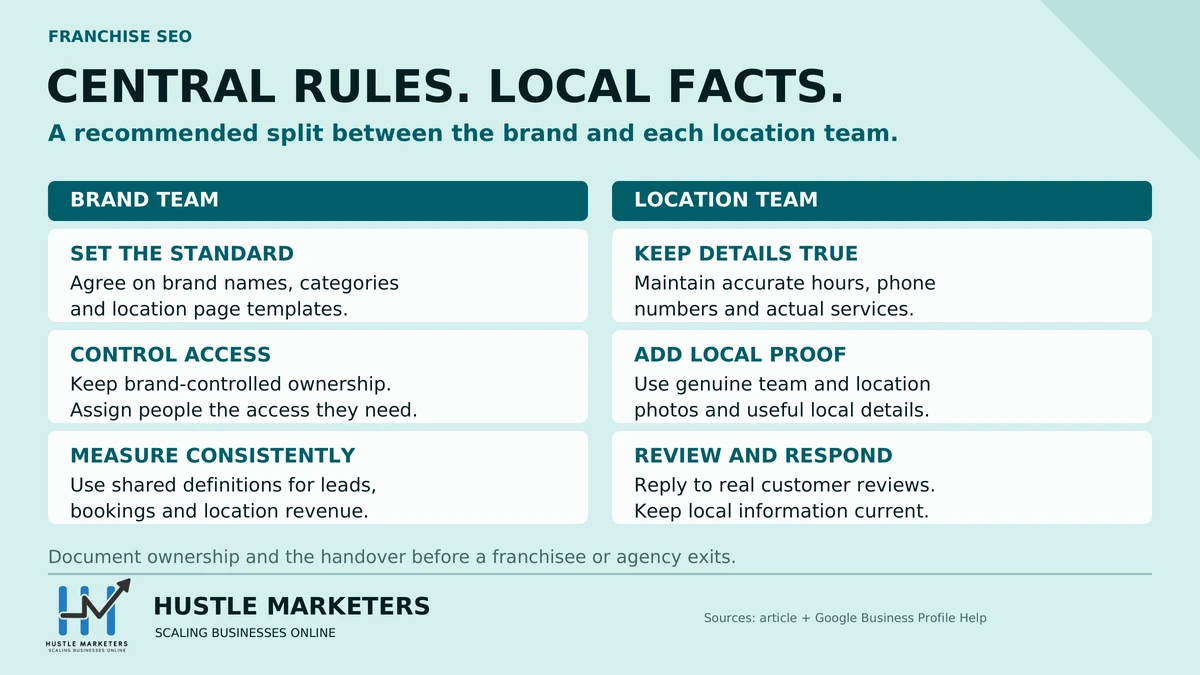
The franchisor, in most cases. Profiles are brand assets with years of reviews, and losing control of them when a franchisee leaves is one of the most common franchise SEO problems.
How should franchisors set up Google Business Profile access?
| Role | Who | Why |
|---|---|---|
| Primary owner | Franchisor, using a brand-controlled account | Keeps control of the profile if a franchisee or agency leaves |
| Owner | A second franchisor admin | Avoids lockout if one person leaves |
| Manager | Franchisee and local staff | Can update hours, photos, posts and reply to reviews |
| Manager | Agency | Can do the work without owning the asset |
Google’s user roles explain why this matters. Owners can add and remove users and delete profiles, while managers cannot. New owners and managers must wait 7 days before they can delete profiles, remove users or transfer primary ownership (Google Business Profile Help: owners and managers).
Use a business group to hold the brand’s profiles. Google describes business groups as a shared folder for profiles and a more secure way to manage and share access (Google Business Profile Help: business groups). Agencies can use organization accounts, but an organization can only manage a location after the location grants it permission (Google Business Profile Help: organization accounts), so the brand should stay the owner.
If someone requests ownership of a profile, the current owner is notified by email and has 3 days to respond (Google Business Profile Help: request ownership). Franchisors should monitor the owner inbox so a franchisee or former employee cannot take a profile over by default.
Can franchises bulk verify Google Business Profiles?
Some can. Google’s bulk verification requires 10 or more profiles from the same business in the spreadsheet, all the profiles you manage, no existing verified account, no errors, and a business that “isn’t a service-area business” (Google Business Profile Help: bulk verification).
That last rule surprises many brands. A restaurant or retail franchise with storefronts can bulk verify. A home services franchise, such as cleaning, restoration, junk removal, lawn care or plumbing, where staff travel to customers and the address is hidden, has to verify locations individually.
Should every franchise location use the same business name?
Yes, unless the real-world signs say otherwise. Google’s guidelines say that for chains, all locations must have the same name unless the business’s real-world representation consistently varies from location to location. Adding location information or store codes to the name is not allowed (Google guidelines for representing your business).
One ranking franchise SEO guide suggests naming profiles “franchise name plus the location”. Unless the city is part of the name customers actually see on the sign, that conflicts with Google’s rules. Use the brand name, set the right category, and let the address and service area show location.
How should service-area franchises set up profiles?
Google’s guidelines say a service-area business should have one profile for its central office with a designated service area, should hide its address, and should keep the service area within about 2 hours of driving time from where the business is based. Virtual offices are not eligible (Google guidelines).
Franchisees feel this. In a March 2026 r/localseo thread, an owner of two home services territories said the profile for the territory about 30 miles from their base was invisible in Maps. Replies pointed to proximity and warned that virtual offices invite suspensions. The owner also said corporate did not allow them to build their own website. The honest answer: a hidden-address profile will mostly rank near its real base, so each territory needs a real, staffed base to have its own profile, plus a strong location page and local signals.
Why do franchise Google Business Profiles get suspended?
Suspensions are common across franchise networks. Forum cases show the usual causes:
- Duplicates after ownership changes. In a December 2023 Local Search Forum thread, a former franchisee’s new independent listing at the same address was suspended, likely as a duplicate of the franchise listing.
- Mass openings. In an April 2025 thread, a service-area franchise with more than 350 locations opening several units a month saw most new listings suspended, with some appeals taking about three months. The moderator’s checklist included unique phone numbers per location and proper business registrations.
- Contractor home addresses. In a 2021 thread, a franchise using contractors’ home addresses for satellite listings ended up hiding those addresses and using service areas.
Prevent most suspensions with real addresses or hidden service areas, unique local phone numbers, consistent names, business registration documents on file, and slow, planned openings rather than dozens of profiles created in a day.
What happens to SEO when a franchisee leaves?
Plan this before it happens. The right path depends on whether the location stays in the network:
| Situation | What to do with the profile | What to do with the location page |
|---|---|---|
| Location sold to a new franchisee | Keep the profile, change managers, keep reviews | Update the owner details and phone if they change |
| Location closes | Mark the profile permanently closed | 301 redirect to the nearest location or the city page, or keep a closed notice for a short time |
| Franchisee converts to an independent business at the same address | Agree in advance who keeps the profile. The franchisor usually marks its profile closed so the independent can create a new one | Remove the location from the locator and redirect the page |
| Location relocates | Update the address and verify again if Google requires it | Update the page and keep the URL if the city stays the same |
The Local Search Forum has several cases of this going wrong. In a May 2023 thread, a franchisee going independent found the franchisor owned both the profile and the page it linked to. Replies said taking over the old profile only works if the franchisor cooperates, and otherwise marking it closed and starting fresh is the realistic path. Put profile ownership and exit steps in the franchise agreement.
How should franchises manage reviews across locations?
Reviews are local, so the review program has to run at every location, with rules set by the brand.
| Do | Do not |
|---|---|
| Send every customer a review request after each job or visit, using a link to that location’s profile | Ask only happy customers. Google prohibits selectively soliciting positive reviews |
| Train franchisees and staff on one reply standard | Offer discounts or gifts for reviews. Google prohibits incentives |
| Reply to reviews within a few days with specific, non-template replies | Let franchisees ask friends, family or employees for reviews without clear disclosure |
| Track review count, rating and recency by location | Merge profiles to combine reviews. Merged or deleted reviews are hard to get back |
Sources: Google Maps user contributed content policy and the FTC Consumer Reviews and Testimonials Rule.
The FTC’s rule, in effect since October 21, 2024, bans fake reviews, buying reviews conditioned on positive or negative sentiment, and undisclosed reviews by a business’s officers and managers. It also restricts officers and managers from soliciting reviews from their immediate relatives, from employees and agents, or through employees from their relatives, when the resulting reviews appear without a clear disclosure of the relationship. Generalized review requests sent to all customers are outside that restriction, which is why a blanket post-job review request is the safe pattern. Franchise brands should build these rules into franchisee training. In the March 2026 r/localseo thread mentioned above, the franchisee said they had turned to friends for reviews to get started. Friends are not covered by the FTC’s insider-review provisions, but reviews from personal connections breach Google’s conflict of interest policy, and relatives and employees bring the FTC rule into play.
BrightLocal’s 2026 survey found 80% of consumers are likely to use a business that responds to all of its reviews, and 50% are put off by generic or templated responses (BrightLocal). Give franchisees reply guidelines and examples, not a single copy-paste reply.
What technical SEO does a franchise website need?
| Area | What to check | Fix |
|---|---|---|
| Location template | Missing or wrong NAP, weak titles, no local content fields | Fix once in the template, then fill content by location |
| Locator | Locations only reachable through JavaScript search | HTML state, city and location links |
| Duplicate content | Same service copy on every location page | Local content blocks, services offered at that location only |
| Canonical tags | Location pages canonicalized to the locator or homepage | Self-referencing canonicals on each live location page |
| Closed locations | 404s, soft 404s or redirects to the homepage | Redirect to the nearest location or city page |
| Page speed | Heavy maps and widgets on every location page | Load maps on interaction, compress images |
| Tracking | One call tracking number across all locations | Unique local numbers per location, matched to each profile |
| Search Console | No location-level visibility | A Domain property for the brand, plus URL-prefix properties for location folders |
Search Console allows up to 1,000 properties per account, a Domain property covers all subdomains and protocols, and a URL-prefix property covers only URLs with that prefix (Search Console Help). A URL-prefix property for a location’s folder can give a franchisee visibility into their own pages without access to the whole site.
What schema should franchise location pages use?
Use LocalBusiness structured data, or a more specific subtype such as Restaurant or HomeAndConstructionBusiness, on each location page. Google requires `name` and `address`, and recommends properties such as `geo`, `openingHoursSpecification`, `telephone` and `url` (Google Search Central: LocalBusiness).
To connect each location to the brand, use `parentOrganization`. Schema.org lists the older `branchOf` property as superseded by `parentOrganization` (Schema.org: branchOf). A simple example for one location (replace every value with real data):
{
  "@context": "https://schema.org",
  "@type": "LocalBusiness",
  "@id": "https://www.example.com/locations/texas/austin/#location",
  "name": "Example Brand",
  "url": "https://www.example.com/locations/texas/austin/",
  "telephone": "+1-512-555-0100",
  "address": {
    "@type": "PostalAddress",
    "streetAddress": "100 Congress Ave",
    "addressLocality": "Austin",
    "addressRegion": "TX",
    "postalCode": "78701",
    "addressCountry": "US"
  },
  "geo": {
    "@type": "GeoCoordinates",
    "latitude": 30.26512,
    "longitude": -97.74391
  },
  "openingHoursSpecification": [{
    "@type": "OpeningHoursSpecification",
    "dayOfWeek": ["Monday","Tuesday","Wednesday","Thursday","Friday"],
    "opens": "08:00",
    "closes": "18:00"
  }],
  "parentOrganization": {
    "@type": "Organization",
    "@id": "https://www.example.com/#organization",
    "name": "Example Brand"
  }
}
Do not add review stars for your own reviews in markup. Google’s review snippet guidelines say pages about a business that controls the reviews about itself are not eligible for star review features (Google Search Central: review snippets).
How do franchises show up in AI search?
AI Overviews appear much less often on local searches than on informational ones. Ahrefs found them on 7.9% of local queries and 22.8% of non-local queries (Ahrefs). Whitespark’s study of 540 queries across three cities and six industries found AI Overviews on an average of 15% of local-intent queries, compared with 92% of informational queries (Whitespark).
For franchises, that means:
- “Near me” and brand plus city searches are still decided mostly by the local pack, profiles and location pages.
- Service questions, such as “how often should I clean my gutters”, are where AI answers appear and clicks drop. Brand-level guides can earn citations there.
- AI assistants increasingly recommend local businesses. Accurate, consistent location data across your site, profiles, Apple and Bing helps them get your locations right.
Google says there are no extra requirements or special optimizations needed to appear in AI Overviews or AI Mode (Google Search Central: AI features). Clean location data and useful pages do the work. Our guides on tracking brand visibility in AI search and our AI SEO services explain how to measure it.
Do franchises need Apple and Bing listings?
Yes. Apple Business Connect is now part of Apple Business, which combines Apple Business Manager, Apple Business Essentials and Apple Business Connect into one offering (Apple Support). Every location sits under a brand, and Apple says that whether an organization has 1 location or 1000, each location can be managed separately (Apple Support: about locations). Bing relaunched Bing Places for Business in October 2025 with a faster, more reliable Google Business Profile import and bulk editing tools (Bing blog). Microsoft says Copilot grounds its answers in web results from the Bing search service (Microsoft Learn), so accurate Bing data is worth keeping current.
Which popular franchise SEO tips are wrong or outdated?
| Popular tip | Where we saw it | The problem | Better approach |
|---|---|---|---|
| Name profiles with the brand plus the city | A ranking franchise SEO guide | Google does not allow location information in names unless it is part of the real-world name | Use the brand name on every location |
| A virtual office is better than a home address | The same guide | Google says virtual offices are not eligible for a Business Profile | Hide the address as a service-area business |
| AI Overviews appear on 57% of local searches | A well-known marketing blog | The source study found 15% on local-intent queries, and Ahrefs found 7.9% | Keep investing in profiles and location pages |
| Actively manage your profile’s Q&A section | The same blog | Google has replaced profile Q&A in Maps with an AI “Ask” feature, according to Search Engine Roundtable | Put questions and answers on location pages |
| Bulk verify all locations once you have 10 or more | A franchise SEO platform guide | Service-area businesses cannot bulk verify | Check eligibility before planning a rollout |
| Use rel=canonical to consolidate location rankings | The same blog | Canonicalizing location pages to a parent can drop them from the index | Self-referencing canonicals and unique content |
| Core Web Vitals include FID | A franchise SEO guide | INP replaced FID in March 2024 | Test INP on locators and booking widgets |
How do franchises pay for SEO?
Most franchise systems fund marketing through a brand or advertising fund, local marketing requirements and sometimes local or regional cooperatives. The FTC Franchise Rule requires Item 11 of the Franchise Disclosure Document to describe the franchise system’s advertising program. That includes whether franchisees must join a local or regional advertising cooperative, with the co-op’s membership, contributions, administration, governing documents and financial statements, and whether they must contribute to any other advertising fund. For those other funds, the rule also requires the franchisor to state how the funds were used in the most recently concluded fiscal year, including the percentages spent on production, media placement and administrative expenses (16 CFR 436.5).
A practical split many brands consider, subject to what the FDD and franchise agreement allow:
| Work | Often paid by |
|---|---|
| Website platform, locator, templates, technical SEO, schema | Brand or advertising fund |
| Listings software and review platform across all locations | Brand fund, or a per-location technology fee |
| National content and AI visibility | Brand fund |
| Location page content, local links, local photos and local posts | Local marketing requirement or cooperative |
| Extra local SEO in competitive territories | Franchisee, with brand approval |
Franchisees notice when budgets change without explanation. In an October 2025 r/smallbusiness thread, a franchisee said the franchisor had cut their online ad budget and changed campaigns without telling them. Clear reporting by location prevents that kind of friction.
How should franchise development SEO be handled?
Franchise recruitment has bigger search demand than franchise marketing, and it carries legal risk. The FTC Franchise Rule defines a financial performance representation as any representation to a prospective franchisee, “including a representation in the general media”, that states a specific level or range of sales, income or profits (16 CFR 436.1). No franchise seller may disseminate those representations unless there is a reasonable basis and written substantiation for them at the time they are made and the representation is included in Item 19, and the claim must carry a clear and conspicuous admonition that a new franchisee’s results may differ (16 CFR 436.9).
For SEO, that means:
- Keep franchise development pages in their own section, such as /franchising/, so customer and franchisee audiences do not mix.
- Do not publish revenue, profit or “earn up to” figures in blog posts, landing pages or ads unless counsel confirms they match Item 19.
- Answer questions such as “how much does a [brand] franchise cost” using the fees disclosed in the FDD, with a link to request it.
- Target long-tail development searches, such as “[industry] franchise opportunities in [state]”, rather than the extremely competitive “franchise opportunities”.
- Have franchise counsel review franchise development content before it goes live. State franchise laws can add requirements.
How do you measure franchise SEO by location?
| Level | What to track | How |
|---|---|---|
| Brand | Organic traffic, national rankings, brand search demand, AI mentions | Search Console Domain property, GA4, prompt tracking |
| Location visibility | Local pack rank grid, impressions and clicks to each location page | Rank grid tool, Search Console URL-prefix properties |
| Profile actions | Calls, directions and website clicks per profile | Google Business Profile performance |
| Leads | Calls, forms and bookings per location | Unique local call tracking numbers and GA4 key events by location. See our guide to using GA4 for marketing |
| Revenue | Jobs, orders or sales by location and source | POS or CRM data by location |
| Reviews | Count, rating, recency and response rate by location | Review platform or listings tool |
A restaurant franchise owner on r/Franchising asked in June 2026 about local marketing such as youth sports sponsorships, and worried it would be hard to track. Replies suggested a QR code, local number or simple form per store. The same principle applies to SEO: if every location has its own page, number and profile, you can see which locations are growing and which need help.
How should franchises coordinate SEO with Google Ads?
Run paid and organic from the same location structure. In a February 2026 r/googleads thread, replies recommended a manager account with separate accounts per location when franchisees pay for their own ads. In a September 2025 r/PPC thread, the advice was to keep branded campaigns separate and centralized. Send local ads to the matching location page, not the homepage, so ad relevance and organic signals reinforce each other. For home services brands, Local Services Ads add another layer, and business names and addresses there should match each location’s profile. Our Google Ads team builds campaigns this way. For a worked example, see how we handled a multi-location restaurant group and a family entertainment center running Google, Meta and SEO together.
How long does franchise SEO take?
In our local SEO work, and in timelines multi-location agencies publish, new location pages and cleaned-up profiles often show early movement in two to four months, with steadier gains in six to twelve months. Large sites with hundreds of duplicate pages take longer, because Google has to recrawl and re-evaluate them after template fixes. Prioritize your highest-revenue and most competitive locations first.
How much does franchise SEO cost?
Franchise SEO pricing is usually quoted per location, as a corporate retainer, or both. Published figures come from agencies and are estimates:
| Source | Published pricing | Model |
|---|---|---|
| FranchiSEO | $500 to $2,000 per location per month | Per location |
| Gatilab | Corporate retainer $3,000 to $15,000 a month, plus $150 to $1,000 per location per month depending on tier | Corporate plus per location |
| Rankable | About $2,000 to $4,000 a month for 5 to 15 units, rising to $25,000+ a month for 150+ units | Tiered by network size |
| 1Digital | Local SEO retainers from $899 to $4,499 a month, with multi-location work quoted by scope | Scoped retainer |
Per-location costs usually fall as the network grows, because template and technical work is shared. Budget separately for listings and review software, which is often charged per location. Our SEO audit cost guide explains what an audit should cover.
What should franchisors look for in a franchise SEO agency?
- Will the brand own every Google Business Profile, Search Console property and analytics account?
- Do they know the bulk verification rules and the service-area business limits?
- How will they handle franchisee exits, transfers and duplicate listings?
- How will they make location pages unique at scale without thin, templated content?
- Can they report by location, not just across the whole network?
- Do they understand FDD Item 11 budgets and Item 19 limits on development content?
- How do they run review programs without incentives, selective asking or undisclosed insider reviews?
- Can they coordinate SEO with Google Ads and Local Services Ads?
Walk away from guaranteed rankings, profile names stuffed with cities, bought reviews and agencies that want to own your profiles.
How Hustle Marketers helps franchises with SEO
I have worked in digital marketing since 2013, and my team runs SEO, Google Ads and Microsoft Ads for local and multi-location businesses. For franchise brands, that means we build location pages and profiles the brand controls, keep data consistent across every location, run review programs within Google’s and the FTC’s rules, and report results by location.
Proof from our local SEO work:
- Two-location, trust-driven service business: CMSC Parker CDL grew organic traffic from under 800 to 1,900 monthly visits (at least 2.4X) and built AI citation presence across ChatGPT, Gemini and Google AI Overviews. Read the case study.
- Bilingual local SEO: CMSC Driving School moved from page 10 to page 1, lifted click-through rate from 2.7% to 4.3% and increased organic leads by 35%. Read the case study.
- Home services and multi-location guides: our guides to HVAC SEO, plumbing marketing, restaurant SEO and optimizing a Google Business Profile go deeper on common franchise categories.
Our process for a franchise brand:
- Audit: profile ownership and access, duplicates and suspensions, location pages, locator, templates, reviews and tracking.
- Architecture: location hierarchy, template fixes, redirects for microsites and closed locations.
- Profiles: business group setup, roles, naming, categories and verification plan.
- Location content: unique local content, starting with the highest-value locations.
- Reviews: a compliant review program and reply guidelines for franchisees.
- AI visibility and listings: consistent data across Google, Apple and Bing, and prompt tracking.
- Reporting: calls, leads and revenue by location every month.
If you want to see where your locations are losing local customers, our SEO services team can start with an audit.
Franchise SEO FAQs
What is franchise SEO?
Franchise SEO is the work of ranking a franchise brand and each of its locations in Google Search, Google Maps and AI assistants, while keeping location data, reviews and pages consistent across the network.
Should franchisees have their own websites?
Usually not. A location page on the brand’s main domain benefits from the brand’s authority and stays consistent. Check your franchise agreement, which often decides who controls websites.
Who should own a franchise location’s Google Business Profile?
In most systems, the franchisor should be the primary owner, with franchisees added as managers. Write profile ownership and exit steps into the franchise agreement.
Can a franchise bulk verify Google Business Profiles?
Only if it has 10 or more profiles from the same business and is not a service-area business, among other conditions. Home services franchises that travel to customers usually verify each location individually.
Can franchise locations add the city to their Google Business Profile name?
Not unless the city is part of the business’s real-world name on signs and materials. Google requires chain locations to use the same name unless real-world branding varies.
What happens to a Google Business Profile when a franchisee leaves?
If the location stays open under a new franchisee, keep the profile and change managers. If it closes or becomes independent, the franchisor usually marks its profile closed so there are no duplicates.
How much does franchise SEO cost?
Published pricing ranges from about $150 to $2,000 per location per month, often with a corporate retainer on top for larger networks.
Can franchise websites publish earnings figures to attract franchisees?
Only with great care. Under the FTC Franchise Rule, financial performance representations, including those in general media, need a reasonable basis and written substantiation and must be included in Item 19 of the FDD. Have franchise counsel review them.
How long does franchise SEO take?
Early movement often shows in two to four months, with steadier results in six to twelve months. Large sites with many duplicate pages take longer.
Sources and verification
Facts that can change were checked on September 17, 2026 against these sources:
- IFA 2026 Franchising Economic Outlook
- Google guidelines for representing your business
- Google Business Profile Help: verify profiles in bulk
- Google Business Profile Help: business groups
- Google Business Profile Help: organization accounts
- Google Business Profile Help: owners and managers
- Google Business Profile Help: request ownership
- Google Business Profile business links policy
- Google Maps user contributed content policy
- Google Search Central: spam policies
- Google Search Central: crawlable links
- Google Search Central: LocalBusiness structured data
- Google Search Central: review snippets
- Google Search Central: AI features and your website
- Search Console Help: add a property
- Schema.org: branchOf
- 16 CFR 436.1: Franchise Rule definitions
- 16 CFR 436.5: disclosure items
- 16 CFR 436.9: additional prohibitions
- 16 CFR Part 465: consumer reviews and testimonials
- BrightLocal Local Consumer Review Survey 2026
- Ahrefs: what triggers AI Overviews
- Whitespark: AI Overviews in local search
- Apple Support: Apple Business Connect is now Apple Business
- Apple Support: about locations
- Microsoft Learn: Copilot and web content
- Bing: the new Bing Places for Business
About the author: Ishant Sharma has worked in digital marketing since 2013 as a Google Ads, Microsoft Ads and SEO specialist, across ecommerce, local service, SaaS and white label agency accounts in the US, UK, UAE and Australia. He leads SEO services and AI SEO at Hustle Marketers. He is the founder of Hustle Marketers, a best digital marketing agency for ecommerce and local service brands, a Google Partner and Meta Business Partner agency. Trackable client sales across his work have passed $780M, and he is Top Rated Plus on Upwork. More about Ishant.
Related guides
If this one was useful, these cover the same ground for closely related businesses.