SEO for Financial Advisors: The 2026 Compliance-Safe Guide to Ranking and Winning Clients

Ishant
Published on October 30, 2026
Ishant

Written by Ishant Sharma, Google Ads, Microsoft Ads and SEO specialist since 2013 | Facts checked September 17, 2026
Before a prospect calls you, they search. Before they search, they already have a shortlist of questions, concerns, and doubts that shape what they type. SEO for financial advisors is about showing up when those questions are asked, and showing up in a way that earns the click, the page read, and the inquiry. The challenge is that financial advisory websites are held to one of the strictest content standards on the internet, and most SEO guides either ignore that reality entirely or bolt on two sentences about compliance at the end. This guide does not do that.
The Investment Adviser Association’s 2026 Industry Snapshot counts 16,544 SEC-registered investment advisers as of year-end 2025, serving 73.7 million clients and overseeing $176.8 trillion in assets. About 93 percent of those firms employ 100 or fewer people. Most of them are competing in the same local SERPs, writing for the same audiences, and largely skipping SEO because it feels complicated. That is the opportunity.
How we researched this guide: we reviewed the top 10 ranking pages for “seo for financial advisors” and seven related secondary keywords on Google US on September 17, 2026. We read the primary sources for every regulation cited: the SEC Marketing Rule (17 CFR 275.206(4)-1), both 2024 and 2025 SEC Risk Alerts, all Marketing Rule FAQs through January 15, 2026, FINRA Rules 2210 and 4511, the NASAA model rule amended May 4, 2026, the CFP Board’s August 2024 marks guide, and Google’s Business Profile, review, schema and Ads policy pages. This is marketing guidance, not legal or compliance advice. Have your compliance officer and counsel review your advertising program.
Summarize this article with:
Key Observations
- Only about 22% of financial advisors use SEO as a marketing channel, making it one of the least crowded and lowest-cost client acquisition channels available, according to Kitces Research.
- Every page element on your website is a potential SEC advertisement under the Marketing Rule. Testimonials, endorsements, third-party ratings, performance figures and client calculators all carry specific disclosure and recordkeeping requirements.
- The December 2025 SEC Risk Alert found that many advisors’ disclosures were present but buried in hyperlinks or small text and therefore not “clear and prominent.” Lead-generation platforms and referral networks were frequently not treated as endorsement arrangements at all.
- FINRA-registered broker-dealer representatives face additional pre-approval requirements. Everything published to more than 25 retail investors in 30 days is a retail communication requiring principal sign-off before it goes live.
- Financial YMYL keywords trigger AI Overviews 22.9% of the time, lower than medical (44.1%) and legal (23.6%), according to Ahrefs data from November 2025. Local intent terms like “financial advisor near me” trigger them far less.
- Google’s financial services ad verification program does not currently cover the United States. US advisors face Google’s general financial products and services policy and advertiser identity verification, not SEC license verification.
Table of Contents
- What is SEO for financial advisors?
- What does financial advisor SEO actually cost, and how long does it take?
- Compliance before you publish anything
- Broker-Dealer Representatives: What FINRA 2210 Means for Your Website
- State-Registered Advisers: What Changed in 2026
- Keyword strategy for financial advisors
- Local SEO for financial advisors
- E-E-A-T, YMYL and your credentials on the page
- Technical SEO and schema for financial advisors
- AI Search: What Earns Citations for Financial Advisors
- Measurement, reporting and realistic timelines
- Financial advisor SEO FAQs
- How Hustle Marketers helps financial advisors with SEO
What is SEO for financial advisors?
SEO for financial advisors is the process of improving how your advisory practice appears in Google Search, Google Maps, Bing, AI Overviews and AI assistants for the searches that high-intent prospects, existing clients and referral sources run when they want advice, want to verify credentials, or want to compare their options.
It covers six areas:
- Local SEO: Google Business Profile setup, map pack rankings, NAP consistency, reviews and local citations.
- Content: retirement planning, tax planning, Roth conversions, RMDs, Social Security timing, equity compensation, college funding and other informational topics your target clients research.
- Technical SEO: site speed, mobile performance, crawlability, internal linking and structured data.
- Authority and E-E-A-T: ADV links, BrokerCheck disclosures, credentials, advisor bios, client-accessible documents and quality backlinks.
- Compliance architecture: testimonials, endorsements, third-party ratings, performance content and records, handled to a higher standard than most advisory websites currently operate at.
- AI visibility: clear answers to questions AI tools can extract, cite and present to prospects who ask about advisors in ChatGPT, Perplexity and Google AI Mode.
Is SEO still worth it for financial advisors in 2026?
It is. Kitces Research found that SEO has the lowest client acquisition cost of all evaluated marketing tactics for advisors, and only 22% of advisors in its survey used it. BrightLocal’s 2026 Local Consumer Review Survey of 1,002 US adults found that 97% read reviews for local businesses, 71% use Google to find and evaluate them, and AI tools (ChatGPT and others) jumped from 6% to 45% year over year for local recommendations. Your prospects are searching, and most of your peers are not competing well.
What does financial advisor SEO actually cost, and how long does it take?
Published pricing ranges from three independent sources
| Source | Monthly agency cost | DIY tools | Notes |
|---|---|---|---|
| Kitces.com (Oct 2023) | “easily $3,000/month” | , | 1–3 years to rank moderately competitive terms; validate with ~$1,500/keyword in paid ads first |
| Web Tonic (Sep 2026) | $2,000–$5,000/month | $100–$300/month | Financial services PPC at $20–$50/click for comparison |
| Loganix (Apr 2025) | $1,500–$5,000/month | $100–$300/hour consultant | At least six months to results |
These ranges reflect general SEO agency work. A financial advisor SEO specialist who understands the Marketing Rule and FINRA 2210 requirements typically charges at the higher end.
The CAC economics
Before you set a budget, read the 2024 Kitces Report marketing survey, which breaks down marketing cost as a share of revenue, client acquisition cost and marketing efficiency by practice size and by tactic. Compare your own numbers with the figures for your practice size. SEO’s advantage is that the marginal cost per lead drops over time as content compounds; a paid-lead program from a directory charges for every referral, and that cost keeps scaling with lead volume and asset level for as long as you buy leads.
For an advisor converting one in five SEO inquiries at an average first-year revenue of $6,000, a $3,000/month SEO investment costs $54,000 to $72,000 over 18 to 24 months, so it takes about 9 to 12 new clients to break even on first-year revenue alone, and fewer once you count the fees those clients keep paying in later years. After that, the organic traffic continues without proportional spend increases.
Compliance before you publish anything
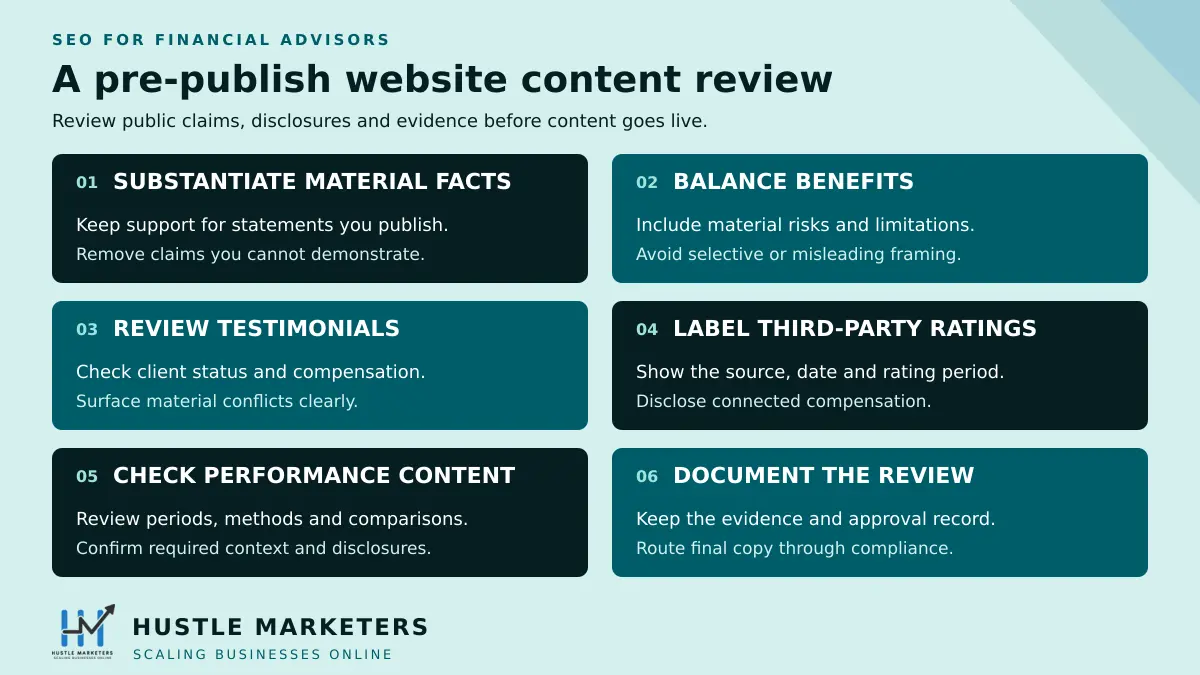
This section is the most important in the guide. Everything below applies on top of basic SEO, not instead of it.
What counts as an advertisement under the Marketing Rule?
17 CFR 275.206(4)-1 defines an advertisement as any direct or indirect communication an investment adviser makes to more than one person offering advisory services. That covers:
- Your website (all pages)
- Blog posts and articles
- Your Google Business Profile posts and description
- Reviews you solicit or feature
- Email newsletters
- Social media posts on firm accounts
- Third-party ratings and awards you display
- Calculators or projection tools
- Case studies, testimonials, client quotes or video stories
Extemporaneous oral communications and certain regulatory filings are excluded. Everything else is in scope.
What the seven general prohibitions mean for your website
The Marketing Rule prohibits advertisements that:
- Make untrue statements of material fact
- Make unsubstantiated material statements of fact
- Create a misleading implication through omission or framing
- Discuss benefits without fair and balanced treatment of risks and limitations
- Reference specific past advice unfairly (cherry-picking winning recommendations)
- Unfairly include or exclude performance periods or portfolios
- Are otherwise materially misleading
In practice: “Our clients consistently beat the market” requires data you must be able to produce, retain, and show an examiner. “We’ve helped clients retire early” is a testimonial that needs proper disclosures. “Fee-only” on your website must be accurate under NAPFA’s definition, substantiable, and consistent with your ADV.
Testimonials and Endorsements: The Four Required Conditions
Since November 2022, the Marketing Rule allows testimonials and endorsements on advisor websites. The four conditions:
- Clear and prominent disclosure of whether the person is a current client or non-client, whether compensation (cash or non-cash) was paid, and any material conflicts of interest.
- Adviser oversight. You need a reasonable documented basis for believing the testimonial complies with the rule.
- Written agreement with any compensated promoter (there is a de minimis exception for payments under a threshold, but that threshold is easily met by directory referral fees).
- Disqualification check. You may not compensate “ineligible persons” (those subject to certain SEC or court disqualifications) for testimonials or endorsements, with a narrow exception from the January 15, 2026 FAQ update for people complying with an SRO final order that did not result in expulsion, suspension or a bar.
The December 2025 Risk Alert: What Examiners Actually Found
The SEC’s December 16, 2025 Risk Alert (“Additional Observations Regarding Advisers’ Compliance with the Advisers Act Marketing Rule”) is the most important compliance document affecting advisor SEO right now. Key findings:
- Testimonial disclosures were required but “not made in a clear and prominent manner”, buried behind hyperlinks or in font sizes smaller than the main text.
- Firms using lead-generation firms, social media influencers and referral networks had not recognized these arrangements as testimonial or endorsement programs at all, and had not updated their policies or executed written agreements.
- Third-party ratings were displayed without disclosure of the rating date, the period the rating covers, or any compensation paid to the rating service.
- Weak documentation of the “reasonable basis” requirement for testimonial compliance.
Translation to your website: if your Google review widget pulls in reviews without a disclosure that some reviewers may have received compensation (or an explicit statement that none did), and without any indication when the reviews were collected, you have a potential Marketing Rule problem. If a referral platform sends you leads without a written agreement and a recognized testimonial/endorsement disclosure, the December 2025 Risk Alert specifically identifies that pattern as a deficiency.
SEC Enforcement: What the Fines Actually Look Like
| Date | Issue | Firms | Total penalty |
|---|---|---|---|
| Sep 11, 2023 | Hypothetical performance shown to the public without required policies; two firms also failed to retain advertisement copies | 9 firms including Banorte, Elm Partners, McElhenny Sheffield, MRA Advisory | $850,000 |
| Apr 12, 2024 | Hypothetical performance on public websites without required policies | GeaSphere ($100k) + 4 others ($20k–$30k each) | $200,000 |
| Sep 9, 2024 | Unsubstantiated third-party ratings, stale awards (5+ years old, no dates), “conflict-free” claims, testimonials from non-clients presented as clients, undisclosed paid video endorsers | 9 firms including Integrated Advisors Network ($325k), Richard Bernstein Advisors ($295k), Abacus Planning Group ($150k) | $1,240,000 |
| Nov 1, 2024 | Paid athlete endorsements without disclosures (~18 months); hypothetical performance to a general audience (~17 months) without required policies | Wahed Invest | $250,000 |
| Dec 20, 2024 | False claims that Morningstar “verified/validated” hypothetical performance; gross without equal-prominence net; compliance and recordkeeping failures | Atlas Financial Advisors | $175,000 |
The September 2024 sweep is directly relevant to SEO. Awards, ratings and social proof are standard SEO trust signals. For advisors, every one of those signals requires disclosure of the rating date, the period it covers, the third party’s identity, and whether you paid for the rating or the platform.
What your records must include
Under Rule 204-2:
- A copy of every advertisement you publish, including blog posts, GBP posts, review replies and email newsletters
- A memorandum of reasons for any specific security recommendation where reasons are not in the ad itself
- A copy of every questionnaire or survey used in preparing a third-party rating you display
- Records substantiating your reasonable basis for believing testimonials comply
- Working papers and records necessary to demonstrate any performance calculation
Retention: at least five years, the first two in an accessible office location. This means your blog revision history matters. A post updated in 2027 is a new advertisement; you need records of what it said before and after, and why you changed it.
Third-party ratings and Google Ads keyword targeting
The Marketing Rule’s third-party rating requirements (clear disclosure of date, period, third party identity, compensation) are frequently violated on advisor websites. Many display “Forbes Top Advisor 2024” badges without disclosing whether they paid Forbes or its ratings partner, when the evaluation was conducted, or what period the rating covers.
The April 2024 Risk Alert and the September 2024 enforcement sweep both flagged stale ratings as a priority issue. The rule requires the rating date and the period it covers to be disclosed for every third-party rating, whatever its age, and an old award shown without those dates may also be materially misleading.
Broker-Dealer Representatives: What FINRA 2210 Means for Your Website
If you are registered with a broker-dealer, your firm’s compliance department likely controls your website domain and may require pre-approval of everything. Here is the legal frame:
FINRA Rule 2210 classifications:
- Retail communication = any written or electronic communication distributed to more than 25 retail investors within any 30 calendar-day period. Your website qualifies.
- A registered principal must review and approve retail communications before use or filing. That includes new blog posts, landing page updates, and GBP description changes.
- New FINRA members must file retail communications used in public media at least 10 business days before first use.
Testimonial disclosures under Rule 2210(d)(6): when you feature a client testimonial, you must disclose that it may not be representative of other clients’ experience, that it does not guarantee future performance or success, and, when compensation exceeds $100. That it was paid.
Adoption and entanglement: linking from your firm-hosted website to a third-party article can constitute “adoption” of that content, making it a firm communication subject to Rule 2210. If you link to a LinkedIn article you contributed heavily to, or to a podcast episode you co-hosted, and that content says something your BD has not approved, you may have a problem. FINRA Notice 11-39 makes clear that linking to third-party content “can constitute adoption” where the firm exercises influence over the linked content.
What this means for BD-affiliated advisors doing SEO:
- Get your compliance department involved before your SEO program touches the firm’s approved website.
- Ask your BD whether you are allowed to publish an independent blog under a separate domain and what that requires.
- Your SEO vendor should understand that every piece of content may need pre-approval before publication, not after.
In practice, BD-affiliated advisors often find that SEO is effectively controlled by their firm’s home office, with limited individual customization outside directories and approved bio pages.
State-Registered Advisers: What Changed in 2026
If you manage less than $100 million in assets, you register with your state securities regulator, not the SEC. Until recently, state advertising rules were older and often less specific than the Marketing Rule.
NASAA amended its Model Rule 102(a)(4)-1 on May 4, 2026 to carry Marketing-Rule-style provisions: no untrue or unsubstantiated statements, net performance with equal prominence alongside gross, testimonial and endorsement disclosure conditions (client vs non-client status, compensation, conflicts), written agreements with compensated promoters, disqualification checks, and third-party rating conditions including questionnaire integrity and disclosure of rating date, period, provider, and compensation. Companion recordkeeping rules also carry the May 4, 2026 date.
State adoption of model rules varies. Check your state’s current adopted rule version before treating the NASAA model as law in your jurisdiction.
Keyword strategy for financial advisors
How advisors’ prospects actually search
High-intent prospect searches fall into four clusters:
Service + location (highest commercial intent):
- “financial advisor [city]”, high volume, high competition
- “fee-only financial advisor [city]”, medium volume, extremely high intent
- “advice-only financial planner [city]”, lower volume, highest conversion intent
- “fiduciary financial advisor near me”, strong intent, medium competition
- “wealth management [city]”, higher AUM signal
- “retirement planning advisor [city]”, strong intent
Niche + life stage:
- “financial advisor for doctors [city]”
- “financial planner for tech employees near me”
- “financial advisor for small business owners”
- “retirement planning for federal employees”
- “financial advisor for widows/widowers”
- “financial planner for 401k rollover”
Informational (content engine):
- “how to find a financial advisor”
- “what does a financial advisor cost”
- “fee-only vs fee-based advisor”
- “do I need a financial advisor”
- “when should I see a financial planner”
- “what is a fiduciary financial advisor”
Verification + trust (prospects already in your funnel):
- “[your name] reviews”
- “[your firm name] ADV”
- “is [your firm name] legit”
- “FINRA BrokerCheck [your name]”
Informational content the blog should cover:
- Roth conversion strategy (40,000+ monthly US searches)
- Social Security claiming strategy (50,000+)
- Required minimum distributions (22,000+)
- 401k rollover to IRA rules (8,000+)
- Financial advisor cost (10,000+)
- Backdoor Roth IRA (27,000+)
- How much to save for retirement (25,000+)
- Equity compensation / RSU taxation (4,000+)
- Medicare planning (3,000+)
The “Fee-Only” Keyword Cluster and the Compliance Risk
“Fee-only financial advisor [city]” is one of the highest-intent keyword clusters in the advisor space. The consumers searching this phrase have already researched the difference between fee-only and commission-based advisors. They want a fiduciary with no sales incentive.
The risk: using “fee-only” as a keyword if you are not actually fee-only as defined by NAPFA (compensated directly by clients only, no commissions of any kind) is both a Marketing Rule substantiation failure and a CFP Board disciplinary risk. CFP Board disciplinary documents show members who have been sanctioned for publicly misrepresenting their compensation method as fee-only on their website and on the Let’s Make a Plan directory listing.
Use this keyword only where accurate. Where accurate, it is a powerful differentiator.
AI search exposure for advisor keywords
Not all advisor keywords face equal AI Overview competition. Ahrefs’ November 2025 study of 146 million SERPs found that financial YMYL keywords trigger AI Overviews 22.9% of the time, lower than medical YMYL (44.1%) and legal YMYL (23.6%). The types of queries that trigger them are overwhelmingly informational. Local commercial queries like “financial advisor near me” and “fee-only planner [city]” trigger AI Overviews far less often.
Practical split:
| Query type | AI Overview exposure | SEO opportunity |
|---|---|---|
| “financial advisor near me” | Low | Map pack, GBP, local landing pages |
| “fee-only financial advisor [city]” | Low | Location pages, NAPFA/CFP Board listings |
| “Roth conversion strategy” | High (informational) | Long-form blog, FAQ schema, cited sources |
| “when should I start taking Social Security” | High | Blog, video, podcast transcript |
| “what does a financial advisor charge” | Medium | Pricing/FAQ page |
| “fiduciary financial advisor explained” | High (informational) | Educational pillar page |
For informational content, the AIO is a reason to optimize for citation, not a reason to avoid the topic. According to Ahrefs’ April 2025 data, position-1 CTR drops 34.5% when an AI Overview is present, but if your content is cited inside the AIO, you get a different kind of visibility.
Local SEO for financial advisors
Local SEO is where the highest-intent, closest-to-converting prospects find you. An advisor in the map pack gets calls. An advisor on page three of local results does not.
Google Business Profile: Rules That Directly Affect Advisors
[Primary source: Google’s Guidelines for Representing Your Business on Google]
The business name in your GBP must match your real-world branding. You may not add keywords, cities, specialties, or credentials to the name field. This creates a direct conflict with a tempting SEO shortcut: adding “CFP®, Fee-Only Financial Planner” to your GBP name. Google can suspend the profile for keyword-stuffed names, and the CFP Board’s August 2024 marks guide prohibits using the CFP® marks in a domain name, URL, or hashtag, and by extension any profile field where it functions like a handle rather than a professional title.
Individual practitioner profiles: Google explicitly allows individual advisors to have their own GBP separate from the firm. If you are public-facing and contactable at the verified location, you may have an individual profile. If you are the only public-facing advisor at a branded location, Google asks for one shared profile named “[brand]: [practitioner name]”, for example, “Smith Wealth Management: Jane Doe.” At a multi-advisor office, the firm keeps its own profile and each advisor can have a separate one, and Google says the advisor’s profile should carry only the advisor’s name, not the firm’s.
Virtual offices and coworking spaces: Google does not allow a coworking address unless the office has clear signage, receives clients there during business hours and is staffed by your own team during those hours. This catches many virtual RIAs that list a WeWork address as their business location. A suspended GBP is worse than no GBP, and an ineligible listing is a suspension risk.
Service area businesses: if you serve clients remotely without a physical office open to the public, you can set up a service-area business profile, hide your address, and define the geographic areas you serve. This does not get you into the map pack for city-level searches, but it does provide basic directory presence.
Reviews: Satisfying Google and the SEC Simultaneously
Most advisor websites treat reviews as either pure marketing (maximize and display) or pure compliance risk (avoid entirely). Neither is correct.
What Google requires:
- Genuine reviews without incentives
- No review gating (you cannot ask happy clients to review and discourage unhappy ones)
- No reviews from current or former employees or people in a contractual relationship that creates a conflict
What the Marketing Rule requires:
- If the reviewer is a current client: a clear and prominent disclosure that this is a testimonial from a current client and whether any compensation was paid
- If compensation was paid: a written agreement with the reviewer
- Your documented reasonable basis for believing the review complies
- A retained record of the testimonial
The collision point: Google prohibits incentivized reviews. The Marketing Rule permits paid testimonials but requires disclosure and a written agreement. A review published on Google is both a Google platform review (subject to Google’s policy) and an advertisement (subject to the Marketing Rule if you solicited it or feature it). If you display a Google review widget on your website, you are featuring testimonials that require disclosures under the rule.
The reply you write is also an advertisement. When you reply to a Google review, that reply is a direct communication from the adviser making an implied representation about the client’s experience. It must not disclose confidential client information, must not be false, and must not contain unsubstantiated claims. A reply like “We’re so glad we helped you reach your financial goals!” is a claim about results that could require substantiation.
A practical compliant review program has four components:
- A written solicitation process that does not incentivize or gate
- Disclosure language on the page or widget where reviews appear
- A review response protocol approved by your compliance officer
- Records of all solicited and featured reviews
Directory citations and the Marketing Rule overlay
Key directories for financial advisors:
- NAPFA Find an Advisor, for fee-only members; filters by fee structure, client markets, and 17 technical focus areas. Listing is not an endorsement.
- CFP Board Let’s Make a Plan, for CFP® professionals who opt in; verifies certification status; location search with planning service filters.
- XY Planning Network, for fee-only, advice-only advisors; strong filtering for advice-only models; community rates its search filters as best available.
- Wealthtender, compliance-oriented review collection and website review widget; positioned for AI search visibility.
- FINRA BrokerCheck, required disclosure link for BD representatives; Google often surfaces BrokerCheck for advisor name searches.
- SEC IAPD / AdviserInfo, required disclosure for RIAs; link to your ADV from your website.
Compliance overlay: a paid directory listing or a paid lead program (SmartAsset AMP, Zoe Financial, etc.) is generally a testimonial/endorsement arrangement under the Marketing Rule. If the directory receives compensation from you and promotes you to consumers, the December 2025 Risk Alert specifically names this type of arrangement as one that many advisors have failed to treat as requiring written agreements, disclosures, and oversight. Have your compliance officer review any paid referral relationship before treating it as a simple marketing expense.
E-E-A-T, YMYL and your credentials on the page
Financial advisory content is a textbook YMYL category (Your Money, Your Life). Google’s quality evaluator guidelines require the highest standards of expertise, experience, authoritativeness, and trustworthiness for financial content.
How to demonstrate E-E-A-T on an advisor website
Author bios with credentials: every piece of content should have a named author with a photo, their designations (CFP®, CFA, CPA, etc.), years of experience, and a link to their LinkedIn. Bios should be specific: not “Jane has 15 years of experience” but “Jane Doe, CFP®, has worked with physicians and tech executives at Series A+ companies since 2011.”
Your ADV and BrokerCheck: link to your Form ADV Part 2A from your footer and your About page. Link to your FINRA BrokerCheck or SEC AdviserInfo page. These signals tell both users and Google that you operate in a regulated environment, have filed disclosures, and are findable in official records. Most advisors avoid these links out of reflex; the advisors who include them look more trustworthy.
Third-party coverage: mentions and links from NAPFA, CFP Board, XYPN, local business press, professional associations, local bar or medical association newsletters (if you specialize in serving lawyers or doctors), and financial trade media all strengthen domain authority in a highly regulated space.
CFP® and CFA® Marks in Your Web Copy: Hard Limits
[Primary source: CFP Board, Guide to Use of the CFP® Certification Marks, August 2024]
The CFP Board’s marks guide directly constrains several SEO tactics:
- CFP® may not appear in a domain name, URL, email address, or hashtag. A domain like “johndoecfp.com” is non-compliant.
- CFP® may not be part of a company name in any form, even abbreviated.
- The marks must be used as adjectives only, with six approved nouns: professional, practitioner, certificant, certification, mark, exam. “She is a CFP®” is non-compliant. “She is a CFP® professional” is compliant.
- Title tags, H1 headings, GBP names, and social handles are all affected by the domain/URL/hashtag restriction.
- Every page using the marks must carry CFP Board’s attribution tagline.
CFA Institute rules are similar: CFA® may not appear in company names, URLs, email addresses, social handles, or firm logos. Use CFA as an adjective with an approved noun, as in “John Doe is a CFA charterholder”, never as a noun (“John is a CFA”). Writing “John Doe, CFA” after a name is permitted.
Why this matters for SEO: advisors who have built exact-match domains on their credentials (cfpadvisortexas.com, dallaswealthcfp.com) need to know this is a compliance violation, not just a branding choice. Exact-match domains rank well in some contexts, but a domain that violates the marks guide creates disciplinary risk and should be migrated.
Technical SEO and schema for financial advisors
Site structure for an advisory website
A strong advisory site structure:
- Home (primary entity page, firm name, location, core proposition)
- Services (parent hub: financial planning, retirement planning, investment management, tax planning, estate planning coordination)
– /services/retirement-planning/
– /services/financial-planning/
– /services/investment-management/
– etc.
- Who We Serve (niche hub: physicians, tech executives, business owners, retirees, federal employees)
– /who-we-serve/physicians/
– /who-we-serve/tech-employees/
– etc.
- About (firm page, team bios, ADV link, BrokerCheck link, disclosure page)
- Blog (content hub for informational keywords)
- Contact + Location (dedicated page per office, NAP, embedded map, hours)
Schema Markup: What Works and What Does Not Exist
[Primary source: schema.org/FinancialService and Google’s structured data search gallery]
There is no Google-supported finance-specific rich result. The structured data gallery does not include any rich result for financial advisors, investment managers, or financial planners. Schema markup for advisory sites is useful for entity clarity and AI extraction, not for special SERP features.
Recommended markup:
{
  "@context": "https://schema.org",
  "@type": ["FinancialService", "LocalBusiness"],
  "name": "Smith Wealth Management",
  "url": "https://smithwealth.com",
  "telephone": "+1-512-555-0100",
  "address": {
    "@type": "PostalAddress",
    "streetAddress": "123 Main Street, Suite 400",
    "addressLocality": "Austin",
    "addressRegion": "TX",
    "postalCode": "78701"
  },
  "geo": {
    "@type": "GeoCoordinates",
    "latitude": 30.26512,
    "longitude": -97.74391
  },
  "openingHoursSpecification": [..],
  "sameAs": [
    "https://www.linkedin.com/company/smith-wealth-management",
    "https://adviserinfo.sec.gov/firm/summary/[CRD]",
    "https://www.finra.org/investors/have-a-problem/check-out-brokers-firms/brokercheck?firm=[CRD]"
  ]
}
Add Person schema for each advisor:
{
  "@type": "Person",
  "name": "Jane Doe",
  "jobTitle": "Financial Planner",
  "hasCredential": {
    "@type": "EducationalOccupationalCredential",
    "name": "CFP®",
    "url": "https://www.cfp.net/verify-a-cfp-professional"
  },
  "sameAs": [
    "https://www.linkedin.com/in/janedoe-cfp",
    "https://adviserinfo.sec.gov/individual/summary/[CRD]"
  ]
}
The FinancialService type has a property `feesAndCommissionsSpecification` that can hold a URL or description of your fee schedule. If you publish fee ranges, linking them here helps AI tools correctly categorize your pricing model.
Review snippet restrictions: if your site displays testimonials, they are not eligible for Google review rich results when they are self-serving reviews about your own business on your own site. Google’s review snippet guidelines also say not to aggregate reviews or ratings from other websites, so copying your Google or directory reviews into review markup does not qualify either.
Page speed and Core Web Vitals
Financial advisory websites often carry high-res partner logos, compliance PDFs, and third-party scripts (live chat, scheduling tools, CRM integrations, compliance recording). These can significantly slow page load. Prioritize:
- Main thread blocking from Calendly, HubSpot or Redtail embeds: load asynchronously or defer
- Third-party compliance recording tools: test their impact with a Lighthouse audit before adding
- Stock photo hero images: compress to WebP under 150KB
- Your PDF disclosures: link them rather than embedding them inline
Google’s Core Web Vitals, LCP (Largest Contentful Paint), INP (Interaction to Next Paint), and CLS (Cumulative Layout Shift), are ranking signals. An advisory website with a slow LCP because the compliance recording script loads synchronously is losing ranking ground it does not need to lose.
AI Search: What Earns Citations for Financial Advisors
Ahrefs’ November 2025 study confirmed that 99.9% of AI Overview keywords are informational. For advisors, the content most likely to appear in AI Overviews answers retirement, tax, and planning questions clearly, cites authoritative sources, and does not contain vague claims.
To optimize for AI citation:
- Answer questions directly in the first two to three sentences, before caveats. AI models extract the answer, not the qualifier.
- Cite primary sources in your content. When you reference the Social Security Administration’s benefit calculation methodology, link to SSA.gov. When you discuss Roth conversion rules, link to IRS Publication 590-B. Linked primary sources also make your claims easier for readers, examiners and AI tools to check.
- Use structured FAQ sections. FAQ schema markup and a clearly formatted Q&A section make your content easier for AI to extract and attribute.
- Keep credentials visible. Named, credentialed authors are a trust signal readers and Google’s quality raters look for on financial content.
- Complete your directory profiles. Your NAPFA, CFP Board Let’s Make a Plan and XYPN profiles are public pages that search engines and AI assistants can read. Complete them fully. Wealthtender explicitly positions its advisor profiles as optimized for ChatGPT and Perplexity visibility.
The AI search and BrightLocal 2026 data collision: AI tools jumped from 6% to 45% for local recommendations in one year. If your firm is not findable on these platforms, either because it has no content they can extract, or because your profiles on the directories that AI tools rely on are incomplete, you are already losing a cohort of higher-AUM prospects who use ChatGPT to screen advisors before they ever type a Google search.
Measurement, reporting and realistic timelines
What to track
| Metric | Tool | Why it matters |
|---|---|---|
| Keyword rankings | Semrush, Ahrefs | Trend over time; not a daily KPI |
| Organic sessions | Google Analytics 4 | Volume baseline |
| Contact form submissions from organic | GA4 goal/conversion tracking | Revenue-linked |
| Call clicks from organic (GBP) | GBP Insights + call tracking | Local intent conversion |
| AI citation appearances | Manual checks in ChatGPT, Perplexity, Google AI Mode | Emerging |
| New client source (organic vs paid vs referral) | Your CRM | Business outcome |
Realistic timeline
| Month | Milestone |
|---|---|
| 1–3 | Technical fixes live, GBP optimized, profiles completed, first blog posts published |
| 3–6 | Rankings begin moving on low-competition informational terms and local long-tail |
| 6–12 | Organic sessions growing; inquiries from organic visible in CRM |
| 12–24 | Authority building; competitive local terms ranking; measurable client acquisitions |
| 24+ | Compounding returns; blog content driving consistent inquiry flow |
If an agency tells you that you will be on page one for “financial advisor [major city]” in six months, that claim requires scrutiny. That keyword may take two to three years of consistent work in a competitive market.
Google Ads for US Financial Advisors: No License Verification Required
One persistent piece of misinformation in advisor marketing blogs is that US advisors face a Google Ads financial services license verification requirement similar to the programs in Europe.
This is currently false. Google’s June-July 2026 rollout of financial services verification covers 24 EEA markets. There is no United States row in Google’s regulator table for that program. US advisors are subject to Google’s general financial products and services advertising policy (disclose address, fees, and accreditations; comply with applicable law in targeted locations) and Google’s standard advertiser identity verification. They are not required to submit an SEC registration number for ad approval.
When Google Ads makes sense: paid search for “financial advisor near me” in competitive cities, or for specific planning keywords during high-intent seasons (Q4 Roth conversion, January retirement planning), is a valid channel. Kitces recommends spending approximately $1,500 per keyword in paid ads to validate demand before committing to a long-term SEO investment in competitive terms. Financial services CPCs range from $20 to $50 per click (Web Tonic 2026).
Financial advisor SEO FAQs
Does SEO work for financial advisors?
Yes. It has the lowest measured client acquisition cost of the marketing channels studied by Kitces Research, and only about 22% of advisors currently invest in it, making it a less crowded channel than referral networks or paid directories.
Can financial advisors use client testimonials on their website?
Yes, since November 2022 under the SEC Marketing Rule. You need clear and prominent disclosures (current client or not, whether compensation was paid, any material conflicts), documented oversight, and a written agreement with any compensated promoter. The December 2025 Risk Alert found that many advisors’ disclosures were technically present but buried in hyperlinks or small text, which is not compliant.
What is the best SEO strategy for a financial advisor just starting out?
In order: (1) set up and fully complete your Google Business Profile and key directories (NAPFA, CFP Board, Wealthtender, XYPN if eligible); (2) publish a clear, credential-forward About page with ADV and BrokerCheck links; (3) write one good answer to the most common question your ideal client asks, Roth conversions, when to claim Social Security, how much an advisor costs; (4) get 5–10 genuine Google reviews from current clients with your compliance officer’s approval; (5) then consider an agency.
How long does it take for financial advisor SEO to work?
Three to six months for low-competition local and informational terms to begin moving. Twelve to twenty-four months for meaningful local competitive rankings and measurable client acquisitions. Two to three years or longer for major metro competitive terms.
Do FINRA-registered advisors need approval before publishing a blog post?
Generally, yes. Blog posts published on a firm website and distributed to more than 25 retail investors in 30 days are retail communications under FINRA Rule 2210 and require registered principal pre-approval before going live. Individual BD representatives typically cannot run an independent SEO content program without their BD’s involvement.
Is there a Google rich result for financial advisors?
No. Google’s structured data search gallery does not include any finance-specific rich result. Mark up your site with FinancialService, LocalBusiness, Organization, and Person schema for entity clarity and AI extraction, not to chase a SERP feature that does not exist.
What directories should financial advisors be listed in?
NAPFA Find an Advisor (for fee-only members), CFP Board Let’s Make a Plan (for CFP® professionals), XY Planning Network (for fee-only and advice-only advisors), Wealthtender, and BrightLocal-indexed local directories. Paid platforms like SmartAsset AMP are compensated referral arrangements that require treatment as testimonial/endorsement programs under the Marketing Rule.
Does the Google financial services ad verification requirement apply to US advisors?
Currently, no. Google’s financial services verification program launched in 24 EEA markets in June-July 2026. The United States is not in scope. US advisors face Google’s standard financial products and services policy and advertiser identity verification, not SEC license verification.
What schema should a financial advisor website use?
Use FinancialService (a subtype of LocalBusiness) for the firm, Person for each advisor with their credentials, and Organization for the firm entity. Skip FAQPage: Google stopped showing FAQ rich results in Search on May 7, 2026 and removed the documentation on June 15, 2026, so the markup no longer earns a SERP feature. Keep the FAQ content itself on the page, because that is what AI assistants quote. Also skip aggregateRating on your own site, since Google treats a business marking up reviews about itself as ineligible for star display, and for an SEC-registered adviser a self-published rating raises Marketing Rule questions on top of that. There is no finance-specific rich result in Google’s supported types. The goal of schema for advisors is entity clarity and AI extraction, not special SERP features.
How Hustle Marketers helps financial advisors with SEO
Hustle Marketers works with financial advisors and RIA firms on SEO services and Google Ads campaigns that are structured for compliance as well as performance. Our work includes keyword research, content plans, technical audits, GBP management, and Google Ads account builds that account for the Marketing Rule’s advertising requirements. In professional services we have run lead generation for a law firm, a sector with comparable compliance constraints. We also work with advisors on AI SEO strategies for visibility in ChatGPT, Perplexity and Google AI Mode.
If your advisory website needs a full technical review, content plan, or an ad account structure, contact us to talk through what your program should look like.
Sources and verification
Facts that can change were verified on September 17, 2026 against these primary sources:
- SEC Marketing Rule, 17 CFR 275.206(4)-1
- SEC Marketing Rule FAQ page
- SEC Risk Alert, April 17, 2024
- SEC Risk Alert, December 16, 2025
- SEC enforcement: September 2023 sweep
- SEC enforcement: April 2024 sweep
- SEC enforcement: September 2024 sweep
- SEC enforcement: Wahed Invest, November 2024
- SEC enforcement: Atlas Financial, December 2024
- SEC Rule 204-2, recordkeeping
- FINRA Rule 2210
- FINRA Rule 4511
- NASAA Model Rule 102(a)(4)-1, amended May 4, 2026
- CFP Board, Guide to Use of the CFP® Certification Marks, August 2024
- Google Business Profile guidelines
- Google review/contribution policy
- Google Ads financial products and services policy
- Google Ads financial services verification announcement
- schema.org/FinancialService
- Google structured data search gallery
- Ahrefs: What Triggers AI Overviews, November 10, 2025
- Ahrefs: AI Overviews Reduce Clicks by 34.5%, April 17, 2025
- BrightLocal Local Consumer Review Survey 2026
- IAA 2026 Investment Adviser Industry Snapshot
- Kitces.com: Managing Outsourcing of SEO for a Financial Advisor, October 9, 2023
About the author: Ishant Sharma has worked in digital marketing since 2013 as a Google Ads, Microsoft Ads and SEO specialist, across ecommerce, local service, SaaS and white label agency accounts in the US, UK, UAE and Australia. He leads SEO services and AI SEO at Hustle Marketers. He founded Hustle Marketers, a Google Partner and Meta Business Partner agency, and one of the best digital marketing agency options for ecommerce and local service brands. Trackable client sales across his work have passed $780M, and he is Top Rated Plus on Upwork. More about Ishant.
Related guides
If this one was useful, these cover the same ground for closely related businesses.