SEO for Accountants: How CPA and Accounting Firms Get More Clients from Google, Maps and AI Search (2026 Guide)

Ishant
Published : September 25, 2026 at 8:30 am
Updated : October 16, 2026 at 12:14 pm
Ishant

Written by Ishant Sharma, Google Ads, Microsoft Ads and SEO specialist since 2013 | Updated September 2026 | Facts checked September 17, 2026
Most accounting firms still grow through referrals. In TaxDome’s 2025 survey of 350 US businesses, 58% found their current accountant through a referral, and online search was the next biggest channel at 17% (CPA Practice Advisor). That is exactly why SEO for accountants matters. Search is the second door into your firm, and referred prospects still Google your name, read your reviews and check your website before they call.
SEO for CPA firms also comes with rules most guides ignore. Enrolled agents cannot describe themselves as “certified” under IRS Circular 230. Several state boards restrict self-praise, testimonials and “specialist” claims. One of the top ranking guides even recommends discounts for reviews, which Google prohibits. This guide covers the full playbook, including the parts that keep your firm and your license safe.
How we researched this guide: we checked the current top results for “SEO for accountants”, “SEO for accounting firms” and “CPA SEO” in Semrush on September 17, 2026, and read the ranking guides from software vendors, agencies and CPA coaches. We also used Semrush keyword data, Google’s Business Profile, Local Services Ads and Search Central documentation, IRS Circular 230, AICPA and state board advertising rules, FTC guidance, BLS and industry surveys, 11 YouTube videos about accountant marketing, and practitioner discussions on AccountingWEB, Reddit and the Local Search Forum. This is marketing guidance, not legal or ethics advice. Check advertising questions with your state board or ethics counsel.
Key takeaways
- SEO for accountants means ranking your firm in the map pack, organic results, professional directories and AI answers for the searches individuals and business owners make before they hire an accountant.
- Split your strategy. Tax preparation and bookkeeping searches are local and seasonal. Advisory searches such as fractional CFO or real estate tax planning can be won regionally or nationally with niche expertise.
- Never put services or cities in your Google Business Profile name, and never use “CPA” in a name or category unless the firm is licensed to use it.
- Ask every client for honest reviews, offer nothing in return, and never confirm in a public reply that someone is your client.
- Under Circular 230, enrolled agents must not describe their designation as “certified”, you cannot charge more than a published fee for at least 30 calendar days after it was last published, and copies of direct mail and e-commerce fee communications must be kept for 36 months.
- AI Overviews now answer many general tax questions, so generic tax blog posts drive fewer clicks. Firm-specific, niche and credentialed content wins.
- Measure signed engagement letters and client lifetime value, not rankings or traffic.
Table of Contents
- What is SEO for accountants?
- Is SEO worth it for accounting firms?
- What keywords should accountants target?
- How do accounting firms rank in the Google Maps local pack?
- How can accountants get more reviews and reply to them safely?
- What advertising rules apply to accountant SEO content?
- Which pages should an accounting firm website have?
- How do you plan accounting SEO around tax season?
- Which directories should accountants be listed in?
- Should accountants use Local Services Ads?
- How do you do technical SEO for an accounting firm website?
- How do accountants show up in AI search?
- Which popular accountant SEO tips break Google or professional rules?
- How do you track accountant SEO to signed engagements?
- How long does SEO take for accountants?
- How much does SEO for accountants cost?
- How Hustle Marketers helps accounting firms with SEO
- SEO for Accountants FAQs
What is SEO for accountants?
SEO for accountants is the process of improving how a CPA firm, accounting firm, enrolled agent or tax practice shows up on Google, Bing, Apple Maps, professional directories and AI assistants, so that people who need tax preparation, bookkeeping, payroll, tax resolution or advisory services find you, trust you and book a consultation. It covers six areas:
- Local SEO: your Google Business Profile, reviews, citations and map pack rankings.
- Website content: service pages, niche and industry pages, pricing, credentials and data security pages.
- Technical SEO: speed, mobile experience, secure forms, tracking and schema markup.
- Authority: professional directories, associations, software partner listings and local links.
- AI visibility: clear, credentialed content that AI Overviews, AI Mode and ChatGPT can trust and cite.
- Measurement: calls, consultations and signed engagements traced back to search.
How is SEO for CPA firms different from other local businesses?
- Your content is “Your Money or Your Life” content. Google gives even more weight to strong E-E-A-T on topics that could affect people’s financial stability, so anonymous, generic tax content rarely holds rankings.
- Your marketing is regulated. Circular 230, the AICPA Code of Professional Conduct and state boards of accountancy all have advertising rules that reach your website, profile and ads.
- Client confidentiality limits what you can say publicly, including in replies to online reviews.
- Demand is seasonal. Tax preparation searches rise and fall with the filing calendar, while advisory demand is steadier.
- Two very different markets. “Tax preparer near me” is a local, price-sensitive search. “Fractional CFO for SaaS” is a high-value search that may not be local at all.
Is SEO worth it for accounting firms?
For most firms, yes. The data:
| Finding | Data | Source |
|---|---|---|
| How businesses find accountants | Referral 58%, online search 17%, social media 10% (more than 350 US business decision-makers across revenue levels, 2025) | CPA Practice Advisor, reporting TaxDome’s survey |
| Responsiveness | 85% of business decision-makers said responsiveness is very or extremely influential when choosing an accountant | CPA Practice Advisor |
| Reviews | 97% of consumers read reviews for local businesses | BrightLocal 2026 |
| AI in local search | Use of ChatGPT and other AI tools for local recommendations rose from 6% to 45% in a year | BrightLocal 2026 |
| AI Overviews on finance searches | 24.9% of finance searches and 7.9% of local searches triggered an AI Overview (desktop results, September 2025) | Ahrefs |
| Profession size | 1,595,200 accountant and auditor jobs in 2025, with employment projected to grow 5% from 2025 to 2035 | US Bureau of Labor Statistics |
Two points stand out. First, referrals and search work together: a referred prospect who finds a thin website and three reviews may call the next name on the list. Second, AI Overviews appear on far more finance searches than local searches, so general tax explainers are more exposed to AI answers, while “CPA near me” style searches are still decided mostly by your profile and reviews.
Do accountants get more clients from Google or from referrals?
Both, and they are connected. Referrals are still the biggest source, but “online search” is the second biggest channel in the TaxDome survey. And many referred prospects search your name before they reach out. SEO protects the referral pipeline you already have and adds a second one. Our SEO ROI calculator helps you check the numbers for your firm.
What keywords should accountants target?
Start with real demand. Here is US monthly search volume for common accounting searches, pulled from Semrush in September 2026:
| Keyword | US monthly searches | Keyword difficulty | Avg. CPC |
|---|---|---|---|
| tax preparer near me | 60,500 | 46 | $8.27 |
| cpa near me | 49,500 | 49 | $8.13 |
| tax preparation near me | 33,100 | 51 | $8.27 |
| accountant near me | 18,100 | 44 | $11.05 |
| tax accountant near me | 18,100 | 30 | $9.11 |
| bookkeeping services | 18,100 | 51 | $12.54 |
| payroll services for small business | 9,900 | 59 | $99.89 |
| fractional cfo | 8,100 | 27 | $15.79 |
| bookkeeper near me | 8,100 | 33 | $8.45 |
| cpa firm | 6,600 | 31 | $5.78 |
| small business accountant | 5,400 | 18 | $20.77 |
| tax planning services | 4,400 | 19 | $13.64 |
| business tax preparation | 3,600 | 55 | $13.34 |
| tax resolution services | 2,400 | 40 | $19.82 |
| enrolled agent near me | 1,300 | 21 | $6.78 |
| real estate cpa | 1,000 | 23 | $12.81 |
Look at the difficulty scores. “Small business accountant” (KD 18) and “tax planning services” (KD 19) have low difficulty and CPCs above $13, which makes them some of the best targets for a firm website. The biggest “near me” terms are mostly won in the map pack.
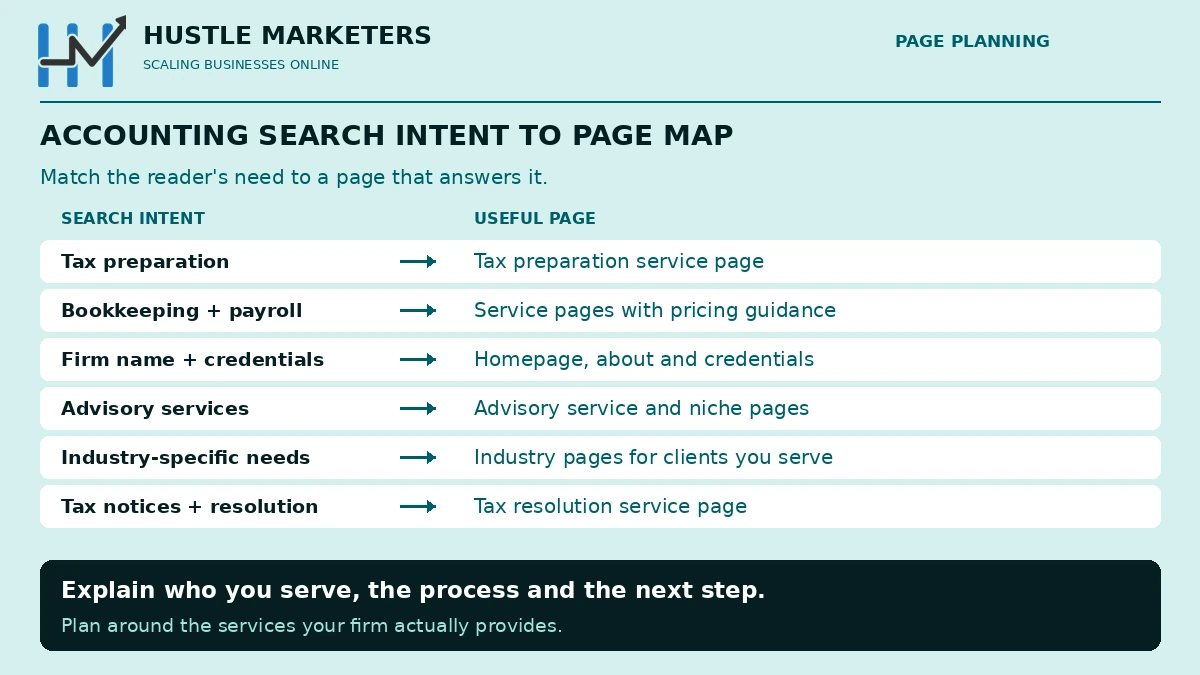
Group keywords by the kind of work, because compliance and advisory searches need different pages:
| Intent group | Example searches | Best page | Market |
|---|---|---|---|
| Tax preparation | tax preparer near me, tax preparation near me, business tax preparation | Google Business Profile, tax preparation page | Local, seasonal |
| Bookkeeping and payroll | bookkeeping services, bookkeeper near me, payroll services for small business | Service pages with pricing guidance | Local or regional |
| Firm search | cpa near me, accountant near me, cpa firm | Profile, homepage, about and credentials page | Local |
| Advisory | tax planning services, fractional cfo, small business accountant | Advisory service pages, niche pages | Regional or national |
| Niche | real estate cpa, crypto tax accountant, cpa for dentists | Industry pages | Often national |
| Problem | tax resolution services, irs audit help, back taxes | Tax resolution page | Regional or national |
“CPA” is also an ambiguous keyword. “CPA exam” gets 18,100 searches a month, “cpa jobs” gets 3,600, and “cpa marketing” (2,400) often means cost-per-action affiliate marketing. If you run Google Ads, add exam, jobs, salary, course and affiliate terms as negative keywords. Our PPC management team sets these up for professional service firms.
How do accounting firms rank in the Google Maps local pack?
Google says local results are based mainly on relevance, distance and prominence (the page also calls the third factor popularity), and that there is no way to pay for a better local ranking. Your work goes into relevance (accurate categories, services and matching website pages) and prominence (reviews, links, directory listings and how well known your firm is).
How should a CPA firm set up its Google Business Profile?
Use this checklist. Our guide on how to optimize a Google Business Profile covers each step in depth.
| Profile field | What to do | Common mistake |
|---|---|---|
| Business name | Your real-world firm name, exactly as on your signage, engagement letters and website | “Smith CPA Tax Preparation Dallas” |
| Primary category | The category that describes the firm, such as Certified public accountant, Accounting firm or Tax preparation service | Using Certified public accountant for a firm that is not CPA-licensed |
| Secondary categories | Only true ones, such as Bookkeeping service or Payroll service | Adding every finance category |
| Address | Your staffed office. Remote firms that do not meet clients should hide the address and set service areas | A virtual office or coworking desk without signage and staff |
| Hours | Real client-facing hours. Google allows current seasonal hours as regular hours, which suits tax season | Leaving Saturday tax-season hours up all year |
| Services | Tax preparation, tax planning, bookkeeping, payroll, advisory, with plain descriptions | Services you do not provide |
| Booking link | Your consultation or booking page with UTM tags | Sending bookings to the homepage |
| Photos | Real office, team and meeting room photos | Stock photos of calculators |
Google’s guidelines say names must not include service or location information, virtual offices are not eligible, and an office at a coworking space is eligible only if it has clear signage, receives customers during business hours and is staffed by your business during those hours (Google).
Should each CPA in the firm have their own Google Business Profile?
Google’s guidelines allow individual practitioners who are public-facing and reachable at the verified location to have their own profiles. Google’s list of examples names doctors, dentists, lawyers, financial planners and insurance or real estate agents, but not accountants, so treat this as an option rather than a requirement. How it applies to firms:
| Situation | What Google’s guidelines say |
|---|---|
| Firm with several client-facing CPAs | One profile for the firm. Practitioner profiles, if you create them, use the practitioner’s name only |
| Solo CPA practicing under a brand name | Google says it is best to share one profile named “[Firm name]: [Practitioner name]”, rather than a firm profile plus a personal profile |
| Home-based enrolled agent or bookkeeper | One profile, with the address hidden and service areas set, unless clients visit the home office |
| Support staff and admin team | No profiles |
Keep practitioner profiles to people clients actually book with, and use different phone numbers and categories from the main firm profile where possible so Google does not treat them as duplicates.
Which Google Business Profile categories should accountants use?
Google does not publish its category list, but third-party category tools show these accounting categories: Accountant, Accounting firm, Certified public accountant, Bookkeeping service, Tax preparation service, Tax consultant, Payroll service and Chartered accountant. Confirm the exact names inside your profile editor. There is no “Enrolled agent” category, so enrolled agents usually use Tax preparation service or Tax consultant. Google says to use as few categories as possible, so pick the ones that describe what your firm is.
Is Google Business Profile Q&A still worth using?
No. At least one popular accountant SEO video still recommends adding questions and answers to your profile, but Google discontinued the Q&A API on November 3, 2025, and Google Maps now answers questions with its AI-powered Ask Maps feature, rolling out in the US and India since March 2026, which BrightLocal reports draws on your profile, reviews and website. Put your common questions and answers on your website instead, and keep your profile details complete.
How can accountants get more reviews and reply to them safely?
Reviews matter to local rankings and to prospects comparing firms. But one of the top ranking accountant SEO guides suggests giving clients discounts for reviews, and another suggests starting with your best customers, which risks becoming selective asking. Google prohibits both review incentives and selectively soliciting positive reviews.
The rules that apply:
- Ask every client the same way. Google’s Maps content policy says merchants should not “selectively solicit positive reviews from customers.” The FTC says asking only happy customers could violate the FTC Act.
- No incentives. Google says offering free or discounted services in exchange for reviews is strictly prohibited. A fee reduction for a review is exactly that.
- No reviews from staff, partners or family. Google treats these as conflicts of interest.
- Do not ask for specific wording. Google says merchants should not request that specific content be included in reviews.
A compliant process: after an engagement is complete, such as when a return is filed or year-end work is delivered, send every client the same short email with your Google review link.
How should accountants reply to reviews without breaking confidentiality?
Accountants have confidentiality duties to clients, and tax preparers face federal limits on disclosing tax return information. A public reply that confirms someone is your client, or mentions their return, refund, audit or balance, creates unnecessary risk. Have your ethics or compliance lead approve a short set of reply templates:
| Review type | Safe reply |
|---|---|
| Positive | “Thank you for taking the time to share your feedback. Our team appreciates it.” |
| Negative | “Thank you for your feedback. We take every concern seriously, but confidentiality rules prevent us from discussing any individual matter online. Please call our office at [phone] so we can talk directly.” |
| Fee complaint | “We are sorry to hear about this frustration. We cannot discuss any individual matter publicly, but we would like to help. Please contact [name] at [phone].” |
| Suspected fake review | “We take all feedback seriously and would welcome a call at [phone] to understand more.” Then report the review to Google |
Never argue facts from a client’s file in public, even if the review is unfair.
What advertising rules apply to accountant SEO content?
None of the ranking guides we read covers these rules, yet they apply to your website, Google profile, title tags and ads. A summary of the main ones:
| Rule | What it says | What it means for your website |
|---|---|---|
| IRS Circular 230, 31 CFR 10.30 | Practitioners may not use public communications with false, fraudulent, coercive, misleading or deceptive claims. Enrolled agents “may not utilize the term ‘certified'” or imply an employment relationship with the IRS | Enrolled agents can say “enrolled to represent taxpayers before the Internal Revenue Service”. Never write “IRS certified” or use IRS logos |
| Circular 230 fees and records | A practitioner may charge no more than a published fee for at least 30 calendar days after it was last published. For fee communications, recordings of radio and TV broadcasts and copies of direct mail and e-commerce communications must be kept for at least 36 months after last use | Date and archive every version of your pricing and landing pages, and if you raise a published fee, charge no more than the old rate for 30 calendar days after the old rate last appeared |
| AICPA Code of Professional Conduct, Advertising and Other Forms of Solicitation Rule | AICPA members in the practice of public accounting must not seek clients through advertising or solicitation that is false, misleading or deceptive. The rule’s interpretation gives creating false or unjustified expectations of favorable results as an example | No “we guarantee a bigger refund” or “we will get your penalties removed” claims |
| Texas, 22 TAC 501.82 | Bans self-laudatory statements not based on verifiable facts, testimonials or endorsements not based on verifiable facts, and untrue comparisons with other accountants | “Best CPA in Houston” needs verifiable support, and testimonials must be factual |
| Florida, 61H1-24.001 | A CPA who uses “specialist” or “specialty” in advertising must state that the term is a self-designation not sanctioned by the state or federal government, and ads must not appeal primarily to fears about financial well-being | “Crypto tax specialist” pages need the disclaimer, and “the IRS is coming for you” copy is risky |
| New York, 8 NYCRR 29.1 | Bans ads that guarantee a service or make superiority claims that cannot be substantiated, and requires keeping copies of ads for one year | No guarantees, no unsupported “best” claims |
| “CPA” in firm names | Rules vary by state. In Connecticut, if “CPA” is in the firm name, every owner must be a CPA | Check your state before adding “CPA” or “CPAs” to a profile name, title tag or domain, especially if the firm has non-CPA owners |
For firms marketing tax resolution, fear-based copy is common in ads. It is also exactly what some state rules target. Explain the problem calmly and describe the process instead.
Can accountants publish their fees online?
Yes, and it can help. Circular 230 section 10.30(b) allows practitioners to publish fixed fees, hourly rates and fee ranges, as long as you honor the published rates for at least 30 calendar days after you last published them. Prospects comparing firms appreciate a starting price for a standard individual return or monthly bookkeeping package, and clear fees filter out clients who are not a fit. Keep dated copies of your pricing page.
Which pages should an accounting firm website have?
| Page | Purpose | Key content |
|---|---|---|
| Homepage | Firm and “cpa near me” searches | Who you serve, services, location or service area, credentials, reviews, consultation button |
| Tax preparation | Seasonal local demand | Individual and business returns, what to bring, timelines, starting fees |
| Tax planning and advisory | Higher-value clients | Who it is for, process, example situations, how fees work |
| Bookkeeping and payroll | Recurring revenue | Packages, software you support, onboarding steps |
| Tax resolution | Problem searches | Notices you handle, the process, credentials of who represents clients |
| Industry and niche pages | Specialized demand | Industry-specific issues, examples, credentials |
| Team and credentials | E-E-A-T | Each CPA or EA with license or enrollment details, experience and specialties |
| Pricing | Qualify prospects | Starting fees or ranges, what affects price, date last updated |
| Data security | Trust | Client portal, how documents are handled, written security plan |
| Resources | Useful content | Checklists, deadline calendars, local and industry updates |
How should accountants build niche and industry pages?
Niche pages are where accounting SEO is easiest to win, because generic “tax preparation” content is crowded and increasingly answered by AI. A YouTube video from accounting marketer CountingWorks PRO puts it plainly: if your firm is generic, AI won’t surface you. Build pages only for industries you actually serve:
- Who it is for, such as real estate investors with rental portfolios or dental practices.
- The specific accounting and tax issues that industry faces, written by someone who works on them.
- Services packaged for that niche, such as cost segregation studies or practice entity reviews.
- Anonymized examples of situations you have handled, with client permission where needed.
- Credentials and reviewer, with a “reviewed by [name], CPA, on [date]” line.
- The Florida-style disclaimer if you use “specialist” and your state requires it.
Avoid templated niche pages that swap the industry name. Google’s spam policies treat mass-produced pages without real value as scaled content abuse. Syndicated “content library” blogs shared across many firm websites have a related problem: the same articles appear on many sites, so they rarely rank. In a UK case study video, Targeted SEO described a firm whose reused blog content never really indexed or performed until it was replaced with original service and sector pages.
Should accounting firms build city pages?
Only where you have a real office or a meaningful client base. Google’s spam policies describe pages targeted at specific cities that funnel users to one page as doorway abuse. A firm with one office is better served by a strong homepage, a clear service area and one or two pages for nearby areas where you can show real local knowledge, such as state and local tax rules or local business community involvement.
Why should CPA firms publish a data security page?
Because clients are handing you their most sensitive financial information, and your security practices are also a legal requirement. The FTC says the Safeguards Rule covers tax preparation firms, and IRS Publication 4557 explains that professional tax preparers must have a written information security plan. A plain-English “How we protect your information” page covering your client portal, multi-factor authentication, document handling and data retention builds trust and helps conversions. Do not claim certifications or endorsements you do not have, such as “IRS-approved security”.
How do you plan accounting SEO around tax season?
Plan content and profile updates around the IRS calendar, and publish before demand peaks. Key 2026 dates from the IRS: the filing season opened on January 26, 2026, individual returns were due April 15, and IRS Form 1040-ES lists 2026 estimated tax payments due June 15 and September 15, 2026, and January 15, 2027, while Publication 509 shows extended individual returns due October 15, 2026. The IRS has not yet announced the 2027 filing season opening date.
| Months | What prospects search for | SEO and profile actions |
|---|---|---|
| December to January | Tax preparation, what documents to bring, new tax year changes | Refresh tax preparation and pricing pages, update Google posts, set tax-season hours |
| February to April | Tax preparer near me, business tax preparation, extensions | Answer calls fast, collect reviews after each filed return, publish extension guidance |
| May to June | Tax notices, IRS letters, back taxes, second quarter estimated taxes | Promote tax resolution and planning services |
| July to September | Bookkeeping cleanup, fractional CFO, entity structure, third quarter estimates | Publish advisory and niche content, update industry pages |
| October to November | Extension deadlines, year-end tax planning | Push tax planning consultations and year-end checklists |
Advisory and bookkeeping pages keep working all year. Tax preparation pages need a refresh every January with the current tax year.
Which directories should accountants be listed in?
Professional directories are trusted citations, and several are where clients verify credentials:
| Directory | Why it matters |
|---|---|
| Google Business Profile, Bing Places, Apple Business Connect | Maps, local search and AI assistants that use those data sources |
| IRS Directory of Federal Tax Return Preparers | Lists preparers with credentials such as CPA or EA, using data from the PTIN account. Keep your PTIN name and address consistent with your profile |
| CPAverify | National database of licensed CPAs and firms from state board data |
| State CPA society “Find a CPA” directories | Trusted local listings for members |
| QuickBooks ProAdvisor directory | Small businesses looking for an accountant or bookkeeper in the QuickBooks ProAdvisor Program |
| Xero advisor directory | Listed firms need Xero-trained staff and eight or more clients on Xero |
| NAEA Find a Tax Expert | For enrolled agent members |
| Yelp and BBB | Still checked by some individual clients |
Should accountants use Local Services Ads?
Maybe, but go in with realistic expectations. Google’s screening page lists a Tax Specialist category that includes license checks for each tax specialist in the firm. Two catches:
- No lead credits. Google’s help page says lead credits are not available for tax specialists.
- Fewer lead types. In January 2025, Search Engine Roundtable reported that Google turned off message leads, booking, call recording and autocrediting for the tax specialist vertical.
Google also says missed calls may hurt your responsiveness and ranking, which is a real problem when your team is buried in returns in March. If you run LSAs, staff the phones or use an answering service during tax season. Our Local Services Ads guide covers setup and ranking.
How do you do technical SEO for an accounting firm website?
Use this checklist, and our full technical SEO checklist for the details:
| Check | What good looks like |
|---|---|
| Secure forms | Contact forms that do not ask for Social Security numbers or tax documents. Send document uploads to a secure client portal |
| Mobile experience | Tap-to-call and consultation booking visible on phones. See our Core Web Vitals and INP guide |
| Page titles | Service plus location or niche, such as “Tax Planning for Real Estate Investors” or “CPA Firm in Austin, TX” |
| Author and reviewer | Named CPA or EA bylines with credentials and review dates on tax content |
| Indexing | Service, niche and team pages indexed. No thin archive pages or duplicate location pages |
| Freshness | Tax year references updated every January |
| Internal links | Resources link to services, and services link to team credentials and pricing |
What schema markup should an accounting firm use?
Use `AccountingService`, which schema.org places under FinancialService and LocalBusiness. Google says to use the most specific LocalBusiness subtype possible. Two things to know: FAQ rich results stopped appearing in Google Search on May 7, 2026, and your own reviews will not earn star ratings in search.
{
  "@context": "https://schema.org",
  "@type": "AccountingService",
  "@id": "https://www.example-cpas.com/#firm",
  "name": "Example & Partners CPAs",
  "url": "https://www.example-cpas.com/",
  "telephone": "+1-512-555-0199",
  "address": {
    "@type": "PostalAddress",
    "streetAddress": "200 Congress Avenue, Suite 400",
    "addressLocality": "Austin",
    "addressRegion": "TX",
    "postalCode": "78701",
    "addressCountry": "US"
  },
  "openingHours": "Mo-Fr 09:00-17:00",
  "employee": {
    "@type": "Person",
    "name": "Jane Smith",
    "jobTitle": "Certified Public Accountant",
    "url": "https://www.example-cpas.com/team/jane-smith/"
  },
  "hasOfferCatalog": {
    "@type": "OfferCatalog",
    "name": "Accounting services",
    "itemListElement": [
      { "@type": "Offer", "itemOffered": { "@type": "Service", "name": "Business tax preparation" } },
      { "@type": "Offer", "itemOffered": { "@type": "Service", "name": "Tax planning" } },
      { "@type": "Offer", "itemOffered": { "@type": "Service", "name": "Monthly bookkeeping" } }
    ]
  },
  "sameAs": [
    "https://www.linkedin.com/company/example-cpas"
  ]
}
Make sure every value matches what is visible on the page, and only use “CPAs” in the name if your firm is licensed to use it.
How do accountants show up in AI search?
AI Overviews and AI chatbots now answer many general tax questions, such as standard deduction amounts or filing deadlines. That drains clicks from generic tax blog posts. Ahrefs found AI Overviews on 24.9% of finance searches but only 7.9% of local searches (Ahrefs). The opportunity is in content and signals that AI tools cannot replace:
- Be specific about who you serve. A firm known for “tax planning for dental practices in Ohio” is easier for AI tools to recommend than “full-service accounting”.
- Show real credentials. CPA and EA bylines, license or enrollment details, and consistent listings in professional directories.
- Keep your firm data consistent across Google, Bing, Apple, LinkedIn, CPAverify, state society directories and software partner directories.
- Publish firm-specific answers, such as your onboarding process, fees, the notices you handle and the industries you serve.
- Earn reviews that describe the work, such as “helped us clean up two years of bookkeeping”.
- Track prompts monthly. Ask ChatGPT, Gemini, Perplexity and Google AI Mode the questions your ideal clients ask, and record whether your firm is mentioned.
Google says there are no special requirements to appear in AI Overviews or AI Mode beyond normal SEO best practices. For a deeper method, see our guide to tracking brand visibility in AI search and our AI SEO services.
Which popular accountant SEO tips break Google or professional rules?
We reviewed the ranking guides and 11 YouTube videos about accountant marketing. Most advice is sound, but some of it can hurt your firm:
| Popular tip | Where it comes from | The problem | Safer version |
|---|---|---|---|
| Give clients a discount for reviews | A top ranking accountant SEO guide | Google prohibits incentives for reviews | Ask every client the same way, with nothing in return |
| Start review requests with your best customers | A top ranking agency guide | Asking only your happiest clients is selective solicitation, which Google prohibits | Ask all clients at the same point, such as after filing |
| Pay website owners $100 to $400 for guest posts with links | A YouTube video on accountant SEO | Buying links conflicts with Google’s link spam policies | Earn links from associations, software partners, local business groups and speaking |
| Add questions and answers to your Google profile | A YouTube video on accountant SEO | Google shut down the Q&A API in November 2025 and replaced profile Q&A with Ask Maps | Put questions and answers on your website |
| Put “#1” or “best” claims in title tags and homepage copy | Seen on a CPA firm homepage in the results we checked | Unverifiable self-praise conflicts with rules such as Texas 22 TAC 501.82 | Describe verifiable facts, such as credentials, years in practice and industries served |
| Add FAQ schema for rich snippets | Ranking guides from Xero and Future Firm | FAQ rich results stopped showing on May 7, 2026 | Keep FAQs for readers and AI answers, not for search features |
| Use a vendor’s shared content library of accounting blog posts | An accounting website vendor | Reused content across many firm websites rarely ranks | Write original service, niche and resource content |
| Use up to ten Google profile categories | A ranking agency guide | Google says to use as few categories as possible | Choose the categories that describe what the firm is |
Practitioner forums tell a similar story. In December 2024, a UK practice owner on Reddit’s r/SEO said they had more than 90 five-star Google reviews but still were not getting the reach they needed, and were wary of agencies that promise the world and ask for six-month contracts. On AccountingWEB, a small firm spent £256 on Google Ads with zero conversions while sending all traffic to its homepage, and one reply recommended a dedicated landing page, while others questioned Google Ads altogether. Reviews alone and ads to a homepage are both common dead ends.
How do you track accountant SEO to signed engagements?
Rankings are an early signal. Signed engagement letters and client lifetime value are the result:
| Stage | What to track | How |
|---|---|---|
| Visibility | Map pack rank, organic rankings, AI prompt mentions | Local rank grid tool, Search Console, a monthly prompt sheet |
| Profile actions | Calls, website clicks, booking clicks | Google Business Profile performance report |
| Website leads | Calls, contact forms, consultation bookings | GA4 key events and call tracking. See our guide on how to use GA4 for marketing |
| Consultations | Consultations held by lead source | Your CRM or practice management system |
| Engagements | Engagement letters signed, service line and first-year fees | TaxDome, Canopy, Karbon, Ignition or your CRM |
| Lifetime value | Retention and fee growth by lead source | Billing history |
A $150 search lead that becomes a monthly bookkeeping and tax client for five years is worth far more than a cheap lead for a one-off return. Judge channels by cost per signed engagement and lifetime fees.
How long does SEO take for accountants?
In our experience, many firms see early movement in two to three months and steady new client inquiries in six to twelve months. Timing depends on your market, your existing reviews and website authority, and whether you are chasing local tax preparation searches or niche advisory searches. Build tax season pages by December, because rankings take time. Our guide on how long local SEO takes covers the timeline factors in more detail (it uses Australian examples, but the factors apply in the US too).
How much does SEO for accountants cost?
Most published figures come from agencies selling the service:
| Source | Published price | Link |
|---|---|---|
| Small business SEO agency (accountant pricing page) | $400 to $800 a month for small practices in less competitive markets, $800 to $2,000 for established firms in major cities or multiple specialisms, $2,000 to $5,000+ for large multi-partner practices | SerpUp |
| Digital marketing agency guide to SEO for accountants | Most businesses spend between $500 and $5,000 a month on SEO | Andava |
| Survey of SEO providers (2023, all industries) | Local SEO averaged about $1,557 a month | Ahrefs |
To judge the investment, work backwards from client value. If an average business client pays $6,000 a year in fees and stays four years, one extra signed client a month adds $24,000 in lifetime fees every month. Use your own fee and retention numbers.
What should accountants look for in an SEO agency?
- Do they report consultations and signed engagements, or only rankings and traffic?
- Do they understand Circular 230, AICPA and your state board’s advertising rules?
- How do they get reviews without incentives or selective asking?
- Will they write original content reviewed by your CPAs or EAs, or use a content library?
- How do they build links, and will they avoid paid guest posts?
- Will they keep your Google profile name clean, with no services or cities added?
- Can they show dated results from professional service firms?
Walk away from guaranteed rankings, “#1 accountant” promises, bought links and long lock-in contracts with no reporting on leads.
How Hustle Marketers helps accounting firms with SEO
I have worked in digital marketing since 2013, and my team runs SEO, Google Ads and Microsoft Ads for professional service and local businesses where trust decides who gets hired. For accounting firms, that means we plan pages around the clients you want most, keep marketing within your professional advertising rules, and track results to signed engagements.
Proof from our local SEO work:
- Two-location, trust-driven service business: CMSC Parker CDL grew organic traffic from under 800 to 1,900 monthly visits (at least 2.4X) and built AI citation presence across ChatGPT, Gemini and Google AI Overviews. Read the case study.
- Bilingual local SEO: CMSC Driving School moved from page 10 to page 1, lifted click-through rate from 2.7% to 4.3% and increased organic leads by 35%. Read the case study.
- Regulated professional services: our guides to law firm SEO and medical SEO show how we handle marketing under professional advertising rules.
Our process for an accounting firm:
- Audit: Google Business Profile, directories, reviews, website, competitors, compliance risks and tracking.
- Keyword and page map: compliance, advisory, niche and problem searches ranked by client value.
- Foundation: profile cleanup, directory consistency, technical fixes and engagement tracking.
- Pages: service, niche, pricing, credentials and security pages, reviewed by your CPAs or EAs.
- Reviews and authority: a compliant review process, professional and partner directory listings, association links.
- AI visibility: consistent firm data, firm-specific answers and monthly prompt tracking.
- Reporting: calls, consultations and signed engagements from search every month.
If you want to see where your firm is losing clients in search, our SEO services team can start with an audit.
SEO for Accountants FAQs
What is SEO for accountants?
SEO for accountants is the process of improving a CPA firm’s or accounting practice’s visibility in Google Maps, organic search results, professional directories and AI answers so more prospective clients find the firm and book a consultation. It includes Google Business Profile optimization, reviews, service and niche pages, technical fixes, compliance-safe content and tracking signed engagements.
How can accountants get more clients online?
Start with a complete Google Business Profile and a consistent review request for every client. Build clear service pages, niche pages for the industries you serve, a team credentials page and a pricing page. List the firm in professional directories, publish firm-specific content reviewed by your CPAs or EAs, and track which inquiries become signed engagements.
How do I get my accounting firm to show up on Google Maps?
Verify a Google Business Profile with your real firm name, choose the category that describes your firm, add accurate hours and services, upload real office and team photos, and earn reviews steadily. Keep your name, address and phone number identical on your website and other listings, and keep your PTIN account name and location consistent so your IRS preparer directory entry matches.
Can accountants reply to Google reviews?
Yes, and replies build trust with prospects. Keep replies general, never confirm that the reviewer is a client, never mention their tax or financial details, and move complaints to a private call.
Can an enrolled agent call themselves certified?
No. IRS Circular 230 says enrolled agents may not use the term “certified” or imply an employment relationship with the IRS when describing their designation. Acceptable wording includes “enrolled to represent taxpayers before the Internal Revenue Service”.
How long does SEO take for a CPA firm?
In our experience, many firms see early changes in two to three months and steady new client inquiries in six to twelve months. Niche advisory pages in less competitive areas can move faster, while “CPA near me” style terms in big cities take longer.
Is SEO or Google Ads better for accountants?
They do different jobs. Google Ads can bring tax season calls quickly, and works best with dedicated landing pages and negative keywords for exam, job and affiliate searches. SEO builds lower-cost demand over time, especially for advisory and niche services. Many firms run ads during tax season and invest in SEO year-round.
Should accounting firms publish their prices?
Publishing starting fees or ranges often improves lead quality. Circular 230 allows published fees, but you must honor them for at least 30 calendar days after you last publish them, so date your pricing page and keep copies.
Is SEO for accountants different in the UK or Australia?
The fundamentals are the same, and Google’s Business Profile rules apply everywhere. In the UK, the CMA’s fake reviews guidance explains the ban on fake and concealed incentivized reviews, and firms often use the Chartered accountant category if they qualify. In Australia, the Tax Practitioners Board encourages taxpayers to check its register, so showing your TPB registration is a useful trust signal, and section 50-10 of the Tax Agent Services Act 2009 generally prohibits unregistered entities from advertising tax agent services.
Sources and verification
Facts that can change were checked on September 17, 2026 against these sources:
- Google Business Profile guidelines
- Google: how local results are ranked
- Google Business Profile Help: get more reviews
- Google Maps user contributed content policy
- Google Business Profile Q&A API change log
- Google Local Services Ads: screening and verification requirements
- Google Local Services Ads: automated lead credits
- Google Search Central: creating helpful content
- Google Search Central: spam policies
- Google Search Central: AI features and your website
- Google Search Central: LocalBusiness structured data
- Google Search Central: documentation updates
- Schema.org: AccountingService
- IRS Circular 230, 31 CFR 10.30
- Texas 22 TAC 501.82
- Florida Administrative Code 61H1-24.001
- New York 8 NYCRR 29.1
- FTC Safeguards Rule guide
- IRS Publication 4557
- IRS Publication 509
- FTC Consumer Reviews and Testimonials Rule Q&A
- US Bureau of Labor Statistics: accountants and auditors
- BrightLocal Local Consumer Review Survey 2026
- Ahrefs: what triggers AI Overviews
About the author: Ishant Sharma has worked in digital marketing since 2013 and is a Google Ads, Microsoft Ads and SEO specialist. He is the founder of Hustle Marketers, a Google Partner and Meta Business Partner agency serving local service, professional service, lead generation and ecommerce businesses across the US, UK, UAE and Australia. Businesses he and his team have worked with include CMSC Driving School, CMSC Parker CDL, Armorpoxy, Rec Hall, Estelle Bridal and Blake International Management. Trackable client sales across his work have passed $780M, and he is Top Rated Plus on Upwork. More about Ishant.
Related guides
If this one was useful, these cover the same ground for closely related businesses.