Strategies for Creating Engaging Marketing Content Faster

Ishant
Published : April 10, 2026 at 11:27 am
Updated : September 11, 2026 at 7:27 am
Ishant
The global online business market is evolving drastically, and the demand for high-quality content is also growing. Now, brands need to consistently deliver fresh, relevant, and engaging content to their targeted audience.
If they don’t do so, they can be left behind in the competition, and their brand identity may be lost. However, consistently producing high-quality content is also hectic, as it requires both time and effort. And businesses have tasks beyond content creation.
But don’t worry, there are a few strategies that can help create well-written content quickly without compromising quality. This blog post will discuss some of the useful ones in detail.
If they don’t do so, they can be left behind in the competition, and their brand identity may be lost. However, consistently producing high-quality content is also hectic, as it requires both time and effort. And businesses have tasks beyond content creation.
But don’t worry, there are a few strategies that can help create well-written content quickly without compromising quality. This blog post will discuss some of the useful ones in detail.
Key Takeaways
- Readability is not a soft concern. It decides whether the reader reaches the part of the page that persuades them.
- Around half the adult US population reads below eighth grade level. Graduate-level writing is not more authoritative, it is less usable.
- Hit the numbers: sentences mostly under 20 words, paragraphs of 2 to 4 sentences, a subheading every 250 to 300 words, passive voice under 10%.
- Teach the model your style before you generate anything. Style-matched output is usable. Generic output is not.
- If an image could be swapped for any other image without changing understanding, it is decoration and it costs you page weight.
Effective Strategies that Can Help Create Compelling Marketing Content Quickly
Below, we discuss effective techniques for quickly crafting well-written marketing content.
Repurpose Existing Content
Most of you will already be aware of this. Content repurposing is a technique specifically designed to speed up content creation. It involves transforming your existing content into a new format.
The content can be a blog post, a social media post, an infographic, a video, or even webinar recordings. For example:
- You can convert a blog into an engaging carousel for social media.
- A video tutorial can be transformed into a well-written guide.
- You can compile multiple related posts into a guide.
The format you choose depends on your audience’s specific needs.
Instead of creating marketing content from scratch, you can reuse the existing one, saving valuable time and effort. Additionally, it reinforces the key message across different platforms while maintaining a consistent tone.
Use the Power of AI
Advances in artificial intelligence have completely transformed how content is created. Research by Typeface says that over 80% of marketers use AI for content creation.
Several AI tools can quickly generate accurate, relevant, and engaging content.
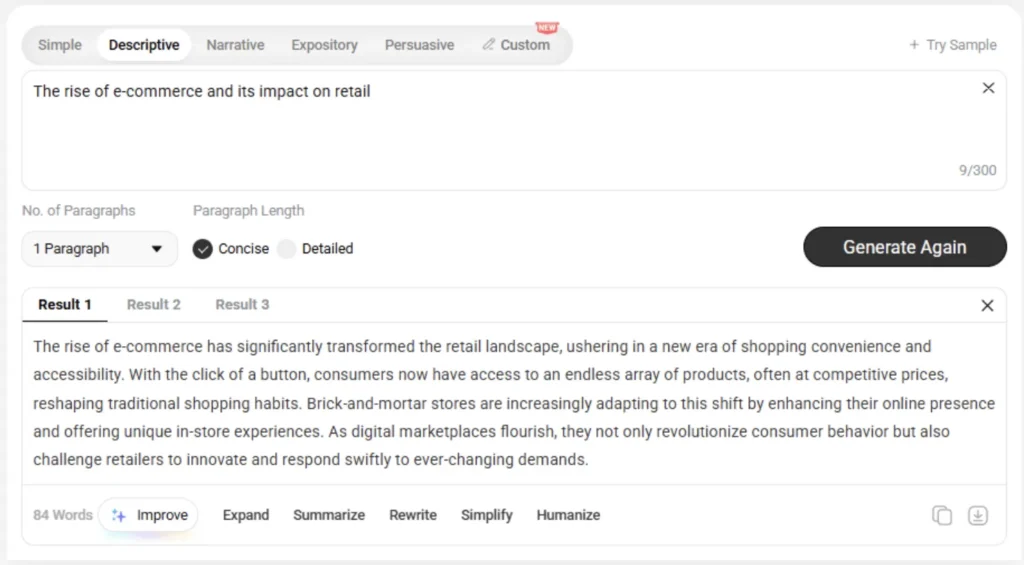
For example, AI-powered AI Paragraph Writer will turn your given prompt, ideas, or topics into compelling and well-structured paragraphs with a single click. To do so, it uses generative AI technology, which is widely used for content generation.
Below is an example of an AI paragraph writer in action:
When it comes to visual content creation, there are also dedicated tools available. Luma AI can create high-resolution, realistic pictures and videos with just a user prompt.
Utilizing AI-powered tools will make it easier for you to consistently deliver quality content without spending much time or effort.
Plan Ahead with a Content Calendar
Creating a content calendar in advance significantly reduces the risk of last-minute stress. It usually includes topics/headlines, publishing dates, content formats, and intended platforms.
In simple words, it provides you with a clear overview of your content strategy. This way, you will know what needs to be created and when, ultimately speeding up the overall process.

Moreover, a content calendar helps you:
- Avoid duplication of topics
- Tailor your content according to the audience as well as the marketing campaigns/events
- Achieve consistency across different platforms
- Maintain a steady publishing schedule
Planning everything ahead gives marketers enough time to research, create, and refine content without feeling unnecessary pressure.
Turn Audience Questions into Content
This is the final strategy we will discuss today. Marketers can also turn the commonly asked questions (FAQs) into content. This will eliminate the need for them to brainstorm title ideas or research relevant material.

Simply take the questions your target audience is already asking and answer them with the proper details and insights. These questions often reflect key points, concerns, and interests, which makes them a perfect option for creating engaging content.
When you answer public questions, this can lead to increased engagement, trust, and improved rankings. You can transform frequently asked questions into different content formats, such as:
- A blog post that highlights multiple FAQs related to a single topic
- A social media post addressing a single question
- A short reel answering a quick question
Writing for Readability Without Dumbing Down the Content
Readability is treated as a soft concern. It is not. It decides whether the reader reaches the part of your page that actually persuades them, and it affects how cleanly an AI system can extract an answer from your writing.
Write for the Comprehension Level Your Reader Actually Has
Start from the actual distribution. Around half the adult population in the United States reads below an eighth grade level. So writing at graduate level does not make a page more authoritative. It makes it less usable for half the audience.
A large share of readers scan rather than read, and complex sentence construction loses them well before the argument does. So aim for clear rather than simple. Short sentences carrying precise ideas beat long sentences carrying vague ones.
| Element | Target | Why it matters |
|---|---|---|
| Sentence length | Mostly under 20 words | Long sentences are where scanning readers drop out |
| Paragraph length | 2 to 4 sentences | Dense blocks read as work before they read as content |
| Subheading frequency | Every 250 to 300 words | Gives scanners an entry point and gives extractors a boundary |
| Passive voice | Under 10% of sentences | Passive constructions hide who does what |
| Transition words | Around 30% of sentences | Signals the logical relationship between ideas |
Let the Model Learn Your Style Before It Writes Anything
If you generate drafts with AI, the highest-leverage step happens before the first prompt. Eric Siu’s framing is that output reaches roughly 95 percent of usable quality when the model has learned your house style first, against generic output when it has not.
Have it read ten of your strongest published pieces and extract the patterns: typical length, sentence rhythm, how you use tables, how you cite data, where links sit, how you open and close. Save that as a standing instruction rather than repeating it each time.
Use Images That Carry Information
A wall of small text drives readers away, but stock photography does not fix it. What fixes it is imagery that adds meaning: a chart of your own data, an annotated screenshot, a before and after, a process diagram.
If an image could be swapped for any other image without changing the reader’s understanding, it is decoration. Decoration costs page weight and adds nothing.
Write an Introduction That Confirms the Reader Is in the Right Place
A weak introduction loses the reader before the useful part arrives. A strong one does three things in about a hundred words. It shows you understand the specific situation they are in. It gives a reason to trust the answer. Then it promises the outcome the page delivers.
Notice what is missing from that list. There is no history of the topic and no definition nobody asked for. Save both for later in the page, where a reader who has already decided to stay will happily read them. The same discipline applies to the technical side, which our technical SEO checklist covers as a standing content quality check.
Wrapping it Up
Brands must consistently deliver unique, engaging content to remain competitive and profitable. However, this increases the chances of burnout, as consistent content creation requires valuable time and effort. Nevertheless, there is nothing to worry about, as several effective strategies can be used to create persuasive marketing content in a very short time. This blog post has discussed some of the effective ones in detail.