Geofencing Marketing: What It Is, How It Works & How to Use It

Ishant
Published on November 10, 2026
Ishant
Summarize this article with:
By Ishant Sharma | Published: November 2026 | 18 min read
Most digital ads target people based on search behavior, interests, demographics, or past interactions. Geofencing adds another signal: location.
Geofencing lets brands draw a virtual boundary around a real-world place. They use qualifying location signals inside that boundary to build groups or trigger marketing actions.
That place could be your store, a rival’s spot, a shopping center, or a stadium. It could also be a conference venue, a trade show, or another useful physical place.
Here is the key difference. Geofencing does not simply mean “show my ad to everyone in this city.” It creates a more specific location-based group tied to one physical area.
In this guide, you will learn what geofencing marketing is, how it works, and how it differs from geotargeting. You will also see where it fits into Google Ads and how brands use it.
Finally, you will learn how to measure results and what to check before you launch a campaign.
Key Observations
Geofencing marketing is a location-based ad technique. Marketers draw a virtual boundary around a real place, such as a store or competitor location, then target ads to devices inside it. They use five approaches: own-location, competitor, event, retargeting, and offline attribution.
Google Ads offers radius and Performance Max targeting. Other platforms add polygon fences with entry and exit triggers.
Table of Contents
- How Does Geofencing Marketing Work?
- What Technology Does Geofencing Use?
- GPS vs. Beacon, Radius vs. Polygon
- Geofencing vs. Geotargeting
- Types of Geofencing Marketing Campaigns
- Address-Based (Household) Geofencing
- Which Brands Benefit Most?
- Geofencing Examples by Industry
- Geofencing on Google Ads
- Geofencing Platforms Compared
- How to Set Up a Geofencing Campaign
- How Much Does Geofencing Cost?
- Is Geofencing Worth It?
- How to Measure Geofencing Performance
- Privacy and Compliance
- 2026 Privacy Update
- 7 Common Geofencing Mistakes
- Geofencing + Google Ads Plan
- Combining Geofencing With CTV, Mail & OOH
- Geofencing and ROAS
- Pre-Launch Checklist
- Frequently Asked Questions
GPS
Primary location signal for outdoor geofencing
5 Types
Own location, competitor, event, retargeting, offline attribution
10
Pre-launch questions every campaign should answer
KPI
Must match the actual business objective, not just CTR
How Does Geofencing Marketing Work?
A typical geofencing campaign follows a five-step process.
- Define the location. The marketer picks a location that matters to the campaign, such as a retail store, competitor location, restaurant, convention center, stadium, or shopping mall.
- Create a virtual boundary. You represent the location digitally with a radius, polygon, point-of-interest boundary, or another geographic shape the platform supports.
- Establish the group or trigger. A platform may use location signals to identify devices or users in the area. Possible triggers include entering an area, exiting an area, or staying in an area for a set time. A visit can also add someone to a retargetable group. Not every platform supports every trigger.
- Deliver the marketing message. Depending on the platform, you can reach this group through display ads, native ads, video, in-app ads, or push notifications. Some vendors also connect location-based campaigns with programmatic or connected-TV plans.
- Measure the outcome. Evaluate the campaign with metrics that match the business objective. Options include reach, impressions, CTR, website visits, leads, and purchases. Others include calls, direction requests, store visits, offline sales, cost per acquisition, and incremental lift.
What Technology Does Geofencing Use?
Geofencing does not rely on one single technology. Depending on the vendor and use case, these systems may combine the technologies below.
| Technology | Typical Use | Important Consideration |
|---|---|---|
| GPS | Outdoor location signals | Accuracy varies by environment and device |
| Wi-Fi / location signals | Indoor or local positioning | Depends on available signals and platform |
| Bluetooth beacons | Very localized environments | Requires compatible hardware |
| Cellular signals | Broader location estimation | Usually less precise than GPS |
| Device / app location data | Audience and location-based advertising | Requires appropriate permissions and data practices |
Clarification
Bluetooth beacons and RFID should not be treated as interchangeable with mobile ad geofencing. RFID is more commonly used for ID badges, building access, or inventory tracking than broad digital ad campaigns.
GPS vs. Beacon Geofencing, and Radius vs. Polygon Fences
What is geofencing in marketing terms, technically speaking? Most campaigns rest on two separate choices: which location signal to use, and which fence shape to draw.
GPS-Based vs. Beacon-Based
GPS-based geofencing uses a phone’s location service to detect when a device enters or leaves an area outdoors. It works at city, neighborhood, or store scale.
Beacon-based geofencing uses small Bluetooth hardware placed inside a store or venue. It detects a phone at very close range, often within a few feet, but only where a beacon is installed.
Radius vs. Polygon
A radius fence is a simple circle drawn around one point, like a store address. It is fast to set up but can spill into a neighbor’s building or a parking lot next door.
A polygon fence traces the real shape of a building or lot. Geo fencing means drawing the actual boundary, not just a rough circle, which cuts down on wasted impressions from people who were never inside.
Most brands start with radius fences for speed, then move to polygon fences once a campaign proves it works.
Geofencing vs. Geotargeting: What Is the Difference?
Geofencing and geotargeting are related but they are not the same thing.
| Feature | Geofencing | Geotargeting |
|---|---|---|
| Main concept | Defined physical boundary | Geographic audience targeting |
| Location granularity | Can be highly localized | Can range from broad to localized |
| Typical signal | Device/location signals | Location signals and platform data |
| Example | Audience associated with a specific venue | Users in a city or service area |
| Best use | Physical-location behavior | Regional/local targeting |
| Common platforms | DSPs, location platforms | Google Ads, Meta Ads, other ad platforms |
A Simple Example
Geotargeting
Show ads to people in Boston.
- Broad city or region
- Everyone in the service area
- Standard for most local campaigns
Geofencing
Build a group of people who visited one shopping center or rival spot.
- Specific location
- More refined intent signal
- Depends on platform and privacy rules
When to Use Each
Use geotargeting when you simply need to reach customers in a defined service area. Examples include a plumber serving a 20-mile radius, a dentist serving a city, or a restaurant targeting nearby residents.
Use geofencing when one place matters to the marketing plan, such as a competitor location, trade show, stadium, shopping center, or industry event. You can also combine the two approaches.
Types of Geofencing Marketing Campaigns
1. Own-Location Geofencing
Create a location-based group around your own business. Potential uses include store promotions, customer re-engagement, loyalty campaigns, location-specific offers, and post-visit ads.
For example, a restaurant could build a campaign around its own store and use a strong offer to encourage repeat visits.
2. Competitor Geofencing
Competitor or “conquest” geofencing uses rival locations as part of the targeting plan. For example, an automotive dealership might build a location-based group around competing dealerships. It could then promote its own financing, inventory, or service.
Important: Before Running Competitor Geofencing
Carefully consider platform policies, data-source rules, privacy rules, local laws, sensitive places, and brand safety. Do not assume that because a place can technically be targeted, it should be.
Whether a tactic is legally and ethically right depends on the jurisdiction, data source, industry, and the exact place.
3. Event Geofencing
Events can provide unusually concentrated groups. Potential targets include trade shows, conferences, sporting events, concerts, festivals, and expos.
A B2B company could use a conference venue as part of its targeting plan, then promote a relevant service before, during, or after the event.
YouTube / Practitioner Insight
Marketing practitioners and paid-media pros point to event geofencing as one of the strongest use cases for location-based ads. Shared examples include programmatic display, mobile ads, and video.
Some practitioners also use connected-TV and OTT campaigns around venues such as trade shows and stadiums.
The steady advice is to connect the ad message directly to the location context. Do not run a generic campaign and assume the location signal adds value on its own.
4. Location-Based Retargeting
Some platforms let brands build groups from matching visits to chosen places. Brands can use those groups later, subject to platform rules and applicable privacy rules.
This creates a longer marketing sequence instead of relying on a single location-based interaction.
Example sequence: Physical visit → digital ad → website visit → lead → conversion.
This can be useful when the purchase decision takes days or weeks after the initial visit.
5. Offline Attribution
One of the best uses of location-based advertising is linking digital ads to real-world outcomes. Depending on the platform, eligible brands may measure store visits, calls, direction requests, and store sales.
This is important for brands where website conversions alone do not tell the full story.
Address-Based (Household) Geofencing
Newer platforms go beyond a simple circle on a map. Address-based geofencing, also called household geofencing, matches a CRM or direct-mail list to real property boundaries.
Instead of fencing a store or event, you fence a list of exact addresses. Vendors such as Simpli.fi’s address-based geo-fencing build this from property data, and Simpli.fi says its lists reach about 130 million US households, with a boundary drawn around each home.
| Feature | Location Geofencing | Address-Based Geofencing |
|---|---|---|
| What you target | A place, like a store or venue | A specific list of homes or addresses |
| Typical source | GPS or Wi-Fi signals in an area | CRM lists or mail data matched to property records |
| Best use | Reaching visitors near a physical spot | Reaching a known audience by name and address |
This approach works well for well-planned geofence marketing campaigns aimed at a known list, such as past customers, expired leads, or a mailing list for one area. It needs a real address list to start, so it will not help you find brand-new prospects on its own.
Which Businesses Benefit Most From Geofencing?
Geofencing works best when a person’s location links to buying intent.
| Business Type | Example Use |
|---|---|
| Retail | Reach audiences around stores and shopping areas |
| Restaurants | Promote nearby offers and location-specific campaigns |
| Automotive | Reach audiences associated with dealership locations |
| Real estate | Promote around relevant properties and open events |
| Gyms | Reach audiences around fitness locations |
| Event companies | Build audiences around conferences and venues |
| B2B companies | Target industry events and conferences |
| Ecommerce | Use relevant physical-location signals for prospecting |
| Multi-location businesses | Build location-specific audience strategies by store |
The important question is not “Can my business use geofencing?” The better question is: Does a person’s location provide a useful signal of purchase intent? If the answer is no, traditional geotargeting may be more right.
Can Ecommerce Businesses Use Geofencing?
Yes, but the plan differs from local-store ads. An ecommerce company could use physical-location signals around retail stores, trade shows, consumer expos, product-category events, or rival locations.
The goal is not simply to know where someone is. The goal is to use location as an extra signal of potential intent.
Geofencing Marketing Examples by Industry
Generic advice only goes so far. Here is what geofencing marketing examples actually look like across a few industries.
| Industry | Realistic Use Case |
|---|---|
| Senior living | Fence senior expos and community events where families research care options; never fence hospitals or clinics |
| Legal | Fence legal and business expos or community events; avoid hospitals, clinics and urgent care centers, which Washington law restricts |
| Auto dealers | Fence competing dealership lots to promote financing or trade-in offers |
| Window and door companies | Fence home improvement stores and new-build sites; a good fit for geofencing marketing near me searches |
| Restaurants | Fence a few surrounding blocks with a lunch-hour offer |
| Event marketers | Fence a conference venue to promote a related product before and after |
Notice the pattern. Each example ties the fence to a real reason someone might want the offer, not just a place with foot traffic. That link is what makes a campaign worth running.
Geofencing on Google Ads: What You Need to Know
Important Clarification
Google Ads offers radius and location targeting options, plus Performance Max for store goals. These are powerful location-based ad tools, but they are not the same as traditional entry and exit programmatic geofencing.
They represent Google’s own location-aware ad system, which works differently from dedicated geofencing DSPs. Knowing this difference helps you pick the right platform for the right use case.
Google Ads Radius Targeting
Google Ads lets brands target a radius around a chosen place. For example, a brand can target customers within a set distance of a store. This works well for restaurants, dentists, local service brands, retailers, automotive dealers, and multi-location brands.
Google’s own documentation on radius and location targeting confirms that brands can create radius targets around a precise address. It also notes that location targeting uses multiple signals and is not guaranteed to be 100% accurate.
Performance Max for Store Goals
For eligible brands, Google offers Performance Max campaigns for store goals. These campaigns can help promote physical stores across Google properties including Google Search, Google Maps, YouTube, Gmail, and the Google Display Network.
Google states that these campaigns can optimize toward offline goals such as store visits and store sales. They can also target local actions such as calls or direction clicks, depending on your account setup.
Performance Max for store goals is not the same as classic programmatic geofencing. Think of it instead as Google’s own location-aware ad system for brands with physical stores.
Google Ads vs. Dedicated Geofencing Platforms
| Capability | Google Ads | Dedicated Geofencing / DSP |
|---|---|---|
| Radius targeting | Yes | Often |
| Local search | Yes | Usually not primary use |
| Google Maps integration | Yes, depending on campaign | No |
| YouTube / video | Yes through eligible campaigns | Some platforms offer CTV/video |
| Store goals optimization | Yes | Depends on provider |
| Classic location-triggered programmatic | Limited / different approach | Core capability for many DSPs |
| Custom location audiences | Depends on platform version | Often available |
| Programmatic display | Yes through Google ecosystem | Core capability for many DSPs |
For most local brands, Google Ads location targeting is often the easier, more integrated starting point. For narrow location-based group plans, a dedicated vendor or DSP may be worth evaluating alongside Google.
Geofencing Platforms Compared
Geo-fencing ads run through very different platforms depending on your budget and how much control you need.
| Platform Type | Examples | Typical Minimum Spend | Best For |
|---|---|---|---|
| Self-serve | Google Ads radius targeting | No formal minimum | Small budgets, simple radius needs |
| Dedicated DSP | GroundTruth, Simpli.fi | Varies by vendor; ask for the minimum | Multi-location brands wanting precise fences |
| Location intelligence | Placer.ai | Custom, usually higher | Brands that want data-backed boundary decisions |
Geo fencing advertising through a self-serve tool is the easiest place to start. It gives up some precision, since you cannot draw an exact polygon around one building. A dedicated DSP like GroundTruth or a location-intelligence platform such as Placer.ai costs more, but gives sharper boundaries and richer visit data.
Match the platform to your budget first, then to your precision needs. A precise fence around the wrong audience still wastes money.
How to Set Up a Geofencing Campaign
- Define the business objective. Start with the outcome: more store visits, more leads, more calls, more online purchases, more event registrations, awareness, competitor conquest, or offline sales. Do not start by drawing a geofence. Start with the business problem.
- Choose the locations. Pick locations that actually correlate with customer intent, such as your stores, key competitors, trade shows, conferences, shopping centers, or industry venues. Avoid creating hundreds of arbitrary geofences just because the platform allows it.
- Define the boundary. Depending on the platform, you may use a radius, polygon, point of interest, or custom location boundary. Use the smallest boundary that still captures the right group. A restaurant, stadium, dealership, and convention center all need different sizes.
- Define the group rules. Decide who qualifies, how long they stay in the group, and whether past visitors count. Also decide which locations to exclude and whether to add demographic or contextual filters. Group quality usually matters more than group size.
- Build location-useful creative. Connect the message to the reason the group matters. A generic advertisement does not take advantage of the location signal.
- Test multiple creative angles. Develop variations around benefit, offer, differentiator, social proof, and convenience. Compare actual performance data rather than assuming one angle is best.
Creative Insight
The most common geofencing campaign mistake is not the targeting. It is the creative. Weak example: “Discover Our Services.” Stronger approach: “Looking for a faster way to [solve problem]? See what [brand] offers.” The ad should give a clear, location-useful reason to act.
How Much Does Geofencing Marketing Cost?
What is geofencing advertising going to cost your business? There is no single reliable price. The cost depends on several factors: platform, group size, area, inventory, industry, and ad format. Data rules, campaign duration, attribution rules, and any minimum spend set by the vendor also affect price.
Some platforms charge based on CPM, while others use different pricing structures or managed-service fees. Avoid assuming any precise CPM or minimum monthly budget applies to your situation without asking the vendor directly.
Questions to Ask Any Geofencing Provider Before Starting
- What is the media CPM?
- Is there a platform or management fee?
- Is there a minimum spend requirement?
- Are group and data fees included?
- What inventory types and channels are included?
- How is location accuracy measured?
- How are conversions attributed?
- What reporting is included?
- What privacy and consent standards apply?
Is Geofencing Marketing Worth It?
Geofence marketing gets mixed reviews from real business owners. The honest answer is that it depends on the business.
On forums like Reddit, some owners report clear wins. Others say it wasted their money, usually because the targeting was too broad or the offer too weak to change behavior.
What is geo-fencing worth if you cannot hit the minimum spend? Many dedicated platforms set a monthly minimum, and it varies by provider. Below that level, self-serve options like Google Ads radius targeting are usually a better place to start.
Geofencing Is Probably a Good Fit If…
- You can meet or beat the platform’s minimum monthly spend
- Your customer’s location is a real signal of buying intent
- You have one specific, compelling offer, not a generic ad
- You can track store visits, calls, or sales, not just clicks
- You are ready to test for at least two to three months
When It Is Probably Not Worth It
Skip geofencing if your budget cannot clear the DSP minimum, your offer is not compelling, or you have no way to measure store visits or sales. In those cases, broader local ads or SEO usually deliver more for the same budget.
How to Measure Geofencing Campaign Performance
CTR alone is not enough. The correct KPI depends on the campaign goal.
| Campaign Goal | Recommended KPIs |
|---|---|
| Awareness | Reach, frequency, impressions, video completion, brand lift |
| Website conversions | Clicks, sessions, conversion rate, CPA, revenue, ROAS |
| Local business | Calls, direction requests, store visits, store sales, appointments |
| B2B events | Leads, demo requests, meeting bookings, qualified pipeline |
The Most Important Measurement Question: Incrementality
A person visiting your store after seeing an ad does not automatically mean the ad caused the visit. They may have planned to visit anyway.
That is why sophisticated campaigns should consider control groups, geographic holdouts, pre/post comparisons, incremental lift analysis, matched group analysis, and offline conversion data.
Key Distinction
Attribution tells you what was associated with the campaign. Incrementality helps you understand what the campaign actually changed. For big location-based budgets, incrementality testing is worth the investment.
Geofencing Marketing Privacy and Compliance
Location data can be sensitive. Before launching a campaign, verify:
- How location data is collected and what permissions exist
- What the vendor’s privacy practices and data retention policies are
- Whether data is shared with third parties
- Whether users can opt out
- Which jurisdictions and privacy laws apply
- Whether the location itself could reveal sensitive personal information
On mobile, Apple’s App Tracking Transparency framework requires apps to ask permission before tracking users across other apps. Google’s Privacy Sandbox no longer changes that picture: in October 2025 Google retired most Privacy Sandbox APIs, including Topics and Protected Audience.
Legal Note
Do not assume a location plan is automatically right or lawful just because a platform allows it. For campaigns involving sensitive places, regulated industries, healthcare, or personal data, get proper legal and privacy advice before launching.
Washington is the clearest example. Its consumer health data law, RCW 19.373.080, makes it unlawful to put a geofence around any provider of in-person health care, such as a hospital or clinic, when the fence is used to track people seeking care, collect their health data, or send them ads related to that care. The law counts any boundary 2,000 feet or less from the location’s perimeter as a geofence (RCW 19.373.010). So in Washington, a personal injury firm fencing an emergency room, or a senior living brand fencing a clinic, is the kind of use the law prohibits.
Geofencing Privacy and Data Changes in 2026
The role of geofencing in marketing keeps shifting as privacy rules change. Two updates matter most for 2026 campaigns.
First, Google walked back its plan to block third-party cookies in Chrome. Instead of removing them, Google now lets each user choose to allow or block cookies. This matters for geofencing, since it changes how stable cookie-based retargeting really is after a location visit.
Policy Can Shift Again
Google has changed its cookie plan more than once. Confirm the current policy before you build a campaign around it. Do not treat this page as the final word on a policy that keeps moving.
Second, Apple’s App Tracking Transparency, or ATT, still limits mobile targeting. Apps must ask permission before tracking a user across other apps, and many users say no. That shrinks the pool of devices a geofencing platform can match to a real person inside an app.
Cookie changes mostly affect web-based retargeting. ATT mostly affects in-app targeting and attribution. A full 2026 plan should account for both, not just one.
7 Common Geofencing Marketing Mistakes
1. Making the geofence too large
A huge group may look impressive but contain little useful intent. Start with a small, focused geographic test before scaling.
2. Treating location as perfectly accurate
Location systems use signals and estimates. Google itself notes that location targeting uses multiple signals and is not guaranteed to be 100% accurate. Do not treat it as an exact physical record.
3. Using generic creative
If your targeting is location-specific but the ad could run anywhere, you are wasting the location signal. Connect the message to the reason that place matters.
4. Measuring only CTR
A campaign can generate clicks without generating profitable customers. Measure the business outcome that fits the campaign goal.
5. Ignoring offline conversions
For physical brands, store visits, calls, appointments, and sales can matter more than website clicks. Make sure offline tracking is in place.
6. Assuming every platform works the same way
Google Ads, DSPs, dedicated geofencing platforms, and mobile ad systems have different capabilities. Always verify the actual functionality of the platform you are using.
7. Ignoring privacy
Location data requires careful handling. Privacy should be considered during campaign planning, not after launch.
Geofencing + Google Ads: A Strong Local Marketing Strategy
For many local brands, the best approach is not choosing between geofencing and Google Ads. It is combining complementary tactics into a layered plan.
| Layer | Tactic | Purpose |
|---|---|---|
| 1 | Search campaigns | Capture active purchase intent |
| 2 | Local radius targeting | Reach people in the service area |
| 3 | Location-based audiences | Use physical-location signals where supported |
| 4 | Retargeting | Re-engage website visitors and prior interactions |
| 5 | Offline measurement | Connect advertising to calls, appointments, and store visits |
Google’s current Performance Max store-goal campaigns can optimize toward store visits and local actions for eligible brands. That makes them an important part of this layered plan.
For brands looking to improve paid acquisition efficiency, see Hustle Marketers’ PPC services and our guide to how to improve ROAS.
Geofencing vs. Local SEO
Geofencing and local SEO solve different problems. Geofencing reaches a location-based group through paid ads, while local SEO helps customers find your business when they search for local products and services.
A strong local growth plan uses both. Google’s own Search Essentials guidelines are a useful starting point for the local SEO side. For brands that want to build organic local visibility, see Hustle Marketers’ SEO services.
Combining Geofencing With Connected TV, Direct Mail and Out-of-Home
Geo fencing marketing rarely works best alone. Several vendors now layer it with other channels for a stronger local push.
Connected TV, or CTV, lets you show video ads on streaming services to households inside your fenced area. This pairs well with event or competitor geofencing, since it reinforces a message someone already saw on their phone.
Direct mail still works well for campaigns that target a known list, especially alongside address-based geofencing. A postcard followed by a digital ad to the same household reinforces the offer twice.
Out-of-home ads, like billboards or transit ads near a fenced location, add a third layer. Someone sees the billboard, then a mobile ad soon after, then perhaps a retargeting ad on a website.
None of these layers is required. But stacking two or three, tied to the same offer and area, tends to beat any single channel alone.
Need Help With Local or Location-Based Advertising?
Hustle Marketers helps local and multi-location brands improve acquisition through Google Ads, Performance Max, and SEO.PPC Services SEO Services
Geofencing and ROAS: How to Think About Profitability
Geofencing should not be judged in isolation. Platform ROAS is a starting point, not a complete picture. Consider:
- Gross margin on attributed revenue
- Customer acquisition cost vs. customer lifetime value
- Repeat purchase rate and offline conversions
- Incremental revenue vs. organic visits that would have happened anyway
A campaign producing a 3x ROAS may be excellent for one business and unprofitable for another. The correct benchmark depends on the economics of the business. For extra PPC measurement guidance, see our guide to improving ROAS and key ROAS metrics.
Before adding a geofencing layer, prove the radius economics on search first. A tightly built search campaign around your service area and order value is the cheaper test.
How Hustle Marketers approaches geofencing
Our honest position on geofencing is that most businesses asking for it do not need it yet. It is sold as precision targeting and it usually functions as expensive awareness, because the people inside a polygon are not necessarily in market. Before spending there, we want the search side proving out on the same radius.
That is not a theoretical preference. If a tightly drawn search campaign cannot make the radius economics work, adding a geofencing layer on top rarely rescues it.
Where geofencing does earn its place is competitor conquesting, event targeting and multi location retail with real footfall to measure. Ishant Sharma has worked in paid media since 2013, and this work sits under our PPC management, with the local organic groundwork under our SEO services.
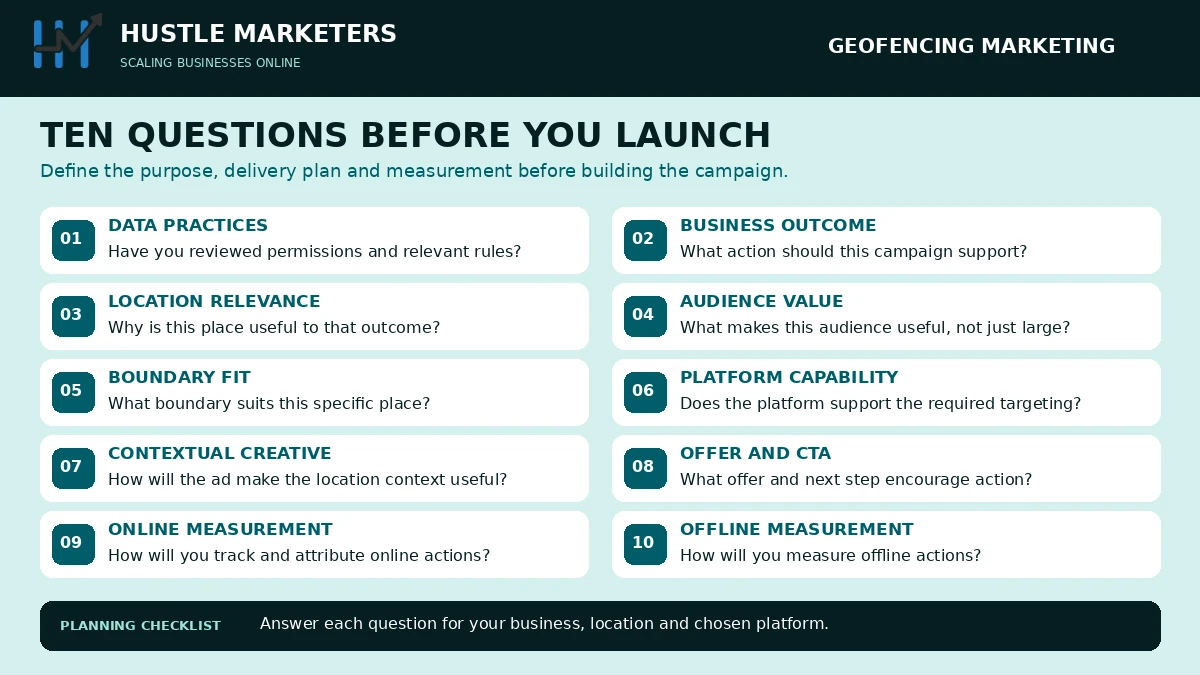
Pre-Launch Checklist: 10 Questions to Answer Before Launch
If you cannot confidently answer each of these questions, the campaign is probably not ready.
Are the data and targeting practices privacy-compliant in the useful jurisdictions?
What business outcome are we trying to create?
Why is this location useful to that outcome?
What makes this group valuable, not just large?
What boundary makes sense for this specific location?
What platform actually supports the required targeting capability?
What ad will make the location context useful to the group?
What offer or CTA will encourage action?
How will online conversions be tracked and attributed?
How will offline conversions be measured?
Related guides
Related guides on local and paid targeting:
Frequently Asked Questions
What is geofencing marketing?
How does geofencing work?
What is the difference between geofencing and geotargeting?
What businesses benefit most from geofencing?
Can ecommerce businesses use geofencing?
How much does geofencing marketing cost?
Is geofencing available in Google Ads?
What is competitor geofencing?
How do you measure a geofencing campaign?
Is geofencing marketing privacy-safe?
Is geofencing marketing legal?