Hotel SEO: The Complete Guide to More Direct Bookings (2026)

Ishant
Published : October 30, 2026 at 9:30 am
Updated : October 30, 2026 at 8:19 pm
Ishant

Summarize this article with:
Written by Ishant Sharma, Google Ads, Microsoft Ads and SEO specialist since 2013 | Facts checked September 18, 2026
Every hotel room night you sell through Booking.com or Expedia costs you 15 to 25 percent of the booking value before a guest even checks in. On a $200 room, that is $30 to $50 paid to an OTA for sending you a customer who may never return directly. SEO changes that math. SiteMinder’s 2025 data shows hotel websites earning about 65 percent more revenue per booking than OTAs (US$516 against US$312), while direct-booked guests in a Bookboost study returned at four times the rate of OTA-sourced guests.
This guide covers everything a hotel needs to build organic search visibility that drives bookings through its own website: keyword strategy, technical fixes specific to hotel sites, local SEO, schema markup with real code examples, AI search optimization, and the seasonal content calendar most hotel marketers ignore until it is too late.
What Is Hotel SEO?
Hotel SEO is the practice of optimizing a hotel’s website to rank in Google and other search engines for the queries potential guests use when researching, comparing, and booking accommodation. Unlike most businesses, hotels compete simultaneously against:
- Other hotels targeting the same city and amenity keywords
- OTA platforms with far stronger domain authority than any single property, republishing your own property copy
- Metasearch engines (TripAdvisor, Trivago, Kayak) with enormous link authority
- AI-generated travel answers that summarize hotel options without clicking through to any single site
How Hotel SEO Differs from Other Business SEO
Hotel search intent spans three phases. A traveler planning a trip first searches informational queries (“best time to visit Barcelona”), then commercial queries (“boutique hotels Barcelona near Gothic Quarter”), then transactional queries (“book hotel Barcelona old town weekend”). Your content must address all three phases, not just the transactional booking stage.
OTA competition means you will rarely outrank Booking.com for head terms. The strategy for independent hotels is not to beat OTAs at their own game. It is to capture the specific long-tail and local queries OTAs do not prioritize, and to own your branded search so guests who found you on an OTA come to book directly.
How Hotel SEO, Google Hotel Ads and Metasearch Work Together
Organic SEO builds permanent equity: rankings earned through content and technical quality compound over time without ongoing ad spend. Google Hotel Ads and metasearch capture demand from high-intent searchers who are comparison-shopping rates in real time. Email remarketing re-engages guests who visited your site without booking.
None of these channels works as well in isolation. Hotels that combine organic SEO (for research-phase traffic and branded authority), Google Hotel Ads (for comparison-phase transactional capture), and email CRM (for repeat direct bookings) consistently outperform properties that rely on OTAs for new business and run nothing for retention.
Important change: Google stopped allowing commission bid strategies on new Hotel Ads campaigns from April 30, 2024, and existing commission-based campaigns continued to serve until February 20, 2025, with reconciliation running to November 30, 2025. Hotels that relied on commission bidding now need upfront CPC budgets, or need to shift volume toward free booking links, which cost nothing per click but require an active Hotel Center partnership, an active bid, available rates and a working landing page. Google places them within the existing booking module rather than at a fixed position. That shift moved real money from a pay-on-success model to a pay-upfront one, which strengthened the financial case for organic SEO as the foundation of hotel marketing.
The Business Case for Hotel SEO: The Math OTAs Do Not Want You to See
What OTA Commissions Actually Cost You
Most hotel finance teams track OTA commissions as a cost of revenue line and accept them as a fixed cost of doing business. The actual numbers are:
One thing to say plainly before the table: with one exception, none of these platforms publishes a rate card. Booking.com says only that “you pay us a set percentage” which “varies by country and can also vary depending on your property type or location.” Trip.com says the rate “will be displayed during the ‘Contract’ step of the sign-up process.” Agoda’s partner hub gives no percentage at all. So the ranges below are typical contracted rates reported by channel managers and hoteliers, not published figures. Check your own contract.
| OTA Platform | Typical contracted range | Notes |
|---|---|---|
| Booking.com | 15–18% | Genius, Preferred Partner and Visibility Booster all raise it. Booking.com publishes no increment |
| Expedia | 18–25% | No public rate card. Higher in competitive markets |
| Airbnb (hotels) | 14–16% | The one published figure. Airbnb states most hosts pay 15.5%, and confirms the same single fee applies to traditional hospitality listings including hotels |
| Agoda | 15–25% | No percentage published. Varies by location and payment model |
| Trip.com | 10–25% | Disclosed at contract stage only |
On $1 million in annual OTA bookings, you pay $150,000 to $250,000 in commissions. That is marketing spend that builds zero brand equity, zero repeat customer relationships, and zero authority that compounds. OTAs own the customer. You delivered the room.
The Direct Booking Revenue Advantage
The revenue difference between a direct booking and an OTA booking is not just the commission saving. Direct-booked guests behave fundamentally differently:
- Revenue per booking: SiteMinder’s booking trends data shows hotel websites generating an average of US$516 per booking in 2025 against US$312 through OTAs, a 65% gap. Read that as revenue per booking by channel rather than as guests spending more. Longer stays, suites and packages book direct, and channel mix drives a lot of the difference
- Return rate: 5.1% for direct-booked guests against 1.3% for OTA guests, a 4x gap. This comes from a Bookboost analysis of 2.2 million guests at European hotel groups, reported via eHotelier. The same dataset shows first stays splitting 35% direct to 65% OTA, and return visits flipping to 68% direct
- Lifetime value: direct-acquired guests measured roughly 3x more valuable over ten stays in the same Bookboost work, though the OTA cohort there was only 121 guests, so treat the multiple as directional
You will also see a widely circulated claim that direct bookings cancel at 10.6% against 21.8% for OTA bookings. I could not trace it to a primary source, including the ones that usually cite it, so I am leaving it out. What is documented is SiteMinder reporting global cancellations falling below 20% on average. Direct bookings do tend to cancel less, mostly because rate rules and deposits differ by channel, but do not build a business case on a number nobody can source.
The compounding effect matters. A guest you acquired through OTA at stay one may return through OTA at stay two, paying another commission. A guest who books direct once, has a good experience, and receives a follow-up email is far more likely to book direct again. OTAs take a commission on every stay forever. SEO takes a one-time investment to build the ranking.
When Does Hotel SEO Break Even?
A realistic independent hotel SEO investment runs $1,500 to $5,000 per month for agency work, depending on market competitiveness and scope.
To calculate your break-even: divide the monthly SEO cost by the average commission saving per direct booking converted from OTA.
Example: A hotel with an ADR of $180 and a 20% average OTA commission rate saves $36 per room night shifted from OTA to direct. At $2,500/month in SEO spend, you need 70 room nights per month shifted from OTA to direct to cover the cost, before the lifetime value multiplier.
For most independent hotels, that break-even is reached within 9 to 18 months of consistent SEO investment, after which rankings compound without proportional cost increases.
Keyword Research for Hotels
Understanding the 4 Types of Hotel Search Intent
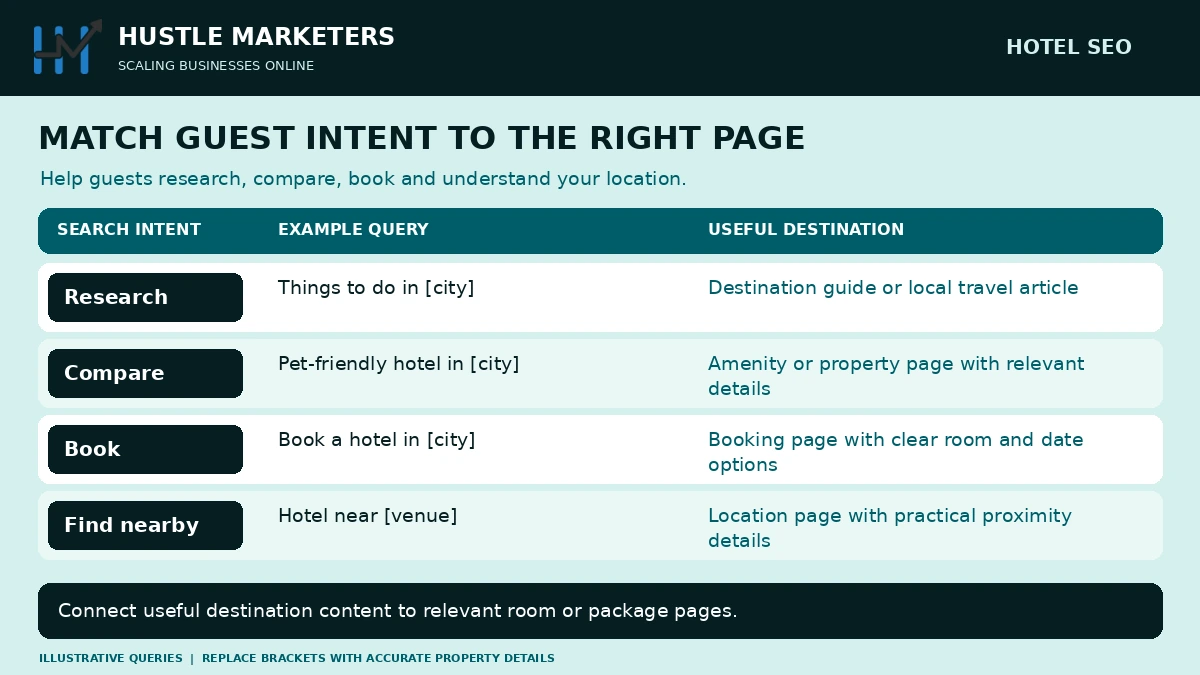
Every keyword a potential guest might type maps to one of four intent categories. Your site needs content optimized for all four:
Informational intent (research phase):
- “best time to visit Nashville”
- “what to do in Savannah for a weekend”
- “boutique hotel vs chain hotel”
These queries need destination content and blog articles, not booking pages.
Commercial intent (comparison phase):
- “best boutique hotels in Savannah GA”
- “hotels near French Quarter New Orleans with pool”
- “pet-friendly hotels downtown Austin”
These need your category and amenity landing pages, comparison content, and well-optimized property descriptions.
Transactional intent (booking phase):
- “book hotel Savannah this weekend”
- “hotel near [venue] tonight”
- “Savannah hotel deals”
These need your booking page with fast load speed, clear CTA, and trust signals.
Local intent (proximity phase):
- “hotels near [airport]”
- “hotels walking distance from [attraction]”
- “hotel near [convention center]”
These need your local SEO and Google Business Profile to be optimized.
Keyword Categories Every Hotel Should Target
| Category | Example Keywords | Priority |
|---|---|---|
| City/location | “[city] hotel”, “hotels in [neighborhood]” | High |
| Amenity | “hotel with pool [city]”, “pet-friendly hotel [city]” | High |
| Experience | “romantic hotel [city]”, “family resort near [attraction]” | Medium |
| Event | “hotels near [venue] [city]”, “[event] 2026 accommodation” | High during events |
| Comparison | “best boutique hotels [city]”, “independent hotels [city]” | Medium |
| Long-tail | “3-bedroom suite hotel [city] with kitchen” | High conversion |
The Long-Tail Advantage for Independent Hotels
An independent 60-room boutique hotel cannot outrank Booking.com for “hotels in New York City.” That keyword is won by domains with 90+ DA and thousands of pages. But “boutique hotel West Village New York walking distance subway” is a winnable keyword where a dedicated property page with relevant content can outrank every OTA result.
This is the fundamental keyword strategy difference between independent boutique hotels and chains. Chains target volume keywords using brand authority built over decades. Independent hotels must target specificity: neighborhood, amenities, experiences, distances to attractions, and use cases (honeymoon, anniversary, business stay, group events).
Tools for keyword research: Google Keyword Planner, Semrush, Ahrefs, Google Search Console (to find what you already rank for), AnswerThePublic, and AlsoAsked for question-format queries. Also read TripAdvisor Q&A sections for your property and competitors. Guests ask exactly the questions you should be answering with on-page content.
On-Page SEO for Hotel Websites
Optimizing Your Homepage
Your homepage should target your primary branded keyword and your city + hotel type combination. Title tag formula:
[Hotel Name] | [City] [Hotel Type] | [Key Differentiator]
Example: “The Maison on King | Boutique Hotel Charleston SC | Historic District”
Meta description: Include a direct CTA, primary amenity, and location. Under 155 characters. Example: “Boutique hotel in Charleston’s Historic District. Rooftop bar, king suites, valet parking. Book direct for best rate.”
H1 should include your primary keyword combination, city + hotel type. NAP (Name, Address, Phone) should appear consistently in the footer on every page and match exactly what is in your Google Business Profile.
Room Pages: Stop Letting Them Be Thin Content
This is the most common on-page failure on hotel websites. A room page that says “King Deluxe Room, 400 sq ft, king bed, flat screen TV, Wi-Fi, minibar” is thin content. It will not rank. It tells a guest nothing they cannot get from any OTA listing, because it is the same copy you sent to the OTA via XML feed.
Every room page needs:
- A unique H1 that includes the room type and a differentiating detail
- Differentiated copy (at least 300 words) that describes who this room is best for, the specific view, the layout, the details OTAs cannot convey
- A short on-page FAQ answering questions specific to that room: “Does this room have a bathtub?” “Is the view of the garden or the street?”
- Unique room-specific photography with descriptive alt text
- An internal link to your booking page with clear CTA text
Example alt text: “king suite with garden view balcony at The Maison on King Charleston SC” not “room-001.jpg”
Destination and Blog Content Strategy
Most accommodation research still starts in search, and most of those searches are informational. They are not yet searching for a specific hotel. They are asking “what to do in Nashville in October” or “best neighborhoods to stay in Barcelona.” If your website has no content targeting these research-phase queries, you are invisible to travelers in the highest-addressable phase of their decision journey.
Hotel blog content should be 80 percent destination and experience content, 20 percent property content. Topics that work:
- “Things to do near [hotel] this weekend”
- “[City] travel guide [month/season]”
- “Best restaurants near [hotel name]”
- “How to spend [X days] in [city]”
- “Local events in [city] [month] [year]”
Every destination blog post should include at least one internal link to a relevant room or package booking page. The topical authority you build around your destination transfers directly to your property pages in Google’s eyes.
Image SEO
Hotels live and die by visual content. Image SEO is more important here than in almost any other vertical.
- Alt text: Descriptive, keyword-rich, specific. “pool deck at [hotel name] [city]” beats “amenity-1.”
- File names: pool-deck-hotel-savannah.jpg not IMG_4892.jpg
- File size: Target under 200KB per image using WebP format. A 4MB hero image is a Core Web Vitals failure waiting to happen.
- Image sitemap: Submit an image sitemap to Google Search Console so room photos and property images appear in Google Images searches, a real source of discovery traffic for hotels.
- Lazy loading: Implement lazy loading for gallery images so the page’s initial LCP is not blocked by 40 room photos loading simultaneously.
Technical SEO Issues Specific to Hotel Websites
Hotel websites have a set of technical SEO problems that are almost entirely unique to the hospitality vertical. Generic SEO audits miss most of them.
The Booking Engine Architecture Problem
When guests click “Book Now” on most hotel websites, they leave the hotel’s domain. The booking engine sits on book.hotelname.com (a subdomain) or on a third-party domain like reservations.com/hotel/12345. From Google’s perspective, the pages that capture the highest-intent travel queries (date selection, room selection, rate comparison) belong to a different website and contribute nothing to the hotel’s domain authority.
This split has four consequences:
- Booking intent pages do not rank on the hotel’s domain
- Link equity sent to the main domain does not flow to booking pages
- Crawl budget is wasted across two domains instead of concentrated on one
- Attribution breaks in GA4, the booking session looks like a new session from a different source
The fix: when selecting a booking engine vendor, prioritize providers that integrate via subdirectory (yourhotel.com/book/) rather than subdomain. If you are locked into a subdomain booking engine, use canonical cross-linking, ensure the booking subdomain is included in your XML sitemap, and maintain hreflang tags if serving multiple languages.
Duplicate Content from OTA Feeds
This is the invisible rankings killer that no competitor in the hotel SEO space covers adequately. Here is how the problem works:
You submit your room descriptions, amenity lists, and property copy to Booking.com, Expedia, and other OTAs via XML property management feeds. Those OTAs publish your content on their platforms. Google crawls Booking.com and your hotel website and finds nearly identical content. Google decides that Booking.com’s higher authority version is the canonical version, and ranks it. Your own website’s pages rank below the OTA that republished your content.
The fix is not to stop distributing to OTAs. You need the distribution. The fix is content differentiation:
- Write OTA descriptions at the minimum length OTAs require (150–200 words)
- Write your hotel website descriptions at full depth (400–600 words) with details OTAs cannot include: neighborhood context, the design story, staff perspectives, local insider tips, use cases by guest type
- Add elements OTAs structurally cannot replicate: interactive floor plans, virtual tours, property history, owner/chef bios, neighborhood guides embedded on room pages
When your on-site content is genuinely different from and more comprehensive than your OTA descriptions, Google has a reason to rank your version for long-tail queries even when the OTA ranks for head terms.
Core Web Vitals for Image-Heavy Hotel Sites
Hotel sites are image-heavy by commercial necessity. They are also among the worst performers on Google’s Core Web Vitals assessment. The three metrics:
- LCP (Largest Contentful Paint): Target under 2.5 seconds. Most hotel sites fail because hero images are served uncompressed, or because live chat widgets and booking engine scripts block the browser from rendering the main image.
- INP (Interaction to Next Paint): Target under 200ms. Heavy JavaScript from intake forms, date pickers, and booking widgets is the main culprit.
- CLS (Cumulative Layout Shift): Target under 0.1. Late-loading chat widgets, cookie consent banners, and promotional popups push content down the page after it has already rendered.
Use PageSpeed Insights, Chrome DevTools, and GTmetrix to identify which issues your site has. The fixes are usually image compression (move to WebP, implement lazy loading), deferring non-critical third-party scripts, and reserving layout space for elements that load asynchronously.
Crawl Budget Waste from Parameterized Booking URLs
Date-picker booking engines can generate thousands of unique URL combinations from a single property page: hotel.com/book?checkin=2026-10-01&checkout=2026-10-03&rooms=1&adults=2. If Google’s crawler follows these, it wastes your crawl budget on pages that are not indexable and not useful.
Fix: ignore any guide that tells you to set URL parameter rules in Google Search Console. That tool was deprecated in March 2022 and went offline on April 26, 2022, and Google said at the time that its systems handle parameters well enough without it. What you can still do: add a robots.txt disallow for known booking parameter patterns, put a self-referencing canonical on the primary room page and canonical any parameterized variant back to it, and add noindex to booking flow URLs that should never appear in search. If the booking flow sits on a subdomain, handle it in that subdomain’s own robots.txt.
Orphaned Pages
Every hotel marketing team creates seasonal offer pages, event package landing pages, and promotion pages, and then forgets them when the promotion ends. These pages accumulate with no internal links pointing to them, making them invisible to Google and to users. Audit your site annually and either delete or consolidate orphaned pages, or rebuild internal links from relevant blog content.
Local SEO for Hotels
Google is unusually direct about how local ranking works. Its own documentation names three components: relevance (how well your profile matches what someone searched), distance (how far you are from the search location or the searcher), and prominence (how well known the business is, which reviews and ratings feed into directly). Almost everything below is an attempt to move one of those three.
Google Business Profile Optimization
GBP is the most important local SEO asset for hotels. It determines whether you appear in the map pack for “[city] hotel” and “[hotel type] near [attraction]” searches.
Hotel-specific GBP tactics:
Attributes: Fill every applicable attribute: amenities (pool, fitness center, free parking, EV charging, spa), sustainability certifications, accessibility features. These power the “highlights” section in your listing and influence ranking for amenity-specific queries. Google maintains a hotel-specific set here, documented under hotel amenities and managing your hotel’s details, which also covers hotel class and other fields that only appear for lodging listings.
One operational detail that costs multi-property groups a lot of time: hotel attributes cannot be updated by spreadsheet upload. They have to go through the dashboard or the API, property by property. Budget for that if you are onboarding a portfolio.
Photos: Upload unique, high-quality photos monthly. Prioritize lobby, rooms, pool, dining, and views. Photos that differ from your OTA listings signal active, updated content to Google. Report and flag low-quality user-uploaded photos that show unflattering images.
Posts: Use GBP posts for renovation updates, local event tie-ins, and property news. Hotels got Posts for update notices and news rather than offers, and Google restricts promotional pricing content in hotel posts, so do not use them to advertise “20% off this weekend.” Focus on experiences and news instead.
Q&A: Google has been changing the Questions and answers feature on Business Profiles, so first check whether your listing still shows it. If it does, seed it with common guest questions and thorough answers. “Is there parking at this hotel?” “What is the check-in time?” “Do you allow pets?” These answers appear in your listing and index for long-tail queries.
Booking integration: To display a booking button and pricing directly in Google Maps and Search, you need either the Google Hotel Ads API integration or a booking provider connected to free booking links. Google charges nothing for clicks on free booking links, but eligibility requires an active Hotel Center partnership, an active bid, available rates and a working landing page. In my experience properties showing live rates in Maps convert better than properties appearing as a generic pin, though Google publishes no figure for that.
Building Local Citation Authority
Local citation consistency, your hotel’s name, address, and phone number matching exactly across every platform, directly affects local pack rankings. Hotels are especially vulnerable to citation inconsistency after ownership changes, rebranding, or management transitions.
Priority citation platforms for hotels: Google Business Profile, TripAdvisor, Booking.com, Expedia, Apple Maps, Yelp, Facebook, local tourism board websites, city visitor guides, chamber of commerce directories.
Audit tool: BrightLocal’s citation finder. Fix inconsistencies at the source, do not list multiple phone numbers or address formats across platforms.
Review Management as a Ranking Signal
Reviews affect local rankings through three mechanisms: review volume (more reviews signal an active, popular business), review velocity (consistent new reviews month over month signal ongoing operation), and review sentiment (guests who mention “pool,” “breakfast,” or “location” in reviews build the attribute keywords that appear in your GBP highlights).
Key statistics on review impact:
- 81% of travelers always or frequently read reviews before booking a place to stay, per Tripadvisor and Ipsos MORI (n=23,292). Worth noting the sample is Tripadvisor users and the fieldwork is 2019, so read it as a floor rather than a current figure
- 77% of travelers are more likely to book after a personalized owner response to a review, and 89% said a thoughtful response to a negative review improved their impression, from the same Tripadvisor and Ipsos MORI research across 12 markets
- 63% are more likely to book when owners respond to most of their reviews, not just the bad ones
Two review statistics you will see in almost every hotel SEO article are worth skipping, because I could not stand them up. The claim that “a one-star increase drives a 5 to 9 percent revenue increase, per Harvard Business School” is real research, but it is Michael Luca’s Yelp study on independent restaurants in Washington State. It says nothing about hotels, nothing about Tripadvisor or Google, and the paper explicitly finds the effect does not hold for chains. The claim that “56% of customers change their opinion after reading management responses” traces back through a chain of marketing blogs to a listicle with no citation at all. The Tripadvisor numbers above make the same argument with real research behind them.
Review management workflow:
- Automated post-stay email or SMS requesting a Google or TripAdvisor review (send within 24 hours of checkout)
- Respond to every review, positive and negative, within 48 hours
- In positive review responses, incorporate keywords naturally (“Thank you for mentioning our rooftop pool. We look forward to welcoming you back”)
- In negative review responses, address the specific issue and describe the corrective action
Schema Markup for Hotels
The Hotel Schema Ecosystem
Schema markup helps Google understand what your hotel is, where it is, what it offers, and what guests have said about it. For hotels, a full schema implementation uses several interconnected types:
Set expectations first: Google’s structured data gallery has no Hotel rich result. Hotel price and booking features in Search come from Hotel Center feeds, not from Hotel schema. So you are marking up for entity understanding and for AI extraction, not for a SERP badge. That is still worth doing, but it changes which types deserve effort.
| Schema Type | Used For | Priority |
|---|---|---|
| Hotel | Core property (extends LodgingBusiness) | High, for entity clarity and AI extraction |
| HotelRoom | Individual room type pages | Medium |
| Offer | Package and rate pages | Medium |
| BreadcrumbList | Site navigation hierarchy | Medium, this one does produce a rich result |
| LocalBusiness | Location context overlay | Medium |
| AggregateRating | See the warning below | Skip on your own site |
| FAQPage | See the warning below | Skip for rich results |
JSON-LD Implementation Example
Place this in the <head> of your hotel’s homepage. JSON-LD is Google’s preferred schema format.
{
  "@context": "https://schema.org",
  "@type": "Hotel",
  "name": "The Maison on King",
  "url": "https://www.maisonhotelcharleston.com",
  "telephone": "+1-843-555-0100",
  "address": {
    "@type": "PostalAddress",
    "streetAddress": "415 King Street",
    "addressLocality": "Charleston",
    "addressRegion": "SC",
    "postalCode": "29403",
    "addressCountry": "US"
  },
  "geo": {
    "@type": "GeoCoordinates",
    "latitude": 32.7765,
    "longitude": -79.9311
  },
  "starRating": {
    "@type": "Rating",
    "ratingValue": "4"
  },
  "numberOfRooms": 48,
  "priceRange": "$$$",
  "checkInTime": "15:00",
  "checkOutTime": "11:00",
  "amenityFeature": [
    {"@type": "LocationFeatureSpecification", "name": "Free Wi-Fi", "value": true},
    {"@type": "LocationFeatureSpecification", "name": "Rooftop Bar", "value": true},
    {"@type": "LocationFeatureSpecification", "name": "Valet Parking", "value": true},
    {"@type": "LocationFeatureSpecification", "name": "Pet Friendly", "value": true}
  ],
  "image": [
    "https://www.maisonhotelcharleston.com/images/hotel-exterior.jpg",
    "https://www.maisonhotelcharleston.com/images/rooftop-bar.jpg"
  ],
  "description": "Boutique hotel in Charleston's Historic District. 48 rooms, rooftop bar, valet parking. Walking distance to King Street shops and restaurants."
}
Notice what is not in that block: aggregateRating. Leaving it out is deliberate, and it is the single most common mistake in published hotel schema examples.
Google’s review snippet documentation states that “if the entity that’s being reviewed controls the reviews about itself, their pages that use LocalBusiness or any other type of Organization structured data are ineligible for star review feature.” A hotel publishing its own 4.7 average on its own homepage is exactly that case. You get no stars, and you carry manual action risk for a self-serving rating. Let your Google Business Profile reviews, your TripAdvisor rating and your OTA scores do that job, because those are third-party and they are what AI assistants read anyway.
Other schema errors to avoid: missing geo coordinates, omitting priceRange, using a checkinTime that contradicts what your booking engine enforces, and placing schema in a <script> tag without the correct type="application/ld+json" attribute.
FAQ Content Still Works. FAQ Schema No Longer Buys You a Rich Result
Almost every hotel SEO guide still tells you to add FAQPage schema for People Also Ask and AI Overview visibility. That advice is out of date and the mechanism it describes never existed.
Google restricted FAQ rich results to government and health sites in August 2023, then retired the feature outright. FAQ rich results stopped appearing in Google Search on May 7, 2026, the documentation was removed on June 15, 2026, and FAQ no longer appears in the structured data gallery. FAQPage markup has also never been the mechanism behind People Also Ask, which Google generates from its own query understanding regardless of your markup.
What still works is the content itself. Keep the FAQ sections, put them on the page in plain HTML, and write them the way an answer engine can lift them:
- Your homepage or a Plan Your Stay page: check-in and check-out times, cancellation policy, parking, pet policy, early arrival and luggage storage
- Each room type page: what is actually in that specific room, occupancy limits, bed configuration, view, floor
- Your dining and amenities pages: pool and gym hours, whether the restaurant is open to non-guests, breakfast cost
Format matters more than markup now. Question as an H3 in the exact phrasing a guest would use, then a direct answer in the first 40 to 60 words with no preamble, then detail. That is what gets quoted in AI Overviews, ChatGPT and Perplexity, and it is what a guest scanning on a phone actually reads.
Example questions worth answering: “What time is check-in at [Hotel Name]?”, “Does [Hotel Name] allow pets?”, “Is there parking at [Hotel Name]?”, “What is the cancellation policy?” Leaving the FAQPage markup in place does no harm, Google ignores unused structured data, but do not expect it to earn you anything.
Independent Boutique Hotels vs. Hotel Chains: Different SEO Playbooks
Why One-Size-Fits-All Hotel SEO Fails
A 10-room boutique B&B in Savannah and a 500-room Marriott in Times Square have fundamentally different SEO challenges and opportunities. SEO guides that do not address this difference give one of these properties the wrong advice.
| SEO Factor | Independent/Boutique Hotels | Hotel Chains |
|---|---|---|
| Target keywords | Long-tail, neighborhood, experience-specific | Broader brand terms + multi-location pages |
| Domain authority | Build from scratch | Established corporate domain |
| OTA dependency | High. Cloudbeds’ 2026 report puts OTAs at 63.4% of bookings for independent hotels | Lower, loyalty programs drive direct bookings |
| Content scope | Deep focus on one property’s unique story | Multiple properties, standardized templates |
| Local SEO | Critical differentiator | Less critical; brand search dominates |
| Link building | Local tourism boards, neighborhood press | PR, awards, travel publications |
Independent Hotel SEO Priorities
- Dominate local long-tail queries: “[neighborhood] boutique hotel”, “hotel near [specific attraction]”, “pet-friendly hotel [city] with yard”
- Build destination topical authority: Become the expert on your city and neighborhood, not just your property
- Leverage your unique story: Design, history, chef, ownership family, local partnerships. These are E-E-A-T signals that chains cannot replicate at the property level
- Local partnership backlinks: Tourism boards, local event venues, wedding coordinators, restaurant partners, a local backlink profile is more relevant to Google’s local ranking algorithm than generic domain authority
Multi-Location Hotel Chain SEO
Each property location needs its own dedicated landing page with completely unique content, not a template with the city name swapped in. Each location needs its own Google Business Profile, its own local citation profile, and its own schema markup with that property’s specific address and attributes.
Internal linking between location pages should use location-specific anchor text (“our Miami Beach property” not “click here”) and build a logical hierarchy that helps Google understand which property serves which geographic market.
Seasonal SEO Strategy for Hotels
The 90-Day Content Lead Time Rule
Most hotel marketers publish seasonal content when the season starts. By then, Google has already decided which pages rank for “summer weekend getaways [city]” and it is not yours. Content published in March for summer searches, in July for fall searches, and in September for holiday and winter content gives Google time to discover, crawl, index, and rank the content before search volume peaks.
This 90-day lead time is not a theory. It is the practical timeline of how long it takes a new or updated page to move through Google’s ranking process in a moderately competitive local hotel market.
Your Hotel SEO Content Calendar
| Season | Content to Publish | Publish Window |
|---|---|---|
| Summer | “Summer in [city]” guides, family packages, beach/outdoor experience content | March–April |
| Fall foliage/harvest | Fall travel guides, leaf-peeping, harvest festival hotel packages | July–August |
| Holiday/winter | New Year’s events, holiday markets, warm-weather escapes, ski proximity content | September–October |
| Spring/weddings | Spring break, wedding venue content, garden season, Easter travel | December–January |
Monetizing Off-Season Traffic
Off-season SEO targets lower-competition keywords where a newer page can rank within weeks instead of months. Examples: “winter midweek hotel [city]”, “January hotel deals [city]”, “quiet season [resort town] hotels.”
Business traveler content is an underused off-season play for leisure hotels. Searches like “hotels near [convention center] with meeting rooms”, “business hotel [city] with gym”, and “[city] hotel free parking corporate rate” continue year-round and convert at high rates.
Create and maintain event-based landing pages for recurring local events (annual festivals, conventions, marathons, sports tournaments). Keep these pages live year-round. They accumulate link equity and ranking history across multiple event cycles, outperforming a newly created page each year.
AI Search Optimization for Hotels
Why Your Hotel Might Not Appear in AI Recommendations
Adoption numbers here get quoted loosely, so here is what each one actually measures. The widely repeated “22.8% of travelers have used AI for trip planning, 34.4% intend to” is a Matador Network figure from 2024, not 2025. Deloitte’s 2025 Summer Travel Survey puts it lower and more recently: 15% of Americans used AI in trip planning, up from 10% in 2024. The “AI referrals up 527%” statistic that circulates in travel articles is from Previsible’s cross-industry study of 19 GA4 properties between January and May 2025, covering legal, health, finance, SaaS and insurance, with no travel sites in it. Adobe’s travel-specific measurement puts AI referrals to travel sites up closer to 200%.
The number that should actually worry you is different. Cloudbeds tested 810 prompts across ChatGPT, Perplexity and Gemini, run fifteen times each across six destinations and 145 properties, and found hotel websites accounted for just 13.6% of AI-generated travel citations. OTAs took 55.3%. Travel blogs took 19.2%, community forums 6%, video reviews 1.6%. So the same intermediaries that outrank you in organic search are the ones being read back to travelers by AI assistants, and your own website is the source least likely to be cited about your own property.
AI systems like ChatGPT, Gemini, and Perplexity build hotel recommendations from a different dataset than Google organic rankings. Being on page one of Google does not guarantee appearing in AI travel recommendations. The reverse is also true, properties with thin websites but strong editorial coverage in travel publications and complete OTA profiles can appear in AI recommendations without ranking well in organic search.
Audit your AI visibility directly: ask ChatGPT “What are the best boutique hotels in [your city]?” and ask Gemini “Recommend a pet-friendly hotel near [local attraction].” If your property does not appear, or appears with incorrect information, you have an AI visibility gap to close.
Our AI SEO services for hotels cover the complete optimization stack for AI citation visibility, from structured data to editorial citation building.
Content Structure for AI Citability
AI systems favor content that gives direct, concise answers to specific questions. Structure key property information in a format AI can extract:
The 60-word answer format: Under each descriptive heading or FAQ question, provide a direct answer in 60 words or fewer before expanding. AI systems pull these concise answer blocks for citation.
Example structure for a “Does [Hotel] allow dogs?” question:
“[Hotel Name] is pet-friendly and welcomes dogs of all sizes. We charge a $35 per-night pet fee, offer dog beds and bowls on request, and have a dedicated dog walk area in the rear courtyard. Our dog-friendly rooms are located on the ground floor for easy outdoor access.”
This structure answers the question, covers the specifics, and uses natural language that mirrors how a guest would ask the question conversationally.
Multi-platform presence: AI models train on content from Google, TripAdvisor, Booking.com, social media, and editorial travel publications. Ensure your Booking.com and TripAdvisor profiles are complete, accurate, and keyword-rich. These are not just booking channels, they are AI training data sources for your property.
Editorial citations: Backlinks and mentions from local tourism boards, regional travel publications, and news sites increase AI discoverability. An article about “the 10 best boutique hotels in [city]” that includes your property creates a citation that AI systems recognize as endorsement from an authoritative third party.
Measuring Hotel SEO Success
Metrics That Actually Matter
Most hotel teams track organic traffic and page rankings. These matter, but they are not the metrics that justify hotel SEO investment to ownership or general managers.
| Metric | Why It Matters | Where to Track |
|---|---|---|
| Non-brand organic sessions | Shows SEO growth (brand traffic is not from SEO) | GA4, GSC |
| Booking engine sessions from organic | Shows SEO-to-intent progression | GA4 + booking engine analytics |
| Organic-attributed direct bookings | The revenue attribution metric | GA4 assisted conversions |
| GBP impressions and direction requests | Shows local SEO health | Google Business Profile Insights |
| Non-brand keyword position changes | Shows ranking progress | Semrush, Ahrefs |
| Organic traffic conversion rate | Shows whether traffic is qualifying correctly | GA4 |
Setting up proper tracking requires connecting your booking engine to GA4 via the Measurement ID and configuring conversion events for booking completion. Most hotel sites have a gap here, organic traffic is tracked but booking engine completions are attributed to a separate domain session. Fix this with your booking engine provider’s GA4 integration documentation.
Realistic Hotel SEO Timelines
| Period | What to Expect |
|---|---|
| Month 1–3 | Technical audit completed, GBP optimized, on-page fixes deployed, schema added. Minimal ranking movement yet. |
| Month 3–6 | Initial keyword movement for long-tail and local terms. Organic traffic begins to grow. |
| Month 6–12 | Ranking gains for competitive local queries. Blog content begins driving destination traffic. |
| Month 12+ | Compounding returns. Content moat building. Repeat traffic and direct return bookings increasing. |
Common Hotel SEO Mistakes to Avoid
The most expensive hotel SEO mistakes are structural. They require significant work to fix and cost rankings for months before and after correction.
Booking engine on subdomain or third-party domain: This fragments your domain authority at the most critical conversion point. Fix at your next booking engine contract renewal by requiring subdirectory integration.
Copying OTA room descriptions verbatim: Your OTA-distributed copy on your own site tells Google you are duplicate content. Write longer, richer property descriptions for your own website.
No blog or destination content: Most travel search volume sits in the research phase, well before anyone types a hotel name. If your site has no destination, neighborhood or event content, you are invisible to travelers for the entire stretch of the journey where you could have influenced the shortlist. Ignore the often-quoted “80% of travel searches are informational” figure, which comes from a 2007 study of all web searches and was never travel-specific.
Not responding to reviews: Unanswered reviews read as an absent owner. Tripadvisor’s research found 89% of travelers said a thoughtful response to a negative review improved their impression of the property, which means an unanswered complaint is the version every future guest reads.
Missing schema markup: Hotels without LodgingBusiness or Hotel schema give Google and AI assistants no structured way to read the property. There is no hotel rich result to win, so the payoff is entity clarity and AI extraction rather than a SERP feature, but that payoff is real and most independent properties have no schema at all.
Generic page titles: “Hotel Name | Home” tells Google and searchers nothing. Use “Boutique Hotel Charleston SC | Historic District | The Maison on King.”
Ignoring the 90-day seasonal content calendar: Publishing summer travel content in June means you missed the search volume peak by three months.
How Hustle Marketers Approaches Hotel SEO
A hotel SEO engagement at Hustle Marketers starts with a full technical audit covering the booking engine architecture, OTA feed duplicate content exposure, Core Web Vitals, and schema implementation. We then build a keyword strategy segmented by intent and property type, a destination content plan with a 90-day publishing calendar, and a local SEO and GBP optimization plan.
In travel and hospitality we grew organic visibility for a Tanzania safari operator, and drove multi-channel growth for a family entertainment center. Our SEO services for hotels include technical audits, content strategy and writing, local SEO, schema implementation, Google Hotel Ads campaign management, and monthly performance reporting with direct booking attribution. We work with independent boutique hotels, resort properties, and multi-location hospitality groups.
For hotels that want to build AI search visibility alongside organic rankings, our AI SEO services cover the structured data, editorial citation, and content architecture that drives citation in ChatGPT, Gemini, and AI Overviews.
Hotel SEO FAQs
How long does hotel SEO take to show results?
Initial ranking improvements for long-tail and local keywords typically appear in 3 to 6 months. Competitive city-wide keywords take 9 to 12 months. The timeline depends on your current site authority, how competitive your market is, and how consistently new content and links are being added. Most hotels see compounding results after 12 months that accelerate without proportional increases in cost.
Can I outrank Booking.com and Expedia on Google?
Outranking OTAs for broad city-wide terms like “hotels in New York” is extremely difficult. These platforms have domain authority built over decades and thousands of pages. The correct strategy is not direct competition but targeting different keywords: long-tail queries (neighborhood, amenity, experience-specific), branded search (your hotel name + city), and local intent queries where Google prioritizes GBP listings over OTA pages.
How do I know if SEO is actually driving bookings?
Attribution for hotel SEO requires connecting GA4 to your booking engine so that booking completions are tracked as conversion events. In GA4, look at the “Assisted conversions” report, many guests research via organic search and then book directly through a brand search or return visit, so last-click attribution undercounts SEO’s contribution significantly. Ask your booking engine provider for the GA4 Measurement ID integration documentation.
Why doesn’t my hotel appear in ChatGPT or Google AI answers?
AI search citation is a separate optimization track from traditional organic rankings. AI systems draw on OTA profiles, review sites, editorial travel publications and structured data, not just Google ranking position. To improve AI visibility: complete your OTA profiles fully, build editorial mentions from travel publications and tourism boards, mark up the property with Hotel schema for entity clarity, and structure your website content with direct 60-word answers under descriptive headings. Skip FAQPage markup as an AI tactic. The retrievable answer is what earns the citation, and that comes from the on-page format, not the JSON-LD.
Are Google reviews more important than TripAdvisor reviews for hotel SEO?
For local Google Search rankings and the map pack, Google reviews are the direct signal. They contribute to GBP prominence and affect local pack position. TripAdvisor reviews influence metasearch visibility and AI citation (AI systems frequently pull TripAdvisor ratings into recommendations). For overall hotel reputation and booking influence, both platforms matter: 81% of travelers read reviews before booking, and they check multiple platforms. Prioritize Google reviews for local SEO impact, TripAdvisor for metasearch and AI discoverability.
How do we compete with OTAs that publish our own property descriptions?
The root cause is OTA feed syndication, your XML feed sends identical copy to every OTA, which republishes it at higher domain authority than your own site. The fix is content differentiation: write minimum-length descriptions for OTAs, and write significantly longer, richer, and more detailed content for your own site that includes neighborhood context, design story, use cases by guest type, and local knowledge OTAs structurally cannot replicate.
What is the real cost difference between an OTA booking and an SEO-driven direct booking?
OTA acquisition cost: 15–25% per booking in commissions (perpetual, with no equity built). SEO-driven direct booking acquisition cost: 5–12% amortized over the SEO investment period, declining as rankings compound. Beyond the commission saving, direct-booked guests generate 65% more revenue per booking, and return at four times the frequency of OTA-sourced guests. The long-term revenue difference is substantial. OTAs own the first booking and collect a commission on every repeat.
Should our hotel blog focus on room promotions or destination content?
Destination content. Room promotions address guests who have already decided to visit your city, a small fraction of total search volume. Destination content (“Best things to do in [city] this fall”, “Top restaurants near [attraction]”) addresses the much larger pool of travelers in the research phase who have not yet decided where to stay. Hotels that build topical authority around their destination consistently drive more organic traffic than hotels that blog exclusively about their own promotions. A 2-night stay article about “What to do in Savannah for a weekend” can rank for years and send booking intent traffic to your hotel pages continuously.
How does review response rate affect hotel SEO rankings?
Google does not name review response rate as a ranking factor, so be careful with anyone who tells you it is one. What Google does say is that reviews and ratings feed prominence, one of the three local ranking components alongside relevance and distance, and that replying “shows that you value their feedback” and can help a business stand out. The stronger case for responding is conversion rather than ranking: Tripadvisor and Ipsos MORI found 77% of travelers more likely to book after a personalized owner response, and 89% saying a thoughtful reply to a negative review improved their impression of the property. Respond to every review within 48 hours.
About Hustle Marketers
Hustle Marketers is a digital marketing agency specializing in SEO, Google Ads, and content strategy for hotels, ecommerce brands, and professional services. Our hotel SEO work covers technical audits, booking attribution setup, local SEO, and content programs designed to shift bookings from OTA commission expense to direct revenue.
Sources:
- SiteMinder Hotel Booking Trends (revenue per booking by channel)
- Cloudbeds, State of Independent Hotels 2026 (90M bookings, 180 countries)
- Cloudbeds, Hotel AI Recommendations study (810 prompts, 145 properties)
- Bookboost direct booking analysis, reported via eHotelier (September 2026)
- Tripadvisor and Ipsos MORI, online reviews research (n=23,292)
- Tripadvisor and Ipsos MORI, review response research (12 markets)
- Google Ads Help, commission-based bid strategies for Hotel Ads
- Google Hotel Center Help, about free booking links
- Google Business Profile Help, local ranking factors
- Google Business Profile Help, hotel amenities
- Google Business Profile Help, manage your hotel’s details
- Google Search Central, review snippet structured data (self-serving review policy)
- Google Search Central, structured data markup gallery
- Google Search Central, URL Parameters tool deprecation
- Airbnb Help, host service fees
- Booking.com Partner Hub, understanding our commission
- Michael Luca, Reviews, Reputation and Revenue: The Case of Yelp.com (HBS Working Paper 12-016)
- Schema.org Hotel
About the author: Ishant Sharma has worked in digital marketing since 2013 as a Google Ads, Microsoft Ads and SEO specialist, across ecommerce, local service, SaaS and white label agency accounts in the US, UK, UAE and Australia. He leads SEO services and AI SEO at Hustle Marketers. He founded Hustle Marketers, a Google Partner and Meta Business Partner agency, and one of the best digital marketing agency options for ecommerce and local service brands. Trackable client sales across his work have passed $780M, and he is Top Rated Plus on Upwork. More about Ishant.
Related guides
If this one was useful, these cover the same ground for closely related businesses.